As an Amazon Associate I earn from qualifying purchases. Links in this article may be affiliate links. How we choose gear
About 5,600 children aged 12 and under were treated in US emergency departments in 2024 after falling out of windows, and roughly one in three of those cases ended in a hospital stay, according to the Consumer Product Safety Commission’s April 2026 window-safety release. Window guards exist to close that gap, and for 2027 the shopping problem is that one phrase covers three different products: steel bars that stop a child, brackets that hold an air conditioner in place, and acrylic strips that keep rain out of a cracked car window.
No guard was bolted to a sash for this guide. The findings lean on CPSC, New York City Health Department and National Safety Council guidance, maker and distributor spec pages, and tester or buyer reports from review sites and a car-parts retailer, each credited where it appears. The five picks below cover a spare-room window nobody uses as an exit, a child’s bedroom, a rental that bans drilling, a window air conditioner and a car with the glass cracked open.
One name, three jobs: what decides which guard fits
Start with the exit question. CPSC’s advice is that on the 6th floor and below, guards should be ones adults and older children can open easily in a fire. The National Safety Council says the same thing in different words: choose devices that comply with ASTM F2090 and use a quick-release mechanism. That standard is aimed at protecting children five and under, and its own text separates fall-prevention devices from burglar bars, allowing a security bar to qualify only when it meets the same requirements.
Gap size comes next, and it covers more than the bars. CPSC recommends stops that keep a window from opening more than four inches, and Guardian Angel’s safety page repeats a 4-inch limit for any opening in or around its guards. New York City uses 4.5 inches for guards, limiting devices and air conditioners alike. A guard with tight bars still fails if there is a hand-sized hole above it.
Then the mount. Screws into a solid frame resist a leaning child better than tension bolts, while tension bolts leave no holes in a rental. Window type matters too: Guardian Angel says its sliding bars go vertically on sliding and casement windows and must cover the full height, because horizontal bars on those windows can act as a ladder, and that horizontal placement suits double-hung windows only.
Rules vary by state and city. New York City requires approved guards or limiting devices in buildings with three or more units whenever a child aged 10 or younger lives there, and owners must also install them on a tenant’s request, per the city Health Department’s window-safety page; one- and two-family homes are not covered but are encouraged. Roundups from Talk of the House and Modelrec sort their picks along the same lines: fixed steel where you can drill, pressure mounts where you cannot, and a quick-release model for any bedroom.
Mount, release and fit: how the five compare
| Pick | Job | How it mounts | Release for escape | Size and key detail |
|---|---|---|---|---|
| Segal S 4752 Fixed Window Guard | Child fall barrier | Screws, one-way tamper-resistant | None (non-egress) | 23.5 to 38 in wide, 15-1/4 in tall, bars on 3-7/8 in centers |
| Defender Security Segal S 4776 Hinged Window Guard | Child fall barrier with an exit | Screws on the wall around the opening | Three-step quick release | 22 to 38 in wide, 21-1/4 in tall, 3-7/8 in bar spacing |
| Fairy Baby Pressure Mounted Window Guard | No-drill child barrier | Four adjustable tension bolts | Pull to remove, per roundups | 32.7 to 36.2 in single panel, 2.6 in bar gap |
| A/C Safe AC-702 Security and Stability Pack | Keeps a window AC from being pushed in | Steel pack, no tools | Not applicable | Two sliding window locks in one retailer’s listing |
| AVS In-Channel Ventvisor Window Deflectors | Rain guard for car windows | 3M tape inside the channel | Not applicable | Vehicle-specific acrylic, limited lifetime warranty |
Only the Defender Security Segal S 4776 Hinged Window Guard carries a documented, deliberately awkward release, which is the feature that matters in a bedroom. The Segal S 4752 Fixed Window Guard and the Fairy Baby Pressure Mounted Window Guard both suit windows nobody needs as an exit, though the Fairy Baby’s pull-to-remove design leaves it in a gray zone between the two. The A/C Safe AC-702 Security and Stability Pack and the AVS In-Channel Ventvisor Window Deflectors solve problems that have nothing to do with child falls.
Check the current width ranges on each listing before you order.
Which guard for which window
1. Segal S 4752 Fixed Window Guard — drilled-in steel for non-bedroom windows
Fixed bars trade an exit for rigidity, and that trade is the whole story of the Segal S 4752 Fixed Window Guard. Prime-Line makes it and sells it under the Defender Security name, in .048-inch carbon-steel square tubing that adjusts from 23.5 to 38 inches wide at 15-1/4 inches tall. Trayco’s distributor page lists a New York City Department of Health approval (HDWG #04-09-2010), a one-year warranty against manufacturing defects, and a plain statement that the guard cannot be opened or quickly removed in an emergency.
Hands-on notes come from reviewers. Talk of the House’s tester leaned about 175 pounds against an installed unit and saw no flex, and named the included one-way screws as the main nuisance because the driver bit is fiddly; the same roundup suggests longer wood screws for masonry or plaster and cites roughly a thousand buyer reviews, about three-quarters of them five-star. A buyer of the taller S 4764 sibling flagged that it is not removable at all with the supplied screws, which reads less like a complaint than a fire-safety fact.
That puts it on a living-room, stairwell, bathroom or spare-room window. For a bedroom, Talk of the House tells anyone who needs an escape route to skip non-egress designs, and CPSC’s lower-floor advice points the same way. No price appears in the sources, so check the current figure on Amazon.com.
Pros:
- ✅ New York City health-department approval listed by a distributor
- ✅ Rigid steel with tamper-resistant screws
Cons:
- ❌ No quick release at all
- ❌ Screws one tester found hard to drive
2. Defender Security Segal S 4776 Hinged Window Guard — a quick-release exit for bedrooms
Bedrooms are where fixed bars cause trouble, and this hinged model is Prime-Line’s answer. The four-bar steel guard fits openings from 22 to 38 inches wide and stands 21-1/4 inches tall, with the same 3-7/8-inch bar spacing as the fixed version. Its release is a distinct three-step procedure that the maker says is meant to discourage toddlers; adults are supposed to open it only in an emergency or to test the mechanism, and Home Depot’s listing calls the model egress capable.
Mounting takes thought. Prime-Line’s parts page says hinged guards cannot be installed inside the window frame and must go outside it, on the surrounding wall, per the instructions, and it advises checking local building and fire codes before installation. Retailer listings for the 22-to-38-inch version run from roughly $95 to $115 across Zoro, Home Depot and Prime-Line’s own store, a clear step above a fixed guard of similar width.
Standards are the thing to compare. The maker and retailer descriptions for this model explain the release but do not cite ASTM F2090, whereas Guardian Angel’s own page says its steel guards comply with ASTM F2090-13, and distributor HD Supply lists Guardian Angel sizes up to 58 inches wide between about $70 and $155 depending on width and bar count. Guardian Angel is sold through supply houses such as HD Supply and DKHardware, so confirm availability before counting on it. A 2013 overview from Legacy Health, a hospital system, listed the brand as fitting single-hung, double-hung, casement, awning and sliding windows.
3. Fairy Baby Pressure Mounted Window Guard — no drilling for renters
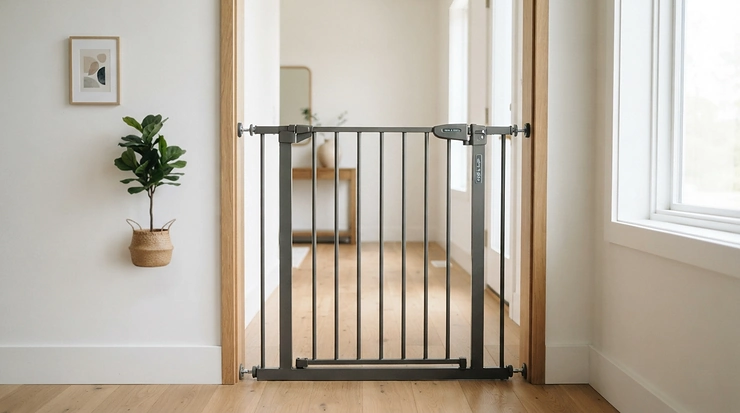
A lease that forbids drilling is the situation pressure mounts were designed for. A single panel of the Fairy Baby Pressure Mounted Window Guard adjusts from 32.7 to 36.2 inches, bar spacing is 2.6 inches, and the pressure system uses four adjustable bolts; The Wearify says larger sets stretch to a four-panel span of 86.6 to 111.8 inches. Talk of the House reports a 150-pound load figure and says its tester saw no shifting at that force, and BestReviews notes it can mount horizontally or vertically.
Release is the appealing part. Talk of the House says a firm pull lets an adult remove it, and The Wearify says it comes out in seconds in an emergency. None of those pages names ASTM F2090 compliance, which is the box a cautious parent should want ticked for a bedroom.
Looseness is the recurring complaint. The Wearify lists dislodging under sustained force as a con of this very guard, Hometosight says pressure mounts in general can loosen over time on uneven frames, and Talk of the House advises checking the mount monthly. Three roundups pointing the same way is a pattern, not a lab result. A Folium Biosciences roundup adds that New York and New Jersey inspectors typically want hardware-mounted guards, so a pressure mount will not satisfy a code-driven install. The sources give no price; see the current figure on Amazon.com.
4. A/C Safe AC-702 Security and Stability Pack — locks a window unit in place
A window air conditioner is not a window guard, and this pack does not pretend to be one. Canadian Tire’s listing says the steel A/C Safe AC-702 Security and Stability Pack interlocks the unit with the window sill so it cannot be pushed in from outside, and that it assembles without tools. The same listing adds two sliding window locks in the box, a 7.87-inch minimum window opening and an assembled weight near 0.58 pound.
For child safety, the bar is higher. New York City’s Health Department says that in apartments where a child aged 10 or younger lives, the AC should be bolted into the window frame with one-way tamper-resistant screws, leaving no open space over 4.5 inches and using rigid material on every side. A clamp pack, by its description, targets push-in entry rather than the gaps around the unit’s side panels. If weight is the worry, the A/C Safe AC-080 Universal Light-Duty Air Conditioner Support Bracket carries units up to 80 pounds per Ace Hardware’s listing, moving the load from the sash and sill to the frame.
Fit is the weak spot in buyer comments. The remarks below appear on a retailer’s mirror of Amazon reviews, so read them as individual reports. One buyer returned the pack because the clamps did not fit standard window tracks or an average AC and ended up screwing the unit to the frame, another cut wood to wedge the sashes tight, and a third paired it with a separate window lock.
Pros:
- ✅ Tool-free and low-cost
- ✅ Steel parts that stop a push-in from outside
Cons:
- ❌ Fit varies by window track and unit
- ❌ Does not replace bolting a unit in where children live
5. AVS In-Channel Ventvisor Window Deflectors — rain guards for cracked car windows
Starting from around $50 for a set, window guards for cars come as rain guards, vent visors or wind deflectors, and the AVS In-Channel Ventvisor Window Deflectors are the in-channel option with the largest review base in the sources checked: RealTruck shows a 4.4 average from 3,242 ratings on its own site. The impact-resistant acrylic is UV and scratch resistant in a dark smoke finish, and the strips slide into the upper window channel with included 3M tape, with no cutting or drilling. AVS describes them as car-wash safe, with a limited lifetime warranty, and Husky Liners says to roll the windows up afterward to seat them and avoid washing the car for 24 hours. Cut for each vehicle, they need your exact year, make, trim and cab style before ordering.
Auto-up windows are where owners report trouble. A NAPA reviewer with an F-150 said the set gave problems with the end tabs and the truck’s auto-up safety feature, and RealTruck’s own install notes mention bounce-back and suggest tape-on visors for vehicles with one-touch windows. An Autoroamer comparison agrees in general terms: in-channel sets hold more securely but fit more fussily and may lightly contact the glass.
The pricier in-channel rival is WeatherTech Side Window Deflectors, 3 mm acrylic with no exterior tape, roughly $55 to $115 depending on vehicle and set size per RealTruck and etrailer. Etrailer buyers average 4.6 across about 1,100 reviews, but one NAPA reviewer reported that a piece broke the first time the window was gently rolled up and called the set hard on the window motor.
How to install window guards so they hold
Method matters as much as the model, and the same few steps apply to nearly every child guard.
- Decide on the exit first. In a bedroom or any window that could be an escape route, choose a release model, and confirm another window or door still works as a way out.
- Measure the narrowest width and the height of the opening, then compare both with the guard’s adjustable range, remembering that the spaces above, below and beside the bars count toward the 4-inch limit.
- Pick the orientation. Guardian Angel says double-hung windows can take horizontal bars, while sliders and casements need vertical bars that cover the full height.
- Anchor into a solid stud or frame. Guardian Angel’s page says screws must reach solid material, and Talk of the House’s tester suggests longer wood screws for masonry or plaster. Use the one-way screws supplied.
- Lean on it, then test the release with an adult present; a release nobody has practiced is worth little in a fire.
- Recheck monthly. Pressure mounts in particular can creep, per the roundups above, and loose screws defeat the point of a fixed guard.
Two hardware warnings round this out. Guardian Angel’s page says its guards should stay indoors because weather rust can impair operation, and Prime-Line’s instructions say hinged models mount outside the frame rather than inside it. For a car set, clean the channel and press the strips fully into place before raising the glass.
Where guards stop helping
Guards deter; they do not supervise. The Guardian Angel page says its guards are not a substitute for adult supervision, and the National Safety Council’s window page says to keep children’s play away from windows and balconies, keep windows closed and locked where children cannot be watched, and never rely on insect screens, which are designed to keep bugs out, not children in. CPSC adds two cheap habits: open windows from the top rather than the bottom, and keep furniture away from windows so a couch does not become a step.
Wrong picks usually come from mixing categories. Burglar bars sold for ground-floor security are not automatically fall guards, as the ASTM text above makes clear, and horizontal rungs on a tall sliding window hand a toddler something to climb. Modelrec’s roundup reports that the most common objection it heard concerned adhesive-only restrictors breaking when a determined child leans on them, and its advice is steel if you can mount it, pressure-mounted if you cannot. Across window guards reviews from Talk of the House, The Wearify and Hometosight, the shared upkeep tip is the same: recheck the mount, because a guard that has crept loose protects no one.
Straight answers on bedrooms, landlords, AC units and car glass
❓ Do window guards replace window screens?
✅ No. CPSC says never to depend on screens to keep children from falling, and the National Safety Council makes the same point: screens keep insects out, not kids in. A rigid guard or a stop that limits the opening to four inches does the actual work.
❓ Can I put a fixed guard on a bedroom window?
✅ Only if another window or door in that room works as a reliable exit. CPSC advises guards that adults and older children can open easily on the 6th floor and below, and fixed non-egress models cannot be removed quickly in a fire.
❓ Are window guards required in rentals?
✅ It depends on where you live. New York City requires approved guards or limiting devices in buildings with three or more units when a child aged 10 or younger lives there, and tenants can ask for them anyway. Check local housing rules and ask your landlord before drilling.
❓ Does a window air conditioner work as a guard?
✅ Not by itself. New York City's Health Department says an AC in a home with a young child should be bolted into the frame with tamper-resistant screws and leave no gap over 4.5 inches. Brackets and security packs mainly keep the unit from falling or being pushed in.
❓ Are rain guards for car windows worth it, and should they be in-channel or tape-on?
✅ They let you crack windows in wet weather. In-channel sets look cleaner but some owners report trouble with one-touch auto-up glass, so tape-on is the safer try on those cars. Wind noise and glass contact vary by vehicle.
The short version before you order
Start with one question: does this window double as an exit? If it does not, the Segal S 4752 Fixed Window Guard is the sturdy, drilled-in choice. If it does, the Defender Security Segal S 4776 Hinged Window Guard adds a deliberate quick release, and an ASTM F2090-listed model such as Guardian Angel’s is worth comparing. If a landlord rules out screws, the Fairy Baby Pressure Mounted Window Guard covers windows that nobody needs as an exit, with a monthly check built into the routine.
The A/C Safe AC-702 Security and Stability Pack and the AVS In-Channel Ventvisor Window Deflectors answer different questions entirely: a unit that won’t be pushed in, and a cracked car window that stays dry. Whichever of these window guards you pick, measure the opening first, then check current availability on Amazon.com.
Recommended for You
- Baby swings: Match Your Budget, Room and Baby
- Furniture Corner Guards Adhesive Type: 7 Top Picks 2026 for Maximum Child Safety
- Cordless Window Blind Safety for Kids: 7 Best Products That Protect Your Family
Measure twice, drill once, and test the release before the first warm night.