As an Amazon Associate I earn from qualifying purchases. Links in this article may be affiliate links. How we choose gear
One kind of climber in this guide weighs roughly 25 pounds and can be carried across a lawn by a single adult. Another ships in four boxes that together weigh about 710 pounds, and owners on Sam’s Club’s review pages report building it in anything from 14 hours to most of a week. Both are sold to families shopping for an outdoor jungle gym in 2027, which is why the label alone tells you so little.
Rather than rank five products against each other, this guide matches each one to a situation: a small lawn, a preschooler, kids who want to swing and hang, a yard big enough for the whole cul-de-sac. I haven’t built any of them, so the details below come from manuals, maker and retailer pages, owner reviews and the Consumer Product Safety Commission’s home-playground documents.
The short answer: the best jungle gym for backyard use depends on the youngest climber and the measured lawn, but for kids from 3 to 10 and a modest lawn, the steel dome is the most direct fit. The plastic tower suits one small child and a patio. The swing sets only make sense once you have measured the ground under them.
Three answers that pick the best jungle gym for backyard play
Gyms for kids are sold by feature count and photo, but three numbers settle the choice before any brand does. The spacing and surfacing figures below come from CPSC’s home playground checklist and its home handbook, both written for families rather than parks.
Who is the youngest climber, and who is the oldest?
Most outdoor jungle gyms for kids carry an age band on the listing, and the bands disagree more than the photos suggest. Walmart’s title for the Eezy Peezy Monkey Bars Climbing Tower says ages 3 to 6, while its spec table says 3 to 8. Target shows 3 to 6 for the Backyard Discovery Buckley Hill Wooden Swing Set, yet a Backyard Discovery reply in the same Q&A says its swing sets are for ages 3 to 10. The maker’s page for the Backyard Discovery Skyfort II Cedar Swing Set gives no age at all, only testing for children up to 11. When sources split, take the narrower number.
Height does the rest. A taller frame holds older kids, but it also raises the fall height and the surfacing you owe the ground. Jungle gyms for kids of mixed ages work best when one frame offers a low way up and a high way up, which is what a dome gives. A hypothetical family with a 3-year-old and a 9-year-old shouldn’t settle for a toddler-height fort the older child may ignore.
How much clear ground do you really have?
CPSC’s checklist asks for protective surfacing at least 6 feet out in every direction, and for swings it asks for room in front and behind equal to twice the height of the suspending bar. Add 6 feet per side to a 10-foot dome and you need roughly 22 feet across. The same arithmetic turns a 263-by-201-inch cedar fort into a patch about 34 by 29 feet. Trees, fences and patio edges inside that rectangle count against you.
What goes under it, and who is building it?
CPSC’s handbook says grass, dirt, concrete and thin mats are not protective surfacing. For equipment up to 7 feet high, the checklist recommends at least 9 inches of wood chips, mulch or shredded rubber, and 9 inches of sand or pea gravel only up to 5 feet. The handbook adds that an initial 12-inch fill settles to about 9 inches, and it drops the minimum to 6 inches for equipment under 4 feet. Its loose-fill ceiling is 8 feet where the checklist says 7, so the fall height in your manual should decide.
A 22-foot square filled 12 inches deep takes about 18 cubic yards (my arithmetic: 484 cubic feet divided by 27), a truck delivery and not a few garden-center bags. Then comes labor. Owner reports run from about two hours for the steel dome, with helpers, to 14 hours or more for the big cedar fort, so whoever is holding the wrench shapes what is realistic.
Five jungle gyms for kids, each tied to one yard situation
Prices below are ranges from the retailer and maker pages, and they move with sales. The clear-area column is my arithmetic from listed dimensions, except for the swing set, where it is the manual’s own figure.
| Product | Ages on listings | Listed footprint | Clear area with 6-ft margins | Price range |
|---|---|---|---|---|
| Eezy Peezy Monkey Bars Climbing Tower | 3–6 or 3–8, by page | 70 × 66 in, 47 in tall | roughly 18 × 18 ft | around $130 to $160 |
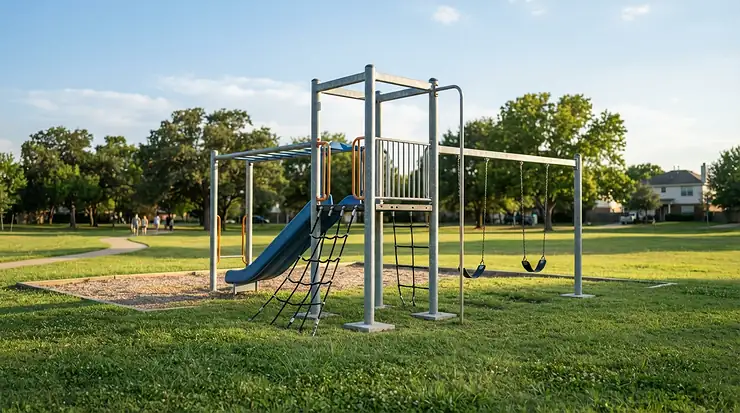
| Lifetime Geometric Dome Climber Play Center | 3–10 | 10 ft wide, 5 ft tall | about 22 × 22 ft | around $240 to $330 |
| Backyard Discovery Buckley Hill Wooden Swing Set | 3–6 on Target; maker reply says 3–10 | 123 × 107 in, 92 in tall | about 22 × 21 ft, before swing clearance | around $450 to $500 |
| Lifetime Monkey Bar Adventure Swing Set | 3–10 per manual; 3–12 on retail pages | 17 ft 7 in × 14 ft 1 in | 26 ft 10 in × 33 ft 5 in per manual | around $1,500 to $1,700 |
| Backyard Discovery Skyfort II Cedar Swing Set | tested to age 11; none stated | 263 × 201 in, 148 in tall | about 34 × 29 ft | around $1,700 to $2,500 |
The dome costs between half and three-quarters of what the cheapest swing set does, and roughly a fifth of the steel one, before a single yard of mulch. The footprint column tells a different story: the dome’s clear area is only a few feet wider than the tower’s, while the cedar fort’s is about twice the dome’s. Outdoor jungle gyms for kids differ more in the ground they claim than the photos admit, so read the rows against your measured lawn first and your wallet second.
1. Eezy Peezy Monkey Bars Climbing Tower — light enough to move around
Preschoolers on a small lawn, or on a patio that doubles as a living area, are the situation this one is built for. The tower is UV-protected plastic with interlocking tubes and double self-locking springs. It measures 70 by 66 by 47 inches, carries up to 150 pounds, and, according to Reviewed, weighs about 25 pounds, so one adult can carry it from a playroom to the grass. Retailer pages put it around $130 to $160.
Age bands split, as noted above, and Gardeningetc, whose roundup says it hasn’t tested these frames, lists 3 to 6. The narrower band is the sensible read for a 150-pound ceiling that has to cover every child on top at once.
Owner feedback is the mixed part. Walmart’s page shows 4.0 stars from 72 ratings. The most-mentioned positive is easy assembly, in 13 reviews, but about one rating in five is a one or two, and the negative themes are connectors that fail or detach, sometimes within days and sometimes after about a year. Reviewed’s roundup, last updated in early 2023, reports owners who found it harder to build than Ikea furniture and warns that plastic may not suit long-term use. Taken together, the two sources point to connector fit more than to frame strength. Walmart’s warranty text is partly garbled and names a different brand, so get the terms from the seller.
At 47 inches the tower sits just under the 4-foot line where CPSC’s handbook lowers the surfacing minimum to 6 inches (my reading), and a clear area of roughly 18 by 18 feet works out to about 6 cubic yards of loose fill at that depth. The 150-pound ceiling is the lowest of the five, so an adult climbing up beside a child can easily pass it.
2. Lifetime Geometric Dome Climber Play Center — five feet tall, ages 3 to 10
Between about $240 and $330 across Tractor Supply, Target and Academy, this is the least expensive structure here with a stated six-child limit. The 60-inch version, model 90136, is 5 feet tall and 10 feet wide, built from steel with HDPE climbing grips, and listed for ages 3 to 10, six occupants and 600 pounds total. Tractor Supply and Target both call it free-standing with no cement needed, Academy lists a 6.6-foot safety perimeter, and the warranty is one year limited.
Ratings run high: 4.8 from 183 reviews at Tractor Supply and 4.8 from 286 at Target, where some reviews were collected through a promotion. Rust is the recurring complaint. Target reviewers describe rusted joints after three to four years, rust on ground-contact parts after about five, and one unit that rusted to pieces after four. Lifetime’s replies there say earlier versions used non-galvanized powder-coated steel and current ones use galvanized steel, and they suggest a rust treatment a couple of times a year in humid areas. Several of the same reviewers praise free replacement parts. Reviewed’s roundup mentions one owner whose dome lasted about five years, lists hot metal as a drawback and calls the pole labels hard to decipher.
Moving it is the other pattern. Reviewers who shifted the dome for mowing report bent bars, and one owner packing up for a move could not remove stripped Allen screws, so choose the spot once. Assembly gets a split verdict, from about two hours with helpers to a build one reviewer found hard enough to need a video tutorial. At 5 feet, the dome sits right at the limit for 9 inches of sand or pea gravel in CPSC’s checklist, which makes mulch the roomier margin (my reading).
Pros:
- ✅ Free-standing per Tractor Supply and Target, with no cement called for
- ✅ A stated limit of six children and 600 pounds total
- ✅ Free replacement parts mentioned by several Target reviewers
Cons:
- ❌ Rust reports from three to five years on older units
- ❌ Bars bend if the dome is dragged around the lawn
- ❌ Only a one-year limited warranty
Curious about the grips and the exact footprint? Take a closer look at the listing before you tape out the lawn.
3. Backyard Discovery Buckley Hill Wooden Swing Set — a starter fort for small yards
Age is the first thing to settle here. Target lists a suggested age of 3 to 6, a Backyard Discovery reply in its Q&A says the maker’s swing sets are for 3 to 10, and a manual summary says 36 months to 6 years. Reviewers add that older kids may outgrow it, and some call it smaller than expected.
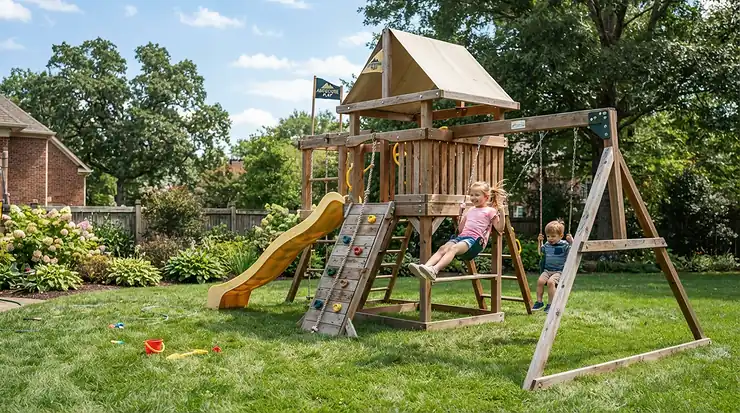
Inside that window it packs a lot into a compact footprint: a cedar frame, a covered upper deck with mesh panels, two belt swings on rope chains, a 6-foot wave slide, a rock-wall ladder with four holds and a chalkboard. Target lists 123 by 107 by 92 inches and a 5-year limited warranty, and the maker states the set is engineered to meet or exceed ASTM F1148-22 for residential use. Retailers put it around $450 to $500.
Target’s reviewers (4.7 from 280, with 92 percent recommending it) split on build quality. Assembly runs from about six hours with two people to two days, and complaints include missing hardware, misaligned holes and boards that did not match listed lengths. Some report split ladder rungs and cracked beams; one reviewer said a beam cracked under a 31-pound toddler, a single report. Ground anchors are included, according to the Q&A. One reviewer says six anchors made the set feel secure in wind, while others had to drill extra holes to fit the augers, and the maker says some movement is normal for a freestanding wood structure as long as it isn’t lifting.
Upkeep is yearly. The maker recommends a clear sealant soon after assembly and about once a year afterward, and the manual summary says to treat the cedar with a preservative annually and to check nuts, bolts and screws regularly. That manual summary gives no surfacing advice and no deck height is listed, so CPSC’s tiers have to fill the gap. A clear area of about 22 by 21 feet, before swing clearance, takes roughly 13 to 17 cubic yards of loose fill at 9 to 12 inches (my arithmetic).
4. Lifetime Monkey Bar Adventure Swing Set — steel frame for kids who hang and swing
The paperwork for this set doesn’t agree with itself. The manual, as posted in Home Depot’s catalog, says ages 3 to 10, a maximum of six occupants and 600 pounds combined. ShedsDirect lists ages 3 to 12, 800 pounds total and 140 pounds per swing seat. I found nothing explaining the gap, so the manual in the box is the document to follow.
What the set offers is variety on one steel frame: three belt swings, a trapeze bar with gym rings, monkey bars, a fireman’s pole and a 9-foot wave slide, with molded HDPE parts and a 5-year limited warranty per ShedsDirect. Prices land between about $1,500 and $1,700. A hypothetical household with a 4-year-old and a 10-year-old would use different pieces: the little one on the swing and slide, the older child on the rings and bars.
Space is the demand. The footprint is 17 feet 7 inches by 14 feet 1 inch, but the swing bar stands 7 feet 9 inches, and twice that height is 15 feet 6 inches of clearance in front of and behind the swings (my arithmetic from the manual’s rule). The manual recommends a play area of 26 feet 10 inches by 33 feet 5 inches. It asks for at least 9 inches of wood mulch or other loose-fill for equipment up to 8 feet, suggests a 12-inch initial fill that settles to about 9, and rules out concrete, asphalt, grass, dirt and thin mats.
Retail listings call the set free-standing with no cement needed, but the manual walks through driving anchors at least 12 inches into the ground and tightening the cable, so read that chapter before deciding. It recommends two capable adults for assembly, lists wrench and socket sizes and says tools are not included, and it gives no build time. The upkeep schedule is the busiest of the five: tighten hardware twice a month in season, lubricate metal moving parts monthly, check for rust, and sand and repaint rust with non-lead paint. I found fewer detailed owner reports for this set than for the dome; ShedsDirect shows two five-star reviews praising a sturdy build and complete hardware.
The manual’s recommended area works out to about 25 to 33 cubic yards of surfacing at 9 to 12 inches (my arithmetic).
5. Backyard Discovery Skyfort II Cedar Swing Set — cedar fort for a crowd
Size comes first with the Skyfort II: 263 inches wide, 201 deep, 148 high and about 710 pounds, shipped in four boxes, according to the maker. The maker’s page says it has multiple play areas for up to 15 kids and has been performance-tested for children up to 11. It includes a raised clubhouse with a balcony, a crow’s nest with a toy telescope, monkey bars, a rock wall with 12 holds, a wave slide of about 10 feet, two belt swings and a trapeze, a covered picnic table and a lower deck with a sandbox (sand not included). The cedar is pre-cut, pre-drilled and pre-stained, with 3D instructions in the BILT app, a 5-year limited warranty and an ASTM F1148-22 claim for residential use.
Prices run around $1,700 to $2,500 depending on the seller and the sale, and the maker’s optional assembly service adds roughly $900 to $1,000. That service looks more reasonable after reading what owners say about the build. Sam’s Club’s page (4.4 from 2,051 ratings, 67 percent of them five-star) carries assembly reports of about 14 hours for two adults, 15 hours over three days, 20 hours, 24 hours alone, 25 to 30 hours mostly by one person, and about a week with four adults over five days. Instructions are generally praised, and one reviewer advises checking every hole position before tightening bolts. One reviewer had to trim two pieces that didn’t fit with a table saw.
Durability reports are thinner and mostly single voices. One reviewer reported screws breaking and the picnic-table top and viewing deck warping within a month; another said the set stood through 60 mph winds; a third warned that the ladder isn’t meant for a 170-pound adult. The maker notes that the wood may require a sealant that is not included, and that the manual states whether it is required.
Deck heights are not given in text, so the manual decides the surfacing depth. A clear area near 34 by 29 feet comes to roughly 27 to 36 cubic yards at 9 to 12 inches (my arithmetic). Anchoring isn’t addressed on the maker’s page or in the reviews, which leaves the manual’s anchor instructions as the only guide.
Pros:
- ✅ Room for far more children than the others, per the maker’s up-to-15 figure
- ✅ Pre-cut, pre-drilled, pre-stained pieces with guided 3D instructions
- ✅ A 5-year limited warranty from the maker
Cons:
- ❌ Owners report 14 to 30 hours of assembly, and some far more
- ❌ A clear area near 34 by 29 feet
- ❌ Sealant may be required and is not included
Eyeing the fort? Check the dimensions diagram against your lawn before you order mulch.
Where jungle gyms for back yard lawns go wrong
Most regrets trace back to four habits, and CPSC’s Outdoor Home Playground Safety Handbook speaks to each.
Trusting the free-standing label to mean no anchors. The steel swing set is a clear example: listings say no cement, and the manual still describes anchors driven at least 12 inches down. CPSC’s handbook says to follow the maker’s anchoring instructions and to bury anchors or cover them with surfacing so nobody trips on them.
Skipping the ground. The handbook states that “About 80% of the injuries occur when children fall from play equipment.” That is the case for the 9-inch rule, and it is the line item most families leave out of the budget.
Letting upkeep slide. The handbook’s schedule is to check and tighten nuts and bolts twice a month, inspect swing seats, ropes and chains monthly, rake the surfacing and repaint rust with non-lead paint. Target reviewers show where rust ends up on a steel dome, and cedar sets ask for a yearly sealant besides.
Ignoring gaps and attachments. The handbook flags openings between 3½ and 9 inches wide as head-entrapment spaces on rails and ladders, and the checklist says never to tie ropes, jump ropes or clotheslines to equipment. Measure anything that looks suspicious before the first play session.
Ages, space, ground cover, anchors and build time: five quick answers
❓ What age is an outdoor jungle gym good for?
✅ It depends on the product, and listings disagree. Retailer pages list a 5-foot steel dome for ages 3 to 10, a plastic climbing tower for 3 to 6 or 3 to 8, and a compact cedar set for 3 to 6, though its maker says 3 to 10.
❓ How much yard does a backyard jungle gym need?
✅ CPSC's home checklist calls for protective surfacing at least 6 feet out on all sides, plus swing clearance of twice the bar height front and back. A 10-foot dome therefore wants about 22 feet across, and a large cedar fort roughly 34 by 29 feet.
❓ What should go under a jungle gym instead of grass?
✅ CPSC says grass and dirt are not protective. Its checklist suggests at least 9 inches of wood chips, mulch or shredded rubber for equipment up to 7 feet, or 9 inches of sand or pea gravel up to 5 feet. Start about 12 inches deep, because loose fill settles.
❓ Does a jungle gym need to be anchored?
✅ Follow the manual. Retailer pages call the steel dome and swing set free-standing with no cement, yet the swing set's manual describes driving ground anchors at least 12 inches deep, and CPSC advises burying anchors or covering them so nobody trips.
❓ How long does it take to build a jungle gym?
✅ Reviewers report about 2 hours for the steel dome with helpers, roughly 6 hours to 2 days for a compact cedar set, and 14 to 30 hours for a large cedar fort. Check hole positions before tightening bolts, one Sam's Club reviewer advises.
Match the frame to the lawn and the youngest climber
The right outdoor jungle gym is the one that fits your youngest child now, your oldest one later and the ground you have measured in between. For a modest lawn and kids from 3 to 10, the Lifetime Geometric Dome Climber Play Center is the most direct fit, provided you plan for rust checks and a mulch delivery. The Eezy Peezy Monkey Bars Climbing Tower suits one preschooler and a patio. The Backyard Discovery Buckley Hill Wooden Swing Set adds swings and a slide for small kids, the Lifetime Monkey Bar Adventure Swing Set serves children who want to hang and swing, and the Backyard Discovery Skyfort II Cedar Swing Set asks for a big lawn, a long weekend and a sealant plan. Measure the clear area first, price the surfacing second, then pick the frame. Leaning toward one? Open its listing and compare the dimensions with your tape-measure numbers.
Recommended for You
- Diy outdoor playset — Matched to Your Yard and Kids
- 7 Best Outdoor Jungle Gym for Kids Options That Guarantee Ultimate Fun in 2025
- 7 Best Jungle Gym for Backyard Adventures That Transform Your Space in 2025
Tape out the clear area on your lawn, then see which of the five fits inside it.