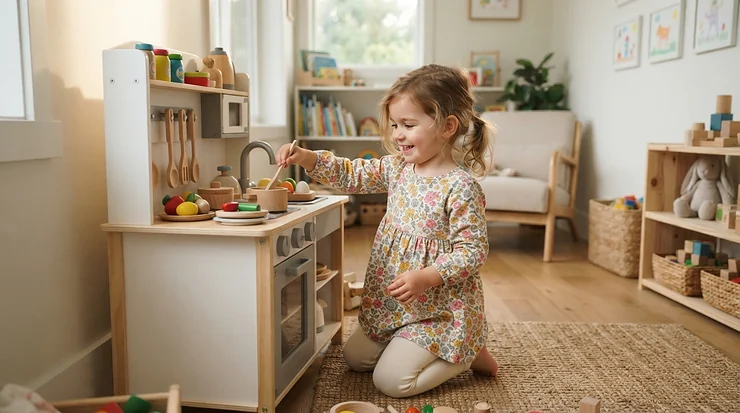
The editors at Parents tested 34 play kitchens for the 2026 list and kept 11, according to a recap on Tiny Land’s newsroom page. That cut is the reason this guide sorts pretend play kitchens by household instead of crowning one winner. For 2027, the five models below answer five situations: a tight budget, a corner of an apartment, a toddler’s low reach, three cooks at one counter, and a playroom that has to look good.
Rather than ranking by star count, the comparison leans on spec sheets, which show that counter height, footprint, weight and anchoring separate these five more than lights and sounds do. No kitchen was built or played with for this guide; the findings rest on maker pages, retailer specs and published tester and buyer reports, with free review samples flagged wherever a reviewer disclosed them, and prices are ranges that may differ on Amazon.com. Hunting for the best pretend play kitchens mostly comes down to three tape-measure numbers: counter height, width and weight.
Counter height, footprint and weight: the numbers that separate these kitchens
Counter height is the number most listings bury. The KidKraft Vintage Play Kitchen lists a 17.75-inch counter, the Lalo Play Kitchen lists 18.75 inches, and Mommyhood101’s comparison puts the Step2 Fun with Friends Kitchen at 22 to 23 inches. That is a gap of roughly 4 to 5 inches (my arithmetic) between the lowest and the highest, which matters more to a 2-year-old reaching in than any feature list does.
Width runs from 21.65 inches on the Hape Gourmet Kitchen to 43 inches on the Tiny Land Play Kitchen for Kids, nearly double (my arithmetic). Weight shows the plastic-versus-wood split: the Step2 listing weighs about 23 pounds at roughly 41 inches tall, while the Tiny Land lists 40.5 pounds at 40 inches tall, around 17.6 pounds more (my arithmetic). A light, tall kitchen is easier to move and easier to tip.
Material is the third divider. EasyTot’s buying guide, which names search volume as its only data source and does no hands-on testing, calls storage the main split between wood and plastic: wood tends to give deeper cabinets and takes no batteries, while plastic costs less and adds sounds. The same guide argues for skipping lights and sounds, since a silent kitchen leaves the child to decide when the food is done. Treat both points as one editor’s opinion; published pretend play kitchens reviews are more useful at the model level, which is where the entries below pick up.
Play kitchens for toddlers: age labels, small parts and anchors
Age labels disagree. Step2’s answers on Target’s product page recommend its kitchen for ages 2 and up, yet the same page carries a small-parts choking warning for children under 3. Hape’s own page for its white Gourmet Kitchen warns against use under 3, and one retailer lists that kitchen for ages 3 to 5. For play kitchens for toddlers, the label on the box outranks the headline age in any listing, and counter height is the second thing to check.
Anchoring is the habit that matters. CPSC’s Anchor It! page is written for furniture, TVs and appliances and does not single out toys, but it describes children climbing to reach something, and a 40-inch kitchen can be climbed. The pages opened show a mixed picture: a buyer says the Tiny Land Play Kitchen for Kids ships with anchoring hardware, Lalo sells an anti-tip kit for the Lalo Play Kitchen, Business Insider’s reviewer says the Hape Gourmet Kitchen came without one, and Mommyhood101 advises tethering the Step2 Fun with Friends Kitchen.
One expectation is worth resetting. A 2013 review of the evidence in Psychological Bulletin concluded that existing research does not support strong claims that pretend play is uniquely important to development. Buy the kitchen for the afternoons of serving soup to stuffed animals, not for a promised outcome.
Where the five land on size, power and price
The best pretend play kitchen for one home can be the wrong one for another, so the table keeps the raw numbers side by side. Sizes are overall width, depth and height in inches from maker or retailer spec lines; price ranges come from retailer pages and review sites, so check the current price on Amazon.com.
Kitchen
Material
Size (W × D × H, in)
Power
Age on listings
Price range on pages seen
Step2 Fun with Friends Kitchen
Plastic
35.75 × 12.5 × 40.88
2 AA, not included
2+
$85 to $140
Hape Gourmet Kitchen
Wood
21.65 × 12.6 × 27.76
None
3+
Under $100 on one review site
KidKraft Vintage Play Kitchen
Wood
33.12 × 13.2 × 34.92
None
3+
$100 to $165
Tiny Land Play Kitchen for Kids
Wood
43 × 14 × 40
Not listed
3+
$110 to $150
Lalo Play Kitchen
Birch plywood and beech
26.8 × 11.8 × 23.42
None
3+
$210 to $395
Only the Step2 Fun with Friends Kitchen takes batteries, and it is the only all-plastic kitchen of the five. The Lalo Play Kitchen is the shortest and shallowest, yet even its lowest price on the pages seen (about $210) sits above the highest figure for the KidKraft Vintage Play Kitchen (about $165). The two widest kitchens, the Tiny Land Play Kitchen for Kids and the Step2 Fun with Friends Kitchen, are also the two with the clearest tipping or anchoring notes in the sources.
Five households, five kitchens
Each household below is hypothetical, built to show which spec decides the choice among pretend play kitchens; swap in your own measurements.
A hypothetical household with a 2-year-old, a 4-year-old and a play area that takes abuse makes the case for the Step2 Fun with Friends Kitchen. It is all plastic, listed at 35.75 by 12.5 by 40.88 inches, and retailer pages run from around $85 to $140 depending on color. Step2’s brand answer on Target’s page puts the age at 2 and up, with roughly two dozen accessories in the box (retailers count 24 or 25) but no play food, and the electronic stovetop takes two AA batteries that are not included.
Mommyhood101’s reviewer assembled it in about 15 minutes, with the battery compartment the fiddliest step, and reports that it tips easily, so the review advises tethering it. That is one hands-on report rather than a consensus, but the weight backs the concern: about 23 pounds at roughly 41 inches tall. Step2’s Q&A answers on Target add that the sink makes no running-water sound and that replacement accessories can be ordered from its website or by phone, which helps once a pot disappears under the couch.
Model numbers differ by color (488399 appears on a pink listing and 488599 on a neutral one), so match the number to the color you want before ordering.
Pros:
✅ Wipe-clean plastic with about two dozen accessories included
✅ A pass-through window that retailers describe as built for restaurant-style play with several children
✅ Replacement accessories sold direct
Cons:
❌ Tips easily and needs a tether, per Mommyhood101’s tester
❌ Takes two AA batteries, and Target’s page carries an under-3 small-parts warning
Step2 Fun with Friends KitchenSee current price, sizes and reviews on Amazon.
Corner space, not budget, is the constraint in a hypothetical one-bedroom apartment, and the Hape Gourmet Kitchen is the narrowest option here: 21.65 inches wide, 12.6 deep and 27.76 tall on one retailer’s spec line. Business Insider’s reviewer, who bought it for personal use, describes it as uncluttered, with a two-burner stovetop, oven and sink and no lights or sounds, so there are no batteries to replace.
Assembly gets two verdicts. Mommyhood101, whose reviewer received a Hape wooden kitchen from the maker as a free sample, timed the build at about 15 minutes for a kitchen listed at roughly 22 by 13 by 28 inches, which matches this model’s size, and put the price usually under $100. The Business Insider write-up describes the build as involved but not complicated.
Flaws are modest. Mommyhood101’s tester found the countertop lower than expected, and Business Insider notes that no anti-tip kit comes in the box, although the kitchen has served two children from early ages without incident, per that reviewer. Age labels also differ: Hape’s own page for the white version warns against use under 3, and one retailer lists it for 3 to 5, a narrower window than the 3-and-up labels on the taller wooden kitchens here. Accessories and play food are sold separately, so they belong in the budget from the start.
Hape Gourmet KitchenSee current price, sizes and reviews on Amazon.
Reach is the whole story for a toddler at the counter, and the KidKraft Vintage Play Kitchen has the lowest counter of the five at 17.75 inches on one retailer’s spec list, which makes it the natural candidate among play kitchens for toddlers. It measures 33.12 by 13.2 by 34.92 inches, weighs about 35.6 pounds and is wood, with a play fridge and ice maker, clicking oven knobs, see-through oven and microwave doors, a removable sink and a cordless play phone. Listings give 3 and up, and the maker’s warranty covers defects for 90 days.
Mommyhood101 rates it best for ages 2 to 3 and likes the build and the value, around $100 in its comparison, but dislikes the number of parts and the long assembly. A retailer listing estimates 1.5 to 2.5 hours, and EasyTot’s guide advises blocking off an afternoon and bringing a second adult for KidKraft wood kitchens. Retailer pages run from $100 to $165 depending on color, and accessories and play food are not included.
Pros:
✅ Lowest counter of the five, at 17.75 inches
✅ Wood with no batteries, plus a fridge, oven, microwave and sink
✅ Mommyhood101 praises the build quality and the value
Cons:
❌ Many parts and an assembly estimate of 1.5 to 2.5 hours
❌ May feel small to older kids, per Mommyhood101
KidKraft Vintage Play KitchenSee current price, sizes and reviews on Amazon.
Forty-three inches of width separate the Tiny Land Play Kitchen for Kids from the rest: the listing data gives 43 by 14 by 40 inches, and a retailer description says up to three children can cook at once. In a hypothetical house that hosts three cousins on weekends, that counts for more than any accessory total.
It is wood, listed as FSC-certified, for ages 3 and up (one listing runs to age 10), and it weighs 40.5 pounds, which is heavy for a toy. One buyer review on a retailer page that republishes the Amazon listing says the weight is the reason to anchor it and adds that anchoring hardware is included; that is a single report, so confirm it on the listing. A retailer comparison page puts the price around $110 to $150.
Parents’ editors picked two Tiny Land kitchens in their 34-kitchen test, a Montessori-style model and a compact one under 23 inches wide, though not necessarily this 43-inch version. The recap says the first held up to daily, rough play, and that a 2.5-year-old tester on the compact model spent much of his time slicing wooden vegetables with the toy knife and board. Tiny Land’s own newsroom wrote that recap and lists no drawbacks, which is worth remembering when weighing it.
Tiny Land Play Kitchen for KidsSee current price, sizes and reviews on Amazon.
Retailer pages put the Lalo Play Kitchen anywhere from about $210 to $395, the widest spread and the highest ceiling here, so the decision is whether design and setup speed are worth a premium. It measures 26.8 by 11.8 by 23.42 inches with an 18.75-inch counter and a 26.5-pound weight, and it is built from birch plywood and solid beech with water-based finishes (a clear lacquer on the Natural version). Lalo says it goes together without tools in under five minutes.
Mommyhood101, whose reviewer received it as a free sample from Lalo, praised the stability, quick assembly, smooth hinges and magnetic doors, and noted that it is shorter than the rest, so taller kids outgrow it sooner. Two Babylist buyers echo the trade-offs: one found the height low and wished for taller legs, and another took off a star over a touched-up spot in the finish that looked obvious at this price.
Lalo’s help page adds two practical limits: the sink and pots are not meant to hold water, and no part works as a real kitchen appliance. It says the kitchen is stable without wall fixing, yet it sells an anti-tip kit and recommends it. The apron, chef hat and pots and pans come as a separate set, and the maker lists an 18-month warranty from the purchase date.
See the current listings for each model on Amazon.com.
Lalo Play KitchenSee current price, sizes and reviews on Amazon.
Open backs, loose straps and hard play food: what to avoid
Open backs come first. Mommyhood101, which received Little Tikes samples from the maker, found that the oven door on a Little Tikes Farmers Market kitchen popped open and that its open back has to sit against a wall, so it lives in a corner or along one.
Loose straps come second. On January 29, 2026, CPSC warned consumers to stop using KareKlub plastic tip-restraint kits after testing showed they failed ASTM F3096-23, and told them to replace the kits with compliant restraints, according to its warning notice. That notice concerns furniture straps, but the same standard is worth checking on any strap added to a play kitchen.
Hard play food comes third. EasyTot’s guide cautions that very hard wooden food can hurt when thrown, so softer or mixed sets suit toddlers better. It is an editor’s caution rather than a tested finding, though it costs little to follow when buying the food most of these kitchens leave out.
Time estimates also vary widely for kitchens of similar size. Mommyhood101 reports about 15 minutes for the Step2 and Hape builds, while a retailer page gives 1.5 to 2.5 hours for the KidKraft Vintage Play Kitchen, so schedule the wood-and-hardware builds when nobody is waiting.
Age, anchors, accessories and elbow room: the details buyers check last
❓ What age is a play kitchen best for?
✅ Most listings here say 3 and up, though Step2 lists 2 and up and the same Target page carries a small-parts warning for children under 3. Read the box label first, then match counter height to your child; the two lowest here sit at 17.75 and 18.75 inches.
❓ Are wooden play kitchens better than plastic ones?
✅ Not automatically. One buying guide says wood tends to give deeper storage and needs no batteries, while plastic costs less and adds sounds. Weight matters as well: a light, tall plastic model is the kind one tester says tips easily, so tether it.
❓ Do play kitchens need to be anchored to the wall?
✅ If one ships with an anchor kit, use it, because children climb. CPSC's Anchor It! page covers furniture, TVs and appliances rather than toys, but the climbing risk it describes applies to tall kitchens. Choose straps that meet ASTM F3096-23, per CPSC.
❓ How much space does a play kitchen need?
✅ Widths on the five models here run from about 22 to 43 inches, and depth stays between roughly 12 and 14 inches. Leave standing room in front: a compact kitchen suits a corner, while the widest is listed for up to three children.
❓ Do play kitchens come with food and accessories?
✅ Seldom a full set, going by these five. One plastic model packs roughly two dozen accessories but no food, two wooden ones leave accessories and play food out, and one premium maker sells its chef set separately. Budget extra for food and cookware.
Matching the kitchen to the child, then to the room
For most households shopping for pretend play kitchens, the decision rule runs counter height first, footprint second, price third. Without more information, the KidKraft Vintage Play Kitchen is the one to start with for a toddler household, because its counter is the lowest listed and the build is wood without batteries. A tight corner points to the Hape Gourmet Kitchen, a rough-and-ready budget buy to the Step2 Fun with Friends Kitchen (tethered), three children at one counter to the Tiny Land Play Kitchen for Kids, and a design-first playroom to the Lalo Play Kitchen, if quick setup and a quiet look justify the price. Whichever you pick, anchor it, put play food in the budget, and trust the age label over the headline. See the current listings on Amazon.com.
The WhizKiddo editorial team researches baby gear, outdoor play equipment, trampolines and kids' products using manufacturer specifications, safety guidance from bodies such as the CPSC and AAP, independent tests, parent reports and retailer listings. We do not claim to have tested the products ourselves. Read how we work on our How We Choose Gear page.