As an Amazon Associate I earn from qualifying purchases. Links in this article may be affiliate links. How we choose gear
A springless backyard trampoline priced well over $1,000, a pogo stick rated for 40 to 80 pounds and a hopper ball sized for a second-grader solve three different problems, and picking the wrong one is how gear ends up in the garage after a week. This guide to bouncing without a tram (tram here means trampoline) sorts six real products by who is bouncing, how heavy they are and where the bouncing happens, for 2027 shopping. Everything below comes from maker pages, retailer listings, a pediatric advice site and one published study, not from a hands-on trial, because we have not bounced on any of these.
People land on this topic for different reasons. Some want other options for bouncing than trampolines because the American Academy of Pediatrics tells parents to keep kids off them. Others want a low-impact alternative to a trampoline for an adult who wants gentle cardio. A third group has already decided on a trampoline and just wants one without coiled steel springs. Each group gets a different answer below.
Four checks that narrow six picks to one
Start with the bouncer’s weight, because every product here has a limit and exceeding it changes how the thing behaves. Springfree’s own page warns that jumpers over its single-jumper limit risk bottoming out at maximum height, and two pogo-stick owners (covered below) describe the same problem on a stick rated for lighter kids.
Then decide indoors or out. A 39-inch rebounder and a balance ball live in a living room; a springless backyard trampoline needs, by its maker’s numbers, an 18-by-18-foot patch of yard.
Third, ask what “no springs” means for you. It might mean a quieter bounce, no steel coils to pinch fingers, or simply a gentler feel underfoot. Those are three different design goals, and the six picks hit them unevenly.
Fourth, look at materials if a child will be on it. The American Academy of Pediatrics’ trampoline page says kids under 6 should never jump on a trampoline and recommends keeping children off them outside settings with professional coaches and specialized equipment. That is the backdrop for the non-trampoline picks here.
Weight limits, springs and price tiers compared
| Pick | Bounce style | Listed weight limit | Springs? | Price tier |
|---|---|---|---|---|
| JumpSport 220 Fitness Trampoline | 39-inch adult rebounder | 250 lb (maker page) | Elastic cords, no steel springs | Check the current price on Amazon.com |
| Springfree Compact Round Trampoline | 8-ft backyard, one jumper at a time | 175 lb single jumper | Composite rods | Over $1,000 |
| Bellicon 44-Inch Folding Rebounder | 44-inch rebounder, cords chosen by body weight | Cords sold for users up to 441 lb | Bungee cords | No price on the maker page |
| Gymnic Hop 55 | 22-inch seated hopper ball | 160 lb | Air-filled | Around $35 to $40 |
| Flybar Foam Jolt Beginners Pogo Stick | Standing pogo for light kids | 40 to 80 lb | Spring-loaded pogo | Around $30 to $40 |
| Gaiam Eco Total Body 65 cm Balance Ball Kit | Seated bounce on a ball | Not stated on the page | Air-filled | Around $20 to $30 |
The weight column does most of the sorting. Only the JumpSport 220 Fitness Trampoline and the Bellicon 44-Inch Folding Rebounder are built around adult bodies, while the pogo stick is narrow by design and the hopper ball sits in between. Price spread is wide: the springless backyard model is the only one listed above $1,000, while the ball and pogo stick sit in the tens of dollars.
Compare the exact model number before buying, because JumpSport and Bellicon both sell several sizes under near-identical names.
Six ways of bouncing without a tram, from quiet rebounders to a balance ball
1. JumpSport 220 Fitness Trampoline — bungee bounce, no steel springs
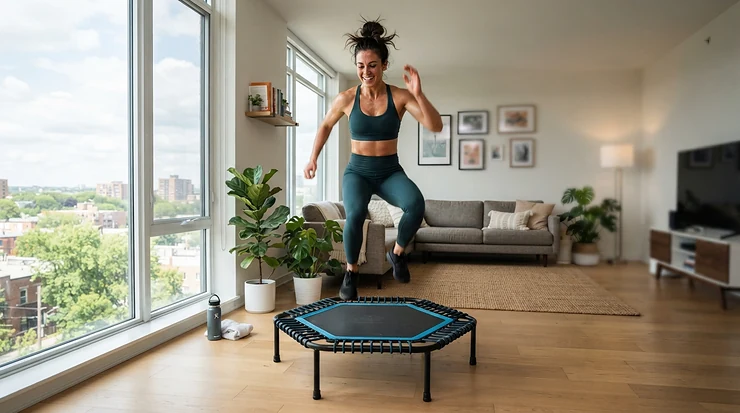
Adults who want a quiet, compact surface for indoor workouts get the most direct answer here. The 220 pairs a 39-inch powder-coated steel frame with a 33-inch skirted mat and 30 EnduroLast elastic cords instead of metal springs. JumpSport’s own page lists a 250-pound maximum, though one retailer shows 225 pounds, so go by the maker’s sheet and the label on the box.
The knotted cords let you adjust firmness, and the warranty is lifetime on the frame and legs, two years on the mat and cords, and one year on other parts. JumpSport rates its cords for 400,000 bounce cycles, a manufacturer figure I could not check independently.
On noise and cord wear, one buyer review reproduced on a retailer page says the bungee system is quiet and still felt great after three years, with a worry about paying for cord replacements eventually. That is a single owner, so treat it as a data point rather than a pattern. JumpSport also bundles a 60-day trial of its fitness video service.
Pros:
- ✅ Cords replace the steel springs that squeak and can pinch
- ✅ Weighs about 26 pounds in the box, light enough to move between rooms
- ✅ Lifetime warranty on the frame and legs
Cons:
- ❌ Cords are a wear item with their own warranty clock
- ❌ Not built for kids or backyard use, and JumpSport’s “low-impact” language is marketing, not a measured result
2. Springfree Compact Round Trampoline — rods instead of springs, one jumper
Well over $1,000 is the entry ticket: Springfree’s page showed about $1,250 for the 8-foot Compact Round and marked the classic color as sold out at the time of writing, so confirm availability before planning a yard around it.
For families set on jumping on a trampoline with no springs, this is a well-documented design. Flexible composite rods sit beneath the mat, which gives 54 square feet of jumping area, and the page states that the design meets ASTM F2225 and F381 standards. Springfree also claims its approach has “eliminated 90% of product related injuries,” a maker statement that is not independently verified.
Limits matter. The single-jumper weight limit is 175 pounds, the maker’s size guide points to roughly ages 6 to 12, and the footprint is 18 by 18 feet once you add 5 feet of clearance on every side. Springfree itself advises one jumper at a time, and the AAP page above notes that nets and padding do not prevent every injury. Springless solves the pinch-point problem; it does not make a trampoline a pediatrician-endorsed purchase.
Springfree also lists a 10-year warranty on all parts, which is its main answer to the high price.
3. Bellicon 44-Inch Folding Rebounder — cords matched to body weight
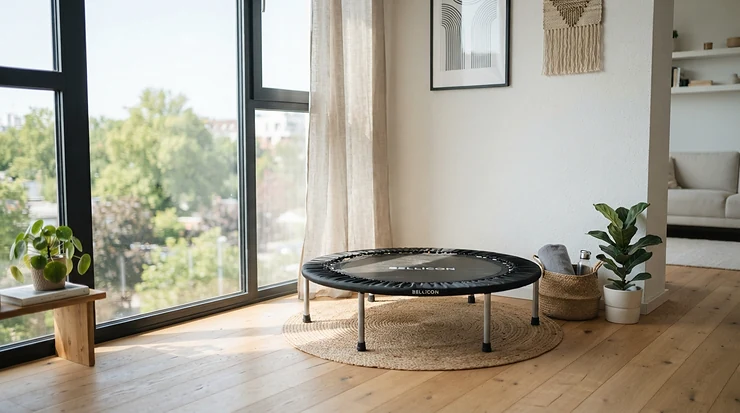
Bellicon’s page for this model does not list a price or a warranty, so budgeting means checking the listing before you decide. What it does list is more unusual: you choose bungee strength by the primary user’s weight, with medium for up to 132 pounds, strong for 133 to 198, extra for 199 to 265 and ultra for 266 to 441. Go one level firmer for intense training or one softer for gentle bouncing.
JumpSport takes the opposite approach, one cord set per model with knots for adjustment, so households with very different body weights have a real reason to look at Bellicon. Folding legs make storage easier, and assembly is DIY unless you pay for the pre-assembled option in the configurator.
Other Bellicon 44-inch pages call the bounce joint-friendly, which reads as marketing language; the page for this configuration made no joint or impact claim at all. Material details were also thin, so ask about the mat before buying if chemicals are a concern.
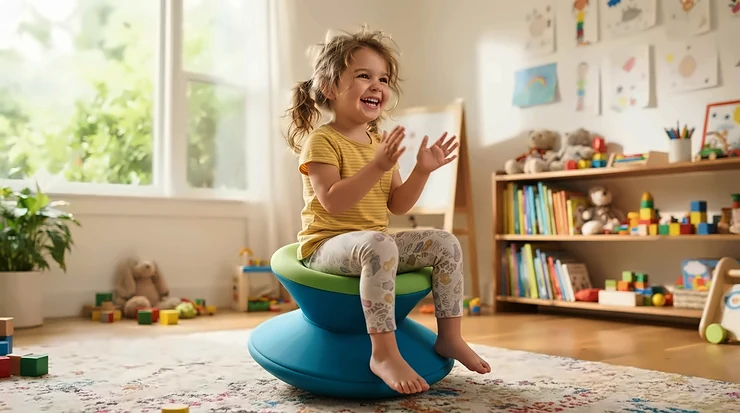
4. Gymnic Hop 55 — a 22-inch seated hopper ball
Twenty-two inches inflated and a 160-pound rating make this a hopper ball that covers older kids and lighter adults, though the listing’s age line says 7 and up. A patented handgrip sits on top, and the ball ships uninflated so you set firmness for the rider’s size.
The vinyl is described as latex-free, BPA-free and phthalate-free, but that wording comes from one retailer’s listing and no test report is named. Treat it as a claim worth asking the seller about, not as proof. The price on that page was about $37.99.
Sources conflict on the larger Hop 66 (26 inches, ages 6 and up per a toy retailer): a Walmart listing gives a max load of 135 pounds, while a buyer comment elsewhere says 300 pounds. If you go bigger, read the label rather than any listing.
Pros:
- ✅ No springs, no frame, nothing to pinch
- ✅ Ships uninflated, so you set the firmness
- ✅ Handgrip on top for balance
Cons:
- ❌ It is a balance toy, so it gives none of a rebounder’s cushioned surface
- ❌ Spec conflicts on the sibling model mean you have to verify the weight rating yourself
5. Flybar Foam Jolt Beginners Pogo Stick — foam-wrapped first pogo for kids
A first pogo stick is the opposite of a cushioned mat: you stand, balance and land on a spring. The Foam Jolt wraps the metal frame and hand grips in foam, adds non-slip foot pads and a wide bounce tip, and is listed for children from 40 to 80 pounds. Its Tractor Supply listing says 5 and up in the title and 6 and up in the description, so the age line is inconsistent.
Tractor Supply’s page shows 4.7 stars from 130 reviews, and the visible reviews mention only cosmetic dents in the foam. Weight limits are the other story. Two buyers on retailer pages mirroring Amazon reviews of a Flybar beginner stick sold for ages 5 and up (it is not confirmed to be this exact Jolt) report that the spring bottomed out under children weighing 45 and 68 pounds. Two separate reports are enough to treat the 40-to-80-pound range as a real boundary, not a suggestion.
Price lands around $30 to $40. Outgrowing it is the built-in trade-off, since the next size up in Flybar’s line, the Master Pogo Stick, is listed for 80 to 160 pounds and ages 9 and up.
6. Gaiam Eco Total Body 65 cm Balance Ball Kit — gentle seated bouncing for adults
Around $20 to $30 buys the cheapest way to bounce in this guide, though what you get is a ball to sit on, not a rebounder. Academy Sports lists it at $24.99 with a dual-action hand pump and a workout DVD, sized for people 5’6″ to 5’10” tall.
The PVC ball is described as made without the six most harmful phthalates, which is a narrower claim than “non-toxic.” The page gave no weight rating and no anti-burst statement, which is the one place I could only read a retailer listing, so look for both on the box before sitting down.
Pros:
- ✅ No springs, no cords, no frame
- ✅ Kit includes a pump and a workout DVD
- ✅ Phthalate wording is stated plainly on the listing
Cons:
- ❌ Bouncing seated is gentler and lower-effort than rebounding
- ❌ Weight rating was not on the page
No spring trampoline: what the design removes and what stays
Removing springs takes away two things: the steel coils at the edge of the mat and the gap a foot can slip into. JumpSport’s cords and Springfree’s rods both claim that benefit, and Springfree’s own FAQ says its design needs no safety pads because the springs and frame are no longer at jumping level.
What stays is every other risk the AAP page lists. Injuries can happen with nets, padding and parents watching, and the page’s rule is that only one child jumps at a time. Springless trampolines also keep a weight limit, which is why Springfree publishes a single-jumper figure separate from its 1,300-pound structural rating. ComplianceGate, a compliance consultancy, notes that ASTM F381, the consumer trampoline standard, is not mandatory under federal children’s product law, so a “meets F381” line is a maker’s choice rather than a legal requirement.
The fitness case for rebounders rests on thin evidence. The American Council on Exercise study put 24 recreationally active college students through a 19-minute JumpSport routine and found an average heart rate of 79% of maximum, while participants rated the effort at 11.7, lighter than the researchers expected. That is useful for judging intensity. It did not measure joint load, used one routine, and was a single session, so “low-impact” remains the manufacturers’ language.
A non-toxic trampoline: what the label can and cannot promise
No page proves that any bouncing product is non-toxic. What exists is narrower. The CPSC’s phthalates guidance says children’s toys and child care articles cannot contain more than 0.1% (1,000 ppm) of regulated phthalates in an accessible plasticized component, with a children’s toy defined as a product for children 12 or younger. ComplianceGate adds that children’s products are limited to 100 ppm of total lead in accessible parts and that PVC trampoline components can contain substances restricted under California’s Proposition 65.
Those rules cover specific chemicals, not everything a buyer might worry about. The Gymnic and Gaiam listings make phthalate claims in their own words, but neither named a lab report on the pages, and the JumpSport and Bellicon pages made no chemical claims at all.
So ask the seller three things: whether a Children’s Product Certificate exists for kid-oriented items, what the mat or ball is made of, and whether the phthalate claim refers to the full regulated list. A sealed answer beats a marketing adjective.
Five quick answers on springless and non-toxic bouncing
❓ Is there such a thing as a non-toxic trampoline?
✅ Not one I could confirm. The pages cite legal limits on lead and certain phthalates, and some listings say phthalate-free, but none defines non-toxic. Ask the seller for the children's product certificate and check the mat and pad materials.
❓ What is a good low-impact alternative to a trampoline?
✅ A bungee-cord rebounder or a seated bounce on a balance ball. Rebounder makers call the bounce gentle, but the ACE study measured heart rate and effort, not joint load, so treat low-impact as a marketing claim rather than a measured result.
❓ Is a trampoline with no springs safer?
✅ It removes spring pinch points and exposed coils, which is the design's selling point. It does not remove falls or collisions. The AAP page says nets and padding do not prevent all injuries and advises one jumper at a time.
❓ Can adults use a hopper ball?
✅ Only if its weight rating covers you. The 22-inch hopper ball covered here caps at 160 pounds, and sources disagree on the 26-inch size, so read the label first. It is balance play, not a trampoline replacement.
❓ How old should a child be before jumping on a trampoline?
✅ The AAP page says kids under 6 should never jump, and recommends keeping children off trampolines except in settings with professional coaches. Springfree's own guide suggests roughly ages 6 to 12 for its compact model, depending on size.
Picking your bounce: adults, young kids, or a household of both
For adults who want a gentle workout surface, the JumpSport 220 Fitness Trampoline is the straightforward starting point, and the Bellicon 44-Inch Folding Rebounder is worth a look if household members differ a lot in weight. Families who have decided on a backyard trampoline and want no coiled springs should read the Springfree Compact Round Trampoline specs closely, including the 175-pound single-jumper limit and the 18-by-18-foot footprint.
Younger children get safer-feeling options in the Gymnic Hop 55 and the Flybar Foam Jolt Beginners Pogo Stick, while the Gaiam Eco Total Body 65 cm Balance Ball Kit is the cheapest adult experiment. Whatever you choose for bouncing without a tram, match the weight rating to the person using it before you match the color.
Recommended for You
- Is The best all in one car seat worth it In 2026? 5 Expert Picks
- 10 Best Trampoline Weight Limit Guidelines For Safe Bouncing in 2025
- 5 Expert Baby Monitor Buying Guide Safety Features for 2026
Check each weight rating against the actual jumper before you order, then enjoy the bounce.