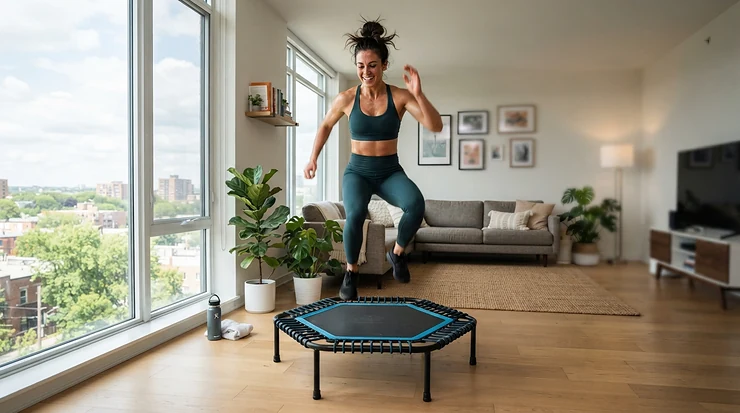
Volunteers in an American Council on Exercise study averaged 79 percent of their maximum heart rate during a 19-minute mini-trampoline routine, yet rated the effort only light to moderate, according to ACE’s write-up of the research. That gap is the whole appeal of a trampoline for weight loss: the body works harder than it feels like it is working, which makes the habit easier to keep. It is also where marketing outruns the evidence, because that study never weighed anyone.
If you are shopping for a trampoline for weight loss in 2027, you are really buying two things: a piece of equipment rated for your body and your floor, and a routine you will repeat. This guide covers the evidence first, then uses three questions to match five rebounders to specific situations. Everything here comes from published studies, maker spec pages and independent reviews, not from my own living room, and where sources disagree I say so.
Does jumping on a trampoline help lose weight? What the studies actually measured
Short version: jumping can produce real cardio effort, while the evidence on the scale is mixed. Both statements hold at once, and the details explain why.
The ACE-sponsored study used 24 recreationally active college students and a 19-minute routine designed by JumpSport. During the workout portion, men burned about 12.4 calories a minute and women about 9.4. Counting warm-up and cool-down, the averages were roughly 11.0 and 8.3. My own arithmetic puts the full session near 210 calories for the men and 160 for the women. ACE set those numbers against the American College of Sports Medicine’s benchmark of 200 to 300 calories per 30-minute workout. The study did not track weight or body fat, it measured a single session, and ACE itself says little data exists on mini-trampolines and body composition.
The older controlled trial that tracked body composition is sobering. Edin and colleagues randomized 17 sedentary women into a rebounding group or a control group. The rebounders trained five days a week for 11 weeks, in two 15-minute bouts at 70 to 85 percent of their maximal treadmill heart rate. Their aerobic capacity rose 4.4 percent. Body weight, body fat and blood lipids did not differ significantly from the control group, according to the University of Minnesota’s record of the abstract.
A newer Italian study points the other way. Eighteen overweight women completed 12 weeks of mini-trampoline training, and the researchers reported significant improvements in fat mass, lean mass and circumferences, plus blood pressure falling from 128/80.5 to 123/71 and peak oxygen uptake rising from 15.4 to 16.9 mL/kg/min (PubMed’s abstract of Cugusi and colleagues, 2018). The abstract compares baseline with week 12 in a small group, so it shows what changed, not what bouncing alone caused.
One more piece matters if your starting point is sedentary. In a proof-of-concept study of inactive adults with overweight or obesity, six mini-trampoline exercises reached 58 to 87 percent of each person’s peak oxygen uptake on a bike test, and average heart rates landed in the moderate-to-vigorous range. The authors describe the intensity as self-adjusting, according to the PubMed abstract.
So, can you lose weight on a trampoline? The evidence supports it as a low-friction way to do moderate-to-vigorous exercise regularly. It does not show that bouncing by itself moves the scale. Whether it does depends on the rest of your week, including food, and nothing in these studies suggests a rebounder works as a shortcut.
Three questions that pick your rebounder
Spec sheets run long, but three questions settle most of the decision on a trampoline for weight loss.
Question 1: What is the rating, and what do you weigh? Every rebounder has a maximum user weight, and two of the five models here top out at 250 pounds. One poster in a MyFitnessPal thread described grabbing a cheap Walmart trampoline and only noticing the 250-pound limit at home. A Mumsnet poster picked a bungee model specifically because it carried a higher limit. Both reports are single anecdotes, but they point at a real mistake. Bouncing loads a frame more than standing does, so leave a margin below the rating rather than sitting right at it. If you are close to a model’s limit, step up a tier.
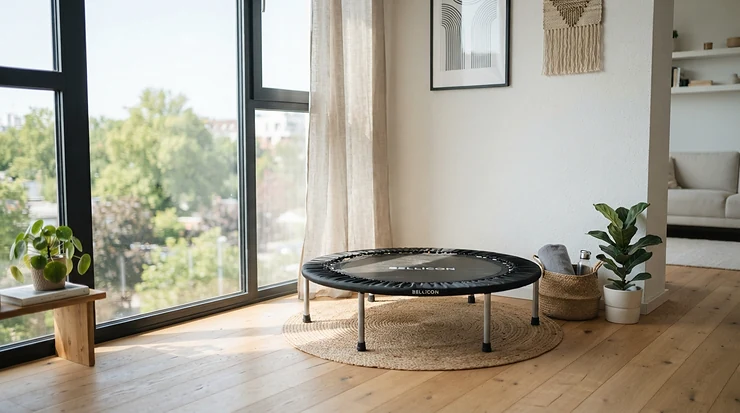
Question 2: Who hears it, and where does it live? Springs can squeak, and reviewers describe bungee systems as quieter. A Talk of the House roundup recommends ground-floor rooms or a detached garage for the spring-based BCAN SP2 Foldable Mini Rebounder, while a reviewer there reported no complaints from a downstairs neighbor during 30-minute high-intensity sessions on an elastic-cord model. If you live upstairs, noise is part of whether you will actually use the thing. Floor space matters too: some frames fold, some do not.
Question 3: How will you bounce? A handlebar helps if balance is a worry. Adjustable tension helps if you plan daily sessions and want the surface to change as you get fitter. A fixed, soft bounce suits a gentle start. Be honest about whether you are building a ten-minute habit or planning interval training, because the models below split along that line.
Five situations, five rebounders
Situation
Pick
Weight rating
Bounce system
First-timer, sore knees or an upstairs home
JumpSport 250 Workout Rebounder
250 lb
Elastic cords, soft bounce
Tight budget, tiny space
Stamina 36-Inch Folding Trampoline
250 lb
30 tension bands
Ground floor, wants to fold it away
BCAN SP2 Foldable Mini Rebounder
330 lb
32 closed springs
Heavier user who needs quiet
BCAN BT2 Mini Rebounder
450 lb
Bungee cords
Daily intense use, adjustable feel
BCAN BT4 Soft Land Pro
500 lb
Bungee, six tension levels
The weight rating climbs as you go down the table. The bungee models trade the spring squeak for quiet, and the BCAN BT4 Soft Land Pro sits in a premium tier. Prices below come from the maker and retailer pages and shift often, so treat them as tiers.
A hypothetical apartment dweller who has not exercised in years, weighs well under 250 pounds and wants something quiet is the buyer this one was designed around. The 39-inch frame is JumpSport’s gentlest tier. The maker lists the 39-inch Essential family, which includes the 250, at a 250-pound rating, a soft bounce, 30 two-knot EnduroLast cords rated for 400,000 bounce cycles, no adjustable tension, and a recommended user height under six feet. Retail listings give it a 35.5-inch jumping surface with a 485-square-inch bounce area and a weight of about 22 pounds, and the steel frame and legs carry a lifetime warranty while the mat and cords are covered for two years.
The Talk of the House roundup describes a smooth, quiet bounce and a padded petal mat that stays steady during interval training, and cites a 4.7-star average across 1,143 reviews. It labels the unit the 350, though the specs it lists (39-inch frame, 250 pounds, two-knot cords) match the Essential family. Its reviewer noted no noise complaint from a downstairs neighbor after 30-minute high-intensity sessions, and the article names the 250-pound limit as the main drawback. Sources conflict on two details: one dealer lists 225 pounds where the maker and others say 250, and retailers split on whether a handlebar ships with it. The maker groups the 250 with the 220 and 230 in one family, so confirm the exact model number on the page.
Prices ranged between about $280 and $390 across the maker’s page and one retailer, so expect a mid-tier cost and check the current price on Amazon.com. It also includes a 60-day free trial of JumpSport Fitness TV workouts, which gives a first-month routine without hunting for one.
JumpSport 250 Workout RebounderSee current price, sizes and reviews on Amazon.
Stamina’s cheapest rebounder goes about as small as these get: 36.5 by 36.5 inches, 8.75 inches tall, 14 pounds, with six detachable rubber-tipped legs and 30 two-inch-wide tension bands instead of springs. The listing carries a 250-pound limit and a 90-day parts, one-year frame warranty. Prices ran between about $60 and $80 across the maker and two retailers.
Its trade-offs are the ones you would predict at that price. Talk of the House says the tension-band system is less durable than rival suspensions. The built-in monitor counts jumps, time and calories but does not read heart rate, so the calorie figure is an estimate. On the plus side, that roundup cites a 4.4 average across more than 16,000 reviews, and the reviewer’s 65-year-old parent found it easy on her knees. Stamina’s own page recommends using it at least three times a week and says it can aid weight loss, which is a manufacturer claim rather than a finding.
Stamina 36-Inch Folding TrampolineSee current price, sizes and reviews on Amazon.
Storage is the reason to buy this one. The 40-inch frame folds to about a quarter of its size, the steel frame is 3 millimeters thick, and 32 closed springs are meant to protect fingers and toes. The weight rating is 330 pounds, an adjustable handlebar comes included, and Talk of the House lists a one-year warranty covering manufacturing defects and a price under about $90.
Noise is its weak spot. That roundup says springs are louder than bungee models and suggests a ground-floor room or detached garage, and the same piece reports over 200 jumps per session by its tester with no sign of frame or spring fatigue. For a household with a spare corner of a ground-floor room and no neighbors underneath, the folding frame matters more than the squeak. A second-floor flat is where it frustrates people.
BCAN SP2 Foldable Mini RebounderSee current price, sizes and reviews on Amazon.
For a heavier user in an apartment, the sticking point is usually the weight limit, and the BCAN BT2 Mini Rebounder answers it with a 450-pound rating on the 40-inch version (a 48-inch size is sold with a 550-pound rating). It uses 32 bungees, an alloy steel frame and an adjustable handlebar with three height positions, which the Mayfair Farms reviewer found stable for users from 5’4″ to 6’2″. The cords are 8-millimeter latex-core bungee with a fixed tension, so the feel does not change as you progress.
Mayfair Farms reports the unit ships about 80 percent assembled, takes 25 to 30 minutes to finish, and drew no neighbor complaints after six weeks of use in the reviewer’s home. Its listed cons are legs that may loosen over time and handlebar foam that wears. Sources disagree on folding: the maker’s naming calls it “foldable” while Mayfair Farms says it does not fold and needs about a 40-by-40-inch space, so check the listing. Another detail FED Fitness’s page leaves out is whether the 450 pounds is a static or dynamic rating, which is worth asking about if you sit near the limit. Check the current price on Amazon.com.
BCAN BT2 Mini RebounderSee current price, sizes and reviews on Amazon.
The highest rating in this group, 500 pounds, comes with six tension levels, natural latex cords and a handlebar with five height settings from 28 to 36 inches, suited to roughly 5’0″ to 6’4″ according to Mayfair Farms. The frame is one piece and does not fold. BCAN says the cords passed a 100,000-jump lab test, which is the company’s own claim; the reviewer logged about 1,200 jumps with no visible wear.
Maintenance deserves attention. BCAN recommends replacing the bungees and mat every 6 to 12 months under heavy use, and the reviewer pegs a replacement cord set at about $30. That makes the model a stronger fit for someone who bounces most days and wants to turn the tension up over time than for a casual user. It sits in the premium tier, so check the current price on Amazon.com.
BCAN BT4 Soft Land ProSee current price, sizes and reviews on Amazon.
Trampoline workouts for weight loss: a first-month structure
The studies above suggest a shape rather than a recipe. ACE’s participants bounced for 19 minutes, and Edin’s group split 30 minutes of work into two 15-minute bouts with a five-minute rest, five days a week. Neither started there on day one, and you should not either.
Trampoline exercises for weight loss do not need to be elaborate. A basic bounce with feet staying on the mat, a jog in place, jumping jacks and a side-to-side step cover most of what a beginner needs. The useful variable is effort: alternate 30 seconds of higher-energy movement with a minute of easy bouncing, and lengthen the hard intervals only as that feels comfortable. Keep the handlebar within reach if you are new.
Lean on your breathing more than on a tracker. The monitor on the Stamina 36-Inch Folding Trampoline, like most counters, estimates calories without reading heart rate, and ACE’s finding that effort felt easier than it measured means your sense of exertion may understate the work. Add a few minutes a week rather than a lot at once, and talk to a clinician before starting if you have a health condition or an injury.
Is a trampoline good for overweight children trying to lose weight?
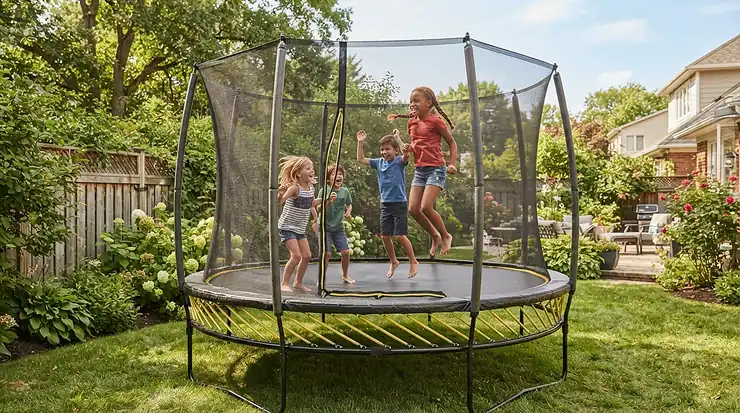
This is the one place where the answer is a firm “ask a pediatrician first.” The American Academy of Pediatrics tells families to keep kids off trampolines unless professional coaches and specialized equipment are involved. Its HealthyChildren.org page reports more than 800,000 children injured on trampolines between 2009 and 2018, roughly 110,000 emergency room visits a year, and an age line of never under 6. It names flips and somersaults as the cause of the most serious neck, head and back injuries, and it says supervised gymnastics or dance programs with trampoline work can be a safer route than a backyard setup. University Hospitals’ pediatric team summarizes the AAP’s advice as covering mini trampolines as well as large ones.
None of the five rebounders above is built for children; they are rated for adult users. So the reasoning is plain. A trampoline might be an enjoyable way to get a child moving, but the injury data weighs against buying one for that purpose, and weight management in children belongs in a conversation with the child’s doctor rather than a product choice.
Four ways a rebounder ends up in the closet
A few predictable mistakes show up across the reviews and forum posts:
Buying to the limit. Matching the rating to your exact weight leaves no margin, the MyFitnessPal poster ran into it after buying, and the Mumsnet poster avoided it by checking first.
Ignoring the floor beneath you. A spring model above someone’s bedroom gets used less than a quiet one, which defeats the point.
Trusting the calorie counter. Monitors estimate; they do not read your heart rate, and the number is only as good as the formula behind it.
Forgetting replacement costs. BCAN advises cord and mat replacement every 6 to 12 months for heavy use, with a cord set around $30 according to Mayfair Farms.
One note on sources: a rebounder seller that stocks spring models says it has received photos of cracked legs and ripped bungees on budget units, but a retailer pitching its own line has a stake, so read that as a caution rather than evidence about any brand named here.
Five quick answers before you click buy
❓ Does trampoline help lose weight?
✅ It can help as part of a routine, because bouncing reaches moderate-to-vigorous effort. A randomized trial found no change in weight after 11 weeks, while a small newer study reported fat-mass improvements. Results depend on frequency, effort and everything else you do.
❓ How long should you jump on a trampoline to lose weight?
✅ Studies give a range rather than a rule: ACE's participants jumped 19 minutes, and a 1990 trial used two 15-minute bouts five days a week. Starting shorter and building gradually is sensible, and a clinician can advise if you have a condition.
❓ Is a trampoline good for overweight children to help lose weight?
✅ Pediatricians advise caution. The American Academy of Pediatrics discourages home trampolines for children, says those under 6 should never jump, and links flips to serious injuries. Talk with the child's doctor about safer activity options, including supervised programs.
❓ What weight limit should a rebounder have?
✅ Choose a rating comfortably above your weight, since bouncing loads the frame more than standing. Two models here stop at 250 pounds, one reaches 330, and the BCAN bungee models reach 450 and 500. Check whether the maker says static or dynamic.
❓ Are bungee rebounders better than spring ones?
✅ Reviewers describe bungees as quieter and softer, which suits upstairs homes. Springs run louder, though one spring model here folds flat. Bungees wear out too; BCAN suggests replacing cords every 6 to 12 months under heavy use.
The short version for your situation
For a trampoline for weight loss, let your weight rating and your floor choose first, and your budget second. If you are under 250 pounds and want a quiet, soft start, the JumpSport 250 Workout Rebounder is the beginner-friendly option. If space and money are tight, the Stamina 36-Inch Folding Trampoline gets you moving. If you need folding storage on a ground floor, the BCAN SP2 Foldable Mini Rebounder fits. Heavier users who need quiet should look at the BCAN BT2 Mini Rebounder, and daily, intense sessions with adjustable tension suit the BCAN BT4 Soft Land Pro.
Pair whichever you choose with a realistic routine, because the studies support the effort, not a promise about the scale. Open the listing that matches your situation and read its weight rating first.
The WhizKiddo editorial team researches baby gear, outdoor play equipment, trampolines and kids' products using manufacturer specifications, safety guidance from bodies such as the CPSC and AAP, independent tests, parent reports and retailer listings. We do not claim to have tested the products ourselves. Read how we work on our How We Choose Gear page.