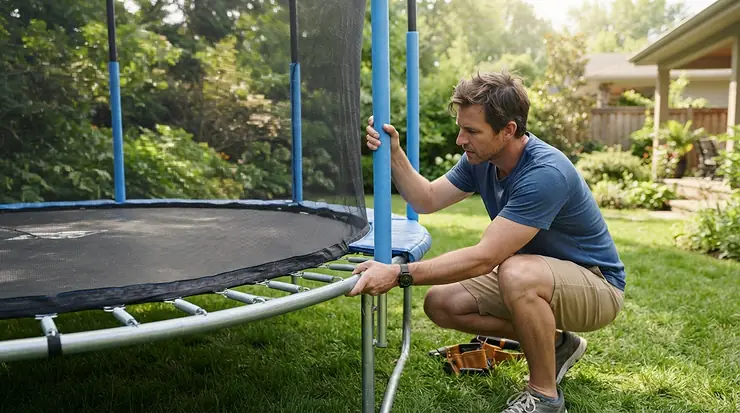
A 12 foot trampoline does not give you 12 feet of bounce. The frame is 12 feet across, but the spring ring and pad take their share, and Springfree’s comparison of 12-foot models puts the Skywalker’s jumping surface at 88 square feet, the room of a 10-foot trampoline. My own arithmetic turns 88 square feet into a mat a little over 10 feet wide. That gap matters before you choose the best 12 foot trampoline for a yard, because it decides who the size really suits.
To help you choose the best 12 foot trampoline for your family, this 2027 guide compares five 12-footers that come with an enclosure, plus the question that sends many shoppers looking for a twelve foot trampoline with a roof: what shade add-ons exist and where they fall short. Everything here comes from maker pages, retailer listings, safety organizations and published reviews, not from hands-on use.
The short version: the Jumpzylla has the strongest outside endorsement, the Zupapa and JumpFlex list the longest warranties, and the Skywalker fits the lightest jumpers on the tightest budget.
Ten feet of mat, one jumper, and a yard to match
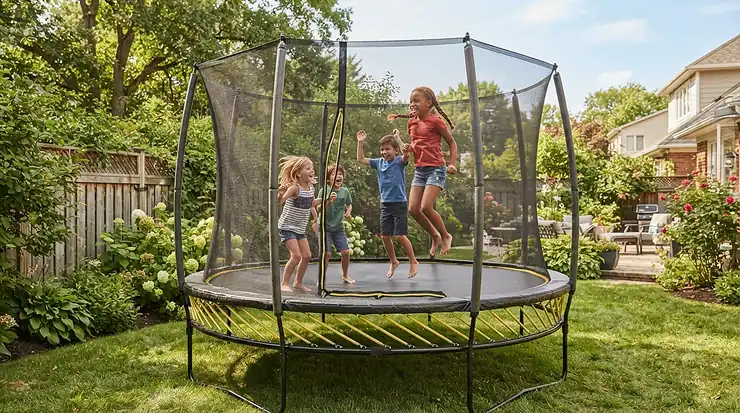
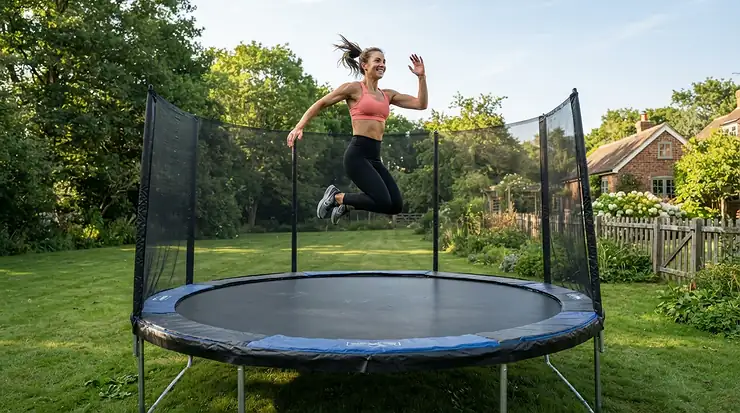
Start with who this size is for. The Skywalker listing recommends its 12-footer for ages 6 and up, and the American Academy of Pediatrics says children under 6 should not jump at all and that only one child should be on the mat at a time. Forbes’ trampoline buying guide quotes an outdoor-safety expert who puts the starting size for adult trampolines at 14 feet. Read together, those points make a 12-footer a school-age kids’ trampoline first, one that a lighter teen or adult can share in turns.
The yard is the other half. Forbes advises 3 to 5 feet of clear space on every side and 24 feet overhead, with grass, mulch, gravel or sand underneath rather than concrete. By those numbers a 12-foot frame wants a clear patch somewhere between 18 and 22 feet across, well beyond the 14.7 feet of yard space that JumpFlex lists as the minimum for its own 12-footer.
How a top rated 12 ft trampoline made this shortlist
Four filters did the work: an enclosure in the box, a weight rating and warranty on a page I could open, a safety standard named by the maker or confirmed by a trusted guide, and at least some owner reporting.
Star averages count for less than they seem to. The Skywalker shows 4.3 stars from 1,365 ratings on Walmart.com, the AOTOB shows 4.5 from 2,954 on a Desertcart mirror of its Amazon listing, and Springfree cites 4.4 from just 49 Amazon reviews for the JumpFlex HERO. Those samples differ by a factor of about sixty, so a best rated 12 foot trampoline judged by stars alone is mostly a statement about review volume. Any 12 ft trampoline review, mine included, is only as good as the sample behind it.
One well-known 12-footer is left out: the Upper Bounce 12 ft Round Trampoline (UBT01-12). The retailer page lists 330 lb, 72 galvanized V-ring springs of 6.5 inches and a one-year warranty, but it neither confirms an enclosure nor names an ASTM standard, which fails the first and third filters. The five below are ordered by situation, not by rank.
Five 12-foot models side by side
Model
Weight rating listed
Springs
Frame warranty
Safety claim
Watch for
Jumpzylla 12FT Trampoline with Enclosure
400 lb (maker FAQ)
Not on the maker page
2 years
ASTM F381-16
Included stakes are light for storms
Zupapa 12FT No-Gap Trampoline
425 lb dynamic (maker page)
Not listed
10 years
TÜV and ASTM claimed
Several 12-foot versions exist
AOTOB 12FT Trampoline with Safety Net
400 lb
72 on the Amazon listing; 64 to 70 elsewhere
5 years on the Amazon listing; 3 on some pages
ASTM F381-16 and F2225 on the maker’s shop page
Spring cover fit
Skywalker 12-Foot Round Trampoline with Safety Enclosure
200 lb
72 at 5.5 in
3 years (1 year on other parts)
No-gap enclosure per maker copy
Lowest weight rating
JumpFlex HERO 12-Foot Trampoline
550 lb max; 40 to 200 lb recommended
72 at 7.1 in
10 years
None named on the maker page
Net and mat attach separately
Weight rating is where the five split. The Skywalker’s 200 lb sits at one end and the JumpFlex’s 550 lb ceiling at the other, yet the JumpFlex page recommends jumpers between 40 and 200 lb and Springfree lists the HERO at 200 lb, so read 550 as a structural ceiling rather than a green light for heavier jumpers. The models in the 400 lb range differ more in warranty and in how much evidence stands behind them than in their specs, and that evidence, not a spec line, is what separates a best 12ft trampoline from a merely cheap one.
The best 12ft trampoline for each kind of buyer: five picks
Forbes named this its favorite overall trampoline, which is the strongest outside endorsement any of the five has. Its write-up lists a 12-foot round frame standing 2.5 feet off the ground, ASTM F381-16 compliance, a 400 lb capacity, a two-year warranty with an optional storm warranty, a reversible UV- and water-resistant mat and curved enclosure poles. Forbes says it consulted outdoor safety experts and staff who own trampolines; the article does not say this model was tested hands-on.
Jumpzylla’s own FAQ backs the 400 lb figure for the 12-foot size and the ASTM F381-16 claim. It lists a ladder, Velcro-attached spring pads, two spring hooks and four galvanized stakes, and describes assembly as taking a few hours. Ratings change with size (265 lb for the 8-foot, 330 lb for the 10-foot, 450 lb for the 14-foot), and some roundups copy another size’s figure onto the 12-footer, so rely on the maker’s 400.
A buyer of the 12-foot model on a Desertcart mirror of Amazon reviews needed two adults to move the box, finished assembly in a little over 90 minutes, found five of six net posts slightly corroded out of the box, and felt the legs wobble until a pack of sturdier ground stakes went in. That is one report, but it lines up with the maker’s own warning that the included stakes are not meant for extreme weather.
Pros:
✅ Forbes’ favorite overall pick, with a named ASTM F381-16 claim
✅ Curved poles, ladder and four stakes in the box
Cons:
❌ Included stakes are light for storm country
❌ Some listings quote another size’s weight rating
Jumpzylla 12FT Trampoline with EnclosureSee current price, sizes and reviews on Amazon.
Two weight figures turn up for this brand, and they mean different things. One Zupapa page pairs a 1,500 lb static rating with 425 lb dynamic, while the 12-foot page gives 425 lb for jumpers and repeats 1,500 in an image caption. For a person bouncing, the lower number is the one that counts. Zupapa also sells more than one 12-foot version: a 2023 Saffun line lists 425 lb, and a reseller page for a 2025 double-frame range leads with an 1,800 lb headline figure. Compare the exact model number against the listing before you order.
The Saffun page lists hot-dip galvanized steel tubing up to 1.5 mm thick, net poles long enough to reach the ground and wrapped in 10 mm foam, and a mat sewn to the net so toes and feet cannot slip into the spring gap. Springfree notes that models where the net and mat are separate pieces can leave exactly that gap, which is the problem a no-gap build targets.
Warranty is where it pulls away: ten years on the frame, two years on the mat, pad, net and springs, and lifetime coverage on other accessories. A ladder, wind stakes and a rain cover come in the box, and the page claims TÜV and ASTM certification without naming the ASTM number. It lists no spring count and showed as sold out at the time of writing, so check the current price and availability on Amazon.com.
Zupapa 12FT No-Gap TrampolineSee current price, sizes and reviews on Amazon.
Assembly is the part reviewers keep mentioning. One buyer on a Desertcart mirror of the Amazon listing finished in about three hours alone; another took under three hours with a second adult and a YouTube video. The Gadgeteer’s reviewer, who tested the 8-foot size rather than the 12, called the frame sturdy and the net secure but found the instructions confusing enough that he had to redo some steps. Same maker, different size, so take that as a hint about the instructions, not a verdict on the 12-footer.
The listing figures are 4.5 stars from 2,954 ratings, a 400 lb limit, 72 springs, a 144-inch frame and a five-year manufacturer warranty. Other pages give 64 or 70 springs and a three-year term, so the label and manual on your unit settle it. AOTOB’s shop page names ASTM F381-16 and F2225 certification, and the Amazon description mentions a ladder, a basketball hoop and a storage bag.
Pros:
✅ 400 lb rating and a five-year warranty on the Amazon listing
✅ Reviewers report assembly in under three hours
Cons:
❌ One reviewer’s spring cover would not stay put, and another saw rainwater collect in it
❌ One reviewer reported greasy metal that stained clothes and a steel sliver from a pole
AOTOB 12FT Trampoline with Safety NetSee current price, sizes and reviews on Amazon.
Springfree’s price-ranked list puts this model first and the JumpFlex HERO far above it, which makes the Skywalker the budget reference in this group. The trade shows up in the weight rating: 200 lb, the lowest of the five, with 72 springs of 5.5 inches placed outside the net and 88 square feet of mat. Springfree, a competing maker, argues that short springs may soften the bounce and that springs take about two feet of jumping room, so weigh that as a rival’s view rather than a test result.
Walmart’s listing shows 4.3 stars from 1,365 ratings, about 69 percent of them five-star and 9 percent one-star. Reviews on that page differ on the one hands-on task: one buyer treated assembly as a one-person job and liked the included spring tool, while another found the springs hard to install even as a large adult. A version with a basketball hoop sells as the Jump N’ Dunk, and its retailer pages also list 200 lb. One feature line on the Walmart page claims up to 800 lb, so trust the 200 in the spec table.
Warranty is three years on the frame and one year on everything else.
Skywalker 12-Foot Round Trampoline with Safety EnclosureSee current price, sizes and reviews on Amazon.
Spring length separates this one: 7.1 inches on 72 springs, against 5.5 inches on the Skywalker, mounted on a dual-ring galvanized frame whose poles curve away from the mat. The maker’s retail page describes a 360-degree polyester net that clips to the mat with a zippered entry, a ladder, no bolts or welds and a 10-year warranty.
It lists 550 lb as the maximum user weight but recommends jumpers from 40 to 200 lb, and Springfree lists the HERO at 200 lb.
The page does not mention an ASTM standard, so ask for the certification before treating it as a given.
Springfree also points out that the net and mat are separate pieces, which can leave a gap that exposes springs, and that the curved poles are static. Springfree reports 4.4 stars from 49 Amazon reviews, a small sample. Going by the two pages, expect somewhere between $800 and $1,200 depending on whether you take the plain HERO or the shade bundle covered in the next section.
The maker’s page asks for at least 14.7 feet of yard space.
Read the weight-rating line on the Amazon page twice before any of these goes in your cart.
JumpFlex HERO 12-Foot TrampolineSee current price, sizes and reviews on Amazon.
Can a twelve foot trampoline have a roof? Shade covers, tents and their fit traps
Not as built. Every 12-footer above has an open-top net on poles, and a roof arrives as an add-on in one of two forms.
The first is a shade canopy. The JumpFlex HERO 12-Foot Trampoline with SMARTSHADE Canopy Cover bundle is not described as a full roof by its maker: the cover sits 5.9 feet above the mat, blocks up to 95 percent of the sun while letting air through, and drains rainwater. The maker’s page shows the bundle as sold out and says nothing about wind or anchoring.
The second is a tent that slips over the net and poles. The Propel 12-Foot Tent for Trampoline has three screened windows with roll-up covers, goes on without tools and shows a 4.2 out of 5 rating on Dunham’s site. It is non-universal: Dunham’s lists it for Propel’s own 12-footers (and inconsistently mentions Kinetic), and another retailer spec sheet calls for six angled poles. That sheet also warns that it does not fully protect a trampoline from every kind of weather, and that some users report limited outdoor durability.
Generic tents sold for a twelve foot trampoline with a roof usually specify six straight poles, and buyer reviews on one Desertcart listing show the spread of outcomes. One buyer got a snug fit over six straight poles in under 30 minutes. Another got a workable but imperfect fit on an eight-pole frame. One said the 12-foot tent did not fit a 12-foot trampoline and returned it for a 15-foot version, and another reported clips that broke while securing it. Count your enclosure poles and note whether they are straight or curved before you shop for one, because the fit has to be checked before the tent goes in the cart.
Wind is the running cost of any roof. Jumpking’s European page for a 12-foot canopy says to take it off when not in use and overnight, because strong wind and rain may damage it, and that such damage is not covered by the warranty. Treat a roof as fair-weather gear and take it down before a storm.
Wind, rust and the mat: what owners and safety groups warn about
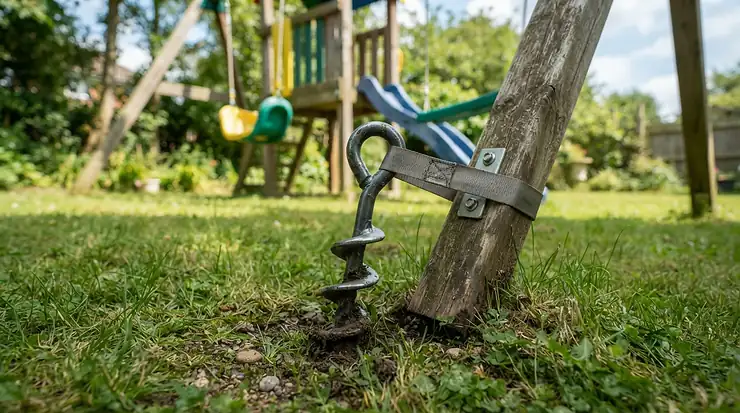
Wind comes up more than any other problem across the 12 ft trampoline reviews. On the Desertcart mirror of Jumpzylla’s Amazon reviews, a 10-foot buyer says the included stakes failed in a severe windstorm, a 14-foot buyer says a windstorm flipped the trampoline before separately ordered stakes arrived, and the 12-foot buyer mentioned earlier bought sturdier stakes to stop the wobble. In both storm cases the company replaced the whole trampoline, and it sent free parts to a 14-foot owner after a support pole snapped at one year. Each is a single report, but three buyers reached the same view of the included stakes, which agrees with Jumpzylla’s own FAQ.
Finish and wear show up in a few reports. The same 12-foot reviewer saw slight corrosion on five of six net posts out of the box, and an AOTOB owner reported tight nets and no mat tears after about five months, with a small weather tear starting on the spring cover. Go over every post, pad and net seam in the first week.
A net is not a cure-all. The American Academy of Orthopaedic Surgeons says most trampoline injuries happen on the mat itself, so an enclosure should not be relied on alone; it also advises one jumper at a time, spotters, ground-level placement and taking the ladder off after use.
Standards labels need reading too. Forbes explains that ASTM F381-16 covers the trampoline’s components, assembly and use, ASTM F2225-15 covers enclosures, and Intertek’s mark signals independent third-party testing. A maker’s ASTM claim on a listing and an independent lab mark are different things.
Weight limits, roofs and yard space: five quick answers
❓ How many people can use a 12 foot trampoline at once?
✅ One. The American Academy of Pediatrics and the American Academy of Orthopaedic Surgeons both advise a single jumper at a time. A high weight rating describes how much load the frame is built for, not how many people should jump together.
❓ How much yard space does a 12 foot trampoline need?
✅ Forbes advises 3 to 5 feet of clearance on every side and 24 feet overhead, over grass, mulch or sand rather than concrete. That works out to a clear patch of roughly 18 to 22 feet across, more than the 14.7 feet JumpFlex lists as its minimum.
❓ Can a twelve foot trampoline have a roof?
✅ Not as built, but add-ons exist. JumpFlex sells a shade canopy bundle that sits 5.9 feet over the mat, and Propel makes a tent for its own 12-footers. Both depend on pole count and shape, and makers advise removing canopies in wind and overnight.
❓ Is a 12 foot trampoline big enough for adults?
✅ Forbes' expert puts the starting size for adult trampolines at 14 feet, so a 12-footer is on the small side. The mat is about 10 feet wide, and the Skywalker's 200 lb rating shows why each weight limit needs reading before an adult jumps.
❓ What does ASTM F381 mean on a trampoline listing?
✅ According to Forbes, ASTM F381-16 is the standard covering a trampoline's components, assembly and consumer use, while F2225-15 covers enclosures. A maker's claim on a listing is not the same as an independent lab mark such as Intertek's, so ask which one applies.
Which one I would start with
Start with the jumper, not the brand. For one or two lighter kids on a tight budget, the Skywalker 12-Foot Round Trampoline with Safety Enclosure and its 200 lb rating do the job. When you need a 400 lb figure, the Jumpzylla 12FT Trampoline with Enclosure has the Forbes endorsement and the AOTOB 12FT Trampoline with Safety Net a five-year listed warranty at the same rating, while the Zupapa 12FT No-Gap Trampoline and the JumpFlex HERO 12-Foot Trampoline both list ten years on the frame. Shade means a JumpFlex bundle or a tent matched to your poles.
The best 12 foot trampoline for most yards is the one whose weight rating, warranty and standards claim you have confirmed on the actual listing. Even a top rated 12 ft trampoline needs sturdier anchors than the box provides, plus the clear space Forbes describes, a zipped net and one jumper at a time.
The WhizKiddo editorial team researches baby gear, outdoor play equipment, trampolines and kids' products using manufacturer specifications, safety guidance from bodies such as the CPSC and AAP, independent tests, parent reports and retailer listings. We do not claim to have tested the products ourselves. Read how we work on our How We Choose Gear page.