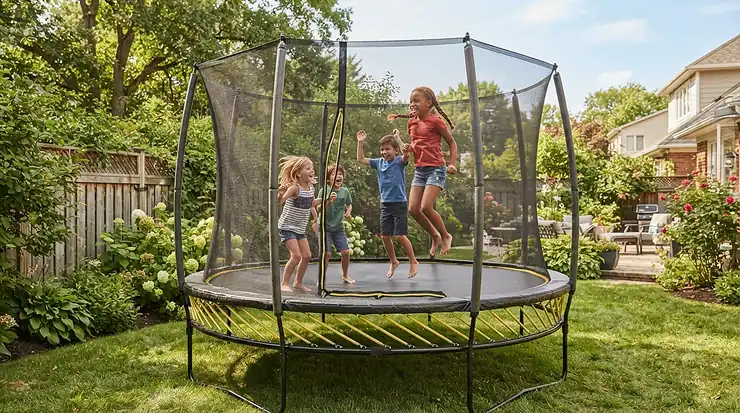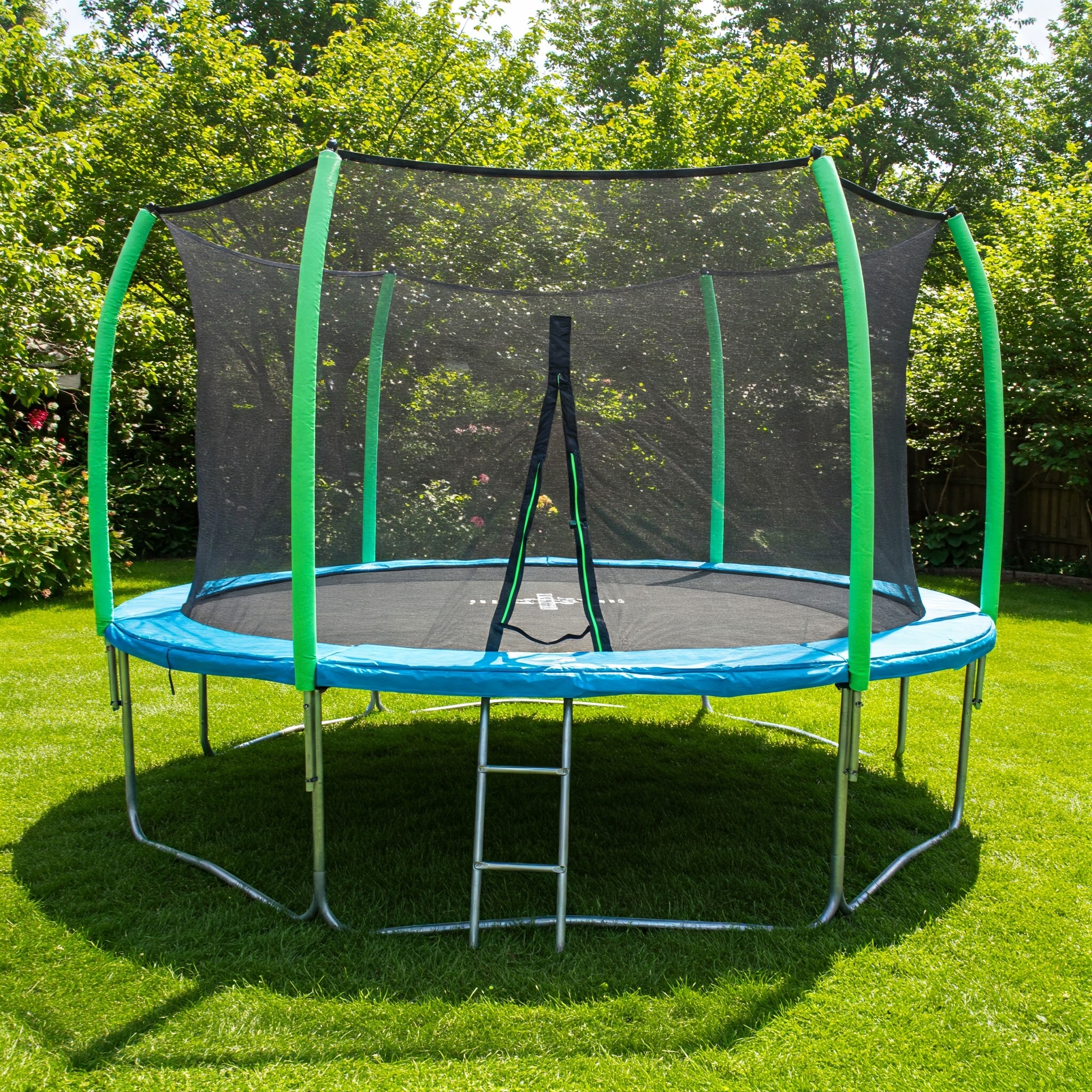
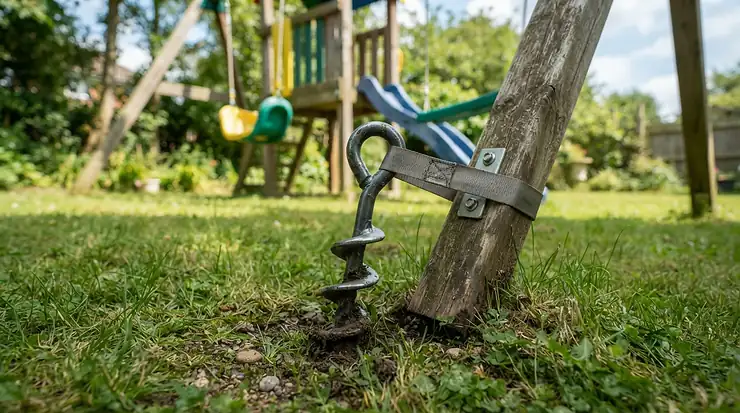
For an exposed yard, trampoline anchors that screw into the soil and strap to the frame are a better bet than U-shaped stakes, provided the ground is firm enough to grip them. The reason is simple physics: the mat catches wind like a sail, and a trampoline retailer’s blog describes frames lifted and carried far from their yards after a single windstorm. Even Springfree, which sells its own anchors, says anchors are not perfect and recommends moving or dismantling the trampoline before a hurricane or tornado.
This 2027 guide runs through the install in order, then matches four kits to the steps they help with. Its findings rest on maker manuals, retailer listings and review roundups, so the strength figures in circulation are manufacturers’ claims, not lab results. The federal safety sheet from the Consumer Product Safety Commission counts an estimated 104,691 emergency-room-treated trampoline injuries for 2014 and never mentions anchoring, which tells you where anchors sit: they protect the frame and whatever it might land on, while supervision, padding and enclosures remain separate jobs.
What do I get to anchor a trampoline down? Four options, each with limits
Four kinds of hardware turn up across the manuals and guides, and they are not interchangeable.
- Corkscrew augers with straps. A wikiHow guide describes a standard kit as four steel augers and four adjustable nylon straps, and puts the price at $40 to $50.
- U-shaped wind stakes. They hammer in over each leg, and the same guide prices four-packs at $15 to $20. A Pure Fun manual for U-shaped stakes limits them to low or moderate winds and rules out mud, dry soil, sand, frozen ground and extremely rocky ground.
- Brand-specific anchors. Springfree’s guide warns that anchors from one brand may not fit another brand’s trampoline, and it puts anchors overall anywhere from under $20 to over $100.
- Ballast and masonry anchors. Sandbags over the legs, or brackets set into concrete; one retailer guide notes that the masonry route leaves permanent holes.
Current listings can undercut those older ranges. Recreations Outlet, a retailer, says basic four-piece corkscrew sets start under $20, so check the current price on Amazon.com before you set a budget.
The mechanism favors augers. That same retailer explains that a spiral grips the soil along its full length and so resists the straight-up pull a gust creates, while a U-stake relies on friction and can be yanked out of saturated ground. Springfree’s own notes, repeated by the retailer, claim pull-out resistance of about 900 newtons for its anchors, roughly 200 pounds of force.
How to use a trampoline anchor kit, start to finish
These seven steps blend Jumpking’s installation sheet, Springfree’s guide and the wikiHow walkthrough. Where they disagree, the sheet that ships with your kit wins, because it matches your hardware.
- Mark what’s underground. Jumpking’s sheet asks for an area free of electrical, gas, phone, water and sprinkler lines, and says an adult should do the work, with gloves. Springfree’s anchoring guide warns that skipping the utility check could cause serious or fatal injury. Recreations Outlet adds a call to 811 and marking sprinkler lines and buried pet fencing yourself.
- Count the legs and match the hardware. Jumpking’s sheet places one stake at the midpoint of each leg, and a retailer rule of thumb suggests four anchors for frames up to about 12 feet, with six to eight for 13- to 15-foot frames in open or windy yards. For U-stakes, measure the leg tube first: the Skywalker Trampolines Wind Stakes 4-Pack below fits legs up to 2 inches in diameter.
- Soften the ground and mark each spot. Jumpking says the ground should be soft and can be wetted first; Recreations Outlet suggests watering a hard lawn the day before. The Pure Fun manual bars dry soil outright, which squares with that advice. Spacing varies by source: Jumpking puts the stake about 6 inches from the outside of the leg base, wikiHow measures 1 to 1.5 feet inward from each leg, and a local TV station’s hurricane piece, describing star pickets, uses 12 to 18 inches from the inside of each leg.
- Screw the augers in. Turn each one by its eye. Jumpking’s sheet says a large screwdriver through the eye works as a T-handle. wikiHow has you turn clockwise until only the circular hook shows above ground and keep the auger as vertical as possible; Recreations Outlet says the eye should end up at or just above ground level. One retail guide advises a slight angle away from the frame instead. Rocky ground may need a pilot hole, and sandy soil calls for longer anchors.
- Run the strap over the top rail. wikiHow’s tip is to anchor at the top of the frame rather than the base for a firmer hold. Jumpking’s sheet threads the large loop around the top rail close to the leg (and under the leg bottom on round frames), then passes the small loop through the stake’s eye and cinches the buckle by its numbered openings.
- Tension every strap, then go around again. Snug with no slack, but not so tight that the frame bends, per Recreations Outlet. wikiHow notes that tightening one strap can loosen another, so it takes a second lap. One enclosure-focused guide says to re-tighten after the first week.
- Tug each one. wikiHow says to jostle each auger to confirm it’s secure. A sensible final check, reasoned from how wind lifts a frame: pull up on the top rail at each leg and watch for any rise in the strap or movement in the stake.
How to test trampoline anchors, and what still defeats them
No independent pull-out test of consumer kits turned up in the sources reviewed, so the realistic test is the one you run yourself. A roundup on beatcopgame.com suggests re-tensioning after the first storm and once per season. Recreations Outlet says to inspect after every big storm and again in spring, since freeze-thaw cycles cause frost heave that slowly lifts anchors over winter. wikiHow adds that bent, broken or rusted anchors should be replaced.
Owner reports show where anchored trampolines still move:
- Soil that gives way. The beatcopgame roundup relays one owner of the EURMAX USA Windproof Trampoline Anchor Kit whose corkscrews pulled out in extreme wind while the screws stayed undamaged, and notes that the Skywalker Trampolines Wind Stakes 4-Pack can rise after big storms; a UK reviewer saw a frame lift along with the stakes. These are single reports, but they agree with the retailer mechanics above.
- Factory wire staples. An enclosure guide on mercury-pc.com says the wire U-staples shipped with many trampolines have a shallow bite and pull out of soft soil in the first serious gust, and cites post-storm threads where owners lost trampolines with those staples in the ground. That is one publication summarizing several threads.
- Saturated ground. A hurricane-prep piece from 13NewsNow says wet soil can loosen pickets even when the trampoline is anchored correctly, and calls taking the trampoline apart the safest option during a storm.
- The enclosure net. Springfree and Recreations Outlet both say to take the net down before severe weather because it catches wind.
Makers are upfront about the ceiling. Jumpking’s sheet gives no guarantee of performance, JumpSport says wind damage isn’t covered by warranty, and Springfree says proper anchoring is the owner’s responsibility. A trampoline retailer’s blog adds that most anchor makers advise against use in very high wind or tornadoes, with the mat removed or the whole trampoline moved. Recreations Outlet attributes a 58 mph severe-thunderstorm threshold to the National Weather Service, and one enclosure guide offers its own rough ladder: anchors are usually enough below 25 mph, matter more from 25 to 40 mph, and above 40 mph the trampoline should come apart. Treat that ladder as one guide’s opinion.
Best trampoline anchors 2027: four kits matched to the job
Each kit ties back to the steps above, so the choice follows soil, leg count and whether you want straps in the box.
| Kit | Hardware | Stake length as published | Straps in box | Fit note |
|---|---|---|---|---|
| EURMAX USA Windproof Trampoline Anchor Kit | Corkscrew augers | 15.84 in | Yes | Listed for round or rectangle frames |
| JumpSport Heavy Duty Trampoline Anchor Safety Kit | Corkscrew augers | Not stated by the maker | Yes, nylon | Attaches to the frame by strap |
| Jumpking Trampoline Anchor Kit | Auger stakes | 13 in per manual (one retailer lists 16 in) | Yes, four | Round or rectangle |
| Skywalker Trampolines Wind Stakes 4-Pack | U-shaped stakes | 12.5 in | No | Legs up to 2 in diameter |
The split is straps: three of the four ship with them, while the Skywalker Trampolines Wind Stakes 4-Pack relies on a hammer and the leg itself. Published stake lengths run from 12.5 to 15.84 inches, with the JumpSport Heavy Duty Trampoline Anchor Safety Kit the one that leaves it out. Every kit here is a four-pack, so count your legs before you count your dollars.
1. EURMAX USA Windproof Trampoline Anchor Kit — longest augers, straps in the box
At 15.84 inches, the augers in the EURMAX USA Windproof Trampoline Anchor Kit run longer than the 13-inch stakes in the Jumpking Trampoline Anchor Kit manual and the 12.5-inch stakes in the Skywalker Trampolines Wind Stakes 4-Pack, and length matters because a corkscrew resists lift along the whole stretch of soil it grips. Listing data describes four galvanized steel corkscrews with a T-hook and adjustable straps, about 1.6 pounds in all. It covers steps 4 and 5 in one box.
On ratings, the beatcopgame roundup counts 7,380 for it, the biggest base among its ten kits, and Walmart’s listing for the corkscrew-and-T-hook version shows 4.6 stars from 42 ratings, with 81% at five stars. Some of the visible five-star reviews on that page carry an incentivized-review label, so weigh them accordingly. The failure report worth knowing is the pull-out account above: an owner’s screws came out when the soil gave way in extreme wind, and the roundup adds that removing the anchors from firm ground is hard. One owner’s account fits the broader pattern that soil, not steel, sets the limit.
Pros:
- ✅ 15.84-inch augers, longer than the other published lengths here
- ✅ Straps included, so no second purchase
Cons:
- ❌ Four anchors fit a four-leg frame; five- and six-leg frames need a second pack
- ❌ Hard to remove from firm ground, per the roundup
Check the current price on Amazon.com, and look at the EURMAX USA Windproof Trampoline Anchor Kit listing there.
2. JumpSport Heavy Duty Trampoline Anchor Safety Kit — enclosure maker’s corkscrews and straps
Anchor length is the one spec JumpSport’s page leaves out for the JumpSport Heavy Duty Trampoline Anchor Safety Kit, so measure the corkscrews when the box arrives. The maker describes four large heavy-duty corkscrews, each connected to a sturdy strap that attaches to the frame, and says plainly that wind damage to the trampoline or enclosure isn’t covered by warranty. That frankness frames the kit as a way to reduce risk, not remove it. The company also describes itself as the inventor of the universal trampoline safety enclosure, which is the context for an anchor product aimed at enclosed frames.
Buyer feedback comes from six reviews on a retailer listing. Owners there say the trampoline stayed put through storms and hurricane-season wind, several call the instructions clear, and one says the anchors never broke while being twisted into the ground. The consistent complaint is install effort in dry, hard clay or rocky soil, where reviewers needed a long-handled screwdriver or ratchet for leverage. None reports a strap or anchor failure, though six reviews is a thin base. Wetting the spot first, as step 3 suggests, should ease most of that complaint.
The kit ships in a single box weighing 4 pounds and measuring 15 by 6 by 3 inches.
3. Jumpking Trampoline Anchor Kit — plain 13-inch augers, clear manual
Placement guidance is where Jumpking’s installation sheet earns its keep for the Jumpking Trampoline Anchor Kit. The manual lists four tie-down straps and four 13-inch auger stakes, puts each stake at a leg’s midpoint about 6 inches outside the leg base, and walks through the buckle threading in eight steps for both round and rectangular frames. It also says plainly that Jumpking grants no guarantee of performance and cannot anticipate every condition of use.
Retail copy is looser. Scheels calls the kit compatible with any size and shape of trampoline and recommends it for areas with occasional winds, not for extreme weather, high-speed winds or tornadoes. Scheels also lists 16-inch anchors while the manual says 13 inches, a contradiction worth settling by reading the sheet in your box; the part number printed on the sheet is ACC-AK.
This is the plainest of the four: augers and straps, no extras. The sheet gives no insertion depth, so the guides’ eye-at-ground-level rule from step 4 is the practical cue.
4. Skywalker Trampolines Wind Stakes 4-Pack — hammer-in stakes for firm yards
Stakes instead of augers: the Skywalker Trampolines Wind Stakes 4-Pack (model SWS204.1) are 12.5-inch galvanized steel U-shapes tapped over a leg and driven in with a mallet, with no strap to thread. The maker’s page lists a fit for legs up to 2 inches in diameter and shows 195 reviews, 52% five-star and 48% four-star, which averages about 4.5. Pricing on that page sits between $30 and $40. Reviewers say a mallet does the driving, and one needed a rubber mallet to seat the stakes fully, which matches the rubber-mallet-only warning in the Pure Fun manual for similar stakes.
These suit firm loam or clay in a sheltered yard. Limits are documented: the beatcopgame roundup says the stakes can rise after big storms and cites a UK reviewer whose frame lifted with them, and that Pure Fun manual restricts comparable stakes to low or moderate winds.
Pros:
- ✅ No strap threading: hammer in and move on
- ✅ Fits legs up to 2 inches in diameter
Cons:
- ❌ No straps, so the stake only clamps the leg
- ❌ Four per pack leaves five- and six-leg frames short
Warranty terms conflict: the maker’s page lists a three-year limited warranty, while Academy’s listing shows 90 days. See the Skywalker Trampolines Wind Stakes 4-Pack on Amazon.
What trampoline anchors reviews agree on, and where they split
Across the manuals, roundups and listings above, three points repeat. Corkscrews with straps beat stakes in soft or exposed ground, hard soil turns the install into the main complaint, and the ground, more than the steel, decides whether anything holds. Star ratings run high on the pages opened, about 4.6 for the EURMAX USA Windproof Trampoline Anchor Kit on Walmart and about 4.5 for the Skywalker Trampolines Wind Stakes 4-Pack on the maker’s page, but a rating shows that the install went well and the first gusts passed, not how a kit behaves in extreme wind.
The sources split on spacing (6 inches outside the leg, 1 to 1.5 feet inside, or 12 to 18 inches), on whether to angle the auger, on whether sandbags help, and on Jumpking’s stake length. When sources split, the sheet packed with your kit is the tiebreaker.
Anchor answers on wind speed, sandbags, concrete and leg counts
❓ Do you really need to anchor a trampoline?
✅ Yes, if your yard gets real wind. The mat catches gusts like a sail, and a trampoline retailer's blog describes frames lifted and carried far from their yards in one windstorm. Anchors lower the odds but come with no guarantee.
❓ How many anchors does a trampoline need?
✅ One per leg is the baseline in one maker's installation sheet. A retailer guide suggests four for frames up to about 12 feet, and six to eight for larger ones in open or windy yards. Five- and six-leg frames outgrow four-packs.
❓ What wind speed can trampoline anchors handle?
✅ None of the kits reviewed here publishes a tested wind rating. One manual limits its stakes to low or moderate winds, and one guide advises taking the trampoline apart above roughly 40 mph. Treat higher claims as marketing unless the listing explains the test.
❓ Can sandbags replace trampoline anchors?
✅ Sources split. Springfree and a retail guide treat sandbags over the legs as a backup that adds weight, while a wikiHow guide calls them ineffective and a local TV piece says weights alone are not enough. Use them with anchors, not instead.
❓ Can you anchor a trampoline on concrete or a deck?
✅ Ground stakes need soil. On concrete, pavers or a deck, one roundup points to bolts set into the slab or sandbags as ballast, and a retailer guide mentions masonry anchors that leave permanent holes. Check the trampoline manual before drilling.
Pick by soil first, then count the legs
Trampoline anchors earn their keep in firm soil: corkscrew augers with straps for open, windy yards, and U-shaped stakes only for sheltered ground with moderate gusts. For an exposed yard, the EURMAX USA Windproof Trampoline Anchor Kit is where I’d start, given its 15.84-inch augers and included straps. The JumpSport Heavy Duty Trampoline Anchor Safety Kit and the Jumpking Trampoline Anchor Kit are the other strap-and-auger options, and the Skywalker Trampolines Wind Stakes 4-Pack suits sheltered, firm ground. Whatever you buy, add a second pack for five- or six-leg frames, re-check the straps after every storm, and take the net down and dismantle the trampoline when a hurricane or tornado is forecast. Pick the kit that fits your soil, then check it against your leg count.
Recommended for You
- Trampolines with enclosure: Safe Setup and Net Care (2027)
- 10 Best Anchor Trampoline Systems For Ultimate Backyard Safety in 2025
- 10 Simple Steps How to Take Apart a Trampoline Safely for Storage or Relocation
Disclaimer: This post contains affiliate links. As an Amazon Associate, I earn from qualifying purchases made through these links, at no additional cost to you.
Count your trampoline’s legs before you put any anchor kit in your cart.