As an Amazon Associate I earn from qualifying purchases. Links in this article may be affiliate links. How we choose gear
Indoor swings come down to one decision before any seat is chosen: whether a door frame, a ceiling joist or a frame standing on the floor will carry the load. Fabric, rope length and color all sit downstream of that choice. This 2027 guide matches five real options to the kind of home each one suits and spells out how to hang a swing without trusting drywall.
The picks rest on maker pages and manuals, a Consumer Product Safety Commission handbook, safety sheets from two therapy-equipment suppliers, and buyer reviews that retailers and review sites have collected; no swing was hung or loaded for this article, so each remark about noise, wobble or feel is credited to whoever reported it. Prices appear as ranges from retailer or maker pages and may differ on Amazon.com.
What carries the load decides everything: door frame, joist or floor
Lists of the best indoor swings usually rank seats and fabrics, yet the sources point to three other differences that separate these five picks far more sharply.
Where the weight goes. A doorway set clamps to the door trim, so nothing gets drilled, but the door cannot close while it is up, a drawback parents report in a doorway-swing roundup on Peggy O’Mara’s site. A ceiling mount works only when the hook bites into solid wood: Harkla’s FAQ calls a drywall-only hookup unsafe, and Bob Vila’s hanging guide says no reliable method skips the joist. A freestanding frame needs neither, and pays for that with floor space.
The lowest number in the chain. A swing, its hook and its frame each carry a rating, and the smallest one governs. Abilitations’ suspended-equipment sheet tells buyers to compare each swing’s maximum with the working load of the frame or ceiling support, a figure that includes the equipment, the person and the extra force movement creates. The OLAKIDS 4-in-1 Triangle Climbing Set shows how it plays out: its maker lists 275 pounds for the triangle but only 55 pounds for the swing.
Room to move. CPSC’s Outdoor Home Playground Safety Handbook asks for at least 6 feet between a swing and any structure or obstacle, and, for to-fro swings, a clear zone in front and behind equal to twice the height of the top bar. It is written for backyard sets. Applied to a frame 67.7 inches tall, that rule works out to roughly 11 feet each way (my arithmetic), which few living rooms can give, so the guidance below leans on short drops, thick mats and a clear 6-foot circle.
Mount, load rating and floor space for the five picks
Each row repeats what the maker or a retailer page states, including the places where pages disagree.
| Model | Mounts to | Stated load | Size or fit | Ages in the listing | Price signal |
|---|---|---|---|---|---|
| Gym1 4-Piece Indoor Doorway Gym Set | Door frame, no drilling | 300 lb on the listing; one older description gives the swing 220 lb | Door opening 25 to 36 in wide | Gym1’s 6-piece listing says 3 to 14 | Check the current price on Amazon.com |
| FUNLIO Foldable Swing Stand | Floor, with 4 sandbags | 200 lb for the stand; seat not included | 47 x 62 x 61 in assembled | None stated for the stand | Around $70 |
| OLAKIDS 4-in-1 Triangle Climbing Set | Floor | 275 lb triangle, 55 lb swing | 48 x 44 x 45 in assembled | 1 and up on one page, 3 to 6 on another | Around $110 to $120 |
| Harkla Compression Sensory Swing | Ceiling joist | 300 lb in the features, 200 lb in the FAQ | 48 x 110 in sling; ceiling 7.5 to 10 ft | 3 and up | Around $105 to $135 on the maker’s page |
| Outsunny 660 lbs Wooden Porch Swing Frame | Floor | 660 lb, frame only | 78.7 x 53.1 x 67.7 in | Best Buy lists a minimum age of 18 | Between about $100 and $145 |
Three different kinds of numbers share that table. A listing’s stated load is a capacity claim, while Abilitations’ working load adds the force of movement, so a 660-pound frame and a 300-pound swing cannot be compared by simple subtraction. What the table does show cleanly is who touches the house: only the Gym1 4-Piece Indoor Doorway Gym Set and the Harkla Compression Sensory Swing ask the building to carry anything.
Check current availability below once the mount type is settled.
Best indoor swings for kids, matched to the home you have
Each entry starts from a household situation, hypothetical wherever it describes a family, and works back to the product.
1. Gym1 4-Piece Indoor Doorway Gym Set — no-drill choice for renters
A renter with a four-year-old and a seven-year-old (a hypothetical household) cannot sink a hook into the ceiling, and that rules out half of this list. The Gym1 4-Piece Indoor Doorway Gym Set gets around the problem with a steel core unit that grips a door frame between 25 and 36 inches wide. The listing names a pull-up bar, a sensory swing, grip rings and an agility ladder, and rates the whole set for 300 pounds. An older Gym1 description on a reseller page splits that figure, giving the swing 220 pounds against 300 for the bar, and says the set was tested to ASTM and EN home-playground standards; the label on the swing attachment is the number to trust.
Fit decides whether the set works at all. A Kohl’s listing for Gym1’s 6-piece set asks for a hallway at least 39 inches wide, top trim under 6 inches, and 2.75 to 4.75 inches from the doorstop ridge to the front of the trim. The 4-piece listing repeats only the 25-to-36-inch figure, so treat the extra numbers as a clue, not a guarantee. One reviewer on a reseller page says the set could not go in a doorway at the end of a standard hallway because the walls crowd it.
Buyer reports split on how the set behaves under load. A reseller page showing the listing’s ratings reads 4.5 out of 5 from just under 2,000 ratings, and most reviewers there call installation easy. One reviewer on that page, though, describes the set coming down within four days with a child of about 60 pounds aboard, an incident that brought paramedics and ended in a full refund from the company. No other review on the page reports a fall, which makes it a single account rather than a pattern. Other buyers mention a family adding L-brackets after the set moved during heavy swinging, a door jamb that is easy to bump, and attachments that hang low on an 82-inch frame, which one reviewer says suits ages 3 to 5 better than a tall 7-year-old. The Peggy O’Mara roundup adds that parents using it in bedrooms removed and reinstalled it daily, about two minutes each time.
Pros:
- ✅ Nothing gets drilled, and the set comes down in minutes when a bedroom door has to close.
- ✅ One core unit carries a swing, rings and a ladder, so play changes without another purchase.
Cons:
- ❌ The door stays open while the bar is up.
- ❌ Trim depth and hallway width can rule the set out before the first swing, and reviewers disagree on how it holds in heavy use.
The reviewer who described the fall notes that the instructions ask for tightening after every use, a step worth treating as a routine rather than a one-time job.
2. FUNLIO Foldable Swing Stand — freestanding frame, nothing to drill
Around $70 buys a metal A-frame that needs 47 by 62 inches of floor and asks nothing of the house. FUNLIO’s manual lists the assembled size as 47 by 62 by 61 inches, the weight as about 11 pounds and the maximum load as 200 pounds, on an alloy-steel frame with anti-slip rubber feet that must be oriented correctly before each use. Four sandbags come empty; each takes up to 11 pounds of sand, rock or bottled water and attaches to the feet. The stand ships without a seat, and the manual says it accepts swings, baby jumpers and hammock chairs bought separately.
Stability is the recurring theme in buyer feedback, and it comes from the seat-included version of the same frame. A reseller page lists that version at 4.2 stars from 2,362 ratings. Reviewers there praise quick setup and easy folding, but one without sandbags found it very unstable, another says it needs weights to stay down, and one reports a plastic piece breaking and a toddler falling and being hurt. Cleveland Heart’s toddler-swing roundup makes the same two points about that version: fill the bags, and leave a generous patch of floor.
The manual’s certification line names ASTM F963-17, the toy-safety specification, while CPSC’s handbook points to F1148 as the home-playground standard, so the difference is a fair question for the seller. Whatever seat goes on the stand carries its own rating, and the lower of the two numbers is the one that counts. For a wobbly frame, the manual’s troubleshooting order is a level floor, correctly set feet, filled sandbags, then tightened bolts.
3. OLAKIDS 4-in-1 Triangle Climbing Set — wooden climber with a small swing
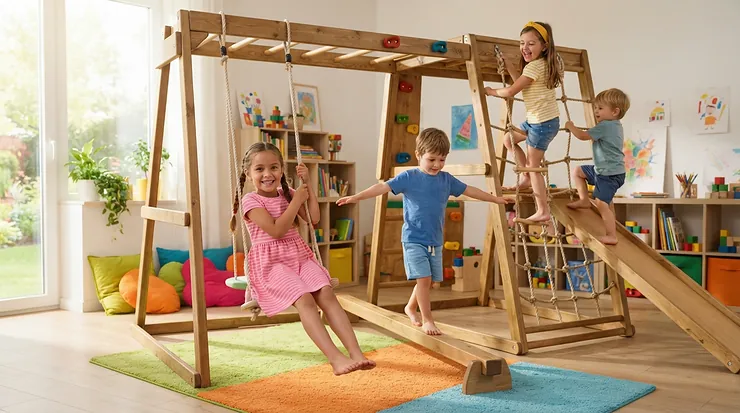
Fun exercise equipment for indoor kids rarely arrives with a swing attached, and this is the one pick here that does it in wood. The OLAKIDS 4-in-1 Triangle Climbing Set (model TS10074) is a Pikler-style triangle ladder with a ramp that works as a slide or a climbing slope, plus a swing section that adjusts between 27 and 34 inches high. The maker’s page lists solid pine and beech with water-based paint, an assembled footprint of 48 by 44 by 45 inches, and a folded size of 48 by 4.5 by 50 inches, so it can tuck behind a door between sessions. Retailer pages put it between about $110 and $120.
The number that matters is not the big one. The triangle is rated for 275 pounds, but the swing stops at 55, and the 45.5-by-15.5-inch ramp is described as a climbing and sliding surface, not a rock wall with holds. Age labels disagree as well: one page says 1 and up, another listing describes it for ages 3 to 6, and the 55-pound limit binds whichever label you trust. The page names no ASTM or CPSIA testing and carries no buyer reviews of its own, so durability is an open question. CPSC’s handbook says to use a swing’s restraint whenever one is provided and never to leave a toddler alone in a swing; the listing text mentions no restraint, which leaves supervision doing the work.
Net weight is 18 pounds, which is what makes the fold-and-stash routine realistic.
4. Harkla Compression Sensory Swing — ceiling-mounted calm corner
Drilling is the entry fee. Harkla’s page requires a solid wood ceiling joist, its FAQ calls a drywall-only mount unsafe, and its help center says the swing is not recommended for doorway installs. What the money buys is a 40-denier, two-way-stretch nylon tricot sling measuring 48 by 110 inches assembled, with carabiners, a daisy chain for height, a Rescue 8, a ceiling hook and lag screws in the box. The maker recommends a ceiling between 7.5 and 10 feet high and children from age 3, and lists the swing at around $105 without a swivel and $135 with one on its own site. Spinning is advised only with the swivel, because turning without it wears the fabric.
The page contradicts itself on load: the features section says the swing holds up to 300 pounds, and the FAQ says it is designed for up to 200. It also says indoor use only, while retailer titles market it for indoor and outdoor, and some roundups call it CPSC certified even though the maker’s page says only that items are third-party tested. A support email asking which figure applies to the version in the cart settles all three.
Owner feedback is thinner than the star ratings suggest. The Peggy O’Mara roundup of sensory swings says the heavy hardware can creak through the joists during active swinging and proposes a rubber isolator between the mount and the ceiling, an untested fix. The same author reports a 30-minute install with a stud finder and drill and suggests a crash pad underneath. That roundup describes its own testing inconsistently, so treat it as one author’s account.
Pros:
- ✅ Hardware is in the box, and the maker’s page lists a lifetime warranty with free returns.
- ✅ Care is a damp cloth with mild soap or a cold delicate cycle, per the maker.
Cons:
- ❌ It needs a solid wood joist, a stud finder and a drill, because drywall alone is unsafe.
- ❌ Two capacity figures sit on one page, and a 48-by-110-inch sling takes real room.
Ceiling height, not floor space, is the first measurement: 7.5 feet is the low end of Harkla’s range.
5. Outsunny 660 lbs Wooden Porch Swing Frame — wooden frame, no ceiling holes
Between about $100 and $145 across Aosom, Target and Best Buy pages, a varnished fir A-frame gives a home an indoor wooden swing structure with no drilling at all. Amazon’s pages list it at 78.7 by 53.1 by 67.7 inches, 35 pounds, a 660-pound capacity, a 66.9-inch top width and two hanging rings 49.2 inches apart, which suits a swing up to 51.2 inches wide. It is sold as a stand only, with a manual and a one-year manufacturer warranty; the swing and its hardware are a separate purchase.
Treat it as a structure, not as a children’s product. Best Buy lists a recommended minimum age of 18, Amazon’s copy describes use on porches, backyards and gardens even though one line calls it an indoor swing stand, and nothing on the listings opened claims testing to a children’s standard. That leaves the swing, and the seat’s weight, to you: CPSC’s handbook advises lightweight seats because heavy wood or metal ones hurt more when they strike a child. The clinic comparison is lopsided too. Abilitations rates its multi-purpose swing frame at a 500-pound working load, a figure that counts movement force, while 660 pounds here is a capacity claim, so the two numbers do not line up.
Colors carry separate model numbers, and Amazon’s page for the natural-wood version (84A-350V00ND) showed it as unavailable, while the carbonized one (84A-350V00TN) is its own listing, so match the model to the page before ordering. The twice-the-top-bar-height clearance rule from earlier puts the free zone at roughly 11 feet each way.
Indoor swing how to hang: finding the joist, choosing hardware and testing the load
People who search indoor swing how to hang usually want a ceiling answer, and ceilings are the least forgiving of the three mounts. The steps below follow Bob Vila’s hanging guide and Angi’s joist article, with the maker’s instructions overriding both wherever they differ.
- Pick the spot first. Keep the 6-foot clear circle described earlier, and check the maker’s ceiling-height range before marking anything.
- Find and size the joist. Sweep a stud finder across the ceiling, mark both edges of each joist and take the center. Bob Vila’s guide says adults and older children need a 2×6 or larger joist, and that a 2×4 is only theoretically adequate for a child under 50 pounds, which it advises against.
- Respect the span. Angi puts wooden joists at 50 to 100 pounds per square foot and notes that longer spans carry less. That is a distributed-load figure, and the page gives none for dynamic loads such as a swinging child, so an unsure builder should call a pro.
- Drill pilot holes correctly. The bit should be narrower than the shank and the hole about half an inch shallower than the fastener, so a 4-inch bolt gets a 3.5-inch pilot. On a wide joist, keep at least three-quarters of an inch between the bolt and the joist edge.
- Use rated hardware. Bob Vila’s minimum for a hanging chair is an eye hook rated for 350 pounds with a shank of at least 4 inches; Angi points to lag screws for swings and to brackets that spread weight across several joists for hammocks and platforms.
- Test before anyone sits. Bob Vila suggests loading rope-hung seats with 25 to 100 pounds to check the knots, and the two suspended-equipment sheets add a stop rule: a ceiling bolt that moves back and forth more than a quarter inch means the swing is out of service.
Fun exercise equipment for indoor kids: swings, rock walls and ramps
A swing is one movement, and the setups that stay in use tend to pair it with others. Ivy Rehab’s guide to a pediatric physical therapy clinic lists swing types beside an obstacle-course kit: an incline ramp for climbing and jumping, balance beams, crawl tunnels and a large crash pad for dropping from swings. The page never mentions rock walls, and among the five picks here the nearest thing is the ramp on the OLAKIDS 4-in-1 Triangle Climbing Set, a climbing slope without holds.
Doorway sets stretch the idea another way. Gym1’s 6-piece listing adds a trapeze, a ladder and a knotted rope to the swing, according to Kohl’s and the O’Mara roundup, and those attachments turn a swing into a short circuit. A freestanding frame such as the FUNLIO Foldable Swing Stand leaves the floor around it clear for a crash pad.
Wall-fixed climbing panels are a separate category. They raise the same what-carries-the-load question as a ceiling swing, and none appear in this guide.
Indoor wooden swing structure: what a pediatric practice gym does differently
This article makes no therapy claims; what a pediatric practice gym offers is a set of engineering habits worth borrowing. Southpaw’s safety sheet for suspended equipment asks for a ceiling support rated for a working load of at least 1,000 pounds, applied at up to 45 degrees in any direction, mounted up to 6 feet from any wall or obstruction. It treats an eyebolt that rotates, or moves back and forth more than a quarter inch, as unsafe, and it calls for the thickest mats a clinic can afford plus a systematic inspection program. Abilitations’ guide, from a second supplier, repeats the quarter-inch rule, puts mats on all floor and wall surfaces around the swing and asks for close supervision at all times.
Set that beside the home listings. None of those opened states a working load, an angle test or a movement limit. The Outsunny 660 lbs Wooden Porch Swing Frame borrows the clinic’s wooden-frame look without the clinic’s testing, which is why its entry above treats it as a structure to build around. A sling from a joist hook can approach clinic practice only if the joist, the hardware and the span all support it, and that is a question for a contractor, not a product page.
Where indoor swings go wrong: drywall, soft floors and one big number
Hooking a swing into drywall alone is the first error, and Harkla’s FAQ and Bob Vila’s guide both name it. The second is reading only the largest number on a listing: 275 against 55 on the OLAKIDS 4-in-1 Triangle Climbing Set, 300 against 200 on the Harkla Compression Sensory Swing, and 300 against 220 in an older Gym1 4-Piece Indoor Doorway Gym Set description.
The landing matters as much as the mount. CPSC’s handbook says grass, dirt, carpeting and thin mats do not protect adequately under backyard swings, and the clinic sheets above ask for thick mats on floors and walls. Loops are the other quiet hazard: the handbook warns against attaching jump ropes, leashes or clotheslines to play equipment and lists hanging cords as a strangulation risk.
Reading indoor swings reviews works best when the filter is the mount, not the star count. The Gym1 4-Piece Indoor Doorway Gym Set and the seat-included FUNLIO frame each pair thousands of ratings with scattered stability reports, so the useful question is which house the swing was hung in.
Indoor swings reviews: answers on drywall, doorways, ages, space and mats
❓ Can you hang an indoor swing from a drywall ceiling?
✅ Not from drywall alone. Maker guidance and hanging guides agree the hook must reach a solid wood joist, because drywall cannot take swinging forces. If no joist sits where you want the swing, a freestanding frame is the safer alternative to compromising the spot.
❓ Will a doorway swing damage the door frame?
✅ Makers describe doorway sets as drill-free, and most reviewers report no damage, but a few describe the mount loosening under heavy swinging. Confirm your trim matches the maker's width and depth limits, and stop using the set if anything moves.
❓ What age is an indoor swing for?
✅ It depends on the model. Listings range from toddler frames to a sensory swing for ages 3 and up and doorway sets marketed for ages 3 to 14. CPSC advises never leaving a child alone in a toddler swing and using any restraint provided.
❓ How much space does an indoor swing need?
✅ Therapy-equipment guidance asks for about 6 feet of clearance from each wall, and CPSC's backyard handbook says at least 6 feet from any obstacle. One sensory-swing maker recommends a 7.5 to 10 foot ceiling. Measure the swing arc, not just the hook position.
❓ What should go under an indoor swing?
✅ Thick mats or a crash pad, not bare floor. Both therapy-equipment sources recommend mats around suspended swings, and CPSC's handbook says carpet and thin mats are not adequate surfacing under backyard swings. Add padding to nearby walls and door trim too.
Which indoor swing to buy first
Start with the mount, then the child’s weight, then the room. A renter with a 25-to-36-inch doorway should look hard at the Gym1 4-Piece Indoor Doorway Gym Set, and a homeowner who has found a solid joist and wants a calm corner has the Harkla Compression Sensory Swing. A family with neither option can use the FUNLIO Foldable Swing Stand, or the OLAKIDS 4-in-1 Triangle Climbing Set for toddlers who like to climb. The Outsunny 660 lbs Wooden Porch Swing Frame is a structure to build around, since nothing on its listings certifies it for children.
My default is the doorway set for renters and the ceiling swing for owners, with a tape measure out before either goes in the cart. For indoor swings of every kind, the lowest rating in the chain, a clear 6 feet and a thick landing matter more than color or fabric. Check current availability below for the model that matches your door, ceiling or floor.
Recommended for You
- Indoor gym for kids: Picks for Different Budgets and Habits
- Insulated kids tumblers: Picks by Budget, Size and Habits
- Indoor climbers for toddlers: Four Steps, Three Picks
Measured your doorway and ceiling? Then the right swing is one click from your cart.