Will a night light calm a four-year-old who hates the dark, or quietly keep them awake? Either outcome is possible, and the difference comes down to color, brightness and placement, which is why kids night lights deserve more thought than the cheapest plug-in in the hardware aisle. This 2027 guide covers five real models, from a hallway plug-in to a Wi-Fi sleep trainer, along with the heat, battery and LED eye-safety questions that decide whether any of them belongs in a child’s room.
The evidence comes from BabyGearLab’s side-by-side tests, a Cleveland Clinic sleep specialist, a federal recall notice, a lighting-standards update and the makers’ own help pages; nobody here switched these lights on at a real bedside, so every comment about feel belongs to a named reviewer. Prices appear as ranges taken from the pages that listed them, and the current price on Amazon.com may differ.
Warm, dim and low: what a child’s night light has to get right
Dr. Brian Chen, a Cleveland Clinic sleep specialist, says a night light’s effect on a child’s sleep depends on its type, brightness and color. Bright blue light, the color of the sky, is the kind that interferes most with melatonin, the hormone that steers the body clock. Red is the best bedtime color because it doesn’t disrupt melatonin, he says, but little kids may find it scary, so orange or amber makes a good alternative.
Placement counts as much as color. His advice is to keep the light low to the ground and make sure it doesn’t illuminate the ceiling. The same article suggests a light that dims slowly and turns off, or one that only signals bedtime and gets switched off once the child is asleep.
Those points turn into four checks for every light below. Can you choose a warm color, or is the glow fixed? Can the brightness come down? Does the light turn itself off or sense daylight? And is the power source (a wall plug, a rechargeable battery or disposable cells) one you’re comfortable having beside a child?
All five lights appear in BabyGearLab’s tests of ten night lights, a site that says it buys the products it tests, and each was cross-checked against a maker or retailer page. They cover five different jobs: a hallway path, a toddler’s cuddly companion, a fear-of-the-dark projector, a parent-run bedside lamp and a full bedtime routine.
Plug-in, rechargeable or battery-powered: how the five differ
Model
Power
Brightness
Auto-off
Price range
Eufy Lumi Plug-In Night Light
Wall plug-in
Fixed soft glow, no adjustment
No timer; turns on automatically
Between $23 and $25 for a multi-pack
LumiPets Bear
Rechargeable battery (USB-C)
Adjustable by remote or tap
15, 30 or 60 minutes
Around $20 to $25
Cloud b Twilight Turtle
Disposable batteries
No adjustment; green, blue, amber or cycling
45 minutes
Between $40 and $45
G Keni Nursery Night Light
Rechargeable battery
Tap, then hold to cycle levels
No timer
Around $20 to $25
Hatch Rest 2nd Gen
Plug-in cord, set through an app
Adjustable in the app
Custom schedule
Between $65 and $75
Color choice is the weakest spot in this group. Only three of the five let you pick a hue at all (the LumiPets Bear, the Cloud b Twilight Turtle and the Hatch Rest 2nd Gen), while the other two glow white. Timers are better represented, since three of five shut off automatically or on a schedule. The two without one, the Eufy and the G Keni, deserve careful placement because they stay lit until a person (or, for the Eufy, daylight) turns them off.
Best kids night lights for five different bedrooms
The walk from bed to bathroom at 2 a.m. is where a plug-in earns its keep. Eufy’s page describes light that guides without dazzling, delivered evenly and without flicker through a diffuser, and the Eufy Lumi Plug-In Night Light switches on automatically instead of waiting for a touch. The body is compact and ivory, and the curved backplate is meant to leave the second outlet free.
That last claim has a counterpoint. An earlier BabyGearLab edition listed “eliminates an outlet space” as a drawback, so the maker’s photos are worth a look if outlets are scarce. The current review praises the inexpensive multi-pack and the soft glow, and scores durability 10 out of 10, calling the light nearly indestructible. That matters in a home where small hands yank at things.
The trade-off is control. Testers could not adjust the brightness, there is no timer and nothing about it travels. A light that is always the same strength has to be placed well, and plug-ins sit at outlet height, which happens to match the Cleveland Clinic advice about staying low. Eufy’s page also leaves out two details that matter here, a color temperature and any UL mark; it lists only an EU declaration of conformity, while a reseller’s description claims UL V0-rated plastic. Direct plug-in night lights fall under UL 1786, so look for a UL or ETL mark on the unit itself.
Expect between $23 and $25 for a multi-pack, and check the current price on Amazon.com.
Eufy Lumi Plug-In Night LightSee current price, sizes and reviews on Amazon.
2. LumiPets Bear — squishy silicone a toddler can hold
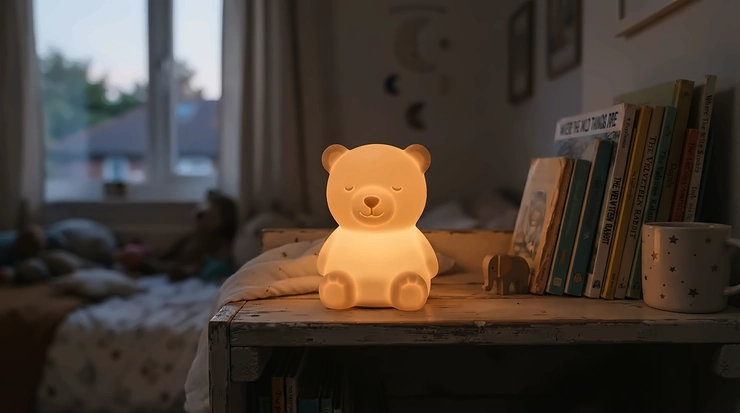
Toddlers who insist on carrying their light to bed are the audience for the LumiPets Bear. It is a soft silicone lamp that responds to a tap, with a remote for the parent, and BabyGearLab names it its best budget-friendly night light for toddlers. Target’s listing describes nine colors, USB-C charging and a 15, 30 or 60-minute sleep timer, which suits the idea of a light that fades out once a child has drifted off.
BabyGearLab’s testers liked the removable exterior, which is washable and dishwasher safe, and the page repeats the maker’s claim that the silicone is free of BPA, latex, lead and phthalates. They also reported that the remote works only after the bear’s power button has been pressed, that there is no wall plug and that the charge cord is short.
Battery claims clash. Target’s listing promises up to 72 hours per charge depending on the color mode, while BabyGearLab calls the battery life mediocre and says a light left on all night needs recharging for the next one. Treat 72 hours as a best case for short, dim use.
Brightness draws mixed reactions too. One Target reviewer judged the light too bright for a nursery even when dimmed. That is a single report, yet it is worth weighing against the Cleveland Clinic advice to keep a bedtime light dim.
Pros:
✅ Soft, washable silicone body that survives hugging
✅ Tap control for the child, remote and timer for the parent
✅ Cordless once charged
Cons:
❌ Remote works only after the power button is pressed
❌ Battery life disputed between the listing and the testers
❌ No wall plug and a short charge cord
Prices run around $20 to $25, depending on the animal.
LumiPets BearSee current price, sizes and reviews on Amazon.
Forty-five minutes is the whole design of the Cloud b Twilight Turtle. Press the shell and it projects eight constellations onto the ceiling and walls in green, blue or amber, or cycles between them, then switches itself off. BabyGearLab’s testers say it has survived toddler rough-housing and been passed from child to child, and they treat it as an entertainer rather than a primary night light, since the brightness can’t be adjusted and there’s no way to keep it on.
That auto-off lines up with the Cleveland Clinic idea of using a light mostly to signal bedtime. It also leaves a gap for the 3 a.m. waker, so pairing it with a dim plug-in in the hallway is a sensible split. Amber is the setting to park it on, because it matches the warm alternative Cleveland Clinic recommends, while the blue setting is the color that article warns about at night.
Retailer copy for the turtle, repeated on Babylist’s listing, describes long-life LEDs that don’t heat up. Read that as the maker’s claim, not a measured temperature.
Cloud b sells a plain Twilight Turtle and a Twinkling Twilight Turtle that adds melodies and lists different batteries in retailer descriptions, so confirm the exact model on the product page before ordering; BabyGearLab’s review describes the 45-minute star projector. Prices land between $40 and $45.
Cloud b Twilight TurtleSee current price, sizes and reviews on Amazon.
A missing timer is the main strike against the G Keni Nursery Night Light, so that comes first. It has no sleep timer and no fade, which means a parent or child has to touch it off. Everything else in BabyGearLab’s testing went its way: it took the Editors’ Choice award and the highest overall score of the five lights here, 80, for being reliable, light and easy to use.
One tap switches it on or off, and a longer hold cycles through brightness levels. Testers found the dim setting a soothing glow, but the brighter white lacks a warm, soft look, which argues for living on the low setting at night. That suits the Cleveland Clinic low-and-dim approach far better than any use as a reading lamp.
Battery numbers disagree widely. The manual claims 12 to 15 hours per full charge, testers ran it for several days, and retailer listings claim 50 to 65 hours. With a spread like that, don’t plan around any single figure; BabyGearLab’s several-day result is the only one from a hands-on test.
The rechargeable cord means no wall plug is included, and the smooth plastic exterior can feel slick in small hands. It is a better match for a parent doing night feeds, or an older child who carries it to the bathroom, than for a toddler who treats everything as a toy. Prices run around $20 to $25.
G Keni Nursery Night LightSee current price, sizes and reviews on Amazon.
Price tier first: at between $65 and $75, the Hatch Rest 2nd Gen costs roughly three times what most lights here do, and it is more sleep trainer than night light. It combines a dimmable light, a sound machine and clock-style cues, all set through the Hatch Sleep app. BabyGearLab gave it a Top Pick for best night light for kids, with the widest brightness range of anything it tested, a 10 out of 10 on that measure.
What the money buys is a routine. A Babylist reviewer of the battery-backed Rest+ describes red for bedtime and green for okay-to-wake, and says their toddler now waits for the green before getting up. A Tanga reviewer reports the same setup keeping a 2-year-old in her room until 7:30. That is two reports describing the same pattern, consistent with how the product is designed, though neither is a controlled test.
Hatch’s help page covers the toddler lock. Child Lock disables the touch ring and the volume and brightness buttons, but by design leaves the night light button on the back working so a parent can switch it on if a child calls out at night. Setup and the schedule happen in the app.
Frustration centers on that app. BabyGearLab found a steep learning curve, a Wi-Fi requirement and a paid subscription for expanded features, and testers found the upsell off-putting. Babylist’s Q&A says the light, sounds and time-to-rise run without Wi-Fi once set, but changes need the phone. One Babylist reviewer in February 2026 calls it hard to use away from Wi-Fi, and another says the power button sits so close to the light button that it gets pressed by accident. Hatch’s help pages call the subscription optional, and Babylist’s Q&A lists 19 preloaded sounds without it; Select reports it at roughly $5 a month or $50 a year.
Two cautions on power. BabyGearLab notes the Rest 2nd Gen has no backup battery for power cuts, and a Best Buy reviewer says an earlier version’s cord sat where their toddler could reach it. A separate model, the Rest+ 2nd Gen, adds a charging base and a backup battery rated up to 8 hours per Babylist’s Q&A, at a higher price.
Hatch Rest 2nd GenSee current price, sizes and reviews on Amazon.
Kids night lights reviews: how BabyGearLab scored these five
BabyGearLab’s overall scores run in this order: the G Keni Nursery Night Light at 80, the LumiPets Bear at 76, the Hatch Rest 2nd Gen at 70, the Eufy Lumi Plug-In Night Light at 66 and the Cloud b Twilight Turtle at 62. Read them as measures of feature breadth, not of how well each fits a child. In the same BabyGearLab testing, both the Eufy and the turtle scored 1 for range of brightness because neither can be adjusted, yet scored 10 and 9 for durability.
The Hatch is the mirror image. It earned the top brightness-range score and only a 5 for ease of use, which is the learning-curve complaint in numerical form. For a fixed bedside light that nothing can mis-set at 2 a.m., a low score for flexibility is not necessarily a drawback, and that explains why the kids night light best suited to one family may be the lowest-scoring one for another.
Night light safety in a baby room: batteries, cords and heat
The Consumer Product Safety Commission’s recall archive shows how the serious failures look. In 2015, Target recalled about 143,000 Circo night lights because a battery could overheat and cause the light to melt. Target had two reports, including one fire that damaged a consumer’s dresser, wall and plug-in, with no injuries. Owners were told to stop using the lights, unplug them and return them for a refund. In 2010, AmerTac recalled about 272,000 Forever-Glo cylinder night lights over a short circuit that could overheat and melt or smolder.
Night light heat emission safety levels: what the standards measure
Direct plug-in night lights are covered by UL 1786, and its temperature test is specific about conditions. According to a standards update notice from testing lab Intertek, the device is installed in the position giving the most severe temperature, run continuously until temperatures stabilize and operated in its most severe normal state. The notice lists no numeric temperature limit, so there is no heat figure a shopper can compare between lights.
What the update does add, effective January 17, 2026, are clauses for plug-in lights with rechargeable batteries and built-in USB ports. Charge voltage and current must stay within the battery maker’s recommendations, packaging must say the battery isn’t user serviceable, and a USB port must be fed by a Class 2 circuit. Of the five lights here, only the Eufy Lumi Plug-In Night Light plugs directly into the wall, so it is the one that standard addresses; for the rest, look for a UL or ETL mark on the label.
Cords, charging and small parts
Cords near a sleeping child are a hazard in their own right. The LumiPets Bear and the G Keni Nursery Night Light run cordless once charged, which counts in their favor, and charging them during the day keeps the cable out of the bed. The Hatch Rest 2nd Gen needs a mains cord, and one reviewer’s complaint about a toddler reaching it is a reminder to route it behind furniture.
Small parts matter as well. BabyGearLab scored the Nestling Eggshell Night Light 1 for durability because the chick’s eyes can detach, and testers called it unsuitable for younger children. Whichever light you buy, check that eyes, ears and caps are molded or glued on, and keep any plug-in clear of bedding and curtains.
Baby eye safety and the LED night light: color, glare and what the standards say
Two separate worries get blurred together here, and the International Commission on Illumination (CIE) pulls them apart in its 2019 position statement. The first is retinal damage from “blue light hazard.” CIE considers that not an issue for white-light sources used in general lighting, including blue-enriched ones, because the exposure limits aren’t exceeded under reasonably foreseeable use.
Sources that emit mainly blue light are different. CIE calls them a concern for children’s eyes, since they can be dazzlingly bright even below the limit, advises against blue indicator lamps in toys and devices children may view, and says the exposure limit should be reduced by a factor of 10 for blue-light sources in such products.
The second worry is sleep. CIE says the term “blue light hazard” shouldn’t be used for circadian rhythm disruption, which is a separate topic; that’s the territory of the Cleveland Clinic advice about melatonin earlier in this guide. Together, the two sources point the same way: avoid blue-dominant modes, choose amber or another warm setting, and use the lowest brightness that still lets an adult see the room’s outline.
On the five lights here, that means amber on the Cloud b Twilight Turtle, a warm, low color on the LumiPets Bear or the Hatch Rest 2nd Gen, and the dim level on the G Keni Nursery Night Light rather than its bright white.
Red or amber, all night or timed: answers before you buy
❓ What color night light is best for kids?
✅ Cleveland Clinic's sleep specialist says red disrupts melatonin least, but young children may find it frightening, so orange or amber works as an alternative. Bright blue light interferes most with sleep, so avoid it for anything left on overnight.
❓ Should a night light stay on all night?
✅ Cleveland Clinic treats night lights as a matter of preference, since some children need them and others don't. It suggests a light that dims slowly and switches off, or one that only signals bedtime. If sleep problems persist, ask a pediatrician.
❓ Are LED night lights bad for a baby's eyes?
✅ The International Commission on Illumination says the retinal blue-light hazard isn't an issue for white light used in general lighting, but sources emitting mainly blue are a concern for children's eyes and can dazzle. Choose warm, dim light and skip blue-dominant modes.
❓ Can a night light overheat?
✅ Defective ones can. The Consumer Product Safety Commission's 2015 recall of about 143,000 Circo night lights involved a battery that could overheat and melt the light, including one fire. Unplug any recalled light, and check the label for a recognized safety mark.
❓ At what age can a child stop using a night light?
✅ There is no fixed age. Cleveland Clinic frames night lights as a preference, since some children need one and others don't. A dimmer or timer lets you lower the glow gradually, and lasting sleep trouble is worth raising with a pediatrician.
Matching the light to the child
Chasing one winner among kids night lights misses the point, because the five here do different jobs. For a toddler who wants to hold the light, the LumiPets Bear and its timer fit. A parent-run bedside lamp points to the G Keni Nursery Night Light on its low setting, and a child afraid of the dark with a bedtime ritual suits the Cloud b Twilight Turtle on amber. The Hatch Rest 2nd Gen belongs to families who want red-to-green wake cues and will tolerate the app.
For a typical toddler room, the plan I’d start with is a Eufy Lumi Plug-In Night Light low on the hallway wall plus one cordless light at the bedside, everything warm, dim and below eye level. Check today’s availability on Amazon.com for whichever one fits your child’s room.
The WhizKiddo editorial team researches baby gear, outdoor play equipment, trampolines and kids' products using manufacturer specifications, safety guidance from bodies such as the CPSC and AAP, independent tests, parent reports and retailer listings. We do not claim to have tested the products ourselves. Read how we work on our How We Choose Gear page.