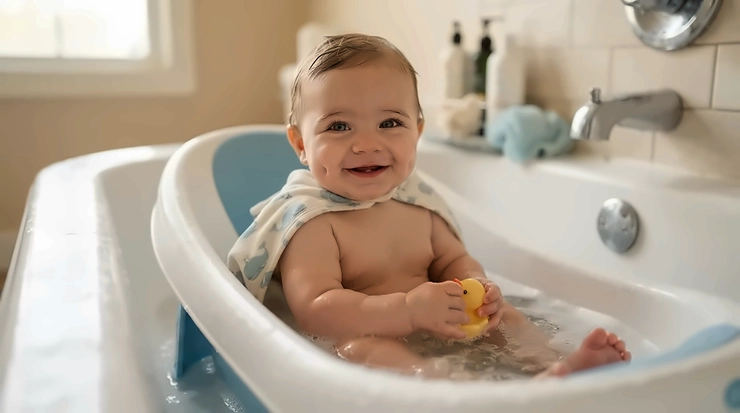
Plenty of parents assume baby bath tubs with a snug sling or contoured seat make it safe to turn away for a few seconds. The American Academy of Pediatrics says otherwise: bath seats can tip, babies can slip out and drown in a few inches of water, and the warning holds even with a supportive infant tub. What a good tub does is make bathing steadier for a slippery baby and far easier on your back, which is still worth paying for.
This 2027 guide covers a routine that works in any tub, the mistakes that undo even well-designed ones, and four tubs matched to the problems they solve. Nobody bathed a baby for it: the findings rest on AAP and CPSC pages, two independent test write-ups and buyer reviews posted on retailer and brand sites.
Bath tubs for bathroom space: match the tub to the sink, the family tub or a stand
Begin with the room, not the product page. Space is the reason many bath tubs for bathroom use end up stored away: BabyGearLab found the Primo EuroBath large and awkward to stow, and sink inserts only work in a sink that matches them. Three setups cover most homes.
A foam or sling insert that sits in a kitchen or bathroom sink suits the first months, when the baby weighs little and your back takes the strain.
A mid-size tub with a removable sling goes in the adult tub or a wide sink and can carry a baby from newborn to sitting.
A large basin belongs in the family tub and can last toward age two, if you have somewhere to keep it.
A fourth option, a foldable tub on a matching stand, solves a different problem: bending over. It gets its own section further down.
Measure before you shop. BabyGearLab reports that the maker of the Puj Tub lists sink dimensions of 12 to 15 inches in length and width and 6.5 to 9 inches in depth, and says the Angelcare Bath Support needs a larger sink than most kitchens have. Hold a tape measure against your own sink first and you will rule out half the field in a minute.
A bath routine that holds up whichever tub you own
Put the tub where it cannot fall: inside the adult tub, in a sink sized for it, or on a stand made for that tub. Not on a counter edge.
Set the water heater no higher than 120°F, the AAP’s faucet limit, then test the bath on your wrist or elbow. Cleveland Clinic says to keep tub water under 100°F for a baby, and Consumer Reports advises against bathing a baby under a running tap because the temperature can swing.
Fill shallow, to about two inches, which Cleveland Clinic attributes to the AAP. Shallow water is about comfort and control. It does not remove the drowning risk, which the AAP puts at one to two inches.
Lay out the towel, cleanser and rinse cup within arm’s reach. The AAP’s point is that you should never have a reason to walk away, and if the doorbell rings, the baby comes with you.
Lower the baby in feet first and keep one hand on them throughout. The AAP calls this touch supervision. For a newborn, a warm, wet washcloth over the tummy helps keep them from chilling, per Consumer Reports.
Lift the baby out using a towel or cloth for grip, a tip from the Lifesaving Society’s infant bathroom checklist, and dry them right away.
Empty the tub completely, rinse it, dry any sling or foam, and leave the drain plug out. The AAP suggests that last step so the tub cannot fill if a toddler later reaches the faucet.
Before the first real bath, sponge baths do the job. Babylist quotes a pediatrician saying submerged baths should wait until the umbilical cord has dried up and fallen off, so check with your baby’s doctor on timing.
Five ways a good tub still goes wrong
Treating the sling as a second pair of hands
A reclined mesh sling feels like a safety feature, and that feeling is the hazard. A KidsHealth page from the pediatric nurse practitioners’ group NAPNAP warns that even a child who looks well propped in a safety tub or bath ring can slip and drown, and Children’s Healthcare of Atlanta advises against bath seats altogether, preferring a baby bathtub or sling insert with a hand on the baby throughout.
Seats and tubs are also regulated separately. The CPSC places bath seats under 16 CFR part 1215 (ASTM F1967) and infant bath tubs, meaning products that hold water, under 16 CFR part 1234 (ASTM F2670), so a listing that blurs the two deserves a second look.
Bathing on the countertop
BabyGearLab rated the Munchkin Clean mesh support Not Recommended, calling countertop use, which the maker suggests, a serious fall risk, and scoring its stability a 1 out of 10. A tub with a wet baby in it needs a floor-level or tub-level home.
Choosing a slick basin and hoping for the best
Hard plastic is easy to clean and easy to slide on. BabyGearLab docked the Primo EuroBath for a slick interior and notes that some parents lay a towel in the bottom to improve comfort and stability for younger babies. One Skip Hop Moby Smart Sling 3-Stage Tub buyer on Target’s page said the tub felt extremely slippery once the sling came out at the sitter stage, and Babylist’s guide says newborns sliding down in a sling is a common complaint across baby bathtubs until they grow a little.
Letting a wet sling sit overnight
Mesh holds water, and mildew follows. Skip Hop’s own care instructions say to rinse the tub and sling after every use, machine wash the sling cold on a gentle cycle without bleach, hang it to dry and run a fan or dehumidifier in humid homes. Even so, Macy’s summary of customer reviews says a significant number of buyers report mold on the Skip Hop Moby Smart Sling 3-Stage Tub sling despite regular cleaning, and a question on Skip Hop’s page shows replacement slings sold separately and out of stock at the time. Foam avoids much of this: BabyGearLab says the Puj Tub resists mildew, while the thicker Blooming Baby Bath needs thorough drying and sanitizing of the sink before each use.
Buying a size the sink cannot hold
A sink insert that overhangs or wobbles in the basin is a fall waiting to happen, and the sink limits on the Puj Tub above are one example. Bulk is the other half of the problem: Reviewed measured the Fisher-Price 4-in-1 Sling ‘n Seat Tub at nearly two and a half feet long, and BabyGearLab found it hard to store, so a tub that fits the sink can still crowd the room.
Baby bath tubs reviews: where testers agree and where they split
Independent reviews are easier to trust when you know how each one was done, so two are worth reading side by side. BabyGearLab put nine tubs through hands-on testing out of more than 40 researched, led by a pediatrician and weighting stability at 45% of the score. Reviewed had its editor bathe her son, about 4 months old at the start, in each tub at least twice, which makes it one family’s experience rather than a lab result.
They agree on more than lists of the best baby bath tubs would suggest. Both found the Primo EuroBath stable but too big to store easily, and both described the Puj Tub as soft, portable and tied to a sink. Both also point to quick-drying materials as a mold defense.
They split on the Angelcare Bath Support. BabyGearLab named it Best Bathtub Bargain, scored its stability 8 out of 10 and credited its rubber-coated base and gentle recline. Reviewed called it the least stable of the group, saying it floated once the water was deep enough to cover the baby. Both can be true: a support that grips in two inches of water may lift in six, which is a reason to keep the water shallow with any mesh design.
The Skip Hop Moby Smart Sling 3-Stage Tub is the other gap. Reviewed ranked it best overall and described it as “one of the most comfortable baby baths we tested,” but it does not appear among BabyGearLab’s nine tested tubs, so the two sites cannot confirm each other on it.
Tubs that fix specific bath-time problems
These four tubs turn up across lists of the best baby bath tubs, and the table lines them up on the things that decide a purchase. Limits come from the makers’ listings or from BabyGearLab and Reviewed, so read the label that arrives with the product for the final word.
Tub
Where it goes
Age or weight range
Footprint
Drying
Skip Hop Moby Smart Sling 3-Stage Tub
Adult tub or wide sink
Birth to 25 lbs in three stages
27.5″ x 19″ x 11.5″
Mesh sling needs washing and hanging
Puj Tub
Sink only
Birth to 6 months or 17 lbs
About 25″ x 26″ open, folds flat
Closed-cell foam, hangs flat
Primo EuroBath
Adult tub or matching stand
Birth to 24 months
About 37″ x 21″ x 10″
Smooth plastic, wipes clean
Stokke Flexi Bath
Adult tub or its own stand
From birth, with Newborn Support
Folds flat, even on the stand
Drains with a tip, per one reviewer
The pattern is that the more months a tub covers, the more floor or tub space it needs. Hold the measurements next to your sink before adding anything to a cart.
Reviewed named this its best overall pick and praised the sling’s two positions, one for full newborn recline and one for a baby learning to sit. Skip Hop lists three stages: up to 15 pounds for the first three months, up to 20 pounds to six months, and up to 25 pounds for sitters, with a swivel hook for hanging the tub from a shower rod or towel bar and a drain plug. Expect to pay between $25 and $40 depending on color and retailer, based on Pampers’ and retailers’ pages.
Where it loses points is upkeep. Zappos reviewers repeatedly describe clips that are hard to unfasten, which makes washing the sling a chore, and the mildew reports covered above come from several retailers’ customer reviews rather than one.
Pros:
✅ Two sling positions carry a baby from newborn to learning to sit
✅ Hangs to dry and drains easily, per Reviewed
Cons:
❌ Sling mildew complaints recur even with regular washing
❌ A bigger footprint than a sink insert
Skip Hop’s maker page puts the packaged weight at 3.6 pounds.
Skip Hop Moby Smart Sling 3-Stage TubSee current price, sizes and reviews on Amazon.
The short lifespan is the main thing to weigh. BabyGearLab rates the Puj Tub for birth to 6 months or 17 pounds, and one reviewer at Made for Mums found her 13-pound four-month-old already too big, though a single parent’s report is thin evidence. The same BabyGearLab review also notes it does not fit every sink, and that the magnets holding the shape can come undone.
In return you get a soft closed-cell foam seat that folds, hangs flat to dry and costs around $45 to $50 according to BabyGearLab’s price notes. BabyGearLab gave it Best for Travel, with stability and comfort each scored 7 out of 10 and portability 9. Reviewed agrees that it dries quickly and packs down small, and lists the sink-only use as its downside. BabyGearLab says the Puj Tub opens to about 25 by 26 inches and is under an inch thick.
Puj TubSee current price, sizes and reviews on Amazon.
For a house with an adult tub and some spare floor, the Primo EuroBath is the long-haul option. BabyGearLab’s Overall Best Bathtub had the highest stability score in its group, a 9 out of 10, and testers said it could outlast more than one child. It covers birth to 24 months, and BabyGearLab lists it as 37 inches long, 21 wide and 10 high, made in the USA, with the maker stating it is free of lead, phthalates and BPA. Expect around $55 to $60 based on BabyGearLab’s price notes.
Reviewed liked the full-recline setup with head, neck and arm cradles, plus a drain plug and toy compartments. One retailer’s listing mentions an optional folding stand and a 30-pound weight limit.
Pros:
✅ Highest stability score in BabyGearLab’s test
✅ One tub from newborn through toddler
Cons:
❌ Slick interior, which some parents offset with a towel
❌ Large and hard to store; BabyGearLab found the hanging notch impractical
Reviewed measured it at about three feet long, the largest tub it tried.
Primo EuroBathSee current price, sizes and reviews on Amazon.
Most of the premium in this setup pays for folding and a purpose-built stand. Stokke’s own page describes the Stokke Flexi Bath as foldable for transport and storage even with the stand attached, sold from birth in a bundle with Newborn Support and the stand, and scored 4.6 out of 5 from 493 reviews, a brand-hosted rating. For the tub itself, check the current price on Amazon.com.
The matching Stokke Flexi Bath Stand is the part worth scrutinizing. Babylist lists it at 22.4 inches wide, 37.4 high and 34.3 deep, weighing 8.2 pounds, rated for babies up to 22 pounds, with non-slip legs, double-action locks and red safety indicators, and shows a 4.7 out of 5 from 11 reviews. It costs between $100 and $140 at specialty baby retailers. Sources disagree on whether a drain hose and plug come with it, since Babylist’s feature list names them while an answer on the same page says the stand does not include them, so confirm before ordering. One reviewer on Stokke’s page also says the tub does not drain fully and must be tipped to empty.
The stand does not fit the Flexi Bath X-Large, according to Babylist’s answered question.
Stokke Flexi BathSee current price, sizes and reviews on Amazon.
Baby bath tub and stand: when raising the tub is worth the money
A stand answers one complaint, a sore back, and nothing else. BabyGearLab describes no freestanding stand among its nine tested tubs, which means stands are mostly brand-specific add-ons rather than a general category. Babylist says the Stokke stand works only with the standard Flexi Bath, so use only the tub a stand was designed for.
A taller setup also has farther to fall if knocked, which is reasoning rather than a tested finding, so the features that matter are non-slip feet and locks that cannot fold by accident, like the double-action locks listed for the Stokke Flexi Bath Stand. The weight cap is the other limit: the Bloomingdale’s listing says that stand suits babies up to 22 pounds, or until the child can stand unaided. After that the baby moves into the family tub anyway, so a baby bath tub and stand setup is a first-year purchase, not a toddler one.
Who repairs jetted bath tubs, and what the baby uses meanwhile
Families who own a jetted tub sometimes wonder whether it can double as the baby bath. None of the pediatric pages cited here addresses jetted tubs, so the safe default is a separate baby tub with the jets off.
If the jetted tub does need work, who repairs jetted bath tubs depends on the fault. Hunker says simple faults, like power, an air switch or clogged jets, are within reach of a careful DIYer, while pump leaks call for an expert because pump access is poor on many tubs. An Aquatic whirlpool manual tells owners to call a plumber to find the source of a leak and then, if the whirlpool system is at fault, to contact the maker’s technical services for a repair visit. A Jason International manual says warranty repairs must be authorized before work starts and directs owners to the dealer or an authorized service center, with power switched off at the main panel. In short, a plumber diagnoses the leak, and the manufacturer’s authorized service handles repairs that fall under warranty.
Baby bath tub questions: age limits, water depth, mold and bath seats
❓ How long can a baby use a baby bath tub?
✅ It depends on the design. Foam sink inserts are rated for roughly six months or 17 pounds, while large basins list up to 24 months. Sling tubs sit in between. Follow the age and weight limit on the label, and stop when your baby outgrows it.
❓ How much water should go in a baby bath tub?
✅ About two inches at most, according to guidance Cleveland Clinic attributes to the AAP, and under 100°F. Shallow water is for comfort, not safety: babies can drown in one to two inches, so keep a hand on them throughout.
❓ How do you stop mold in a baby bath tub?
✅ Rinse after every bath, wring out and hang any sling to dry, and wash it cold on a gentle cycle without bleach, as one maker advises. A fan or dehumidifier helps in humid homes. Closed-cell foam resists mildew better than mesh.
❓ Is a baby bath tub and stand worth buying?
✅ Mostly for your back. A stand lifts the tub to counter height and folds away, but it fits only the matching tub and carries a low weight cap, around 22 pounds for one popular model, so it covers the early months only.
❓ Can a bath seat replace a baby bath tub?
✅ The AAP warns that bath seats can tip and babies can slip out, and Children's Healthcare of Atlanta advises against them. Seats and tubs fall under separate CPSC rules. A tub that holds the baby low with a hand on them is the better route.
How to settle on one tub without regret
The right pick among baby bath tubs is the one that fits your sink and your baby’s stage, so measure the sink first. A foam insert suits the earliest weeks in a small kitchen, a sling tub suits one tub from newborn to sitting, a large basin suits a family tub with room to store it, and a stand suits a back that hates bending, for a few months only. Federal rules cover infant bath tubs under 16 CFR part 1234, and the CPSC’s business guidance says the permanent label must show the maker, model name or number and date of manufacture, so look for it when the product arrives.
Whichever tub you choose, the hand on the baby does the real safety work. Compare the exact model number, age range and weight limit on the listing before you buy.
The WhizKiddo editorial team researches baby gear, outdoor play equipment, trampolines and kids' products using manufacturer specifications, safety guidance from bodies such as the CPSC and AAP, independent tests, parent reports and retailer listings. We do not claim to have tested the products ourselves. Read how we work on our How We Choose Gear page.