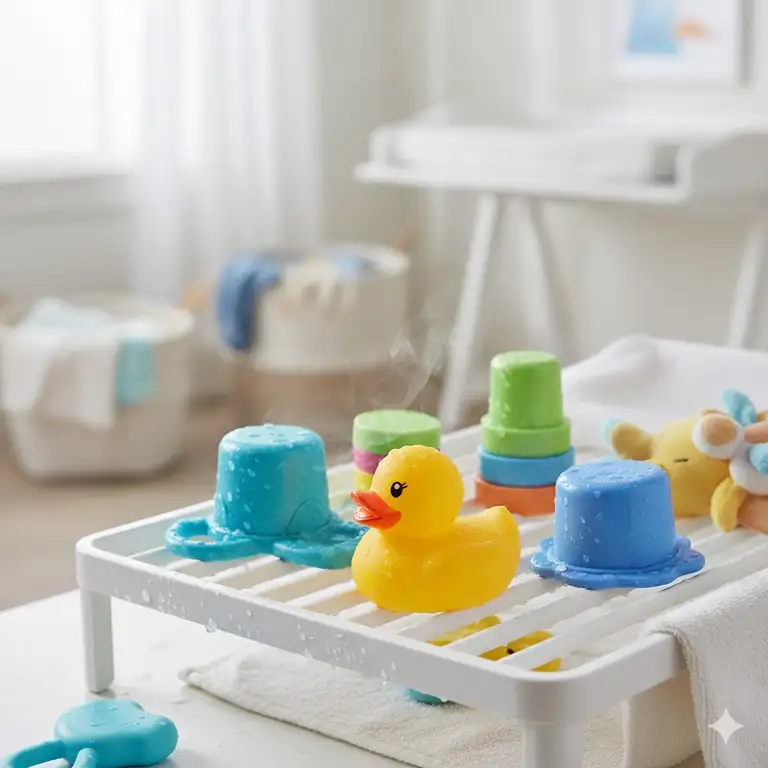
Let’s be real for a second. You’ve seen your baby drop a teether on the kitchen floor—which you think you swept last week—and, in that split second before you can react, they’ve popped it right back into their mouth.
It’s the universal cringe-moment for parents.
✨Was this helpful? Spread the word!
[addtoany]
Babies explore their world with their mouths. It’s a fundamental part of their development. However, this “oral exploration” phase also means their favorite toys become magnets for dust, grime, drool, and, unfortunately, germs. This reality is why keeping baby toys clean and sanitized isn’t just a “nice-to-do” task for overachieving parents; it’s a core part of keeping your little one healthy and safe.
But then the questions start piling up. Do I need to sanitize or just clean? What’s the difference? Can I use the dishwasher? Are these chemicals safe? How often am I really supposed to be doing this?
I get it. The confusion is real. You want to protect your baby without turning your home into a sterile hospital ward (or spending all your precious nap-time scrubbing).
This guide is your answer. We’re going to dive deep into the practical,
no-stress methods for keeping baby toys clean and sanitized. We’ll break down what to use, when to do it, and which products are actually worth your money.
First, let’s clarify the terms, because they are not interchangeable.
| Term | Goal | Method | Best For… |
| Cleaning | Removes visible dirt, grime, & germs | Soap, water, wipes, or plant-based sprays | Daily tidying, non-porous toys, removing gunk. |
| Sanitizing | Lowers the number of germs to a safe level | Steam, boiling, UV-C light, specific sprays (HOCl) | Teethers, bath toys, and items after illness or playdates. |
| Disinfecting | Kills (almost) all germs and viruses | Chemical solutions (bleach, alcohol), high-heat steam | Hard, non-porous surfaces. Rarely needed for toys unless specified by a doctor. |
For most parents, a routine of regular cleaning combined with periodic sanitizing is the sweet spot.
Before we get into the nitty-gritty of how to clean, let’s look at the tools that make the job a whole lot easier. After testing and researching dozens of options, I’ve narrowed down the top products that families in the USA are raving about.
Quick Comparison: Top 7 Products for keeping baby toys clean and sanitized
| Product Name | Product Type | Best For | Key Feature |
| Munchkin Nursery and Toy UV Sterilizer | UV-C Sanitizer Box | Chemical-free sanitizing of toys, bottles, & electronics | Kills 99.9% of germs in 5 minutes with UV-C light |
| Baby Brezza Sterilizer and Dryer Advanced | Steam Sterilizer | High-capacity steam sanitizing and drying | Kills 99.9% of germs with natural steam; modular design |
| CleanSmart Toy Disinfectant Spray | Sanitizing Spray (HOCl) | Quick, on-the-spot sanitizing (no rinse) | Hypochlorous acid; safe to spray on toys, pacifiers, etc. |
| Babyganics Toy & Highchair Cleaner | Cleaning Spray (Plant-Based) | Daily cleaning of surfaces and toys | Plant-derived ingredients; fragrance-free; no-rinse formula |
| Dapple Baby Toy & High Chair Wipes | Cleaning Wipes | On-the-go cleaning and travel | Plant-based, preservative-free, and fragrance-free |
| Medela Quick Clean Wipes | Cleaning Wipes | Cleaning pumps, but excellent for non-porous toys | Quick, portable, and unscented |
| The Clevamama Steri-Wand | Portable UV-C Wand | Sanitizing on the go (strollers, high chairs, toys) | Compact, portable, and fast (10-second pass) |
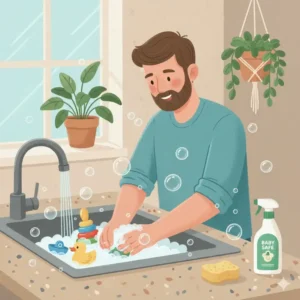
Top 7 Products for keeping baby toys clean and sanitized: Expert Analysis
Finding the right tools can make the task of keeping baby toys clean and sanitized infinitely easier. Here’s a detailed look at our top picks.
1. Munchkin Nursery and Toy UV Sterilizer
Product Type: UV-C Sanitizer Box
If you’re looking for a high-tech, chemical-free solution, this is it. The Munchkin Nursery and Toy UV Sterilizer uses 21 hospital-grade UV-C LED lights to kill 99.9%+ of bacteria and viruses (including Staph, E. coli, and flu) in just 5 minutes.
-
Detailed Specifications:
-
Technology: UV-C Light (21 LEDs)
-
Cycle Time: 5 minutes
-
Capacity: Large interior, fits multiple toys, bottles, or even a smartphone.
-
Safety: Auto shut-off when the lid is opened.
-
Dimensions: Approximately 13.8″ x 13.8″ x 10.1″
-
-
Customer Review Analysis: Parents consistently praise the “peace of mind” this device offers. They love the speed and the fact that there are no chemicals, water, or heat involved. The large capacity is a major plus. The main complaint is the initial cost, which is higher than traditional methods.
-
Warranty: Typically includes a 1-year limited warranty from Munchkin.
-
Pros & Cons:
-
✅ Pros: Extremely fast (5 mins), chemical-free, dry sanitizing (great for electronics), large capacity, no residue.
-
❌ Cons: Premium price point, requires electricity, UV light only sanitizes surfaces it can directly hit.
-
2. Baby Brezza Baby Bottle Sterilizer and Dryer Advanced
Product Type: Steam Sterilizer & Dryer
While marketed for bottles, the Baby Brezza Sterilizer and Dryer Advanced is a powerhouse for any heat-safe toys, teethers, and pacifiers. It uses natural steam—not chemicals—to kill 99.9% of germs, and then automatically dries everything. This drying feature is a game-changer, preventing mold and mildew.
-
Detailed Specifications:
-
Technology: Natural Steam Sterilization
-
Cycle Time: 8-minute sterilization; 30, 45, or 60-minute dry cycles.
-
Capacity: Modular design holds up to 6 bottles, plus accessories and toys.
-
Controls: LCD control panel.
-
Material: BPA-free plastic.
-
-
Customer Review Analysis: Users call this a “must-have” for new parents. The “sterilize and dry” function is universally loved, saving time and counter space. The large, customizable capacity is also a hit. Some users note that it requires regular descaling (cleaning with vinegar) to keep it running efficiently, which is typical for all steam-based appliances.
-
Warranty: Comes with a 1-year limited warranty.
-
Pros & Cons:
-
✅ Pros: Kills germs with natural steam, automatic drying function, large capacity, modular and easy to configure.
-
❌ Cons: Requires regular descaling, only for heat-safe items, takes up counter space.
-
3. CleanSmart Toy Disinfectant Spray
Product Type: Sanitizing Spray (Hypochlorous Acid)
This spray is a marvel of science and a parent’s best friend. CleanSmart Toy Disinfectant Spray uses hypochlorous acid (HOCl), which is the same substance your body’s immune system creates to fight infection. It’s incredibly effective at killing 99.9% of germs but is 100% baby-safe, food-contact-safe, and requires no rinsing.
-
Detailed Specifications:
-
Active Ingredient: Hypochlorous Acid (HOCl)
-
Kill Time: Kills 99.9% of germs in as little as 60 seconds.
-
Safety: No rinse required, even on pacifiers. Free of alcohol, bleach, and harsh fumes.
-
Use: Spray on any hard, non-porous surface (plastic toys, high chairs, changing tables) and let air dry.
-
-
Customer Review Analysis: Parents are “obsessed” with this stuff. They love that they can quickly spray down a toy that’s been dropped and hand it right back, all without worrying about chemical residue. It’s especially popular for use on items that can’t be soaked, like playmats and bouncers. There are virtually no negative reviews, aside from wishing it came in larger bottles.
-
Warranty: Not applicable (consumable product).
-
Pros & Cons:
-
✅ Pros: Incredibly safe (no rinse), highly effective, no fumes or chemical residue, extremely fast, versatile.
-
❌ Cons: Not a “cleaner” (doesn’t remove grime, just germs), consumable product you’ll need to rebuy.
-
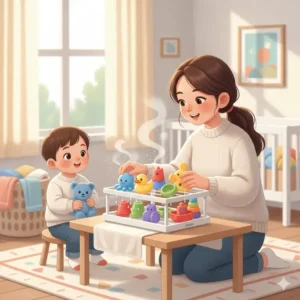
4. Babyganics Toy & Highchair Cleaner, Fragrance Free
Product Type: Cleaning Spray (Plant-Based)
This is your go-to for the cleaning part of the equation. Babyganics Toy & Highchair Cleaner is designed to tackle the daily grime—sticky residues, food spills, and dust. It uses plant-derived cleaning agents and is formulated without any harsh chemicals, sulfates, or fragrances.
-
Detailed Specifications:
-
Active Ingredients: Plant-derived cleaning agents (like coco-glucoside).
-
Formula: Non-allergenic, fragrance-free, pediatrician & dermatologist tested.
-
Safety: No-rinse formula (though I’d rinse a teether).
-
Use: Spray and wipe clean. Great for high chairs, play tables, and hard toys.
-
-
Customer Review Analysis: This is a staple in many homes. Users love that it’s gentle, effective on grime, and truly fragrance-free. It gives parents confidence to clean surfaces their baby will be touching (and licking). Some note that for very tough, dried-on food, it might take a little extra “elbow grease,” but for daily use, it’s perfect.
-
Warranty: Not applicable.
-
Pros & Cons:
-
✅ Pros: Excellent for daily cleaning of grime, plant-based ingredients, no harsh chemicals, no fragrance, widely available.
-
❌ Cons: This is a cleaner, not a sanitizer or disinfectant. It removes germs but doesn’t kill them on contact.
-
5. Dapple Baby Toy & High Chair Wipes, Fragrance Free
Product Type: Cleaning Wipes
For the parent on the go, these wipes are a diaper bag essential. Dapple Baby Toy & High Chair Wipes are perfect for public high chairs, airplane tray tables, or that toy that just hit the floor of the grocery store. They use a plant-based, preservative-free, and fragrance-free formula to wipe away gunk.
-
Detailed Specifications:
-
Formula: Plant-based (powered by Green & Clean Technology™), fragrance-free.
-
Safety: Free of parabens, phthalates, and formaldehyde.
-
Count: Available in various pack sizes, including travel packs.
-
Use: Wipe toy or surface, and you’re done.
-
-
Customer Review Analysis: Parents love the convenience and the ingredient list. They feel safe using these on items that will go directly into their baby’s mouth. The wipes are described as durable and moist enough to clean effectively. The main critique is that they are pricier than standard (non-baby) wipes, but most agree the peace of mind is worth it.
-
Warranty: Not applicable.
-
Pros & Cons:
-
✅ Pros: Ultimate convenience, safe plant-based formula, perfect for travel, truly fragrance-free.
-
❌ Cons: Creates more waste than a spray, higher cost per use, only for cleaning (not sanitizing).
-
6. Medela Quick Clean Breast Pump & Accessory Wipes
Product Type: Cleaning Wipes (High-Quality Alternative)
Here’s an expert tip: the wipes designed for breast pumps are often fantastic for toys. The Medela Quick Clean Wipes are a prime example. They are designed for cleaning pump parts without water, meaning they are incredibly safe, efficient, and leave no residue. They are unscented and perfect for a quick wipe-down of silicone or plastic toys.
-
Detailed Specifications:
-
Formula: Water, soap, and preservatives (designed for breast milk residue). Unscented.
-
Safety: Safe for cleaning items that come in contact with breast milk and baby’s mouth.
-
Count: Typically sold in 24-count packs.
-
Use: Wipe item to remove residue.
-
-
Customer Review Analysis: While primarily bought by pumping moms, many discover they are perfect for “everything else.” They cut through milk film and drool residue better than many other wipes. They are a bit of a “hidden gem” in the baby toy cleaning world.
-
Warranty: Not applicable.
-
Pros & Cons:
-
✅ Pros: Very effective at cutting through drool/milk, portable, unscented, trusted brand.
-
❌ Cons: Not specifically marketed for toys, higher price point.
-
7. The Clevamama Steri-Wand
Product Type: Portable UV-C Wand (Lesser-Known Gem)
For the parent who wants sanitizing power outside the home, this is a brilliant, lesser-known alternative. The Clevamama Steri-Wand is a compact, battery-powered UV-C wand. You simply wave it over a surface (stroller bar, restaurant high chair, public changing table, or a toy) for about 10 seconds to kill germs.
-
Detailed Specifications:
-
Technology: UV-C Light
-
Cycle Time: 10-20 seconds per area.
-
Power: Battery-powered (typically 4x AAA).
-
Safety: Includes a child-lock feature and an auto-shut-off if the light is pointed upwards.
-
-
Customer Review Analysis: Users who find this product love its portability. It’s a lifesaver for travel and gives peace of mind in public spaces. It’s small, light, and easy to toss in a bag. The main drawback is that it’s manual—you have to consciously pass it over every surface, and it’s less “set-it-and-forget-it” than a UV box.
-
Warranty: 1-year limited warranty.
-
Pros & Cons:
-
✅ Pros: Extremely portable, great for travel, chemical-free, fast, child-safety features.
-
❌ Cons: Battery-operated, requires manual effort, only sanitizes small areas at a time.
-
✨ Don’t Miss These Exclusive Deals!
Take the guesswork out of keeping baby toys clean and sanitized. Click on any of the expert-recommended products above to check current pricing, read more reviews, and give yourself the gift of peace of mind!
Just one click – help others make better buying decisions too!
[addtoany]
Why keeping baby toys clean and sanitized is Non-Negotiable
A baby’s immune system is a work in progress. It’s brilliant, but it’s still learning. According to the Centers for Disease Control and Prevention (CDC), young children are more susceptible to illnesses because their immune systems are not fully developed, and they are in close contact with… well, everything.
The “Mouth-First” phase isn’t just a quirk; it’s a biological drive. But it also means a direct pathway for germs. A toy that rolls under the sofa can pick up dust, pet dander, and bacteria. A teether shared during a playdate can be a super-spreader of the common cold.
This is why a good routine for keeping baby toys clean and sanitized is so vital. It’s not about paranoia; it’s about prevention. It’s about managing the environment to reduce the risk of illness, from simple colds to more serious things like hand, foot, and mouth disease.
Cleaning vs. Sanitizing vs. Disinfecting: The Deep Dive
We touched on this, but let’s really nail it down. Using the wrong method can be ineffective (like just cleaning after an illness) or overkill (like disinfecting with bleach every day).
| Feature | ✅ Cleaning | ⚠️ Sanitizing | Disinfecting |
| What it Does | Removes visible dirt, grime, and some germs. | Lowers the number of germs to a safe level (kills ~99.9%). | Kills nearly 100% of germs, including bacteria and viruses. |
| Primary Goal | Make things look clean; remove gunk. | Reduce the risk of infection. | Stop the spread of disease (e.g., after illness). |
| Common Methods | Soap and water, plant-based sprays (Babyganics), wipes (Dapple). | Steam, boiling water, UV-C light, specific sprays (CleanSmart). | Diluted bleach solution, Lysol, alcohol-based solutions. |
| When to Use | Daily. For high chairs, playmats, and toys with visible dirt. | Weekly. For frequently mouthed toys (teethers). After playdates or illness. | Rarely. Only on hard, non-porous surfaces and only if recommended by a pediatrician (e.g., after a C. diff or Norovirus infection). |
| Safety Note | Generally very safe. | Very safe when using baby-specific methods (steam, UV, HOCl). | Not recommended for routine toy cleaning. Requires thorough rinsing and ventilation. |
For 99% of your parenting journey, you will live in the “Cleaning” and “Sanitizing” columns.
️ How Often Should You Be cleaning baby toys?
This is one of the most common questions I get. The answer? It depends on the toy and how it’s used. You don’t need to sanitize the entire toy box every night. Here’s a sane, manageable schedule.
| Toy Type | How Often to Clean | Best Method for baby toy cleaning |
| Plastic/Rubber Toys (Blocks, rings) | Weekly. (Or as-needed if visibly dirty). | Top-rack of dishwasher (in a mesh bag) or a 50/50 vinegar-water soak. |
| Silicone Teethers & Pacifiers | Daily. | Boil for 5 minutes, use a steam sterilizer (like Baby Brezza), or wash with hot, soapy water. |
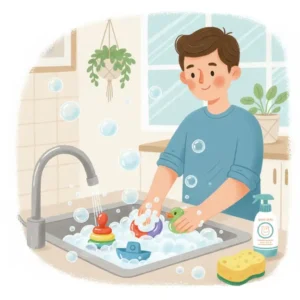
| Bath Toys | After every bath. | Squeeze ALL water out. Weekly, soak in a vinegar-water solution to prevent mold. |
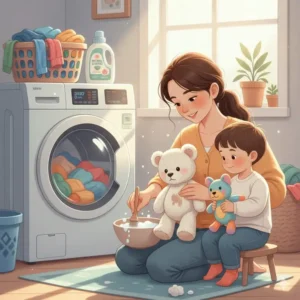
| Plush/Fabric Toys (Stuffed animals) | Monthly. (Or as-needed). | Check tag. Most can go in the washing machine (gentle cycle, in a pillowcase). Air dry. |
| Electronic Toys (Light-up, musical) | Weekly “spot clean.” | NEVER SOAK. Power off. Wipe with a damp cloth or a sanitizing wipe (like Dapple). |
| Wooden Toys | As-needed. | NEVER SOAK. Wipe with a damp cloth and mild soap or a vinegar-water solution. Dry immediately. |
| “The Favorite” (The one toy that never leaves their side) | Every 1-2 days. | A quick wipe-down with a CleanSmart spray or hot, soapy water. |
Pro-Tip after illness: After your baby (or a playmate) has been sick, you should do a full sanitizing session of all toys they came into contact with. This is when products like the Munchkin UV Sterilizer or CleanSmart spray are invaluable for a quick, effective germ-killing pass.
️
The Best Methods for cleaning baby toys safely: A Step-by-Step Guide
You don’t always need fancy gadgets. Some of the best methods for keeping baby toys clean and sanitized use things you already have.
Method 1: The Dishwasher (For Hard, Non-Electronic Toys)
This is the easiest “set it and forget it” method for many plastic and silicone toys.
-
Check for safety: Look for a “dishwasher safe” symbol on the toy.
-
Load ’em up: Place small items in a mesh laundry bag so they don’t fall and melt on the heating element.
-
Place on top rack: The top rack is further from the heating element and gentler.
-
Run the cycle: Use a hot water cycle and your regular detergent. The heat from the water and the dry cycle will clean and sanitize.
| Pros & Cons of the Dishwasher Method |
| ✅ Pros |
| Highly effective at cleaning and sanitizing. |
| Minimal effort (“set it and forget it”). |
| Uses hot water you’re already using. |
Method 2: The Vinegar/Water Soak (The Natural Way)
White vinegar is a fantastic natural cleaner. It’s acidic, which helps break down grime and has mild antimicrobial properties.
-
Create the solution: Mix a 50/50 solution of white vinegar and warm water in a basin or sink.
-
Soak: Let hard, non-porous toys soak for 15-30 minutes. (This is a great way to clean inside bath toys!)
-
Scrub (if needed): Use a bottle brush to scrub any stubborn spots or get inside toy crevices.
-
Rinse: Rinse thoroughly with plain water to remove the vinegar smell.
-
Dry: Let air dry completely on a clean towel.
The University of Florida’s Extension office confirms that vinegar is an effective, non-toxic cleaning agent for many household surfaces.
Method 3: Boiling Water (The Classic Sanitizer)
This is the old-school method, and it works perfectly for non-porous, heat-safe items like silicone teethers and classic plastic rings.
-
Bring water to a boil: Use a clean pot and fill it with water.
-
Add toys: Carefully place the toys in the boiling water. Do not let them touch the bottom of the hot pan if possible.
-
Boil for 5 minutes: This is the standard time recommended by the American Academy of Pediatrics (AAP) for sterilizing bottle parts (the principle is the same).
-
Remove: Use clean tongs to remove the items.
-
Dry: Place on a clean, dry towel to air dry.
Method 4: Steam vs. UV-C Sterilization
These are the high-tech, modern solutions. Both are excellent, but they work differently.
| Feature | Steam Sterilizers (e.g., Baby Brezza) | UV-C Sterilizers (e.g., Munchkin) |
| Method | Uses high-temperature steam (212°F / 100°C) | Uses short-wavelength ultraviolet light. |
| Effectiveness | Kills 99.9% of germs. | Kills 99.9%+ of germs. |
| Cycle Time | Slower (8-12 min + drying time) | Faster (3-5 minutes, no drying needed) |
| Material Safety | Only for heat-safe items. Can warp some plastics. | Safe for all materials, including electronics, plush toys, and wood. |
| Residue | None. (May require descaling the machine) | None. (But only sanitizes surfaces light can touch). |
| Cost | Mid-range to High. | Mid-range to High. |
The verdict: If you primarily want to sanitize bottles and heat-safe toys, a steam sterilizer is perfect. If you want an all-in-one solution that can also sanitize your phone, remote controls, and stuffed animals, a UV-C sterilizer is the more versatile choice.
A Guide to Sanitizing Different Toy Types
The strategy for keeping baby toys clean and sanitized changes based on the toy’s material.
Hard Plastic Toys (Blocks, Rings, etc.)
-
Cleaning: Wipe with a Babyganics spray or a damp cloth.
-
Sanitizing: Top-rack of the dishwasher or a soak in a vinegar-water solution.
Silicone and Rubber Toys (Teethers, Bath Toys)
-
Cleaning: Wash daily with hot, soapy water.
-
Sanitizing: These are perfect for the Baby Brezza steam sterilizer or boiling for 5 minutes.
-
Bath Toy MOLD ALERT: Mold grows inside bath toys. After every bath, squeeze all the water out. Once a week, suck up a 50/50 vinegar-water solution into the toy, shake it, and squeeze it out. Let it dry completely.
Plush and Fabric Toys (Stuffed Animals)
-
Cleaning: Check the tag. Most can go in the washing machine.
-
Place the toy in a mesh laundry bag or pillowcase.
-
Wash on a gentle cycle (cold or warm).
-
Tumble dry on low heat or, preferably, air dry.
-
-
Sanitizing: For a quick, water-free refresh, you can place fabric toys in the Munchkin UV Sterilizer.
Wooden Toys
-
Cleaning: NEVER SOAK WOODEN TOYS. Wood is porous and will warp and swell.
-
Mix a mild soap or vinegar with warm water.
-
Dampen a cloth with the solution (do not saturate).
-
Wipe the toy down.
-
Wipe again with a cloth dampened with plain water.
-
Dry immediately with a clean towel.
-
Electronic Toys
-
Cleaning: This is the trickiest category.
-
Power down and remove batteries.
-
Use a Dapple Baby Wipe or a cloth lightly sprayed with a cleaner like CleanSmart.
-
Wipe the surface, being careful to avoid seams and openings.
-
Use a Q-tip to clean small crevices.
-
Let it air dry completely before replacing batteries.
-
| Toy Material | ✅ Recommended Cleaning Method | ❌ Method to AVOID |
| Hard Plastic | Dishwasher (top rack), hot soapy water, vinegar soak | Boiling (unless 100% sure it’s heat-safe) |
| Silicone | Boiling, steam sterilizer, dishwasher, UV sterilizer | Harsh chemical soaks |
| Plush/Fabric | Washing machine (gentle cycle), UV sterilizer | Soaking (can damage internal parts), high heat dry |
| Wood | Wipe with damp cloth (vinegar/soap solution) | SOAKING OR DISHWASHER (will destroy them) |
| Electronic | Wipes, lightly-dampened cloth, UV wand | SOAKING OR DISHWASHER (will destroy them) |
How to sanitize baby toys without chemicals: The Natural Approach
Many parents are (rightfully) wary of using harsh chemicals around their babies. The good news is, you rarely need to. The most effective methods for keeping baby toys clean and sanitized are chemical-free.
| Method | How It Works | Best For… |
| Hot Water & Soap | Friction and soap lift and wash away grime and germs. | Daily cleaning of all toy types (except electronics/wood). |
| Boiling Water | Heat (212°F) kills bacteria and viruses. | Sanitizing silicone teethers, pacifiers, and hard plastics. |
| Steam | High-temperature steam kills 99.9% of germs. | Same as boiling, but in a convenient machine (e.g., Baby Brezza). |
| UV-C Light | Specific light wavelength (254nm) destroys the DNA/RNA of germs. | Sanitizing everything—plastics, electronics, plush, wood. (e.g., Munchkin). |
| Vinegar Solution | Acetic acid acts as a natural cleaner and mild disinfectant. | Cleaning hard surfaces, bath toys (prevents mold), and wooden toys (wipe-down). |
| Sunlight | The UV rays from the sun have natural sanitizing properties. | A great finishing step. After cleaning plush or plastic toys, let them dry in the sun. |
Common Mistakes Parents Make (And How to Avoid Them)
-
Using Harsh Chemicals: You do not need bleach, alcohol, or conventional disinfecting wipes (like Lysol or Clorox) for daily toy cleaning. These can leave harmful residues. Stick to baby-safe products like CleanSmart or Babyganics.
-
Forgetting Bath Toys: This is the #1 source of hidden mold. Squeeze them out every time and do a weekly vinegar soak. If you see black flecks, toss the toy.
-
Soaking Wood or Electronics: A surefire way to ruin a toy. These items are “wipe-clean” only.
-
Not Cleaning the Cleaning Tools: Your dishwasher needs cleaning, your sink needs scrubbing, and your sponges should be replaced often. Don’t “clean” toys in a dirty sink.
✨ Ready to Make Cleaning Easier?
Browse our top-rated selection of baby-safe cleaners, sterilizers, and wipes. Click any of the links in our review section to find the perfect solution for your family and get back to what matters most: playtime!
Conclusion: A Simple Routine for a Healthy Baby
Look, the goal of keeping baby toys clean and sanitized is not to create a sterile bubble. It’s about risk reduction. It’s about letting your baby explore, learn, and mouth-to-their-heart’s-content, all while minimizing the chance of them picking up a nasty bug.
You don’t have to be perfect. You don’t have to sanitize everything, every day.
Just remember this simple routine:
-
Clean grime as you see it (with wipes or sprays).
-
Sanitize the “high-risk” items (teethers, pacifiers) daily or weekly.
-
Rotate toys, giving them a chance to be cleaned and to dry.
-
Wash your hands and your baby’s hands often.
By building these simple habits and using the right tools—whether it’s a high-tech Munchkin UV Sterilizer or a simple bottle of vinegar—you’ll master the art of keeping baby toys clean and sanitized without losing your mind.
You’ve got this.
FAQs
✅ The best sanitizer depends on your needs. UV sanitizers like the Munchkin UV Sterilizer are fast and chemical-free, while steam sterilizers like the Baby Brezza are great for heat-safe items. For quick cleans, sprays like CleanSmart are effective...
✅ Yes, UV-C light sanitizers are considered safe and effective for baby toys, bottles, and even electronics. They use light, not heat or chemicals, to kill 99.9%+ of germs and automatically shut off for safety. They won't melt or warp plastics...
✅ To clean, spray Babyganics Toy Cleaner directly on the toy and wipe clean with a cloth or paper towel. For disinfecting with a product like CleanSmart, spray the toy until wet, let it sit for the required time (e.g., 60 seconds), then let air dry. No rinsing is needed...
✅ It is not recommended to use standard Clorox or Lysol wipes on baby toys. These contain harsh chemicals that require thorough rinsing, and residue can be harmful if ingested. Always opt for wipes specifically formulated for babies, like Dapple or Babyganics...
✅ The best natural cleaners are plant-based sprays like Babyganics Toy & Highchair Cleaner or a simple solution of 50/50 white vinegar and water. For sanitizing naturally, you can use boiling water for heat-safe items or a steam sterilizer... ❓ What is the best baby toy sanitizer?
❓ Is UV sanitizer safe for baby toys?
❓ How do you use baby toy cleaning spray?
❓ Can you use Clorox wipes on baby toys?
❓ What is the best natural baby toy cleaner?
Recommended for You
- Avoiding Small Parts in Baby Teething Toys: 7 Safest Picks 2025 for Happy, Healthy Babies
- Safe Baby Bath Spout Cover: 7 Best Picks 2025
- Sun Safety Hat for Crawling Baby: 7 Best Picks 2025
Disclaimer: This article contains affiliate links. If you purchase products through these links, we may earn a small commission at no additional cost to you.
✨ Found this helpful? Share it with your friends!
[addtoany]