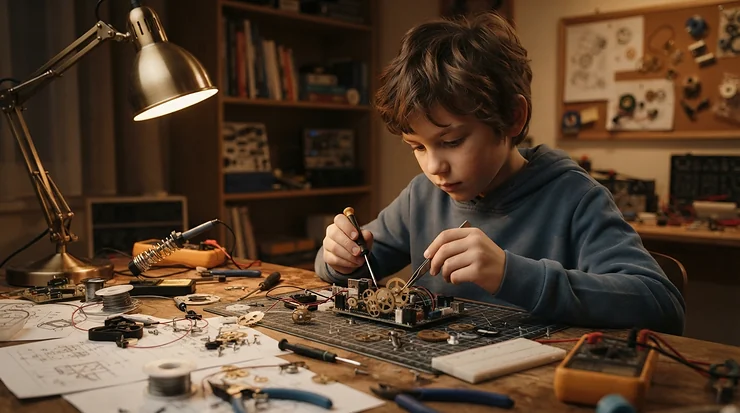
A ThinkFun marble-logic game holds 60 challenge cards, three marbles and no batteries, while an Infento ride-building kit lists 11 electric rides and sits between $595 and $695 on the maker’s own page. Both get sold as stem toys, which shows how little the label settles on its own. For 2027, the more useful move is to sort by what a child will actually do with the box: decide, build, wire or calculate.
No kit here was assembled for this guide. The findings rest on maker and retailer pages, the Dr. STEM instruction sheet that Sharper Image hosts, two Popular Science roundups and the buyer reviews that retailer listings carry, so every remark about how a kit feels to build belongs to a named source.
The short answer: the best stem toys are the ones that make a child choose, fail and try again. In the 8-to-12 band that points to an electronics kit, a marble-logic game, a solar robot and a pretend bank, each checked for age label, batteries and small parts before it goes in the cart.
Four checks that separate a working stem toy from a labeled one
Live Science quotes Kathy Hirsh-Pasek, a psychologist at Temple University, as saying the toys worth buying are active, social and fun, and that many are simple things kids can build with, take apart and build again. The same article warns that very few toys carrying STEM claims have actually been studied, and that some are fun without teaching much while others teach but lose a child’s attention. A badge, in other words, is marketing. These four checks replace it.
Check one: does the child make a decision?
A toy that tells the child what to do at every step is a craft kit with a science name. ThinkFun’s marble-logic game works the other way: the maker describes a solo puzzle where the player arranges towers to carry a marble from start to target, so the child, not the box, solves it. A circuit kit passes the same test once the manual’s projects run out and the child starts rewiring.
Check two: does the age label match the build?
Age grading is safety guidance, not a verdict on intelligence, as a PIRG toy-safety guide puts it. Build difficulty is a separate question, and printed ages miss it. One reviewer on a Desertcart listing for a 4WD climbing-vehicle kit says the box claimed ages 6 and up while the listing said 10 and up. Popular Science reports that users find the mBot Ultimate slow to assemble and steep for younger kids, and that some say younger builders need adult help with the LEGO Technic Mars Rover.
Check three: what does the toy need after the box is open?
Batteries, a phone or a tablet decide whether a kit gets used on a Tuesday evening. The marble game needs nothing. A circuit kit needs AA cells that the box does not include. StemGeek notes that LEGO Boost needs a tablet or smartphone for its coding app, which turns a building kit into a screen session.
Check four: what can go in a mouth?
The U.S. Consumer Product Safety Commission says in its holiday toy reminder that most toy injuries and deaths involve choking on small parts, and that button or coin batteries and high-powered magnets are ingestion hazards. Kits rated 8 and up are built for older kids, which makes them the ones most likely to land within reach of a younger sibling. The agency also suggests confirming a toy has not been recalled at cpsc.gov/recalls before buying.
Where stem toys for boys age 8-12 get harder than the box says
Nothing in the four kits below is gender-specific, so the list works for any child in the 8-to-12 range; the printed age, the build and the patience of the builder decide fit. What changes between 8 and 12 is the gap between the age rating and the effort.
Popular Science’s own STEM toy roundup shows the pattern. Its 8-to-12 pick, the 3Doodler Start+ Maker Bundle, is listed for ages 6 to 13 while the text says it suits 10 and older, and the page reports that some users find the learning curve steep and the plastic strands run out quickly. Its LEGO Technic NASA Mars Rover Perseverance carries a 10+ spec line under a 13+ heading. These are single-source findings, but they point the same way: the number on the box is a floor, not a promise.
The practical rule is to buy for the age at which the child will finish the build alone, and to treat the printed age as the age at which they will finish it with help.
“Toys ride stem”: what a rideable build kit costs
The phrase “toys ride stem” points to kits where the child builds a vehicle and then rides it. That category exists, and it sits in a different budget class than anything below.
Infento’s own kit page lists four sets: the Adventure Kit (ages 0 to 6, 26 rides, roughly $395 to $445), the Innovator Kit (ages 4 to 10, 39 rides, roughly $695 to $795), the Volt Kit (ages 6 to 14, 11 electric rides, between $595 and $695) and the Ultimate Kit (all ages, 73 rides, between $1,395 and $1,595). The page calls the Volt Kit the only one with real electric rides, such as e-scooters and first electric bikes. Confirm motor and battery details with the maker before ordering any of them.
Cheaper options exist. A Walmart listing for a 12V ride-on lets kids assemble either a truck or a kart from large building blocks on one chassis, with a remote and rechargeable battery in the box. Whatever the price, a PIRG toy-safety guide advises that kids wear safety gear on scooters, hoverboards and other riding toys. A built vehicle is still a vehicle.
How a decent kit ends up in the closet, and how to recover
Counting pieces instead of projects. A box with 190 pieces and a box with 100-plus projects are not comparable numbers. Look at how many different things can be made and how much of the manual is needed to make them.
Skipping the first-day inventory. Listings disagree about what is in the box. ThinkFun’s page lists 10 towers for ThinkFun Gravity Maze while some retailers list nine towers plus a target piece, and listings for Snap Circuits Jr. SC-100 count anywhere from 28 to 32 parts. Count everything against the manual on day one, while returns are still simple.
Buying for the child they will be next year. The recovery is to build the first model together. Popular Science’s note that younger builders needed help with the Mars Rover points the same way: an adult at the table shortens the first build.
Letting batteries become the project. Dr. STEM’s instruction sheet says not to mix old and new cells or different types and not to use rechargeables, and the Snap Circuits retailer page recommends NiMH rechargeables for its own kit. Read the manual of the toy in the room, not the one in the last box.
What stem toys reviews agree on, and where they thin out
Popular Science says its picks rest on research, expert opinion, user feedback and testing, but its pages don’t describe a protocol, and most of the real-use findings it reports are attributed to unnamed users or parents. StemGeek’s list of picks for 8-year-olds is similar: it reports no build times, lost parts or adult help, and its ratings reflect editors’ choices and product descriptions rather than hands-on trials. Treat stem toys reviews of this kind as a shortlist, not proof.
The failure modes worth watching live in buyer reviews on retailer listings: locks that won’t open, tiny screws that vanish, instructions pitched at the wrong age. Those are the findings used below, each tied to the listing it came from.
Four kits, matched to the checks
Kit
Listed age
What the box holds
Power
Screen needed
Snap Circuits Jr. SC-100
8+
100+ projects, 28 to 32 parts depending on the listing
None of these four needs a phone or tablet, so they differ more in how they push back. ThinkFun Gravity Maze pushes with logic, Snap Circuits Jr. SC-100 with wiring mistakes, the Sillbird STEM 12-in-1 Education Solar Robot Toy with assembly time, and the Dr. STEM Toys Talking ATM Bank with arithmetic and a stubborn lock.
This is the kit for a child who asks how a doorbell works. Elenco’s snap-together modules sit on a plastic grid, so a wrong connection costs a few seconds, not a soldering session, and the manual walks through 100-plus projects. A retailer page for the set lists it as ages 8 and up and shows 4.8 stars across 330 reviews, though that page carries no written comments to read.
Listings disagree about the box: 28 parts in some listing titles, 30 on a Motionrc page, 32 components in another description. Elenco sells several Snap Circuits sets, so confirm SC-100 on the listing. The kit needs two AA batteries that aren’t included, and the retailer page warns of a choking hazard because the toy contains a cord and is not for children under 3. Listings describe the set as combinable with other Snap Circuits kits, which is how a child who finishes the manual keeps going.
Pros:
✅ No tools or soldering, so the first project can happen the day it arrives
✅ Wrong connections are cheap to fix, which keeps trial and error cheap
Cons:
❌ Small parts and a cord make it a poor fit for a house with a toddler
❌ Listings disagree about the part count, so an inventory check matters
Snap Circuits Jr. SC-100See current price, sizes and reviews on Amazon.
Batteries and screens are absent here by design. ThinkFun’s page lists one game grid, 10 towers, three stainless steel marbles and 60 challenges from beginner to expert, for one player aged 8 and up, and it names awards including a Toy of the Year win in the specialty category and a Parent’s Choice Gold Award. A retailer listing for the same game gives nine towers and a target piece instead of 10 towers, so the two counts may reflect different editions.
The player uses the challenge cards to place towers and build a path for the marble to reach the target. That is a spatial-reasoning exercise with a clear finish line, which suits a child who quits open-ended building when nothing says whether the build is right. Three loose marbles also count as small balls, and the CPSC says to keep those away from children under 3.
ThinkFun lists the game for one player, so it won’t fill a family evening unless the adults take turns at the harder cards.
ThinkFun Gravity MazeSee current price, sizes and reviews on Amazon.
Popular Science names this its best overall pick in its robot kit guide, with 190 pieces, 12 robot designs and an age range of 8 to 13. It lists the pros as variety, problem-solving and efficient energy use, and the con as that it may need adult assistance, and it says the instructions are straightforward and the robots can move on land and water.
Age labels vary: Popular Science says 8 to 13, while another roundup lists 10 and up. Power is also unsettled. One listing mentions solar or AAA battery modes, a roundup says no batteries are needed, and Popular Science’s page leaves it open, so read the power line on the listing before assuming a sunny windowsill is the only option.
Pros:
✅ Twelve designs from one box give a kit room to be rebuilt
✅ A real motor and a solar panel make the energy-conversion lesson concrete
Cons:
❌ Popular Science flags that an adult may need to help
❌ The age rating and the power source differ from one listing to another
Sillbird STEM 12-in-1 Education Solar Robot ToySee current price, sizes and reviews on Amazon.
Money math is the STEM here, and the box asks a child to keep an honest ledger. The instruction sheet for models BF550 and BF555, made by THiN AiR Brands, says deposits are entered by typing the amount, then dropping coins in a slot and feeding bills with a side knob. The balance caps at $999.99, the card key switches the machine on, and it shuts off after 10 seconds of non-use.
The Desertcart listing for the BF550 shows 3.9 stars from 1,957 reviews. Several reviewers say the machine tracks typed amounts and does not count the actual bills or coins, one says a mistyped large deposit threw off the total, and some found the bill-feeding knob slow. Many say their kids loved it and that it helped start saving habits.
The lock is where complaints concentrate. One reviewer says the drawer would not open out of the box, another says the combination on the back did not work, and one adds that the dial is hard to turn and that two machines share a combination. The next section covers the steps.
Weighing this one against the other three? Each listing states its age and battery lines near the top, so the comparison takes a minute.
Dr. STEM Toys Talking ATM BankSee current price, sizes and reviews on Amazon.
The search “dr stem toys atm how to open” has more than one answer, because the brand sells several banks. The steps below come from the instruction sheet for the Talking ATM (items BF550 and BF555), hosted on Sharper Image’s site.
Turn the combination knob counter-clockwise (left) two full rotations, until you hear clicking, and stop at 10.
Turn the knob clockwise (right) to 12.
Open the drawer. The sheet shorthands the code as “left 10, right 12” and says it is printed on a sticker on the back of the machine.
To withdraw money, insert the card, press Withdrawal, enter the amount, press Withdrawal again, then open the lock and take the cash out. A mistyped number can be cleared with the C button, and the reset button inside the battery compartment returns the balance to $0.00. The sheet says not to lose the card key or the combination and describes no replacement process, so if the drawer still won’t open, contact the maker through the website printed on the sheet instead of prying the case.
Two warnings from the sheet and the listings. The manual calls for three AA batteries and says not to mix old and new cells or use rechargeables, while the Desertcart listing says two AA, so go by the manual in your box. And a different Dr. STEM bank, the Electronic Alarm Safe, is listed at Walmart and Target with PIN protection and a keypad, which means the dial steps above don’t apply to it.
Labels, batteries, locks and age: stem toys and games, answered
❓ Does a STEM label mean a toy was tested for learning?
✅ No. Live Science notes that very few toys carrying STEM claims have actually been studied, and some are fun without teaching much. Judge the toy by what the child does with it: choosing, building, failing and retrying matter more than the badge on the box.
❓ How do I open a Dr. STEM Toys ATM?
✅ On the Talking ATM in the BF550 and BF555 manual, turn the knob left two full rotations until it clicks, stop at 10, then turn right to 12; the code is on a back sticker. Models listed with PIN protection, such as the alarm safe, work differently.
❓ Which stem toys for boys age 8-12 are worth a look, and do girls fit the same list?
✅ Nothing in these kits is gender-specific; the printed age decides fit. The electronics kit, the marble logic game and the solar robot all list 8 and up. Popular Science's 3D pen pick is called best for 10 and older.
❓ Are stem toys safe around younger siblings?
✅ Not automatically. The Consumer Product Safety Commission says most toy injuries and deaths involve choking on small parts, and it warns that button batteries and high-powered magnets are ingestion hazards. Keep older kids' kits out of reach of anyone under three and check cpsc.gov/recalls.
❓ Do stem toys need screens, apps or Wi-Fi?
✅ Not the kits here. The marble game needs nothing, the electronics kit takes two AA batteries, and the ATM bank runs on batteries and a card key. Popular Science notes the mBot is block-coded, and StemGeek says LEGO Boost needs a tablet or phone.
Start with the child’s patience, not the box
A child who likes puzzles gets the most from ThinkFun Gravity Maze. One who likes taking things apart suits Snap Circuits Jr. SC-100, or the Sillbird STEM 12-in-1 Education Solar Robot Toy if an adult will sit in on the build. A saver who enjoys numbers can try the Dr. STEM Toys Talking ATM Bank, as long as the lock gets tested on day one.
Whichever of the stem toys you pick, read the age line against the real build, count the batteries and check the small-parts warning before the box enters the house. Those three lines tell you more than the word STEM does.
Curious about any of the four? Their listings are the next place to look.
The WhizKiddo editorial team researches baby gear, outdoor play equipment, trampolines and kids' products using manufacturer specifications, safety guidance from bodies such as the CPSC and AAP, independent tests, parent reports and retailer listings. We do not claim to have tested the products ourselves. Read how we work on our How We Choose Gear page.