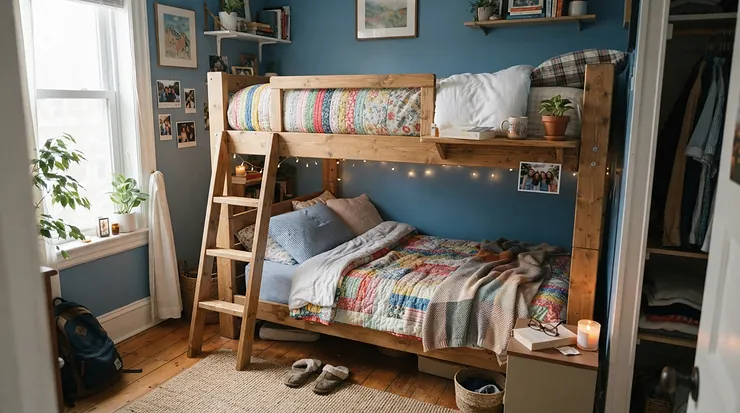
As an Amazon Associate we earn from qualifying purchases. Links in this article may be affiliate links. How we choose gear
Kids bunk beds suit a room when four checks line up: the child on top is at least 6, the guardrail rises 5 inches above the mattress, the ceiling leaves a sitting-height gap overhead, and the frame has a real safety paper trail. Wood versus metal and ladder versus stairs are matters of fit. This 2027 guide does the measuring first, then matches three specific models to three different problems.
The findings rest on CPSC’s bunk bed guidance, a federal warning issued in October 2026, a children’s hospital injury page, maker spec sheets and retailer listings; none of the beds was assembled or slept on for this guide, so every remark about squeaks or finish odor is credited to the reviewer who made it. Prices appear as ranges from pages that carried them, and the current price on Amazon.com may differ.
Kids bunk beds for small rooms: measure before you shop
A bunk bed gives back floor space and takes it out of the vertical dimension, so the tape measure comes before the shopping cart. For kids bunk beds for small rooms, width and ladder swing matter as much as height, and the six checks below cover all three. Each one rules out a different kind of regret.
Start with the ceiling, not the floor
Retail buying guides disagree a little on headroom. Amerisleep’s bunk bed guide asks for 30 to 36 inches between the top mattress and the ceiling, and Cubby’s guide wants at least 36. You can test a bed against that range with its listed height, because the guardrail has to sit at least 5 inches above the mattress. The sleeping surface is therefore no higher than the listed height minus 5 inches (my arithmetic), which gives a cautious headroom figure.
| Bed | Listed height | Highest mattress surface | Headroom, 8-ft ceiling | Headroom, 7-ft ceiling |
|---|---|---|---|---|
| Max & Lily Twin Over Twin Low Bunk Bed | 50 in | 45 in | 51 in | 39 in |
| Storkcraft Caribou Twin-over-Twin Bunk Bed | 64.72 in | 59.72 in | about 36 in | about 24 in |
| DHP Dusty Twin over Twin Metal Bunk Bed | 61.5 in (retailer listing) | 56.5 in | about 40 in | about 28 in |
On an 8-foot ceiling all three clear 30 inches, though the Storkcraft Caribou Twin-over-Twin Bunk Bed sits at the low end of the guides’ range. On a 7-foot or sloped ceiling only the low bunk passes. The figures assume the mattress sits exactly 5 inches below the rail; a mattress thicker than the maker allows pushes the surface up and shrinks both the headroom and the rail’s protection.
Check the age rule before the color
The top-bunk age line is the same wherever you look, and it applies to every one of the bunk beds for kids discussed here. The Dorel page for the DHP Dusty Twin over Twin Metal Bunk Bed says the top bunk is for children at least 6 and the bottom for children at least 3. Nationwide Children’s Hospital calls children under 6 too young for the top bunk, reports about 36,000 bunk bed injuries a year among US children (the page gives no year for that figure), and says half of them involve children under 6. Falls cause most of them, and the head and neck are hurt most often.
The practical reading: if your youngest is 4 or 5, they sleep on the bottom bunk, and a frame that splits into two beds spares you from buying a second bed later.
Read the mattress limit on the listing
CPSC’s rule is that the guardrail tops must rise at least 5 inches above the thickest mattress the maker recommends, so the thickness limit on the label is a safety number rather than a comfort suggestion. The hospital’s page adds that any mattress pad counts toward that 5 inches.
Limits differ by bed. Retailer pages quote Storkcraft’s warning that the mattress should not exceed 7 inches. Max & Lily’s page accepts standard twin mattresses between 5 and 8 inches thick with no box spring or bunkie board. BestReviews tells shoppers to skip box springs altogether because they lift the mattress toward the rail, and to use a bunkie board of 1 to 3 inches only when a frame calls for one. The Dorel page for the DHP Dusty Twin over Twin Metal Bunk Bed doesn’t print a thickness limit, so the manual is the place to confirm it.
Choose ladder or stairs by wall length
Stairs are friendlier to small climbers and bring storage, but they take wall. Max & Lily lists its ladder-fronted low bunk at 81.5 inches long and its staircase-and-trundle twin bunk at 99.5, about 18 inches more (my arithmetic, comparing two different models). A ladder takes floor space too: the hospital advises a night light near it and teaching children to climb carefully.
Ladders also come with rules. Max & Lily’s page for the low bunk allows one user at a time, 200 pounds at most, hands on the rungs, facing the ladder, with no jumping on or off. A BestReviews write-up of a different metal bunk, a DHP twin-over-full, found its metal steps uncomfortable to climb, which is worth checking on any steel ladder before a child uses it barefoot every night.
Match wood or metal to the budget tier
BestReviews sorts bunk bed prices into three tiers: roughly $150 to $250 for basic metal frames, $250 to $500 for better metal and low-profile wood, and $500 to $1,500 for mostly wood with built-in storage. Sleep Foundation’s bed frame guide adds that wood generally costs more than metal and that build quality matters more than the material.
When you browse bunk beds for sale in the bottom tier, the silhouette tells you little, because Bonnlo, DHP and Dorel listings all quote roughly 78 by 41.5 inches for steel twin-over-twin frames. The brand and the safety paperwork do the separating, which is the next check.
Ask for the safety paper trail
CPSC requires children’s bunk beds to be tested by an accredited, CPSC-accepted third-party lab, after which the maker or importer issues a Children’s Product Certificate. The bed also has to carry a label with the maker’s name and address, the model number and the month and year of manufacture, plus a warning label and mattress-size instructions.
The structure itself is regulated. Upper bunks need guardrails on both sides, the wall-side rail must run continuously end to end, and the open-side rail may leave no more than 15 inches at each end. Lower bunks whose foundation sits 30 inches or less from the floor need no guardrails.
Two habits cost nothing. Look for that label when the box arrives, and search the brand on CPSC’s recall and warning pages before ordering. A CPSC warning dated October 1, 2026 shows why: it told owners of about 19,000 Bonnlo twin-over-twin metal bunk beds to stop using them. The hospital adds a caution about do-it-yourself bunk bed kits, whose designs may not meet current guidelines, and suggests checking recalls.gov before anything comes home.
Kids bunk beds reviews and CPSC notices: where the problems show up
Star ratings on retail pages are hard to compare across brands, so this section leans on named sources instead of tallies. Among kids bunk beds reviews and agency notices, slat failure is the clearest documented problem. CPSC’s Bonnlo warning describes top-bunk slats that can fail, letting the frame and top bunk collapse. The agency counted nine reports of slat failures, three of them with the top bunk dropping onto the lower bunk, and no injuries. The beds, black, gray or white metal frames measuring about 78 by 41.5 by 65 inches, sold on Amazon.com, Abunda.com, eBay.com and Walmart.com from January 2019 through September 2026 for about $140 to $170, and the manufacturer has not responded to CPSC’s request to recall them. The shape is generic, which is why the label and the brand matter more than the photo.
Noise and wobble show up in softer form in independent write-ups. BestReviews notes that the plastic latches on the Isabelle & Max Eastfield metal bunk sometimes squeak and that its frame may need readjusting to stay stable. One reviewer’s remark, but it argues for a second pass with the wrench after the first few weeks of use. The same write-up says the non-toxic finish on the Max & Lily low bunk has a smell that fades only after a while, so expect to air the room.
Assembly is the cost people forget. Max & Lily’s page for its low bunk offers professional assembly through Angi for $247.50, more than half the bed’s price in the $400 to $450 range the page shows (my arithmetic). Overstock’s listing says the Storkcraft ships in multiple boxes, and Best Buy’s page offers a Geek Squad assembly service for it, so many bunk beds for sale come with a labor question attached.
Room setup finishes the list. The hospital recommends keeping the top bunk away from ceiling fans, removing hazardous objects near the bed, never hanging belts, scarves or ropes from it, and retiring a bunk or ladder with a damaged part.
Best kids bunk beds, matched to the problem they solve
The best kids bunk beds depend on the room, so these three real models are each tied to one of the checks above rather than ranked against each other. Check the model number on the listing against the numbers quoted here, because makers sell several near-identical versions.
1. Max & Lily Twin Over Twin Low Bunk Bed — 50 inches tall for low ceilings
Low ceilings, attic bedrooms and children who are still learning to climb all point here. Max & Lily’s page lists the frame at 81.5 inches long and 50 inches high with the bottom bunk about 2 inches off the floor, and gives the width as 54.25 inches in the specs and 54.5 in the description. Even at the smaller figure that is nearly 13 inches wider than the 41.5-inch DHP Dusty Twin over Twin Metal Bunk Bed (my arithmetic), a real cost in a narrow room.
The build is knot-free solid pine with engineered slats and a metal support bar, GREENGUARD Gold certified, with 400 pounds per bunk and a reversible ladder. Standard twin mattresses between 5 and 8 inches thick fit without a box spring. The page positions it for younger kids and a first bunk bed but gives no age figure, so apply the age-6 rule to the top bunk yourself. The frame comes in seven finishes.
Check current availability on Amazon.com before you settle on a finish.
2. Storkcraft Caribou Twin-over-Twin Bunk Bed — converts into two separate beds
Priced between $250 and $320 across Storkcraft’s own page and three retailer listings, this is the mid-priced solid-wood option, and its distinguishing trick is that the frame separates into two twin beds when siblings stop sharing. Storkcraft’s page lists GREENGUARD Gold certification, 79.13 inches long and 64.72 inches high, and a top bunk tested to 225 pounds.
Two numbers conflict across listings. Storkcraft’s page gives the depth as 63.16 inches while other retailer pages print 41.97, so plan the floor around the larger figure until the label settles it. A few resale listings print a 120-pound capacity, yet the maker’s safety section states 225, and Overstock notes that this capacity includes the mattress. Slats come with the frame, so no bunkie board is needed according to Wayfair’s listing, which also gives 12.99 inches of space under the lower bunk.
Pros:
- ✅ Separates into two twin beds, useful if a sibling leaves or the room changes.
- ✅ Mid-priced solid wood with GREENGUARD Gold certification.
Cons:
- ❌ A 7-inch mattress limit and the lowest headroom of the three on an 8-foot ceiling, at about 36 inches.
- ❌ A top-bunk limit of 225 pounds, well below the 400 pounds Max & Lily lists.
A Home Depot Canada page quotes the maker’s warranty at 1 year, limited.
3. DHP Dusty Twin over Twin Metal Bunk Bed — slim steel frame with storage clearance
Dorel’s own page for this bed is thin on numbers: it omits dimensions, weight limits and a mattress limit, so those come from a Cymax listing carrying the same SKU, 3135196, under the Ameriwood name. That listing gives 78 by 41.5 inches, 61.5 inches high, 83.5 pounds, and 200 pounds on the top bunk with 225 on the bottom. Dorel’s page confirms a steel frame with metal slats that need no box spring, full-length guardrails on the top bunk, an integrated front ladder, and 10.5 inches under the lower bunk for storage bins.
The color choices are black, silver, white and pink, and a twin-over-full version exists. Dorel’s age guidance is 6 for the top bunk and 3 for the bottom. BestReviews places basic metal bunks in its $150 to $250 tier; for this model, check the current price on Amazon.com.
The footprint matches the recalled Bonnlo frame almost exactly, which is a reason to compare labels rather than photos, and Dorel’s manual is where the mattress limit should be confirmed. Its top-bunk limit of 200 pounds is the lowest of the three beds here.
See the current options and pricing on Amazon.com.
Quick answers on age, mattress depth and ceiling height
❓ What age can a child sleep on the top bunk?
✅ Six. Dorel's page for its twin-over-twin steel bunk ties the top bunk to age 6 and the bottom to age 3, and Nationwide Children's Hospital calls children under 6 too young for the top bunk. Half of the bunk bed injuries it describes involve children under 6.
❓ How thick should a top-bunk mattress be?
✅ Thin enough to keep the guardrail at least 5 inches above the sleeping surface, pads included. Maker limits vary: one popular solid-wood frame caps it at 7 inches, another accepts 5 to 8 inches. Skip box springs, which raise the mattress toward the rail.
❓ How much ceiling height do bunk beds for kids need?
✅ Retail guides ask for 30 to 36 inches between the top mattress and the ceiling. Subtract 5 inches from a frame's listed height to estimate the mattress surface, then subtract that from your ceiling. A 50-inch low bunk leaves about 51 inches under an 8-foot ceiling.
❓ Do kids bunk beds work in a small room?
✅ They can, if the footprint and ladder fit. Low frames around 50 inches tall suit short ceilings but can run about 54 inches wide, nearly 13 inches more than a 41.5-inch steel frame. Measure wall length, door swing and the ladder side before ordering.
❓ How can I tell if a bunk bed is safe to buy?
✅ Check for the required label with the maker's name, model number and manufacture date, and ask the seller for the Children's Product Certificate. Then search CPSC recalls and warnings by brand; an October 2026 warning covered about 19,000 Bonnlo beds sold on Amazon.com and elsewhere.
Measure first, then match the bed
The decision rule is short. Subtract 5 inches from the listed height, compare the result with your ceiling, and keep 30 to 36 inches overhead. Then match the frame to the problem: the Max & Lily Twin Over Twin Low Bunk Bed for low ceilings and young climbers, the Storkcraft Caribou Twin-over-Twin Bunk Bed when the beds may need to separate, and the DHP Dusty Twin over Twin Metal Bunk Bed for a slim steel frame once its limits are confirmed in the manual.
Whatever you buy, read the mattress limit, the label and the CPSC warnings page before the first night. A shortlist of kids bunk beds is only as good as the room it has to fit, so run the ceiling math on your own walls. Check current availability on Amazon.com for the model whose numbers match your measurements.
Recommended for You
- Backyard trampolines: Mistakes to Avoid and What to Buy
- Outdoor play tents: 6 Worth Buying Before Summer
- Stair gates: The Mounting Method and Gear to Buy
Measure the ceiling tonight, then see which of these frames actually fits under it.