As an Amazon Associate I earn from qualifying purchases. Links in this article may be affiliate links. How we choose gear
What separates a real first instrument from a noisy toy? For kids musical instruments, three checks do most of the sorting: whether the age grade fits the child, whether the pitches are in tune, and whether the size suits small hands. This 2027 plan runs through those checks in order and then names four instruments that pass them at different stages.
The advice leans on a museum educator’s interview in USA Today, federal small-parts guidance, maker spec pages and specialist reviews, and because the site owner supplied no hands-on notes, nothing here is presented as tested at home.
The short version, based on those sources: give toddlers percussion or a tuned glockenspiel, move to a small keyboard around preschool age, and bring in a soprano ukulele once a child is in school and wants real chords. The rest is detail about safety, tuning and budget.
Five checks, in the order that saves the most returns
Read the age grade before the product photos
Federal rules draw the first line. Products intended for children under 3 cannot present a choking, aspiration or ingestion hazard from small parts, and a small part is anything that fits entirely inside the test cylinder, according to the Consumer Product Safety Commission’s small-parts guidance. Products with small parts that are meant for ages 3 to 6 carry a choking-hazard warning instead.
Maker grades in this plan run from 12 months for a toddler glockenspiel to 2 years for a wooden percussion set, with one retailer placing a mini keyboard at roughly 2.5 to 7. A grade is a safety starting point, not a skill rating. A cracked piece can also turn into a small part, so a damaged toy is worth retiring (that last step is my reasoning from the CPSC definition, not a CPSC instruction).
Favor sound that needs no battery, at least for the youngest
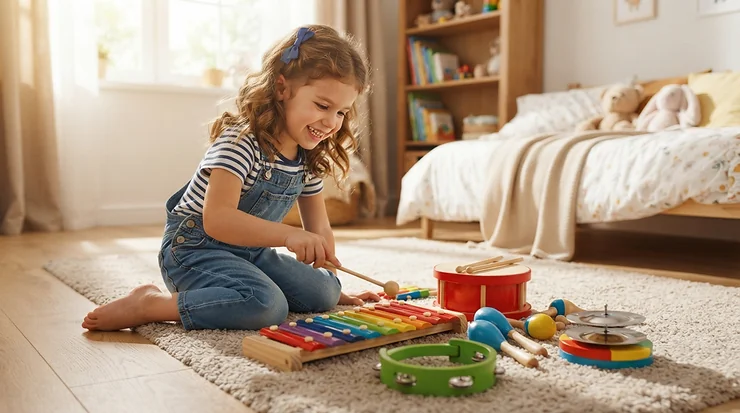
Katherine Palmer, curator of education at the Musical Instrument Museum in Phoenix, said in a 2020 interview that drums, egg shakers, single jingle bells and glockenspiels let young children play on their own. She advised steering clear of battery-powered, plastic or light-up instruments in favor of natural materials played acoustically (USA Today interview, republished on Yahoo News).
That is one educator’s view, and two picks below bend it: the keyboard runs on batteries, and some dealer pages call the glockenspiel bars plastic. Both are explained in their entries. Most toy musical instruments sold for toddlers fall on the plastic or electronic side of her line, which is why it is worth knowing where you are choosing to cross it.
Insist on in-tune pitches
Dynamic Music Room’s xylophone roundup asks for at least one octave, eight notes, with every note in tune for children around 3. It says tuning matters even for one-year-olds because they can then hear a scale move, and it wants two octaves or more once children reach elementary age. Merriam Music makes a similar point about the keyboard covered below: a young child’s first instrument should play in tune.
Pitch is also where the cheapest strings fail. A December 2024 forum thread on ukuleles for an 8-year-old keeps coming back to instruments that drift out of tune within a single song.
Fit the instrument to the hand
MusicRadar measures the Kala soprano ukulele at 21 inches long and 13.4 ounces, and notes that players with big hands may prefer concert or tenor models because the frets sit close together. The forum thread splits on size: one poster suggests a concert ukulele for an eight-year-old’s small hands, while another says a soprano would feel tiny to a child who already plays double bass.
Palmer makes the same point in different words. Choose what fits the child, because a bigger instrument is not automatically a better one.
Decide whether to buy, rent or buy used
Prodigies, a music-education company, advises keeping a first ukulele under $100, noting that children commonly outgrow it within a year or two and that used ukuleles hold resale value. Palmer suggests renting through school music programs or local music stores before buying. The sections on used listings and homemade instruments below cover the cheaper routes.
A musical instruments list, sorted by age band and hand size
This musical instruments list groups the instruments named in the sources by the stage where each one shows up.
| Stage | Instruments named | What to check first |
|---|---|---|
| 12 months to about 3 | Egg shakers, small drums, single jingle bells, a tuned glockenspiel such as the Hohner Kids HMX3008B Toddler Glockenspiel | Small-parts grade, in-tune bars |
| About 2 to 7 | Wooden percussion sets such as the Hape Mighty Mini Band, a mini keyboard such as the Casio SA-76 | Age grade, durability, battery use |
| School age | Piano, violin, a soprano or concert ukulele such as the Kala KA-15S | Size, tuning stability, rent or buy |
The bands overlap on purpose, because grades describe safety rather than readiness. A four-year-old who has outgrown a rhythm board may be comfortable on the keyboard, and a seven-year-old may be ready for a ukulele. Piano and violin come from Palmer’s school-age list, while the ukulele row rests on reviewers and forum posters rather than on any age rule.
Four ways a first instrument ends up in the closet
Buying the cheapest ukulele on the shelf is the classic one. In the December 2024 forum thread, one father reports that his son’s budget ukulele went out of tune during a single song and had badly placed frets, another poster says a Stagg model would not hold tuning for a whole tune, and a third notes that Mahalo ukuleles, otherwise liked, need regular retuning. A few posters point to cheap electronic tuners or phone apps as the fix, and one suggests trying instruments in a music shop first. The reports agree with each other, though they all come from one thread.
Handing a toddler a keyboard too early is another. Merriam Music warns that a child around 18 months may break the keys of a mini keyboard and that such damage would not be covered by warranty. Waiting until age 3 or later, or starting with wooden percussion, avoids the problem.
Missing the small-parts line is quieter and more serious. A homemade shaker filled with loose beads, or a toy with a cracked part, can put small pieces within reach of a younger sibling. The CPSC’s age-grade and warning-label rules exist to prevent choking in young children, so a label saying a toy is not for children under 3 deserves to be taken at face value, even on cheap toy musical instruments.
Expecting the first instrument to last is the fourth. Because children commonly outgrow a first ukulele within a year or two, according to Prodigies, a modest purchase, a rental or a used instrument makes more sense than a long-term investment.
Used gear and the pgh craigslist musical instruments search
Local classifieds are where many families look first, and a search for pgh craigslist musical instruments will turn up nearby listings, though nothing in an ad vouches for the seller. The Brass Exchange, a site devoted to used brass instruments, tells Craigslist buyers to insist on meeting in person, inspect the instrument, check its typical value (a very low price can be a warning sign) and ask for close-up photos. It also warns against wire transfers and gift cards.
For a child’s instrument, add two checks of your own: press every key or strum every string to confirm nothing buzzes or sags, and look over any toy-grade instrument for cracks, because a broken piece can become a small part. For a school-age child, Palmer’s rent-first advice may settle the question before you ever message a seller.
How to make kids musical instruments at home first
Homemade instruments are a cheap way to find out whether a child cares about sound before spending on a real one. KiwiCo’s project list tags many of its builds for ages 3 to 8: spin drums, coffee can drums, a straw flute, a rubber band guitar and a tambourine. Its duct tape drums are rated for ages 3 to 5 and its Easter egg maracas for ages 5 to 11. A South Australian playgroup guide suggests saucepans and large mixing bowls as drums, plus a hanging “musical garden” of tin cans, pans and lids to strike with spoons.
KiwiCo’s list gives no safety guidance for these builds, so the precautions here are reasoning from the small-parts definition rather than sourced rules: tape or glue every lid shut, and keep loose fillings such as beads or rice out of reach of children under 3.
A homemade set covers rhythm well. Pitch is guesswork, since tin cans and shoebox strings will not play a scale in tune, and that is where a tuned instrument earns its place.
What kids musical instruments reviews agree on, and where they split
Read side by side, the reviews behind this plan agree on three points. Durability depends on age: Merriam Music’s write-up says the SA-76 keyboard is not the most durable instrument, while Dynamic Music Room’s roundup calls a Hape mini band set fairly durable and marks it down for a xylophone that falls short of a full octave and for a higher price. Tuning stability separates serious ukuleles from toys: MusicRadar’s reviewer noticed no slippage from the Kala’s tuners, while the forum thread reports the opposite for budget models. And the two sources that discuss pitch, Dynamic Music Room and Merriam Music, both treat accuracy as a baseline.
They split on electronics. Palmer wants acoustic instruments in natural materials for the youngest children, while Merriam Music presents a battery-powered keyboard as a way to gauge a young child’s early interest. The split is less contradictory than it sounds, because Palmer is talking about toddlers and Merriam puts the keyboard at roughly 2.5 to 7.
Four tools for the job: best kids musical instruments by stage
Each pick below answers one stage from the list above rather than competing with the others.
| Model | Stage and age signal | Sound source | Power | Price signal | Known gap |
|---|---|---|---|---|---|
| Hape Mighty Mini Band | Toddler to preschool; maker says 2 years and up | Wooden percussion | None | Around $20 to $30 on Hape’s own store pages | No note count on the page |
| Hohner Kids HMX3008B Toddler Glockenspiel | Toddler; 12 months and up on retail listings | Struck tuned bars | None | Around $20 to $30 at two dealers | Bar material described two ways |
| Casio SA-76 | Preschool; roughly 2.5 to 7 per Merriam Music | Electronic | Six AA batteries or optional AC adapter | Check the current price on Amazon.com | No touch sensitivity, no MIDI, fragile for toddlers |
| Kala KA-15S | School age; no age stated by MusicRadar | Nylon strings | None | Roughly $60 to $75 across review headers and buying guides | Soprano frets can feel cramped |
Only the Casio SA-76 needs power, and only the Kala KA-15S asks the child (and a parent) to learn a tuning routine. Searches for the best kids musical instruments return endless rankings, so this plan ties each pick to a stage and a known weakness instead. The two cheapest entries cost about the same, which makes the choice between them a question of goals: varied rhythm sounds, or one octave of real notes.
1. Hape Mighty Mini Band — a wooden rhythm table for toddlers
A child who has just discovered that hitting things makes sounds benefits more from variety than from melody, and that is the case for the Hape Mighty Mini Band. Hape’s store page lists a xylophone, drum, cymbal, guiro, clapper and drumsticks on a board measuring 15.75 by 9 by 3.54 inches, with a maker age of 2 years and up. The page calls it a 5-in-1 set but names six items, and it describes the finishes as non-toxic and child safe.
Dynamic Music Room’s xylophone roundup praises a Hape mini band set for its mix of sounds and fair durability, yet marks it down for a xylophone that falls short of a full octave and for a higher price. That is one reviewer’s view, and the Hape page lists no note count to confirm or refute it. Hape’s own store pages put the set at around $20 to $30, and one of them showed it out of stock, so check the current price on Amazon.com.
Treat the xylophone bars as one more sound to explore and leave real scales to the glockenspiel below.
2. Hohner Kids HMX3008B Toddler Glockenspiel — eight tuned bars, no batteries
Palmer’s list for young children includes glockenspiels, and this is the smallest tuned version in the plan. A dealer page lists eight “precision tuned” bars, a vinyl carrying bag and a child-safe mallet, and two dealers put the set at around $20 to $30.
Two details vary by listing. Retail pages carry a 12-months-and-up grade, yet that dealer page names no age range at all. Sources also disagree on material: one marketplace description calls it an eight-bar metal instrument, while another dealer’s Q&A calls it plastic, so the product label is the tiebreaker. Hohner sells other 8-note glockenspiels, so confirm the HMX3008B model number on the listing before ordering.
One reviewer quoted on a retailer’s page chose it for being a full C-major octave and true to pitch, which lines up with Dynamic Music Room’s one-octave minimum for toddlers. The same roundup asks for two octaves or more at elementary age, so a child who wants two-handed tunes will need a larger glockenspiel later.
3. Casio SA-76 — 44 mini keys for early melodies
Toddlers and keyboards do not mix well, according to Merriam Music’s SA-76 review: a child around 18 months may break the keys, and the damage would not fall under warranty. For older preschoolers the picture changes. Casio’s page lists 44 mini keys, 100 tones, 50 rhythms, 8-note polyphony and 10 built-in songs, with two 8-centimeter speakers (about 3.1 inches) and a stereo headphone jack. The body measures 604 by 211 by 57 millimeters, about 23.8 by 8.3 by 2.2 inches by my arithmetic, and weighs 1.4 kilograms.
It runs on six AA batteries for about six hours, per Casio, or on an optional AC adapter that Merriam Music notes is not included. That battery dependence cuts against Palmer’s advice for the youngest children, which is why Merriam’s age range of roughly 2.5 to 7 matters. Merriam also reports accurate tuning and describes the keys as thinner and shorter for small fingers. Check the current price on Amazon.com.
Pros:
- ✅ Keys sized for small hands, according to Casio’s page
- ✅ A headphone jack for quiet practice
- ✅ Described as accurately tuned by Merriam Music
Cons:
- ❌ No touch sensitivity, sustain pedal, MIDI or Bluetooth
- ❌ Not the most durable build, per Merriam Music
- ❌ Merriam Music says an older child may lose interest
4. Kala KA-15S — a real ukulele for school-age hands
At roughly $60 to $75 across review headers and buying guides, the Kala KA-15S costs more than a department-store toy and less than the $100 ceiling Prodigies suggests for a child’s first ukulele.
MusicRadar’s review lists a mahogany soprano, 21 inches long and 13.4 ounces, with a 13.625-inch scale, 12 frets and Aquila Super Nylgut strings. Its reviewer calls the open tuners a little stiff and uneven but noticed no slippage, and frames the instrument as aimed at buyers wanting “a musical instrument, not a toy.” The same review lists limited tonal depth and a slightly scruffy interior as drawbacks, and it never mentions children, so the age fit comes from elsewhere: Prodigies recommends a soprano as a child’s entry point, and the one forum poster who names Kala calls it reliably good.
Budget for extras. Prodigies puts a clip-on tuner at about $10, recommends a padded gig bag and notes that cheap strings are common even on good ukuleles, so a spare set is sensible. It also suggests letting children play with their fingers rather than a pick during the first year.
Short answers on age, safety, and secondhand gear
❓ What is the best first musical instrument for a child?
✅ It depends on age. A museum educator interviewed by USA Today points young children to drums, egg shakers, jingle bells and glockenspiels, and school-age children to piano or violin. Specialist reviewers add the soprano ukulele for beginners who want real chords and have a modest budget.
❓ What age can kids start playing real instruments?
✅ There is no single age. Maker grades start around 12 months for a tuned glockenspiel and 2 years for a wooden percussion set, while one retailer puts a mini keyboard at roughly 2.5 to 7. Fit, safety grade and interest matter more than the birthday.
❓ Are toy musical instruments safe for toddlers?
✅ Safety depends on the age grade. CPSC bars small parts in products intended for children under 3, and products with small parts meant for ages 3 to 6 carry a choking-hazard warning. Retire any toy that cracks or sheds pieces.
❓ Is it smarter to rent or buy used instruments for kids?
✅ Renting or buying used both make sense for a first instrument. Prodigies says children commonly outgrow a first ukulele within a year or two and that used ones hold resale value, while a museum educator suggests renting through school programs or music shops first.
❓ How do you make musical instruments with kids at home?
✅ Start with sealed shakers, coffee can drums, pots and spoons, or a shoebox guitar; KiwiCo tags many of its builds for ages 3 to 8. Tape lids shut, because loose beads or rice can become small parts for a younger sibling.
Which first instrument goes in the cart
Start with the child’s age, not the instrument’s reputation. Under three, a tuned glockenspiel or a wooden percussion board keeps things acoustic and sidesteps small-parts trouble. From roughly 2.5, a mini keyboard can test interest in melodies, and once a child is in school and asks for chords, a soprano ukulele with reliable tuning is the step up. For kids musical instruments at every stage, keep the first purchase modest, confirm the age grade and the pitch, and plan to rent, resell or pass it on. Check current availability on Amazon.com through the product links above.
Recommended for You
- Outdoor climbing structure for kids: A Practical Guide (2027)
- Art supplies for kids: Matched to Age, Budget and Habits
- Smallest slide and swingset for kids outdoor: Practical Guide (2027)
Match the stage to the pick, then check current availability on Amazon.com 🎵