The best kids play tents in 2027 are the ones whose frame matches how a child actually plays: wooden-pole teepees for reading corners, pop-up polyester for tight budgets and travel, and a steel climber with a tent on top for kids who have outgrown a corner. Pole material and floor space separate the picks far more than color or theme does. The six models below run from a narrow beechwood tent built for apartments to a backyard set rated for ages 3 to 12.
No tent was set up for this guide. The findings come from maker spec pages, retailer listings with their posted reviews, a parent-sourced roundup and federal recall notices, and each comment on durability is credited to the page it came from. Prices appear as ranges drawn from those pages, so check the current price on Amazon.com before ordering.
Pole type, fabric and floor space: what separates these six
The Bump’s parent-sourced roundup boils tent shopping down to a few checks: a structure with several internal rods that click into place, a tent kept upright for airflow, supervision for infants and toddlers, and a watch for loose poles. It also says to measure floor space, since one tent on its list is the narrowest and another is called very large. Those checks turn into three real differences among the picks below.
Poles come first. Wooden poles, pine on the teepee and beechwood on the Lalo Play Tent, make a heavier tent; The Bump lists the Tiny Land Kids Teepee Tent at 8.4 pounds against 2 pounds for the fiberglass-poled 3 Sprouts Recycled Fabric Play Tent. The USA Toyz Happy Hut Teepee Tent uses pop-up aluminum poles that its listing says go up with no tools, and the climbing set trades poles for galvanized steel.
Covers come second. Cotton canvas covers are heavier and, on some models, machine washable, yet the makers’ pages say little about rain. Polyester is lighter and, per the listings, wipes clean.
Floor space comes last, and the spec sheets argue with each other more than you would expect. One retailer lists a tent as 44.5 inches tall while two others list the same tent as 40, and one dome carries three different age ranges across stores. The table uses the numbers as listed; each entry flags where pages disagree.
Model
Frame and cover
Size as listed
Age as listed
Price range
Tiny Land Kids Teepee Tent
Pine poles; cotton canvas (poly-cotton blend on one version)
About 47 by 47 in base; 59 to 66 in tall by source
3 and up
Around $40 to $70 by version
Lalo Play Tent
Beechwood poles; natural canvas
44.5 by 25 by 40 in
12 months and up
Around $125 to $140
USA Toyz Happy Hut Teepee Tent
Aluminum pop-up poles; water-resistant polyester
43 by 43 by 62.5 in
3 and up
Around $25 to $30
3 Sprouts Recycled Fabric Play Tent
Fiberglass poles; recycled polyester
39.4 in across, 53 in tall
3 and up
Around $35 to $40
Pacific Play Tents Super Duper 4-Kid Play Tent
Shock-corded fiberglass poles; polyester
58 by 58 by 46 in
3 and up on one page; others differ
Around $40 to $70
TP Toys Explorer 2 Climbing Set Jungle Gym with Platform and Tent
Galvanized steel frame; polyester canopy
82.5 in tall at full height
3 to 12
Around $300
Only the Lalo Play Tent and the Tiny Land Kids Teepee Tent have wooden frames, and the TP Toys Explorer 2 Climbing Set Jungle Gym with Platform and Tent is the only one whose sources list a weight limit (220 pounds, per Target and Kohl’s). The rest are light, foldable tents meant to move between rooms. Check current availability through the links in each pick below.
Best kids play tents, matched to six households
Each pick starts from a household and works back to the tent.
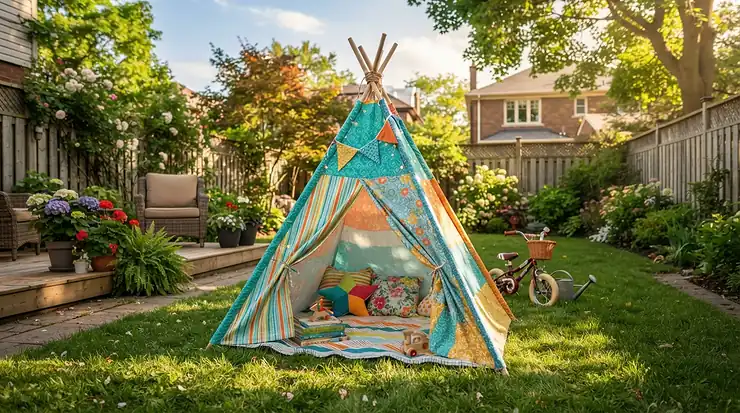
The Bump picks this as its overall best, crediting the foldable design, easy assembly, peek-through window, interior pockets, carry case and a roomy inside for several children. The version it tested is a 60% polyester, 40% cotton blend over pinewood poles, 47.2 by 47.2 by 59 inches and 8.4 pounds, rated for ages 3 and up. Tiny Land’s own page sells a 100% cotton canvas edition at about 47 inches square with a half-inch non-slip mat, 13 feet of fairy lights and 16 pine poles, and calls it designed for indoor and outdoor use without making any waterproofing claim.
Pages disagree on height: 59 inches at The Bump, 60 on the maker’s page, 63 on Babylist and 66 on a marketplace listing. Two fabric versions also share the name, which is why the price spans around $40 to $70.
Owner reports are mixed but agree on setup. Buyer reviews mirrored on marketplace pages describe assembly in about 10 minutes, yet one buyer says the poles kept slipping out of the plastic connectors and another says the tent wobbles when children push on the sides; each is a single owner’s account. The Bump adds that opinions on the string lights are mixed.
Tiny Land also has a separate tent under recall, covered in the safety section below, and the teepee as The Bump and the maker describe it uses pine poles rather than fiberglass.
Tiny Land Kids Teepee TentSee current price, sizes and reviews on Amazon.
At around $125 to $140 this is the priciest fabric tent here, and what the money buys is a small footprint rather than extra room. The Bump names it best for small spaces and lists it as the narrowest of its picks, with an FSC-certified beechwood frame, natural cotton canvas, a 6-pound weight and a starting age of 12 months. Its drawbacks, per The Bump, are the cost and the lack of windows, and the canvas cannot be ironed or dry-cleaned.
Dimensions flip between pages. The Bump and Bloomingdale’s give 44.5 long by 25 wide by 40 high, while Target gives 44.5 tall, 40 wide and 25 deep. Either way, the 25-inch dimension points to a tent for sitting and reading more than sprawling (my reading of the numbers).
Target’s page shows 4.8 stars from 88 reviews, carrying reviews originally posted on Lalo’s own site. Buyers there praise setup in roughly 10 to 15 minutes and thick, opaque canvas. The complaints are specific: one reviewer says the poles often came loose and the tent fell apart within a year, another says it tips and leans, and two report noticeable shrinkage after following the cold-wash, low-dry instructions. A handful of voices against a strong average, and all of them point at joints and fabric care.
Lalo Play TentSee current price, sizes and reviews on Amazon.
Budget pop-ups are where this tent lives. A marketplace mirror of the Amazon listing gives 43 by 43 by 62.5 inches, an aluminum frame, water-resistant polyester, mesh windows, a tote bag and room for up to three children, with 4.4 stars from about 19,400 ratings on that page. The USAToyz eBay storefront asks around $25 to $30, the lowest of the six, and says the polyester wipes clean with a soft cloth, water and mild soap.
Setup stories on the mirrored page are short. One buyer put it together without directions during a 5-to-7-minute work break, and another used it with five children at once in a church class for 3-to-6-year-olds and says it held up well.
The frame is where the price shows. BestReviews says a different USA Toyz model, the Rocket Ship tent, has a bottom frame that can tear out with rough play; read that as a hint about the maker’s pop-up construction, not a verdict on this teepee.
USA Toyz Happy Hut Teepee TentSee current price, sizes and reviews on Amazon.
Two pounds is the number that matters here, and it is why The Bump names this the best lightweight tent. It is 100% recycled polyester over fiberglass poles, 39.4 inches across and 53 inches tall, rated 3 and up, with mesh windows and a storage bag. Both The Bump and Babylist put the price near $35 to $40, and Babylist calls the poles sturdy and lists several neutral colors.
The Bump reports mixed reviews on fabric durability. One parent it quotes calls the tent very light and pretty waterproof, voices some durability worries, and still backs it as a great option under $40, which is a fair summary of the whole category.
Pros:
✅ Lightest of the six at 2 pounds, per The Bump
✅ Around $35 to $40 at Target and Amazon, per The Bump and Babylist
✅ Mesh windows and a storage bag
Cons:
❌ Mixed fabric-durability reviews, per The Bump
❌ A tent this light can slide in a breeze outdoors (my reading of the 2-pound weight)
3 Sprouts Recycled Fabric Play TentSee current price, sizes and reviews on Amazon.
Sleepovers and playdates are the reason this dome exists. Woot’s listing gives 58 by 58 by 46 inches in polyester over shock-corded fiberglass poles, with a hook-and-loop front door, a carry bag and two tunnel ports with roll-down flaps that connect to the maker’s tunnels. Tractor Supply’s copy says it is large enough for two parents and three children, and BestReviews names it its best of the best, praising the bright colors, mesh top, light weight and construction, with sizing as the only warning. Retailers price it from around $40 to around $70.
Fine print varies by store. Staples and Woot cite CPAI-84 and ASTM F963 compliance, yet the age label reads 3 and up at Woot, 1 to 8 at Walmart and 36 months to 10 years on a marketplace mirror, and the warranty is one year on one page and 90 days on another. A Super Duper 4-Kid II version with a single 19-inch tunnel port is also sold, so match the model number to the page before you order.
Pros:
✅ Two tunnel ports link to the maker’s crawl tunnels, per Tractor Supply
✅ Mesh top for airflow, per BestReviews
✅ Waterproof floor for spills, per School Specialty
Cons:
❌ A 58-inch footprint needs real floor space, and BestReviews flags sizing
❌ Age and warranty details conflict between retailers
Pacific Play Tents Super Duper 4-Kid Play TentSee current price, sizes and reviews on Amazon.
Children who want height, not just a hideout, are the audience for this set, which pairs a polyester canopy with a galvanized steel frame. Target and Kohl’s list round viewing windows, roll-up doors, a mesh vinyl platform and a printed explorer playmat. The frame adjusts between two heights: low, at 53.5 inches tall with the platform at 22 inches, and full, at 82.5 inches with the platform at 47. The limit is 220 pounds and the age range is 3 to 12, and Target prices it around $300, the same as Academy.
Assembly is the first hurdle. Target lists it as adult assembly with no tools provided, and reviewers there report about two hours or “a few hours.” The page’s rating is 3.8 of 5 from only nine reviews, with 60% saying they would recommend it. Praise comes from a parent whose kids kept using it for years and another who called it a backyard tree house without the trees; complaints are a window much smaller than pictured and a set of grandchildren who wanted more climbing. Treat nine reviews as a hint, not a trend.
Surfacing matters here in a way it does not for a fabric tent. At full height the platform sits at 47 inches, just under 4 feet (my arithmetic), so check the maker’s manual for fall height and read the surfacing section below before choosing where to place it. Target’s listing also gives an overall height of 120 inches that conflicts with its own 82.5-inch full-height spec, and Kohl’s lists a 90-day warranty.
TP Toys Explorer 2 Climbing Set Jungle Gym with Platform and TentSee current price, sizes and reviews on Amazon.
Indoor play gym for kids: when a tent stops being enough
A tent gives a child a place; a gym gives movement. HGTV’s roundup of eight indoor play gyms sorts them by how they stand, and that split decides what suits a rental or a small house. The self-standing ones need no wall: the Avenlur Magnolia 7-in-1 Indoor Playground (ages 2 to 6, 250 pounds, around $400) and the Merax 6-in-1 Kids’ Indoor/Outdoor Playset (plastic, 800 pounds, around $190). Wall-mounted units such as the Avenlur Walnut 9-in-1 Swedish Ladder Wall Gym Set (500 pounds, between $550 and $650) need a structure to attach to. The Gym1 4-Piece Deluxe Indoor Doorway Gym Set, around $150 and rated for 300 pounds, needs no floor space but fits only door frames 25 to 26 inches wide.
HGTV states plainly that it gives no guidance on ceiling height, floor padding or supervision for any of them, which leaves those checks to each maker’s manual. The full HGTV indoor play gym roundup lists the climbing features each one carries, from rock walls and slides to rope ladders and rings.
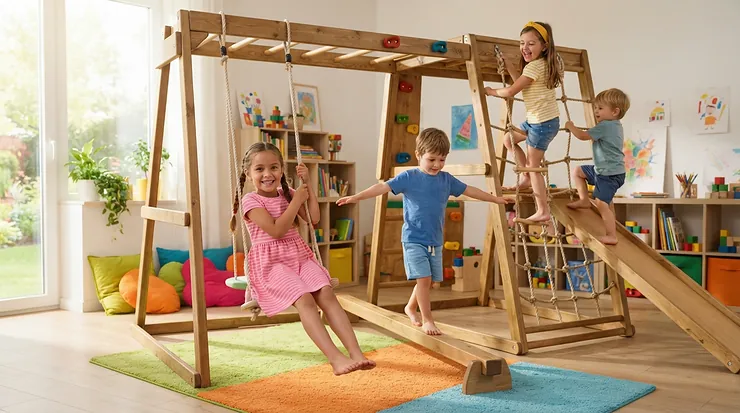
A reasonable split: a tent for quiet play, an indoor play gym for kids who need to burn energy on rainy days, and a tent-on-a-frame like the TP Toys Explorer 2 Climbing Set Jungle Gym with Platform and Tent for the child who wants both.
Play sets for older kids: where jungle gym play equipment takes over
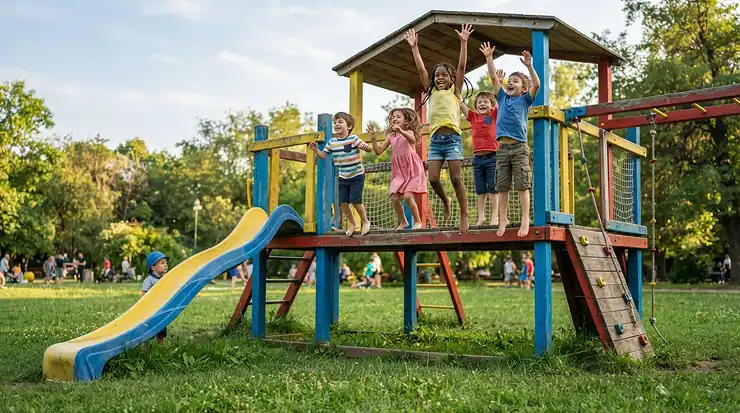
Searches such as “jungle gym play equipment for amazon kids boys” usually mean a climbing structure, not fabric, and the sources support that split. Gorilla Playsets, a maker, recommends its sets for children aged 3 to 11 and says older kids need a challenge, pointing to monkey bars, disc and tire swings, mesh bridges and rock walls. That is a promotional page, but the feature list matches what older children outgrow tents for.
Size is the other signal. Of the six picks, only the Tiny Land Kids Teepee Tent (59 to 66 inches by source), the USA Toyz Happy Hut Teepee Tent (62.5 inches) and the climber (82.5 inches) come near or past 5 feet, which is where play sets for older kids start to make more sense than fabric. HGTV also lists the Eezy Peezy Mega Pyramid Monkey Bar Climber (plastic, 220 pounds, indoor or outdoor, around $280) as a middle step.
The surface under them is the part people skip. The CPSC’s Outdoor Home Playground Safety Handbook asks for at least 9 inches of wood mulch, engineered wood fiber or shredded rubber under equipment up to 8 feet, 9 inches of sand or pea gravel up to 5 feet, and at least 6 inches under equipment lower than 4 feet. It says to avoid concrete, asphalt, grass, dirt and thin carpet, to extend surfacing 6 feet in every direction, to anchor equipment so it cannot tip, and to start with about 12 inches of loose fill because it settles. Ground-level playhouses need none of this, which is why a fabric tent can sit on a rug while a platform cannot.
Kids play tents reviews: what testers and owners keep repeating
Four patterns recur across the pages opened for this guide, and none comes from a lab test.
Joints loosen first. Reviewers on Target’s page for the Lalo Play Tent, a buyer of the Tiny Land Kids Teepee Tent and BestReviews’ note on a sibling USA Toyz model all describe connectors or frames giving way, across beechwood, pine and aluminum. Three sources and three materials suggest the weak point is the joint more than the wood.
Fabric surprises come next. The Bump flags durability on the polyester 3 Sprouts Recycled Fabric Play Tent, while Target reviewers report shrinkage on canvas after washing as instructed. Read the care label before the first spill.
Spec sheets contradict each other, as the entries show with heights, ages and warranty terms. Assembly time follows the frame: about 10 minutes for teepees and pop-ups, about two hours for the steel set. The practical rule is to tighten the connectors every few weeks and treat any wobble as a reason to stop for the day.
Fiberglass poles, flame standards and one 2026 recall: checks before first use
The CPSC’s play tent recall page currently lists one recall, number 26-526, dated June 4, 2026. About 7,500 Tiny Land play tents had fiberglass poles that can shed fibers, with eight reports of skin or eye irritation. The recalled tent is cream-colored with three windows, a closable door, 34 poles, star-shaped lights and a quilted mat, measures about 57 by 52 by 36 inches, and was sold on Amazon.com and Tinylandus.com from November 2025 through March 2026. A label inside carries the SKU TLTGTT003BG-XYF1506251. Owners are told to stop using it, disassemble it and keep the poles away from children, and Tiny Land offers a free repair kit with four plastic poles.
That recall covers one tent’s poles, not fiberglass in general, and no source opened here ties the 3 Sprouts Recycled Fabric Play Tent or the Pacific Play Tents Super Duper 4-Kid Play Tent to a problem. Still, both use fiberglass, so inspect the poles for splintering or fraying at the start of each season.
Standards claims are worth reading closely. CPSC’s toy-safety summary says ASTM F963 is mandatory for children’s toys, with third-party testing and a Children’s Product Certificate for products meant for children 12 and under, and that its flammability section is not itself mandatory. A flame claim such as CPAI-84 on a listing is therefore a separate statement from toy-standard compliance. Supervise toddlers, keep tents upright for airflow, and anchor any frame with a platform.
Washing, rain, age labels and size: quick answers before you order
❓ Can kids play tents go in the washing machine?
✅ Some can. One canvas tent here lists a machine-washable cover but warns against ironing and dry cleaning, and two reviewers on a retailer page report shrinkage after a cold wash. Polyester pop-ups are usually wiped with a damp cloth and mild soap. Check the care label first.
❓ Are kids play tents waterproof?
✅ Not as a rule. One pop-up is described as water-resistant polyester and one dome has a waterproof floor, but the cotton canvas teepee's maker page makes no weather claim. Treat these tents as indoor or dry-day gear, and bring them in before rain arrives.
❓ What age is a play tent for?
✅ Labels disagree. One dome is listed for ages 3 and up, 1 to 8, and 36 months to 10 years depending on the store, while canvas tents say 3 and up and one narrow tent starts at 12 months. Follow the maker's page and your child's height.
❓ Which kids play tent best fits a small bedroom?
✅ The narrowest listed here is a beechwood tent about 25 inches deep, then a 39.4-inch round tent and a 43-inch square pop-up. Measure the corner, leave room for the door flap, and remember that dome and tunnel sets need far more floor.
❓ When does a child need a climbing set instead of a tent?
✅ When the goal moves from hiding to moving. A tent is a place to sit and pretend, while platforms, ladders and bars add falls from height, which is why the CPSC asks for protective surfacing under them but not under ground-level playhouses.
Which of the six belongs in your home
Start with where the tent will live and how rough the play gets. For most families shopping for kids play tents, the Tiny Land Kids Teepee Tent is the safest all-round starting point: roomy, wooden-poled and The Bump’s overall pick, though two fabric versions share its name. Apartments and shared rooms favor the Lalo Play Tent, budgets and travel favor the USA Toyz Happy Hut Teepee Tent or the 3 Sprouts Recycled Fabric Play Tent, and playdates with tunnels favor the Pacific Play Tents Super Duper 4-Kid Play Tent. A child who wants to climb belongs on the TP Toys Explorer 2 Climbing Set Jungle Gym with Platform and Tent, with proper surfacing underneath.
Whichever you pick, tighten the connectors every few weeks and check poles for wear. Check current availability below for the size and pole type you settled on.
The WhizKiddo editorial team researches baby gear, outdoor play equipment, trampolines and kids' products using manufacturer specifications, safety guidance from bodies such as the CPSC and AAP, independent tests, parent reports and retailer listings. We do not claim to have tested the products ourselves. Read how we work on our How We Choose Gear page.