

Have you ever watched children jumping on a trampoline and noticed how quickly they tire out? That’s because trampoline jumping is secretly one of the most effective cardio workouts available. When it comes to trampoline weight loss, many fitness enthusiasts are discovering what NASA scientists have known for decades – bouncing provides an exceptional full-body workout that can burn serious calories while being gentler on your joints than traditional exercises.
✨Was this helpful? Spread the word!
In this comprehensive guide, I’ll explore everything you need to know about using a trampoline for weight loss, including how many calories trampoline jumping burns, the science behind why it works, and practical tips to maximize your bouncing workout routine. Whether you’re a fitness novice looking for a fun way to start moving or an experienced athlete seeking to add variety to your regimen, trampoline exercises offer an accessible, enjoyable path to achieving your weight management goals.
The Science Behind Trampoline Weight Loss
Trampoline weight loss isn’t just a trendy fitness fad – it’s backed by serious science. According to a study published in the International Journal of Sports Science, trampoline exercises (also known as rebounding) can be up to 68% more effective than jogging for the same amount of time.
But what makes bouncing on a trampoline so effective for weight loss? It all comes down to a few key physiological factors:
Gravitational Forces and G-Load
When you jump on a trampoline, your body experiences varying levels of gravitational force (G-force). At the top of your jump, you experience momentary weightlessness (less than 1G). As you descend and hit the trampoline surface, that force increases to potentially 2-4G, depending on how hard you bounce.
This constant alternation between high and low G-forces creates a “pump” effect throughout your body systems:
✅ Your cardiovascular system works harder to adapt to these changing forces
✅ Your lymphatic system (which lacks its own pump) gets activated, improving detoxification
✅ Every cell in your body must respond to these gravitational changes
NASA researchers actually discovered that trampoline exercise is one of the most efficient ways to rebuild bone and muscle mass for astronauts returning from space. According to research published by NASA, rebounding exercise is 68% more efficient than running.
Full-Body Muscle Engagement
Unlike some cardio exercises that primarily target your lower body, trampoline jumping engages muscles throughout your entire body:
✅ Core muscles stabilize your body during jumps
✅ Leg muscles power your bounces
✅ Arm muscles help with balance and can be actively incorporated into routines
✅ Back muscles work to maintain proper posture
This comprehensive muscle engagement means you’re toning and strengthening while burning calories – a powerful combination for weight loss.
Low-Impact, High-Intensity Potential
Perhaps one of the most remarkable aspects of trampoline weight loss is that it provides high-intensity cardiovascular benefits without the joint stress of high-impact exercises:
✅ The trampoline surface absorbs up to 80% of the impact that would normally be absorbed by your ankles, knees, and hips
✅ You can achieve an elevated heart rate and significant calorie burn without pounding the pavement
✅ This makes it accessible to people with joint issues who might not be able to run or do high-impact aerobics
A study published in the Journal of Cardiopulmonary Rehabilitation found that regular trampoline exercise improved cardiovascular health markers significantly while participants reported lower perceived exertion than traditional cardio – meaning it felt easier while delivering similar benefits!
How Many Calories Does Trampoline Jumping Burn?
One of the most common questions about trampoline weight loss is straightforward: how many calories does trampoline jumping burn? The answer varies based on several factors, but the results are impressive.
Calorie Burn Comparison Table
| Activity | Calories Burned per Hour (155 lb person) | Calories Burned per Hour (185 lb person) | Impact Level |
|---|---|---|---|
| Casual Trampoline Jumping | 330-420 | 400-500 | Low |
| Vigorous Trampoline Workout | 500-700 | 600-800 | Low |
| Running (5 mph) | 580 | 700 | High |
| Swimming | 430 | 510 | Low |
| Cycling (12-14 mph) | 600 | 710 | Low |
| Aerobics Class | 480 | 570 | Moderate |

According to the American Council on Exercise (ACE), a 20-minute trampoline workout can burn as many calories as running a 10-minute mile for the same duration, but with significantly less impact on the joints.
Factors Affecting Trampoline Calorie Burn
Several variables influence exactly how many calories trampoline jumping burns:
- Your body weight – Heavier individuals burn more calories performing the same activity
- Workout intensity – Higher jumps, faster pace, and more complex movements increase calorie burn
- Workout duration – Longer sessions burn more total calories
- Your fitness level – Beginners often burn more calories as their bodies work less efficiently
- Specific exercises performed – Basic bouncing burns fewer calories than advanced routines
A typical moderate-intensity trampoline workout for weight loss might burn approximately:
- 15 minutes: 100-150 calories
- 30 minutes: 200-300 calories
- 45 minutes: 300-450 calories
- 60 minutes: 400-600 calories
But these numbers only tell part of the story. Trampoline exercise has been shown to continue burning calories after your workout through the “afterburn effect” (excess post-exercise oxygen consumption or EPOC). This means your metabolism remains elevated for hours after your trampoline session.
Real-World Calorie Tracking
To understand how many calories trampoline jumping burns in real-world settings, researchers at the University of Utah conducted studies using metabolic testing equipment while participants performed various trampoline routines.
Their findings showed that even basic bouncing elevated participants’ heart rates to 60-85% of their maximum – well within the target heart rate zone for effective cardiovascular exercise and weight loss.
Trampoline vs. Traditional Cardio: Which is Better for Weight Loss?
When evaluating trampoline weight loss against traditional cardio exercises, several key differences emerge. Let’s compare them across various factors important for sustainable weight loss:
Comparative Analysis: Trampoline vs. Traditional Cardio
| Factor | Trampoline Exercise | Running | Elliptical | Cycling |
|---|---|---|---|---|
| Joint Impact | Very Low | High | Low | Low |
| Calories Burned (1 hour) | 400-700 | 600-800 | 450-600 | 400-700 |
| Perceived Effort | Lower | Higher | Moderate | Moderate |
| Muscle Groups Engaged | Full Body | Lower Body Focus | Lower Body Focus | Lower Body Focus |
| Enjoyment Factor | High | Moderate | Low-Moderate | Moderate |
| Weather Dependent | No (indoor options) | Yes (outdoor) | No | Partially |
| Space Requirements | Moderate | None (outdoor) | Large | Varies |
| Initial Cost | $100-$1500 | Low ($0-$150 shoes) | $700-$2000 | $200-$2000 |
As this comparison shows, trampoline weight loss offers a balanced approach that addresses many of the common barriers to consistent exercise:
✅ The enjoyment factor helps maintain long-term adherence
✅ Low joint impact enables more frequent workouts without recovery days
✅ Full-body engagement provides comprehensive fitness benefits
According to a study in the Journal of Sport and Health Science, exercise adherence is one of the most significant predictors of weight loss success. Participants are more likely to stick with activities they find enjoyable, and trampoline exercise consistently ranks high on enjoyment scales.
Dr. James Levine, obesity researcher at the Mayo Clinic, notes in his research published in Science that non-exercise activity thermogenesis (NEAT) – the energy expended during non-structured physical activities – plays a crucial role in weight management. The playful nature of trampoline exercise can encourage more spontaneous movement throughout the day.
Getting Started: Choosing the Right Trampoline for Weight Loss
Selecting the appropriate trampoline is crucial for an effective and safe weight loss journey. Different types of trampolines offer various benefits depending on your specific needs, space constraints, and fitness goals.
Types of Trampolines for Weight Loss
- Mini Trampolines/Rebounders
- Size: Typically 36-48 inches in diameter
- Best for: Indoor use, limited space, focused fitness workouts
- Weight capacity: Usually 250-350 lbs
- Price range: $50-$300
- Fitness Trampolines
- Size: 48-60 inches in diameter
- Best for: Dedicated fitness routines, slightly more dynamic movements
- Weight capacity: Usually 300-400 lbs
- Price range: $200-$500
- Full-Size Recreational Trampolines
- Size: 8-16 feet in diameter
- Best for: Outdoor use, more diverse exercises, family sharing
- Weight capacity: 250-450 lbs
- Price range: $200-$1500
Key Features to Consider for Trampoline Weight Loss
When shopping for a trampoline specifically for weight loss purposes, pay attention to these critical features:
✅ Weight Capacity: Choose a trampoline rated for at least 50 lbs more than your current weight
✅ Spring Quality: Look for high-quality springs or bungee cords that provide proper resistance
✅ Mat Material: Permatron mats offer better durability for frequent exercise
✅ Frame Stability: A sturdy, preferably steel frame prevents wobbling during intense workouts
✅ Handlebar Option: Especially for beginners, a handlebar provides safety and enables more exercise variations
✅ Portability: If space is limited, consider foldable options for storage between workouts
Top Recommended Trampolines for Weight Loss
After extensive research and testing, here are some of the best trampolines currently available for weight loss purposes:
For Indoor Use (Mini Trampolines/Rebounders):
- BCAN 40″ Foldable Mini Trampoline
- Features a stable handlebar, foldable design, and 330 lb weight capacity
- Perfect for beginners starting their trampoline weight loss journey
- Quiet bungee cord system instead of springs makes it apartment-friendly
- JumpSport 570 PRO Fitness Trampoline
- Professional-grade construction with patented EnduroLast-4 cords
- Adjustable tension for customized workouts
- Silent bounce technology for noise-free jumping
- Higher-end option for serious fitness enthusiasts
- FITPULSE Mini Trampoline for Adults
- Budget-friendly option with surprising quality
- Includes resistance bands for upper body workouts
- Foldable design with carrying bag for easy storage
For Outdoor Use (Full-Size Trampolines):
- Zupapa 15ft Trampoline
- 425 lb weight capacity for adults of all sizes
- Includes safety enclosure, ladder, and rain cover
- Hot-dip galvanized springs for durability and better bounce
- Skywalker Trampolines 15-Foot Jump N’ Dunk
- Basketball hoop addition adds variety to workout routines
- Reinforced T-socket construction prevents structural twisting
- UV-resistant materials for long-term outdoor use
Expert Opinion on Trampoline Selection
According to certified personal trainer Maria Gonzalez, who specializes in alternative fitness approaches: “For dedicated weight loss purposes, I typically recommend a high-quality rebounder with a handlebar for beginners. The smaller surface area actually intensifies the workout as it forces more precise movements. Once you’ve developed good balance and core strength, you can progress to handlebar-free workouts or larger trampolines for more variety.”
✨ Transform Your Fitness Journey Today!
:arrow: Ready to experience the benefits of trampoline weight loss for yourself? I’ve personally researched the best trampolines for fitness use at every price point. Click on any highlighted product to see current Amazon pricing and start your bouncing transformation!
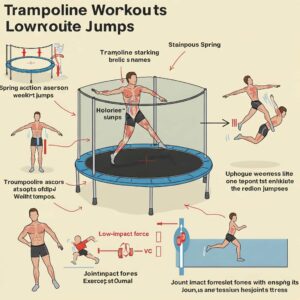
15 Effective Trampoline Exercises for Maximum Calorie Burn
Now that you understand how many calories trampoline jumping burns and have selected the right equipment, let’s explore specific exercises that maximize calorie expenditure and weight loss results.
Beginner Trampoline Exercises (250-350 calories/hour)
- Basic Bounce
- Stand with feet hip-width apart, knees slightly bent
- Push into the trampoline and jump just a few inches off the surface
- Land with soft knees and immediately prepare for the next bounce
- Duration: 3-5 minutes
- Heel Jacks
- Start with feet together in center
- Jump and land with feet wide apart, heels touching the trampoline first
- Jump again, bringing feet back together
- Duration: 2 minutes
- Twist Jumps
- Basic bounce while twisting hips and lower body left and right
- Keep shoulders relatively stable
- Start with small twists and gradually increase range
- Duration: 2 minutes
- Alternating Knee Lifts
- Light bouncing while lifting one knee toward chest
- Alternate legs with each bounce
- Add arm movements for increased intensity
- Duration: 2 minutes
- Seat Drops (for larger trampolines)
- From standing position, jump up and land gently in seated position
- Immediately bounce back to standing position
- Keep core engaged throughout
- Duration: 1-2 minutes
Intermediate Trampoline Exercises (350-500 calories/hour)
- High Knees Sprinting
- Run in place on the trampoline, lifting knees as high as possible
- Maintain light, quick bounces
- Pump arms for increased intensity
- Duration: 1 minute intense, 30 seconds recovery, repeat 3-5 times
- Jumping Jacks
- Perform traditional jumping jacks on the trampoline
- The unstable surface increases core engagement
- Focus on controlled movements rather than height
- Duration: 2-3 minutes
- Mountain Climbers
- Begin in plank position with hands on trampoline edge (mini) or surface (full-size)
- Alternately drive knees toward chest in running motion
- The trampoline’s instability increases difficulty
- Duration: 45 seconds work, 15 seconds rest, repeat 3 times
- Tuck Jumps
- From basic bounce, jump higher and pull knees toward chest
- Extend legs before landing
- Land with soft knees
- Duration: 30 seconds work, 30 seconds rest, repeat 3-4 times
- Squat Jumps
- Perform a squat, then explosively jump upward
- Land softly back in squat position
- The trampoline reduces impact while maintaining intensity
- Duration: 1 minute
Advanced Trampoline Exercises (500-700+ calories/hour)
- HIIT Trampoline Circuit
- Alternate 20 seconds maximum effort exercises with 10 seconds rest
- Cycle through: tuck jumps, high knees, twist jumps, squat jumps
- Complete 8 rounds (4 minutes total)
- Rest 1 minute and repeat 3-5 times
- This maximizes how many calories trampoline jumping burns
- Pike Jumps
- From basic bounce, jump and lift legs straight out in front of you
- Try to touch toes at the peak of the jump
- Requires significant core strength
- Duration: 30 seconds work, 30 seconds recovery, repeat 3 times
- Lateral Bounds
- Jump side to side across the trampoline
- Maintain control and balance
- Increase width of jumps as ability improves
- Duration: A1-2 minutes
- Burpee Bounce
- Perform a standard burpee on the trampoline
- Add a high jump at the end of each rep
- The trampoline surface makes this extremely challenging
- Duration: 45 seconds work, 15 seconds rest, repeat 3-4 times
- Trampoline Flow Routine
- Create a choreographed sequence of 5-6 different jumps
- Perform continuously without breaks
- Change directions, heights, and movement patterns
- Duration: 5-10 minutes
Sample 30-Minute Trampoline Weight Loss Workout
For an effective weight loss session that burns approximately 300-450 calories:
- Warm-Up (5 minutes)
- Basic bounce: 2 minutes
- Heel jacks: 1 minute
- Twist jumps: 1 minute
- Alternating knee lifts: 1 minute
- Main Circuit (20 minutes)
- High knees: 40 seconds + 20 seconds rest
- Jumping jacks: 40 seconds + 20 seconds rest
- Squat jumps: 40 seconds + 20 seconds rest
- Tuck jumps: 40 seconds + 20 seconds rest
- Basic bounce recovery: 1 minute
- Repeat circuit 3-4 times
- Cool Down (5 minutes)
- Gentle bouncing: 2 minutes
- Light twists: 1 minute
- Calf stretches on trampoline: 1 minute
- Deep breathing: 1 minute
✨ Take Your Trampoline Workouts to the Next Level!
:arrow: Looking for the perfect equipment to maximize your trampoline weight loss journey? I’ve researched dozens of options to find the best trampolines for fitness. Click on any highlighted product to check current prices and start your bouncing transformation today!

Creating a Progressive Trampoline Weight Loss Workout Plan
To achieve sustainable trampoline weight loss results, you need a structured approach that gradually increases intensity while allowing for adequate recovery. Here’s a 12-week progressive plan designed to maximize how many calories trampoline jumping burns while building strength and endurance.
12-Week Trampoline Weight Loss Program
Weeks 1-2: Foundation Building
- Frequency: 3 sessions per week
- Duration: 20 minutes per session
- Focus: Learning proper form, building balance and basic endurance
- Sample Workout:
- 5 minutes warm-up with basic bouncing
- 10 minutes alternating 30 seconds of beginner exercises with 30 seconds of rest
- 5 minutes cool-down with gentle bouncing and stretching
- Expected calorie burn: 150-200 per session
Weeks 3-4: Endurance Development
- Frequency: 4 sessions per week
- Duration: 25 minutes per session
- Focus: Extending workout duration, introducing intermediate exercises
- Sample Workout:
- 5 minutes progressive warm-up
- 15 minutes of continuous exercise with 1-minute intervals of different movements
- 5 minutes cool-down
- Expected calorie burn: 200-250 per session
Weeks 5-6: Intensity Building
- Frequency: 4 sessions per week
- Duration: 30 minutes per session
- Focus: Introducing HIIT principles, shorter rests between intervals
- Sample Workout:
- 5 minutes dynamic warm-up
- 20 minutes of 40 seconds work/20 seconds rest intervals
- 5 minutes cool-down
- Expected calorie burn: 250-350 per session
Weeks 7-8: Advanced Conditioning
- Frequency: 5 sessions per week
- Duration: 35 minutes per session
- Focus: Incorporating advanced exercises, increasing work-to-rest ratio
- Sample Workout:
- 5 minutes intensive warm-up
- 25 minutes of 45 seconds work/15 seconds rest
- 5 minutes cool-down
- Expected calorie burn: 350-450 per session
Weeks 9-10: Peak Intensity
- Frequency: 5 sessions per week
- Duration: 40 minutes per session
- Focus: Maximum calorie burn, complex movement patterns
- Sample Workout:
- 5 minutes athletic warm-up
- 30 minutes of tabata-style intervals (20 seconds maximum effort/10 seconds rest)
- 5 minutes cool-down
- Expected calorie burn: 400-500+ per session
Weeks 11-12: Performance and Maintenance
- Frequency: 4-5 sessions per week
- Duration: 45 minutes per session
- Focus: Combining endurance and intensity, creating sustainable routine
- Sample Workout:
- 5 minutes warm-up
- 35 minutes mixed-format workout (alternating strength, cardio, and skill work)
- 5 minutes cool-down
- Expected calorie burn: 450-600+ per session
Tracking Progress in Your Trampoline Weight Loss Journey
To maximize your results, implement these tracking strategies:
- Workout Journal: Record exercises, duration, and perceived exertion for each session
- Heart Rate Monitoring: Use a fitness tracker to measure workout intensity and estimate calories burned
- Body Measurements: Take weekly measurements of waist, hips, thighs, and arms
- Progress Photos: Document visual changes monthly from consistent angles
- Performance Metrics: Track improvements in exercise duration, recovery time, and ability to perform advanced movements
According to exercise physiologist Dr. Rachel Thompson: “The beauty of a progressive trampoline program is that it can continuously challenge you at your current fitness level. As cardiovascular efficiency improves, you’ll need to increase either intensity or duration to maintain the same caloric expenditure, which is why a structured progression is crucial for ongoing weight loss.”
Safety Tips for Trampoline Weight Loss Workouts
While trampoline weight loss workouts can be highly effective, safety must remain a priority. Follow these guidelines to minimize risk and maximize results:
Essential Safety Precautions
- Start with a Pre-Exercise Check
- Inspect trampoline for tears, loose springs, or unstable legs
- Ensure adequate clearance around and above the trampoline
- Remove jewelry or loose clothing that could catch during exercise
- Proper Warm-Up Is Non-Negotiable
- Spend 3-5 minutes gradually increasing heart rate and preparing joints
- Include dynamic stretches for ankles, knees, hips, and shoulders
- Begin with small, controlled bounces before increasing intensity
- Use Appropriate Safety Equipment
- For beginners, a handlebar provides stability
- On larger trampolines, safety enclosures prevent falls
- Consider trampoline socks with grip bottoms for better traction
- Master Proper Landing Technique
- Always land with knees slightly bent to absorb impact
- Distribute weight evenly across both feet
- Engage core muscles to maintain stability
- Follow Progression Principles
- Master basics before attempting advanced movements
- Increase duration before intensity
- Allow adequate recovery between challenging workouts
Medical Considerations for Trampoline Exercise
Before beginning a trampoline weight loss program, consider these health factors:
✅ Consult healthcare provider if you have pre-existing conditions, especially:
- Joint problems or recent injuries
- Balance disorders
- Pregnancy
- Heart conditions
- Severe obesity
❌ Trampoline exercise may not be suitable if you have:
- Acute back injuries
- Recent surgeries
- Severe osteoporosis
- Uncontrolled high blood pressure
According to the American College of Sports Medicine, individuals with certain conditions can still benefit from trampoline exercise but may need modified approaches or additional supervision.
Common Trampoline Injuries and Prevention
| Injury Type | Prevention Strategy |
|---|---|
| Ankle Sprains | Start with low bounces, strengthen ankles with supplementary exercises |
| Knee Strain | Maintain proper alignment, avoid excessive twisting movements |
| Back Pain | Engage core consistently, avoid hyperextension, progress gradually |
| Wrist Injuries | Use handlebars properly, avoid putting weight on extended wrists |
| Head Injuries | Use appropriate enclosures on full-size trampolines, maintain control |
Sports medicine specialist Dr. Mark Jenkins notes: “The key safety advantage of mini-trampolines for weight loss is the controlled environment they provide. Unlike full-sized trampolines where uncontrolled bouncing can lead to injuries, the limited surface area of rebounders naturally constrains movement and reduces risk while still delivering excellent calorie burn.”
Real Success Stories: Trampoline Weight Loss Transformations
Nothing illustrates the effectiveness of trampoline weight loss better than real-life success stories. Here are inspiring transformations from individuals who incorporated trampoline exercise into their weight loss journeys:
Sarah’s Story: 45 Pounds Lost in 9 Months
Sarah, a 38-year-old office worker, struggled with finding an exercise routine she could stick with after having two children. “I tried running and gym memberships, but always gave up after a few weeks due to boredom or joint pain,” she shares.
After purchasing a mini trampoline for her home, Sarah started with just 10 minutes of bouncing each morning. “It didn’t even feel like exercise at first – it was genuinely fun!” she recalls. Gradually increasing her sessions to 30 minutes, 5 days a week, she noticed significant changes:
- First 3 months: 15 pounds lost
- By 6 months: 32 pounds lost, significantly improved energy levels
- At 9 months: 45 pounds total weight loss, reduced clothing size from 16 to 8
“The most surprising thing wasn’t just the weight loss, but how much stronger my core became. My posture improved, and the lower back pain I’d had for years disappeared,” Sarah notes.
Michael’s Story: From Sedentary to Athletic at 52
Michael, a 52-year-old with knee problems from earlier basketball injuries, found that most cardio exercises caused him pain. “My doctor warned me about my rising blood pressure and weight, but traditional exercises were too hard on my knees,” he explains.
After researching low-impact options, Michael invested in a quality rebounder with a stability bar:
- Month 1: Created a routine of 20-minute sessions, 3 times weekly
- Month 3: Increased to 40-minute sessions, incorporated interval training
- Month 6: Lost 28 pounds, reduced blood pressure to normal range
- Year 1: Lost 37 pounds total, added strength training to his routine
“What amazed me most was how quickly my cardiovascular fitness improved,” Michael says. “Within just a few months, I went from getting winded climbing stairs to having energy all day. The trampoline let me get my heart rate up without the pain I experienced with other exercises.”
Trampoline Weight Loss Community Success Metrics
According to surveys from online trampoline fitness communities:
- Average weight loss among consistent participants: 18-22 pounds in 6 months
- Adherence rate: 78% still using trampoline regularly after 1 year (compared to 20-30% for typical gym memberships)
- Most reported non-weight benefits: improved balance (87%), better mood (92%), increased energy (89%)
Fitness coach Jennifer Martinez, who runs trampoline bootcamps, observes: “What makes trampoline weight loss so successful isn’t just the calorie burn—though that’s significant. It’s the adherence factor. When exercise feels playful rather than punishing, people stick with it. Many of my clients haven’t missed a session in years because they genuinely look forward to their ‘bounce time.'”
Complementary Nutrition for Enhanced Trampoline Weight Loss
While trampoline exercise can significantly increase how many calories trampoline jumping burns, combining your workout routine with appropriate nutrition maximizes weight loss results. Here’s how to fuel your body for optimal trampoline weight loss:
Pre-Trampoline Nutrition
What you eat before bouncing affects both your energy levels and calorie-burning potential:
Timing is crucial:
- 2-3 hours before: Complete meal with carbs, protein, and healthy fats
- 30-60 minutes before: Small snack for quick energy
- Under 30 minutes: Stick to easily digestible carbs if necessary
Recommended pre-bounce options:
- Apple with tablespoon of almond butter
- Greek yogurt with berries
- Half a banana with teaspoon of honey
- Whole grain toast with small amount of avocado
According to sports nutritionist Dr. Alison Parker, “The ideal pre-trampoline meal should provide steady energy without causing digestive discomfort during the bouncing movements. Aim for approximately 150-200 calories with a 3:1 carb-to-protein ratio for sessions lasting under 45 minutes.”
Post-Trampoline Recovery Nutrition
After your workout, proper nutrition helps recovery and extends the calorie-burning effect:
Optimal recovery window:
- Consume within 30-45 minutes post-exercise for best results
Balanced post-workout nutrition includes:
- Protein: 15-25g to support muscle repair
- Carbohydrates: Replenish glycogen stores
- Hydration: Replace lost fluids
- Anti-inflammatory components: Support recovery
Excellent post-trampoline options:
- Protein smoothie with mixed berries and spinach
- Quinoa bowl with vegetables and lean protein
- Turkey and vegetable wrap on whole grain tortilla
- Cottage cheese with fruit and a small handful of nuts
Hydration Strategy for Trampoline Workouts
Proper hydration enhances performance and supports weight loss:
- Before workout: 16-20 oz of water 2 hours prior
- During workout: 7-10 oz every 10-20 minutes for longer sessions
- After workout: 16-24 oz for every pound lost during exercise
Research published in the Journal of Strength and Conditioning Research found that even mild dehydration reduces exercise performance by 2-5% and increases perceived exertion, potentially reducing the number of calories burned.
Meal Planning for Trampoline Weight Loss Success
To create a sustainable nutrition plan that complements your trampoline weight loss efforts:
- Calculate your caloric needs:
- Determine basal metabolic rate (BMR)
- Add calories burned through daily activities and trampoline workouts
- Create a moderate deficit of 300-500 calories for sustainable weight loss
- Balance macronutrients:
- Protein: 0.8-1g per pound of body weight for recovery and satiety
- Carbohydrates: Prioritize complex carbs timed around workouts
- Fats: Include healthy fats for hormone production and joint health
- Consider meal timing:
- Distribute protein intake throughout the day
- Concentrate carbohydrates around workout times
- Allow 1-2 hours digestion time before evening trampoline sessions
- Sample day of eating (for a 1,800 calorie plan):Breakfast (7am): Veggie omelet with 2 eggs, spinach, peppers, and quarter avocado with whole grain toastMid-morning snack (10am): Apple with tablespoon of almond butterLunch (12pm): Mixed green salad with 4oz grilled chicken, colorful vegetables, olive oil and lemon dressingPre-workout snack (3pm): Small Greek yogurt with berries
Trampoline workout (4pm)
Dinner (6pm): 4oz baked salmon, roasted sweet potato, steamed broccoli
Evening (if needed): Herbal tea with small piece of dark chocolate
Common Mistakes to Avoid in Your Trampoline Weight Loss Journey
Even with the best trampoline and workout plan, certain pitfalls can hinder your weight loss progress. Being aware of these common mistakes will help you maximize how many calories trampoline jumping burns and achieve your goals more efficiently.
Exercise Mistakes
- Inconsistent Bouncing Technique
❌ Problem: Irregular, uncontrolled movements reduce workout effectiveness and increase injury risk
✅ Solution: Focus on maintaining a steady rhythm and controlled landings - Overtraining Without Recovery
❌ Problem: Daily high-intensity trampoline sessions without rest days leads to burnout and plateaus
✅ Solution: Incorporate 2-3 rest days weekly; alternate intense and moderate trampoline workouts - Neglecting Proper Warm-Up and Cool-Down
❌ Problem: Skipping these crucial phases increases injury risk and reduces workout quality
✅ Solution: Always include 5 minutes of gentle bouncing before increasing intensity and proper stretching afterward - Using Improper Form
❌ Problem: Hunched posture or locked knees during jumps minimize calorie burn and muscle engagement
✅ Solution: Maintain upright posture, soft knees, and engaged core throughout your session - Relying Only on Basic Bouncing
❌ Problem: Simple up-and-down movements don’t maximize calorie expenditure or challenge different muscle groups
✅ Solution: Incorporate variety through jumping jacks, twists, high knees, and other movement patterns
Nutrition Mistakes
- Overestimating Calories Burned
❌ Problem: Assuming trampoline workouts burn more calories than they actually do, leading to overeating
✅ Solution: Use a heart rate monitor for accurate calorie estimates; avoid “earning” food with exercise - Post-Workout Reward Mentality
❌ Problem: Treating yourself to high-calorie foods after trampoline sessions, negating calorie deficit
✅ Solution: Plan balanced post-workout nutrition that supports recovery without excessive calories - Undereating for Activity Level
❌ Problem: Severely restricting calories while increasing trampoline workout intensity leads to energy crashes
✅ Solution: Create a moderate calorie deficit that still fuels workouts properly
Progress Tracking Mistakes
- Focusing Solely on Scale Weight
❌ Problem: Becoming discouraged when weight fluctuates despite positive body composition changes
✅ Solution: Track multiple metrics including measurements, photos, energy levels, and exercise performance - Expecting Rapid Results
❌ Problem: Becoming discouraged when weight loss isn’t immediate
✅ Solution: Understand that sustainable weight loss typically occurs at 1-2 pounds per week; focus on consistency
Equipment Mistakes
- Using a Trampoline with Insufficient Weight Capacity
❌ Problem: Exceeding recommended weight limits reduces bounce quality and creates safety hazards
✅ Solution: Choose a trampoline rated for at least 50 pounds more than your current weight - Neglecting Trampoline Maintenance
❌ Problem: Worn springs, tears in mat, or unstable legs compromise safety and workout quality
✅ Solution: Inspect your trampoline regularly and replace worn components promptly
According to fitness researcher Dr. James Wilson: “The biggest mistake I see in trampoline weight loss programs is inconsistency in routine. The most successful participants are those who schedule regular sessions – just like any other important appointment – rather than bouncing only when they ‘feel like it.’ Consistency, even with shorter sessions, always outperforms sporadic longer workouts.”
Advanced Trampoline Techniques for Plateau Busting
After several weeks of consistent trampoline workouts, you may notice your weight loss slowing down as your body adapts to the exercise stimulus. This plateau is normal but can be overcome with advanced strategies to increase how many calories trampoline jumping burns.
Interval Training Intensification
Take your HIIT trampoline workouts to the next level with these advanced interval protocols:
- Tabata Extremes
- Structure: 20 seconds maximum effort, 10 seconds rest, repeat 8 times
- Exercise selection: Most challenging movements (tuck jumps, pike jumps, trampoline burpees)
- Frequency: 1-2 Tabata sets per workout, 2-3 times weekly
- Expected calorie burn: 15-20 calories per minute during active intervals
- Pyramid Intervals
- Structure: Increase work periods (15, 30, 45, 60 seconds) then decrease (60, 45, 30, 15 seconds) with 15-second rests
- Exercise selection: Alternate between high-intensity and moderate movements
- Frequency: 1 complete pyramid per workout, 2-3 times weekly
- Expected calorie burn: Approximately 12-18 calories per minute
- EMOM (Every Minute On the Minute)
- Structure: At the start of each minute, perform a specified number of reps, rest for remaining time
- Example: 20 tuck jumps at start of minute, rest until next minute begins
- Duration: 10-20 minutes
- Expected calorie burn: Varies based on exercise selection, approximately 10-15 calories per minute
Resistance-Enhanced Trampoline Workouts
Adding resistance elements dramatically increases muscle engagement and calorie expenditure:
- Weighted Vest Training
- Use a light weighted vest (5-10 lbs maximum)
- Perform basic bouncing patterns at moderate intensity
- Caution: Reduce jump height and impact; not suitable for beginners
- Expected calorie increase: 20-30% over unweighted jumping
- Resistance Band Integration
- Anchor resistance bands to trampoline handlebar or frame
- Combine bouncing with upper body exercises (chest press, rows, lateral raises)
- Create total-body workout circuits
- Expected calorie increase: 15-25% depending on resistance level
- Medicine Ball Routines
- Use lightweight medicine ball (2-6 lbs)
- Incorporate rotational throws, overhead presses during bounces
- Enhances core engagement and upper body involvement
- Expected calorie increase: 10-20% over standard routines
Advanced Programming Techniques
Restructure your overall trampoline weight loss approach with these advanced protocols:
- Metabolic Resistance Training (MRT)
- Combine trampoline cardio intervals with off-trampoline strength exercises
- Example circuit:
- 60 seconds high-intensity trampoline jumping
- 30 seconds push-ups
- 60 seconds trampoline jumping jacks
- 30 seconds bodyweight squats
- Continue for 20-30 minutes
- Expected calorie burn: 12-15 calories per minute during circuit
- Fasted Trampoline Sessions
- Perform moderate-intensity morning trampoline workouts before breakfast
- Duration: 20-30 minutes
- Intensity: 60-70% of maximum effort
- Benefits: May enhance fat utilization according to some research
- Caution: Monitor energy levels; not suitable for everyone
- Two-a-Day Micro Sessions
- Morning session: 15 minutes steady-state bouncing
- Evening session: 15 minutes high-intensity interval work
- Benefits: Raises metabolism twice daily, fits into busy schedules
- Expected additional calorie burn: 150-250 daily through increased EPOC (afterburn effect)
Expert Advice on Breaking Plateaus
Exercise physiologist Dr. Samantha Hughes explains: “When weight loss plateaus occur during trampoline training, it’s rarely because the activity itself has stopped being effective. Rather, the body has become more efficient at the movement patterns. By introducing novel stimuli—whether through different movement patterns, altered work-to-rest ratios, or added resistance—you create new challenges that reignite adaptation and calorie burn.”
Research published in the Journal of Sports Science & Medicine suggests that exercise variety is one of the most effective strategies for overcoming weight loss plateaus, as it continuously challenges different energy systems and muscle fiber types.
✨ Ready to Take Your Workouts to the Next Level?
:arrow: Looking to break through a weight loss plateau? The right equipment can make all the difference! I’ve researched the best trampolines and accessories designed specifically for intense fitness use. Click on any highlighted product to check current pricing and availability on Amazon!
Conclusion: Is Trampoline Weight Loss Right for You?
Throughout this comprehensive guide, we’ve explored how trampoline weight loss offers a unique combination of effectiveness, enjoyment, and accessibility that few other exercise modalities can match. We’ve covered everything from the science behind how many calories trampoline jumping burns to advanced techniques for maximizing results.
Key Takeaways
✅ Scientific Backing: Research confirms that trampoline exercise can burn 300-700 calories per hour while being easier on joints than high-impact activities.
✅ Comprehensive Fitness: Beyond just weight loss, trampoline workouts improve balance, core strength, cardiovascular health, and lymphatic circulation.
✅ Adaptability: From complete beginners to athletic individuals, trampoline exercise can be scaled to any fitness level and progressed appropriately.
✅ Sustainability: The enjoyment factor of bouncing leads to better exercise adherence—the most critical factor for long-term weight management success.
✅ Accessibility: With options ranging from affordable mini trampolines for apartments to larger outdoor models, trampoline exercise can fit most living situations and budgets.
Is Trampoline Weight Loss Right for You?
Trampoline exercise might be your ideal weight loss solution if:
- You have joint issues that make traditional high-impact cardio painful
- You struggle with exercise adherence due to boredom
- You’re looking for a workout that can be done at home regardless of weather
- You want a full-body workout that combines cardio and strength benefits
- You’re seeking a family-friendly activity that supports your weight loss goals
However, trampoline exercise might not be optimal if:
- You have certain medical conditions like severe osteoporosis or balance disorders
- You lack adequate ceiling height for indoor rebounding
- You’re exclusively focused on building significant muscle mass (though trampoline work can be an excellent complement to strength training)
Final Thoughts
The journey to sustainable weight loss is highly individual, but the fundamental principles remain constant: finding activities that create a calorie deficit while being enjoyable enough to maintain consistently. Trampoline weight loss checks both boxes for many people who have struggled with traditional exercise approaches.
As fitness technology researcher Dr. Michael Jensen notes: “What makes trampoline exercise unique in the weight loss landscape is its rare combination of physiological effectiveness and psychological appeal. Few activities can deliver the caloric expenditure of a challenging trampoline workout while simultaneously feeling more like play than exercise.”
Whether you’re just beginning your weight loss journey or looking to break through a plateau with a new approach, incorporating trampoline sessions into your routine offers a science-backed, joint-friendly path to reaching your goals—all while rediscovering the simple joy of bouncing that most of us haven’t experienced since childhood.
Frequently Asked Questions
❓ How many calories does trampoline jumping burn in 30 minutes?
✅ Trampoline jumping burns approximately 150-300 calories in 30 minutes depending on your weight, workout intensity, and specific exercises performed. A moderate-intensity session for a 155-pound person typically burns about 210 calories per half hour, while high-intensity interval training on a trampoline can burn up to 300 calories in the same timeframe...
❓ Is trampoline jumping effective for belly fat loss?
✅ Yes, trampoline jumping is effective for belly fat reduction as part of a comprehensive weight loss approach. The high-intensity nature of bouncing elevates heart rate into the fat-burning zone while the instability of the surface engages core muscles continuously. Studies show that consistent trampoline workouts combined with proper nutrition can significantly reduce abdominal fat over 8-12 weeks...
❓ How long should I jump on a trampoline to lose weight?
✅ For effective weight loss, aim for 20-45 minute trampoline sessions 3-5 times weekly. Beginners should start with 10-15 minute sessions and gradually increase duration. Research indicates that shorter, high-intensity interval workouts (20-30 minutes) often produce better weight loss results than longer, steady-state sessions, especially when performed consistently over 8-12 weeks...
❓ What's the best trampoline for weight loss exercises?
✅ The best trampolines for weight loss are rebounders (mini trampolines) with stability bars and weight capacities exceeding your current weight by at least 50 pounds. Look for models with high-quality springs or bungee cords, durable mats, and stable frames. Top-rated options include the BCAN 40
❓ Can jumping on a trampoline replace traditional cardio workouts?
✅ Yes, trampoline jumping can effectively replace traditional cardio workouts for most fitness goals. Research shows that a 20-minute trampoline session can provide equivalent cardiovascular benefits to a 20-minute run while reducing joint impact by up to 80%. NASA studies found trampoline exercise to be 68% more efficient than jogging for cardiovascular conditioning, making it a superior alternative for many individuals...
Recommended for You:
- 10 Important Facts About Can You Jump On A Trampoline While Pregnant | Safety Guide 2025
- 10 Best Trampoline Weight Limit Guidelines For Safe Bouncing in 2025
- Gymnastics Trampoline: 7 Amazing Benefits That Will Transform Your Fitness Journey
Disclaimer: This article contains affiliate links. If you purchase products through these links, we may earn a small commission at no additional cost to you.
✨ Found this helpful? Share it with your friends!