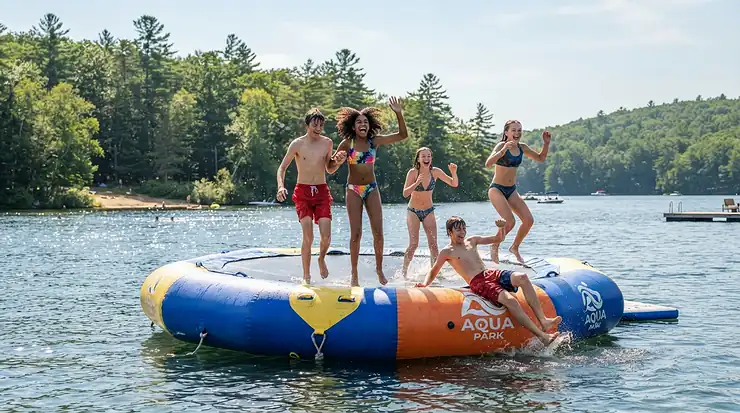
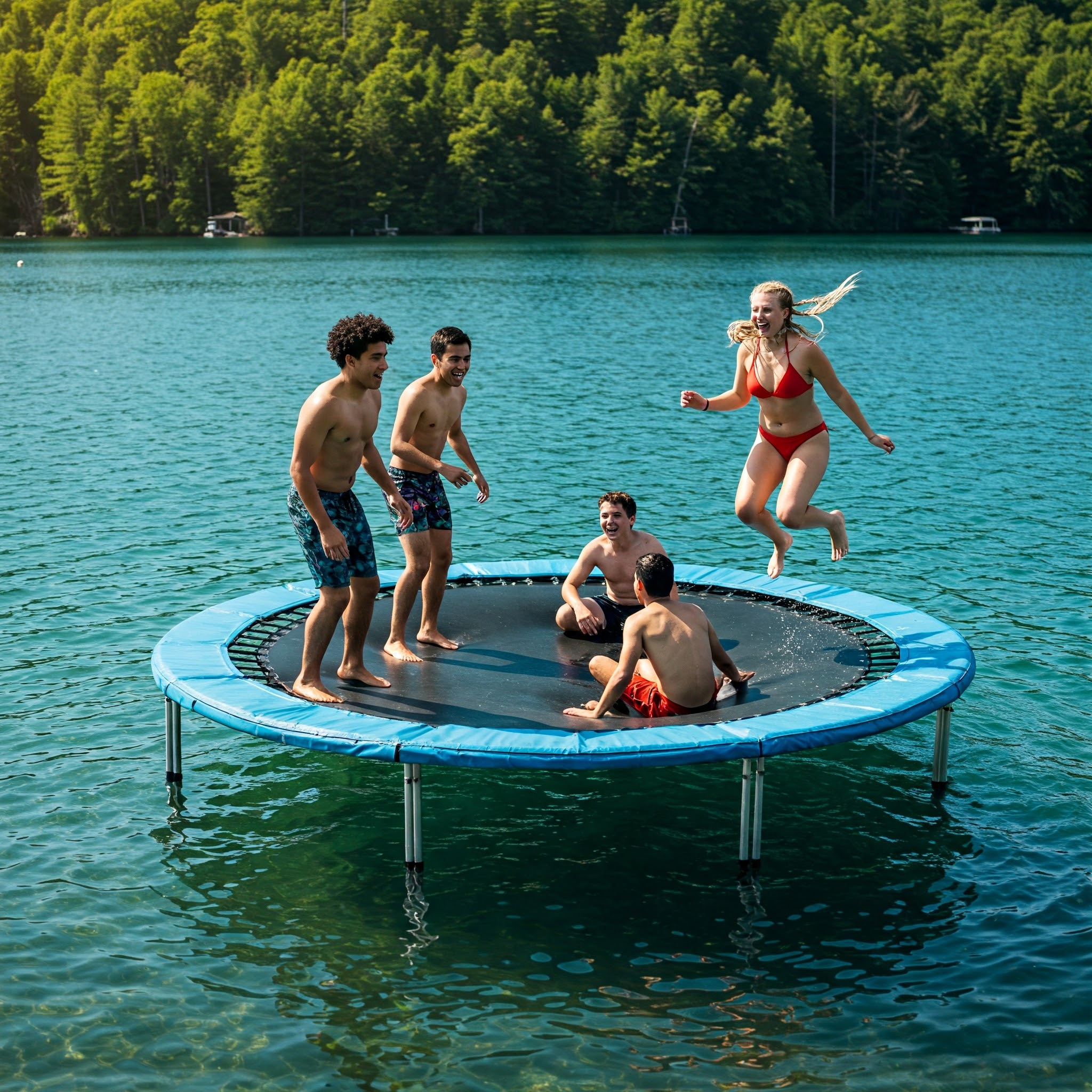
The RAVE Sports Aqua Jump Eclipse 120 asks for at least 10 feet of water, and Rave’s own anchoring guide calls for a minimum of 150 pounds of anchor weight in most setups. The Goplus 12FT Inflatable Water Bouncer lists 6.5 feet of depth and arrives with a single anchor. Both get sold as a water trampoline for lake use, yet they are very different commitments in money, muscle and mooring.
Prices are ranges pulled from those pages and they shift, so check the current price on Amazon.com before you order.
If you’re buying for the 2027 season, start with three questions, then match one of four picks to your water and your crowd. Anchoring, reviews and the Oregon rules questions come after.
Three questions that narrow a lake trampoline fast
Answer these in order and most of the surprises disappear before the box reaches the dock.
How deep is the water where it will sit, measured at the lowest point of the season?
Who will be jumping: young kids, teens, adults, or all three at once?
Will it stay moored for months or come out of the water every weekend?
Depth comes first because it rules models out. Rave lists 10 feet for its spring-type trampolines, 8 feet for its springless bouncers, and Goplus lists 6.5 feet. A Detroit Lake campground listing notes that the lake level changes with the seasons, which is a reminder that the depth you measure in June may not be the depth you have in September.
Model
Water depth listed
Capacity listed
Weight listed
Bounce type
Price range
RAVE Sports Aqua Jump Eclipse 120
10 ft
500 lb, up to 4 users (manual)
about 98 lb
70 springs
around $2,300 to $2,700
Island Hopper 13′ Bounce N Splash
not listed
300 lb on one page, 500 lb on others
about 70 to 78 lb
springless webbing
around $1,100 to $1,150
RAVE Sports Bongo 13
8 ft
700 lb (2 adults or 4 children)
50 lb
springless
around $900 to $1,300
Goplus 12FT Inflatable Water Bouncer
6.5 ft
330 lb
about 51 lb
nylon cloth surface
around $300 to $330
The spread is the story. The Eclipse 120 costs several times what the Goplus 12FT does and asks for the deepest water and the heaviest anchor, while the Bongo 13 weighs half as much as the Eclipse 120 and still lists the highest capacity of the four.
Spend roughly $2,300 to $2,700 and this is the one pick that jumps like a trampoline. A Rave dealer listing counts 70 springs of 5¼ inches under a safety pad, and Dick’s Sporting Goods describes the design as dropping the steel frame around the perimeter for a larger jump surface, faster setup and less weight. Cabela’s lists the footprint at 12 feet 2 inches by 26 inches high, and Overtons and Rave dealers list a limited lifetime warranty.
Capacity depends on who you ask. Overtons shows a maximum of 2 users, while Rave’s owner’s manual allows up to 4 users and 500 pounds for the 120. The manual also sets a working pressure of 2 psi, warns that over-inflation can rupture a seam, bars pool use, recommends against children under six, and says the safety pads stay on at all times. It asks every jumper to wear a Coast Guard approved Type III life vest.
This suits a lake house with a permanent mooring, teen and adult jumpers, and water that stays deep all summer. Overtons shows 3.7 of 5 for the Northwoods Edition.
Pros:
✅ Spring-based surface, with about 44 square feet of jump space per Rave dealers
✅ Limited lifetime warranty listed by retailers
✅ A manual with real anchor, pressure and capacity numbers
Cons:
❌ Needs 10 feet of water and at least 150 pounds of anchor weight
❌ About 98 pounds, the heaviest of the four to move
❌ Costs well above the other three
RAVE Sports Aqua Jump Eclipse 120See current price, sizes and reviews on Amazon.
Two pages, two warranties. Overtons lists a one-year limited warranty on the Bounce N Splash, while Pontoon Authority’s roundup lists a five-year seam and blow-out warranty. Capacity splits the same way: 300 pounds on Overtons, 500 pounds on several roundups. When pages disagree, the label and manual on the exact unit win.
The common specs agree. It is 13 feet across and 26 inches tall with a 10-foot jump surface, 1000-denier PVC, half-inch foam padding around the perimeter, six anchor D-rings, a ladder, a storage bag and a repair kit. Four retailers put it between about $1,100 and $1,150.
Real-use reports are mixed and worth reading before you commit. Pontoon Authority relays an Amazon buyer whose first unit leaked at a fold crease and again after lake use; the seller shipped a replacement fast, and the buyer topped up the air with a battery blower. That buyer also found it hard for bigger kids and adults to climb onto, and said the center dips toward the water when many people are on it, though the kids played all day and the build felt durable. BestReviews, which names it best for families, still lists weak bounce as a complaint.
So the case for it is a padded edge and a manageable size for younger children at a family dock, not lift. Overtons rates the 13-foot model 3.5 of 5 from three ratings, a thin sample.
Spotted one you like? Take a closer look at its listing and its manual before you decide.
Island Hopper 13′ Bounce N SplashSee current price, sizes and reviews on Amazon.
Fifty pounds is the number to remember. Rave lists that weight with a 12-foot-6-inch inflated diameter, 26-inch height, 66 square feet of jump mat, 8 feet of required water depth, a 3-step ladder and a 700-pound limit described as 2 adults or 4 children. Setup is listed at 10 to 18 minutes, retailers cite a limited lifetime warranty, and prices run around $900 to $1,300 across Rave’s own page and a dealer.
Anchor guidance contradicts itself. The product pages recommend 35 to 45 pounds of anchor weight, and one dealer notes that no anchor system is included. Rave’s own anchoring guide says a minimum of 150 pounds is needed for most applications and asks for at least 15 feet of clearance from docks and boats for a bouncer. For a lake with wind or current, I’d plan around the heavier figure.
No springs means no rust, which Rave’s product data cites as the reason its springless bouncers are preferred for salt water. It also means a softer jump. Pontoon Authority, which lists it first, notes that it does not offer the same jump as a spring-based water trampoline.
A 50-pound bag one person can carry down a dock makes sense for someone who inflates and anchors it each weekend, a rental cabin, or a cove that gets used only in July and August.
RAVE Sports Bongo 13See current price, sizes and reviews on Amazon.
For a family that wants to learn whether anyone will use a lake trampoline before spending four figures, this is the entry point. Walmart lists the 12-foot at around $315 to $320, with 10- and 15-foot versions at roughly $250 and $390. The box includes a 500W electric inflator, a rope ladder, three mooring ropes and one anchor; the listing gives a 330-pound limit and a 6.5-foot depth requirement for calm water.
Look at the age line. The listing recommends it for ages 14 and up, which matters if your jumpers are younger. The pages give no anchor weight, and that single included anchor is a long way from the 150 pounds Rave asks for on its own bigger models, so budget for something heavier.
Specs are easy to cross up between sizes: one Walmart page lists 180 by 180 by 25.5 inches and 65 pounds, which are 15-foot dimensions, while Lowe’s lists 144 by 144 by 25.5 inches and 51 pounds for the 12-foot. Goplus sells 10-, 12- and 15-foot versions, so match the size on the listing before ordering. BestReviews names it best bang for the buck but flags concerns about longevity, and a Desertcart mirror of a Goplus water trampoline listing shows 4.0 of 5 from 213 ratings.
Pros:
✅ Inflator, ladder, mooring ropes and an anchor in the box, per Walmart
✅ Only 6.5 feet of water required
✅ By far the lowest cost of the four
Cons:
❌ 330-pound limit and a recommended minimum age of 14
❌ Longevity concerns noted by BestReviews
❌ Retailer pages mix up specs between the three sizes
Spotted one you like? Have a closer look at the listing and its depth line.
Goplus 12FT Inflatable Water BouncerSee current price, sizes and reviews on Amazon.
Anchoring is what decides whether a lake setup lasts
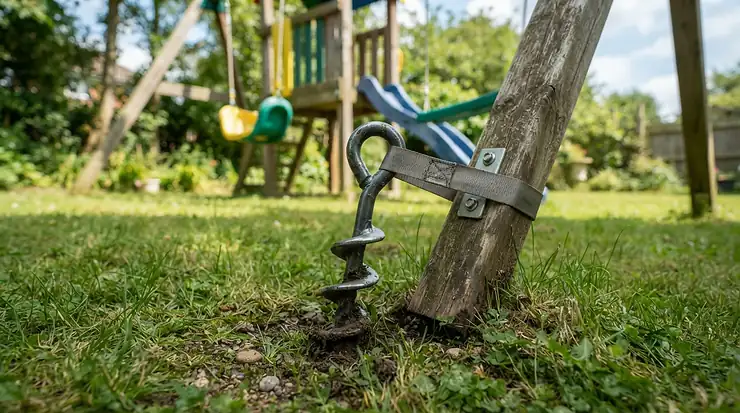
Rave’s guide matches the anchor to the bottom. Sandy or rocky bottoms call for an earth anchor that screws in, weedy or muddy bottoms for concrete blocks with chain, and bell anchors are out because they drag. Add a shock cord to absorb waves and bounce, and in windy conditions double the anchor weight. The same guide wants a water trampoline at least 30 feet from docks and boats, and a bouncer at least 15 feet.
Rave’s owner’s manual for its spring-type trampolines adds line geometry: a line about 1 to 2 feet longer than the water depth, with total slack of 3 feet or less, because too much slack can let the unit stand on edge in high wind. My reasoning from that: if a reservoir drops through summer, the slack grows, so check the line again after the level moves.
Owner reports back up the weight advice. On the Winnipesaukee Forum, a New Hampshire lake community board, one member uses a 500-pound concrete block placed by a diver, with all stainless chain and hardware. Another reports that the chain on a 12-year-old setup had corroded “wafer thin” before a storm finished it. Two members, one report each, but both point at the hardware under the water.
Water options for trampolines: lake, pool, or salt water
A pool is the wrong place for most of these. Rave’s manual bars use in swimming pools and calls for a large body of water at least 10 feet deep, and even the 6.5 feet Goplus lists rules out most backyard pools. Walmart listings for several cheaper models pitch pool use anyway, so read the depth line, not the headline.
Salt water is where the springs matter. Rave’s data says its springless bouncers avoid rust and are preferred for salt water, and Overtons sells a separate saltwater version of Rave’s 20-foot spring model, which suggests spring models need a different build there. For freshwater lakes any of the four works if the depth and anchor are right.
Reviews for lake trampolines: what owners and retailers report
Star ratings on these products rest on small counts. Overtons shows 3.5 of 5 from three ratings on the 13-foot Bounce N Splash and 3.7 of 5 on the Eclipse 120 Northwoods Edition, which is too little to rank anything on. The longer stories carry more weight.
Seams and creases are the recurring leak point. The Amazon buyer quoted by Pontoon Authority found the leak at a fold crease. Repair experience varies on the Winnipesaukee Forum: one member describes sending a leaking water trampoline to a Florida repair service that was costly and slow, enough that they’d think long and hard before repairing again, while another says rubber repair kits fix a leak easily once it’s found. A repair kit in the box, which the Bounce N Splash and Eclipse 120 both include, is worth having.
On bounce, roundups agree that springless designs soften the jump. A reader who wants real lift should look at spring models, and one who mostly wants a floating deck for lounging and swimming will not miss it.
Lakes in Oregon with water trampoline rules: what the state pages say
I found no official list of Oregon lakes that allow or ban a privately owned water trampoline, so treat any lake-by-lake answer you see with caution and ask the managing agency. What the state pages do say is narrower. The Department of State Lands says Oregon-owned rivers and lakes are open for lawful activities such as swimming and boating, that the public may not go above the ordinary high water line onto private land, and that building something like a dock needs a waterway authorization or other permits.
The closest rule I could find sits with the Marine Board. OAR 250-010-0097 covers special use devices such as ski courses, ski jumps and race buoys, and exempts a private, non-commercial device that is installed and removed between sunrise and sunset and stays up no more than 12 hours. DSL’s registration rule for non-commercial docks and floats also covers water sport structures unless the Marine Board authorizes them, without defining the term, so the text doesn’t say whether an anchored inflatable counts.
So an inflate-in-the-morning, pack-up-by-dusk setup looks like the easiest to defend, while anchoring one all summer in popular reservoirs like Detroit Lake or Lake Billy Chinook is the case to raise with DSL, the Marine Board and the park or lake manager first.
Four ways a lake setup goes wrong
Buying for the listed depth rather than the late-summer depth is the first. A spot that measures 11 feet in June could fall below the 10 feet Rave asks for by September.
Treating the bundled anchor as the plan is the second. One anchor in a Goplus box and a 35-to-45-pound figure on a Bongo 13 page both sit far below Rave’s 150-pound guide.
Ignoring the climb comes third. The buyer Pontoon Authority quoted found the Bounce N Splash hard for bigger kids and adults to climb onto, so check which ladder comes in the box: the Goplus 12FT lists a rope ladder and the Bongo 13 a 3-step ladder.
Leaving it ready to use is the fourth. Rave’s manual says that when not in use, you should disconnect the ladder and take the unit out of the water to prevent unauthorized access.
Five quick answers on depth, anchors and leaving it in the water
❓ How deep does the water need to be for a lake water trampoline?
✅ It depends on the model. Rave's manual calls for at least 10 feet for its spring-type trampolines, Rave lists 8 feet for its springless bouncers, and Goplus lists 6.5 feet for its 12-footer. Measure at the lowest level your lake reaches in late summer.
❓ How do you anchor a water trampoline in a lake?
✅ Match the anchor to the bottom: screw-in earth anchors for sand or rock, heavy concrete blocks with chain for mud or weeds. Rave says at least 150 pounds for most setups, plus a shock cord in the line to absorb waves and bounce.
❓ Can you leave a water trampoline in the lake all summer?
✅ Some Winnipesaukee Forum owners do, using heavy blocks and stainless chain, and one member recommends a dive service for seasonal put-in and take-out. Rave's manual says to remove it from the water or disconnect the ladder when unused. In Oregon, ask the state before leaving one anchored.
❓ Is a water trampoline as bouncy as a regular one?
✅ No. Pontoon Authority notes that springless bouncers don't offer the same jump as spring-based water trampolines, and BestReviews lists weak bounce as a complaint about one padded model. Choose a spring-type model if bounce matters most to you.
❓ How many people fit on a 12-foot water trampoline?
✅ Check the maker's limit, not the diameter. Rave's manual allows four users and 500 pounds on its 12-foot spring model, while Goplus lists 330 pounds for its 12-footer. Rave's 13-foot springless bouncer lists 700 pounds, described as two adults or four children.
Which one to buy, by the water you have
Pick by depth first, then by who is jumping. For deep water, a fixed mooring and teens or adults who want real bounce, the RAVE Sports Aqua Jump Eclipse 120 is the one to build the setup around. For younger kids at a family dock, the Island Hopper 13′ Bounce N Splash gives a padded edge and a modest size. For a trampoline that comes out every weekend, the RAVE Sports Bongo 13 is the 50-pound option. For a low-cost trial in calm water, the Goplus 12FT Inflatable Water Bouncer is the cheapest way in, provided you upgrade the anchor.
Whichever you choose, treat the anchor and the depth line as part of the purchase. A water trampoline for lake use is only as good as what holds it down, and in Oregon, a quick call to the state agencies before leaving one anchored is cheap insurance.
Spotted the one for your shoreline? Take a closer look at its listing and its manual.
The WhizKiddo editorial team researches baby gear, outdoor play equipment, trampolines and kids' products using manufacturer specifications, safety guidance from bodies such as the CPSC and AAP, independent tests, parent reports and retailer listings. We do not claim to have tested the products ourselves. Read how we work on our How We Choose Gear page.