About 50,000 children a year are treated in U.S. emergency rooms for injuries on home playground equipment, and roughly 80 percent of those injuries come from falls, according to the CPSC’s outdoor home playground handbook. That number is the reason to choose a jungle gym for kids by age, weight and ground space first, and by feature list last.
I haven’t assembled or climbed on any of the frames below. Everything here comes from maker pages, retailer spec lists and CPSC and pediatric guidance, and where two listings disagree I say so and name the figure I’d plan around. Going into 2027, five outdoor jungle gyms for kids made the shortlist, each tied to a different household: a first climber for a two-year-old, a swing-free dome for a tight lawn, two compact swing-and-slide sets (one plastic, one cedar) and a monkey-bar frame for school-age climbers.
Three questions sort them.
Three questions that sort the field
Answer these in order. The first one usually removes two or three options by itself.
Question one: how old is the youngest regular user, and how heavy is the heaviest?
Age floors in these listings are 2 and up for one frame and 3 and up for the other four. Weight caps tell you more than group totals do. The Step2 Woodland Climber II is capped at 60 pounds per user, the clubhouse on the Step2 Playhouse Climber & Swing Extension and each of its swings at 75, and a dealer page for the Lifetime Monkey Bar Adventure lists 140 pounds per swing even though the whole structure is rated at 800. A total says how many children fit. A per-user number says when one child has outgrown the thing.
Question two: how much clear ground do you really have?
CPSC’s home guidance asks for protective surfacing at least 6 feet out in every direction from the equipment, and the American Academy of Pediatrics’ home-playground tips add that the set should sit at least 6 feet from fences and walls. Add 6 feet on every side of a frame that is 10 feet wide and you are at 22 feet across before the fence line comes into play. Measure the lawn before you read a spec sheet.
Question three: swings or no swings?
Swings enlarge the surfacing zone, since CPSC wants it to extend in front of and behind each swing by twice the height of the top bar. They also show up in the injury data: CPSC’s page on the home playground standard reports that about two-thirds of the home-equipment injuries in its 1999 study involved swings. None of that rules swings out. It makes them the feature that needs the most ground and the most watching, so a short lawn points toward a dome or a climber.
The five picks side by side
Pick
Listed ages
Listed capacity
Space the frame takes
Step2 Woodland Climber II
2 and up
60 lb per user, 180 lb total, 3 children
47 by 75 in, 53.75 in tall
Lifetime Geometric Dome Climber 90136
3 to 10
6 occupants; 600 lb on Academy’s page
10 ft wide, 5 ft tall
Step2 Playhouse Climber & Swing Extension
3 and up
75 lb per user, 300 lb total, 75 lb per swing, 4 children
110 by 115 in, 75 in tall
KidKraft Appleton
3 to 10 at Academy, 3 to 7 on other listings
660 lb, 6 children
10.25 by 9 ft
Lifetime Monkey Bar Adventure
3 to 10 or 3 to 12, depending on the listing
800 lb, 6 occupants; 140 lb per swing
17 ft 7 in by 14 ft 1 in
Only the two Step2 frames give per-child limits on the maker’s own page, and only the Step2 Playhouse Climber & Swing Extension adds a per-swing figure. The other three state group totals, and some of those totals come from retailers rather than the maker. The two Lifetime frames and the KidKraft Appleton also disagree with themselves across listings on ages or capacity, so the notes below flag which number to use.
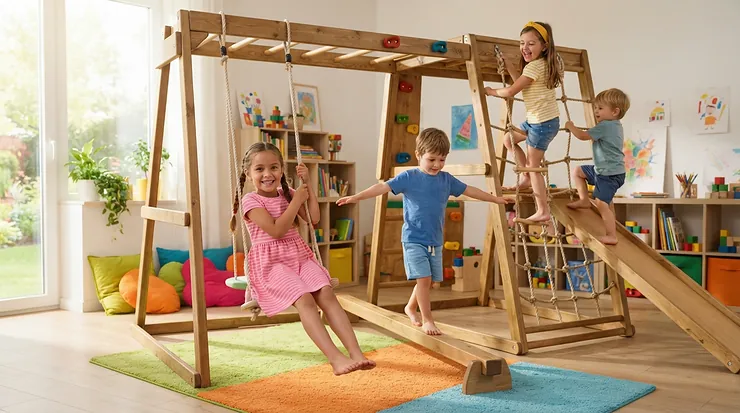
A two-year-old who wants to climb everything in sight is the audience here, and Step2 lists the minimum age at 2 and up. Assembled, the structure measures about 53.75 inches tall, 47 wide and 75 deep, and the rotational-molded plastic pieces weigh roughly 85 pounds put together, per answers on Step2’s page. The slide is about 27 inches off the ground, 16 wide and 32 long.
Capacity is the figure to read twice: 60 pounds per user, 180 pounds in total, three children at a time. A resale listing I came across cites 240 pounds, so go with the maker’s numbers. A 60-pound per-user cap also sets a ceiling on how long any one child can use it, however much they still enjoy it.
Step2 labels it an outdoor set, requires adult assembly and carries small-parts and sharp-points warnings. Its own page shows 4.7 out of 5 across 141 reviews, which is the maker’s site and should be read as such. One reviewer there reports building it alone in under 90 minutes. Counting a 6-foot surfacing zone on every side, my arithmetic gives a clear patch of about 16 by 18 feet. Step2’s page puts the price around $400, so check the current price on Amazon.com.
Replacement parts are free under warranty, according to Step2’s Q&A, but individual parts aren’t sold, so a cracked piece means a claim rather than a quick order.
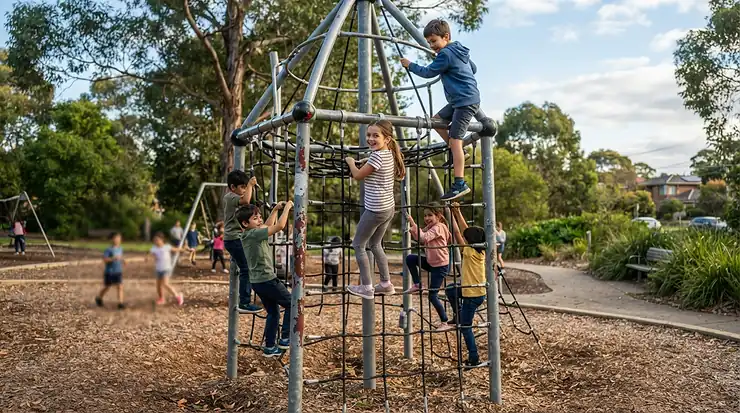
Nothing on this frame swings, and that is the whole appeal. Lifetime’s page lists ages 3 to 10, a size of 5 feet tall by 10 feet wide and a limit of six occupants. The frame is powder-coated steel with polyethylene grips, and the page says it stands on its own with no cement or bolt-down installation.
Lifetime says the dome passes playground performance and safety standards but names none, and its page gives no user weight limit or warranty. Academy’s listing for the same dome fills one gap: a 600-pound maximum and a 6.6-foot safety perimeter. Both pages put the price around $300. At 5 feet, the dome sits inside CPSC’s home surfacing guidance for sand or pea gravel (9 inches up to 5 feet) as well as for wood chips and rubber mulch (9 inches up to 8 feet).
Without swings, the ground math is simple: 10 feet of dome plus 6 feet on each side is about 22 feet square, or just over 23 with Academy’s perimeter.
Pros:
✅ No chains, hooks or seats to inspect, because none are listed
✅ Freestanding, per Lifetime, so there’s nothing to cement in
✅ Two retailers’ pages agree on the size
Cons:
❌ Lifetime’s own page lists no weight limit and no warranty
❌ The 600-pound figure comes from Academy alone
❌ A 10-foot structure needs a clear area over 22 feet square
Price tier first: Step2’s own page lists it around $900, with a separate truck-delivery and curbside fee, so compare the Amazon.com listing before deciding. For that money you get a climber with a door, a 5.5-foot slide, two strap swings, an A-frame, ground anchors and the hardware, in double-wall plastic that Step2 calls weather resistant and easy to clean.
Step2 spells the limits out clearly: 75 pounds per user and 300 total in the clubhouse, 75 pounds per swing, four children at once, ages 3 and up. Assembled, it measures 75 inches tall, 110 wide and 115 deep. The swing’s top bar can’t be taller than the 75-inch overall height, so twice that gives at most about 12.5 feet of surfacing in front of and behind the swings by CPSC’s rule.
Reviews on Step2’s page average 4.4 out of 5 across 171. One reviewer says the strap swings weren’t suitable for a 20-month-old and bought a separate toddler seat, and a 3-star review says the swing crossbar didn’t seat properly in the tower. The included ground anchors have to be driven into the soil, so according to Step2’s Q&A any thick tiles or flooring in that spot may need to come up first, which matters if you were planning on rubber mats.
Step2 links its warranty page without summarizing the terms in the listing.
Academy’s spec list and other retailer pages disagree about who this set is for: ages 3 to 10 at Academy, 3 to 7 on other listings. The smaller range is the safer one to plan around. Academy lists a maximum of 660 pounds and six children, 10.25 feet long by 9 feet wide, and a safety perimeter of 22.7 feet.
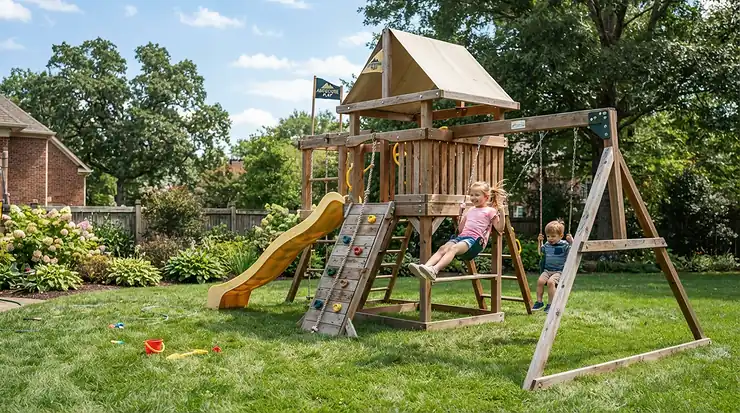
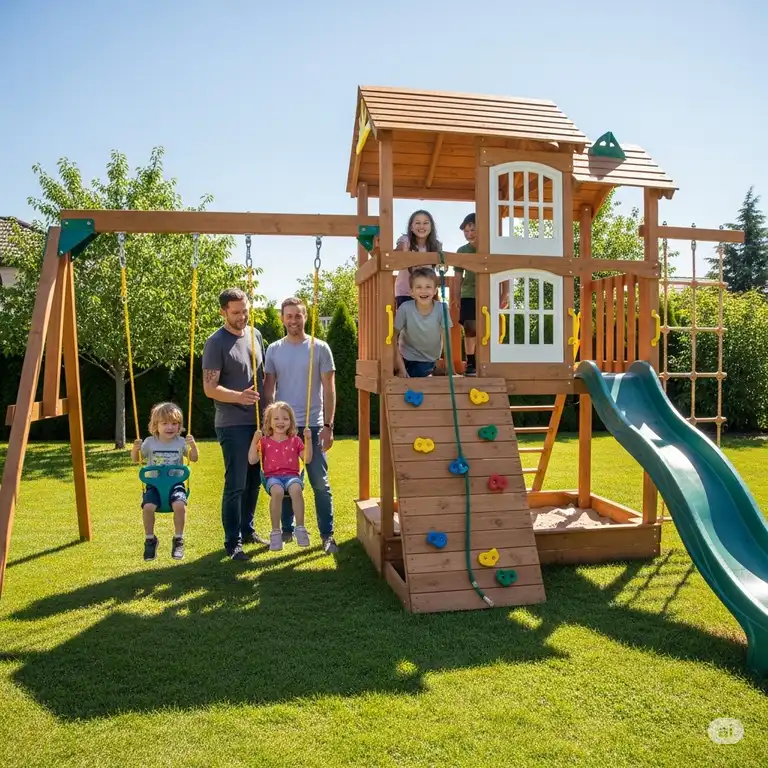
What you get is a canopied play deck, two belt swings, a high-rail wave slide, a rock climbing wall, a sandbox and a vinyl chalk wall, all in cedar. Assembly is listed at 4 to 8 hours and recommended for two people, and the warranty is five years limited on parts, labor and general coverage. Academy’s page shows the set around $600.
Wood trades the maintenance-free plastic of the Step2 frames for a look that blends into a yard, and sealing the lumber becomes your job. KidKraft’s figures reach me only through Academy’s page, so check the manual’s surfacing zone against CPSC’s twice-the-bar-height rule for swings before you place it.
The 10.25-by-9-foot footprint looks modest, yet the 22.7-foot safety perimeter means the set still wants more than twice that length in clear ground.
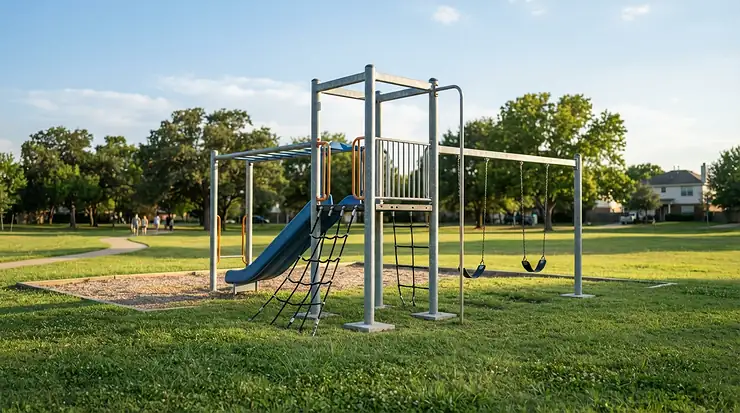
Monkey bars are the dividing line. Where the other four frames stop at a slide or a rock wall, this one adds a trapeze bar with gym rings, a fireman’s pole and three belt swings. Lifetime’s own page for the primary-color version, 91022, shows no specifications in what I could read, so the figures below come from Academy’s listing and a dealer page for the earthtone model, 91028.
Academy lists ages 3 to 10, an 800-pound maximum and six children, with one slide. The dealer page says ages 3 to 12, 140 pounds per swing, a footprint of 17 feet 7 inches by 14 feet 1 inch, a swing bar 7 feet 9 inches high and a five-year limited warranty. Molded parts are high-density polyethylene, and the dealer calls the set freestanding with no cement required. Follow the manual’s anchoring instructions regardless, since CPSC asks owners to follow the maker’s guidance so equipment doesn’t tip.
Twice a 7-foot-9-inch bar is 15.5 feet, which is how far CPSC’s rule asks for surfacing in front of and behind the swings. The dealer’s listed safety zone works out to about 33 by 27 feet, so check which way the swings face and compare both numbers before choosing a spot, then use the larger one.
Pros:
✅ Monkey bars, a trapeze bar with gym rings, a fireman’s pole and three belt swings
✅ An 800-pound total and six occupants on Academy’s listing
✅ A five-year limited warranty on the dealer’s page
Cons:
❌ Ages read 3 to 10 on one page and 3 to 12 on another
❌ A listed zone near 33 by 27 feet, before the swing rule is applied
❌ A 7-foot-9-inch bar means a long surfacing strip in front of and behind the swings
Where a toddler jungle gym ends and a backyard jungle gym for kids begins
Four of the five frames start at age 3, and the fifth at 2. That makes the Step2 Woodland Climber II the only toddler jungle gym on the list, and the rest are frames to grow into. A household with a 2-year-old and a 7-year-old (a hypothetical pairing) can reasonably buy the Step2 Woodland Climber II now and add a bigger frame later, rather than force one structure to serve both.
Swing seats deserve their own line. The sets here come with belt or strap seats, and the Step2 reviewer who needed a separate toddler seat is a reminder that the default seat isn’t built for the youngest. CPSC’s home handbook says never to leave a child alone in a toddler swing and to use its restraint system when one comes with it. The American Academy of Pediatrics also recommends soft swing seats rather than wood or metal ones.
Ground rules that apply to every frame here
Surfacing is the part buyers skip. CPSC’s handbook calls for 9 inches of wood chips, engineered wood fiber or shredded rubber mulch under equipment up to 8 feet high, and 9 inches of sand or pea gravel up to 5 feet. It suggests starting with about 12 inches of loose fill because the material compresses to roughly 9 over time. Safety-tested rubber mats are the alternative.
One wrinkle on height: CPSC’s one-page home playground checklist quotes 9 inches for equipment up to 7 feet, while the handbook says 8. The Lifetime Monkey Bar Adventure has a swing bar listed at 7 feet 9 inches, so the handbook figure and the maker’s manual are the ones to follow.
The same checklist asks you to look for open S-hooks and protruding bolt ends, and to keep openings, such as gaps between ladder rungs or guardrails, under 3.5 inches or over 9 inches. It also says never to tie ropes, jump ropes, clotheslines or pet leashes to the equipment. Remove exposed footings, stumps and rocks around the set, and check the anchors after storms.
Buying locally: jungle gyms at Academy versus ordering online
Three of the five frames show up on academy.com spec pages that I opened: the Lifetime Geometric Dome Climber 90136, the KidKraft Appleton and the Lifetime Monkey Bar Adventure. Academy’s page for the dome is marked online only, so a store trip isn’t a given. I can’t see store inventory, so if “SA” for you means San Antonio, the store locator on academy.com is how to find out which location has a floor model to look at.
Seeing a frame in person helps with scale, because a 10-foot dome and a 17-foot swing set look different on a lawn than in a photo. For the exact model you want, compare the Academy page against the Amazon.com listing for ages, capacity and what’s included in the box.
Four questions before the boxes arrive
What is the best outdoor jungle gym for kids?
There isn’t one winner. For a child under 3, the Step2 Woodland Climber II is the only frame in this group listed from age 2. For ages 3 and up, the answer depends on lawn size and whether you want swings.
How much space does a backyard jungle gym for kids need?
At least 6 feet of surfacing in every direction from the equipment, and for swings twice the height of the top bar in front and behind. By that arithmetic the Lifetime Geometric Dome Climber 90136 needs about 22 feet square and the Lifetime Monkey Bar Adventure more than 31 feet in the direction the swings travel.
Is grass enough under a toddler jungle gym?
CPSC’s list of surfacing is wood chips, engineered wood fiber, rubber mulch, sand, pea gravel or safety-tested mats, and plain lawn isn’t on it. The handbook says about 80 percent of home-equipment injuries are falls, which is the reason it spends so much of its length on what goes under the frame.
Which safety standard should the label name?
The American Academy of Pediatrics’ home playground tips say to buy equipment marked as meeting ASTM F1148. Lifetime’s pages say its sets pass safety standards without naming one, so ask the seller which standard applies before you order.
Start with the youngest child, then the shortest lawn dimension
For a two-year-old, the Step2 Woodland Climber II is the one frame here with an age floor that low. A tight lawn with mixed ages and no room for swing arcs suits the Lifetime Geometric Dome Climber 90136. Preschoolers who want swings and a slide can go with the Step2 Playhouse Climber & Swing Extension if you’d rather skip upkeep, or the KidKraft Appleton if you prefer cedar. School-age climbers belong on the Lifetime Monkey Bar Adventure.
Whichever you choose, the right jungle gym for kids in your yard is the one whose surfacing zone you can really clear, so lay that out before comparing features. Check current availability on Amazon.com.
Disclaimer: This post contains affiliate links. As an Amazon Associate, I earn from qualifying purchases made through these links, at no additional cost to you.
Tape out the safety zone on your lawn before you order anything.
At WhizKiddo, our mission is to help parents find the safest and most engaging toys for their little ones. With years of experience researching child-friendly products, we provide honest, in-depth reviews to ensure you make the best choices for your kids
Home » Jungle gym for kids — Find Your Fit in Three Questions About 50,000 children a year are treated in U.S. emergency rooms for injuries on home playground equipment,
Home » Jungle gym for kids — Find Your Fit in Three Questions About 50,000 children a year are treated in U.S. emergency rooms for injuries on home playground equipment,
Home » Jungle gym for kids — Find Your Fit in Three Questions About 50,000 children a year are treated in U.S. emergency rooms for injuries on home playground equipment,