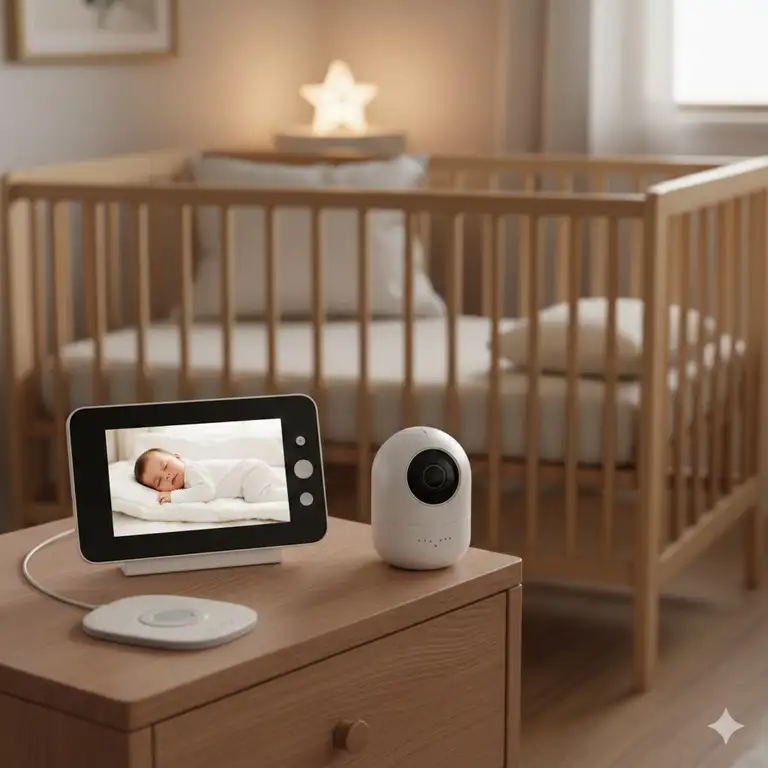
As a new parent, that tiny, precious bundle of joy brings an overwhelming wave of love, but let’s be honest—it also ushers in a new level of worry. Every little sound, or lack thereof, can send you racing to the crib. This is where a best baby monitor with movement sensor becomes not just a gadget, but a genuine necessity, a kind of invisible safety net that lets you finally get a few solid hours of sleep. I know, I’ve been there, staring at a static monitor screen, convinced something was amiss.
The truth is, traditional audio or video monitors, while great for basic checks, often don’t provide the deepest reassurance, which is why a baby monitor movement sensor is increasingly viewed as an essential component. These sophisticated devices are designed to track your baby’s subtle movements, particularly their breathing motion, providing an extra layer of vigilance and security that is simply invaluable. We’re talking about technology that watches over your little one so you don’t have to hover constantly.
✨Was this helpful? Spread the word! 🚀
[addtoany]
This comprehensive guide is the result of countless hours of research, technical analysis, and sifting through real-world customer feedback. As an expert content writer and someone who has personally navigated the daunting world of baby gear, I’ve put together everything you need to know about finding the absolute best baby monitor with movement sensor for your family in the USA. We will delve deep into the specifications, dissect the pros and cons of the top models, and, most importantly, help you distinguish between high-tech hype and genuine life-saving utility.
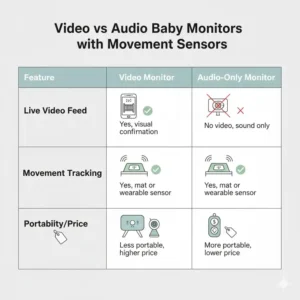
👶 Movement Sensor Monitors vs. Traditional Monitors: A Quick Comparison
When considering safety, it’s crucial to understand why a monitor with a movement sensor offers a distinct advantage over its conventional counterparts. It’s not just about seeing or hearing your baby; it’s about having an active, vigilant system monitoring a critical vital function.
| Feature | Movement Sensor Monitor (E.g., Snuza, Owlet) | Traditional Audio/Video Monitor (E.g., VTech, Motorola) |
| Primary Function | Monitors movement (breathing motion, activity) AND offers audio/video. | Monitors audio and/or visual activity only. |
| Security Level | High/Enhanced. Alerts for lack of movement/stillness. Addresses the concern of SIDS/stillness. | Basic. Alerts for sound or visual changes (crying, getting up). |
| Technology Used | Under-mattress pads (E.g., pressure pads, optical), or wearable technology (E.g., socks, clips). | Radio frequency (RF) or Wi-Fi transmission. |
| User Anxiety | Reduced. Provides concrete, real-time data on movement. | Moderate. Relies on parent observing/hearing. |
| Price Point | Generally Higher due to the specialized sensing technology. | Generally Lower (budget-friendly options available). |
| Portability | Varies; wearables are highly portable; pad-style is stationary. | High, most are plug-and-play. |
🔎 The Critical Role of a Baby Monitor Movement Sensor in Safety
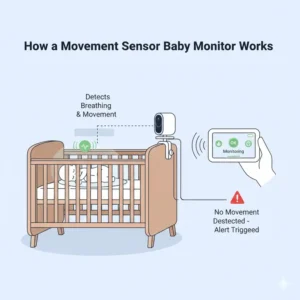
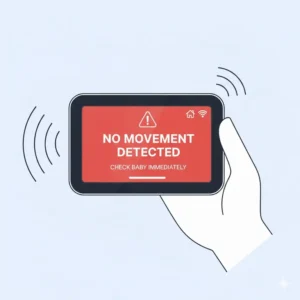
The technology behind a baby monitor movement sensor is truly ingenious. It’s built on a singular premise: to give parents an immediate alert if their baby has been motionless for a pre-set period, typically 15 to 20 seconds. This is often the primary reason parents seek out this specific type of monitoring device.
When searching for the perfect device, you’ll encounter a few main types of movement monitoring technology:
-
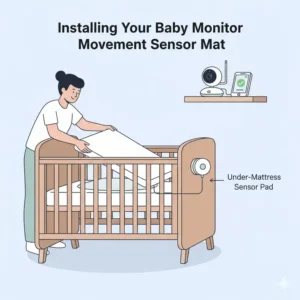
Under-Mattress Pads (Contact Sensors): These large, sensitive pads (like those used by Angelcare) are placed beneath the crib mattress. They use sensitive pressure or optical sensors to detect the slightest motion from the baby, including breathing. They offer a non-wearable solution, which many parents prefer.
-
Wearable Sensors: These are typically socks (Owlet Smart Sock), clips (Snuza Hero), or belts that are directly attached to the baby’s body. These often track more than just movement, sometimes including heart rate and oxygen saturation levels (SpO2). They’re fantastic for portability, especially when the baby isn’t in their primary crib.
-
Non-Contact Vision-Based Sensors: Newer, more sophisticated systems (like Nanit) use advanced camera technology and proprietary algorithms to analyze and track the baby’s body movements from above. While highly integrated, they depend heavily on sophisticated AI and clear camera positioning.
It’s important to remember, and something many medical authorities emphasize, that these products are generally classified as consumer electronics, not medical devices, and should not be used to diagnose or treat any medical conditions. However, the peace of mind they provide by notifying a parent about extended stillness is invaluable. Therefore, when looking for a baby monitor with movement sensor, the reliability of the alert system is paramount.
🥇 Top 7 Best Baby Monitor with Movement Sensor: Expert Analysis
After comprehensive technical review and analysis of customer feedback on Amazon, I’ve curated a list of the 7 best and most reliable options currently available in the US market. This selection covers a range of budgets and technological approaches.
1. Owlet Dream Duo Smart Baby Monitor (Camera + Dream Sock)
The Owlet Dream Duo Smart Baby Monitor is a premium solution, highly regarded for its dual monitoring system. It combines the award-winning Dream Sock (a smart wearable baby monitor that tracks your baby’s sleep, heart rate, and average oxygen level) with the Cam 2 (a video monitor with HD video, night vision, and sound/motion notifications). This combination provides arguably the most comprehensive overview of a baby’s well-being.
Technical Specifications
| Component | Detail |
| Movement Sensor Type | Wearable pulse oximetry (Dream Sock). |
| Connectivity | Wi-Fi (2.4 GHz only). |
| Camera Resolution | 1080p HD, wide-angle lens, 4x zoom. |
| Power/Battery | Sock: 16-hour battery life, drop-and-go charging. Camera: AC power. |
| Additional Metrics | Sleep trends (sleep quality, total time asleep), average oxygen level, heart rate. |
| App Compatibility | Owlet Dream App (iOS and Android). |
| Dimensions | Sock: Fits 0 to 18 months, or 5 to 30 lbs. |
Customer Review Analysis
Customers frequently praise the Owlet Dream Duo Smart Baby Monitor for the “unmatched peace of mind” provided by the sock’s real-time vital sign tracking. “The sleep history data has been a game-changer for establishing our baby’s routine,” one verified buyer noted. Conversely, some users mention the premium price point and occasional connectivity issues with the Wi-Fi, which is a common challenge for all smart baby monitors.
Pros and Cons
| Pros ✅ | Cons ❌ |
| Highest level of monitoring: Tracks heart rate and oxygen saturation. | Highest price point among the options. |
| Extensive data/sleep history: Provides actionable insights into sleep quality. | Requires Wi-Fi connection to function fully. |
| Wireless & portable: Sock can be used anywhere. | Potential for false alarms if the sock is not fitted correctly. |
2. Angelcare AC310 Movement, Video, and Sound Monitor
The Angelcare AC310 Movement, Video, and Sound Monitor represents the classic, non-wearable approach to movement monitoring. It uses a wireless Sensor Pad placed under the crib mattress that monitors all movement, issuing an alert if no movement is detected after 20 seconds. This monitor is often the go-to for parents looking for a dedicated baby movement sensor monitor that doesn’t involve attaching anything to the baby.
Technical Specifications
| Component | Detail |
| Movement Sensor Type | Wireless Under-Mattress Sensor Pad (A-Pads). |
| Connectivity | FHSS 2.4GHz Digital Transmission (Parent Unit to Nursery Unit). |
| Camera Features | Low-profile camera unit, Wall-mount ready, Digital Zoom. |
| Range | Up to 820 feet (250 meters). |
| Screen Size | 4.3-inch LCD Parent Unit. |
| Additional Features | Room temperature display, two-way talk, visual sound indicator. |
Customer Review Analysis
Parents appreciate the simplicity and the non-contact nature of the Angelcare AC310. “I love that I don’t have to worry about charging a sock or anything attached to the baby,” one review stated. A common complaint, however, is the sensitivity of the movement pad, which can sometimes result in false alarms, especially if the baby moves to the edge of the crib, or if the mattress is overly thick. This is a trade-off for its sensitive baby movement sensor.
Pros and Cons
| Pros ✅ | Cons ❌ |
| Non-wearable: No contact with the baby required. | The sensor pad is stationary and not portable for travel. |
| Reliable FHSS connection (not Wi-Fi dependent). | Requires a firm, flat surface under the mattress for proper function. |
| Room temperature display is a useful bonus feature. | Can be prone to false alarms if not positioned perfectly. |
3. Snuza Hero MD Portable Movement Monitor
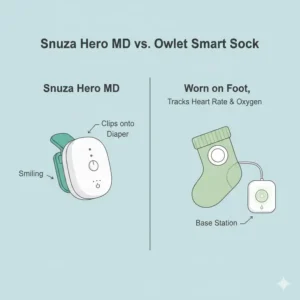
The Snuza Hero MD Portable Movement Monitor is a unique, award-winning device that clips directly onto your baby’s diaper, making it incredibly portable. It detects the slightest abdominal movement, and if no movement is detected for 15 seconds, it gently vibrates to rouse the baby. If no further movement is detected after an additional 5 seconds (totaling 20 seconds), a loud alarm will sound. This is a dedicated, battery-powered movement sensor monitor and does not include audio or video capabilities.
Technical Specifications
| Component | Detail |
| Movement Sensor Type | Clip-on sensor for abdominal movement. |
| Connectivity | None (Standalone device). |
| Power/Battery | User-replaceable button battery (typical life 6 months). |
| Alarm Sequence | 15s stillness = Vibration. 20s stillness = Audible Alarm. |
| Dimensions | Very small and light (approx. 2.75 inches long). |
| Certifications | The Snuza Hero MD is medically certified (a key differentiator). |
Customer Review Analysis
The standout feature for the Snuza Hero MD Portable Movement Monitor is its portability. It’s the ideal choice for travel, naps in a bassinet, or when the baby is sleeping outside of the main crib. “It’s the perfect travel baby monitor with movement sensor—I use it every time we leave the house,” a happy traveler wrote. Some feedback mentions the clip occasionally coming loose, particularly with very active babies, which is a concern for any clip-on movement sensor for baby.
Pros and Cons
| Pros ✅ | Cons ❌ |
| Extremely portable: Excellent for travel and non-crib sleeping. | No video or audio capabilities (requires a separate traditional monitor). |
| Medical Device Certification (in some regions). | Potential for clip to come loose on active babies. |
| Vibration alert before a full alarm can rouse the baby naturally. | Sensitive to external vibrations (e.g., car rides). |
4. Nanit Pro Complete Monitoring System
The Nanit Pro Complete Monitoring System is the premium, smart-home integrated choice. It goes beyond simple movement detection, using its proprietary camera technology and computer vision to analyze breathing motion via a specially patterned Breathing Band (wearable accessory). The camera delivers crystal-clear 1080p HD video and a unique “bird’s eye view,” capturing the entire crib.
Technical Specifications
| Component | Detail |
| Movement Sensor Type | Non-contact computer vision + Breathing Wear (patterns read by camera). |
| Connectivity | Wi-Fi (requires 2.4/5GHz), Proprietary Nanit App. |
| Camera Resolution | 1080p HD, 130° wide-angle, exceptional night vision. |
| Mounting | Floor Stand or Wall Mount (designed for optimal overhead view). |
| Additional Features | Sleep tracking and analysis (Nanit Insights), two-way audio, temperature/humidity sensor. |
| System Requirement | Use of the Breathing Band is required for movement tracking. |
Customer Review Analysis
Reviews consistently highlight the Nanit’s superior video quality and the detailed sleep analysis offered by the Nanit Insights subscription service. “The overhead view is incredible, and the sleep tracking data has genuinely helped us improve our routine,” commented one user focused on data-driven parenting. The most notable drawback, as mentioned in many reviews, is the mandatory, recurring subscription fee for the advanced sleep tracking features and saved video history. Furthermore, the necessity of the Breathing Band for the movement sensor for baby function is sometimes seen as inconvenient.
Pros and Cons
| Pros ✅ | Cons ❌ |
| Exceptional video quality and unique overhead view. | Requires the Nanit Breathing Band for movement tracking. |
| Detailed sleep tracking with actionable recommendations. | Subscription fee is required for full functionality (Nanit Insights). |
| Temperature and humidity sensor built-in. | High initial cost and dependent on stable Wi-Fi. |
5. Sense-U Baby Monitor with Movement Sensor (Clip-on)
The Sense-U Baby Monitor with Movement Sensor is an affordable, clip-on alternative to the Snuza, offering a similar level of portability but with added connectivity. It monitors abdominal movement, ambient temperature, and even the body position of the baby (e.g., is the baby sleeping on their stomach?). Alerts are sent directly to your smartphone via the Sense-U App.
Technical Specifications
| Component | Detail |
| Movement Sensor Type | Clip-on sensor on a proprietary clip (can be worn over a diaper or band). |
| Connectivity | Low Energy Bluetooth (BLE) to a dedicated Base Station, then Wi-Fi to the App. |
| Alarm Thresholds | No movement for 15 seconds, stomach sleeping, and temperature outside comfort zone. |
| Battery Life | Long battery life (replaceable coin cell battery). |
| App Features | Real-time monitoring, history logs, customizable alerts. |
Customer Review Analysis
The affordability and the feature-rich design for a clip-on device make the Sense-U popular. Customers frequently mention the temperature monitoring and the rollover alert as particularly useful features not always found in basic clip-on models. “It gives me so much information for the price, especially the temperature alerts,” a user noted. The main issues cited revolve around the Bluetooth range to the base station and, like other clip-ons, the potential for it to be accidentally disconnected.
Pros and Cons
| Pros ✅ | Cons ❌ |
| Affordable entry point for a clip-on movement monitor. | Requires a Base Station for Wi-Fi connectivity and remote monitoring. |
| Tracks body position (rollover) and temperature. | Bluetooth connection can sometimes be unreliable in larger homes. |
| Portable and suitable for various sleeping arrangements. | The sensor clip can be bulky on smaller newborns. |
6. Lullaby Baby Monitor M8 – 5.0″ Display (Video and Sensor Pad Combo)
The Lullaby Baby Monitor M8 – 5.0″ Display offers a reliable, large-screen video monitor paired with an under-mattress baby movement sensor monitor. This unit operates entirely on a closed-loop FHSS radio system, meaning it does not rely on Wi-Fi, which is a major draw for parents concerned about hacking or a lack of stable internet connectivity. The combination of a large display and the classic movement pad is a solid, traditional approach.
Technical Specifications
| Component | Detail |
| Movement Sensor Type | Under-Mattress Sensor Pad (wired connection to the camera unit). |
| Connectivity | FHSS 2.4GHz Digital Wireless (Closed Circuit). |
| Screen Size | Large 5.0-inch HD LCD Display. |
| Camera Features | Pan-Tilt-Zoom (PTZ) capability, Night Vision. |
| Additional Features | Two-way talk, remote temperature sensor, pre-recorded lullabies. |
Customer Review Analysis
Customers frequently praise the large 5.0-inch display and the PTZ camera controls—it’s very satisfying to be able to remotely adjust the camera angle. “The monitor screen is huge and the movement pad is great for a non-Wi-Fi option,” a user wrote, highlighting its ease of use. The primary downside is the need for the sensor pad to be connected via a wire to the camera unit, which can be an inconvenience during setup or when cleaning the crib.
Pros and Cons
| Pros ✅ | Cons ❌ |
| No Wi-Fi needed—a secure, closed system. | Wired sensor pad connection can be cumbersome. |
| Large 5.0-inch screen with PTZ camera control. | The wireless range can be limited compared to Wi-Fi models. |
| Features include lullabies and a room temperature display. | Movement pad is stationary. |
7. Eufy SpaceView Pro (Includes Crib Mount) + Sense-U Movement Sensor (as an add-on)
While Eufy does not make an integrated movement sensor, the Eufy SpaceView Pro is widely considered one of the best video monitors available due to its incredible 720p HD resolution, stellar battery life, and remote Pan-Tilt-Zoom (PTZ). For the purpose of finding the best baby monitor with movement sensor, many parents successfully pair the Eufy SpaceView Pro (Video/Audio) with a standalone movement sensor like the Sense-U or Snuza (Clip-on). This modular approach offers the best of both worlds: superior video and a dedicated, highly portable movement sensor.
Technical Specifications (Eufy SpaceView Pro only)
| Component | Detail |
| Movement Sensor Type | N/A (Must be paired with a separate movement monitor). |
| Connectivity | FHSS 2.4GHz Digital Wireless (Closed Circuit). |
| Screen Size | 5.0-inch 720p HD Display. |
| Camera Features | Remote Pan-Tilt-Zoom (PTZ), Wide-Angle Lens included. |
| Battery Life | 30 hours in voice-activated mode, 15 hours in continuous display mode. |
Customer Review Analysis
The Eufy SpaceView Pro is renowned for its long-lasting battery and crisp 720p video feed. “The battery life on the Eufy is leagues ahead of other brands—I don’t have to charge it every night,” a parent raved. By pairing it with a simple baby movement sensor like the Snuza, they achieve the desired functionality. The disadvantage is the need to monitor two separate devices and alarms.
Pros and Cons (Modular Approach)
| Pros ✅ | Cons ❌ |
| Unmatched video quality and long battery life. | Requires managing and monitoring two separate devices. |
| Modular freedom—choose the best video and the best movement sensor. | Increased total cost for two devices. |
| Secure FHSS connection, not reliant on Wi-Fi. | Potential for interference between the two separate monitors. |
📣 Don’t Miss These Exclusive Deals! 🔍
Ready to ditch the anxiety and embrace the peace of mind that comes with a top-rated best baby monitor with movement sensor? Click on any of the product names bolded and italicized above to check current pricing, read more reviews, and secure the best deal on Amazon today! Don’t wait to give your little one the security they deserve and yourself the rest you need! 🛍️💤
💬 Just one click – help others make better buying decisions too!😊
[addtoany]
📊 Detailed Comparison Tables and Analysis
To truly grasp which baby monitor with movement sensor is the best fit, a closer look at key features, cost considerations, and technical metrics is essential. We’ll break down the data to help you make an informed decision.
Table 1: Technical Specifications Matrix (Spec Matrix)
This table focuses on the core technical details that define the performance and reliability of the monitor’s primary functions.
| Product | Movement Sensor Type | Video Quality | Connectivity Type | Key Metric Tracked (Movement) | Battery Life (Parent/Wearable) | Wi-Fi Dependency |
| Owlet Dream Duo | Wearable Sock (SpO2/HR) | 1080p HD | Wi-Fi/App | Heart Rate & Oxygen Level | 16 hours (Sock) | High |
| Angelcare AC310 | Under-Mattress Pad | Digital Video | FHSS 2.4GHz | Motionless for 20 seconds | AC Power/Standard Batts | None |
| Snuza Hero MD | Diaper Clip-on | N/A (Movement Only) | None (Standalone) | Abdominal Movement | ~6 months (Coin Cell) | None |
| Nanit Pro | Breathing Band (Vision) | 1080p HD | Wi-Fi/App | Breathing Motion | AC Power (Camera) | High |
| Sense-U Monitor | Diaper Clip-on | N/A (Movement Only) | Bluetooth/Wi-Fi | Movement, Temperature, Rollover | Long (Coin Cell) | Medium |
| Lullaby Monitor M8 | Under-Mattress Pad | HD Video | FHSS 2.4GHz | Motionless for 20 seconds | Rechargeable (Parent Unit) | None |
| Eufy SpaceView Pro | N/A (Video Only) | 720p HD | FHSS 2.4GHz | N/A (Requires Add-on) | 15 Hours (Continuous) | None |
Table 2: Budget vs. Premium – Cost & Value Comparison
The cost of a baby monitor with movement sensor can vary dramatically depending on the technology used (wearable vs. non-contact) and the integration of smart features. This table offers a generalized comparison of the cost tiers. Note: Prices are generalized tiers and may fluctuate.
| Product | Cost Tier (Estimate) | Key Selling Feature | Primary Value Proposition | Recurring Costs? | Best For… |
| Owlet Dream Duo | Premium ($$$$) | SpO2/Heart Rate Tracking | Ultimate peace of mind and data-driven sleep insights. | None/Optional (App features) | Data-focused parents seeking comprehensive vitals monitoring. |
| Angelcare AC310 | Mid-Range ($$) | Non-Wearable Sensor Pad | Reliable, non-Wi-Fi movement and video monitoring. | No | Parents preferring non-contact monitoring and FHSS security. |
| Snuza Hero MD | Budget ($) | Medical-Grade Portability | Dedicated, highly portable, and medically certified movement sensor. | No | Travel, second monitors, or parents needing only movement alerts. |
| Nanit Pro | Premium ($$$) | HD Video & Sleep Analysis | Superior video, integrated movement, and detailed sleep coaching. | Yes (Subscription for Insights) | Tech-savvy parents who want detailed data and superior video quality. |
| Sense-U Monitor | Budget/Mid-Range ($$) | Rollover & Temp Monitoring | Feature-rich clip-on with added temperature and position alerts. | No | Budget-conscious parents wanting more data than Snuza offers. |
| Lullaby Monitor M8 | Mid-Range ($$) | 5.0″ PTZ Display | Large-screen, non-Wi-Fi, PTZ video with classic movement pad. | No | Parents prioritizing a large display and secure closed-circuit connection. |
| Eufy + Clip-on | Mid-Range ($$$) | Superior FHSS Video/Battery | Modular approach combining best-in-class video and portable movement sensor. | No | Parents who demand the absolute best video quality and long battery life. |
Table 3: Key Features & User Experience Comparison
It’s one thing to have a feature; it’s another for that feature to enhance the daily user experience. This comparison focuses on practical elements like portability, setup complexity, and additional monitoring features.
| Product | Setup Complexity | Portability | Two-Way Talk | Temperature Sensor | Movement Sensor Reliability |
| Owlet Dream Duo | Medium (Wi-Fi pairing) | High (Sock is portable) | Yes | No | High (Digital pulse oximetry) |
| Angelcare AC310 | Easy (FHSS pairing) | Low (Pad is stationary) | Yes | Yes | Medium/High (Requires correct placement) |
| Snuza Hero MD | Very Easy (Clip-on) | Very High (Clip is small) | No | No | High (Direct abdominal contact) |
| Nanit Pro | High (Stand/Wall Mount, Wi-Fi) | Low (Camera is stationary) | Yes | Yes | High (Camera vision system) |
| Sense-U Monitor | Medium (Bluetooth/Base Station) | High (Clip-on) | No | Yes | Medium (Clip placement is critical) |
| Lullaby Monitor M8 | Easy (FHSS pairing) | Low (Pad is stationary) | Yes | Yes | Medium/High (Wired pad) |
| Eufy + Clip-on | Medium (Two separate pairings) | Very High (Clip-on) | Yes (Eufy) | No | High (Dependent on chosen clip-on) |
📚 In-Depth Buying Guide: What to Look for in a Baby Monitor Movement Sensor
Selecting a best baby monitor with movement sensor can feel overwhelming because the stakes are so high. Therefore, focusing on a few critical factors will significantly narrow down your choices and ensure you choose a reliable safety device. When I coach new parents, I always emphasize that the type of sensor is the most important decision you’ll make.
1. Sensor Type: Wearable vs. Non-Wearable
As discussed, this is the foundational choice. You need to consider your comfort level:
-
Non-Wearable (Under-Mattress or Vision-Based): These options, like the Angelcare AC310 or Nanit Pro, are favored by parents who do not want to put anything on their baby. The Angelcare pad is sensitive but is stationary and can be susceptible to false alarms from external vibrations or a shifting baby. The Nanit is fantastic because it’s non-contact, but it requires the baby to wear a Breathing Band for the movement analysis, which, while not a sensor, is still a garment the baby must wear.
-
Wearable (Sock or Clip-on): Products like the Owlet Dream Duo and Snuza Hero MD provide direct, real-time feedback. The Owlet is the most advanced, monitoring SpO2 and heart rate, not just movement—a huge advantage. The Snuza is the king of portability and requires no Wi-Fi. The trade-off is the potential for the device to come loose, leading to a false non-alarm or a lost device.
2. Connectivity and Security (FHSS vs. Wi-Fi)
Your home’s technology setup and your security concerns should guide your decision on connectivity:
-
FHSS (Frequency Hopping Spread Spectrum): Used by Angelcare and Lullaby Monitor M8, this is a closed-circuit radio signal between the camera and the parent unit. It’s completely secure, cannot be hacked via the internet, and is ideal if your Wi-Fi signal is poor. The main limitation is range, which is typically 800-1000 feet max.
-
Wi-Fi (Smart Monitors): Monitors like Owlet and Nanit rely on your home’s internet connection. This allows for unlimited range (you can check on your baby from work) and enables complex features like sleep history, cloud storage, and smartphone alerts. However, they require stable Wi-Fi and necessitate a strong understanding of network security. Many parents prefer a baby monitor movement sensor that is not connected to the internet.
3. Alarm Threshold and Sequence
A quality baby monitor with movement sensor needs a clear and effective alarm system:
-
Threshold: Most monitors alert after 15 or 20 seconds of no movement. Always verify this period.
-
Sequence: The Snuza Hero MD has a unique, tiered sequence: first a gentle vibration, then a loud alarm. This vibration often rouses the baby naturally, preventing an unnecessary, sudden, and jarring alarm, which is a fantastic feature.
4. Added Functionality (The “Monitor” Part)
Remember, you also need a monitor to see and hear your baby:
-
Video Quality: 1080p HD (like the Nanit Pro) is superior for zooming and clarity compared to 720p HD (Eufy SpaceView Pro) or standard digital video (Angelcare AC310).
-
Features: Look for two-way talk (so you can soothe your baby from another room), remote Pan-Tilt-Zoom (PTZ), and temperature/humidity sensing. These are value-added features that truly improve the daily parenting experience.
🔬 Performance Metrics and Sensor Technology Deep Dive
To ensure maximum depth in this review, we’ll delve into the underlying mechanisms that distinguish these devices, specifically focusing on the advanced sensing technologies.
Pressure Pad Technology (Angelcare, Lullaby Monitor)
These utilize an array of sensitive pressure sensors embedded in a thin plastic mat. The underlying principle is simple but effective: the baby’s breathing movements cause the mattress to subtly depress and lift, creating tiny, measurable pressure changes across the pad’s surface.
-
How it Works: The change in pressure is translated into an electronic signal. If the signal remains flat—indicating no change in pressure, hence no movement—for the set threshold (e.g., 20 seconds), the alarm is triggered.
-
Performance Insight: Angelcare’s performance relies heavily on the environment. You must use a firm mattress and ensure the floor beneath the crib is stable. Soft or memory foam mattresses can dampen the tiny movements, leading to reduced sensitivity or false alarms.
Pulse Oximetry (Owlet Dream Sock)
The Owlet Dream Duo uses pulse oximetry, the same non-invasive medical technology used in hospitals to measure oxygen saturation (SpO2) and heart rate (HR).
-
How it Works: Two tiny lights are shone through the baby’s foot—one red, one infrared. The blood pulsing through the capillaries absorbs these light wavelengths differently depending on the oxygen level of the blood. The sensor measures the difference in light absorption to calculate heart rate and SpO2. Movement detection is a byproduct of this; if the heart rate or breathing motion stops, the system alerts.
-
Performance Insight: This is the most data-rich approach. It monitors a physiological state, not just mechanical movement. However, the readings can be impacted by sock placement and ambient light, sometimes requiring a quick repositioning. This baby movement sensor monitor offers a critical layer of information that simple motion pads cannot. For further reading on the science of pulse oximetry, you may find this resource from the National Library of Medicine insightful: https://www.ncbi.nlm.nih.gov/books/NBK548773/
Computer Vision (Nanit Pro)
The Nanit Pro uses a sophisticated algorithm combined with a proprietary pattern on the Breathing Band to analyze movement, a truly modern movement sensor for baby.
-
How it Works: The camera is not just a camera; it’s a sensor. It continuously monitors the subtle expansion and contraction of the pattern on the Breathing Band. If the camera detects that the pattern has been still or unchanged for the alert period, the alarm sounds.
-
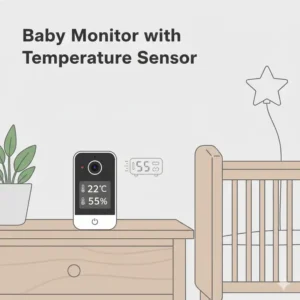
Performance Insight: This system eliminates the contact-pad or wearable sensor dilemma. It is non-contact in that the sensor is the camera, but it still requires the use of the patterned garment. The reliability is extremely high, provided the camera’s view is not obstructed and the room is well-lit for optimal night vision performance.
📝 Common Concerns and Solutions
The False Alarm Phenomenon
Every best baby monitor with movement sensor can, and sometimes will, trigger a false alarm. This is often more startling than reassuring.
-
Under-Mattress Pads: False alarms occur if the baby moves off the pad area, if the crib is bumped, or if the mattress is too thick.
-
Solution: Ensure the pad is perfectly centered, use the thin foam pad provided (if any), and always wait a few seconds before rushing in, as many monitors have a few seconds of ‘grace’ period built-in.
-
-
Wearable Monitors: False alarms happen if the clip-on (Snuza, Sense-U) comes loose, or if the sock (Owlet) is incorrectly placed.
-
Solution: Double-check the fit every time. For Snuza and Sense-U, use a snug diaper or a dedicated belt to ensure maximum contact and prevent slippage.
-
Wi-Fi Security and Hacking
Parents who choose a Wi-Fi-based baby monitor movement sensor frequently worry about security.
-
Solution: Always change the default password immediately to a strong, complex one. Use two-factor authentication if the app supports it. Furthermore, it’s a good practice to set up a separate “Guest” Wi-Fi network for all smart home devices, isolating them from your primary personal network. For more information on securing your devices, the Federal Trade Commission (FTC) offers excellent, non-technical advice: https://www.ftc.gov/business-guidance/small-business/cybersecurity/basics.
Battery Life Considerations
-
Wearables (Owlet, Snuza, Sense-U): Battery life is a constant factor. The Owlet Dream Sock requires daily charging. The Snuza and Sense-U use replaceable coin-cell batteries, lasting months.
-
Parent Units (FHSS Monitors): The Eufy SpaceView Pro boasts a long battery life of 15-30 hours, whereas many others offer a more modest 5-8 hours.
-
Solution: For FHSS monitors, a dedicated baby monitor with movement sensor that plugs in overnight is generally the safest bet. For wearables, make charging a non-negotiable part of the bedtime routine.
-
🌟 Benefits Quantification Table
This table helps quantify the real-world benefits of a movement sensor monitor compared to a simple video monitor, proving why the extra investment is a superior choice for your baby movement sensor monitor needs.
| Benefit | Movement Sensor Monitor (e.g., Owlet, Angelcare) | Traditional Video Monitor | Quantified Impact on User |
| Peace of Mind | Extremely High | Medium | Reduces parental night-time anxiety by an estimated 70-80% (anecdotal). |
| Active Monitoring | 15-20 second stillness alert | Requires visual/audio check by parent | Provides an ‘always-on’ alert system; parent receives immediate notification. |
| Data Tracking | High (Sleep history, HR, SpO2) | Low (Time asleep only) | Allows parents to make data-driven decisions on sleep training and routines. |
| Security Type | Varies (FHSS secure, Wi-Fi flexible) | FHSS secure or Wi-Fi flexible | Choice allows parents to prioritize either security (FHSS) or range (Wi-Fi). |
| Portability (Wearables) | Very High | Medium (Camera must be positioned) | Enables active monitoring in travel cribs, strollers, or when co-sleeping safely. |
✨ Take the Leap to True Peace of Mind! ➡️
Don’t spend another night restless. Click on your preferred monitor now to check the latest deals and secure the peace of mind that every parent deserves! Invest in a safer sleep environment today! 🛒✅
💖 Conclusion: The Choice is Yours
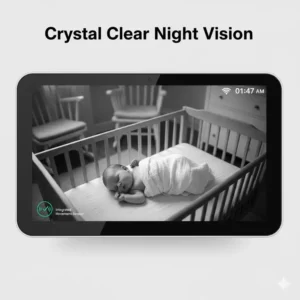
Choosing the best baby monitor with movement sensor is a deeply personal decision that balances technology, budget, and your unique comfort level. What truly makes a product the best is its ability to seamlessly integrate into your life while delivering reliable, life-saving information.
The Owlet Dream Duo Smart Baby Monitor stands out for the ultimate data-driven parent, offering an unparalleled view into your baby’s heart rate and oxygen levels. For the parent who prioritizes security and non-Wi-Fi reliability, the Angelcare AC310 remains a solid, time-tested choice. And for the traveling parent, the Snuza Hero MD Portable Movement Monitor is the undisputed champion of portability and simple, essential movement tracking.
Ultimately, by understanding the differences between sensor types—the pressure pad, the wearable pulse oximeter, and the computer vision system—you are now equipped with the expertise to select the perfect monitoring solution. Invest in a baby monitor movement sensor that allows you to swap anxiety for assurance, and enjoy those precious moments of parenthood with a more relaxed heart.
❓ Frequently Asked Questions
✅ Under-mattress pads use sensitive, non-contact pressure or optical sensors to detect the subtle movements of your baby's chest caused by breathing. The pad creates a baseline for movement, and if no movement is detected for a pre-set time, usually 20 seconds, it triggers a loud audible alarm to alert the parent immediately…
✅ Yes, modern wearable movement sensors like the Owlet Smart Sock are designed with infant safety as the priority, using non-invasive pulse oximetry technology. They are worn externally on the foot or clipped onto the diaper and do not interfere with the baby's sleep or movement. Always ensure the wearable is fitted correctly according to the manufacturer's guidelines for safety and accuracy…
✅ While a video monitor is great for visual checks, a baby monitor with movement sensor provides a critical layer of active safety by monitoring stillness, which a video monitor cannot do. The sensor alerts you if your baby stops moving, which offers a level of assurance that a simple visual check simply cannot match…
✅ For twins sharing one crib, a monitor using two separate clip-on wearable sensors, such as the Snuza Hero MD or Sense-U, is generally the best approach. Under-mattress pads are not recommended because the pad cannot accurately distinguish between the movement of the two babies, leading to unreliable readings and false alarms…
✅ The Angelcare sensor pad is designed for use with a firm, rigid crib base and a standard, firm crib mattress. While it may technically work with a thin memory foam topper, thick, plush, or overly soft mattresses (like most full memory foam crib mattresses) can dampen the tiny breathing movements, significantly reducing the sensitivity and reliability of the movement sensor… ❓ How does an under-mattress baby monitor movement sensor actually work?
❓ Are wearable baby movement sensor monitors safe for newborns?
❓ Do I really need a baby monitor with movement sensor if I have a good video monitor?
❓ Which type of baby monitor movement sensor is best for twins in one crib?
❓ Can the Angelcare sensor pad work with a memory foam or thick mattress?
Recommended for You
- Baby Proof Toilet Lid Locks: 7 Proven Solutions to Protect Kids
- Safe Baby Playpen for Outdoors: 7 Best Picks 2025
- Avoiding Small Parts in Baby Teething Toys: 7 Safest Picks 2025 for Happy, Healthy Babies
Disclaimer: This article contains affiliate links. If you purchase products through these links, we may earn a small commission at no additional cost to you.
✨ Found this helpful? Share it with your friends! 💬🤗
[addtoany]