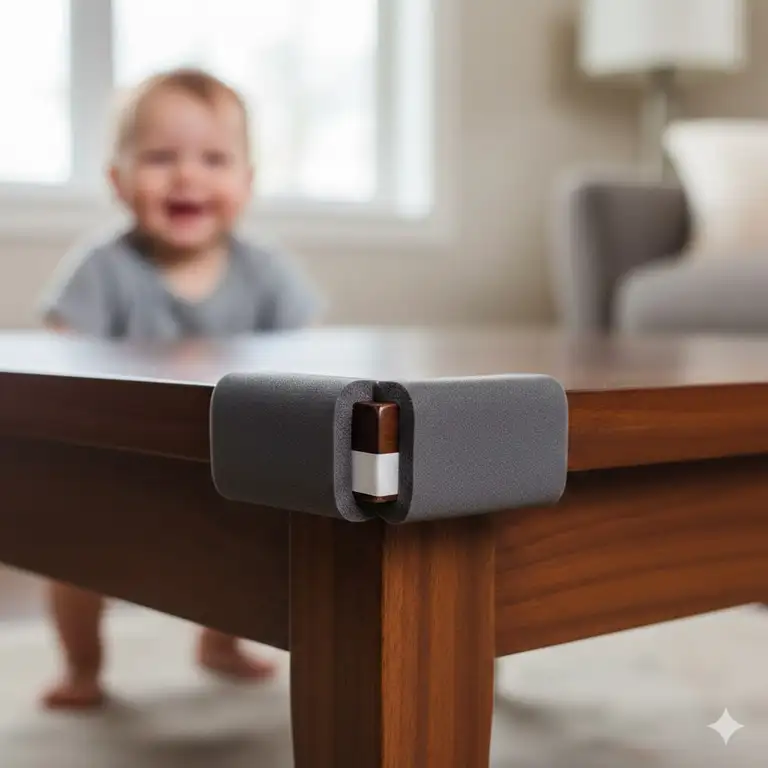
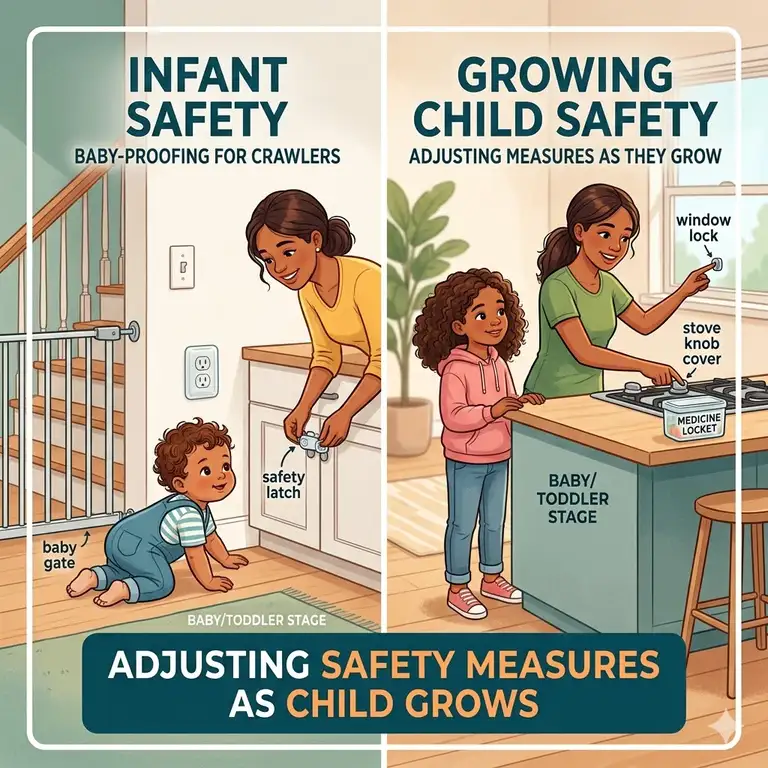
Being a parent in 2026 is a bit like being a software developer; just when you think you’ve patched every bug and secured the perimeter, the “user” (your child) discovers a brand-new workaround. I remember when my firstborn finally learned to crawl. I had spent hours obsessing over outlet covers, only to realize he was far more interested in tasting the bottom of my dusty sneakers. The reality is that childproofing isn’t a “set it and forget it” task. It’s an evolving strategy. Adjusting safety measures as child grows is the only way to stay ahead of the chaos.
✨Was this helpful? Spread the word! 🚀
When we talk about adjusting safety measures as child grows, we aren’t just moving things higher on the shelf. We are transitioning from physical barriers to cognitive boundaries. In the early days, you’re worried about SIDS and rolling off changing tables. Fast forward a few years, and you’re worried about them hacking the Wi-Fi or “borrowing” the car (okay, maybe that’s a bit too far ahead, but you get my point). This guide is designed to walk you through the nuances of this transition, ensuring your home remains a sanctuary rather than a hazard course.
Quick Stage-by-Stage Safety Comparison
Before we dive into the nitty-gritty, let’s look at how safety priorities shift over time. This table helps you visualize the transition points for adjusting safety measures as child grows.
| Child Stage | Primary Physical Hazard | Key Safety Strategy | Necessary Hardware |
| Infant (0-6 mo) | Falls & Suffocation | Safe Sleep & Anchored Bases | Video Monitors, Swaddles |
| Crawler (6-12 mo) | Choking & Sharp Edges | Low-Level Clearing | Corner Guards, Gates |
| Toddler (1-3 yr) | Tip-overs & Poisoning | Vertical Security | Anchors, Magnetic Locks |
| Preschooler (3-5 yr) | Climbing & Water | Boundary Education | Pool Alarms, High Latches |
| School-Aged (6+ yr) | Digital & Outdoors | Skills & Digital Literacy | Helmets, Firewalls |
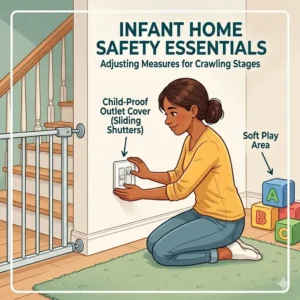
Top 7 Child Safety Products for 2026: Expert Analysis
Navigating the sea of baby gear is exhausting. I’ve done the heavy lifting for you by researching the best, most durable products currently available on Amazon that specifically help with adjusting safety measures as child grows.
1. Graco 4Ever DLX Grad 4-in-1 Car Seat
The Graco 4Ever DLX Grad 4-in-1 Car Seat is the “Swiss Army Knife” of vehicle safety. It is specifically designed to handle the adjusting safety measures as child grows requirement by transitioning from a rear-facing harness to a backless booster.
-
Technical Specifications:
-
Weight Range: 4 to 120 lbs.
-
Modes: Rear-facing, Forward-facing, High-back booster, Backless booster.
-
Safety Tech: ProtectPlus Engineered; SnugLock technology for 1-minute installation.
-
Adjustability: 10-position headrest and 6-position recline.
-
-
Customer Review Analysis: Users rave about the longevity. One reviewer noted, “It’s the only seat we’ve bought in 5 years.” Some find it bulky in smaller sedans.
-
Warranty: 1-year limited warranty.
-
Pros: Incredible lifespan; easy-to-read level indicator.
-
Cons: Heavy; fabric can be difficult to remove for deep cleaning.
2. Toddleroo by North States 3-in-1 Superyard
When your child starts moving, you need a versatile barrier. The Toddleroo by North States 3-in-1 Superyard works as a playpen or a long safety gate.
-
Technical Specifications:
-
Coverage: Up to 19 square feet as a playard; 144 inches as a barrier.
-
Material: Heavy-duty plastic with non-slip pads.
-
Height: 26 inches.
-
-
Customer Review Analysis: Parents love the versatility for open-concept homes. Reviewers mention it’s great for keeping kids away from Christmas trees or fireplaces.
-
Warranty: 1-year limited.
-
Pros: Easy to fold; works indoors and outdoors.
-
Cons: Can be “clunky” to open with one hand.
3. Jambini Magnetic Cabinet Locks (20-Pack)
Traditional “hook” locks are easily defeated by persistent toddlers. The Jambini Magnetic Cabinet Locks stay hidden and require a magnetic key, making them perfect for adjusting safety measures as child grows without ruining your decor.
-
Technical Specifications:
-
Mechanism: Magnetic latch with 3M adhesive backing.
-
Compatibility: Most cabinets and drawers up to 1.5 inches thick.
-
Features: On/off switch to disable the lock when kids aren’t around.
-
-
Customer Review Analysis: Most buyers appreciate that no drilling is required. A common tip from reviews: “Keep the magnetic key on top of the fridge!”
-
Warranty: Lifetime replacement guarantee from the manufacturer.
-
Pros: Invisible from the outside; very strong adhesive.
-
Cons: If you lose the keys, you’re locked out of your own snacks.
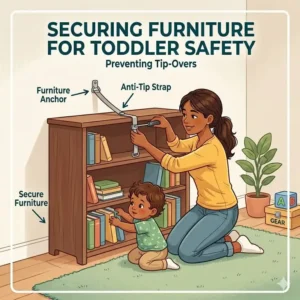
4. Hangman Anti-Tip Furniture Kit (Steel Aircraft Cable)
As kids grow, they become climbers. The Hangman Anti-Tip Furniture Kit is the gold standard for preventing tip-overs.
-
Technical Specifications:
-
Material: Galvanized steel aircraft cable.
-
Weight Capacity: Up to 400 lbs per pair.
-
Installation: Requires drilling into studs.
-
-
Customer Review Analysis: High marks for the “peace of mind.” Unlike plastic zip-tie versions, these don’t become brittle over time.
-
Warranty: Limited lifetime warranty.
-
Pros: Tamper-resistant; virtually unbreakable.
-
Cons: Requires permanent holes in furniture and walls.
5. Roving Cove Safe Edge & Corner Cushion
Once your toddler starts running, every coffee table becomes a forehead magnet. The Roving Cove Safe Edge & Corner Cushion is significantly denser than cheap foam alternatives.
-
Technical Specifications:
-
Material: High-density NBR foam (non-toxic, BPA-free).
-
Length: 15 feet of edging + 4 corner cushions.
-
Adhesive: Heavy-duty 3M double-sided tape.
-
-
Customer Review Analysis: Parents highlight the “squish factor”—it actually absorbs impact. Some mention that curious kids might try to bite the foam.
-
Warranty: 30-day money-back guarantee.
-
Pros: Very thick; fire-retardant.
-
Cons: The adhesive can leave residue on finished wood.
6. Bouncie – Smart GPS Car Tracker
For the older kids (the “big kid” stage of adjusting safety measures as child grows), safety means knowing where they are. Bouncie – Smart GPS Car Tracker plugs into the OBD-II port.
-
Technical Specifications:
-
Update Frequency: 15-second intervals.
-
Features: Speed alerts, geo-fencing, accident detection.
-
App: Compatible with iOS and Android.
-
-
Customer Review Analysis: Used mostly by parents of new drivers. Users appreciate the “Hard Braking” notifications to help teach better driving habits.
-
Warranty: 1-year warranty.
-
Pros: No battery to charge; detailed trip history.
-
Cons: Requires a monthly subscription fee.
7. Kidde Carbon Monoxide & Smoke Detector with Lithium Battery
Safety isn’t just about falls; it’s about the environment. The Kidde Carbon Monoxide & Smoke Detector with a 10-year battery is essential as you expand your home’s safety net.
-
Technical Specifications:
-
Sensor Type: Ionization and Electrochemical.
-
Battery: Sealed-in 10-year lithium (no battery changes needed).
-
Alarms: Voice warning (tells you specifically if it’s fire or CO).
-
-
Customer Review Analysis: Highly rated for the voice feature, which is proven to wake sleeping children more effectively than a standard beep.
-
Warranty: 10-year limited warranty.
-
Pros: Maintenance-free; worry-free for a decade.
-
Cons: Expensive upfront compared to basic models.
✨ Don’t Miss These Exclusive Deals!
🔍 Take your home safety to the next level with these carefully selected products. Click on any highlighted item to check current pricing and availability. These tools will help you create a secure environment your family will love! ✨
💬 Just one click – help others make better buying decisions too!😊
Detailed Product Feature Comparison
To help you decide which tools are right for your current stage of adjusting safety measures as child grows, let’s look at how these varied products stack up in terms of utility and ease of use.
Table 2: Product Performance & Compatibility Matrix
| Product Name | Age Range | Difficulty to Install | Durability (1-10) | Key Benefit |
| Graco 4Ever DLX | 0 – 10 years | Medium | 10 | One-time purchase |
| Toddleroo Superyard | 6 mo – 3 years | Easy | 8 | Creates a safe zone |
| Jambini Locks | 1 – 4 years | Easy | 7 | Keeps cabinets clean |
| Hangman Anchors | 1 – 8 years | Hard | 10 | Prevents fatalities |
| Roving Cove Foam | 8 mo – 4 years | Easy | 6 | Impact protection |
| Bouncie GPS | 15+ years | Very Easy | 9 | Driver monitoring |
| Kidde Detector | All Ages | Medium | 9 | Life-saving alerts |
Table 3: Budget vs. Premium Safety Solutions
| Category | Budget Option | Premium Option | Why Go Premium? |
| Car Seats | Basic Booster ($25) | Graco 4Ever DLX ($300) | Better side-impact protection & longevity. |
| Cabinet Safety | Plastic Latches ($10) | Jambini Magnetic ($30) | Aesthetics and higher “toddler-proof” rating. |
| Furniture Safety | Plastic Straps ($15) | Hangman Steel ($30) | Steel doesn’t degrade or snap under tension. |
| Edge Guards | Thin Foam Tape ($8) | Roving Cove ($25) | Denser foam equals higher force absorption. |
The Physics and Psychology of Growth
Why is adjusting safety measures as child grows so important? It comes down to basic physics. As a child grows, their center of gravity shifts. A toddler’s head is disproportionately heavy compared to their body. When they lean over a bathtub or out a window, that mass acts as a lever.
In scientific terms, the potential energy $U$ of a child on a high surface is given by:
Where:
-
$m$ is the child’s mass.
-
$g$ is the acceleration due to gravity (~9.8 $m/s^2$).
-
$h$ is the height.
As $m$ and $h$ increase with age, the potential for a high-impact fall increases exponentially. This is why a fall that might result in a “bonk” for an 8-month-old could be a major injury for a 4-year-old who has climbed onto a counter.
The Developmental Transition
-
The Immobility Phase (0-6 months): Safety is passive. You focus on air quality, sleep surfaces, and water temperature. According to the CDC Safe Child Program, suffocation is the leading cause of unintentional injury for infants.
-
The Exploration Phase (6-18 months): This is where adjusting safety measures as child grows becomes a daily workout. They are at eye-level with outlets and table corners.
-
The Autonomy Phase (2-5 years): They can now turn knobs and pull levers. You need to secure the “forbidden” zones—laundry rooms, tool sheds, and medicine cabinets.
-
The Digital & Social Phase (6+ years): Safety moves outside the home and into the cloud.
Table 4: Benefits Comparison (Hardware vs. Education)
| Factor | Hardware (Locks/Gates) | Education (Teaching Safety) |
| Effectiveness | 100% (if installed right) | Variable (depends on child) |
| Effort | High initial effort | Constant reinforcement |
| Longevity | Temporary | Lifetime value |
| Primary Use | Infants & Toddlers | Preschoolers & School-Age |
| Reliability | Mechanical | Behavioral |

Expanding Your Safety Strategy: Beyond the Hardware
When you are adjusting safety measures as child grows, you eventually run out of things to lock. You can’t childproof the entire world, much as I’d like to wrap the neighborhood in bubble wrap. This is where the “Expert” part of “Expert Analysis” comes in.
Kitchen and Bathroom: The High-Risk Zones
The kitchen is the heart of the home, but it’s also a land of knives, heat, and chemicals. As your child grows, they’ll want to “help.”
-
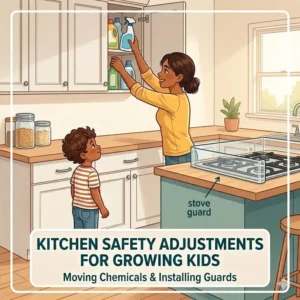
Stove Safety: By age 3, a child can reach the knobs. If you have a gas stove, remove the knobs or use covers.
-
Water Temperature: Adjust your water heater to 120°F ($48.9°C$) to prevent scalds. As kids get taller, they can reach the “hot” handle in the sink more easily.
-
The Toilet Lock: Essential for toddlers, but by age 4, it becomes a hindrance to potty training. This is a classic example of adjusting safety measures as child grows—knowing when to remove a safety feature is just as important as knowing when to add one.
The Climbing Conundrum
Did you know that according to the Consumer Product Safety Commission (CPSC), a child is treated in an emergency room for a tip-over injury every 43 minutes? When kids are 2 or 3, they use dresser drawers as stairs.
-
Anchoring is Non-Negotiable: If it’s taller than a foot and has drawers, anchor it.
-
TV Safety: In 2026, most of us have flat-screens. These are incredibly front-heavy. Even if they are on a “sturdy” stand, a child pulling on the screen can bring the whole thing down.
Table 5: Requirements Analysis for Different Living Spaces
| Room | High Priority (0-3 yrs) | High Priority (4-7 yrs) |
| Living Room | Corner guards, Outlet covers | TV Anchors, Blind cord safety |
| Kitchen | Cabinet locks, Stove guards | Knife storage, Appliance safety |
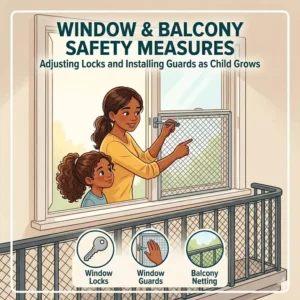
| Bedroom | Furniture anchors, Video monitor | Window stops, Smoke detector |
| Bathroom | Toilet locks, Non-slip mats | Medication locks, Water temp |
| Garage | Total lockdown (gates) | Tool storage, Chemical safety |

Expert Tips for Adjusting Safety Measures As Child Grows Up
The phrase “as child grows up” implies a journey. Here are some pro-tips I’ve picked up over the years (often the hard way).
1. Get on Your Hands and Knees
Literally. Every six months, crawl through your house. You will see things from your child’s perspective that you never noticed standing up. Is there a loose wire under the couch? A penny under the radiator? A “forbidden” snack that fell behind the trash can?
2. The “Toilet Paper Roll” Test
If an object can fit through a toilet paper roll, it’s a choking hazard. As you are adjusting safety measures as child grows, you might relax on this rule around age 3, but be careful if there are younger siblings in the house.
3. Review Your “Zone of Control”
As kids get older, they spend more time in the backyard or the garage. Make sure your “outer perimeter” is as secure as your inner one. This includes checking gate latches and ensuring your grill is inaccessible.
4. Don’t Forget the Internet
By the time a child is 6, they might be using a tablet for school. Safety measures now include:
-
Setting up “Kids” profiles on Netflix and YouTube.
-
Using hardware like the Circle Home Plus for network-level filtering.
-
Teaching the concept of “Private Information.”
Table 6: Performance Metrics for Safety Latches
| Latch Type | Force Resistance (lbs) | Ease of Adult Use | Child Bypass Rate (Est.) |
| Adhesive Strap | 40 lbs | Easy | 15% (Age 3+) |
| Magnetic Latch | 60 lbs | Medium | 2% (If key is hidden) |
| Spring Hook | 30 lbs | Medium | 40% (They learn the pinch) |
| Sliding Cabinet Lock | 50 lbs | Hard | 5% |
Common Myths About Child Safety
I hear a lot of “old wives’ tales” when it comes to childproofing. Let’s set the record straight with some cold, hard facts.
-
Myth 1: “I’ll just watch them every second.”
-
Reality: It takes 2 seconds for a dresser to tip over. It takes 10 seconds for a child to swallow a button battery. Supervision is great, but physical barriers are your “backup.”
-
-
Myth 2: “My child is too smart to touch that.”
-
Reality: Curiosity is a sign of intelligence, not disobedience. Even the “smartest” kid doesn’t understand the chemistry of a Tide pod or the physics of a falling television.
-
-
Myth 3: “Childproofing ruins my home’s aesthetic.”
-
Reality: Modern safety gear, like the Jambini Magnetic Locks, is completely invisible. You don’t have to live in a padded cell to be safe.
-
Table 7: Comparative Analysis of Safety Strategies
| Strategy | Cost | Effectiveness | Best For |
| The “Lock Everything” Approach | High | Excellent | Toddlers (12-36 months) |
| The “Supervision Only” Approach | Free | Low | Non-mobile infants |
| The “Education First” Approach | Low | Medium | Older kids (4+ years) |
| The Hybrid Strategy | Moderate | Superior | All growing children |
✨ Ensure Your Home is Ready for the Next Stage!
🔍 Don’t wait for a close call. Check out our Top 7 Safety Products now to secure your home for 2026. Your peace of mind is just a click away! 🛡️

Conclusion: Safety is a Journey, Not a Destination
If there is one thing I’ve learned as an expert in home safety, it’s that your child’s development will always be one step ahead of your planning if you aren’t careful. Adjusting safety measures as child grows isn’t about being paranoid; it’s about being prepared. By investing in high-quality, durable gear like the Graco 4Ever DLX or the Hangman Anti-Tip Kit, you are creating a framework that evolves with your family.
Remember, the goal isn’t just to prevent “boo-boos.” It’s to prevent life-altering accidents while giving your child the freedom to explore their world. As they get older, the physical locks will come off, and the “locks” you’ve built in their minds—through education and safety habits—will take over. It’s a beautiful transition, even if it means you’re constantly moving the “fancy” breakables to higher and higher shelves.
Stay vigilant, stay informed, and most importantly, stay flexible!
FAQs
✅ You should begin adjusting safety measures as child grows as soon as your child shows signs of new milestones, like rolling, crawling, or pulling up. Proactive adjustment (about 2 weeks before a milestone) is safer than reacting after an accident...
✅ Prioritize anchoring heavy items like dressers, bookshelves, and televisions. As kids grow, they often use drawers as steps to reach toys. High-quality steel anchors are recommended to handle the increased weight and force of older toddlers...
✅ Magnetic locks are generally superior because they are hidden from view and require a key, preventing children from figuring out the mechanism. As kids get older and more dexterous, they often bypass standard plastic 'press and pull' latches...
✅ You should test your detectors monthly and replace the batteries every six months, unless you use a 10-year sealed lithium battery model. Consistent monitoring ensures your safety net remains functional as your child grows and matures...
✅ Most experts suggest removing gates once a child can safely navigate stairs independently, usually around age 3. However, adjusting safety measures as child grows means keeping the gate if the child is a frequent 'night wanderer'... ❓ When should I start adjusting safety measures as child grows for my toddler?
❓ Which furniture is most important to anchor in a growing child's room?
❓ Are magnetic locks better than traditional plastic latches for cabinets?
❓ How often should I check the smoke and carbon monoxide detectors?
❓ At what age can I stop using a baby gate on the stairs?
Recommended for You:
- Baby Proofing Cribs for Small Spaces: 7 Essential Safety Tips
- Baby Proofing Kitchen Drawers and Doors: 7 Safe Picks 2025
- Safe Baby Monitor Options Wireless: 7 Top Picks 2025
Disclaimer: This article contains affiliate links. If you purchase products through these links, we may earn a small commission at no additional cost to you.
✨ Found this helpful? Share it with your friends! 💬🤗