Introduction: Why CedarWorks Playsets Keep Showing Up on Wish Lists
If you’ve spent any time pricing backyard swing sets, you’ve probably noticed that cedarworks playsets sit in a different universe from the boxed kits at big-box stores. They cost more, they look different (that pale, almost silvery wood), and owners tend to talk about them the way people talk about a well-built house rather than a toy. So what’s actually going on — and is it worth it for your family heading into 2027?
Here’s the short version. CedarWorks is a family-owned company based in Rockport, Maine, in business since 1983, and every outdoor playset it makes uses a single wood species: Northern White Cedar. That one decision drives almost everything you’ll read in this guide — the splinter-free claim, the no-stain maintenance, the chunkier posts, and yes, the price tag.
This guide does three things. First, it breaks down the main CedarWorks playsets lines (Rustic, Classic, Architectural, plus playhouses and indoor sets) so you understand what each tier really buys you. Second, because CedarWorks sells direct rather than through Amazon, it includes two well-reviewed cedar alternatives you can order on amazon.com, so you can compare honestly. Third, it gives you practical, real-world help: site prep, assembly expectations, long-term cost, and safety standards.
One important note on honesty: we have not personally assembled or tested these sets. Everything below is built from manufacturer spec sheets, published warranty terms, federal safety guidance, and real aggregated customer sentiment where we could verify it. Where verified reviews were thin, we say so plainly instead of guessing.
Ready? Let’s start with the big picture.
Quick Comparison: CedarWorks Playsets and Alternatives at a Glance
Product
Tier
Where to Buy
Price Range (approx.)
Best for
CedarWorks Rustic
Entry (premium)
CedarWorks direct
$2,500 to $10K+
CedarWorks Rustic: families wanting authentic cedar on a tighter budget
CedarWorks Classic
Mid/High
CedarWorks direct
$3,500 to $25K+
CedarWorks Classic: families who want a set that grows with kids
CedarWorks Architectural
Flagship
CedarWorks direct
$10,000 to $50K+
CedarWorks Architectural: design-first homeowners
CedarWorks Outdoor Playhouse
Add-on/Standalone
CedarWorks direct
Varies by design
CedarWorks Outdoor Playhouse: pretend-play lovers
CedarWorks Indoor Playset
Indoor
CedarWorks direct
Varies by design
CedarWorks Indoor Playset: cold-climate and apartment families
Backyard Discovery Woodridge Elite
Mid-range
amazon.com & retailers
Roughly $2,500–$3,500
Backyard Discovery Woodridge Elite: big clubhouse fans on a budget
Looking at the table above, the dividing line is clear: the five CedarWorks options are made-to-order and priced as long-term home improvements, while the Backyard Discovery Woodridge Elite and Gorilla Playsets Chateau are boxed kits that land in the low-to-mid thousands. The CedarWorks Rustic line is the interesting overlap — its entry point sits close to the top Amazon kits, which makes it the most direct head-to-head comparison in this guide. Prices change often, so treat these as ranges at the time of writing and check current pricing.
💬 One click helps other shoppers make an informed choice too! 😊
What Are CedarWorks Playsets?
CedarWorks playsets are modular, made-to-order wooden swing sets, playhouses, and indoor play structures built by CedarWorks of Rockport, Maine. Every outdoor set uses Northern White Cedar, a native North American wood the company describes as naturally splinter-free and rot-resistant without paints, stains, or chemical treatments.
That definition hides a lot of nuance, so let’s unpack it. “Modular” means you’re not buying a fixed product the way you would with a kit. Each set is assembled from a library of components — towers, decks, swing beams, slides, climbers — which you can configure online with the company’s design tool or with help from one of its design experts. The company also offers interactive 3D models for most residential designs, so you can spin a set around and see how a slide or tunnel attaches before you commit.
The wood itself deserves a quick explainer. Northern White Cedar, known botanically as Thuja occidentalis, grows across the northeastern US and eastern Canada and has long been used for fence posts, shingles, and boats because of its natural decay resistance. CedarWorks also notes that every 4×4, 4×6, and round log it uses has the tree’s heartwood at its center, which it credits for the strength of its posts.
In practice, that means you’re buying the material as much as the design. Most of the decisions you’ll make — which line, which accessories, whether to stain — flow from the wood.
Top 7 CedarWorks Playsets and Alternatives: Expert Analysis
The CedarWorks Rustic line is the company’s budget-friendly tier, built from round cedar stock rather than milled square posts, with prices starting around $2,500 and climbing past $10K for larger configurations.
The round-log construction gives it a cabin-in-the-woods look that blends into wooded lots and natural landscaping. Because it’s modular, every Rustic set is custom configured — you can start with a simple swing beam and tower or design something completely unique to your yard. One practical limit to know: accessories from the Classic and Architectural lines generally won’t fit, though the standard two-rope swings (kid swing, poly swing, sling swing) do cross over.
Based on comparing the specs, the CedarWorks Rustic is the right pick if your main priority is the wood — splinter-free, chemical-free cedar — and you can live without some of the fancier accessories. It’s also the most honest competitor to premium Amazon kits, since its starting price overlaps theirs.
On customer sentiment: we couldn’t locate a large pool of independent, verifiable reviews specifically for the Rustic line, so we won’t summarize ratings we can’t confirm. What is verifiable is the warranty: CedarWorks covers above-ground wooden components against structural failure from rot or insects for five years.
Pros:
✅ Lowest-cost way into Northern White Cedar
✅ Fully custom configurable for odd-shaped yards
✅ Natural log look suits wooded properties
Cons:
❌ Limited accessory compatibility with other lines
❌ Shorter rot warranty than the Classic line
Value verdict: in the $2,500-to-$10K+ range, it’s the strongest value if wood quality matters more to you than accessory variety.
CedarWorks RusticSee current price, sizes and reviews on Amazon.
The CedarWorks Classic line is the company’s core tier — larger milled lumber, a deep accessory catalog, and a design built to be reconfigured as your kids get older, priced from about $3,500 to $25K+.
What sets the CedarWorks Classic apart is its long-game thinking. You can start with a toddler-friendly setup — CedarWorks makes a patented toddler swing for the Classic and Architectural lines that starts soft and cradling for little ones — and later add taller climbers, monkey bars, or longer slides. On paper, this means you’re buying a platform rather than a one-size-fits-all product.
Here’s what to weigh: the Classic line carries the strongest published structural warranty we found in the CedarWorks lineup — two years on materials and workmanship, ten years on structural cedar against rot or insect failure, and five years for accessories. That’s a meaningful signal of confidence in the wood, though note that parts installed below ground surfacing aren’t covered.
Independent aggregated reviews for this specific line were limited in our research. The most-cited long-term account comes from CedarWorks itself — the company president has written about retiring his family’s set after more than 20 years, still splinter-free — which is useful context but obviously not independent.
Pros:
✅ Ten-year structural warranty against rot and insects
✅ Reconfigurable from toddler years to tweens
✅ Deep catalog of slides, climbers, and swings
Cons:
❌ Costs can climb quickly with accessories
❌ Made-to-order means waiting on delivery
Value verdict: for families planning a decade of use, the $3,500-to-$25K+ range is easier to justify here than anywhere else in the lineup.
CedarWorks ClassicSee current price, sizes and reviews on Amazon.
The CedarWorks Architectural line is the flagship, adding design details like grand arches, colored finials, and fish-scale shingles to the same Northern White Cedar, with prices running from about $10,000 to $50K+.
Functionally, the CedarWorks Architectural sets share the same wood and modular approach as the Classic line, and the toddler swing is available here too. What you’re paying extra for is the look — structures that read more like garden architecture than play equipment. If your playset will be visible from the street or sits right outside a patio, that matters more than you might think.
Our honest take: this is a design purchase. Families who care about how the backyard looks as a whole — or who are building around a landscaping project — will appreciate it. Families focused purely on play value will get nearly the same swinging and sliding from the CedarWorks Classic for less. One compatibility note from CedarWorks: only a very limited selection of Architectural items will attach to a Classic set, so pick your line deliberately.
We couldn’t find enough independent, verifiable reviews to summarize customer sentiment for the Architectural line, and we won’t invent it. Ask CedarWorks for current warranty terms on this line before you buy.
Pros:
✅ Most distinctive, home-like visual design
✅ Same splinter-free cedar as other lines
✅ Highly customizable to large yards
Cons:
❌ Highest price tier by a wide margin
❌ Limited cross-compatibility with Classic accessories
Value verdict: in the $10K-to-$50K+ range, it’s worth it only if design and curb appeal are top priorities.
CedarWorks ArchitecturalSee current price, sizes and reviews on Amazon.
The CedarWorks Outdoor Playhouse collection gives kids a standalone or attached cedar house for imaginative play — a smart option if your children are more “run a restaurant” than “climb the rock wall.”
Here’s what most buyers overlook: a playhouse often gets more hours of use than a swing beam, because it works for quiet play, rainy afternoons (under a roof), and a wider age range. Because CedarWorks builds its playhouses from the same Northern White Cedar as its swing sets, the CedarWorks Outdoor Playhouse shares the no-stain, splinter-free benefits, and it weathers to the same silver-gray if you leave it natural.
Who is it for? Families with younger kids (roughly preschool through early elementary), yards that can’t fit a full swing-set safety zone, or parents who want to start small and add a swing structure later. Pricing varies widely by design and size, so it’s best to configure one and check the current price directly.
Customer sentiment: independent reviews were sparse in our research, and we won’t fabricate any. CedarWorks highlights that its playhouses can be viewed in 3D before ordering, which helps you check proportions against your yard and your kids’ heights.
Pros:
✅ Supports quiet, imaginative play for wider ages
✅ Same chemical-free cedar as the swing sets
✅ Fits yards too small for swing zones
Cons:
❌ Pricing isn’t transparent without configuring first
❌ Fewer active-play features than a tower set
Value verdict: a strong value per hour of play for younger kids, but price varies, so configure before deciding.
CedarWorks Outdoor PlayhouseSee current price, sizes and reviews on Amazon.
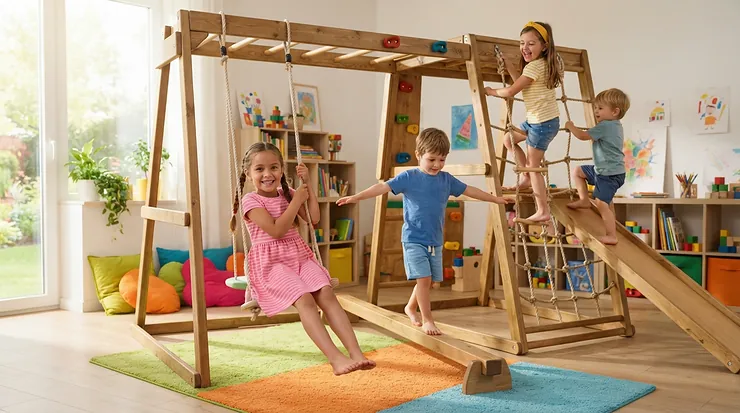
The CedarWorks Indoor Playset line (which grew out of the company’s Rhapsody indoor collection) brings towers, slides, and climbers into a playroom or bedroom, with related playbeds that combine sleeping and play.
The case for indoor play is practical: CedarWorks’ president has argued that kids spend the vast majority of their at-home time indoors, and families who own both sets often report the indoor one gets more year-round use. If you live somewhere with long winters — Maine, Minnesota, the Mountain West — that logic is hard to argue with.
Based on the published terms, the CedarWorks Indoor Playset carries a four-year warranty on parts under normal residential use, with finishes, stains, and paints covered for two years. That’s a reasonable window for furniture-grade play equipment that never sees weather.
Who should skip it? Families with low ceilings or small rooms — measure height carefully, since a tower plus a child standing on top needs real headroom. Independent aggregated reviews were limited in our research; the strongest verifiable signal is that the line has been showcased at major design shows and retailers over the years.
Pros:
✅ Year-round active play regardless of weather
✅ Four-year parts warranty for residential use
✅ Playbed options save floor space
Cons:
❌ Requires generous ceiling height
❌ Premium pricing for indoor furniture
Value verdict: excellent value for cold-climate families who’d otherwise lose half the year of outdoor play.
CedarWorks Indoor PlaysetSee current price, sizes and reviews on Amazon.
The Backyard Discovery Woodridge Elite is a large cedar kit available on amazon.com and at other major retailers, built around a raised clubhouse with a wooden roof and wrap-around porch, typically in the $2,500–$3,500 range.
The specs are generous: roughly 231″ wide by 188″ deep and 141″ tall assembled, a listed maximum weight recommendation of 1,080 pounds, a 10-foot wave slide, a crawl tunnel, a crow’s nest, belt swings, a trapeze, and a rock wall. In practice, that footprint means you need a big, level yard plus the safety zone around it. It’s rated for ages 3 to 10, and the set itself weighs roughly 716 pounds — expect a freight delivery and a full weekend of assembly.
Our analysis: if you want the “wow” of a giant fort without CedarWorks pricing, the Backyard Discovery Woodridge Elite delivers far more square footage per dollar. The trade-off is the wood and longevity story — it’s a stained cedar kit, not Northern White Cedar, and it won’t have the same oversized posts.
Real review sentiment we could access is mostly positive about the clubhouse and play value, with some buyers praising responsive customer service while wishing the swing portion felt sturdier.
Pros:
✅ Huge clubhouse with wrap-around porch
✅ 1,080-pound listed maximum weight recommendation
✅ Orderable on amazon.com with standard returns
Cons:
❌ Massive footprint needs a large yard
❌ Some reviewers want a sturdier swing section
Value verdict: in the $2,500–$3,500 range, it’s the best play-per-dollar pick here — just check the current price.
Backyard Discovery Woodridge EliteSee current price, sizes and reviews on Amazon.
The Gorilla Playsets Chateau (model 01-0003-AP) is a time-tested cedar fort-and-swing kit for ages 3 to 11, featuring a rock wall, slide, built-in picnic table, and a 4×6 three-position swing beam, usually in the $2,100–$2,600 range.
That 4×6 swing beam is the spec to notice: a three-position beam lets you rearrange swings as kids grow or as you swap in a tire swing, and a 4×6 is meaningfully stiffer than the 4×4 beams on cheaper kits. The picnic table under the deck turns dead space into a snack spot, which, practically speaking, keeps kids outside longer. Gorilla also sells several Chateau variants that differ mainly by roof style.
Who’s it for? Families who want a proven, mid-size layout that fits a typical suburban yard. Compared with the Backyard Discovery Woodridge Elite, the Gorilla Playsets Chateau is smaller but arguably more balanced. Dealer listings cite a limited 10-year warranty on lumber and one year on accessories — confirm the current terms on your listing.
Aggregated sentiment is solid: at Tractor Supply, the set showed around 4.5 out of 5 stars across roughly 400 reviews at the time of research, with buyers frequently praising the build quality and appearance.
Pros:
✅ Stiff 4×6 three-position swing beam
✅ Built-in picnic table adds usable space
✅ Consistently strong aggregated ratings
Cons:
❌ Accessories carry a short warranty
❌ Stained cedar needs periodic resealing
Value verdict: one of the most reliable values in the low-$2,000s for a mid-size yard.
Gorilla Playsets ChateauSee current price, sizes and reviews on Amazon.
Head-to-Head: Comparing the Top 7 on What Really Matters
Product
Wood
Published Warranty Highlight
Assembly
Customization
Best for
CedarWorks Rustic
Northern White Cedar (round)
5 yrs rot/insect, above-ground parts
~1 day, 2 adults (company estimate)
Fully custom
CedarWorks Rustic: budget authentic cedar
CedarWorks Classic
Northern White Cedar (milled)
10 yrs structural rot/insect
~1 day, 2 adults
Fully custom
CedarWorks Classic: long-term growth
CedarWorks Architectural
Northern White Cedar
Confirm with CedarWorks
~1 day+, 2 adults
Fully custom
CedarWorks Architectural: curb appeal
CedarWorks Indoor Playset
Indoor finished wood
4 yrs parts, 2 yrs finishes
Varies
Fully custom
CedarWorks Indoor Playset: winter play
Backyard Discovery Woodridge Elite
Stained cedar
Check listing
Full weekend typical
Fixed kit
Backyard Discovery Woodridge Elite: max size per dollar
Gorilla Playsets Chateau
Stained cedar
~10 yrs lumber (dealer-cited)
Full weekend typical
Fixed kit + variants
Gorilla Playsets Chateau: mid-size yards
Reading the table, the biggest gap isn’t features — it’s flexibility and the wood itself. Every CedarWorks option is custom configured, while the Backyard Discovery Woodridge Elite and Gorilla Playsets Chateau are fixed kits you assemble as designed. On warranty, the CedarWorks Classic stands out with its ten-year structural coverage, though the Gorilla Playsets Chateau is surprisingly competitive on lumber coverage for its price.
💬 One click helps other shoppers make an informed choice too! 😊
Who Is CedarWorks? The Maine Company Behind the Cedar
Understanding cedarworks as a company helps explain why the products look and cost the way they do. CedarWorks started in Rockport, Maine, in 1983, and it has stayed family-owned while expanding to customers in all 50 states and more than 20 countries. Barrett Brown serves as company president.
A few things stand out about how CedarWorks operates:
🌲 One wood, no exceptions. Every outdoor playset and playhouse uses Northern White Cedar, a species native to Maine. The company even donates cedar seedlings to small woodlot owners and environmental groups in the state each May.
🏠 No showrooms. CedarWorks sells from home — online or by phone — and ships to all 50 states, Canada, and many other countries. That’s why you won’t find it on Amazon or in a big-box aisle.
💳 Financing available. The company partners with Affirm for split payments.
🔧 DIY or pro install. CedarWorks says the average person with common tools can assemble its products, and it can refer you to an experienced installer near you (US only, excluding Alaska).
🤝 Giving back. The company has described donating 10% of profits to organizations benefiting children and the environment.
What does that mean for you as a buyer? The direct model is a double-edged sword. On the plus side, you get design experts who know the product intimately and a configuration process built around your yard. On the minus side, you can’t walk up and touch a set in a store before spending thousands — which is exactly why the 3D viewer and the design consultation matter. Our advice: use both. Ask the design team specific questions about ground slope, swing clearance, and future add-ons, and get them in writing with your quote.
🌟 Build a backyard they’ll remember for a decade!
🔍 Whether you go with a made-to-order cedar set or a ready-to-ship kit, the right pick turns your yard into the neighborhood hangout. Click a highlighted product to check current pricing and availability, and give your kids a place to climb, swing, and imagine for years to come!
Northern White Cedar vs. “Cedar” Kits: What You’re Really Paying For
This is the heart of the CedarWorks pitch, so it deserves a careful, skeptical look.
CedarWorks makes several material claims. It says Northern White Cedar is the only playset wood that’s both naturally splinter-free and naturally long-lasting without paints, stains, or chemicals. It also says its lumber is produced in dimensions up to 33% larger than competitors’ — pointing out that a typical “4×4” from other premium brands is no more than 3½ inches per side, and sometimes 3¼ inches or less. And it argues that much of the “cedar” in other playsets isn’t authentic North American cedar at all, but cheaper imported species marketed under the cedar name.
Factor
Northern White Cedar (CedarWorks)
Typical Stained “Cedar” Kit
Pressure-Treated Pine
Splinters
Naturally splinter-free (brand claim)
Can splinter as stain wears
Prone to splintering
Chemicals
None required
Factory stain
Chemical preservatives
Maintenance
Optional clear stain only
Periodic resealing
Periodic sealing
Post size
Up to 33% larger (brand claim)
Standard 3½” “4×4”
Standard
Best for
Long-term, low-maintenance owners
Budget-conscious families
Lowest upfront cost
How should you read this? Treat the manufacturer’s claims as manufacturer’s claims — they’re not independent lab results. That said, some of it is easy to verify yourself: post dimensions can be measured, and warranty length is a written commitment. The ten-year structural rot warranty on the Classic line is the most concrete evidence that the company stands behind its wood.
On the flip side, kits like the Gorilla Playsets Chateau and Backyard Discovery Woodridge Elite are perfectly safe, well-reviewed products — they simply ask you to budget time for resealing and accept that the wood may not last as long. For a family whose youngest child is already six, that shorter life may be exactly right.
How to Choose CedarWorks Playsets: 7 Steps
Measure your usable yard — including the safety zone. The structure’s footprint is only part of it; you need clear space around it and in front of and behind swings. Measure before falling in love with any design.
Count the years, not just the kids. If your youngest is two, a reconfigurable CedarWorks Classic makes sense. If your youngest is seven, a fixed kit may cover the remaining play years for far less.
Pick the line before the accessories. Accessories rarely cross between Rustic, Classic, and Architectural, so locking in a line early prevents expensive regrets.
Decide on the look. Natural Northern White Cedar weathers to silver-gray; a clear stain with UV inhibitors keeps a golden tone if you apply it before graying starts.
Compare warranties line by line. Look at rot and insect coverage, accessories coverage, and what’s excluded (like below-ground parts).
Budget for installation. Decide early whether you’ll DIY or hire one of the installers CedarWorks can refer.
Each step narrows the field. Most families who follow them end up confident in one line within an afternoon of research.
Getting Started: Site Prep, Assembly, and the First 30 Days
Once your set is ordered, the work shifts from shopping to prep. Here’s a practical roadmap.
Before delivery
✅ Level the site. Even a few inches of slope complicates assembly and can stress joints. Plan to dig down on the high side rather than shimming.
✅ Call 811 before digging. It’s free and avoids hitting buried utility lines.
✅ Clear a staging area. Large sets arrive in multiple boxes or bundles; a garage or covered patio keeps parts dry and organized.
Assembly day
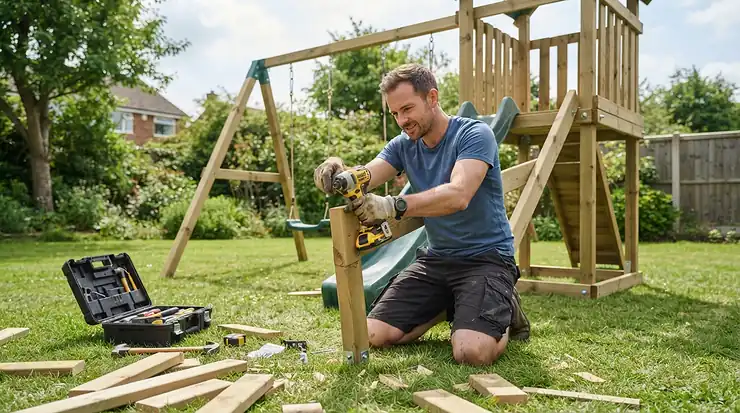
CedarWorks estimates the average outdoor playset takes about one full day for two adults with common household tools — and notes that reviewing the instructions in advance cuts that time meaningfully. Boxed kits like the Backyard Discovery Woodridge Elite and Gorilla Playsets Chateau commonly take longer, often a full weekend. A few tips that apply to any set:
⚡ Inventory every part against the parts list before you start.
⚡ Use a cordless drill/driver, but hand-tighten final bolts to avoid stripping.
⚡ Recruit a second adult for lifting beams — this isn’t optional.
The first 30 days
🔧 Re-check all bolts after two weeks. Wood settles, and fasteners loosen slightly.
🔧 Top up surfacing as loose-fill compacts under swings and slide exits.
🔧 Decide on staining early. If you want a golden tone on Northern White Cedar, apply clear UV-inhibiting stain before graying begins; otherwise, leave it natural — there’s no structural need to treat it.
Get these basics right and you’ll avoid most of the issues families run into later.
Real-World Scenarios: Matching Families to the Right Set
Specs are abstract. Here’s how the picks map onto real situations.
Scenario 1: Young family, long horizon
A couple with a two-year-old and a baby on the way, a half-acre suburban lot, budget around $6,000–$9,000. The CedarWorks Classic is the natural fit. Start with a modest tower, toddler swing, and short slide; add monkey bars and a taller climber in three or four years. With ten years of structural warranty and reconfigurable parts, the cost spreads across a decade of play — and potentially another family’s kids if you resell.
Scenario 2: Two school-age kids, practical budget
Parents of a six- and eight-year-old, standard quarter-acre yard, budget under $3,000. The Gorilla Playsets Chateau or CedarWorks Rustic both make sense. The Chateau wins on ready-made features per dollar; the Rustic wins on wood quality and maintenance. If the kids will outgrow the set in five years, the Chateau’s economics are hard to beat.
Scenario 3: Long winters, active kids
A family in Minnesota with three kids aged 4–9, a basement playroom with good ceiling height. The CedarWorks Indoor Playset probably delivers more total play hours than any outdoor option, since it works from November through March. Pair it later with a small outdoor set if the budget allows.
Scenario 4: Big yard, maximum “wow”
A family with a large, level yard who wants a giant fort for under $3,500. The Backyard Discovery Woodridge Elite gives the most clubhouse per dollar — just plan for the footprint and a full weekend of assembly.
Problem → Solution: Fixing the Most Common Playset Headaches
Problem 1: The wood is turning gray. Solution: on Northern White Cedar, that’s normal weathering, not decay. If you prefer a warmer tone on a CedarWorks Classic or CedarWorks Rustic, apply a clear stain with UV inhibitors before graying starts. On stained kits like the Gorilla Playsets Chateau, graying usually means it’s time to reseal.
Problem 2: Swings are drifting or twisting. Solution: check that hangers are level and the swing beam isn’t bowing. Three-position beams — like the one on the Gorilla Playsets Chateau — let you redistribute swings to balance load.
Problem 3: Puddles under the swings. Solution: loose-fill surfacing compacts into a bowl. Rake it back level weekly in peak season and add fresh material at least once a year.
Problem 4: The kids “outgrew” the set. Solution: on any CedarWorks line, add taller climbers, monkey bars, or longer slides rather than replacing the set. On fixed kits like the Backyard Discovery Woodridge Elite, accessory upgrades are more limited, so consider swapping belt swings for a trapeze or tire swing instead.
Problem 5: Missing or damaged parts at delivery. Solution: inventory everything the day it arrives, photograph damage immediately, and contact the seller before assembly. This is one of the most common complaints in reviews of boxed playset kits generally, and documenting early makes replacement much faster.
Long-Term Cost and Maintenance: The Real Math
Sticker price tells you very little about what a playset actually costs. A better question: what does each year of play cost you?
The pattern is consistent: CedarWorks front-loads cost but minimizes ongoing work, while kits are cheaper upfront and ask more of you over time. Imagine a CedarWorks Classic at $7,000 that’s used for 12 years — that’s under $600 per year, before counting resale value. A $2,400 kit used for 6 years with two resealing weekends lands around $400 per year plus your time. Neither is “cheaper” in every case; it depends on how long your kids will play and how much you value weekends spent not resealing wood.
Don’t forget hidden costs: surfacing material, professional installation (if you go that route), freight delivery, and replacement swings and ropes over the years. Build a 10–15% buffer into your budget for these extras.
Safety, Regulations, and Standards for Backyard Playsets
Safety isn’t a feature you buy — it’s something you set up and maintain. The CPSC’s Outdoor Home Playground Safety Handbook is the best free resource for US families, covering site selection, hardware, anchoring, surfacing, and ongoing maintenance.
Key takeaways that apply to every set in this guide:
🛡️ Location matters. Place the set away from roads, driveways, fences, and trees, and where adults can see it easily.
🛡️ Surfacing is non-negotiable. Never install over concrete, asphalt, or packed dirt; use shock-absorbing loose-fill or rubber surfacing.
🛡️ Check hardware. Protruding bolts and open S-hooks are classic hazards; inspect them at the start of every season.
🛡️ Anchor properly. Follow the manufacturer’s anchoring instructions to prevent tipping.
On standards: home playground equipment in the US is covered by the voluntary ASTM F1148 performance specification, which CPSC staff supports. For commercial and public installations, the bar is higher — CedarWorks says its commercial sets meet or exceed ADA, ASTM, and CPSC specifications. Heading into 2027, one meaningful change is that the CPSC finalized updates to its Public Playground Safety Handbook in 2025, which affects schools, parks, and childcare buyers more than homeowners.
Cedar Works Playgrounds for Schools, Churches, and Parks
Searching for cedar works playgrounds usually means you’re shopping for a facility rather than a backyard. CedarWorks runs a separate commercial division that adapts its residential designs for childcare centers, schools, churches, play cafés, and parks.
What’s different about these cedar works playgrounds?
🏫 Standards compliance. CedarWorks says its commercial playsets meet or exceed ADA, ASTM, and CPSC specifications, and can be designed to meet ADA requirements for accessibility.
👶 Age-zoned designs. Commercial sets can be configured for ages 2–5, 5–12, or 2–12 — critical for licensing and insurance in childcare settings.
📐 Custom fit. Because the system is modular, cedar works playgrounds can tuck into a small courtyard or scale up for dozens of kids at once.
🔁 Expandable over time. Facilities can add components later as budgets allow, which helps with phased funding.
For administrators, the standards landscape matters. The CPSC published a notice of final updates to its Public Playground Safety Handbook in August 2025, so any 2027 project should be designed against the current edition. Our advice: ask any vendor — CedarWorks included — to document compliance for your specific configuration in writing, and confirm surfacing requirements with your inspector.
Cedar works playgrounds also appeal to programs focused on natural materials: no chemical treatments means less concern about kids’ hands and mouths on the wood, which many early-childhood educators value.
Common Mistakes to Avoid When Buying a Cedar Playset
❌ Buying for today’s kids instead of tomorrow’s. A toddler set that can’t grow will feel cramped in three years. If you’re choosing CedarWorks playsets, plan your future add-ons now.
❌ Ignoring the safety zone. The set fits, but the swing arc hits the fence. Always add clearance space to your measurements.
❌ Mixing lines. Choosing Rustic, then wishing for Classic accessories, is an expensive surprise.
❌ Skipping surfacing in the budget. It can easily add hundreds of dollars.
❌ Assuming all “cedar” is equal. Ask what species is used and what the warranty says about rot — the answer reveals a lot.
❌ Underestimating assembly. Even “one-day” builds assume two prepared adults and a level site.
❌ Forgetting resale. Well-kept premium sets often find second owners; cheaper kits rarely do.
Avoid these seven, and you’ll sidestep most buyer’s remorse stories.
Features That Actually Matter (and Ones That Don’t)
Features that matter:
⭐ Wood species and post size. This determines lifespan, maintenance, and sturdiness more than any accessory.
⭐ Reconfigurability. Sets that can grow — like CedarWorks playsets — stretch your money across more years.
⭐ Swing beam stiffness. A 4×6 beam, like on the Gorilla Playsets Chateau, reduces sway with multiple kids.
⭐ Written warranty terms. Structural rot coverage tells you how confident a maker really is.
Features that matter less than marketing suggests:
💤 Toy telescopes and steering wheels. Fun for a summer, ignored by year two.
💤 Sheer accessory count. Ten small add-ons rarely beat one great climber.
💤 Factory stain color. It fades; wood quality doesn’t.
The takeaway: spend on structure first, play features second, and decorations last.
FAQ: CedarWorks Playsets
❓ Can I buy CedarWorks playsets on Amazon?
✅ Not directly, based on our research. CedarWorks sells online and by phone from its Maine headquarters and ships across the US. If you prefer Amazon, cedar kits like the Gorilla Playsets Chateau are close alternatives.
❓ How much does a CedarWorks swing set cost?
✅ It depends on the line. Rustic starts around $2,500, Classic around $3,500, and Architectural around $10,000, with large custom builds exceeding $25,000–$50,000. Configure online for current pricing.
❓ Do CedarWorks playsets need to be stained?
✅ No. Northern White Cedar doesn't require stain for durability. It weathers to silver-gray; if you want a golden tone, apply a clear UV-inhibiting stain before graying begins.
❓ Can I hire someone to assemble a CedarWorks set?
✅ Yes. CedarWorks can refer you to an experienced assembly provider near you in the US (excluding Alaska), or a handy friend can typically finish in about a day with a helper.
❓ Does CedarWorks offer financing?
✅ Yes. CedarWorks partners with Affirm, so you can split your playset purchase into payments. Terms depend on your approval and the amount financed, so review details before committing.
Conclusion: Which CedarWorks Playset Is Right for You in 2027?
Here’s the honest bottom line. CedarWorks playsets are a long-term investment built around one standout material — Northern White Cedar — and a modular design that grows with your kids. If you’re planning for a decade of play and want minimal maintenance, the CedarWorks Classic is the most balanced choice, backed by the strongest published structural warranty in the lineup. If you want authentic cedar on a tighter budget, the CedarWorks Rustic is a genuinely smart entry point. And if design and curb appeal are your priorities, the CedarWorks Architectural is in a class of its own.
Not every family needs that kind of horizon, though. If your kids are already in elementary school or your budget is firmly under $3,000, the Gorilla Playsets Chateau and Backyard Discovery Woodridge Elite — both orderable on amazon.com — deliver plenty of play for the money. Cold-climate families should seriously consider the CedarWorks Indoor Playset, while pretend-play fans will get years from a CedarWorks Outdoor Playhouse.
Whatever you choose, the fundamentals don’t change: measure your yard and safety zone, invest in proper surfacing, check hardware every season, and read the warranty before you buy. Do that, and your playset — premium or practical — will be the backyard’s favorite spot for years.
🚀 Ready to give your kids the backyard of their dreams?
🔍 Take your backyard play to the next level with this carefully curated lineup. Click a highlighted product to check current pricing and availability. These picks will help you create a safe, lasting play space the whole family will enjoy!
The WhizKiddo editorial team researches baby gear, outdoor play equipment, trampolines and kids' products using manufacturer specifications, safety guidance from bodies such as the CPSC and AAP, independent tests, parent reports and retailer listings. We do not claim to have tested the products ourselves. Read how we work on our How We Choose Gear page.