The second your baby starts pulling up on the coffee table, every square edge in your living room suddenly looks like a hazard. That wobbly first step, that inevitable stumble — it’s usually a hard corner that catches the fall, not the floor. If you’re searching for diy babyproofing tips for sharp corners, you’re already ahead of the game, because most parents don’t think about corner protection until after the first bump.
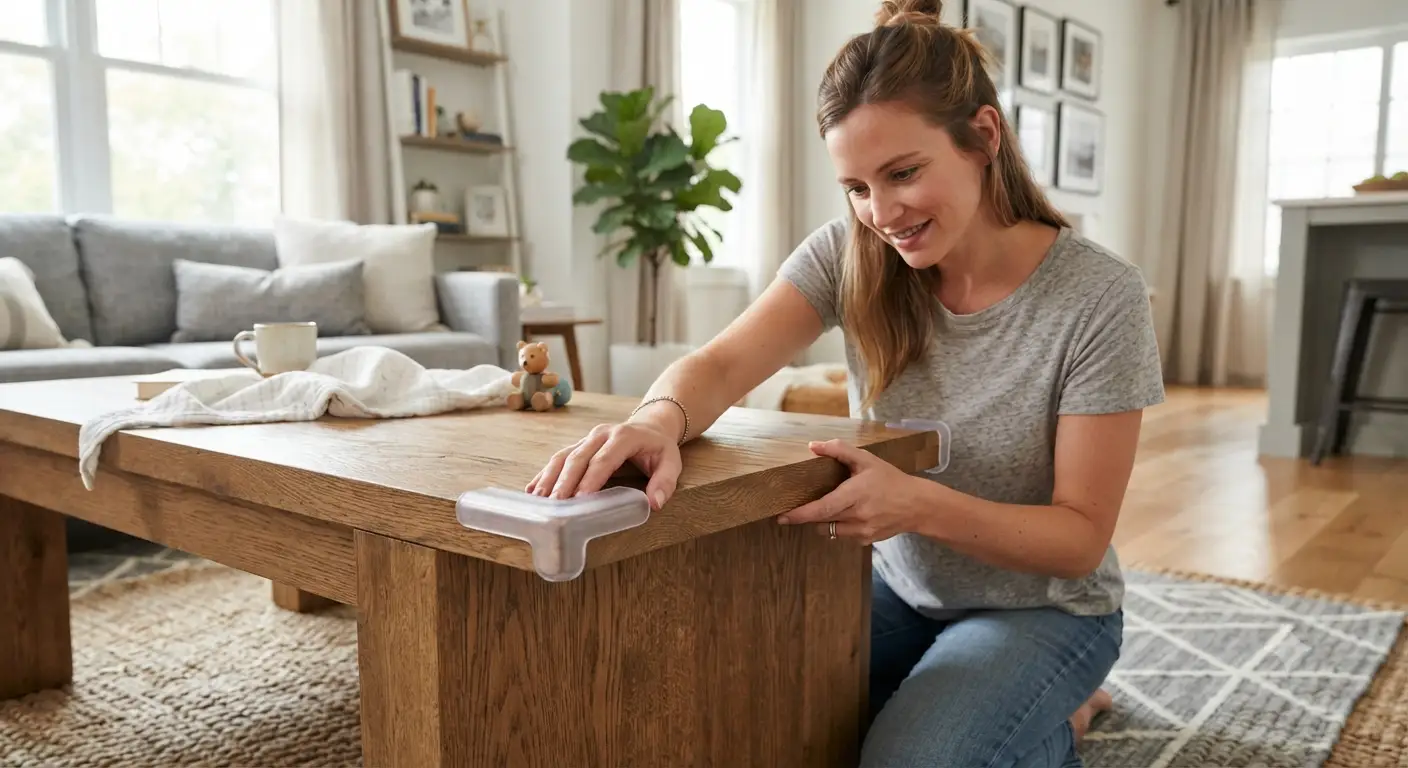
So, what is DIY babyproofing for sharp corners? It’s the process of covering hard, angular edges on furniture — tables, countertops, hearths, cabinets — with cushioned guards you install yourself, using adhesive-backed foam, rubber, or silicone, rather than replacing the furniture or hiring a professional childproofing service.
The good news is that this is one of the easiest and cheapest babyproofing projects you’ll tackle. You don’t need tools, you don’t need a contractor, and most kits install in under 20 minutes per room. But “easy” doesn’t mean “one-size-fits-all.” A clear silicone bumper that disappears on a glass coffee table won’t hold up on a stone fireplace hearth, and a jumbo foam corner built for a toddler’s first steps is overkill on a home office desk nobody climbs on. According to hands-on testing by Consumer Reports, corner protectors and edge guards can genuinely help protect young children from injuries when furniture has sharp edges, but not every product performs equally well once you factor in adhesion, impact absorption, and how long it stays put.
In this guide, we’ll walk through seven real, currently available corner and edge guard products, break down exactly how to install and maintain them, and cover the regulatory and safety context that most Amazon listings skip entirely — so you can make a genuinely informed choice instead of grabbing the first clear plastic bumper that pops up in your search results.
Quick Comparison: Top Corner Guard Picks at a Glance
Before we dig into the full reviews, here’s a snapshot of how these seven options stack up on the factors that matter most: material, coverage, and who each one is really built for.
| Product | Material | Coverage | Best For |
|---|---|---|---|
| Roving Cove HeftyFit | Rubber foam | 12 large corners | Heavy-duty furniture |
| KidKusion Jumbo | Foam rubber | 4 jumbo corners | Budget-conscious buyers |
| Safety 1st Clearly Soft | Clear gel/PVC | 4 corners | Glass or modern tables |
| Komfortology 18ft Kit | Rubber foam | 18 ft + 8 corners | Whole-home coverage |
Looking at this snapshot, the pattern is clear: foam-based guards like the Roving Cove HeftyFit and KidKusion Jumbo trade a bit of visual subtlety for serious impact absorption, while clear options like Safety 1st Clearly Soft prioritize blending into your decor over raw cushioning power. If you’ve got multiple rooms and multiple furniture styles to cover, a bundled kit like Komfortology often ends up being the more economical route than buying several small packs separately.
💬 One click helps other shoppers make an informed choice too! 😊
Top 7 DIY Corner Guards for Sharp Furniture — Expert Picks
We evaluated these seven products on real spec sheets, verified US availability, and aggregated customer review sentiment. Every one of them is a genuine, purchasable product — not a placeholder.
1. Roving Cove HeftyFit Corner Protector — toughest foam for heavy furniture
The Roving Cove HeftyFit is built for furniture that takes real abuse: coffee tables, fireplace hearths, and low bookshelves that a toddler will use as a launching pad. This set includes 12 large, pre-taped corners made from a dense rubber foam that’s noticeably thicker than most budget alternatives.
The foam is BPA- and phthalate-free, and the pre-applied 3M adhesive backing means you’re not fumbling with a separate tape roll mid-install. In practice, that thickness is the whole point: a thin corner cushion softens a light bump, but a determined toddler falling from standing height needs more compression distance before their head reaches the hard surface underneath, and this is where the HeftyFit’s bulk earns its keep.
Based on comparing the specs against thinner competitors, this is the pick for parents whose living room furniture has genuinely sharp 90-degree corners — antique tables, stone hearths, or anything with an edge you’d wince at yourself. It’s a poor match for delicate glass furniture, though, where the black or oyster foam will visually dominate rather than disappear. Reviews consistently report that the adhesive holds well on wood and laminate but needs a firmer press-and-hold on textured or painted surfaces to avoid peeling at the edges within the first week.
Pros:
- ✅ Thick foam absorbs high-impact falls effectively
- ✅ Pre-taped 3M adhesive speeds up installation
- ✅ BPA- and phthalate-free material
Cons:
- ❌ Bulky profile stands out on modern furniture
- ❌ Less suited to curved or narrow table edges
At a price point in the $20 to $25 range, the Roving Cove HeftyFit is a solid value pick if durability matters more to you than discretion — you’re paying for genuine cushioning depth, not a decorative accent.
2. Roving Cove SlimFit Edge & Corner Protector — slimmest full edge-and-corner coverage
Where the HeftyFit prioritizes bulk, the Roving Cove SlimFit goes the opposite direction: 15 feet of edge guard plus four corner pieces, engineered to sit lower and narrower on the furniture so it reads more like a design element than a safety add-on.
The trade-off is straightforward — less foam depth means slightly less impact absorption on a direct hit, but the payoff is coverage along entire table edges, not just the corners. This matters more than people expect, because plenty of toddler injuries come from bumping the flat side of a coffee table on the way down, not just the corner point. The SlimFit’s edge sections handle that gap that corner-only kits leave exposed.
What most buyers overlook with edge-and-corner combo kits is the installation time difference: running 15 feet of adhesive foam along table edges takes considerably longer than snapping on four corner pieces, so budget an extra 15 to 20 minutes compared to a corners-only set. Aggregated customer sentiment on this product line is generally positive on adhesion, with a recurring note that the foam holds its shape well over months of use rather than compressing flat.
Pros:
- ✅ Covers full edges, not just corner points
- ✅ Slim profile blends better with modern furniture
- ✅ Foam resists flattening over months of use
Cons:
- ❌ Longer, fussier installation than corner-only kits
- ❌ Slightly less cushioning depth than jumbo foam options
Priced around $20, this is the better buy for anyone whose furniture has long, exposed edges — think rectangular dining tables or low TV consoles — rather than just isolated sharp points.
3. Prince Lionheart Cushiony Corner Guards — trusted classic for wood furniture
Prince Lionheart has been a fixture in the baby-gear aisle for decades, and its Cushiony Corner Guards are the product a lot of parents remember from their own childhood homes. Each set includes four foam corner cushions plus full-length double-stick tape, available in finishes like chocolate and grey designed to match wood furniture rather than disappear entirely.
The material is described by the manufacturer as fire-retardant, non-toxic, and latex-free — details that matter more than they seem, since corner guards sit at exactly the height a crawling or teething baby will chew on. What the spec sheet doesn’t say, but the installation guide reveals, is that these guards are explicitly designed to be removable and reusable: you can peel them off, clean residue with furniture polish, and reposition them as your child grows or as furniture moves between rooms.
This is a strong option for parents who want a brand with a long safety track record and don’t mind a visible foam corner in a warm wood tone rather than a clear, invisible one. It’s less ideal if your furniture is black, white, or glass, since the brown and grey colorways will stand out.
Pros:
- ✅ Fire-retardant, non-toxic, latex-free foam
- ✅ Designed for clean, damage-free removal
- ✅ Long-standing brand reputation in baby safety
Cons:
- ❌ Limited color options for non-wood furniture
- ❌ Sold in smaller packs, so multi-room coverage adds up
Expect to pay somewhere between $10 and $20 depending on the pack size and whether you add the matching edge guard — a fair value trade for a brand many parents already trust from cribs and high chairs.
4. KidKusion Jumbo Foam Corner Guards — best budget pick, made in the USA
If you want dependable protection without overthinking it, the KidKusion Jumbo Foam Corner Guards are hard to beat on price. This four-count pack of soft foam rubber cushions is manufactured in the USA and, per hardware retailer listings, carries a UL 94 flame-retardant rating — a detail worth knowing if you’re comparing safety documentation across brands.
The features here are simple by design: closed-cell foam corners with double-sided tape, available in black, brown, off-white, and taupe. That simplicity is actually the selling point — there’s no edge guard to fuss with, no elaborate kit, just four corners that go on the pieces of furniture your toddler actually collides with most (typically the coffee table and one end table). Based on comparing this to pricier combo kits, most households don’t need edge coverage on every piece of furniture; they need corner coverage on the two or three pieces in the main play area, and this product nails that narrower job efficiently.
Reviews consistently report that these cushions are “thick and well made,” with several buyers specifically noting that competing brands’ corner cushions felt thinner by comparison at a similar price.
Pros:
- ✅ UL 94 flame-retardant rating per retailer specs
- ✅ Made in the USA
- ✅ Genuinely budget-friendly for basic coverage
Cons:
- ❌ Corners only — no edge guard included
- ❌ Fewer pieces per pack than bundle kits
At under $15 for a four-pack, this is the pick for parents who want to cover the two or three highest-traffic corners in the house without committing to a full-room kit.
5. Safety 1st Clearly Soft Corner Guards — most discreet option for glass tables
Safety 1st is one of the most recognized names in US baby gear, and its Clearly Soft Corner Guards solve a specific problem: how do you protect a glass or high-gloss modern table without covering it in a chunky black foam block? The answer here is a rounded, transparent gel-style cushion that’s designed to cushion corners “from all angles” while staying visually unobtrusive.
The four-pack uses an adhesive mount rather than a pre-taped full-coverage backing, which makes for a smaller footprint but also means the bonding surface is more limited than foam-based competitors. In practice, that’s a reasonable trade for the discretion you get in return — on a glass dining table or a modern acrylic desk, a bulky foam corner would be the first thing anyone notices walking into the room, while this clear option genuinely does blend in.
What most buyers overlook with clear PVC or gel corner guards generally is that they tend to offer less impact absorption than dense foam, simply because there’s less material compressing on impact. This makes the Safety 1st guards a better fit for households prioritizing subtlety on furniture that sees moderate bumps, rather than the primary corner a toddler is actively cruising around.
Pros:
- ✅ Nearly invisible on glass and modern furniture
- ✅ Trusted, long-established safety brand
- ✅ Rounded shape cushions from multiple angles
Cons:
- ❌ Less impact absorption than thick foam options
- ❌ Smaller adhesive footprint may need reapplication over time
Typically priced under $10, this is an easy, low-cost add for a secondary table rather than the single corner guard you’d rely on for a high-impact play zone.
6. CalMyotis Clear Silicone Corner Protectors — best value multi-room bundle
The CalMyotis Clear Silicone Corner Protectors take the “invisible protection” concept and scale it up into a bulk pack — commonly sold in sets of 12 to 24 — aimed at parents who need to cover every table, cabinet, and shelf corner in a multi-room home in one purchase.
Made from a soft, impact-absorbing silicone rather than rigid PVC, these corners are marketed specifically as safe for teething toddlers who chew on furniture edges, since silicone tends to hold up better to biting than harder plastics without cracking or shedding small pieces. The strong adhesive backing is designed for one-time application across wood, metal, marble, and glass surfaces, which is a genuinely useful detail if your home has a mix of furniture materials rather than matching sets.
Here’s what to weigh: because these are sold as bulk packs, the per-corner cost is often lower than buying several small four-packs from other brands, making this the practical choice if you’re babyproofing an entire house — living room, kitchen island, home office — rather than a single room. The clear finish keeps the aesthetic consistent from room to room, which matters if you’re covering a dozen-plus corners and don’t want a patchwork of different colors and materials.
Pros:
- ✅ Silicone withstands teething and biting well
- ✅ Bulk pack lowers the cost per corner
- ✅ Works across wood, metal, marble, and glass
Cons:
- ❌ Silicone offers less rigidity than dense foam
- ❌ Bulk packs are less economical if you only need a few corners
Expect a price in the $10 to $15 range for a full multi-pack, which stacks up as excellent value-for-money if you’re tackling whole-house corner coverage in a single order.
7. Komfortology 18ft Baby Proofing Edge Guard Kit — most complete whole-house kit
Rounding out the list, the Komfortology 18ft Baby Proofing Edge Guard Kit is the closest thing on this list to a true “set it and forget it” solution. It bundles 18 feet of soft rubber foam edge guard with eight corner protectors, enough to cover several pieces of furniture — a coffee table, a TV stand, and a dining table edge — from a single box.
The foam is BPA- and phthalate-free, non-toxic, and manufacturer listings emphasize a no-odor, no-residue formulation, addressing a common early complaint with cheaper foam products that arrive smelling strongly of off-gassing plastic. The peel-and-stick tabs are designed for a one-minute-per-piece install, which adds up meaningfully once you’re covering eight or more corners across a living room and dining area.
Based on comparing the sheer coverage-per-dollar here against buying separate small packs, this kit tends to work out as the better deal specifically because it solves the edge-plus-corner problem in one purchase rather than forcing you to mix and match brands (and colors) across your furniture. The main trade-off is coverage flexibility — 18 feet sounds like a lot, but it goes quickly once you’re wrapping multiple table edges, so measure your furniture before ordering to confirm you won’t run short.
Pros:
- ✅ Bundles both edge guard and corner protectors
- ✅ No-odor, no-residue foam formulation
- ✅ Efficient for covering multiple furniture pieces at once
Cons:
- ❌ 18 feet can run short in larger, multi-table rooms
- ❌ Foam color options are more limited than premium brands
At a price between $15 and $20, this kit offers strong value-for-money for anyone tackling a full room in one go rather than piecing together several smaller products.
How to DIY Babyproof Sharp Corners: A Step-by-Step Guide
Buying the right corner guard is only half the job — a poorly installed one falls off within a week, which defeats the purpose entirely. Start by identifying your actual danger zones: get down at your child’s eye level (literally crawl the room) and note every corner between waist- and head-height on a crawling or newly-walking child. Coffee tables, hearths, and low cabinet edges top the list; you can usually skip corners above 30 inches for a toddler-specific pass.
Before applying any adhesive-backed guard, clean the surface thoroughly with rubbing alcohol or a degreasing wipe, then let it dry completely — skipping this step is the single most common cause of guards peeling off within days, since dust and furniture polish residue prevent 3M-style adhesives from bonding properly. Press each guard firmly for a full 30 seconds once positioned, since most manufacturers note that adhesive strength builds over the first 24 to 48 hours.
Common first-30-days mistakes include installing guards while distracted (leading to crooked placement that peels at the corners first) and forgetting to reinforce high-traffic corners with a strip of clear packing tape over the guard’s edge for extra hold. Plan to inspect all corner guards monthly, since foam compresses and adhesive weakens with repeated impacts, and a guard that’s shifted or loosened offers a false sense of security.
Real-Life Scenarios: Matching Corner Guards to Your Family’s Needs
If you’re a first-time parent with a single coffee table and a newly cruising nine-month-old, a focused, budget-friendly option like the KidKusion Jumbo covering just that one high-traffic corner is often enough — you don’t need a whole-house kit for a single hazard point.
If you’re renovating a nursery-to-playroom transition and have a glass-and-metal media console alongside a wood dining set, a mixed approach works best: Safety 1st Clearly Soft on the glass piece to preserve the look, paired with Prince Lionheart Cushiony Corner Guards on the wood furniture for a more matched aesthetic.
If you’ve got multiple young kids, a multi-room layout, and want to babyproof the whole main floor in a single weekend project on a moderate budget, the bulk-pack route — either the CalMyotis Clear Silicone multi-pack or the Komfortology 18ft Kit — tends to be the most time- and cost-efficient, since you’re not reordering small packs room by room as you discover new hazards.
Common Corner-Proofing Problems (and Quick Fixes)
Problem: The guard won’t stay stuck. This is almost always an adhesion issue, not a product defect. Solution: clean the surface with rubbing alcohol, let it fully dry, and press for a full 30 seconds; on textured or painted wood, consider a stronger construction-grade double-sided tape as a backup layer.
Problem: The foam color clashes badly with your furniture. Solution: switch to a clear silicone or gel-style option like CalMyotis or Safety 1st Clearly Soft rather than fighting the aesthetics of a foam block that was never designed to match your decor.
Problem: Your toddler picks at and peels the guards off. Solution: reinforce the edges with a thin strip of clear packing tape, and choose pre-taped, full-surface-contact products like the Roving Cove HeftyFit over smaller adhesive-mount styles, since a larger contact area is harder for small fingers to lift.
Problem: You keep running out of edge guard mid-installation. Solution: measure every edge you plan to cover before ordering, add 10 to 15 percent extra length for trim waste and corner overlaps, and lean toward bundle kits like Komfortology that include generous footage upfront.
How to Choose the Best Corner Guards for Sharp Corners
- Measure first. Walk the room and count actual sharp corners and exposed edges before buying — this determines whether you need a small corner-only pack or a full edge-and-corner kit.
- Match the material to the furniture finish. Foam works well on wood and matte surfaces; clear silicone or gel suits glass, acrylic, and high-gloss modern pieces.
- Prioritize impact depth for high-traffic corners. The corner your toddler passes daily (usually the coffee table) deserves the thickest foam you can find, even if it’s less discreet.
- Check the adhesive type. Pre-taped, full-contact backing generally outperforms small adhesive-mount tabs for long-term hold.
- Confirm non-toxic, BPA- and phthalate-free materials. This matters since these products sit at chewing height for infants and toddlers.
- Buy slightly more than you think you need. Edge guards run out faster than expected once you start wrapping actual furniture.
- Plan for removal, not just installation. Look for products explicitly designed for clean removal, so you’re not left with sticky residue when your child outgrows the need.
Common Mistakes to Avoid When Babyproofing Sharp Corners
The biggest mistake is treating corner guards as a complete babyproofing solution rather than one layer of a broader safety plan. Corner guards reduce injury severity from a fall against furniture; they don’t address furniture tip-over risk, which is a separate hazard that has sent tens of thousands of young children to emergency rooms nationally. Independent testers at BabyGearLab make a similar point in their own edge-guard reviews: no single product replaces a layered safety approach. Anchoring furniture to the wall matters just as much as cushioning its edges.
A second common mistake is under-measuring. Parents often buy a single small pack, run short mid-installation, and end up with one bare corner — usually the most dangerous one, because it’s the last one tackled. A third mistake is skipping the surface-cleaning step, which is the leading cause of early adhesive failure and negative reviews that blame the product rather than the prep work. Finally, many parents install guards once and never revisit them; foam compresses and adhesive loosens over 6 to 12 months of daily impacts, so a periodic check-and-reinforce routine matters more than a “set and forget” mentality.
Corner Guards vs Other Babyproofing Methods
Corner guards aren’t the only way to soften a sharp edge, and it’s worth understanding how they stack up against the alternatives before you commit.
| Method | Cost | Effort | Best Use Case |
|---|---|---|---|
| Adhesive corner guards | Low | Low | Most homes, rented spaces |
| Furniture replacement (rounded edges) | High | High | Renovations, new builds |
| Professional babyproofing service | Moderate–High | Low | Busy parents, full-home audits |
| DIY foam/pool-noodle hacks | Very low | Moderate | Temporary or budget fixes |
Adhesive corner guards win on cost and effort for the vast majority of households, especially renters who can’t permanently modify furniture. Replacing furniture with rounded-edge designs is the most thorough fix but only realistic during a renovation or a new purchase cycle. Professional babyproofing services can be worth it if you want a full-home safety audit beyond just corners — think outlet covers, cabinet locks, and furniture anchoring all assessed at once — but they cost considerably more than a $20 corner guard kit for what is, ultimately, the same core protection.
✨ Don’t miss these exclusive deals!
🔍 Take your home safety setup to the next level with this carefully curated lineup. Click a highlighted item to check current pricing and availability. These picks will help you create a safer space the whole family will enjoy!
Baby Proofing Sharp Corners for Different Rooms and Furniture Types
Living rooms typically need the heaviest foam, since coffee tables and low TV consoles see the most direct toddler traffic during the cruising and early-walking stage — this is where a product like the Roving Cove HeftyFit earns its bulk. Kitchens and dining rooms call for a different approach: countertop corners and dining table edges benefit from thinner, food-safe-adjacent options like CalMyotis Clear Silicone, since these surfaces get wiped down constantly and a chunky foam block would trap moisture and grime along its edges.
Fireplaces deserve special attention, since hearths combine a sharp edge with a hard stone or brick surface and sit at a height toddlers frequently fall against — a dedicated fireplace guard, or a bundle kit like Komfortology with generous edge footage, is worth prioritizing here over a standard table corner pack. Home offices and nurseries with glass or acrylic furniture are the one place where discretion often outweighs raw impact absorption, making Safety 1st Clearly Soft or similarly clear options the more sensible pick, since a bulky black foam corner would be the first thing you notice walking into an otherwise minimalist room.
What to Expect: Everyday Performance of Corner Guards
On paper, every corner guard promises impact absorption and painless removal. In everyday use, the differences show up mostly in two places: how the adhesive performs after repeated impacts, and how the material ages under sunlight and cleaning products. Foam-based guards generally hold their shape better over the first year, while clear PVC and gel styles are more prone to yellowing if placed near a sunny window — something worth factoring in if aesthetics were your main reason for choosing a clear option in the first place.
You should also expect a short adjustment period where toddlers pick at and explore the new texture on furniture corners; this is normal and typically fades within the first week or two as the novelty wears off. What the spec sheet doesn’t say, but real-world use reveals, is that guards installed on furniture in direct high-traffic paths — a coffee table in the center of a living room, for instance — will need more frequent inspection than a guard on a rarely-touched side table, simply due to the sheer number of daily impacts and hand contact.
Long-Term Cost and Maintenance: Is DIY Corner Proofing Worth It?
The math here is straightforward and favorable. A full living room corner-and-edge kit typically runs somewhere between $15 and $30 depending on the brand and coverage, a one-time cost that covers the entire high-risk toddler period — roughly the 9-month to 3-year window when falls against furniture are most common. Compare that to the cost of even a single urgent care visit for a facial laceration, and the value proposition becomes obvious.
Maintenance costs stay low too: most guards last through the full toddler window without replacement, though budget for the occasional re-adhesion using extra double-sided tape (a few dollars) if a corner sees especially heavy traffic. The total cost of ownership for a full-home corner-proofing project, spread across two to three years of active use, typically works out to less than $1 per month per room — a genuinely low-cost insurance policy against one of the most common early-childhood injury mechanisms in the home.
Features That Actually Matter (and Ones That Don’t)
Foam density and adhesive contact area are the two features that actually drive real-world performance — everything else is largely aesthetic. A wider adhesive footprint (full corner coverage versus a small center tab) resists peeling far better than marketing copy about “extra-strong” adhesive alone would suggest.
On the flip side, color variety and decorative shaping (scalloped edges, novelty prints) look appealing in product photos but rarely affect actual protection, and a novelty shape can sometimes mean less material directly over the sharpest point of the corner. Similarly, “extra-large” pack counts matter less than whether the individual pieces are sized correctly for your specific furniture — sixteen small corners that don’t fully cover a jumbo table edge protect less than eight properly-sized ones.
Safety, Regulations, and Standards for Babyproofing Products
Corner and edge guards themselves aren’t subject to a dedicated federal safety standard the way car seats or cribs are, but several relevant consumer-safety frameworks still apply. Materials marketed as BPA-free, phthalate-free, and latex-free are responding to broader federal restrictions on these substances in children’s products, and flame-retardancy claims like UL 94 reference a recognized flammability testing standard used across consumer plastics and foams.
It’s also worth understanding that corner guards address only one slice of furniture-related injury risk. The CPSC’s “Anchor It!” national safety campaign specifically targets furniture and TV tip-overs, a separate but related hazard that corner cushioning doesn’t solve. A genuinely complete babyproofing approach pairs corner and edge guards with anti-tip furniture straps, particularly on dressers, bookcases, and any TV stand not built specifically to hold a television. If you’re doing a full home safety pass, treat corner guards as one item on a longer checklist rather than the whole project.
Frequently Asked Questions
❓ Do corner guards actually prevent injuries?
✅ Yes — corner guards reduce the severity of impact injuries by absorbing and distributing force on contact, though they don't eliminate risk entirely. They work best combined with furniture anchoring and active supervision…
❓ What's the best material for babyproofing sharp corners?
✅ Dense foam offers the most impact absorption for high-traffic corners, while clear silicone or gel suits glass and modern furniture where discretion matters more than maximum cushioning…
❓ How long do adhesive corner guards last?
✅ Most well-installed guards last through the full toddler safety window, roughly one to three years, though heavy-traffic corners may need periodic reinforcement with extra tape…
❓ Can I remove corner guards without damaging my furniture?
✅ Most modern corner guards are designed for clean removal; gently heating the adhesive with a hair dryer before peeling typically prevents residue or finish damage…
❓ Do I need corner guards on every piece of furniture?
✅ No — prioritize corners at your child's head height on furniture they interact with daily, like coffee tables and low shelving, rather than covering every surface in the house…
Conclusion
Babyproofing sharp corners is one of the highest-value, lowest-effort safety projects you can tackle as a new parent, and as we’ve covered, the “best” product really depends on your furniture and priorities rather than a single universal pick. If durability is your top concern, the Roving Cove HeftyFit delivers the thickest, most impact-absorbing foam on this list. If you’re working with glass or modern furniture, Safety 1st Clearly Soft and CalMyotis Clear Silicone stay nearly invisible while still cushioning impact. And if you’re covering an entire main floor in one weekend, a bundled kit like Komfortology or the Roving Cove SlimFit combo set saves you from piecing together mismatched products room by room.
Whichever option you choose, remember that corner guards are one layer of a broader safety strategy — pair them with furniture anchoring, active supervision, and a periodic check of adhesive wear, and you’ll have covered one of the most common early-childhood injury risks in your home for the cost of a single takeout dinner.
Recommended for You
- Baby Proofing Tips for Apartments: 7 Must-Know Safety Solutions for Parents
- Top 9 Ultimate tips to baby proof house for crawling baby: Your Safety Expert Guide
- 7 Best Baby Proofing Brands Affordable for 2026 Home Safety Booyah!
Disclaimer: This post contains affiliate links. As an Amazon Associate, I earn from qualifying purchases made through these links, at no additional cost to you.
✨ Found this article helpful? Share it with someone who needs it! 💬🤗