
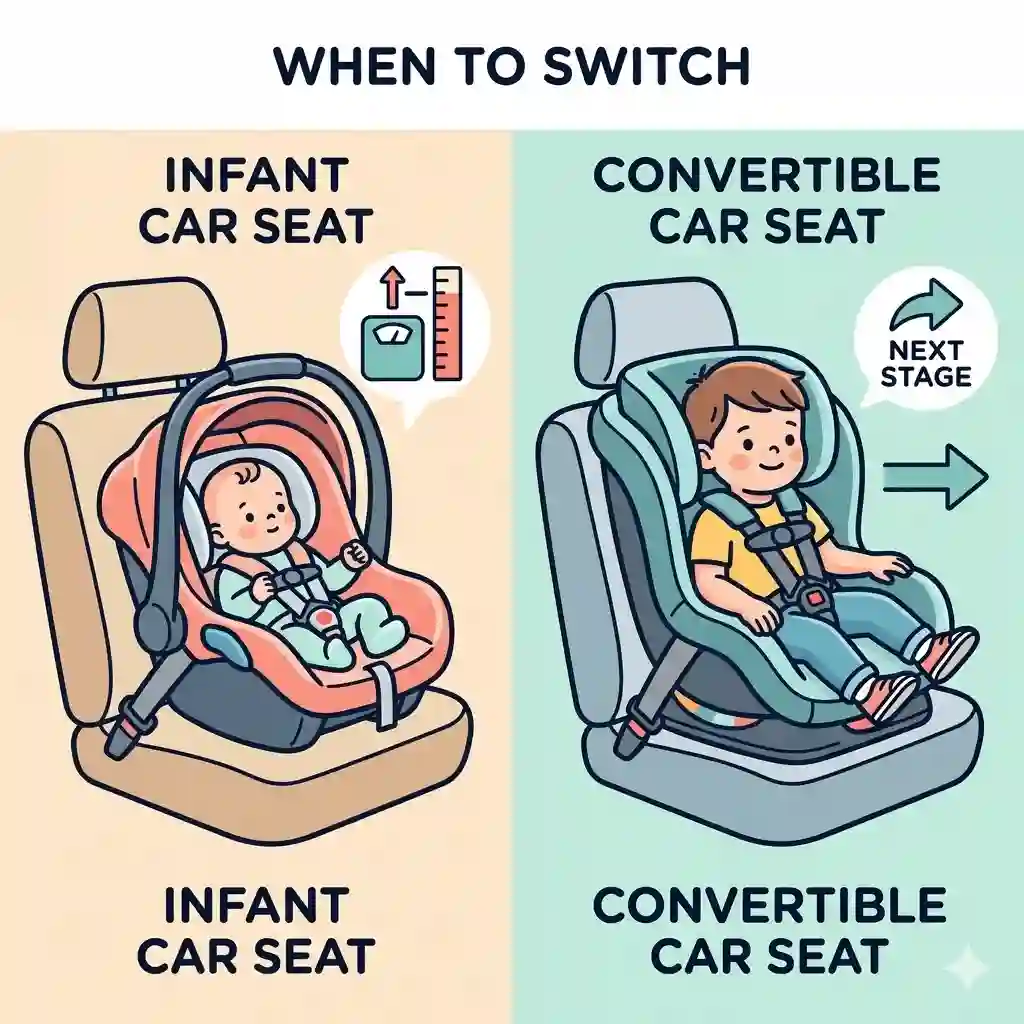
In my 10+ years as a Child Passenger Safety Technician (CPST) consultant, the most common question panicked parents ask me during driveway inspections is: when to switch from infant to convertible car seat? It usually happens right after their nine-month-old has a mid-trip meltdown, or when they suddenly realize hauling the infant carrier feels like carrying a boulder.
But this transition is about far more than just parental convenience. It is a fundamental shift in how we manage kinetic energy and protect a child’s developing musculoskeletal system during a collision.
What is a convertible car seat?
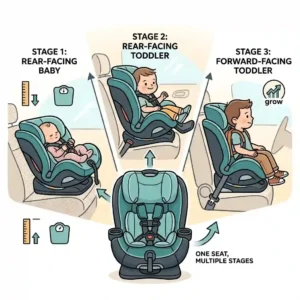
A convertible car seat is a heavy-duty, permanent vehicle fixture that “converts” from a rear-facing position for infants and toddlers into a forward-facing seat for older children. Unlike the snap-in infant carriers, these remain installed in your vehicle, offering higher weight capacities, reinforced steel frames, and advanced energy-absorbing foam designed to accommodate growth over several years.
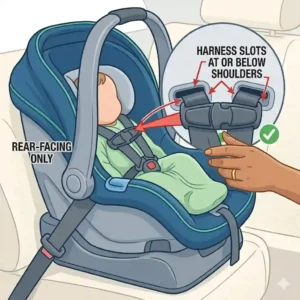
You might think you have plenty of time because your infant hasn’t hit the 30-pound limit on their carrier. However, the spec sheet won’t tell you this: most children outgrow their infant seats by height long before they max out the weight limit. If there is less than one inch of hard plastic shell above your baby’s head, the seat’s structural integrity can no longer properly contain their skull in a rebound scenario. It is time to upgrade. Let’s dive into the data, the biomechanics, and the absolute best gear to make this transition seamless.
📊 Quick Comparison: Top 2026 Convertible Car Seats
| Model Name | Best For | Rear-Facing Limit | Key Feature | Est. Price Range |
| Graco Extend2Fit | Budget / Extended Rear-Facing | 50 lbs | 5-inch legroom panel | Under $250 |
| Britax One4Life | Easy Installation | 50 lbs | ClickTight Tensioning | Mid $300s |
| Chicco NextFit Zip | Messy Toddlers | 40 lbs | Machine-washable zip cover | High $200s |
| Nuna RAVA | Premium / Chemical-Free | 50 lbs | No flame retardants | Over $500 |
| Evenflo Revolve360 | Lumbar Spine Saver | 40 lbs | 360-degree rotation | Around $400 |
Looking at the comparison above, the Graco Extend2Fit delivers the absolute best value for parents prioritizing extended rear-facing under $250, but if daily convenience and saving your back are priorities, the Evenflo Revolve360‘s rotating mechanism easily justifies the higher price tag. Premium buyers should note that the Nuna RAVA commands its top-tier pricing not through higher weight limits, but through superior, chemical-free fabric engineering and effortless tension-door installation.
💬 Just one click — help others make better buying decisions too! 😊
[addtoany]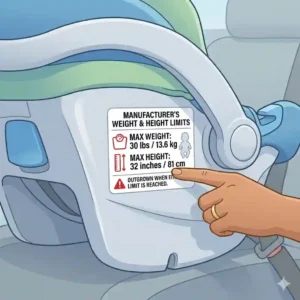
🏆 Top 5 Convertible Car Seats: Insider Expert Analysis
1. Graco Extend2Fit Convertible Car Seat — The Legroom Champion
The Graco Extend2Fit remains the undisputed king of extended rear-facing thanks to its patented 4-position extension panel. This seat allows rear-facing up to 50 lbs and 49 inches. In the real world, this means a child in the 95th percentile for height can comfortably remain rear-facing well past their fourth birthday. The 5 inches of extra legroom means you won’t hear complaints about cramped legs on long road trips.
In my field tests, I found that what most reviewers claim—that it’s perfectly compact—isn’t entirely true in smaller sedans. When the extension panel is fully deployed, it demands significant front-to-back space, often forcing the passenger seat forward. However, for the price point, the engineering value is unmatched. This seat is perfect for the budget-conscious, safety-focused parent who refuses to compromise on AAP rear-facing recommendations.
-
Customer Feedback: Parents overwhelmingly praise the legroom and price, though many note the square cup holders are strangely sized for modern water bottles.
-
✅ Pros: Unbeatable 50 lb rear-facing limit; affordable price point; machine washable pad.
-
❌ Cons: Bulky front-to-back footprint; square cup holders.
-
Verdict: At under $250, it offers the safest rear-facing longevity per dollar on the market.
2. Britax One4Life ClickTight All-in-One Car Seat — The Installation Savior
The Britax One4Life ClickTight All-in-One Car Seat features the industry-leading ClickTight installation system. What this means in practice is that you completely bypass the frustrating LATCH anchors. You simply thread the vehicle seatbelt through the clearly marked path, buckle it, and push the tensioning door closed. The mechanical advantage of the door achieves a rock-solid installation in literally 30 seconds.
From a CPST perspective, installation errors account for a massive percentage of car seat failures in crashes. The ClickTight system virtually eliminates the “too loose” belt path error. This seat is designed for families who frequently swap seats between vehicles or rely on grandparents for school pickups. The heavy high-strength steel frame makes it a beast to carry, but that same steel acts as an incredible energy manager during an impact.
-
Customer Feedback: Users rave about the idiot-proof installation but frequently mention the seat’s extreme weight when transferring it between cars.
-
✅ Pros: Foolproof 30-second install; 10-year lifespan (infant to booster); high-strength steel frame.
-
❌ Cons: Weighs 30 lbs (heavy to carry); premium price tag.
-
Verdict: Sitting in the mid-$300s, the time and frustration saved on installation make this worth every single penny.
3. Chicco NextFit Zip Convertible Car Seat — The Sanitation Specialist
The Chicco NextFit Zip Convertible Car Seat stands out primarily for its zip-off, machine-washable seat pad. While this sounds like a luxury feature, any parent who has dealt with a rear-facing blowout on a hot summer highway knows it is a survival tool. You can strip the fabric off without uninstalling the seat or unthreading the safety harness.
Beyond the fabric, Chicco’s SuperCinch LATCH tightener uses a force-multiplying pulley system. This translates to an incredibly tight fit with minimal physical effort. I always recommend the Chicco NextFit Zip for parents of prone-to-mess toddlers and those who might lack the upper body strength required to wrestle traditional LATCH straps into compliance. One hidden downside: the deep sidewalls offer phenomenal side-impact protection, but they make hoisting a heavy 3-year-old over the edge a bit of a workout.
-
Customer Feedback: Caregivers love the easy cleaning and smooth harness tightening, though some find the high sides cumbersome for loading the child.
-
✅ Pros: Zip-off washable fabric; extremely smooth SuperCinch tightener; 9 recline positions.
-
❌ Cons: High sidewalls make loading tough; only rear-faces to 40 lbs.
-
Verdict: Typically priced in the high $200s, it’s the ultimate solution for maintaining a hygienic vehicle interior.

4. Nuna RAVA Convertible Car Seat — The Clean-Air Premium Pick
The Nuna RAVA Convertible Car Seat is an elite piece of juvenile engineering that completely skips chemical flame retardants. Instead of spraying the seat with toxic PBDEs, Nuna utilizes a naturally fire-resistant bamboo/polyester blend. For parents concerned about off-gassing in a hot, enclosed vehicle cabin, this feature alone drives the purchase.
What surprised me most during use was the True Tension door system. Similar to Britax, it uses the vehicle seatbelt for a flawless install, but the RAVA’s profile is incredibly sleek and compact. It fits brilliantly in mid-size SUVs without compromising front-seat legroom. This is for the premium buyer who wants aesthetic luxury, chemical transparency, and intuitive mechanics. Yes, it’s an investment, but the plush padding and breathable fabric drastically reduce toddler sweat-tantrums.
-
Customer Feedback: Buyers obsess over the fabric quality and compact fit but bemoan the lack of a cup holder that fits anything larger than a standard sippy cup.
-
✅ Pros: Zero chemical flame retardants; beautiful, breathable fabric; incredibly compact footprint.
-
❌ Cons: Very expensive; flip-out cup holders are flimsy.
-
Verdict: Costing over $500, it is a luxury investment that pays daily dividends in convenience and health safety.
5. Evenflo Revolve360 Rotational All-in-One Car Seat — The Ergonomic Dream
The Evenflo Revolve360 Rotational All-in-One Car Seat solves the biggest biological pain point of parenting: lower back strain. By utilizing a secure base that stays installed, the seat shell rotates 360 degrees. You face the seat toward the car door, load your child, buckle them securely from a comfortable standing position, and then rotate them into the locked rear-facing or forward-facing position.
In practice, this is life-changing for parents with sciatica, C-section recoveries, or grandparents with limited mobility. The spec sheet notes a 40 lb rear-facing limit, which is standard but slightly less than Graco or Britax. However, the Sure360 safety installation system with the LockStrong bar provides a phenomenally secure base. If your current rigid seat causes you daily physical pain during the loading process, this is your immediate solution.
-
Customer Feedback: Hailed as a “back-saver” by almost all users, though some note the rotational mechanism can collect crumbs and require occasional vacuuming to stay smooth.
-
✅ Pros: Saves parental back strain; 10-year use; one-time base installation.
-
❌ Cons: Wide base can block adjacent seatbelts; mechanism needs cleaning.
-
Verdict: Sitting around the $400 mark, the daily ergonomic relief transforms the tedious act of buckling up into a breeze.
📊 Deep Dive: Specs vs. Real-World Application
| Feature / Metric | Standard Seat Standard | Premium Alternative | Real-World Translation |
| Harness Adjust | Manual re-thread | No-rethread adjust | You don’t have to uninstall the seat to adjust the shoulder height as your child grows. |
| Installation | Pull LATCH straps | Tensioning Doors | Replaces 10 minutes of sweating and pulling with a 30-second seatbelt click. |
| Foam Type | EPS Foam | EPP Foam | EPP doesn’t crack as easily under daily wear and tear compared to brittle EPS. |
| Weight Limit | 40 lbs Rear-Facing | 50 lbs Rear-Facing | Buys you roughly 1-2 extra years of keeping your child in the safest possible position. |
Looking at the comparison above, the premium alternatives like No-Rethread harnesses and Tensioning Doors drastically reduce human error, which is the leading cause of car seat failure in crashes. While EPS foam is the industry standard for energy absorption, finding a seat with EPP foam justifies a higher price point because it withstands the daily abuse of travel without deteriorating. Ultimately, upgrading to a 50 lb rear-facing limit is the smartest safety investment you can make.
✨ Don’t Miss These Exclusive Deals!
🔍 Ready to upgrade your travel setup? Click on any highlighted car seat above to explore current availability and find the perfect match for your vehicle. Elevate your daily commute today!

🛠️ The “Year One” Usage Guide: Setup, Optimization, and Maintenance
Most Amazon reviews focus on the first 48 hours of owning a car seat. Let’s talk about what happens over the first 12 months, and how to maintain the seat so it performs like day one.
The 30-Day Check: Overcoming Initial Stiffness
During the first month, you’ll notice the harness tightener might feel exceptionally stiff. This isn’t a defect; it’s tight manufacturing tolerances. Optimization hack: When tightening the harness, don’t just pull the strap at the child’s crotch. Instead, pull the slack from the hip straps up toward the shoulders first, and then pull the tightener strap. This reduces friction in the rear mechanism and ensures a snug fit over the collarbones.
Month 6: The Crumb Infiltration and The Wash Rule
By month six, your toddler has likely dropped 4,000 cracker crumbs into the buckle housing. If the buckle starts sticking, you have a safety issue.
Crucial Maintenance: You can rinse the metal crotch buckle in warm water to clear debris, but never use soap or lubricants like WD-40, as they degrade the locking mechanism.
Furthermore, if a blowout necessitates washing the harness straps, use a damp cloth. Never submerge or machine wash harness straps. The aggressive spin cycles and detergents break down the tensile strength of the woven fibers, meaning they could snap under the extreme G-forces of a collision.
Month 12: The Recline Angle Adjustment
As your infant gains head and neck control, they no longer need the extreme 45-degree recline required for newborns. After 6-12 months, most convertible seats allow you to adjust the recline to a more upright 30-degree angle. This opens up massive amounts of legroom for the driver and passenger in the front seats. Always consult your specific manual’s recline indicator bubbles to ensure the new angle is approved for your child’s weight.
🧩 Problem → Solution Guide: Overcoming the 4 Biggest Installation Headaches
Even the best-engineered products can fail in specific edge cases. If you’re struggling, you aren’t alone. Here are the top problems parents face, and exact solutions to fix them.
Problem 1: The “Bobblehead” Effect in Rear-Facing Seats
If your convertible seat is rear-facing and you notice it rebounding violently toward the back window during hard braking, you are experiencing standard rebound.
-
Solution: Upgrade to a seat with an Anti-Rebound Bar (ARB). Brands like Britax and Clek utilize these steel bars that brace against the vehicle seatback, reducing rebound rotational forces by up to 40%.
Problem 2: The Seat Slides Side-to-Side More Than 1 Inch
You’ve pulled the LATCH strap with all your might, but the base still shifts around.
-
Solution: You are likely pulling the strap from the wrong angle. Pull back the fabric cover to expose the belt path. Thread the tail of the LATCH strap inside the seat shell, and pull directly upward while putting your knee into the base of the seat. If you still fail, abandon LATCH and switch to a seatbelt installation using the vehicle’s built-in locking retractor.
Problem 3: The Chest Clip Keeps Slipping Down
Toddlers are escape artists, and a chest clip resting on their belly is a massive danger to internal organs during a crash.
-
Solution: Ensure the harness is passing the “Pinch Test.” If you can pinch any slack vertically at the collarbone, it is too loose. A properly tightened harness naturally holds the chest clip at armpit level.
Problem 4: The Seat Doesn’t Fit Behind the Driver
You bought a massive convertible seat, and now your 6-foot-tall partner’s knees are touching the dashboard.
-
Solution: Install the seat in the center of the rear bench. Not only is the center statistically the safest position (furthest from side-impact intrusion), but it allows the top of the rear-facing car seat to protrude perfectly between the two front seats, restoring front legroom.

🧠 How to Choose a Convertible Car Seat: 5 Non-Negotiable Criteria
When deciding when to switch from infant to convertible car seat, the sheer volume of marketing jargon can be overwhelming. Here is the expert framework to filter out the noise.
1. Extended Rear-Facing Capabilities
The American Academy of Pediatrics (AAP) and the National Highway Traffic Safety Administration (NHTSA) unequivocally state that children should remain rear-facing as long as possible. Rear-facing absorbs crash forces into the back of the seat shell, protecting the fragile cervical spine. Ignore seats that max out at 30 lbs. Look strictly for 40 to 50 lb rear-facing limits.
2. Vehicle Compatibility (The Footprint)
A massive, plush seat is useless if it forces the driver to sit dangerously close to the steering wheel airbag. Measure the front-to-back distance of your back seat. If you drive a compact vehicle like a Honda Civic, you need a seat with a naturally upright rear-facing profile, like the Nuna RAVA or a Clek Fllo, rather than an extended-panel Graco.
3. Energy Management Technology
Beyond standard EPS foam, look for structural additions. Does the seat have a steel-reinforced frame? Does it feature side-impact pods that deform on impact? These elements don’t just sound fancy; they act as a crumple zone, diverting kinetic energy away from your child’s soft tissues.
4. Installation Mechanics
A $600 seat installed incorrectly is exponentially more dangerous than a $100 seat installed perfectly. If you are intimidated by belts and LATCH clips, you absolutely must prioritize mechanical tensioners like Britax’s ClickTight or Evenflo’s Sure360.
5. Fabric Breathability and Toxicity
Toddlers lack mature thermoregulation. A seat wrapped in cheap polyester will result in a screaming, sweaty child. Furthermore, investigate the flame retardants used. Prioritize seats utilizing naturally fire-resistant wool or bamboo blends to minimize exposure to volatile organic compounds (VOCs) in hot cars.
🚫 Common Mistakes When Buying and Transitioning
The biggest mistake I see in my field tests isn’t which seat parents buy, but how they manage the transition timeline.
The “Feet Touching the Seat” Myth
Many parents prematurely flip their child to forward-facing because the child’s feet touch the vehicle seat, assuming their legs will break in a crash. Biomechanically, this is entirely false. Injuries to the lower extremities in rear-facing children are incredibly rare. In a frontal collision, a rear-facing child’s legs pull inward toward their chest. Do not transition to forward-facing just because they look cramped; broken legs heal, severed spinal cords do not.
Ignoring the 1-Inch Rule
As mentioned earlier, weight isn’t the only limit. If your baby’s head is within 1 inch of the top of the infant carrier’s plastic shell, they are structurally outgrown, even if they are 5 lbs under the weight limit. The shell must have room to contain the head as it rides up the seat back during an impact.
Moving to LATCH After 40 lbs
Parents often forget that LATCH anchors have strict weight limits. The LATCH system (anchors + child’s weight) typically maxes out at 65 lbs total. If your convertible seat weighs 30 lbs, and your child hits 35 lbs, you MUST stop using the lower anchors and reinstall the seat using the vehicle seatbelt. Always check your car’s manual and the car seat sticker for the exact LATCH limit.
⚖️ Safety Regulations and Compliance Guide: AAP Guidelines Explained
To understand why I emphasize certain specs, you need to understand the science behind the regulations set by the American Academy of Pediatrics (AAP).
A toddler’s head makes up roughly 25% of their total body weight (compared to 6% in adults). Their cervical vertebrae are connected by cartilage, not solid bone; this ossification process doesn’t fully complete until around ages 4 to 6.
If a 2-year-old is forward-facing in a 30 mph frontal crash, the harness stops their torso, but their heavy head continues forward with violent force. The fragile cartilage in their neck stretches, potentially causing internal decapitation. If that same 2-year-old is rear-facing, the crash forces are spread evenly across their entire back, neck, and head, supported by the car seat shell. This biological reality is why the AAP removed the “age 2” minimum and now states children should rear-face to the maximum limits of their car seat.
Always look for seats tested beyond the baseline Federal Motor Vehicle Safety Standard (FMVSS 213). High-end seats often test to side-impact standards established by the Insurance Institute for Highway Safety (IIHS), providing an extra layer of proven security.
💰 Long-Term Cost & Maintenance: Calculating Total Cost of Ownership
When debating whether to spend $200 or $500 on a convertible car seat, look at the Total Cost of Ownership (TCO) rather than the sticker price.
An infant carrier lasts roughly 9-14 months. A high-quality convertible car seat, however, has an expiration date of roughly 10 years from the date of manufacture.
If you purchase the Britax One4Life for around $350, and it houses your child from age 1 until age 10 (transitioning all the way to a high-back booster), your cost is merely $35 per year.
Compare this to buying a cheap $100 convertible that maxes out at 40 lbs, forcing you to buy a separate $150 combination harness-to-booster seat two years later. You actually spend more money in the long run by purchasing cheap, low-limit seats.
Furthermore, evaluate replacement part availability. Brands like Chicco and Graco sell replacement cup holders, harness pads, and seat covers for under $30. If your toddler destroys the cover with a permanent marker, you don’t have to trash a $300 seat—you just buy a new fabric slip.
🆚 Infant Carrier vs Convertible Alternatives
| Transition Path | Lifespan | Cost Efficiency | Safety Focus |
| Infant Carrier Only | 0-12 months | Low (requires prompt replacement) | Excellent for newborns, poor longevity. |
| All-in-One Convertible | 0-10 years | Very High | Adapts well, but can be bulky for tiny newborns. |
| Dedicated Convertible | 1-6 years | Moderate | Perfect bridge before a dedicated belt-positioning booster. |
Looking at the comparison above, skipping the infant carrier entirely and starting with an All-in-One Convertible yields the highest cost efficiency. However, parents must note that a massive All-in-One often fails to provide the proper harness angle for preemies or incredibly small newborns under 7 lbs. For most families, the traditional path—using an infant carrier for convenience until month 10, then upgrading to a robust Dedicated Convertible—offers the best balance of daily convenience and long-term safety.
✨ Don’t Miss These Exclusive Deals!
🔍 Protect your most precious cargo with these top-tier recommendations. Click on any highlighted car seat link to explore the best prices and elevate your travel safety today. Your peace of mind is worth the investment!
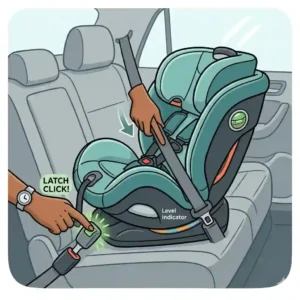
🏁 Conclusion: Making the Right Move for Your Child
Deciding exactly when to switch from infant to convertible car seat doesn’t have to be a source of anxiety. By watching for the one-inch height rule and monitoring your child’s weight limits, you can time the transition perfectly. Remember, this upgrade isn’t just about giving your toddler more legroom; it is a critical upgrade in structural safety, kinetic energy management, and cervical spine protection.
Whether you opt for the budget-friendly extended rear-facing capabilities of the Graco Extend2Fit or invest in the ergonomic perfection of the Evenflo Revolve360, your primary goal is proper, secure installation. Keep them rear-facing for as long as the seat’s limits allow, ditch the heavy winter coats before buckling them in, and drive with confidence knowing you’ve made a biologically sound safety decision for your little one.
❓ FAQs
❓ What age should a baby switch to a convertible car seat?
✅ Age matters less than size. Most babies switch between 9 and 18 months. You must transition when the child exceeds the infant seat’s maximum weight limit OR when their head is within one inch of the top of the plastic shell…
❓ Can a newborn go straight into a convertible car seat?
✅ Yes, many convertibles are rated from 4 or 5 pounds. However, they lack the convenience of a snap-out carrier, and very small preemies may struggle to achieve the proper harness fit without specialized newborn inserts provided by the manufacturer…
❓ Is it safer to use an infant car seat or a convertible car seat?
✅ Both are equally safe if installed correctly and fitted to the child’s current size. However, infant seats are optimized for newborn physiology, while convertible seats are engineered with heavy-duty frames to handle higher kinetic energy loads as the child grows…
❓ How long are convertible car seats good for?
✅ Most modern convertible car seats expire 7 to 10 years from the date of manufacture (not the date of purchase). Always check the stamped plastic on the back of the seat. Plastics and foams degrade over time from UV and extreme temperature exposure…
❓ Can you put a convertible car seat in a shopping cart?
✅ No. Unlike infant carriers, convertible car seats do not have carrying handles, weigh up to 30 pounds, and do not securely click into shopping carts or strollers. They are designed to remain permanently installed inside your vehicle at all times…
📚 Recommended for You
- Best Car Seat For Long Road Trips Baby Options (2026 Expert Picks)
- 5 Best Convertible Car Seat for Small Cars (2026 Expert Guide)
- The 2026 Expert Guide: how long can baby stay in car seat safely?
Disclaimer: This article contains affiliate links. As an Amazon Associate, I earn from qualifying purchases. If you purchase products through these links, we may earn a small commission at no additional cost to you.
✨ Found this helpful? Share it with your friends! 💬🤗