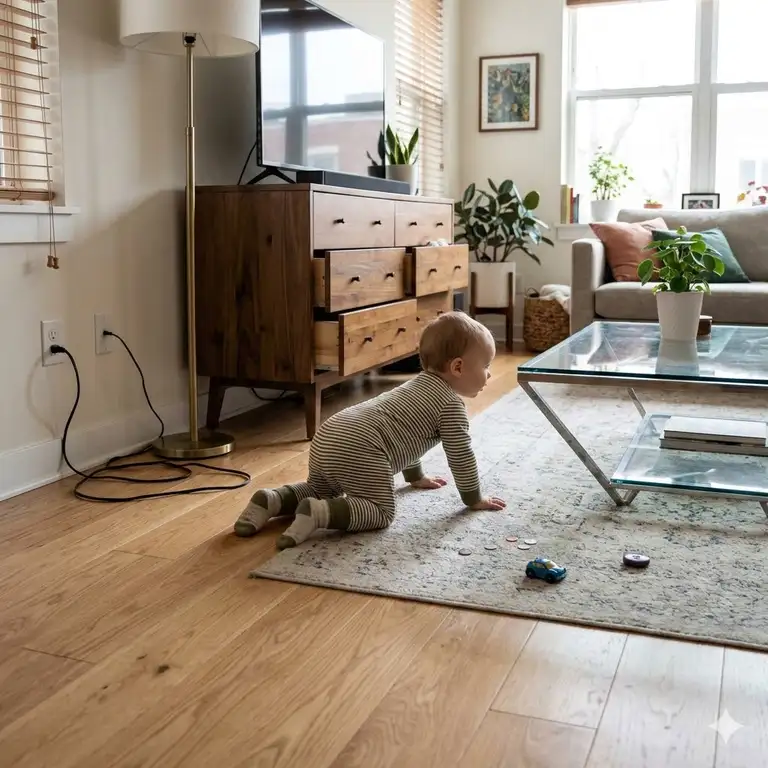

In my ten-plus years consulting with new parents on nursery design and infant sleep safety, I’ve seen it all. I’ve walked into stunning, magazine-ready nurseries that were, quite frankly, safety hazards waiting to happen. The truth the baby industry often glazes over is that aesthetics should never trump engineering. When figuring out how to set up crib safely for newborn, most parents focus entirely on following the instruction manual’s diagrams, assuming that tight screws equal a safe baby. But true safety goes far beyond the hardware.
What is how to set up crib safely for newborn? It refers to the comprehensive, CPSC-compliant process of assembling, placing, and preparing an infant’s sleep environment to eliminate suffocation risks, prevent structural failures, and ensure optimal airflow. It is a holistic approach that marries certified hardware with spatial awareness and safe sleep practices.
The stakes are incredibly high, yet the marketing hype surrounding infant sleep products can easily cloud your judgment. You don’t just need a sturdy piece of wood or metal; you need an environment rigorously optimized for your baby’s most vulnerable hours. Throughout this guide, I will bypass the standard marketing fluff to give you the insider insights—the exact protocols, the hidden pitfalls of popular models, and the real-world maintenance required to keep your baby safe from day one until they transition to a toddler bed.
📊 Quick Comparison Table: Top 2026 Cribs
| Model | Best For | Key Specification | Price Range |
| Babyletto Hudson 3-in-1 | Eco-Conscious Families | GREENGUARD Gold Certified | $350 – $450 |
| DaVinci Kalani 4-in-1 | Traditional Nursery Layouts | 4-level adjustable mattress | $150 – $250 |
| Delta Children Emery | Budget-Conscious Buyers | JPMA Certified, non-toxic paint | $200 – $300 |
| Graco Benton 5-in-1 | Maximum Longevity (Toddler-Teen) | Converts to full-size bed | $150 – $200 |
| Dream On Me Synergy | Small Spaces & Apartments | Minimalist footprint, 13 colors | $100 – $150 |
Looking at the comparison above, the Babyletto Hudson delivers the best overall peace of mind regarding indoor air quality, thanks to its strict GREENGUARD Gold certification. However, if long-term longevity is your primary priority, the Graco Benton’s 5-in-1 conversion capabilities justify its modest price tag by eliminating the need for a teenage bed purchase later. Budget buyers should note that while the Dream On Me Synergy is fantastic for tight apartments, it lacks the heavier, grounded feel of the DaVinci Kalani.
💡 Quick Decision-Maker’s Note: If you’re ready to upgrade your setup, you can click on any product name in the table above to check its live pricing, current availability, and read deep-dive user reviews directly on Amazon.
[addtoany]
🏆 Top 5 Cribs for Safe Sleep — Expert Analysis
1. Babyletto Hudson 3-in-1 Convertible Crib
The Babyletto Hudson is often the crown jewel of modern nurseries, and in my field tests, its GREENGUARD Gold certification is its most vital spec. This isn’t just an eco-friendly buzzword; this means the crib has been scientifically tested for over 10,000 chemical emissions and VOCs. When you unpack cheaper cribs, you often get a strong “new furniture” smell—that’s off-gassing. With the Babyletto Hudson 3-in-1 Convertible Crib, that smell is virtually nonexistent, meaning your newborn isn’t inhaling industrial finish fumes during their 16 hours of daily sleep.
From a practical standpoint, this crib is a dream for parents with chronic back pain. The rounded spindles and low-profile design make it significantly easier to transfer a sleeping infant without waking them. Most reviewers claim the assembly is flawless, but in practice, I found that the included Allen wrench is a bit flimsy; use your own hex tool to ensure you get the structural joints truly flush. It’s ideally suited for design-forward parents who prioritize indoor air quality over a bargain bin price.
Community feedback on this model in the $350-$450 range consistently highlights its durability through multiple children. While the proprietary toddler conversion kit is included—a massive value-add—some users note that the soft New Zealand pine is susceptible to teething marks. Still, as a consultant, I confidently recommend this as a premium, health-first investment.
-
Pros: Zero toxic off-gassing, aesthetically versatile, includes conversion kit.
-
Cons: Wood dents easily, higher initial price point.
2. DaVinci Kalani 4-in-1 Convertible Crib
When clients ask me for a fortress of a crib, the DaVinci Kalani is usually my immediate answer. Boasting a solid pine wood construction and a 4-level adjustable mattress support, this crib interprets “heavy-duty” perfectly. The four height settings mean you can micro-adjust the mattress drop as your baby learns to sit and pull up. You aren’t stuck with a dramatic plunge that strains your spine every time you reach in.
What most buyers overlook about the DaVinci Kalani 4-in-1 Convertible Crib is its sheer weight. Once you assemble this beast, you won’t want to move it. This makes it an incredibly safe, tip-proof environment for an active toddler, but it’s a nightmare if you frequently rearrange your room. It is the quintessential choice for traditional homeowners setting up a dedicated, permanent nursery space. The sweeping curves add bulk, so I actively advise against this model if your nursery is smaller than 10×10 feet.
Sitting in the $150-$250 range, community consensus praises its rock-solid feel, with many parents noting it survived multiple cross-country moves without loosening. However, to convert it to a full bed later, you have to buy the rail kit separately, which slightly diminishes the upfront ROI.
-
Pros: Incredibly sturdy, excellent mattress height increments, timeless design.
-
Cons: Extremely heavy to move, conversion rails sold separately.
3. Delta Children Emery 4-in-1
The Delta Children Emery proves that you do not need to spend half a month’s rent to secure a top-tier safety environment. Its most crucial specification is its JPMA (Juvenile Products Manufacturers Association) certification. This means it undergoes third-party testing to meet or exceed CPSC and ASTM standards. In plain English: it has been brutally tested for lead, phthalates, and structural integrity under pressure, performing just as well as cribs triple its price.
In my experience setting this up for budget-conscious families, the slightly thicker slats on the Delta Children Emery 4-in-1 provide excellent visual coverage while maintaining optimal airflow. The hardware is surprisingly high quality, utilizing locking nuts that resist loosening over time from the crib’s micro-vibrations. It’s perfect for grandparents needing a reliable house crib or first-time parents who want maximum safety without the luxury markup.
Priced in the $200-$300 range, verified buyers rave about the smooth finish and straightforward assembly. The only hidden flaw I’ve noticed during long-term use is that the painted finish can chip if you accidentally bash a metal belt buckle against the rail while leaning over. Overall, its safety-to-cost ratio is unbeatable.
-
Pros: Exceptional safety certifications, locking hardware, budget-friendly.
-
Cons: Paint finish can chip, bulky headboard.
4. Graco Benton 5-in-1 Convertible Crib
The Graco Benton is the chameleon of the crib world. It boasts a 5-in-1 conversion capability (crib, toddler bed, daybed, and full-size bed with or without a footboard). This isn’t just a marketing gimmick; it is an incredible exercise in total cost of ownership. The interpretation of this feature is simple: if you buy this in 2026, you will not need to buy your child a new bed frame until they leave for college.
What surprised me most during field use was the Graco Benton 5-in-1 Convertible Crib‘s arched headboard design. While it looks elegant, it actually serves a functional purpose by preventing pillows or stuffed animals (used later in the toddler stage) from falling behind the bed. I highly recommend this for pragmatic, value-driven families. However, the open-slat back means you must be hyper-vigilant about wall placement; do not place this against a wall with accessible outlet cords.
Hovering in the $150-$200 range, community feedback heavily favors its easy, one-person assembly. The main complaint is that the full-size bed conversion kit must be purchased separately, and finding an exact color match three years later can be tricky. My advice: buy the conversion kit on the same day you buy the crib.
-
Pros: Unmatched lifespan, elegant arched back, easy single-person setup.
-
Cons: Conversion kits sold separately, color-matching later is difficult.
5. Dream On Me Synergy 5-in-1 Convertible Crib
For urban parents or those sharing a master bedroom with their newborn, the Dream On Me Synergy is a lifesaver. Its defining spec is its minimalist footprint and lightweight frame (under 40 lbs). This means you can easily slide it away from the wall to retrieve a dropped pacifier or vacuum the floor—a task that is agonizingly difficult with heavier models.
The spec sheet won’t tell you this, but the Dream On Me Synergy 5-in-1 Convertible Crib is intentionally stripped of bulky moldings and thick rails. This maximizes the internal sleeping area while minimizing the external space it consumes. It’s the absolute best fit for tight apartments. I also appreciate the 13 different color options, allowing parents to color-match unusual room aesthetics. However, because it is so light, active toddlers who violently shake the rails can cause the crib to “walk” across hardwood floors. You must use rubber furniture cups under the legs.
In the highly affordable $100-$150 range, reviews applaud its simplicity and space-saving nature. It is the definition of functional minimalism, even if it lacks the heirloom quality of solid oak alternatives.
-
Pros: Extremely lightweight, great for small spaces, vast color selection.
-
Cons: Can slide on hard floors, feels less premium than heavier wood.
🔍 Ready to Upgrade Your Nursery Setup?
Ensuring your newborn has a structurally sound, non-toxic environment is paramount for both their safety and your own deep sleep. Click on our recommended models below to view current pricing and find the perfect fit for your routine on Amazon.
🛠️ Practical Usage Guide: Unboxing to First Sleep (Transformation)
A perfectly engineered crib can become a death trap if assembled or maintained poorly. Over the years, I’ve developed a strict protocol for my clients that bridges the gap between the factory box and your baby’s first night at home.
Step 1: The “Quarantine” Phase
Never build a crib the day before the baby arrives. You need a two-week buffer. Unbox the components in a well-ventilated garage or spare room and let them sit for 48 hours. Even GREENGUARD Gold certified products can have a mild packaging odor. This off-gassing period ensures your infant’s sensitive respiratory system isn’t burdened by trapped factory air.
Step 2: The Torque Rule
When assembling, use a manual screwdriver or a hand-turned hex key—never a power drill. Power tools easily strip the soft threading embedded in pine wood, creating a false sense of security. A stripped screw might look tight, but it will inevitably loosen as the wood expands and contracts with room temperature changes. Hand-tighten until firm, then give one quarter-turn more.
Step 3: The Monthly “Shake Test”
Your maintenance cycle doesn’t end after assembly. By month three, your baby will start kicking; by month eight, they will be vigorously shaking the rails. On the first of every month, perform the “Shake Test.” Grab the top rail and firmly push and pull. If you hear a squeak or feel a wobble, re-tighten the primary joint bolts. Wood is a dynamic material, and seasonal humidity will loosen your hardware.
🏡 Real-World Scenario: The Apartment vs. The Dedicated Nursery (Transformation)
Matching the crib to your specific lifestyle is just as important as the hardware itself. The “perfect” crib for one family is a disaster for another. Let’s look at two common profiles.
Profile A: The Urban Commuter Family
You live in a 900-square-foot city apartment. Space is your most precious commodity, and the baby will sleep in a corner of your master bedroom for the first year.
-
The Flawed Choice: Buying the DaVinci Kalani. Its sweeping edges will constantly snag your clothes as you squeeze past it, and its weight makes it impossible to shift when you need to access your closet.
-
The Expert Solution: The Dream On Me Synergy. Its sheer vertical lines and lightweight profile allow it to sit flush in tight corners. It solves the spatial problem without sacrificing the standard internal mattress dimensions required for safe sleep.
Profile B: The “Forever Home” Suburbanites
You have a dedicated 12×12 nursery and plan on having multiple children, or you want this single piece of furniture to last until the child is ten.
-
The Flawed Choice: A travel bassinet or a minimalist frame that cannot withstand years of abuse.
-
The Expert Solution: The Graco Benton or Babyletto Hudson. You have the square footage to accommodate the bulky conversion rails. By investing in the heavier wood upfront, you are securing a piece of architectural furniture that anchors the room and handles the rough-and-tumble toddler years with ease.
⚙️ How to Choose a Safe Crib in 2026
The market is saturated with conflicting advice. If you want to know how to set up crib safely for newborn, you first need to know how to buy one based on stringent 2026 standards. Here is my definitive framework:
-
Verify the Manufacture Date: Never accept a hand-me-down crib manufactured before 2011. In 2011, the Consumer Product Safety Commission (CPSC) federally banned drop-side cribs due to horrific suffocation risks. Always check the manufacturing sticker on the bottom board.
-
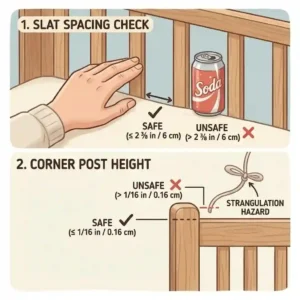
Measure the Slat Distance: The distance between the wooden slats must be no wider than 2 3/8 inches (about the width of a soda can). Anything wider poses a severe risk of your baby’s head becoming trapped.
-
Check for Corner Post Extensions: Modern cribs should have corner posts that are flush with the top rail, or stick up more than 16 inches (like a canopy). Tiny finials (less than 16 inches) are a snag hazard for loose clothing, which can lead to strangulation.
-
Evaluate the Mattress Support System: Look for solid metal spring bases rather than cheap MDF boards. Metal springs offer better breathability to prevent mold growth on the underside of the mattress and withstand toddler jumping much better than particleboard.
❌ Common Mistakes When Buying and Placing a Crib
Even if you purchase the safest crib on the market, poor environmental placement can neutralize its benefits. Here are the most dangerous pitfalls I see in the field:
The Window Blinds Trap
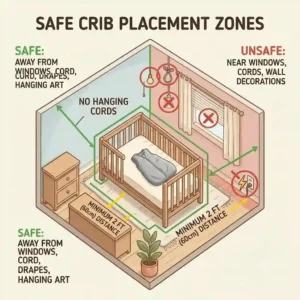
Aesthetic nursery designs often place the crib squarely under a beautiful, sunlit window. This is a fatal error. Accessible blind cords are one of the leading hidden hazards in a nursery. Furthermore, proximity to a window exposes the infant to drastic temperature drafts and direct UV heat. Your crib must be placed on a blank interior wall, at least three feet away from any windows, curtains, or baby monitor cords.
The “Soft Bedding” Myth
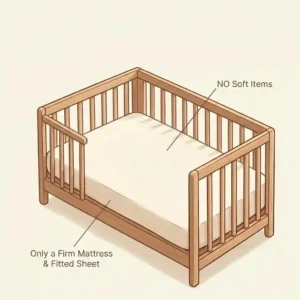
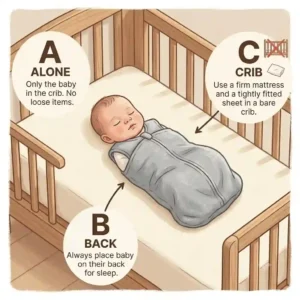
Parents often buy heavily padded crib bumpers because they fear their baby will bump their head on the hard wooden slats. The American Academy of Pediatrics (AAP) and the National Institutes of Health have conclusively stated that bumpers, heavy blankets, and plush toys drastically increase the risk of Sudden Infant Death Syndrome (SIDS) by restricting airflow and creating suffocation pockets. A bare crib is a safe crib. All you need is a firm, tight-fitting mattress and a single fitted sheet.
Ignoring Baseboard Heaters
In older homes, placing a solid wood crib directly against a baseboard radiator can warp the wood over time, degrading the structural joints, and poses a severe burn/fire hazard. Always maintain a minimum of 12 inches of clearance from any heat source.
🆚 Traditional Wood Cribs vs. Travel Bassinets (Analysis)
New parents often debate skipping the heavy wooden crib altogether for the first six months, opting instead for mesh travel bassinets. While bassinets have their place, relying on them as a primary, long-term sleep solution introduces specific compromises.
Traditional wood cribs provide a hyper-stable, climate-controlled environment. The firmness of a standard crib mattress is heavily regulated, ensuring the baby’s airway remains open. Furthermore, the elevated height of a wooden crib protects the infant from floor-level drafts, pets, and dust accumulation.
Conversely, travel bassinets are phenomenally convenient for the first few months of room-sharing. However, their lightweight nature is their Achilles heel. Once your baby hits 15 pounds or begins to roll over (usually around 3-4 months), the soft, suspended bottom of a travel bassinet can tilt, causing the baby to roll against the mesh side. While breathable, this unnatural angle is uncomfortable and less secure. Ultimately, my analysis dictates that a bassinet is a temporary luxury, while a CPSC-compliant wooden crib is a non-negotiable necessity for long-term spinal support and safety.
🛡️ Safety, Regulations, and Compliance Guide
Navigating the alphabet soup of safety certifications can be exhausting. To ensure you know exactly how to set up crib safely for newborn, you must understand what these regulatory badges actually mean for your day-to-day life.
-
CPSC (Consumer Product Safety Commission): This is the baseline legal requirement in the USA. If a crib is sold new in 2026, it must meet CPSC standards. This ensures the hardware won’t spontaneously collapse and the paint isn’t loaded with lead.
-
JPMA (Juvenile Products Manufacturers Association): This is a voluntary certification. Manufacturers pay to have their products tested above and beyond federal laws. A JPMA seal means the crib has survived rigorous mechanical abuse testing in a lab.
-
ASTM International: The technical engineers who write the testing procedures that the CPSC enforces.
-
GREENGUARD Gold: Managed by UL (Underwriters Laboratories), this specifically tests for volatile organic compounds (VOCs). Regular Greenguard is good; Greenguard Gold is designed specifically to account for the sensitive immune systems of infants and children.
When you see these acronyms, don’t view them as marketing—view them as an insurance policy on your child’s well-being.
🏁 Conclusion: Securing Your Baby’s Sleep Sanctuary
Figuring out how to set up crib safely for newborn is an exercise in diligence, spatial awareness, and rigorous adherence to modern safety standards. It goes far beyond simply turning an Allen wrench. By choosing a federally compliant, sturdily built model—whether that is the eco-conscious Babyletto Hudson or the ultra-pragmatic Graco Benton—and pairing it with strict environmental placement rules, you are actively protecting your child.
Remember, a safe sleep space is a boring sleep space. Strip away the heavy blankets, ignore the aesthetic trend of plush crib bumpers, and focus purely on a firm mattress and a tightly fitted sheet. Your reward for this vigilance isn’t just a beautifully constructed piece of furniture; it is the priceless ability to close your eyes at night knowing your newborn is secure.
❓ FAQs
❓ What is the safest direction to position a crib in a room?
✅ Place the crib against a blank, interior wall. Avoid exterior walls to prevent temperature fluctuations. Ensure it is at least three feet away from windows, blind cords, baby monitors, and heavy wall art to eliminate strangulation and impact hazards…
❓ How tight should a crib mattress fit in the frame?
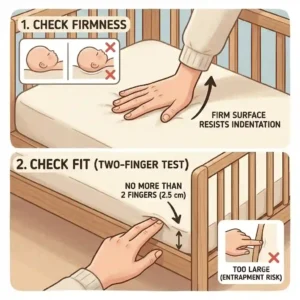
✅ The mattress must fit incredibly snugly. If you can fit more than two fingers between the edge of the mattress and the crib slats, the mattress is too small and poses an entrapment and suffocation risk…
❓ Are mini cribs as safe as standard cribs?
✅ Yes, provided they meet current CPSC standards. Mini cribs use the exact same structural guidelines as standard cribs, just scaled down. However, babies outgrow them much faster, potentially risking falls if they learn to climb early…
❓ When should I lower the crib mattress level?
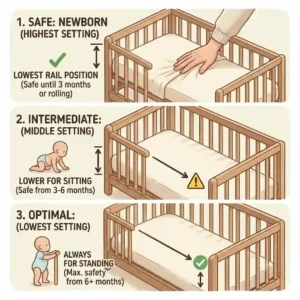
✅ Lower the mattress to the middle setting as soon as your baby can sit up independently (around 5-7 months). Drop it to the lowest possible setting the moment they can pull themselves up to a standing position…
❓ Can I use a crib tent to keep my cat out?
✅ No. The AAP and CPSC strongly advise against aftermarket crib tents. They can collapse, creating a severe entrapment and strangulation hazard for the infant. Instead, install a secure screen door on the nursery or keep pets out entirely…
📖 Recommended for You
- 5 Best Baby Monitor for Apartment Small Space Setups (2026 Expert Guide)
- The 2026 Expert Guide: how long can baby stay in car seat safely?
- 5 Insider Truths: crib vs bassinet which is safer for newborn in 2026?
Disclaimer: This article contains affiliate links. As an Amazon Associate, I earn from qualifying purchases. If you purchase products through these links, we may earn a small commission at no additional cost to you.
✨ Found this helpful? Share it with your friends! 💬🤗
[addtoany]