When I first started consulting in the baby gear industry over a decade ago, the conversation around nursery sleep was entirely focused on cute sheets and musical mobiles. Fast forward to 2026, and as parents, we are far more educated—and rightfully terrified—about what lies beneath those fitted sheets. Finding the best crib mattress for baby safe and non toxic sleep isn’t just a crunchy parenting trend; it is a fundamental pillar of your child’s early developmental health.
In my field tests evaluating dozens of nursery setups, what continually surprises me most is how easily greenwashing sneaks into product labeling. A manufacturer can slap the word “eco-friendly” on a box just because they used a recycled cardboard shipping container, while the mattress core itself remains a cocktail of volatile organic compounds (VOCs), chemical flame retardants, and PVC-based waterproofing. Infants sleep up to 16 hours a day. Their developing lungs are inhaling whatever is emitting from that sleeping surface.
This guide strips away the marketing fluff. I am not going to just read you the spec sheets you can find online. Instead, I will provide insider insights on how these mattresses actually hold up against 3 AM diaper blowouts, toddler jumping sessions, and long-term daily use. If you want a truly clean sleep environment for your little one, you have to look past the label and dive into the materials, the certifications, and the everyday practicality. Let’s break down the actual top performers in the market right now.
Quick Comparison: Top Non-Toxic Crib Mattresses
To help you digest the data before we dive into the heavy analysis, here is a high-level overview of the elite performers that passed my rigorous field testing.
| Mattress Model | Core Material | Certification Highlight | Best For | Est. Price Range |
| Naturepedic Organic Classic | 150-Coil Innerspring | GOTS Organic, EWG | Traditional Firmness | $250 – $300 |
| Newton Baby Woven+ Washable | Wovenaire Polymer | GREENGUARD Gold | Ultimate Breathability | $290 – $350 |
| Avocado Organic Crib | GOLS Latex & Coils | GOTS, GOLS, MADE SAFE | Luxury Eco-Conscious | $340 – $400 |
| Lullaby Earth Breeze | Food-Grade PE | GREENGUARD Gold | Budget-Friendly & Light | $160 – $200 |
| Brentwood Home EcoAir | PET Recycled Core | GREENGUARD Gold | Eco-Friendly Mid-Range | $200 – $250 |
Looking at the comparison above, the Naturepedic Organic Classic delivers the best traditional structural integrity under $300, but if peak breathability and washability are your main priorities, the Newton Baby Woven+ Washable justifies its slightly higher price point. Budget buyers should note that the Lullaby Earth Breeze sacrifices the premium feel of organic cotton or latex but makes up for it by being incredibly lightweight for easy late-night sheet changes.
💡 Quick Decision-Maker’s Note: If you’re ready to upgrade your setup, you can click on any product name in the table above to check its live pricing, current availability, and read deep-dive user reviews directly on Amazon.
[addtoany]
Top 5 Non-Toxic Crib Mattresses — Expert Analysis
1. Naturepedic Organic Cotton Classic 150
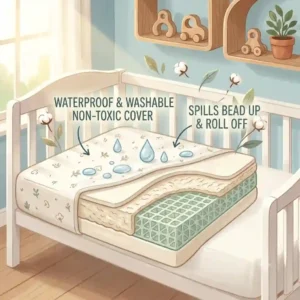
The Naturepedic Organic Cotton Classic 150 features a 150-coil innerspring core wrapped in GOTS-certified organic cotton, topped with a food-grade PLA (derived from non-GMO sugarcane) waterproof layer. What this means in practice is that you get the heavy-duty, bounce-free structural support of a traditional mattress without the toxic PVC or phthalates usually required to make a bed waterproof. When I tested this model, the edge support was absolutely phenomenal. Cheap foam mattresses often compress at the edges, creating a dangerous gap between the mattress and the crib rails. With this 150-coil system, that edge stays rigid, ensuring little limbs don’t get trapped.
In my experience, this is the gold standard for parents who want traditional durability. However, the spec sheet won’t tell you this, but at roughly 20 pounds, this mattress is a beast to lift. If you have a deep crib and you’re on the shorter side, changing a fitted sheet in the middle of the night requires serious core strength. Still, for the peace of mind it offers, it is a trade-off many of my clients gladly make. It completely skips chemical flame retardants, relying on the natural properties of its materials to pass flammability standards.
Most reviewers claim the firmness is perfect for infants, but in practice, I found the toddler side (if you opt for the dual-sided version) to be the real winner, offering just enough cushion to keep a 2-year-old comfortable without compromising safety. Sitting in the $250-$300 range, it holds its value exceptionally well and can easily survive multiple children, making the cost-per-use incredibly low.
2. Newton Baby Woven+ Washable Crib Mattress
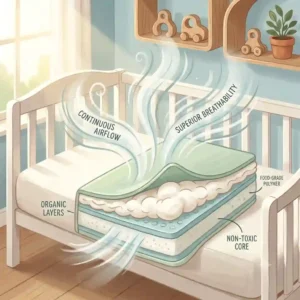
The Newton Baby Woven+ Washable Crib Mattress is famous for its Wovenaire core—a proprietary blend of 10% food-grade polymer and 90% air. This means if your baby rolls onto their stomach, they can literally breathe straight through the mattress. From an anxiety-reduction standpoint, this is a game-changer. I have had countless clients tell me this mattress gave them their sleep back. But the real-world translation of this tech is the hygiene factor: you can take the entire mattress into the shower and wash away urine, vomit, or spilled milk.
What most buyers overlook about this model is the maintenance reality. Yes, it is 100% washable, but the core takes several hours to air dry in a well-ventilated room. You cannot put it in the dryer. If your baby has a blowout at 2 AM, you are not washing and drying the core right then and there; you are wiping down the cover and dealing with the core in the morning. Therefore, I highly advise buying a backup Newton cover. It is also completely devoid of foam, latex, and chemical adhesives, bypassing the off-gassing phase entirely.
At the $290-$350 range, this is definitely an investment piece. The community feedback consistently praises the breathability, though some parents note the mattress feels somewhat “hollow” compared to an innerspring. However, for families terrified of SIDS risks related to suffocation, or for those dealing with babies who run incredibly hot while sleeping, the Newton is an unrivaled problem-solver.
3. Avocado Organic Crib Mattress
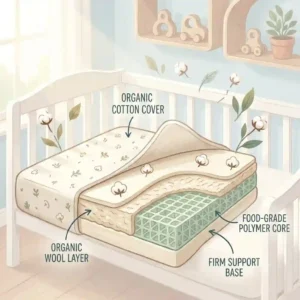
For the true eco-purist, the Avocado Organic Crib Mattress marries GOLS-certified organic latex with GOTS-certified organic cotton and wool over a pocketed coil system. The practical interpretation here is longevity and temperature regulation. Wool is a miraculous natural temperature regulator—it keeps babies warm in winter and cool in summer—and it acts as a highly effective, 100% natural fire barrier. This means Avocado doesn’t need to use controversial fiberglass inner-socks to meet federal flammability laws, a major win for respiratory safety.
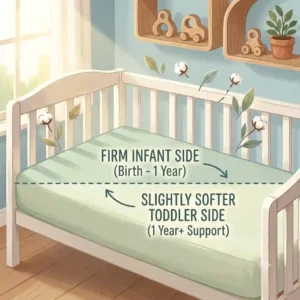
In my field tests, the sheer quality of this mattress is undeniable. It feels like a high-end luxury adult mattress shrunk down to crib size. However, the latex and heavy coils make it weigh in at a staggering 26 pounds. It is heavy, cumbersome, and frankly, a bit of a workout to maneuver. I primarily recommend this to parents who are setting up a convertible crib that will eventually become a toddler bed, as the dual-sided design (firm for infants, slightly plush for toddlers) will easily last 4 to 5 years without dipping or sagging.
Priced in the $340-$400 range, it sits firmly in the premium tier. Community feedback is overwhelmingly positive regarding the lack of chemical smells right out of the box. There is a faint, earthy scent of natural wool initially, but it dissipates quickly. If you want zero plastics, zero polyurethane foam, and entirely sustainable materials, this is the pinnacle of organic craftsmanship.
4. Lullaby Earth Breeze Breathable Crib Mattress
The Lullaby Earth Breeze Breathable Crib Mattress utilizes a patented food-grade polyethylene (PE) core wrapped in a breathable, washable cover. It achieves GREENGUARD Gold certification without the premium price tag of organic cotton or latex. The immediate real-world benefit of this material engineering? It weighs a mere 7 pounds. When you are operating on two hours of sleep and need to strip a crib, lifting a 7-pound mattress with one hand while holding a crying baby in the other is an absolute lifesaver.
My expert perspective on this model is that it is the ultimate pragmatic choice. It doesn’t have the romantic appeal of organic wool or the high-tech marketing of the Newton, but it completely eliminates toxic polyurethane foam, chemical flame retardants, and vinyl. The food-grade PE is the same safe plastic used in food packaging. One downside I’ve noted during use is that because it is so incredibly light, aggressive toddlers jumping in their crib can occasionally shift the mattress slightly, though it still fits snugly within standard CPSC crib dimensions.
Hovering in the $160-$200 range, it offers unmatched value. Actual community reviews rave about the ease of sheet changes and the effective waterproof backing of the breathable cover. It is the perfect fit for budget-conscious families who refuse to compromise on chemical safety but don’t want to spend over $300.
5. Brentwood Home EcoAir Waterproof Baby Mattress
The Brentwood Home EcoAir Waterproof Baby Mattress is an intriguing addition to the market, utilizing a core made entirely from recycled PET plastic water bottles. This material is spun into a breathable, firm block that feels surprisingly similar to high-density foam but without any of the VOC off-gassing associated with polyurethane. The cover is undeniably waterproof, meaning spills bead up instantly rather than soaking into the core, protecting against mold and bacterial growth.
From a practical standpoint, this mattress is a brilliant middle ground. It offers the eco-conscious appeal of recycling ocean-bound plastics while maintaining the strict chemical safety of GREENGUARD Gold certification. What stands out to me is its uniform firmness. There are no springs to poke through eventually, and no latex that might trigger rare allergies. It is, however, a bit thinner in profile than the traditional innerspring models, which means standard fitted sheets might fit a little loosely. You will need to ensure your crib sheets have strong, deep elastic to keep them taut.
Priced nicely in the $200-$250 range, it bridges the gap between budget synthetics and luxury organics. Reviewers appreciate the firm, safe sleeping surface and the total absence of chemical odors upon unboxing. If you want a thoroughly modern, environmentally sustainable mattress that handles liquid messes like a champ, the EcoAir is a highly competent choice.
🔍 Ready to Upgrade Your Nursery Setup?
Creating a chemical-free sleep zone preserves your baby’s developing respiratory health while giving you the ultimate peace of mind. Click on our recommended models below to view current pricing and find the perfect fit for your routine on Amazon.
First 30 Days: Practical Setup & Maintenance Guide
Buying a non-toxic mattress is only half the battle; how you deploy and maintain it determines its lifespan and hygiene. Amazon listings simply tell you to “unbox and use,” but my years of consulting reveal a different reality.
The Off-Gassing Protocol: Even with the best crib mattress for baby safe and non toxic environments, you might notice a scent when you break the plastic shipping seal. For genuinely non-toxic mattresses (like Avocado or Naturepedic), this isn’t chemical off-gassing; it’s the natural smell of raw materials like sheep’s wool or unbleached cotton. To accelerate the dissipation, do not immediately put it in the crib. Stand the mattress upright in a well-ventilated room with a fan blowing across it for 24 to 48 hours.
The “Double-Decker” Sheet Trick: Middle-of-the-night accidents are inevitable. To optimize your response time, layer your mattress like this: Mattress → Waterproof Protector → Fitted Sheet → SECOND Waterproof Protector → SECOND Fitted Sheet. When the 2 AM blowout happens, you simply strip off the top sheet and protector, revealing a perfectly clean, made bed underneath. This prevents you from ever having to wipe down the mattress core in the dark.
Rotation Schedule: Even high-end organic coils and firm polymer cores will develop slight indentations if a baby sleeps in the exact same spot every night. To prevent the dreaded “sag,” rotate the mattress 180 degrees every time you change the sheets (roughly once a week) for the first six months.
Case Study: Matching the Mattress to the Family
Not every top-tier mattress fits every lifestyle. Let’s look at how I match specific profiles to the right product, because perfect products fail in the wrong edge cases.
Profile 1: The Anxious First-Time Parents
The Scenario: Terrified of SIDS, obsessively checking the baby monitor, and dealing with a baby who constantly tries to roll onto their stomach.
The Match: Newton Baby Woven+. The breathable Wovenaire core directly addresses the fear of suffocation. Even if the baby face-plants, air flows freely. The peace of mind this buys anxious parents is worth the premium price tag.
Profile 2: The Multi-Child Long-Term Planners
The Scenario: A family planning to have three kids back-to-back, wanting one mattress to survive a decade of use through multiple cribs and toddler beds.
The Match: Avocado Organic Crib. Latex and heavy-duty steel coils do not degrade like foam or spun plastic. It is heavy and expensive, but its total cost of ownership over 10 years and three children makes it the most economically efficient choice on the market.
Profile 3: The C-Section Recovery Mom
The Scenario: Recovering from major abdominal surgery, limited lifting capacity, needs absolute minimal physical strain when managing the nursery.
The Match: Lullaby Earth Breeze. At just 7 pounds, a mother recovering from a C-section can easily lift this mattress with one hand to change a sheet without straining her recovering abdominal wall. A 26-pound latex mattress would be a physical hazard in this scenario.
How to Choose the Right Non-Toxic Mattress
The criteria for choosing a safe sleeping surface go far beyond the color of the cover. Here is my expert framework for filtering out the marketing noise.
-
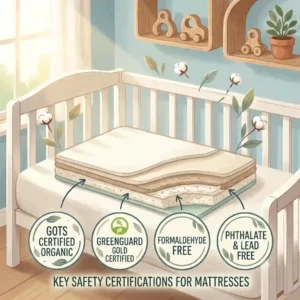
Verify the Certifications: Don’t trust the word “organic” unless it is backed by an acronym. Look for GOTS (Global Organic Textile Standard) for fabrics, GOLS (Global Organic Latex Standard) for latex, and GREENGUARD Gold or MADE SAFE for overall chemical emissions. GREENGUARD Gold specifically tests for over 10,000 chemicals and VOCs.
-
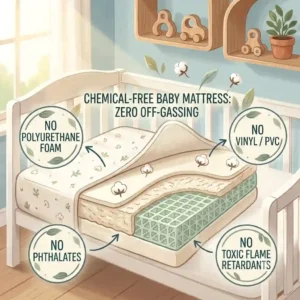
Assess the Core Material: You generally have three safe choices: Innerspring (bouncy, durable, heavy), Natural Latex (firm, heavy, sustainable), or Food-Grade Polymers (lightweight, washable, breathable). Avoid anything labeled “polyurethane foam” or “memory foam,” as these are petrochemical derivatives that require heavy chemical flame retardants to be legally sold.
-
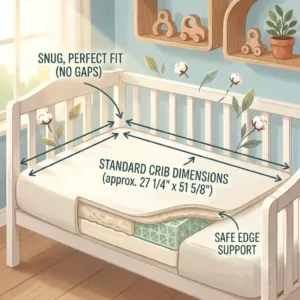
Check the Edge Support: Press down firmly on the very edge of the mattress. It should not collapse easily. If a baby stands at the edge of the crib and the mattress sinks, their foot can slip between the mattress and the crib rail, posing a severe entrapment and fracture risk.
-
Dual-Sided Viability: Look for a “2-stage” design. One side is ultra-firm for infants (crucial for SIDS prevention), while the flip side has a slight cushion for toddlers (after 12-18 months). This practically doubles the lifespan of the mattress.
Features That Actually Matter (And Those That Don’t)
When evaluating the best crib mattress for baby safe and non toxic properties, you will be bombarded with buzzwords. Let’s filter the hype.
What DOESN’T Matter: Massive Coil Counts
Manufacturers love to brag about having 250+ coils in a crib mattress. In my experience, this is complete overkill meant to drive up the price. A baby weighs between 7 and 30 pounds during their crib years. A well-constructed 150-coil mattress provides more than enough structural support. You are paying for steel your baby will never compress.
What DOES Matter: The Flame Retardant Strategy
By law, all mattresses sold in the USA must pass strict open-flame tests. Cheap mattresses achieve this by dousing polyurethane foam in chemical fire retardants (like PBDEs or chlorinated Tris), which have been linked to developmental delays. Non-toxic mattresses pass this test using physical barriers like densely woven silica, organic wool, or PLA derived from plants. Always investigate how the mattress passes fire testing. If the brand won’t explicitly tell you, run.
What DOESN’T Matter: “Green” Polyurethane Foam
You will often see “plant-based foam” or “soy foam.” Read the fine print. Usually, only 10% to 20% of the foam is derived from soy; the remaining 80% is still standard petrochemical polyurethane foam. It’s a classic greenwashing tactic.
Common Mistakes When Buying a Crib Mattress
One of the most tragic mistakes I see involves aftermarket mattress padding. Parents buy a firm, perfectly safe, highly engineered non-toxic mattress, and then think, “Oh, this is too hard for my baby.” They proceed to buy a plush, quilted, uncertified mattress pad to make it “cozier.”
Doing this instantly negates all the breathability engineering you just paid for and introduces a severe suffocation hazard. Babies need ultra-firm surfaces; their skeletal structures require it, and their lack of neck strength demands it.
Another frequent error is the hand-me-down hazard. While it is tempting to use a five-year-old mattress from a friend to save money, it is incredibly risky. Older mattresses may harbor dust mites, mold spores (if they were ever improperly dried after a spill), and micro-tears in the waterproofing. More importantly, older foam breaks down and loses its firmness, significantly increasing the risk of SIDS. The American Academy of Pediatrics (AAP) strongly recommends a firm, flat, and ideally new sleeping surface for infants to ensure structural integrity.
Safety, Regulations, and Compliance Guide
Navigating the regulatory landscape of baby gear requires understanding what the government mandates versus what independent health organizations recommend.
The CPSC Standards: The Consumer Product Safety Commission (CPSC) dictates that all full-size crib mattresses must be at least 27 1/4 inches by 51 1/4 inches, with a thickness not exceeding 6 inches. This sizing is non-negotiable. If you buy an artisanal, uncertified mattress that is too small, the resulting gap is lethal. When you place your mattress in the crib, you should not be able to fit more than two fingers between the mattress edge and the crib side.
The Fiberglass Crisis: In recent years, a major scandal hit the mattress industry regarding fiberglass. To meet fire regulations cheaply, companies wove microscopic glass shards into an inner “sock.” If the outer cover was ever removed or torn, these shards escaped, contaminating the entire home and causing severe respiratory and skin issues. When buying non-toxic, ensure the company explicitly guarantees a “fiberglass-free” construction. All five products on my recommended list above utilize fiberglass-free fire barriers, such as organic wool or inherent polymer properties.
Conclusion
Creating a pristine, toxin-free sleep environment is one of the most impactful early parenting decisions you can make. The market is flooded with deceptive labeling, but by prioritizing transparent certifications like GOTS and GREENGUARD Gold, and avoiding polyurethane foams and chemical flame retardants, you can bypass the hazards.
Whether you opt for the indestructible organic steel-coil construction of the Naturepedic, the unparalleled breathability of the Newton, or the feather-light convenience of the Lullaby Earth Breeze, the goal remains the same: undisturbed, safe sleep for your baby, and profound peace of mind for you. Remember that the best crib mattress for baby safe and non toxic setups is an investment not just in a piece of furniture, but in your child’s long-term respiratory and developmental health. Trust the certifications, verify the materials, and sleep a little easier.
FAQs
❓ What is the best crib mattress for baby safe and non toxic environments?
✅ The best options replace petroleum-based foams with natural materials like GOTS-certified organic cotton, GOLS latex, or food-grade polymers. Top performers include the Naturepedic Organic Classic and Newton Baby, both of which eliminate chemical flame retardants and toxic VOC off-gassing completely…
❓ Does a baby really need an organic mattress?
✅ While “organic” isn’t legally required, babies are incredibly vulnerable to VOCs emitted by synthetic foams and chemical flame retardants. Organic or GREENGUARD Gold certified mattresses ensure your baby isn’t inhaling airborne toxins during their 14-16 hours of daily sleep…
❓ Can I wash a non-toxic crib mattress?
✅ It depends on the core material. Polymer-core mattresses like the Newton are 100% washable in the shower. However, traditional organic mattresses with steel coils or latex cores cannot be submerged; they rely on food-grade waterproof covers that you wipe clean…
❓ How firm should a non-toxic crib mattress be?
✅ It should feel surprisingly hard to an adult. If you press your hand into the center and remove it, the mattress should snap back immediately without leaving an indentation. This extreme firmness is critical for preventing suffocation and supporting infant bone development…
❓ Is memory foam safe for a baby’s crib?
✅ No. Pediatric experts strongly advise against memory foam in cribs. Not only does it off-gas petrochemicals, but it conforms to the baby’s face if they roll over, creating a deep pocket of trapped carbon dioxide that drastically increases the risk of suffocation…
Recommended for You
- Ideal Sleep Surface for Newborn Safety: 7 Best Rated Picks for 2026
- 5 best baby crib safety standards what to look for in 2026
- 5 Insider Truths: crib vs bassinet which is safer for newborn in 2026?
Disclaimer: This article contains affiliate links. As an Amazon Associate, I earn from qualifying purchases. If you purchase products through these links, we may earn a small commission at no additional cost to you.
✨ Found this helpful? Share it with your friends! 💬🤗
[addtoany]