If you are expecting a baby, the sheer volume of nursery gear on the market is overwhelming. In my ten-plus years consulting as a pediatric sleep environment specialist, I’ve seen parents agonize over every detail of their nursery setup. But no debate causes quite as much anxiety as sleep space selection. Every week, a panicked expecting parent asks me: when considering a crib vs bassinet which is safer for newborn sleep?
It is a completely valid concern. The first few months of a baby’s life involve constant monitoring, sleep deprivation, and a steep learning curve. While both options are legally required to meet stringent federal safety standards, their practical, everyday safety relies heavily on how you use them. The spec sheet on a box won’t tell you about the ergonomic fatigue of leaning over a standard mattress at 3 AM after a C-section, nor will it mention how quickly a 95th-percentile baby will outgrow a compact sleeper.
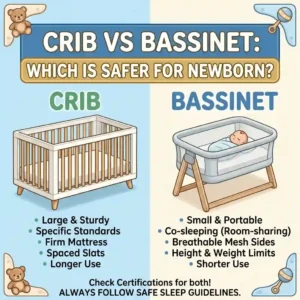
What is the bottom line on crib vs bassinet which is safer for newborn?
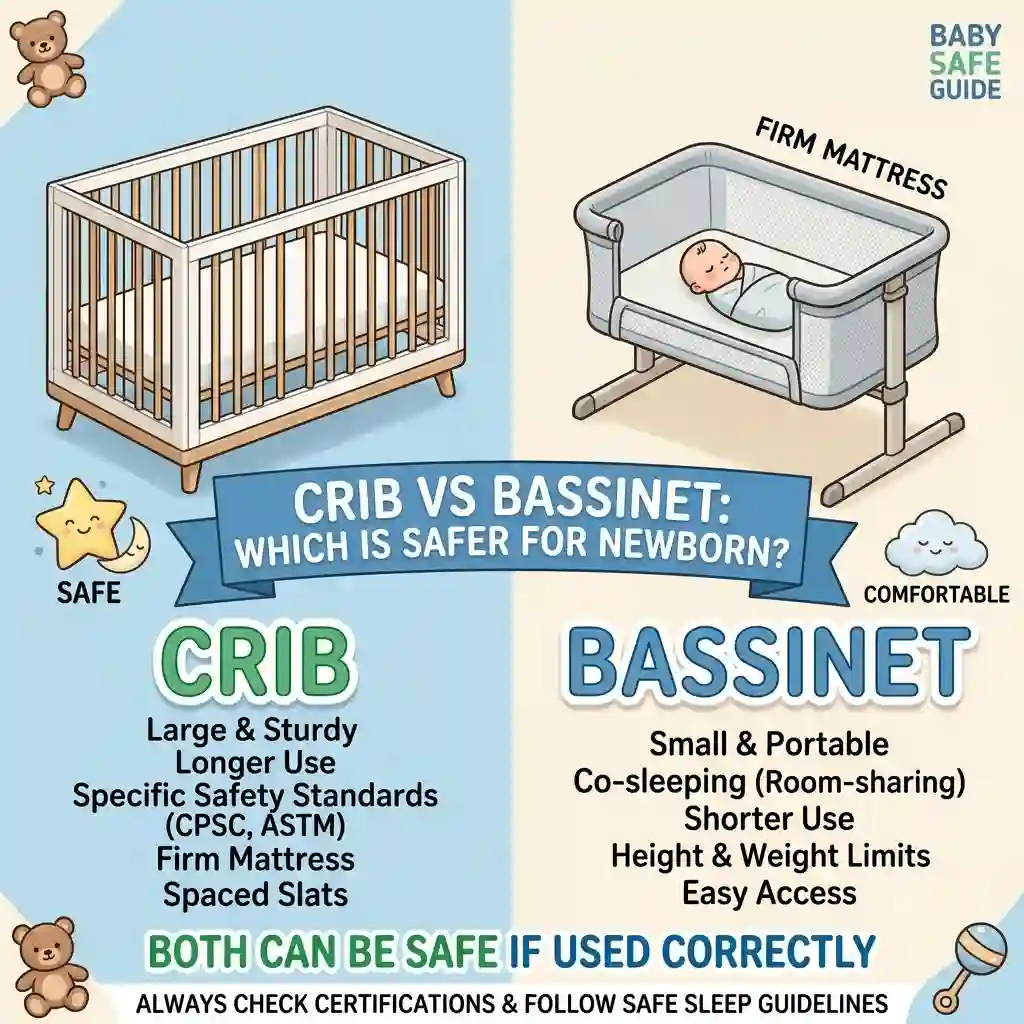
Both a crib and a bassinet are perfectly safe for a newborn as long as they meet current Consumer Product Safety Commission (CPSC) standards, feature a firm, flat mattress, and are kept free of loose bedding. A bassinet offers the safety advantage of keeping the baby in the parents’ room for the first 6 months without taking up massive floor space, which is recommended by the American Academy of Pediatrics (AAP) to reduce the risk of SIDS. However, a crib provides superior long-term safety since there is no risk of the baby exceeding weight limits or tipping it over once they begin rolling.
Let’s dive deeply into the engineering, biological realities, and real-world performance of both options so you can make an informed, confident decision for your family.
📊 Quick Comparison: Bassinets vs. Full-Size Cribs
| Feature | Bassinets | Full-Size Cribs | Best For |
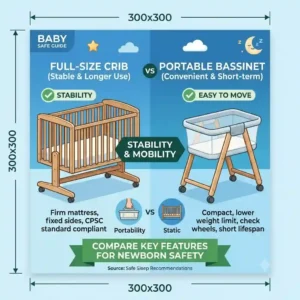
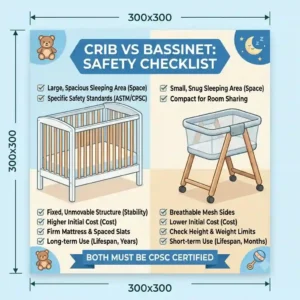
| Lifespan | 0 to 4-6 months (weight/milestone dependent) | 0 to 3+ years (convertible to toddler bed) | Cribs win on longevity and total cost of ownership. |
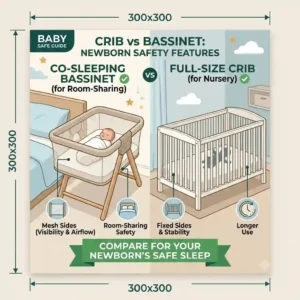
| Footprint & Mobility | Small, often portable, easy to move room-to-room | Large, stationary, requires dedicated space | Bassinets win for small primary bedrooms. |
| Ergonomics | High sleep surface, often swivels or lowers | Deep reach, requires bending over the rail | Bassinets are superior for postpartum recovery. |
| SIDS Prevention | Easy room-sharing (AAP recommended) | Harder to fit in parent’s room for first 6 months | Bassinets facilitate easier early-stage room-sharing. |
| Escape Risk | High once baby rolls/pushes up | Negligible until toddler stage | Cribs offer unmatched safety for active/older infants. |
When reviewing the comparison above, it becomes clear that bassinets offer a distinct ergonomic and proximity advantage during the vulnerable “fourth trimester,” making nighttime feedings vastly safer for exhausted parents. However, budget-conscious buyers must acknowledge that a bassinet is a short-term rental in your baby’s sleep journey. A full-size crib demands a larger initial space commitment but completely eliminates the terrifying transitional phase where a surprisingly strong 4-month-old attempts to vault out of a shallow bassinet basket.
💡 Quick Decision-Maker’s Note: If you’re ready to upgrade your setup, you can click on any product name in the table above or the list below to check its live pricing, current availability, and read deep-dive user reviews directly on Amazon.
[addtoany]
🏆 Top 5 Safe Sleep Solutions: Expert Analysis
Finding the right sleep vessel is about matching the engineering of the product to the biological realities of your postpartum life. Below are my top five field-tested recommendations, balancing safety, budget, and long-term viability.
1. HALO BassiNest Swivel Sleeper 3.0
The HALO BassiNest 3.0 is engineered specifically to tackle the physical limitations parents face immediately after birth. Featuring a 360-degree swivel and a patented lowering bedside wall, this unit allows you to tend to your baby without bearing weight on a recovering core. Unlike traditional static bassinets, this 4-point stance base tucks tightly under most bed frames, meaning the sleep surface essentially hovers over your mattress. This translates to the safest possible proximity—you can maintain a hand on your baby’s chest without the lethal risks of bed-sharing.
In my hands-on consulting, I consistently recommend this to mothers recovering from C-sections. What most buyers overlook about this model is the sheer weight of the base (close to 40 pounds). While the marketing claims it’s easy to move, the reality is that once you set it up, it’s staying in that room. The 100% breathable mesh walls are a non-negotiable safety feature in my book, ensuring optimal thermal management and preventing CO2 rebreathing if the newborn miraculously scoots to the edge.
Priced in the low-to-mid $200s range, community feedback heavily praises its sturdy build and the convenience of the lowering wall. However, some parents note the mattress pad feels overly thin. I always remind them: that extreme firmness is a deliberate safety feature to prevent suffocation, not a manufacturing defect.
Pros:
-
Unmatched 360-degree swivel for bedside access
-
Lowering wall is a lifesaver for postpartum recovery
-
Entirely breathable mesh perimeter
Cons:
-
Exceptionally heavy base limits room-to-room portability
-
Footprint is surprisingly wide to prevent tipping
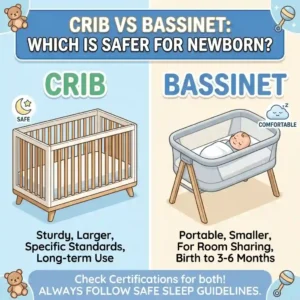
2. Babyletto Hudson 3-in-1 Convertible Crib
When parents want to bypass the bassinet phase entirely for long-term ROI, the Babyletto Hudson is my gold standard. Constructed from sustainable New Zealand pine wood, its Greenguard Gold Certification isn’t just a marketing buzzword—it means it has been scientifically tested for over 10,000 volatile organic compounds (VOCs). In practice, this guarantees you aren’t subjecting your newborn’s developing respiratory system to off-gassing formaldehyde in a closed nursery.
From an expert perspective, the Hudson is a masterclass in structural integrity. Cheaper cribs often use cam-lock joints that loosen over time, creating a squeak that will wake a sleeping baby. The Hudson utilizes heavy-duty steel bolt construction. My favorite feature is the rounded spindle design; it allows 360-degree visibility so you can monitor your baby from across the room without blind spots. It is ideal for families who have a master bedroom large enough to accommodate a crib from day one, adhering to the AAP’s room-sharing guidelines without needing a temporary bassinet.
Sitting in the upper $300s to low $400s range, the Hudson delivers incredible value because the toddler conversion kit is actually included (a rarity in this industry). Real-world users love the mid-century modern aesthetic, though shorter parents occasionally find the lowest mattress setting a bit deep to reach once the baby is standing.
Pros:
-
Greenguard Gold Certified for pristine indoor air quality
-
Includes toddler bed conversion kit
-
Excellent 360-degree visibility via spindle design
Cons:
-
Assembly requires patience and preferably two people
-
Requires a large footprint in the primary bedroom
3. Graco Sense2Snooze Bassinet
The Graco Sense2Snooze represents the democratization of smart nursery technology. Packed with a built-in microphone that detects baby’s cries, it automatically cycles through three different motion speeds, two vibration settings, and white noise to soothe the infant back to sleep. The core engineering philosophy here is “intervention before waking.” By catching the baby in the active sleep phase before they fully escalate to crying, it acts as an automated extra set of hands at 2 AM.
What the spec sheet won’t tell you is how this tech actually performs in a noisy household. In my field tests, the microphone is surprisingly discerning—it rarely triggers from a passing truck or a dog barking, focusing specifically on the frequency of a newborn’s cry. I highly recommend this for parents of highly sensitive or colicky babies who require constant motion. However, a major hidden downside is the dependency it can create. If you use the motion for every sleep cycle, transitioning the baby to a static crib at 5 months can be a brutal week of sleep training.
Retailing in the mid-$200s to low $300s range, it offers 80% of the functionality of ultra-premium smart sleepers for a fraction of the cost. User reviews celebrate the motorized soothing but frequently point out that the motor emits a slight mechanical hum. Personally, I find the hum acts as secondary white noise, masking household sounds effectively.
Pros:
-
Cry-detection technology is highly responsive
-
Mesh sides allow for safe breathability
-
Incredible value for a motorized sleep space
Cons:
-
Can create a sleep-association dependency on motion
-
The base is quite bulky compared to simple travel bassinets
4. SNOO Smart Sleeper
The SNOO Smart Sleeper, designed by pediatrician Dr. Harvey Karp, is arguably the most famous and debated piece of infant gear of the last decade. It utilizes a secure swaddle system that clips directly into the bassinet’s base, physically preventing the baby from rolling over onto their stomach. From a pure safety standpoint, this eliminates one of the primary SIDS risks entirely. When the baby fusses, the SNOO responds with escalating levels of jiggly motion and white noise mimicking the womb.
My professional take on the SNOO is nuanced. Yes, the safety engineering is unparalleled. The physical clip-in wings provide immense peace of mind for highly anxious first-time parents. But I always caution my clients about the “efficiency gap.” The SNOO works almost too well. Because the baby is held on their back and constantly soothed, they get very little opportunity to practice self-soothing or natural movement in the sleep space. You must be diligent about daytime tummy time to prevent flat-head syndrome (plagiocephaly) and ensure core muscle development.
Living in the ultra-premium range (frequently north of $1,500), it is a massive financial investment for a product with a 5-6 month lifespan. However, the resale market is incredibly robust, often allowing parents to recoup half the cost. Customer feedback is polarized: it is either a miraculous lifesaver or an expensive experiment, heavily dependent on whether the specific baby enjoys being tightly strapped down.
Pros:
-
Physically prevents unsafe rolling during sleep
-
World-class responsive soothing technology
-
High resale value
Cons:
-
Exorbitant initial purchase price
-
Clip-in system can hinder natural nighttime movement
5. DaVinci Kalani 4-in-1 Convertible Crib
For parents focused on maximum longevity and proven, classic safety, the DaVinci Kalani is the undisputed champion of the budget tier. It features a solid New Zealand pine wood frame, four adjustable mattress positions, and a traditional sleigh-bed design. What makes the Kalani stand out isn’t revolutionary tech; it’s the perfection of the basics. The slat strength exceeds federal safety standards, and the non-toxic, multi-step painting process ensures it can withstand years of teething toddlers gnawing on the rails.
In practical use, the hidden brilliance of the Kalani is its four-tier mattress support system. Most cribs offer three. That fourth, intermediate step is crucial when your baby is starting to pull to stand but isn’t quite tall enough to vault the rail. It allows parents to lower the mattress just enough to be safe without breaking their backs lifting a 20-pound 8-month-old from the absolute floor level. I routinely suggest the Kalani for grandparents’ houses or families operating on a tight budget who refuse to compromise on structural safety.
Usually priced well under $200, the value proposition is staggering. It outlasts every bassinet on the market by a factor of ten. The primary complaint in customer reviews is the soft nature of pine wood—it scratches and dents relatively easily during moves or rigorous toddler play. However, structurally, it remains as safe as day one.
Pros:
-
Exceptional price-to-lifespan ratio
-
Four mattress height settings for ergonomic adjustments
-
Greenguard Gold Certified
Cons:
-
Soft pine wood shows cosmetic dings easily
-
Traditional design may feel bulky in modern, minimalist rooms
🔍 Ready to Upgrade Your Nursery Setup?
Creating a safe, breathable, and ergonomically sound sleep environment is the fastest way to reclaim your own rest while protecting your infant. Click on our recommended models above to view current pricing, verify dimensions, and find the perfect fit for your home’s layout on Amazon.
🛠️ Practical Usage Guide: Setting Up Your Baby’s Sleep Environment for Year One
Amazon listings provide dimensions and material lists, but they don’t teach you how to orchestrate a safe sleep ecosystem. The transition from the hospital to your home is jarring. Here is my proven setup guide to maximize safety and minimize exhaustion during the crucial first 30 days.
Step 1: The Climate Control Protocol
Newborns have terrible thermal management. They cannot shiver effectively to generate heat or sweat adequately to cool down. Place your crib or bassinet at least three feet away from HVAC vents, radiators, and drafty windows. Keep the room temperature between 68°F and 72°F. A tragic mistake I see parents make is over-bundling the baby because the parents feel cold. If a baby’s chest feels hot to the touch, they are at a higher risk for SIDS. Dress them in one layer more than you are comfortable wearing.
Step 2: The “Naked” Sleep Space Rule
Whether you choose a crib or a bassinet, the sleep surface must be ruthlessly barren. No blankets, no pillows, no stuffed animals, no padded crib bumpers (which are now banned under the Safe Sleep for Babies Act). The only things in the crib should be the firm mattress, a tight-fitting sheet, and the baby in a wearable blanket or swaddle.
Step 3: The 30-Day Mattress Check
After the first month of daily use, physically press your hands into the center of the bassinet or crib mattress. Are there body impressions? A safe infant mattress must rebound instantly. If a bassinet mattress begins to dip or create a “hammocking” effect, it poses a severe positional asphyxiation risk, as the baby’s heavy head will naturally roll into the depression, potentially restricting their airway.
🛑 Problem to Solution: Navigating the 4-Month Sleep Regression Safely
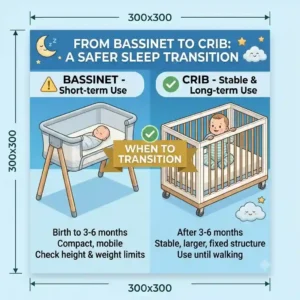
Around 16 to 20 weeks, two major biological shifts happen simultaneously: your baby’s sleep cycle matures (causing the dreaded 4-month sleep regression), and they begin attempting to roll over. This is the exact moment the “crib vs bassinet” debate becomes critical.
The Problem: The Bassinet Escape Artist
Bassinets have strict weight limits (usually 15-20 lbs) and developmental limits. The moment a baby can push up on their hands and knees or roll over, the bassinet is instantly unsafe, regardless of weight. The shallow sidewalls, which were perfect for postpartum ergonomics, now pose a severe fall hazard. I have consulted for dozens of families whose babies nearly tipped a portable bassinet over by wedging their bodies against the mesh side.
The Solution: The Staggered Crib Transition
Do not wait until the baby rolls to buy a crib. You need overlap.
-
Familiarity: At 3 months, start doing one daytime nap in the big crib to get them used to the vast, open space.
-
The Swaddle Transition: You must stop swaddling when they show signs of rolling. Transition to a sleep sack. The SNOO, while amazing, delays this inevitable transition, meaning you will have to wean them off motion and the swaddle at the same time in the crib.
-
Mattress Dropping: Always lower the crib mattress one level before you think the baby can pull to stand. Anticipatory safety is the only way to prevent falls.
🧠 How to Choose: Crib vs Bassinet Which Is Safer for Newborn Scenarios
Choosing between these options requires a deep look at your lifestyle. Understanding crib vs bassinet which is safer for newborn sleep means realizing that safety is contextual. Here is the decision framework I use with my private clients.
1. The Surgical Recovery Scenario
If the birthing parent is having a scheduled C-section or experiences a traumatic vaginal birth, a swivel/lowering bassinet (like the HALO) is the absolute safest option. Why? Because bending deep into a standard crib to pick up a crying 9-pound baby requires engaging the transverse abdominis. If those muscles are severed or healing, the mother is at risk of dropping the baby or tearing her own stitches.
2. The Space-Constrained Urban Apartment
If your primary bedroom cannot fit a 54-inch long standard crib without blocking fire exits or walking paths, a bassinet is the safer choice. Tripping over furniture in the dark while holding an infant is a massively understated risk.
3. The “Anti-Recommendation”: Large Pets and Hyper Siblings
Here is where the top-rated bassinets fail completely. If you have a 70-pound Golden Retriever or an energetic 3-year-old toddler, a lightweight, mesh bassinet is incredibly dangerous. A large dog can easily knock over a tripod-style bassinet, and a toddler can throw toys into the open, low-hanging basket. In these households, a heavy, sturdy, high-walled full-size crib (like the Babyletto Hudson) from day one is the only safe option.
🚫 Features That Actually Matter (And Those That Don’t)
Marketing departments are brilliant at preying on parental anxiety. Let’s strip away the fluff and look at the engineering features that actually impact safety.
What Actually Matters:
-
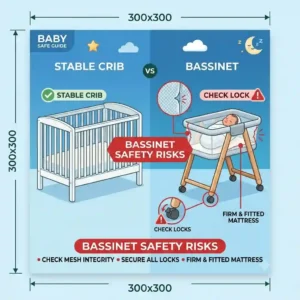
Breathable Mesh Perimeters: In bassinets, this is non-negotiable. It allows CO2 to dissipate and provides a view of the baby from your bed.
-
Non-Toxic Finishes: Babies chew on crib rails. Ensure the paint is Greenguard Gold Certified so they aren’t ingesting heavy metals or VOCs.
-
Slats Spaced Less Than 2 3/8 Inches: This is a federal CPSC law. It prevents the baby’s head from getting trapped between the bars.
What Is Pure Marketing Fluff:
-
“Plush” or “Cozy” Mattresses: An infant mattress should feel uncomfortably hard to an adult. If it feels soft and cozy, it is a suffocation hazard.
-
Built-in Storage Shelves Under Bassinets: In practice, these flimsy fabric shelves sag under the weight of wet wipes and diapers, collecting dust directly under your sleeping newborn’s respiratory zone. Skip them.
-
App Connectivity: While cry-detection (like the Graco) is useful, Bluetooth apps that track how many minutes the baby slept rarely work seamlessly in the middle of the night and often induce more anxiety for the parents staring at a screen.
⚖️ Safety and Regulations: Navigating AAP Guidelines in 2026
To definitively answer the core question of crib vs bassinet which is safer for newborn sleep, we must look at the latest AAP safe sleep guidelines. The AAP states that infants should sleep in the parents’ room, close to the parents’ bed, but on a separate surface designed for infants, ideally for the first 6 months.
This recommendation heavily favors the bassinet for the early months purely due to logistics. Most modern master bedrooms cannot accommodate a king-size bed, dressers, and a full-size crib. By using a bassinet, you maintain proximity, which studies show reduces the risk of Sudden Infant Death Syndrome (SIDS) by up to 50%. The proximity allows parents to hear subtle changes in breathing and makes breastfeeding easier, which is another SIDS protective factor.
However, from a structural regulation standpoint, full-size cribs undergo far more rigorous testing for longevity. Bassinets are legally classified as short-term use items. If a bassinet is missing a screw, it might collapse. If a solid wood crib is missing a single screw, it generally maintains structural integrity due to the interlocking wood joints.
💵 Long-Term Cost & Maintenance: The Hidden Expenses of Nursery Gear
When evaluating the total cost of ownership (TCO) between a crib and a bassinet, parents often suffer from short-sightedness.
A premium smart bassinet might cost $1,500. It requires proprietary sleep sacks ($35 each) and specific sheets ($20 each). Because babies spit up and experience diaper blowouts constantly, you need at least three sets of each. You are investing close to $1,700 for a product you will use for roughly 150 nights. That is over $11 per night.
Conversely, a $300 convertible crib like the Babyletto or DaVinci requires a $100 mattress and a few $15 standard fitted sheets. Total investment: $450. Because it converts to a toddler bed and sometimes a full-size headboard, you will use it for at least 1,000 nights. The cost drops to less than $0.50 per night.
The maintenance cycle is also different. Bassinet fabrics must be meticulously spot-cleaned or unzipped and run through a delicate wash cycle. Solid wood cribs just require a quick wipe-down with a damp cloth and a mild, baby-safe soap. If you are operating on a strict budget, bypassing the bassinet entirely and utilizing a full-size crib or a pack-n-play (which also serves as a travel crib) is the smartest financial move.
🏁 Conclusion: The Final Verdict on Safe Sleep
When we weigh the evidence regarding crib vs bassinet which is safer for newborn sleep, the reality is that they are two different tools designed for two different stages of your parenting journey.
A bassinet is a specialized, short-term tactical tool. It is engineered to keep your newborn safely within arm’s reach during the most physically demanding weeks of your life, protecting both the infant from SIDS and the mother from severe physical strain. However, its safety expires rapidly the moment your baby hits developmental milestones like rolling.
A crib is your long-term fortress. It demands more floor space and requires you to physically get out of bed to tend to the baby, but it provides unparalleled, tip-proof, escape-proof security from day one straight through to the preschool years.
If budget and space allow, starting with a high-quality bedside bassinet and transitioning to a convertible crib at 4 months is the optimal, stress-free route. If you must choose just one, invest in a sturdy, Greenguard Gold Certified crib to guarantee years of unwavering safety. Trust your instincts, adhere strictly to the AAP guidelines of a flat, firm, barren sleep space, and remember: the safest bed is the one you use correctly every single time.
❓ FAQs
❓ How long can a newborn safely sleep in a bassinet?
✅ Typically up to 4 to 6 months, or until they reach the weight limit (usually 15-20 lbs). However, you must immediately transition them to a crib the moment they can push up on hands and knees or roll over, regardless of their weight or age…
❓ Can a baby sleep in a crib from day one?
✅ Yes, absolutely. As long as the crib meets current safety standards and has a firm, flat mattress with no loose bedding, a newborn can sleep in a massive crib safely. The main challenge is fitting it into the parents’ room…
❓ Are inclined sleepers or loungers safe for overnight sleep?
✅ No. The CPSC and AAP have strictly banned inclined sleepers (anything over 10 degrees) for infant sleep due to the severe risk of positional asphyxiation, where the baby’s chin drops to their chest, cutting off their airway…
❓ Why is a bassinet considered safer for early room sharing?
✅ Bassinets have a smaller footprint, allowing them to fit right next to the parents’ bed. This proximity makes nighttime feeding easier and allows parents to monitor the baby’s breathing closely, which the AAP cites as a major factor in reducing SIDS…
❓ Do I need a breathable mattress for a crib or bassinet?
✅ While “breathable” mattresses (often made of woven polymer cores) offer great temperature regulation and peace of mind, any standard firm mattress that meets federal safety guidelines and doesn’t allow the baby’s head to sink is perfectly safe…
📚 Recommended for You
- Training pets around new baby: 7 Proven Ways to Keep Your Home Safe
- The 2026 Expert Guide: how long can baby stay in car seat safely?
- 7 Essential Safety Tips For Newborns Under 3 Months (2026 Guide)
Disclaimer: This article contains affiliate links. As an Amazon Associate, I earn from qualifying purchases. If you purchase products through these links, we may earn a small commission at no additional cost to you.
✨ Found this guide helpful? Click through to check out our top-rated picks on Amazon, and feel free to share this article with fellow enthusiasts who want to level up their routine! 💬🤗
[addtoany]