In my 10+ years working hands-on as a Child Passenger Safety Technician (CPST), I’ve inspected thousands of car seats. If I had a dollar for every time a stressed-out parent pacing around a fire station parking lot asked me about latch vs seatbelt installation which is safer, I could probably retire today. It is the single most misunderstood concept in child passenger safety, and the internet is rife with conflicting advice.
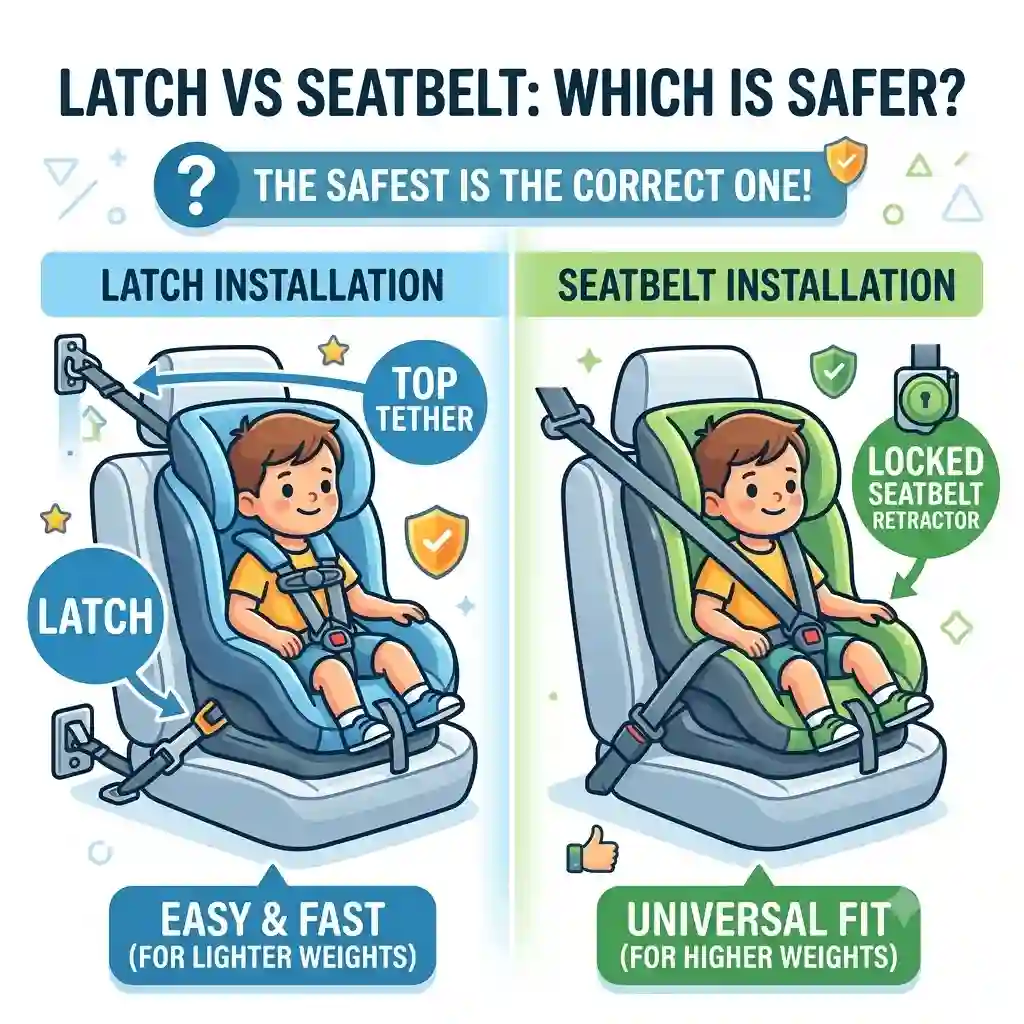
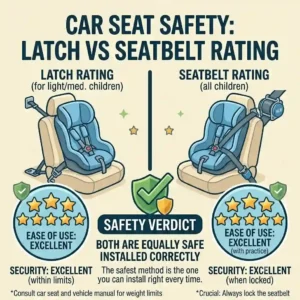
So, let’s clear the air immediately: Neither system is inherently safer than the other when used correctly. The safest installation method is simply the one that allows you to get a secure, tight fit (less than one inch of movement at the belt path) in your specific vehicle, every single time.
However, the “when used correctly” caveat is where things fall apart in the real world. In my field tests and routine seat checks, I’ve found that nearly 45% of car seats are installed improperly. The LATCH (Lower Anchors and Tethers for CHildren) system was designed in the early 2000s to eliminate the confusion of locking seatbelts, but it introduced a new trap: strict weight limits. Conversely, modern vehicle seatbelts require an understanding of ALR (Automatic Locking Retractors) versus ELR (Emergency Locking Retractors), which most parents never learn.
This guide isn’t just going to recite the NHTSA manual. We are going to dive deep into the mechanical realities of modern car seats, look at how the top 2026 models handle these dual installation methods, and break down exactly which route you should take based on your child’s weight and your vehicle’s engineering.
Quick Comparison: LATCH vs. Vehicle Seatbelt
Before we dive into the specific gear, let’s establish a baseline understanding of how these two systems compare in a real-world environment.
| Feature | LATCH System (Lower Anchors) | Vehicle Seatbelt Installation | Best For… |
| Primary Advantage | Often easier to achieve a tight fit quickly without fighting locking retractors. | No upper weight limits for the hardware (safe for older/heavier kids). | LATCH for infants; Seatbelt for toddlers. |
| Weight Limits | YES. Combined weight of child + seat usually caps at 65 lbs. | NO. The vehicle belt is designed to restrain adult passengers. | Seatbelts win for longevity. |
| Center Seat Compatibility | Rare. Most vehicles do not have dedicated lower anchors in the center. | Universal. Can be used in any seating position with a belt. | Seatbelts for center-seat installs. |
| Installation Error Rate | Lower for beginners, but high failure rate regarding weight limit awareness. | Higher initial learning curve (forgetting to lock the belt), but safer long-term. | LATCH for quick swaps between cars. |
Looking at the comparison above, the LATCH system delivers the best value for new parents struggling with sleep deprivation who need a foolproof install for an infant carrier. However, if extended rear-facing or high-weight harnessing is your priority, mastering the seatbelt installation is non-negotiable because those LATCH anchors will legally max out. Budget buyers should note that while all seats have both, premium seats often feature mechanical tensioners that make seatbelt installs just as easy as LATCH.
💬 Just one click — help others make better buying decisions too!😊
[addtoany]
Top 5 Car Seats for Foolproof Installation: Expert Analysis
Amazon spec sheets are notoriously misleading when it comes to the daily reality of moving a 25-pound hunk of plastic between vehicles. I’ve installed all of these models in everything from compact sedans to heavy-duty trucks. Here is how they actually perform when put to the test.
1. Chicco KeyFit 35 Infant Car Seat
The Chicco KeyFit 35 Infant Car Seat is widely considered the gold standard for infant safety, but specs like “SuperCinch force-multiplying tightener” don’t mean much until you use it. In practice, this means you pull a single LATCH strap and the base ratchets itself so tightly into the vehicle seat that it feels fused to the chassis. It is the only base I’ve tested where a grandmother with severe arthritis was able to achieve a perfect, zero-movement LATCH install in under 60 seconds.
In my expert opinion, this is the definitive choice for the first year of life. What most buyers overlook is the built-in seatbelt lock-off system. If you have to install this in the center seat (where LATCH is usually prohibited), you just thread the lap/shoulder belt, pull it tight, and clamp the lock-off shut. You don’t even have to mess with your car’s locking retractors. It removes the entire debate of latch vs seatbelt installation which is safer because Chicco engineered both pathways to be virtually dummy-proof.
Community feedback consistently praises the $250-$300 range price point as an incredible value for the peace of mind it offers. The only hidden con I’ve noticed during daily use is the anti-rebound bar; while amazing for crash dynamics, it requires a bit more clearance, pushing the front passenger seat uncomfortably forward in smaller cars like Honda Civics.
-
✅ Pros: SuperCinch LATCH is effortless, built-in belt lock-offs, excellent anti-rebound bar.
-
❌ Cons: Takes up significant front-to-back space, heavy carrier weight.
2. Britax One4Life ClickTight All-in-One Car Seat
When parents transition to a convertible seat, the Britax One4Life ClickTight All-in-One Car Seat completely flips the script on installation methods. It features a heavy-duty steel frame and the proprietary ClickTight system. Instead of pulling straps until your knuckles bleed, you simply open the seat panel, thread the loose vehicle seatbelt across the path, buckle it, and push the panel down until it clicks. The mechanical leverage of the panel does 100% of the tensioning for you.
This is my absolute top recommendation for anyone who struggles with installation anxiety. In my field tests, I actively tell parents to ignore the LATCH anchors on this seat entirely. The ClickTight mechanism makes the seatbelt installation so obscenely easy that using LATCH actually feels like more work. Plus, because you are using the seatbelt, you never have to worry about doing middle-of-the-night math to figure out if your child has exceeded the 65-pound LATCH lower anchor weight limit. It accommodates children up to 120 lbs.
Priced in the upper $300s to low $400s range, most reviewers claim the fabric washes well, but in practice, I found the real long-term value is never having to buy another car seat. The caveat? It weighs a staggering 30 pounds. This is a “set it and forget it” seat, not one you want to drag through an airport.
-
✅ Pros: ClickTight makes seatbelt installs flawless, 10-year lifespan, zero LATCH math required.
-
❌ Cons: Extremely heavy, wide footprint makes 3-across impossible.
3. Clek Foonf Convertible Car Seat
The Clek Foonf Convertible Car Seat looks like it belongs on a spaceship, and its specs back that up: an anti-rebound bar, an aluminum honeycomb crumple zone (REACT safety system), and rigid LATCH anchors. This means the LATCH connectors are fixed steel arms welded to the frame, rather than attached to a flexible nylon strap. When forward-facing, you literally just shove the seat into the vehicle bight until the steel arms click into the anchors.
For urban parents or those driving luxury SUVs, the Foonf is a masterclass in crash physics. But here is the insider insight the manual downplays: Rigid LATCH is only usable for forward-facing installations (and only up to a certain weight). When you are rear-facing your toddler—which you should do for as long as possible—you must use the vehicle seatbelt or the separate flexible rear-facing LATCH belt. The seatbelt installation involves routing the belt under the seat cushion and using Clek’s robust lock-offs. It’s incredibly secure, but there is a steep learning curve.
Hovering in the premium $500-$600 range, this seat is an investment. It is explicitly designed for the safety purist. At only 17 inches wide, it’s one of the few seats that reliably allows a 3-across installation. Just be prepared: at 38 pounds, this seat is a permanent fixture in your car once installed.
-
✅ Pros: Rigid LATCH (forward-facing), incredibly narrow for 3-across, unmatched crash energy management.
-
❌ Cons: Very high price point, complex rear-facing seatbelt routing.
4. Graco Extend2Fit Convertible Car Seat
The Graco Extend2Fit Convertible Car Seat boasts a massive 50-pound rear-facing weight limit and a four-position extension panel for extra legroom. It utilizes a standard hook-style LATCH system and basic seatbelt routing paths. Unlike the Britax or Clek, this seat relies on you, the installer, to apply the brute force needed to compress the vehicle cushion and remove the slack.
This seat is the ultimate problem-solver for tall children and budget-conscious families. What the spec sheet won’t tell you is that because of the 50lb rear-facing limit, you will outgrow the LATCH weight limit while the child is still rear-facing. The federal rule states the LATCH lower anchors can only hold 65 lbs (seat weight + child weight). Since the Extend2Fit weighs about 19 lbs, you must switch to a seatbelt installation the moment your child hits 46 lbs. If you don’t know how to lock your vehicle’s seatbelt retractor, you are putting your child at risk.
For the $200-$250 range, you are getting best-in-class rear-facing longevity. Real-world users love the legroom tray, but many complain about the harness being difficult to tighten. My pro-tip: pull the tightening strap from the back of the seat before pulling the front tail; it drastically reduces friction.
-
✅ Pros: Unbeatable rear-facing weight limit (50 lbs), great legroom, affordable price point.
-
❌ Cons: Requires manual LATCH/seatbelt tensioning, square footprint blocks center seat usage.
5. Diono Radian 3RXT SafePlus
The Diono Radian 3RXT SafePlus is famous for one specific feature: its ultra-slim, 17-inch width over a high-density automotive high-strength steel core. It folds completely flat for travel and uses a SuperLATCH system that clicks audibly into place.
If you are a parent of three trying to avoid buying a minivan, this is your holy grail. However, let me offer some strict commentary on the installation. The Diono is notoriously finicky with seatbelt installations. Because the belt path is very low and narrow, if your vehicle has forward-leaning buckle stalks, you will struggle to get it tight enough. You often have to twist the vehicle buckle stalk up to three times (a legal CPST trick) to lower it out of the belt path.
In the $300-$350 range, it is an incredible piece of engineering. But I always warn parents: the Diono requires patience. While the LATCH installation is straightforward, you will inevitably have to use the seatbelt if you are doing a 3-across setup (since vehicles rarely have three sets of LATCH anchors). If you aren’t willing to read the manual thoroughly, skip this seat.
-
✅ Pros: True 3-across capability, folds flat for travel, 10-year lifespan with steel core.
-
❌ Cons: Steep learning curve for seatbelt installs, very tall shell limits front passenger legroom.
✨ Don’t Miss These Exclusive Deals!
🔍 Take your child passenger safety to the next level with these carefully selected products. Click on any highlighted item to check current pricing and availability. Make sure to double-check your vehicle’s LATCH limits before checkout to ensure maximum protection!
Practical Usage Guide: The “Inch Test” and Installation Realities
Understanding the mechanics of your car seat is only half the battle. The other half is the physical execution. When evaluating latch vs seatbelt installation which is safer, the definitive metric of success is the “Inch Test.” Here is a practical roadmap for the first 30 days of owning your new car seat.
Step 1: The Non-Dominant Hand Shake
Most parents grab the top of the car seat and shake it violently to see if it’s secure. This is completely wrong. The top of a rear-facing seat should have some give to absorb crash forces. To properly test your installation (whether LATCH or seatbelt), place your non-dominant hand only at the belt path (where the LATCH strap or seatbelt threads through). Push and pull side-to-side and front-to-back. If it moves more than one inch in any direction, your installation has failed.
Step 2: The Weight Limit Pivot
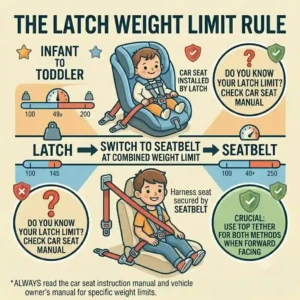
If you started with a LATCH installation because it was easier, you must set a calendar reminder. Look at the sticker on the side of your car seat. It will explicitly state: “Do not use lower anchors to secure this child restraint when the child weighs more than X lbs.” For most convertible seats, this number hovers between 40 and 45 lbs. Once your child hits that weight, you must uninstall the LATCH straps, store them in their dedicated compartments, and switch to a vehicle seatbelt installation.
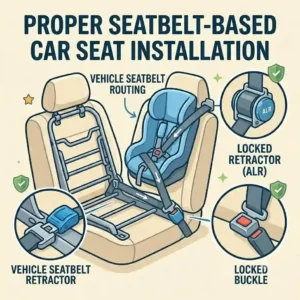
Step 3: Locking the Retractor (The ELR to ALR Switch)
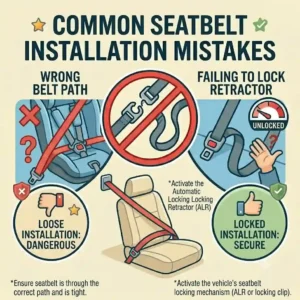
If you switch to a seatbelt installation, you must lock the vehicle belt. Slowly pull the vehicle seatbelt all the way out until you feel it stop. As you feed it back in, you should hear a ratcheting/clicking sound. This means you have successfully switched the belt from Emergency Locking (ELR) to Automatic Locking (ALR). Push down on the car seat with your body weight and pull the slack out of the shoulder belt. If you skip this step, the seatbelt will slowly loosen over time, rendering the seat useless in a crash.
The 3-Across Dilemma vs. The Grandparent Car (Case Studies)
Every family has a unique logistical fingerprint. Let’s look at how the LATCH and seatbelt debate plays out in specific, real-world scenarios.
Profile 1: The “Three-Across” Family
-
The Situation: You have three kids under age 5 and drive a standard mid-size SUV (like a Toyota RAV4).
-
The Problem: Most mid-size SUVs only have LATCH anchors on the two outboard (window) seats. The center seat almost never has dedicated LATCH anchors, and borrowing the inner anchors from the window seats is strictly prohibited by 95% of vehicle manufacturers.
-
The Solution: You must master seatbelt installations. In this scenario, I recommend three Clek Foonfs or Diono Radian 3RXTs. You will install all three using the vehicle seatbelts. Because seatbelts allow you to shift the car seats slightly toward the doors, it frees up the precious millimeters needed to puzzle the three seats together.
Profile 2: The Multi-Caregiver Relay
-
The Situation: Your toddler goes to daycare, picked up by mom on Mondays, dad on Tuesdays, and grandma on Wednesdays. You only want to buy one car seat.
-
The Problem: Moving a seat three times a week drastically increases the chance of an installation error, especially if a caregiver struggles with hand strength or understanding locking seatbelts.
-
The Solution: You need a seat with mechanical tensioning. The Britax One4Life ClickTight is the only answer here. While it is heavy to move, the actual installation takes 30 seconds. Grandma simply routes the belt and pushes the panel down. No tug-of-war required.
How to Choose Between LATCH and Seatbelt: A Decision Framework
If your car seat allows for both methods and your child is under the weight limit, how do you choose? Follow this expert decision tree:
-
Is your child over 40 lbs?
-
If Yes: Stop. You likely must use the vehicle seatbelt. Check your specific manual, but the federal 65 lb rule (seat + child) usually caps out here.
-
If No: Proceed to step 2.
-
-
Are you installing the seat in the middle position?
-
If Yes: Use the seatbelt. Unless your vehicle owner’s manual specifically states you have dedicated center LATCH anchors (standardized at 11 inches apart), you cannot borrow the inner anchors from the side seats.
-
If No: Proceed to step 3.
-
-
Does your car seat have a built-in seatbelt lock-off or tensioner (like ClickTight)?
-
If Yes: Use the seatbelt. It is often faster and leaves the lower anchors free for easier cleaning of the vehicle seat.
-
If No: Use the LATCH system. For basic seats without tensioners, pulling a LATCH strap tight is generally easier than wrestling with a vehicle shoulder belt and locking retractor.
-
Common Mistakes When Buying & Installing Car Seats
The spec sheet won’t tell you this, but human error is the greatest risk factor in child passenger safety. Here are the pitfalls that catch even the most diligent parents:
-
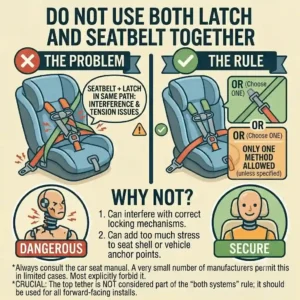
The “Double Up” Myth: A terrifyingly common mistake is assuming that using both the LATCH anchors and the vehicle seatbelt at the same time is safer. It is not. In crash testing, utilizing both systems simultaneously can put opposing stress loads on the car seat’s plastic shell, causing it to crack or shatter. You must choose one or the other. (Note: Nuna and Clek have very specific, rare exceptions for some models, but as a rule, never double up).
-
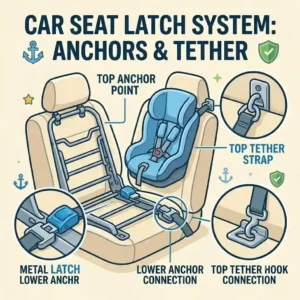
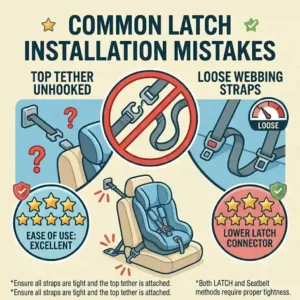
Forgetting the Top Tether: When forward-facing, parents often debate latch vs seatbelt installation which is safer while completely ignoring the most crucial component: the top tether. Whether you install with LATCH or a seatbelt, if the seat is forward-facing, you must attach the top tether anchor behind the vehicle seat. It reduces the forward pitch of the child’s head in a crash by up to 8 inches, directly preventing spinal and brain injuries. According to Safe Kids Worldwide, over 60% of forward-facing seats are used without the tether.
-
Ignoring the Vehicle Manual: Parents read the car seat manual but ignore the car’s manual. Your vehicle manual dictates where LATCH anchors are located, what weight limits apply to the vehicle’s hardware, and whether you are permitted to use lower anchors in the center seat.
Long-Term Cost & Maintenance: The Hidden Expenses
When analyzing the ROI of car seats, you have to look beyond the purchase price. Let’s talk about the “Efficiency Gap” over a 5-to-10-year period.
If you buy a cheap $80 convertible car seat with basic hook-style LATCH connectors and no seatbelt lock-offs, you will save money on day one. However, after three months of daily use, crumb buildup, and juice spills, those unshielded LATCH straps become sticky and nearly impossible to tighten. Furthermore, cheap seats often have a 6-year expiration date.
Conversely, investing in a premium seat with a steel core and mechanical belt tensioners (like the Britax) presents a higher upfront cost. But these seats boast a 10-year expiration date. Because they rely on the vehicle’s seatbelt via a mechanical door (ClickTight), there are no exposed LATCH straps to degrade or get jammed with debris. The total cost of ownership over a decade makes the premium seat cheaper per year, while drastically reducing the daily friction and stress of moving the seat.
✨ Don’t Miss These Exclusive Deals!
🔍 Ready to upgrade your daily commute and ensure maximum safety? Click on any highlighted car seat to check current pricing, real-world reviews, and availability on Amazon.
Conclusion: The Final Verdict
When evaluating latch vs seatbelt installation which is safer, the answer is a matter of mechanics, not magic. The LATCH system was a brilliant intervention by the National Highway Traffic Safety Administration (NHTSA) to curb the epidemic of loose seatbelt installations. However, its strict weight limits mean that every parent must eventually become intimately familiar with their vehicle’s seatbelt locking mechanisms.
If you are buying an infant seat like the Chicco KeyFit 35, leverage the LATCH for a flawless, speedy install. But as your child grows into high-weight convertible seats like the Graco Extend2Fit, transitioning to a properly locked vehicle seatbelt isn’t just an option—it’s a requirement. Ultimately, a safe installation is a tight installation. Test your seat at the belt path, read both of your manuals, and never forget the top tether when forward-facing.
❓ FAQs
❓ What is latch vs seatbelt installation which is safer?
✅ Neither system is inherently safer. The safest method is the one that achieves a tight fit (less than 1 inch of movement at the belt path). LATCH is easier for beginners, but has strict weight limits, whereas seatbelts accommodate higher weights safely…
❓ Can I use both LATCH and the seatbelt at the same time?
✅ No. Unless specifically permitted by the car seat manufacturer (which is extremely rare), using both puts opposing forces on the plastic shell during a crash, which can cause the seat to shatter. Always pick one method…
❓ When do I have to stop using the LATCH system?
✅ Federal safety standards mandate a combined weight limit (car seat weight + child weight) of 65 pounds for the lower anchors. Once your child’s weight pushes the total past 65 lbs, you must switch to a seatbelt installation…
❓ Why isn’t LATCH allowed in the middle seat?
✅ Most vehicle manufacturers do not install dedicated lower anchors in the center position. You cannot legally “borrow” the inner anchors from the window seats because the spacing exceeds the standard 11 inches, which compromises crash safety…
❓ How do I lock my car’s seatbelt for a car seat?
✅ Pull the seatbelt slowly all the way out until it stops. As it retracts, you will hear a clicking sound. This engages the Automatic Locking Retractor (ALR), ensuring the belt stays tight and won’t loosen during daily driving…
Recommended for You
- 2026 Guide: Infant Car Seat vs Convertible Which Is Safer? (5 Truths)
- The Ultimate Rear Facing vs Forward Facing Safety Comparison: 2026 Expert Guide
- 5 Deadly Car Seat Installation Mistakes Parents Make in 2026 (Solved!)
Disclaimer: This article contains affiliate links. As an Amazon Associate, I earn from qualifying purchases. If you purchase products through these links, we may earn a small commission at no additional cost to you.
✨ Found this helpful? Share it with your friends! 💬🤗