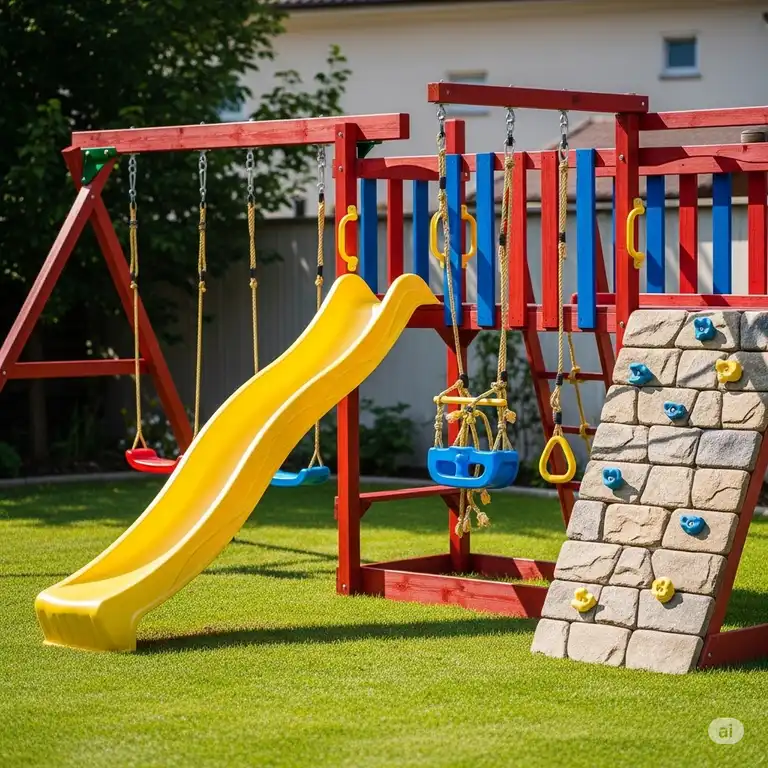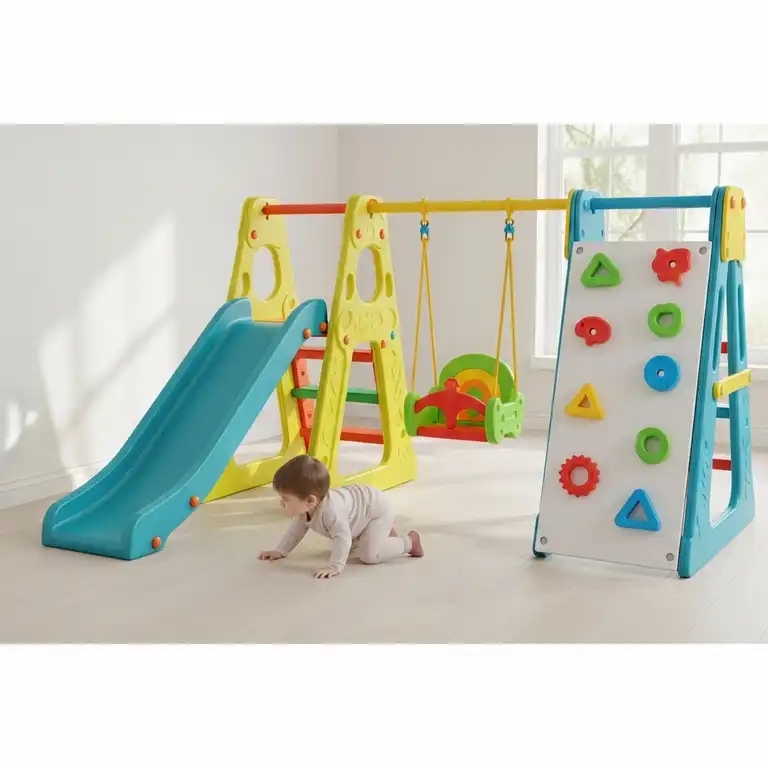
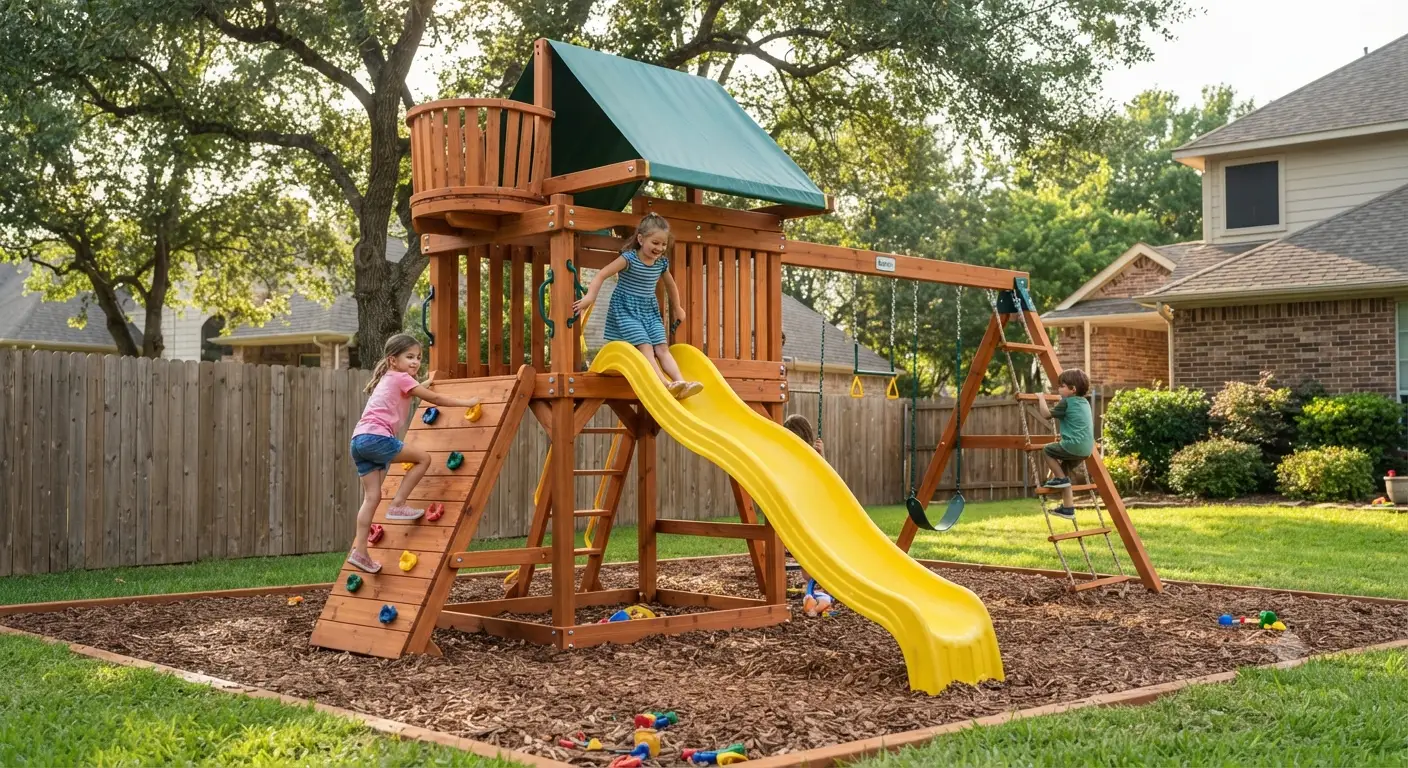
If you’ve spent any time scrolling backyard inspiration lately, you’ve probably noticed that the jungle gym has quietly become the centerpiece of the modern American yard — right up there with the grill and the fire pit. And it makes sense: kids need somewhere to burn off energy that isn’t a screen, and a good jungle gym delivers hours of that without you having to referee a single argument about whose turn it is on the tablet.
So, what is a jungle gym? In modern usage, a jungle gym is a backyard play structure that combines climbing elements — bars, walls, domes, or ladders — with features like slides, swings, and platforms, designed to build strength, balance, and coordination through active, unstructured play. The category ranges from a $100 steel climbing dome to a $2,800 multi-level cedar fortress with a clubhouse, and the “right” one depends entirely on your kids’ ages, your yard size, and how much assembly time you’re willing to sacrifice on a Saturday.
This guide breaks down seven real jungle gym options currently available on Amazon, spanning entry-level climbing domes to premium cedar and steel play systems. We’ll look at what each one actually delivers in real-world use, what buyers consistently say after living with them, and how to think about the decision so you don’t end up with a structure your kids outgrow in a summer — or one that turns your weekend into an unplanned carpentry project. As an Amazon Associate, we earn from qualifying purchases, so let’s get into the specifics.
Quick Comparison: The Best Jungle Gym for Backyards at a Glance
Before diving into full reviews, here’s a fast snapshot of how these seven options stack up if you’re trying to find the best jungle gym for backyard use on a deadline.
| Jungle Gym | Best For | Price Range | Ages |
|---|---|---|---|
| Backyard Discovery Skyfort II | Families wanting the most features in one set | $1,700–$2,700 | 3–10 |
| Lifetime Adventure Tower Deluxe | Zero-maintenance, low-upkeep households | $2,200–$2,800 | 3–12 |
| Gorilla Playsets Westbrook | Buyers who want two slides and heavy-duty framing | Around $2,700 | 3–10 |
| Sportspower Grand Mesa | Large families and group play on a mid-size budget | $600–$800 | 3–10 |
| Backyard Discovery Tucson | Small yards and first-time swing set buyers | Under $500 | 3–10 |
| VEVOR 10FT Geometric Dome Climber | Pure climbers who don’t need swings | $120–$190 | 3–10 |
| Little Tikes Campin’ and Climb Wall | Toddlers, tiny patios, and indoor/outdoor flexibility | $70–$100 | 2–5 |
Looking at the table above, there’s a clear pattern: price climbs sharply once cedar wood and multi-structure clubhouses enter the picture, while steel domes and compact climbers stay affordable but trade away swings and shaded platforms. If your yard is small or your kids are still toddlers, the Little Tikes Campin’ and Climb Wall or the VEVOR 10FT Geometric Dome Climber make more sense than a $2,000 fortress they won’t grow into for years. Families with the space and budget for a true backyard destination should be comparing the Backyard Discovery Skyfort II, Lifetime Adventure Tower Deluxe, and Gorilla Playsets Westbrook against each other instead.
💬 Found a front-runner already? Every click helps you compare real prices before you commit — and helps other parents find this guide too! 😊
Top 7 Jungle Gyms for Backyards: Expert Analysis
We dug into spec sheets, manufacturer documentation, and aggregated customer feedback across major retailers to put together this lineup. It covers entry-level, mid-range, and premium jungle gym swing set options, so whatever your yard and budget look like, there’s a realistic pick below.
1. Backyard Discovery Skyfort II — most feature-packed backyard fortress
The Skyfort II is the set most people picture when they imagine a dream backyard jungle gym for kids, and it earns that reputation by simply including more than almost anything else at this price point. You get a raised clubhouse with a wood roof, windows, and a covered entryway, a front porch with a sun balcony, and a crow’s nest complete with a telescope — plus a lower deck with a built-in picnic table.
On the activity side, kids get two belt swings, a trapeze bar, a rock climbing wall, a flat-step entry ladder, monkey bars, and a roughly 10-foot wave slide. What that combination means in practice is that this single structure functions like three or four separate pieces of playground equipment rolled into one footprint — climbing, swinging, sliding, and imaginative “castle” play are all covered without buying anything else. The whole structure is built from cedar, a wood species chosen specifically because it naturally resists rot and insect damage better than pine or fir, which matters if this thing is going to live outside in Ohio winters or Texas summers for the next decade.
This is the pick for families who want one big investment rather than several smaller purchases, and who have kids spanning a wide age range (3 to 10) who’ll all find something to do on it at once. Reviews consistently report that the Skyfort II holds up well for years and that the variety keeps kids engaged longer than simpler swing sets — one of the more common praises across retailer reviews is that it “seemed to offer the most variety and value for the price” compared to competing sets. What most buyers overlook going in, though, is the assembly commitment: aggregated review sentiment repeatedly flags build times in the 10-to-14-hour range, and some reports mention wood pieces that can split if hardware is over-tightened during setup.
Pros:
- ✅ Combines clubhouse, slide, swings, and rock wall in one unit
- ✅ Cedar construction naturally resists rot and insects
- ✅ Wide 3–10 age range keeps multiple kids engaged
Cons:
- ❌ Assembly commonly takes 10+ hours for two adults
- ❌ Wood finish may need resealing after a couple of seasons
At around $1,700 to $2,700 depending on retailer and slide configuration, the Backyard Discovery Skyfort II sits at the higher end, but for a family that would otherwise buy a slide, a swing set, and a playhouse separately, the combined value holds up.
2. Lifetime Adventure Tower Deluxe — zero-maintenance steel-and-HDPE build
If the idea of resealing cedar every couple of years sounds like a chore you’d rather skip entirely, the Lifetime Adventure Tower Deluxe solves that problem by not using wood at all. The frame is powder-coated steel paired with UV-protected high-density polyethylene (HDPE) panels — the same material family used in heavy-duty outdoor furniture and marine hardware because it shrugs off sun, rain, and temperature swings without warping, rotting, or splintering.
Features include a covered clubhouse with a hardtop roof, a 9-foot UV-protected wavy slide, monkey bars, a climbing wall, a storefront window, and a lookout tower positioned above the main play deck. In practice, this means a family can leave the structure completely untouched for years — no staining, no sealing, no annual maintenance weekend — while the rubber-coated swing chains and rounded corners handle the safety side of things. That’s a meaningful difference from cedar sets, where upkeep is baked into the ownership cost whether you plan for it or not.
This set is best suited to households in humid or rainy climates where wood maintenance is genuinely burdensome, or simply for parents who want to set it up once and never think about it again. Reviews consistently praise the build quality and the “set it and forget it” durability, with aggregated feedback frequently mentioning the heft of the steel components right out of the box. The tradeoff shows up in two places: it’s one of the pricier options in this roundup, and assembly reportedly consumes most of a full weekend rather than a single afternoon — the steel hardware and multiple HDPE panels take longer to align than a straightforward wood A-frame.
Pros:
- ✅ No staining, sealing, or wood maintenance ever required
- ✅ Steel-and-HDPE frame resists warping and rot long-term
- ✅ Rubber-coated chains and rounded edges reduce pinch risk
Cons:
- ❌ Among the more expensive options in this lineup
- ❌ Full assembly often takes most of a weekend
Priced in the $2,200 to $2,800 range, the Lifetime Adventure Tower Deluxe asks for a premium upfront, but the near-zero ongoing maintenance can offset that over five or six years of ownership.
3. Gorilla Playsets Westbrook — double-slide cedar showpiece
The Gorilla Playsets Westbrook takes a different approach to standing out: instead of maximizing the number of distinct zones like the Skyfort II, it doubles down on slide variety, offering both an Extreme Tube Slide and an Alpine Wave Slide on the same structure. Add a rock wall with a climbing rope and a built-in picnic table, and you’ve got a jungle gym swing set that leans hard into repeat-play value for kids who genuinely love sliding down in different ways.
Under the hood, the frame uses 4×4 wood posts and a 4×6 swing beam, which combine for an 800-pound total weight capacity — noticeably higher than several competitors, which matters if you routinely host neighborhood kids or have three children close in age using it simultaneously. The lumber arrives pre-cut, pre-sanded, and pre-stained in an amber finish, which practically translates to a shorter assembly window than fully raw-lumber competitors, since you’re not sanding down rough edges or staining boards yourself before building.
This is the set for buyers who specifically want redundancy in the sliding department and don’t mind paying a premium for reinforced framing. Reviews are more limited in volume for this particular model compared to the higher-volume Backyard Discovery line, but the available aggregated feedback centers on the swing chains’ rubber-grip coating preventing pinched fingers and the sturdiness of the double-slide tower — genuinely useful details you won’t find by reading the spec sheet alone. Given the smaller review sample size, it’s worth reading a handful of recent buyer photos before ordering to confirm current lumber quality, since wood sourcing can shift between production runs.
Pros:
- ✅ Two distinct slides for varied, repeatable play
- ✅ 800 lb. weight capacity is above average for cedar sets
- ✅ Pre-cut, pre-sanded lumber speeds up assembly
Cons:
- ❌ Smaller pool of verified customer reviews than rival brands
- ❌ Among the pricier cedar options in this category
At roughly $2,700, the Gorilla Playsets Westbrook competes directly with the Skyfort II and Lifetime Adventure Tower — the deciding factor usually comes down to whether double slides or a clubhouse-plus-crow’s-nest layout wins your kids’ vote.
4. Sportspower Grand Mesa — budget-friendly capacity for large families
Not every household needs — or can justify — a $2,000+ investment, and the Sportspower Grand Mesa exists for exactly that gap. Built from Finland Spruce wood, it packs in an 8-foot blow-molded wavy slide, a 29.5-inch flying saucer swing, metal monkey bars, a rock climbing wall, two sling swings with vinyl chain covers, a fabric shade canopy, and a sandbox tucked underneath the main structure — all rated to support up to 10 kids and 1,000 pounds combined.
What that weight and kid-capacity rating means for a real backyard is that this jungle gym for kids can comfortably host a birthday party or a rotating cast of neighborhood friends without anyone waiting long for a turn. The fabric canopy is a practical touch competitors in this price bracket often skip, giving kids (and the play equipment itself) some relief from direct summer sun.
This is the pick for larger families or anyone who regularly has multiple children playing at once but doesn’t want to spend cedar-tower money to get there. Aggregated review sentiment is genuinely mixed here, and in the interest of honesty, that’s worth stating plainly rather than glossing over: several buyers report the build going smoothly in under six hours with two people, while others note that pre-drilled holes occasionally needed minor adjustment during assembly, and that the built-in “sandbox” area sits shallow enough that it holds less sand than the name implies. Ground anchors are also sold separately and are strongly recommended — multiple reviewers mention the structure shifting under active play without them.
Pros:
- ✅ Supports up to 10 kids and 1,000 lbs. combined
- ✅ Fabric canopy adds shade most competitors skip
- ✅ Noticeably lower price than premium cedar towers
Cons:
- ❌ Ground anchors sold separately but functionally necessary
- ❌ Sandbox area is shallower than the name suggests
At around $600 to $800, the Sportspower Grand Mesa delivers genuine multi-kid capacity for well under half the price of the premium sets above — a fair trade if you factor in budgeting a little extra for anchors on installation day.
5. Backyard Discovery Tucson — smallest footprint real-wood option
For a family working with a modest backyard or buying their very first swing set, the Backyard Discovery Tucson is one of the more approachable entry points into cedar construction. It scales down the fortress-style layout of sets like the Skyfort II into a smaller footprint while keeping the core activities: a slide, belt swings, and a rock wall climbing feature, all built from the same rot-resistant cedar the brand uses across its lineup.
In practice, this means you get the durability benefits of real wood — no plastic panels to fade or crack in UV exposure over a few summers — without needing a massive backyard or a full weekend crew to install it. It’s a genuinely smart on-ramp for parents who aren’t sure yet whether their kids will use a swing set daily or lose interest within a season, since the investment is a fraction of the premium options.
This set is best suited to households with younger children (roughly ages 3–7) who don’t need monkey bars or a clubhouse yet, or families prioritizing yard space for other uses. Aggregated reviews sit lower on average than Backyard Discovery’s premium Skyfort line, and it’s worth being upfront about why: feedback frequently mentions basic hardware quality and simpler wood cuts that some buyers feel reflect the lower price point, alongside praise for how quickly it goes up compared to larger sets. If your priority is testing the waters rather than building a backyard destination, the tradeoff is reasonable.
Pros:
- ✅ Compact footprint fits smaller backyards
- ✅ Real cedar construction at an entry-level price
- ✅ Fast assembly compared to multi-tower sets
Cons:
- ❌ Hardware and wood quality trail premium Backyard Discovery sets
- ❌ Limited activities — no monkey bars or clubhouse
Typically priced under $500, the Backyard Discovery Tucson is one of the most accessible ways into a real wood jungle gym swing set without committing to a multi-thousand-dollar structure.
6. VEVOR 10FT Geometric Dome Climber — pure climbing, zero swings
Sometimes the simplest option is the right one, and the VEVOR 10FT Geometric Dome Climber strips the category down to its core idea: a 10-foot-wide, roughly 5-foot-tall geometric steel dome built for climbing, with a swing attachment and a detachable cushion that doubles as ground padding or a hammock. The frame is thickened, hot-dip galvanized steel with a powder-coated finish designed to resist UV damage, rust, and corrosion outdoors.
What that construction means in practice is a climbing dome for kids that goes up in under an hour — most buyers report needing no power tools — and that holds up through repeated freeze-thaw cycles better than untreated metal alternatives. With a roughly 750-pound weight capacity, it comfortably supports multiple kids climbing at once, and the geometric bar pattern is genuinely more versatile for creative play (tents, forts, obstacle courses) than a single fixed slide ever is.
This is the right call for families who specifically want a compact climbing structure rather than a full swing set — smaller yards, urban lots, or households that already have a separate swing set or trampoline and just need a dedicated climbing feature. Reviews consistently highlight how quick and tool-light the assembly process is, along with the sturdiness of the welded joints, while a recurring complaint across steel dome climbers in this category generally is that ground anchors, sold separately in most cases, are genuinely necessary in windy regions to keep the dome from shifting.
Pros:
- ✅ Assembles in under an hour with minimal tools
- ✅ Galvanized steel resists rust and UV damage
- ✅ Compact footprint fits smaller yards
Cons:
- ❌ No slide or full swing seat included
- ❌ Ground anchors recommended but sold separately
Priced roughly between $120 and $190, the VEVOR 10FT Geometric Dome Climber is one of the most cost-efficient ways to add genuine climbing-based active play without touching swing-set territory.
7. Little Tikes Campin’ and Climb Wall — best for toddlers and tiny yards
Rounding out the list at the most accessible end is the Little Tikes Campin’ and Climb Wall, a 2-in-1 climbing wall and tent designed specifically with younger kids in mind. The climbing wall angle is adjustable — it can lean against an exterior wall or stand freely — and includes 10 climbing pegs secured with stainless steel bolts so handholds stay put under a toddler’s full body weight. Unfold it the other way, and the same panel opens into a spacious hideaway tent.
In real terms, this design means one compact piece of equipment does double duty: active climbing practice on one side, quiet imaginative play on the other, which is a smart use of a small patio, apartment balcony, or narrow side yard where a full jungle gym simply won’t fit. The all-weather tent fabric is built to handle some outdoor exposure, though this is best treated as a semi-portable piece you bring in during harsh weather rather than a permanent fixture like the cedar sets above.
This is squarely the pick for parents of toddlers and preschoolers (roughly ages 2–5) who aren’t ready for monkey bars or an 8-foot slide but still benefit enormously from supervised gross-motor practice. Aggregated review sentiment is largely positive on stability and ease of setup — most reviewers report it standing up to daily toddler use without wobbling — with occasional notes that bigger kids around age 6 and up outgrow the scale of it fairly quickly, which is expected given the intended age range.
Pros:
- ✅ Doubles as a climbing wall and a play tent
- ✅ Ideal scale for toddlers and small spaces
- ✅ Stainless steel bolts keep pegs secure
Cons:
- ❌ Kids around age 6+ outgrow it quickly
- ❌ Not a substitute for a full-size swing set
At roughly $70 to $100, the Little Tikes Campin’ and Climb Wall is the lowest-commitment way to introduce climbing dome for kids-style play before graduating to something larger down the line.
Full Feature Comparison: All 7 Jungle Gyms Side by Side
| Jungle Gym | Material | Key Features | Weight Capacity | Best For |
|---|---|---|---|---|
| Backyard Discovery Skyfort II | Cedar wood | Clubhouse, crow’s nest, slide, swings, rock wall | Not published; supports multi-child use | Feature-rich all-in-one set |
| Lifetime Adventure Tower Deluxe | Steel + HDPE | Hardtop clubhouse, slide, monkey bars, lookout tower | 550 lbs | Low-maintenance households |
| Gorilla Playsets Westbrook | Cedar wood | Two slides, rock wall, picnic table | 800 lbs | Multi-kid durability |
| Sportspower Grand Mesa | Finland Spruce wood | Slide, saucer swing, monkey bars, sandbox, canopy | 1,000 lbs | Large families, group play |
| Backyard Discovery Tucson | Cedar wood | Slide, swings, rock wall | Not published | Small yards, first swing set |
| VEVOR 10FT Geometric Dome | Galvanized steel | Climbing dome, swing attachment, cushion | 750 lbs | Compact climbing-only setups |
| Little Tikes Campin’ and Climb Wall | Plastic + steel bolts | Climbing wall, hideaway tent | Toddler-rated | Toddlers, tiny spaces |
The weight-capacity spread here tells its own story: the Sportspower Grand Mesa and Gorilla Playsets Westbrook are engineered for high-traffic, multi-kid backyards, while the Lifetime Adventure Tower Deluxe trades a bit of raw capacity for materials that need essentially zero upkeep. If your household regularly hosts group play, weight capacity and swing count should outrank clubhouse aesthetics; if it’s mostly your own one or two kids, a lower-capacity set like the Backyard Discovery Tucson or VEVOR 10FT Geometric Dome Climber is plenty of structure without the excess cost.
Setting Up Your Jungle Gym: A First-30-Days Guide
Buying the right jungle gym is only half the job — how you set it up and use it in the first month determines whether it lasts for years or develops problems early. Start with ground prep: the U.S. Consumer Product Safety Commission recommends at least 9 inches of protective surfacing like mulch, wood chips, or rubber under and around any home play equipment, extending at least 6 feet in every direction, since grass and dirt alone don’t cushion falls adequately (CPSC home playground safety guidance). Skipping this step is the single most common regret among parents in aggregated reviews across every product category above.
During assembly, resist the urge to fully tighten every bolt until the entire frame is loosely connected — cedar sets in particular are prone to splitting if hardware gets torqued down before the structure is square. For steel-and-HDPE builds like the Lifetime Adventure Tower Deluxe, double-check that panels are seated flush before adding screws, since forcing a misaligned panel is the top cause of stripped hardware.
In week one, walk the perimeter and check that ground anchors (if applicable) are seated fully — this matters enormously for lighter dome climbers and metal-frame sets, which can shift several inches under active play if anchors are skipped. By week two or three, recheck all bolts and connectors once the structure has settled with real use; wood swells and steel joints seat in slightly during the first few weeks of play. A simple maintenance rhythm from there — a hardware check every season, plus resealing cedar every 12–24 months depending on climate — keeps most sets structurally sound well past their warranty window.
✨ Ready to compare current prices?
🔍 Take backyard playtime to the next level with this carefully curated jungle gym lineup. Click a highlighted option above to check current pricing and availability, and give your kids a backyard upgrade the whole family will actually use this summer.
Which Jungle Gym Fits Your Family? Real-World Scenarios
Buying decisions get a lot easier when you match a set to your actual situation rather than comparing spec sheets in a vacuum. Here are three common household profiles and where they tend to land.
The growing family with a big yard and kids ages 3–10 who play together daily is the classic case for a premium multi-feature set. With a $2,000+ budget and a backyard that can accommodate a roughly 15×20-foot footprint, the Backyard Discovery Skyfort II or Gorilla Playsets Westbrook make sense because the variety of activities keeps siblings of different ages engaged simultaneously instead of fighting over a single slide.
The budget-conscious household hosting frequent playdates needs capacity more than aesthetics. With a $600–$800 range in mind and a yard that regularly holds four or five kids at once, the Sportspower Grand Mesa‘s 10-kid, 1,000-pound rating solves the actual problem — nobody’s waiting in line for a turn — without stretching into premium cedar-tower pricing.
The apartment-dwelling or small-yard family with a toddler and limited outdoor square footage is better served by scaling down entirely. A patio or narrow side yard, a budget under $200, and a child under 5 point directly toward the Little Tikes Campin’ and Climb Wall or the VEVOR 10FT Geometric Dome Climber — both deliver genuine gross-motor benefits without requiring a permanent, oversized structure the family might need to remove at their next move.
How to Choose a Jungle Gym for Your Backyard
Working through these criteria in order will narrow the field faster than browsing by price alone.
- Measure your actual yard space first. Add 6 feet of clearance on every side of the structure’s footprint (per CPSC surfacing guidance) before falling in love with a specific model — a Skyfort II won’t fit where a Tucson will.
- Match the age range to your kids’ actual stage, not their eventual one. A toddler doesn’t need monkey bars yet, and a 9-year-old will outgrow a toddler climbing wall within a season.
- Decide how you feel about ongoing maintenance. Cedar needs resealing every year or two; steel-and-HDPE sets like the Lifetime Adventure Tower Deluxe need essentially none.
- Check weight and kid capacity against how you actually use your yard. Frequent group play calls for higher-capacity sets like the Sportspower Grand Mesa or Gorilla Playsets Westbrook.
- Budget for extras up front — anchors, mulch or rubber surfacing, and a shade solution if the set doesn’t include a canopy, since these routinely add $50–$150 to the real total cost.
- Read recent reviews, not just star averages. A 4.5-star average can still hide a recurring hardware issue that only shows up in the written comments.
- Confirm ASTM compliance. Reputable home playground equipment should meet ASTM F1148 safety standards, a voluntary but widely adopted benchmark manufacturers reference directly on their spec sheets.
Common Mistakes to Avoid When Buying a Jungle Gym
The most expensive mistake buyers make is sizing the purchase to their child’s current age rather than the structure’s actual footprint and their yard’s real dimensions — a common regret in aggregated reviews is discovering, mid-assembly, that the set barely clears a fence line or shades out a garden bed. A close second is skipping ground anchors to save $20–$40 upfront, only to have a lighter steel-frame set shift noticeably within the first month of real use, according to a recurring theme across dome-climber reviews specifically.
Buyers also frequently underestimate assembly time, treating a two-person, 10-hour cedar build as a Saturday-morning project rather than blocking off a full weekend — which leads to rushed, improperly tightened hardware. Finally, many households skip protective ground surfacing entirely, relying on existing grass, despite the CPSC’s clear guidance that grass and dirt don’t adequately cushion falls the way mulch, wood chips, or rubber surfacing do.
Jungle Gym vs. Traditional Swing Set: What’s the Real Difference?
The terms get used interchangeably, but there’s a meaningful distinction worth understanding before you shop. A traditional swing set is built around suspended motion — two or three swings hanging from an A-frame beam, sometimes with a single slide attached. A jungle gym, by contrast, centers on climbing structure first: monkey bars, rock walls, geometric domes, or multi-level platforms, with swings as an optional add-on rather than the main event.
In terms of developmental value, both support gross motor skills, but a jungle gym’s climbing-heavy design tends to build upper-body strength, spatial awareness, and problem-solving (figuring out a route up a rock wall or dome) more directly than a swing set’s back-and-forth motion does. A pure climbing dome for kids, like the VEVOR model in this list, sacrifices swinging entirely in exchange for that concentrated climbing benefit and a noticeably smaller footprint — a real advantage for tight yards where an A-frame swing set’s fore-and-aft clearance requirement simply won’t fit. On the other hand, a hybrid jungle gym swing set, like the Skyfort II or Sportspower Grand Mesa, gives you both experiences in a single structure, at the cost of a considerably larger footprint and, usually, a higher price.
The practical takeaway: if your yard is tight or your kids gravitate toward climbing over swinging, a dedicated climbing dome wins on space efficiency. If you have room and want to cover every kind of active play in one purchase, a full hybrid set justifies its larger footprint and price tag.
Safety, Regulations, and Standards for Home Jungle Gyms
Unlike public playgrounds, which fall under detailed municipal and school-district oversight, home jungle gyms are governed primarily by voluntary industry standards rather than federal mandates — which makes it the buyer’s responsibility to check compliance before purchasing. The relevant benchmark is ASTM F1148, the Standard Consumer Safety Performance Specification for Home Playground Equipment, maintained by ASTM International. A 2009 revision to that standard specifically prohibited attaching swings, gliders, or trapeze bars directly to monkey bars, reducing the risk of kids falling from the bars into the path of a swinging component — worth checking for on any older or secondhand set you might inherit or buy used.
The CPSC’s Outdoor Home Playground Safety Handbook lays out the core home safety checklist: at least 9 inches of protective surfacing extending 6 feet in every direction from the equipment (more behind and in front of swings, based on twice the height of the suspending bar), regular hardware inspections for sharp edges or open “S” hooks, and a firm rule against attaching ropes, leashes, or cords of any kind to play equipment due to strangulation risk (CPSC Outdoor Home Playground Safety Handbook). Every set in this roundup that publishes compliance info references ASTM F1148 or equivalent standards, which is worth confirming on the listing page before you buy, since compliance details can change between production runs.
Long-Term Cost and Maintenance: What a Jungle Gym Really Costs Over Time
The sticker price is rarely the full cost of ownership, and this is where materials really start to matter. Cedar sets like the Skyfort II, Westbrook, and Tucson need periodic resealing or staining — typically every 12 to 24 months depending on climate exposure — which runs somewhere in the $30–$80 range in materials per application if you do it yourself, plus a weekend of labor. Skip this step in a rainy or humid climate, and you’re looking at faster wood graying, minor splitting, or in worst cases, rot at ground-contact points over five-plus years.
Steel-and-HDPE construction, as used in the Lifetime Adventure Tower Deluxe, essentially eliminates that recurring cost — the tradeoff is a higher purchase price upfront that needs to be weighed against those saved maintenance dollars over the ownership period. Steel dome climbers like the VEVOR model carry the lowest total cost of ownership by a wide margin: minimal upfront price, powder-coated rust resistance, and no wood maintenance at all, though their smaller size means less total play value per dollar for households with multiple, differently-aged kids.
Across the board, budget an additional $50–$150 beyond the sticker price for ground anchors, mulch or rubber surfacing, and basic tools if you don’t already own them — a detail that rarely appears in the base price but is functionally part of getting any of these sets safely installed.
The Jungle Gym Decision Framework
If you want a simple mental shortcut rather than re-reading every section above, use this:
- If your yard is under 200 square feet, choose a compact climbing dome or wall-mounted climber, because a full-size hybrid set physically won’t fit with required clearance.
- If your kids are under 5, choose a toddler-scaled climber over a full swing set, because monkey bars and tall slides exceed safe use for that age group.
- If you host group playdates regularly, choose a high-capacity set like the Sportspower Grand Mesa, because weight and kid capacity matter more than clubhouse features for that use case.
- If you want to avoid ongoing maintenance entirely, choose a steel-and-HDPE build like the Lifetime Adventure Tower Deluxe, because cedar’s upkeep becomes a recurring cost otherwise.
- If budget is the primary constraint, choose an entry-level cedar set like the Backyard Discovery Tucson or a steel dome climber, because both deliver core play value at a fraction of premium pricing.
What to Expect: Everyday Performance
Specs only tell you so much — here’s what actually changes day to day once one of these is in your backyard. In the first few weeks, expect kids to gravitate toward whatever’s newest and most novel, whether that’s a slide or a climbing wall, before settling into a rotation across features. According to the American Academy of Pediatrics, unstructured outdoor play like this genuinely supports physical development, motor skills, and even mood regulation in young children, which lines up with what many parents report anecdotally — fewer screen-time battles once an outdoor structure is available and appealing (HealthyChildren.org, Playing Outside: Why It’s Important for Kids).
Weather resistance also plays out differently across materials in daily use. Cedar sets handle rain reasonably well but show wear (graying, minor splintering at high-friction points like slide entries) faster in consistently humid or coastal climates. Steel-and-HDPE sets and powder-coated dome climbers shrug off moisture almost entirely, which is noticeable specifically after the first heavy rain, when wood sets need a dry-out period before kids should climb on wet, potentially slick surfaces and steel sets generally don’t.
Jungle Gyms for Active, Multi-Age Families
Households with kids spanning several years in age face a specific challenge: what engages a 4-year-old often bores or under-challenges an 8-year-old on the same structure. The wider ASTM-rated age ranges (3–10 or 3–12) on sets like the Skyfort II, Lifetime Adventure Tower Deluxe, and Sportspower Grand Mesa exist specifically to address this by layering easier and harder elements — a low entry ladder alongside taller monkey bars, for instance — into a single footprint. The CDC’s physical activity guidance recommends that children ages 6 through 17 get 60 minutes or more of moderate-to-vigorous activity daily, and a well-chosen multi-age jungle gym is one of the more reliable ways to hit that target without scheduling formal sports for younger kids who aren’t there yet (CDC Physical Activity Guidelines for School-Aged Children and Adolescents).
For families in this situation, prioritizing a set with genuinely tiered difficulty — not just more features, but features spanning easy to hard — pays off more than raw feature count. A rock wall with varying-difficulty rock placement, or a slide alongside a steeper climbing net, gives every age something appropriately challenging rather than one child dominating the “fun” parts while a sibling sticks to the swings.
Features That Actually Matter (and Ones That Don’t)
Marketing copy loves to highlight telescopes, steering wheels, and tic-tac-toe panels, and while those add genuine imaginative-play value, they’re not what determines whether a set lasts or performs well. What actually matters: weight capacity relative to your real usage, the presence (or absence) of rubber-coated swing chains to prevent pinched fingers, whether ground anchors are included or need separate purchase, and the wood species or steel treatment used in the frame.
What matters less than it appears: the total number of “activities” listed on the box. A set advertised as “8-in-1” or “10-in-1” is often just counting a slide, two swing types, and several climbing surfaces separately — genuinely useful play value doesn’t scale linearly with that number the way marketing implies. Focus instead on whether the specific combination fits your kids’ current stage and your yard, which the scenarios and framework sections above are designed to help you sort through.
Frequently Asked Questions
❓ How much does a jungle gym cost?
✅ Prices span roughly $70 for a compact toddler climber up to around $2,800 for a premium cedar or steel multi-feature set. Mid-range wood swing sets with slides and sandboxes typically land in the $600–$800 range…
❓ What age is a jungle gym appropriate for?
✅ Most full-size jungle gym swing sets are rated for ages 3 to 10 or 3 to 12, while compact climbers and dome-style structures are often designed for toddlers as young as 2. Always match the specific product's stated age range to your child…
❓ Is a jungle gym safer than a trampoline?
✅ Both carry different risk profiles rather than one being categorically safer. Jungle gyms involve fall risk from height, while trampolines involve bounce-related injuries; CPSC surfacing and supervision guidelines apply to both categories…
❓ How much space do I need for a backyard jungle gym for kids?
✅ Beyond the structure's footprint, the CPSC recommends at least 6 feet of clear space in every direction, extended further behind and in front of swings. Compact dome climbers need far less total space than multi-tower cedar sets…
❓ Do jungle gyms need to be anchored to the ground?
✅ Most manufacturers recommend ground anchors, and lighter steel-frame or dome-style sets in particular can shift under active play without them. Anchors are frequently sold separately, so budget for them as part of the total purchase…
Conclusion
Choosing the best jungle gym for backyard use really comes down to three honest questions: how much space do you actually have, how many kids will realistically use it at once, and how much ongoing maintenance are you willing to take on. Families with room and budget to spare get the most complete experience from the Backyard Discovery Skyfort II, Lifetime Adventure Tower Deluxe, or Gorilla Playsets Westbrook — each covers climbing, swinging, and imaginative play in one structure, with the deciding factor mostly coming down to maintenance preference and slide style. Larger, budget-conscious families should look hardest at the Sportspower Grand Mesa for its genuine group-play capacity, while smaller yards and younger kids are far better served by the Backyard Discovery Tucson, VEVOR 10FT Geometric Dome Climber, or Little Tikes Campin’ and Climb Wall.
None of these are wrong choices in isolation — they’re built for different households, and the scenarios and decision framework above should make it clear which bucket you fall into. What matters most, regardless of which one you pick, is pairing it with proper ground surfacing, secure anchoring, and a quick seasonal hardware check, since even the best-built set only performs as well as its setup and upkeep allow.
Recommended for You
- 7 Best Jungle Gyms for Adults That Transform Your Fitness Routine in 2025
- 7 Best Jungle Gym Backyard Options For Ultimate Fun in 2025
- Infant Indoor Jungle Gym: 7 Best Options for Ultimate Baby Development in 2025
Disclaimer: This post contains affiliate links. As an Amazon Associate, I earn from qualifying purchases made through these links, at no additional cost to you.
✨ Found this article helpful? Share it with someone who needs it! 💬🤗