Introduction: Why a Backyard Jungle Gym Is Worth Planning Carefully in 2027
If your kids treat the couch like a climbing wall and the kitchen counter like a summit, a backyard jungle gym is probably already on your wish list. The good news? Heading into 2027, the market is wider than ever — from a fold-flat toddler climber that costs less than a family pizza night to a cedar fortress with a crow’s nest that needs a full weekend and three adults to build. The bad news is that the same breadth makes it easy to buy the wrong thing: a dome that’s too big for your yard, a toddler set your 6-year-old outgrows in one summer, or a swing set that never gets anchored properly.
This guide cuts through that. Instead of rewording product listings, we compared real spec sheets — weight capacities, footprints, age ratings, safety zones, materials — and the aggregated sentiment from real customer reviews to explain what each number actually means for your family. You’ll find seven genuine options across entry-level, mid-range, and premium budgets, plus setup advice, safety standards, long-term cost math, and the mistakes buyers make most often.
What Is a Backyard Jungle Gym?
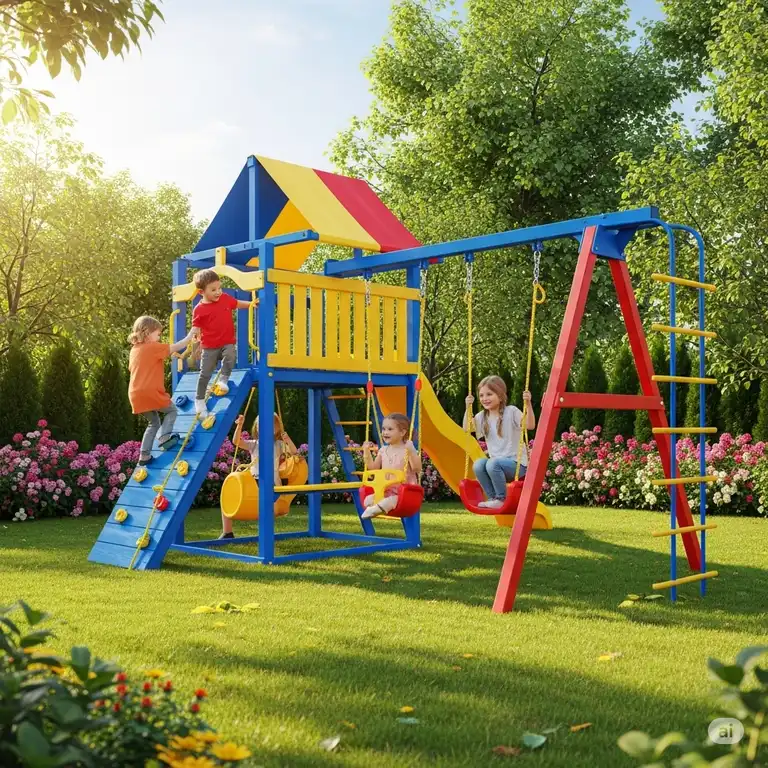
A backyard jungle gym is a home-scale outdoor play structure built mainly for climbing — think domes, monkey bars, rock walls, ladders, and raised decks — often combined with slides, swings, or hideouts. The classic jungle gym began as a public playground fixture; today’s residential versions come in plastic, powder-coated steel, and cedar, sized for yards rather than parks.
In short: it’s the park, minus the drive. Let’s find the right one for your space.
Quick Comparison: 7 Backyard Jungle Gym Picks at a Glance
Here’s the fast version before we dig into the details. Price ranges are approximate at the time of writing — prices change frequently, so check the current price on Amazon.
| Product | Type | Listed Ages | Key Spec | Approx. Price Range | Best for |
|---|---|---|---|---|---|
| Lifetime Geometric Dome Climber | Steel dome | 3–10 | 600 lb capacity, 10 ft wide | $130–$260 | Lifetime Geometric Dome Climber: best all-around value |
| Step2 Woodland Climber II | Plastic climber + slide | 2–6 | 27″ platform, 2 climbing walls | $300–$400 | Step2 Woodland Climber II: toddlers & preschoolers |
| Little Tikes Hide & Seek Climber | Plastic toddler climber | Toddler (~1.5–4) | Compact, short slide | $100–$150 | Little Tikes Hide & Seek Climber: first climber |
| Little Tikes Easy Store Slide & Explore | Folding climber + slide | 1–3 | Folds for storage | $40–$75 | Little Tikes Easy Store Slide & Explore: tight budgets & small spaces |
| Eezy Peezy Monkey Bars Climbing Tower | Plastic dome tower | 3–6 (some listings 3–8) | 27 lb, 150 lb max load | $150–$250 | Eezy Peezy Monkey Bars Climbing Tower: portable climbing |
| Backyard Discovery Mount McKinley | Cedar swing set | 3–10 | 8 ft wave slide, rock wall | $700–$1,100 | Backyard Discovery Mount McKinley: mixed-age families |
| Backyard Discovery Skyfort II | Cedar fort + swing set | 3–10 | Monkey bars, 10 ft slide | $2,400–$3,200 | Backyard Discovery Skyfort II: the “forever” playset |
Looking at the table, the Lifetime Geometric Dome Climber stands out because its 600-pound capacity and 10-foot footprint deliver group play at a price closer to a toddler slide than a swing set. Families with kids under 4 should lean toward the Step2 Woodland Climber II or the Little Tikes Hide & Seek Climber, whose low platforms match small bodies. Meanwhile, the two Backyard Discovery cedar sets only make sense if you have the yard, the budget, and the patience for a long build.
💬 One click helps other shoppers make an informed choice too! 😊
Top 7 Backyard Jungle Gym Picks: Expert Analysis
Each pick below includes what the specs mean in practice, who it’s genuinely for, what real reviews consistently say, and an honest value verdict.
1. Lifetime Geometric Dome Climber — most kids per dollar
The Lifetime Geometric Dome Climber (model 90136) is the rare backyard jungle gym that comfortably hosts a group without a four-figure price tag. It measures 10 feet in diameter and 5 feet tall, with a 600-pound total weight capacity and room for up to six kids.
That 5-foot height is a deliberate design choice: tall enough to feel like a real summit to a 5-year-old, low enough to limit fall height compared with taller domes. The frame uses powder-coated steel tubing with UV-resistant grips, so it won’t fade to chalky pastel after two summers. Lifetime recommends a 6-foot safety zone beyond the perimeter — meaning you really need a roughly 22-by-22-foot clear area, not just a 10-foot circle.
Based on the specs, this is the strongest choice for families with two or three kids between about 3 and 10, or for anyone who hosts the neighborhood crowd. It’s less ideal for toddlers, since the open lattice offers no enclosed rails. Reviews consistently praise its sturdiness under multiple kids; the most common complaint is a tedious, bolt-heavy assembly.
Pros:
- ✅ Handles up to six kids at once
- ✅ Weather-resistant powder-coated steel frame
- ✅ Low height limits fall distance
Cons:
- ❌ Assembly involves many small bolts
- ❌ Needs a large clear safety zone
Typically in the $130–$260 range (check the current price) — excellent value for multi-kid households.
2. Step2 Woodland Climber II — best for toddlers who climb everything
The Step2 Woodland Climber II is built for the 2-to-6 crowd, and its woodland-brown styling blends into a yard instead of screaming primary colors.
It packs two climbing walls, a ladder, a slide, two steering wheels, and an under-deck hideout into a 75 x 47 x 53.75-inch footprint. The platform sits 27 inches high, and the slide runs about 32 inches long — modest numbers, but exactly right for small kids who are still learning to judge height. Step2 says the assembled unit weighs about 85 pounds, so it won’t scoot when a preschooler launches off the ladder, yet two adults can still relocate it to save the grass. The double-walled plastic shrugs off rain and won’t splinter, and the listing notes a 3-year limited warranty.
Here’s what to weigh: kids around 6 may find it tame. If you have a 2-year-old and a 7-year-old, this alone won’t cover both. Reviews consistently highlight build quality, straightforward assembly, and kids’ love for the slide and steering wheels.
Pros:
- ✅ Multiple play zones for two kids
- ✅ No rust, splinters, or repainting
- ✅ Natural look suits landscaped yards
Cons:
- ❌ Older kids outgrow it quickly
- ❌ Pricey for a plastic climber
Usually in the $300–$400 range at the time of writing — fair value given durability and resale demand.
3. Little Tikes Hide & Seek Climber — the classic first climber
The Little Tikes Hide & Seek Climber is the starter jungle gym many parents remember from their own childhood, and it’s still one of the best ways to introduce climbing to toddlers.
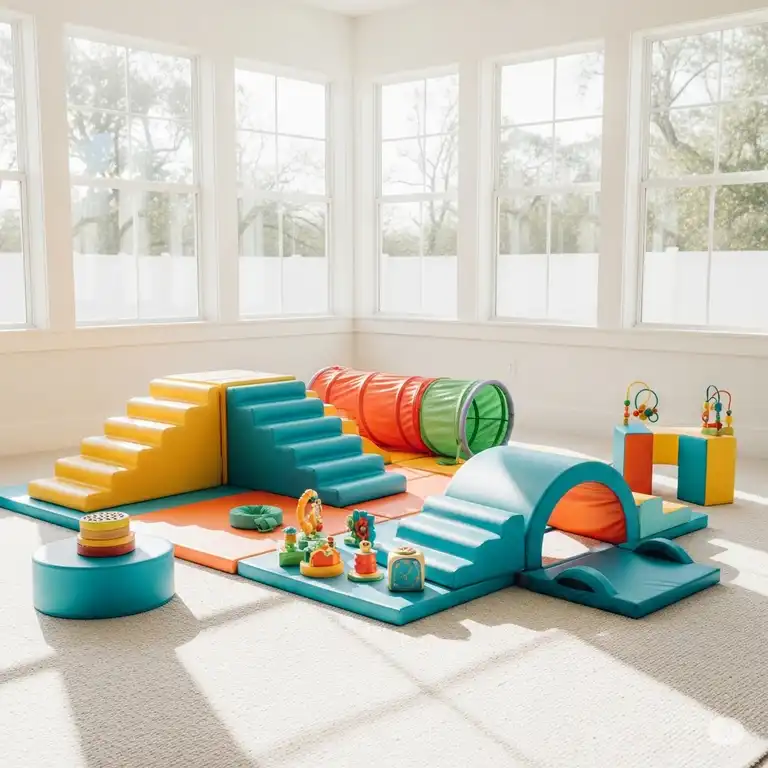
It combines climb-up steps, a short slide, and crawl-through hideaway openings in one compact molded-plastic unit. The practical meaning: short heights and enclosed spaces let toddlers practice climbing and sliding with very little fall risk. It’s also light enough to move indoors over winter, which matters if your 2027 plan includes year-round play. Age listings vary by retailer — Amazon’s listing tops out around 4 years, while some stores say 2–5 — so think of it as a toddler product, not a preschool one.
On paper, this is the right pick for a 1.5- to 3-year-old and for parents who want something ready in under an hour. Aggregated reviews on Amazon have sat in the mid-4-star range across thousands of ratings, with parents praising durability and toddler appeal; recurring complaints say kids outgrow it fast.
Pros:
- ✅ Very low, toddler-friendly heights
- ✅ Quick assembly and easy to move
- ✅ Durable rotomolded plastic build
Cons:
- ❌ Outgrown by most kids around age 4
- ❌ Colors fade with constant sun
Generally $100–$150 at the time of writing — strong value for a 2–3 year window.
4. Little Tikes Easy Store Slide & Explore — best budget and small-space pick
The Little Tikes Easy Store Slide & Explore is the most affordable kids jungle gym on this list, and it folds up when you need your patio back.
It’s a combined slide-and-climber designed for ages 1 to 3, made for both indoor and outdoor use. The folding design is the headline feature: you can stash it in a garage corner or behind a sofa when it’s not in use, which is a genuine advantage for apartment patios, rentals, and families who don’t want a permanent structure. The tradeoff is scale — it’s a first-climbing experience, not a jungle gym your kids will grow into.
Based on its spec profile, this suits grandparents who want something for visits, families with a 12-month-old just learning to climb, or anyone testing whether their toddler actually enjoys climbing before spending more. Deal-tracker listings show it frequently dipping well below its typical price, so patience pays. Review sentiment is broadly positive about portability; some parents note the climbing portion is very basic.
Pros:
- ✅ Folds away for easy storage
- ✅ Works indoors and outdoors
- ✅ Lowest entry price on this list
Cons:
- ❌ Very short useful age window
- ❌ Limited climbing challenge
Typically $40–$75 (prices vary) — hard to beat as a starter set.
5. Eezy Peezy Monkey Bars Climbing Tower — lightest dome for flexible yards
The Eezy Peezy Monkey Bars Climbing Tower delivers dome-style climbing in a 27-pound package you can drag across the lawn with one hand.
Assembled, it measures about 70 x 66 x 47 inches, with a 150-pound maximum load. Those two numbers tell the whole story: it’s light enough to move so you can mow under it, but 150 pounds means roughly two small kids — not the neighborhood. It snaps together from interlocking plastic tubes with self-locking connectors, and the plastic is UV-protected for outdoor use. Note that ground anchors are not included, so budget for a stake kit if your kids are rough climbers.
Who is it for? Families with 3- to 6-year-olds who want monkey-bar practice without committing to steel or wood. Age listings vary (3–6 on some, 3–8 on others); the lower limit is the honest one for taller kids. Reviews across the Eezy Peezy line praise tool-free assembly and portability; a common critique is that taller children find the bars too low.
Pros:
- ✅ Ultra-light and easy to relocate
- ✅ Tool-free snap-together assembly
- ✅ Rust-free UV-protected plastic
Cons:
- ❌ Low 150 lb weight limit
- ❌ Anchors must be bought separately
Usually $150–$250 at the time of writing — fair value for portability, less so for big families.
6. Backyard Discovery Mount McKinley — best mid-range cedar all-rounder
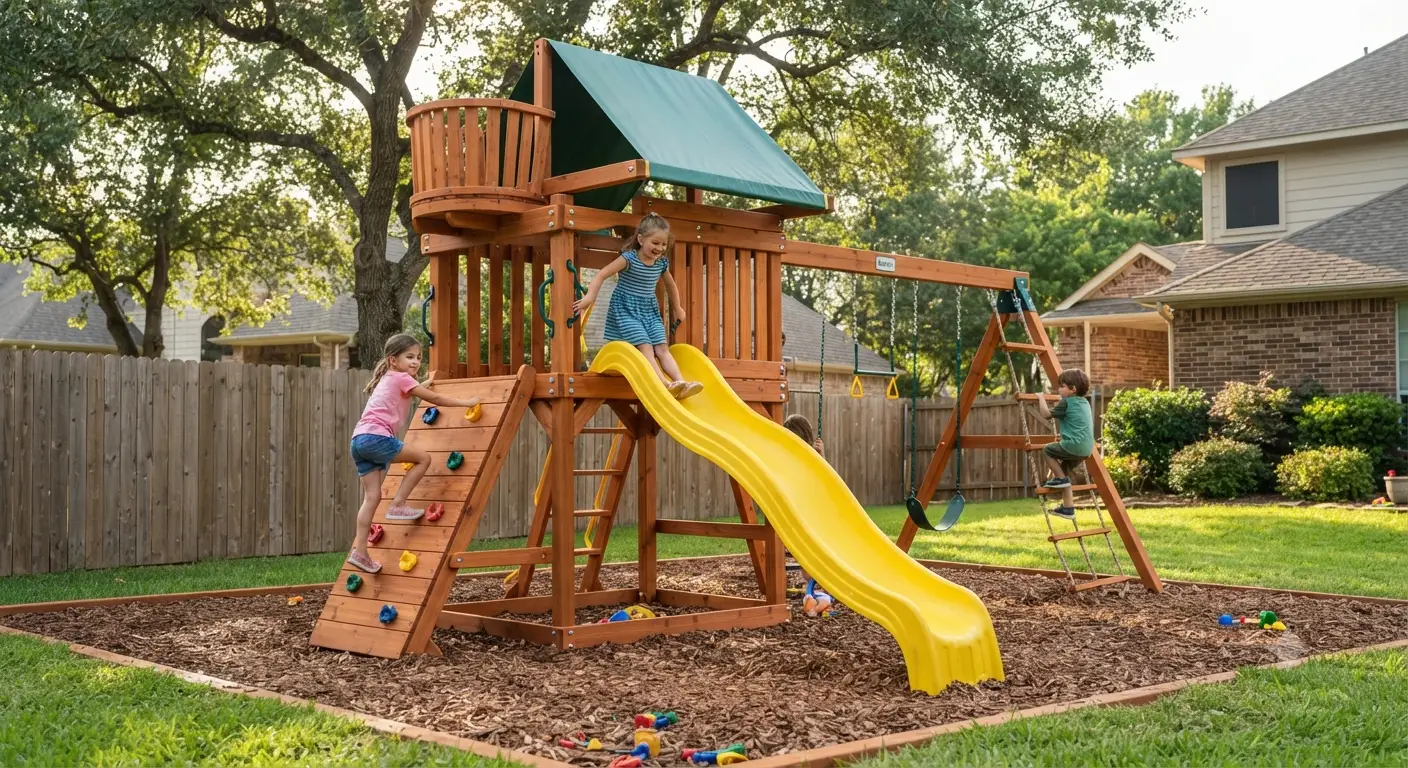
The Backyard Discovery Mount McKinley is where a jungle gym becomes a full backyard playground: deck, slide, rock walls, swings, and a sandbox in one cedar structure.
The spec list is long — a raised canopy deck, double rock wall, rope ladder, 8-foot wave slide, web swing, belt swings, telescope, steering wheel, and a shaded sandbox — in a footprint of roughly 150 x 186 inches and about 119 inches tall. Backyard Discovery rates the set for up to 10 kids and says it’s engineered to meet or exceed ASTM F1148 home-playground standards. In practice, the mix of activities means a 3-year-old and an 8-year-old can play at the same time without fighting over one feature.
Here’s what most buyers overlook: at around 308 pounds of lumber and hardware, owners commonly report 8–10 hours of assembly with two people, and you need a level area of about 15 by 19 feet plus a 6-foot safety zone. Aggregated reviews are strongly positive on quality and play value; the dominant complaint is the time-consuming build.
Pros:
- ✅ Covers ages 3 through 10 well
- ✅ Naturally rot-resistant cedar frame
- ✅ Many simultaneous play zones
Cons:
- ❌ Long, two-person assembly
- ❌ Requires a large, level site
Generally $700–$1,100 (check the current price) — solid value per year of use.
7. Backyard Discovery Skyfort II — the premium “forever” playset
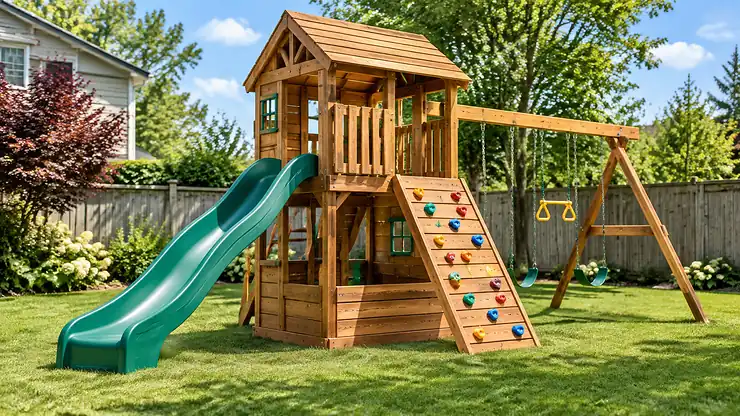
The Backyard Discovery Skyfort II is the flagship-style cedar set for families who want one structure to cover an entire childhood.
It adds a raised clubhouse with a wood roof and windows, a crow’s nest, monkey bars, a 10-foot wave slide, a rock wall, belt swings, a trapeze bar, a picnic table, and a sandbox. Its listed dimensions are about 201 x 263 x 148 inches, and the set weighs in around 710 pounds. That weight is the point: heavy cedar framing means less wobble when two kids swing hard while a third runs across the monkey bars.
Based on comparing the specs, this is for large yards, multiple kids aged 3–10, and parents who’d rather buy once. It is massive — with a 6-foot safety perimeter, you’re dedicating a big chunk of lawn. Reviews at major retailers sit in the mid-to-high 4-star range, praising the clubhouse and monkey bars; complaints focus on delivery logistics and multi-day assembly. Professional installation is worth pricing in.
Pros:
- ✅ Monkey bars for older kids
- ✅ Huge clubhouse and crow’s nest
- ✅ Heavy, stable cedar construction
Cons:
- ❌ Very large footprint
- ❌ Premium price plus likely installation costs
Typically in the $2,400–$3,200 range at the time of writing — worth it only if you’ll use it for years.
Top 7 Side by Side: Specs That Actually Matter
| Product | Material | Max Load / Capacity | Footprint (approx.) | Assembly Effort | Best for |
|---|---|---|---|---|---|
| Lifetime Geometric Dome Climber | Powder-coated steel | 600 lb / 6 kids | 10 ft diameter | Moderate (many bolts) | Lifetime Geometric Dome Climber: groups of kids |
| Step2 Woodland Climber II | Double-walled plastic | Multi-child play | 75 x 47 in | Easy | Step2 Woodland Climber II: ages 2–6 |
| Little Tikes Hide & Seek Climber | Molded plastic | Toddler use | Compact | Very easy | Little Tikes Hide & Seek Climber: first climber |
| Little Tikes Easy Store Slide & Explore | Plastic, folding | Toddler use | Small, folds | Very easy | Little Tikes Easy Store Slide & Explore: small spaces |
| Eezy Peezy Monkey Bars Climbing Tower | UV-protected plastic | 150 lb | 70 x 66 in | Easy, tool-free | Eezy Peezy Monkey Bars Climbing Tower: portability |
| Backyard Discovery Mount McKinley | Cedar | Up to 10 kids | 150 x 186 in | Hard (8–10 hrs) | Backyard Discovery Mount McKinley: mixed ages |
| Backyard Discovery Skyfort II | Cedar | Multi-child | 201 x 263 in | Very hard | Backyard Discovery Skyfort II: long-term investment |
Reading across this table, the real dividing line isn’t price — it’s assembly effort and footprint. The plastic options from Step2, Little Tikes, and Eezy Peezy go up in an afternoon and move when you need them to, while the Backyard Discovery Mount McKinley and Backyard Discovery Skyfort II are semi-permanent fixtures. If you rent or expect to move within two years, that alone should steer your decision.
✨ Don’t miss these top-rated picks!
🔍 Take your backyard play to the next level with this carefully curated lineup. Click a highlighted product name to check current pricing and availability on Amazon — these picks will help your kids climb, slide, and burn energy in ways the whole family will enjoy!
Getting Started: Setup, Anchoring, and Your First 30 Days
Buying is the easy part. Here’s how to set up any backyard jungle gym so it stays safe and actually gets used.
Before the box arrives
- Pick the spot first. Choose level ground away from fences, trees, driveways, and AC units, with a clear line of sight from the kitchen window or back door.
- Measure the full use zone. For most structures, that’s the footprint plus at least 6 feet in every direction. For swings, the zone extends further in front and behind.
- Plan the surfacing. Grass and packed dirt are not adequate cushioning under climbing equipment. Budget for wood chips, mulch, sand, pea gravel, or rubber mulch.
Assembly day
- Sort hardware before you start — a muffin tin works wonders for small bolts.
- Recruit a second adult for anything larger than a toddler climber.
- Use the manufacturer’s app or video if one exists; Backyard Discovery owners regularly say the step-by-step app shortens the cedar builds.
- Anchor it. Domes and swing sets can tip or “walk” under dynamic loads; use the included anchors or buy a compatible kit.
Your first 30 days
- Week 1: Re-check every bolt after the first few play sessions — wood settles and plastic connectors seat themselves.
- Week 2: Set house rules: one kid on the slide at a time, no jumping from the top of a dome, no ropes or jump ropes tied to the frame.
- Week 4: Top up loose-fill surfacing that has been kicked out of high-traffic spots like slide exits and swing landings.
The most common first-month mistake? Skipping anchors because the structure “feels heavy enough.” It’s the push-and-pull of kids in motion, not static weight, that moves a frame.
Real-World Scenarios: Matching Kids Jungle Gym Picks to Real Families
Specs only matter in context. Here’s how the seven options map to three common households.
Scenario 1: One toddler, small suburban yard, budget under $200
A 2-year-old, a 30-by-20-foot yard, and parents who aren’t sure how long the climbing phase will last. Best match: the Little Tikes Hide & Seek Climber, with the Little Tikes Easy Store Slide & Explore as the budget fallback. Both sit low, assemble in minutes, and move indoors for winter. Spending $800 on a cedar set for a 2-year-old usually means paying for features they can’t use until age 5.
Scenario 2: Two kids aged 4 and 7, medium yard, mid-range budget
Here, age spread is the problem. A toddler climber bores the 7-year-old; a big swing set may intimidate the 4-year-old. Best match: the Lifetime Geometric Dome Climber if your budget tops out near $250, because both kids can climb at their own level. If you can stretch to around $1,000, the Backyard Discovery Mount McKinley gives each child a “zone” — swings for one, rock wall and slide for the other.
Scenario 3: Three kids, large yard, buying once for the next decade
Families with kids aged 3 to 9 and a big flat lawn get the most from the Backyard Discovery Skyfort II. Monkey bars and a 10-foot slide keep older kids interested; the clubhouse and sandbox engage the youngest. Pair it with the Eezy Peezy Monkey Bars Climbing Tower as a secondary, movable climber for playdates.
The lesson across all three: match the structure to the youngest child’s safety needs and the oldest child’s boredom threshold — then choose the cheapest option that satisfies both.
Problem → Solution: Fixing Common Outdoor Jungle Gyms for Kids Headaches
Even well-chosen outdoor jungle gyms for kids come with predictable issues. Here are five, with fixes.
Problem 1: The structure wobbles or shifts. ✅ Solution: Re-tighten hardware, confirm the ground is level, and add anchors. Domes like the Lifetime Geometric Dome Climber and lightweight towers like the Eezy Peezy Monkey Bars Climbing Tower benefit most from staking.
Problem 2: Grass dies under the play area and turns to mud. ✅ Solution: Accept it and replace the grass with loose-fill surfacing. It’s safer anyway. Use landscape edging or timbers to keep mulch contained — Mount McKinley owners frequently report needing dozens of bags of rubber mulch for full coverage.
Problem 3: Metal gets dangerously hot in summer. ✅ Solution: Place steel domes where they get afternoon shade, or schedule play for mornings. Plastic slides heat up too, so touch-test surfaces on hot days before kids climb on.
Problem 4: Kids lost interest after a month. ✅ Solution: Rotate add-ons — a tarp over a dome becomes a fort, a hammock turns it into a hangout, chalk “routes” turn a rock wall into a challenge. Novelty, not a bigger structure, usually fixes boredom.
Problem 5: Cedar is graying or splintering. ✅ Solution: Sand rough spots and apply a water-based wood sealant every year or two, following the manufacturer’s guidance. Check our maintenance section below for a realistic schedule.
How to Choose a Backyard Jungle Gym
Choosing the right backyard jungle gym comes down to seven decisions, in this order:
- Measure your yard, including the safety zone. Add at least 6 feet on every side of the footprint; a 10-foot dome realistically needs a 22-foot clear square.
- Start from your youngest child’s age. Platform heights and openings sized for older kids can create fall and entrapment risks for toddlers.
- Check total and per-user weight limits. A 150-pound limit means two small kids; a 600-pound limit supports a playdate.
- Pick a material that fits your climate and patience. Plastic is low-maintenance, steel is strong but heats up, and cedar is beautiful but needs sealing.
- Be honest about assembly. An afternoon project and a two-day project are very different commitments; factor in professional installation for large cedar sets.
- Look for standards compliance. Prefer products stating they meet ASTM F1148, the home playground equipment standard.
- Budget for surfacing and anchors. These can add meaningfully to the total cost and are non-negotiable for safety.
For a deeper planning checklist, the CPSC’s Outdoor Home Playground Safety Handbook walks through site selection, hardware, anchoring, and surfacing in plain language. It’s free and short enough to read over coffee.
The takeaway: the “best” jungle gym is the one that fits your space and your youngest climber — not the one with the longest feature list.
Safety, Regulations, and Standards Every Parent Should Know
There’s no federal mandatory rule specific to residential playsets, but there is a well-established voluntary framework, and the better manufacturers design to it.
ASTM F1148
The key standard is ASTM F1148, the Standard Consumer Safety Performance Specification for Home Playground Equipment. CPSC staff have long supported this voluntary standard, and you can follow its history on the CPSC’s Home Playground Equipment standards page. Backyard Discovery, for example, states its sets are engineered to meet or exceed ASTM F1148. When a listing doesn’t mention any standard, treat that as a reason to look closer.
The handbook guidance that matters most
The CPSC’s home playground handbook emphasizes a handful of practical points: locate equipment away from roads and driveways and within view of the house; avoid protruding bolts and open S-hooks; anchor equipment; and install protective surfacing. It also notes a design change moving swings away from monkey bars, to reduce falls onto moving swings.
What’s new heading into 2027
In August 2025, the CPSC announced final updates to its public playground handbook — the Public Playground Safety Handbook covers parks and schools, not backyards, but its guidance on surfacing and use zones is a useful benchmark for home setups too. We found no verified new federal rule for home playsets taking effect in 2027.
Supervision still beats specs
No standard replaces an adult in sight. Remove bike helmets and drawstring clothing before climbing, as both pose entanglement risks on play equipment.
Jungle Gym Playground at Home vs. the Public Park
Is a home jungle gym playground actually better than walking to the park? It depends on what you value.
| Factor | Backyard Jungle Gym | Public Park Playground | Best for |
|---|---|---|---|
| Availability | Anytime, no travel | Limited by hours, weather, crowds | Backyard for daily play |
| Upfront cost | $40 to $3,000+ | Free | Park for tight budgets |
| Variety of equipment | Limited to one structure | Often several structures | Park for variety |
| Supervision ease | Watch from a window | Must be on-site | Backyard for busy parents |
| Socialization | Mostly siblings/playdates | Meet new kids | Park for social skills |
| Maintenance | Your responsibility | Handled by city | Park for zero upkeep |
The table makes the tradeoff clear: a home jungle gym wins on convenience and supervision, while the park wins on variety, cost, and socialization. That’s why many families use both — the backyard structure for quick daily energy burns and the park for weekend adventures. If your nearest playground is a 20-minute drive, the convenience math tilts strongly toward buying.
There’s also a frequency argument. A kid who can step outside and climb for 15 minutes before dinner gets far more total active time than one who visits a park twice a week. A backyard set turns climbing into a habit rather than an outing, and for many parents that daily habit is the real return on the investment.
Little Tikes Jungle Gym and Little Tikes Gym Options: What’s Actually Available
Many parents search for a little tikes jungle gym because they remember the brand’s chunky, near-indestructible climbers. Here’s the honest picture for 2027 shoppers.
Little Tikes (now owned by MGA Entertainment) remains strongest in the toddler segment. On amazon.com, the most consistently available options are the Little Tikes Hide & Seek Climber and the Little Tikes Easy Store Slide & Explore — both featured above. Other Little Tikes climbers appear at US retailers, such as the Jr. Activity Gym and the Hide & Slide Climber, though availability on Amazon varies.
What about the older “Jungle Climber” — the multi-level model with two platforms, a wavy slide, and a cargo net? It still shows up through international resellers, but we couldn’t verify reliable current availability through amazon.com in the US. If you find it listed, check the seller carefully and confirm it’s new, not a decades-old used unit with sun-brittle plastic.
So what does a little tikes gym do well? Rotomolded plastic means no splinters, no rust, and minimal maintenance — just hose it down. What it doesn’t do: scale up with your kids. Most Little Tikes climbers target roughly ages 1–5, so think of them as a first chapter, then plan your next step (a dome or cedar set) around age 5. The good news is that these climbers hold resale value well on local marketplaces, which softens the cost of moving on.
Kids Jungle Gym Outdoor Picks by Age Group
The single most useful filter for a kids jungle gym outdoor purchase is age. Here’s how our seven picks line up.
Ages 1–3: Low and enclosed
The Little Tikes Easy Store Slide & Explore and the Little Tikes Hide & Seek Climber keep heights low and include enclosed spaces. At this age, falls from even modest heights are the main risk, so lower is genuinely better.
Ages 2–6: The preschool sweet spot
The Step2 Woodland Climber II is purpose-built here, with a 27-inch platform and multiple climbing routes. The Eezy Peezy Monkey Bars Climbing Tower also fits from age 3, as long as you respect the 150-pound limit.
Ages 4–10: Real climbing challenges
The Lifetime Geometric Dome Climber, Backyard Discovery Mount McKinley, and Backyard Discovery Skyfort II all hit this range. Monkey bars and taller walls build upper-body strength and coordination — skills toddler sets simply can’t develop.
A note on “boys” vs. “girls” searches
If you landed here searching for jungle gym play equipment for amazon kids boys, the reality is that none of these structures is gendered — climbing benefits every child equally. Choose by age, size, and energy level, not color scheme. Neutral finishes like the Step2 Woodland Climber II‘s woodland brown or natural cedar also resell better.
Long-Term Cost and Maintenance
The sticker price is only part of the cost of owning backyard jungle gyms for kids. Here’s a realistic view of total cost over the years you’ll use one.
| Product | Approx. Price Range | Likely Extras | Useful Years (typical) | Best for |
|---|---|---|---|---|
| Little Tikes Easy Store Slide & Explore | $40–$75 | Minimal | 1–2 | Little Tikes Easy Store Slide & Explore: lowest total cost |
| Little Tikes Hide & Seek Climber | $100–$150 | Minimal | 2–3 | Little Tikes Hide & Seek Climber: toddler years |
| Lifetime Geometric Dome Climber | $130–$260 | Surfacing, anchors | 5–7 | Lifetime Geometric Dome Climber: best cost per year |
| Backyard Discovery Mount McKinley | $700–$1,100 | Surfacing, sealant, possible install | 6–8 | Backyard Discovery Mount McKinley: value per kid |
The cost-per-year math reshapes the picture. A dome at roughly $200, used for six years, costs about $35 a year — less than many single toddler toys. A cedar set at around $900 over seven years lands near $130 a year before surfacing and sealant, which is still reasonable if two or three kids use it. The cheapest option up front isn’t always the cheapest to own.
A realistic maintenance schedule
- Monthly (play season): Check bolts, look for cracks in plastic, rake surfacing back under slides and swings.
- Each spring: Inspect swing hangers and chains, replace worn parts, top up mulch to its original depth.
- Every 1–2 years (cedar): Sand splinters and reseal per the manufacturer’s instructions.
- Each fall: Move small plastic climbers inside or cover them to slow UV fading.
Common Mistakes to Avoid When Buying Backyard Jungle Gyms for Kids
After comparing specs and sifting through review complaints, the same buyer mistakes come up again and again.
1. Measuring the footprint but not the safety zone. A set that “fits” the yard can still leave kids landing against a fence. Always add at least 6 feet per side — more for swings.
2. Buying for the age your child will be “someday.” A 2-year-old on a structure designed for 8-year-olds faces taller drops and wider gaps. Buy for now, or choose a set with genuinely low entry points.
3. Ignoring the weight limit for playdates. A 150-pound plastic tower works for two siblings, not five neighborhood kids. If you host often, prioritize capacity.
4. Underestimating assembly. Reviews of large cedar sets regularly mention full-day or multi-day builds. Professional installation services exist, and for 700-pound sets they’re often worth it.
5. Skipping surfacing. It’s the single most important safety investment, and the one buyers most often postpone. Grass wears away fast under play equipment.
6. Falling for feature counts. “15 activities” sounds great, but a telescope and a steering wheel don’t add much play value. Focus on climbing, sliding, and swinging quality.
7. Overlooking heat and sun. Dark plastic slides and steel bars in full afternoon sun can get uncomfortably hot. Plan placement or shade before you buy.
Avoid these, and almost any pick on this list will serve you well.
FAQ: Backyard Jungle Gym Questions Parents Ask Most
❓ How much space do I need for a backyard jungle gym?
✅ Measure the structure's footprint, then add at least 6 feet of clear space on every side. A 10-foot dome needs roughly a 22-by-22-foot area, while large cedar swing sets can require far more, especially for swings…
❓ What should go under a jungle gym instead of grass?
✅ Loose-fill materials like wood chips, mulch, sand, pea gravel, or rubber mulch cushion falls much better than grass or dirt. Keep it topped up, especially at slide exits and under swings, where it gets displaced fastest…
❓ Is a metal or plastic jungle gym better?
✅ Plastic suits toddlers, is easy to move, and never rusts, but has lower weight limits. Powder-coated steel handles more kids and more weight but heats up in sun. Choose based on age and how many kids play…
❓ Do I need to anchor a kids jungle gym?
✅ Yes, in most cases. Climbing and swinging create dynamic forces that can tip or shift a structure. Use the included anchors or a compatible kit, especially for domes and lightweight towers that don't ship with them…
❓ Can I install a big wooden playset myself?
✅ You can, but plan for two or more adults and a full day or more. Large cedar sets weigh hundreds of pounds. If you're short on time or tools, a professional installer is a worthwhile safety investment…
Conclusion: Choosing the Right Backyard Jungle Gym for Your Family
The best backyard jungle gym isn’t the biggest or the most expensive — it’s the one that fits your yard, your youngest climber, and your tolerance for assembly and upkeep. For most families with kids between 3 and 10, the Lifetime Geometric Dome Climber offers the strongest mix of capacity, durability, and price. Toddler households get the most from the Step2 Woodland Climber II or the Little Tikes Hide & Seek Climber, while the Little Tikes Easy Store Slide & Explore is the smart budget test run. Portability fans should look at the Eezy Peezy Monkey Bars Climbing Tower, and families ready to invest in a full backyard playground can choose between the Backyard Discovery Mount McKinley and the premium Backyard Discovery Skyfort II.
Whichever you choose, the same three steps protect your kids and your investment: measure the full safety zone, anchor the structure, and install proper surfacing. Do those well, and you’re not just buying a toy — you’re building a daily habit of outdoor, screen-free play that strengthens bodies and builds confidence through 2027 and beyond.
One last tip: involve your kids in the choice. A child who helped pick the structure is usually the one who uses it most.
🚀 Ready to bring the playground home?
🌳 Compare the highlighted picks, check current pricing and availability on Amazon, and choose the backyard jungle gym that will keep your kids climbing, laughing, and outside for years to come!
Recommended for You
- Baby-proofing a stairway: 7 Best Expert-Picked Gates (2027)
- indoor playground for kids: 7 Best Picks Compared (2027)
- DIY Babyproofing Tips for Sharp Corners: 7 Best Picks (2026)
Disclaimer: This post contains affiliate links. As an Amazon Associate, I earn from qualifying purchases made through these links, at no additional cost to you.
✨ Found this article helpful? Share it with someone who needs it! 💬🤗
[wpf_share]