Moving to a tropical paradise or just heading there for a much-needed vacation? It sounds like a dream until you realize that your little one isn’t exactly built like a heat-seeking missile. I remember the first time I took my six-month-old to South Florida in July—I spent half the time worrying if he was melting and the other half looking for a high-powered fan. Understanding heat safety in tropical climates babies is more than just a “nice to know”; it’s a vital skill set for any parent navigating high humidity and soaring temperatures.
✨Was this helpful? Spread the word! 🚀
[addtoany]
Tropical climates present a unique challenge because the air is often saturated with moisture, which makes it harder for the body to cool itself through sweat evaporation. For infants, whose thermoregulation systems are still “under construction,” this can lead to overheating much faster than it would for an adult. In this comprehensive guide, I’ll walk you through the science of keeping your baby cool, the best gear to invest in, and how to spot the warning signs before they become emergencies.
Tropical vs. Temperate Heat Safety Comparison
Before we dive into the products, let’s look at why heat safety in tropical climates babies requires a different approach than a standard summer day in a dry climate.
| Feature | Temperate/Dry Heat | Tropical/Humid Heat |
| Cooling Mechanism | Sweat evaporates quickly | Sweat stays on skin (ineffective) |
| Hydration Need | Moderate | High (due to constant sweating) |
| Clothing Strategy | Any light fabric | Only ultra-breathable (Cotton/Linen) |
| Risk of Heat Rash | Low to Moderate | Extremely High |
| Sun Intensity | Varies by season | Consistently high (Year-round) |
Quick Comparison: Top Cooling Gear for Babies
If you are in a rush to pack your bags, here is a snapshot of the top-rated items designed to enhance heat safety in tropical climates babies.
| Product | Primary Benefit | Best For |
| Ergobaby Omni Breeze | Maximum Airflow | Hiking & Walking |
| UPPAbaby Vista V2 | Full Sun Coverage | All-terrain travel |
| WiHoo Stroller Fan | Active Cooling | Strollers & Car Seats |
| Simple Joys Bodysuits | Breathable Layering | Everyday wear |
| Summer Infant Pop ‘n Sit | Elevated Seating | Beach & Picnics |
| Boudreaux’s Butt Paste | Rash Prevention | Humidity Protection |
| Green Sprouts Sun Hat | Facial Protection | Water & Sun Play |
Top 7 Products for Baby Heat Safety: Expert Analysis
Finding the right gear is essential for maintaining heat safety in tropical climates babies. I’ve spent hours researching the most trusted products on Amazon that real parents swear by in hot, humid environments.
1. Ergobaby Omni Breeze Baby Carrier
When it comes to heat safety in tropical climates babies, the carrier you choose makes a massive difference. Traditional padded carriers can act like a furnace. The Ergobaby Omni Breeze is specifically designed with SoftFlex Mesh to maximize airflow.
-
Technical Specifications:
-
Material: 100% Polyester SoftFlex Mesh.
-
Weight Range: 7 to 45 lbs (3.2 to 20.4 kg).
-
Positions: 4 carry positions (Inward, Outward, Hip, Back).
-
Warranty: ErgoPromise Lifetime Guarantee.
-
-
Customer Review Analysis: Users consistently praise the “breathability” in 90-degree weather. One reviewer in Singapore noted that “it’s the only carrier that doesn’t leave both me and the baby drenched in sweat.”
-
Pros:
-
Rated #1 for airflow in independent tests.
-
Integrated hood for sun protection.
-
Ergonomic support for parent’s back.
-
-
Cons:
-
Mesh can feel slightly scratchy against very sensitive skin.
-
Higher price point than basic carriers.
-
2. UPPAbaby Vista V2 Stroller
For heat safety in tropical climates babies, a stroller with a massive canopy is a non-negotiable. The UPPAbaby Vista V2 offers an extendable UPF 50+ canopy and multiple ventilation windows.
-
Technical Specifications:
-
Frame: Aluminum/Magnesium.
-
Canopy: UPF 50+ extendable fabric with mesh panels.
-
Wheels: All-wheel suspension with No-Puncture tires.
-
Age Range: Birth to 50 lbs.
-
-
Customer Review Analysis: Parents in Florida and Hawaii love the “huge sunshade” and the “smooth ride on uneven tropical paths.” Some mention the weight is a bit much for frequent lifting, but the cooling features compensate.
-
Pros:
-
Exceptional sun coverage.
-
Bassinet included is overnight-sleep safe and well-ventilated.
-
Expandable to a double stroller.
-
-
Cons:
-
Relatively heavy (27 lbs).
-
Large footprint when folded.
-
3. WiHoo Mini Handheld Stroller Fan
Active airflow is the secret weapon for heat safety in tropical climates babies. The WiHoo Mini Handheld Stroller Fan uses a flexible tripod design that can wrap around anything.
-
Technical Specifications:
-
Battery: 5200mAh rechargeable (up to 20-40 hours).
-
Speeds: 3 adjustable speeds.
-
Rotation: 360-degree horizontal and vertical.
-
Safety: Narrow gaps in the fan cover to protect small fingers.
-
-
Customer Review Analysis: A “must-have” for Disney World trips. Reviewers love the battery life, though some warn that the tripod legs can lose their “grip” over many months of heavy use.
-
Pros:
-
Extremely versatile mounting options.
-
Quiet motor doesn’t disturb naps.
-
Can be used as a handheld fan for parents too.
-
-
Cons:
-
Takes several hours to fully recharge.
-
Not waterproof (keep away from tropical downpours).
-
4. Simple Joys by Carter’s Baby 6-Pack Short-Sleeve Bodysuit
Clothing is a foundational part of heat safety in tropical climates babies. You want 100% cotton to allow the skin to breathe.
-
Technical Specifications:
-
Material: 100% Breathable Cotton.
-
Closure: Nickel-free snaps on reinforced panels.
-
Size Range: Preemie through 24 Months.
-
Variants: Dozens of colors and patterns.
-
-
Customer Review Analysis: “Basic, reliable, and cheap.” Parents find these essential for high-frequency outfit changes caused by sweat or humidity-induced spills.
-
Pros:
-
Lightweight and thin (but durable).
-
Tagless labels to prevent irritation.
-
Easy to wash and quick to dry in humid air.
-
-
Cons:
-
May shrink slightly in high-heat dryers.
-
Very basic aesthetic.
-
5. Summer Infant Pop ‘n Sit Portable Booster
When you’re outdoors, heat safety in tropical climates babies involves keeping the baby off the hot ground. The Summer Infant Pop ‘n Sit provides a raised, ventilated seat.
-
Technical Specifications:
-
Design: Pop and fold with a 3-point safety harness.
-
Features: Removable BPA-free tray and carry bag.
-
Weight: Approximately 4 lbs.
-
Capacity: Up to 37 lbs.
-
-
Customer Review Analysis: “Game changer for beach days.” Users appreciate how it keeps the baby away from hot sand and bugs, though some say the tray is a bit difficult to snap on initially.
-
Pros:
-
Ultra-portable and lightweight.
-
Rear storage pocket for wipes or sunblock.
-
Easy to clean after a messy day.
-
-
Cons:
-
Not suitable for babies who cannot sit up unassisted.
-
The seat doesn’t have a built-in umbrella (must use in shade).
-
6. Boudreaux’s Butt Paste Maximum Strength
In the tropics, “diaper soup” is a real thing. Humidity leads to moisture buildup, making heat safety in tropical climates babies also about skin health.
-
Technical Specifications:
-
Active Ingredient: 40% Zinc Oxide.
-
Formula: Paraben-free, preservative-free, and phthalate-free.
-
Size: Available in 2oz, 4oz, and 14oz jars.
-
-
Customer Review Analysis: “The only thing that works for heat rash.” Parents in tropical regions swear by this for creating a thick moisture barrier that doesn’t melt away instantly.
-
Pros:
-
Very fast-acting on redness.
-
Starts protecting on contact.
-
Pleasant, mild scent compared to other brands.
-
-
Cons:
-
Thick texture can be hard to wash off your hands.
-
Can stain certain fabrics if not careful.
-
7. Green Sprouts Baby Sun Hat
Finally, the Green Sprouts Baby Sun Hat is an icon for heat safety in tropical climates babies. It covers the neck, ears, and face.
-
Technical Specifications:
-
Protection: UPF 50+ sun protection.
-
Material: 100% Polyester (moisture-wicking lining).
-
Features: Adjustable toggle for a custom fit and a tie strap.
-
-
Customer Review Analysis: “Stays on even in the wind!” Reviewers highlight the “wicking” liner that keeps the baby’s head from getting too sweaty under the hat.
-
Pros:
-
Dries incredibly fast after getting wet.
-
Wide brim stays stiff and doesn’t flop into eyes.
-
Machine washable.
-
-
Cons:
-
Sizing can run a bit small; many suggest sizing up.
-
✨ Don’t Miss These Exclusive Deals!
🔍 Take your baby’s comfort to the next level with these carefully selected products. Click on any highlighted item to check current pricing and availability. These tools will help you maintain heat safety in tropical climates babies so your family can enjoy the sun safely! 🛒
💬 Just one click – help others make better buying decisions too!😊
[addtoany]
Detailed Spec Matrix: Comparing the Top 7
| Product Name | Category | Primary Material | Key Safety Feature |
| Ergobaby Omni Breeze | Carrier | SoftFlex Mesh | Airflow Design |
| UPPAbaby Vista V2 | Stroller | Aluminum/Poly | UPF 50+ Canopy |
| WiHoo Stroller Fan | Fan | Plastic/Silicone | Rechargeable Battery |
| Simple Joys Bodysuits | Clothing | 100% Cotton | Breathable Weave |
| Summer Infant Pop ‘n Sit | Seat | Canvas/Plastic | Elevated Platform |
| Boudreaux’s Butt Paste | Skincare | 40% Zinc Oxide | Moisture Barrier |
| Green Sprouts Sun Hat | Headwear | Polyester | UPF 50+ Protection |
Budget vs. Premium: Achieving Heat Safety
You don’t always have to spend a fortune on heat safety in tropical climates babies, but some premium items offer features that cheaper alternatives simply can’t match.
| Feature | Budget Option (e.g., Generic Cotton) | Premium Option (e.g., High-Tech Mesh) |
| Moisture Management | Absorbs sweat (gets heavy) | Wicks moisture away (stays light) |
| Sun Protection | Basic coverage | Certified UPF 50+ |
| Durability | May wear out with salt/sand | Designed for rugged outdoor use |
| Adjustability | Standard sizes | Multi-point custom adjustments |
The Science of Infant Thermoregulation in the Tropics
Why is heat safety in tropical climates babies so much more complex than for adults? To understand this, we have to look at how a baby’s body functions.
Higher Surface Area to Mass Ratio
Babies have a lot of skin relative to how much they weigh. This means they absorb environmental heat much faster than we do. In a tropical climate, where the ambient temperature is often close to body temperature, the baby’s body can’t “dump” heat into the air as easily.
Underdeveloped Sweat Glands
Adults rely on sweating to stay cool. The evaporation of sweat from the skin removes heat. However, babies heat safety tropical climate concerns arise because an infant’s sweat glands aren’t fully functional until they are older. They don’t sweat as efficiently, meaning their core temperature can rise 3 to 5 times faster than an adult’s.
High Humidity Complications
In places like the Caribbean, Southeast Asia, or the American South, humidity is the real enemy of tropical heat safety for babies. When the air is already 90% saturated with water, the baby’s sweat (what little they have) can’t evaporate. It just sits on the skin, causing the body to continue heating up and increasing the risk of heat rash.
Hydration Strategies: Preventing Dehydration
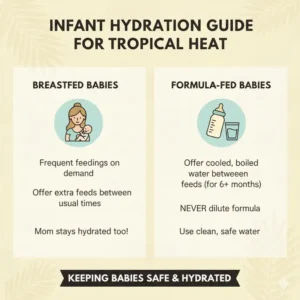
Maintaining heat safety in tropical climates babies is impossible without a solid hydration plan. However, the rules for babies are different than for adults.
For Breastfed Babies
If you are breastfeeding, you don’t actually need to give your baby water, even in the tropics. Breast milk is about 80% water. On very hot days, your baby might want to “snack” more frequently. These short, frequent feeds provide the foremilk, which is thinner and more hydrating.
-
Tip: Ensure you are drinking enough water so your milk supply stays steady.
For Formula-Fed Babies
Similar to breastfeeding, you should not dilute formula with extra water. This can lead to water intoxication, which is a serious medical emergency. Instead, offer smaller, more frequent bottles of properly mixed formula.
Identifying Dehydration
When practicing heat safety in tropical climates babies, keep a “diaper log.”
-
Fewer than 6 wet diapers in 24 hours is a warning sign.
-
Dark yellow urine indicates the baby needs more fluids.
-
Sunken soft spot (fontanelle) on the head is a sign of advanced dehydration.
Clothing and Sun Protection: The “Less is More” Rule
When it comes to babies heat safety tropical climate, your fashion choices matter.
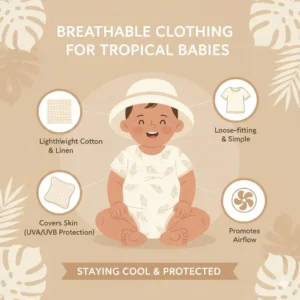
1. Choose Natural Fibers
Always opt for 100% cotton or bamboo. These fabrics are “breathable,” meaning they allow air to circulate around the skin. Synthetic fabrics like standard polyester act like plastic wrap, trapping heat and moisture against the baby’s body.
2. The Single Layer Rule
A good rule of thumb for tropical baby heat protection is to dress your baby in exactly one layer of loose-fitting clothing. If you are comfortable in a T-shirt, your baby is probably comfortable in just a diaper or a thin onesie.
3. Sunscreen Safety
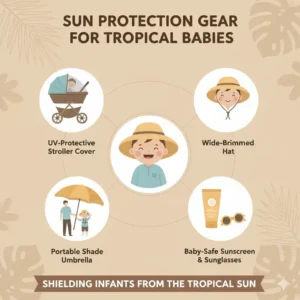
The American Academy of Pediatrics (AAP) recommends keeping babies under 6 months out of direct sunlight entirely. If you must be out, use small amounts of mineral-based sunscreen (zinc oxide or titanium dioxide) on exposed areas like the backs of hands and the tops of feet.
Recognizing the Danger Signs: Heat Exhaustion vs. Heatstroke
Part of heat safety in tropical climates babies is knowing when to stop the fun and seek medical help.
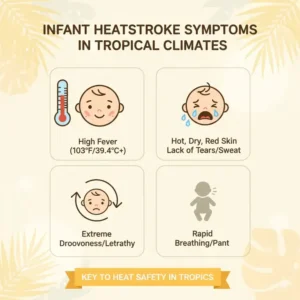
| Symptom | Heat Exhaustion (Act Now) | Heatstroke (Emergency!) |
| Skin Tone | Pale and clammy | Red, hot, and dry |
| Behavior | Irritable or extremely fussy | Lethargic or unresponsive |
| Body Temp | Slightly elevated | Over 103°F ($39.4°C$) |
| Thirst | Extreme thirst | Refusing to drink |
| Action | Move to shade, cool cloth, fluids | Call 911 immediately |
If you notice heat saftey in tropical climates babies issues like your infant becoming unusually sleepy or “floppy,” this is a medical emergency. Always trust your gut.
Performance Metrics: Stroller Ventilation Comparison
Not all strollers are created equal for the tropics. Let’s look at how ventilation impacts the internal temperature of a stroller.
| Stroller Type | Airflow Rating (1-10) | Average Internal Temp Rise | Best Feature for Tropics |
| Standard Travel Stroller | 4 | +7°F | Lightweight |
| Jogging Stroller | 6 | +4°F | Large canopy |
| High-End Vista V2 | 9 | +1.5°F | Multi-mesh panels |
| Umbrella Stroller | 5 | +5°F | Portability |
Proactive Tips for Travel in Tropical Regions
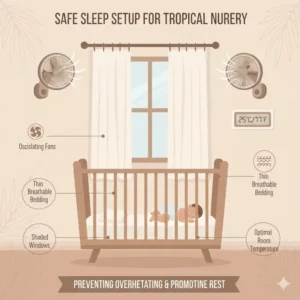
If you’re traveling, keeping babies cool in tropical heat requires a bit of strategy.
-
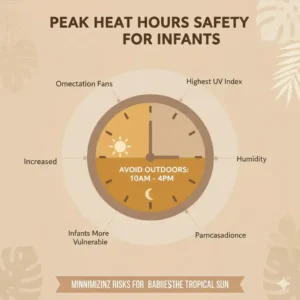
The “Golden Hours”: Avoid being outdoors between 10:00 AM and 4:00 PM when the sun is at its peak. This is the most important rule for heat safety in tropical climates babies.
-
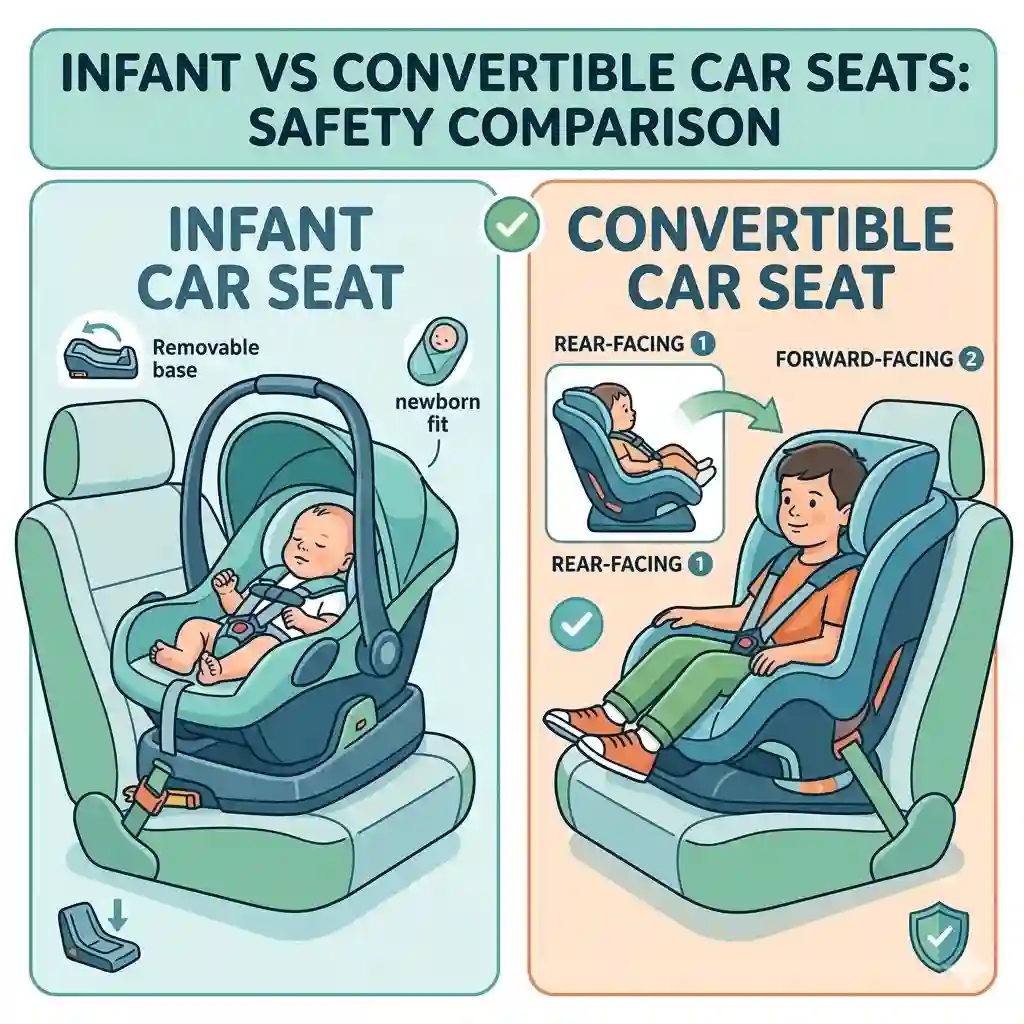
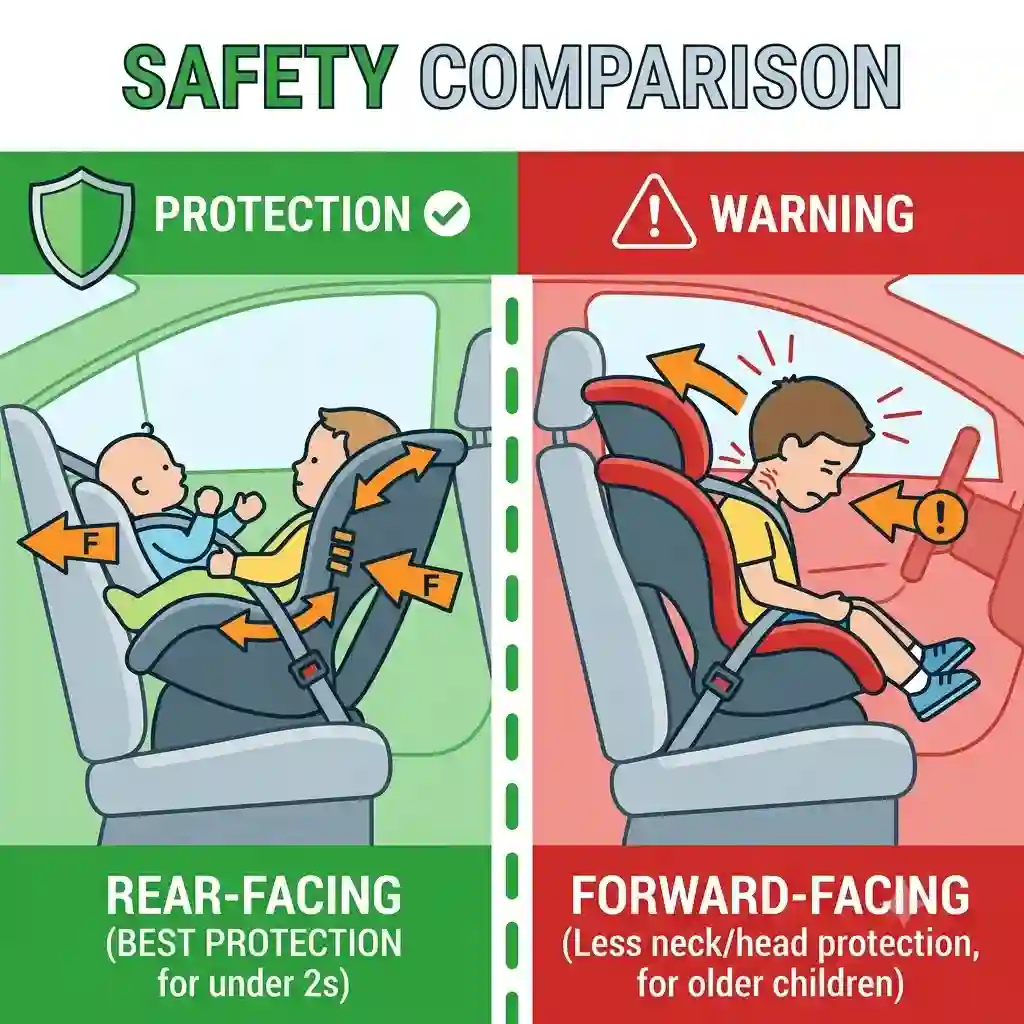
The Car Seat Trap: Car seats are notoriously hot because they are lined with foam. Never leave a baby in a car seat inside a parked car, even for a minute. When driving, ensure the AC is reaching the back seat. Use a “Noggle” (a flexible vent extender) if your car doesn’t have rear AC vents.
-
Cooling Baths: A lukewarm (not cold!) bath can help reset a baby’s core temperature after a day at the beach.
-
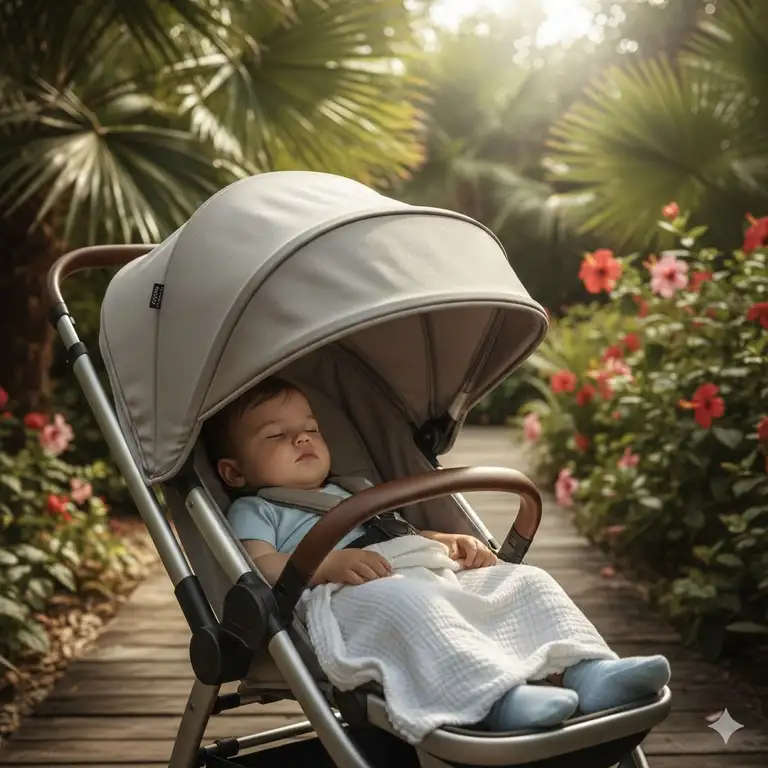
Strategic Shading: Use a clip-on umbrella rather than a blanket over the stroller. Draping a blanket over a stroller—even a thin muslin one—can create a “greenhouse effect,” raising the temperature inside to dangerous levels.
Feature Matrix: Accessories for Tropical Safety
| Accessory | Necessity Level | Why you need it |
| Cooling Gel Mat | Optional | Great for strollers on long walks |
| Clip-on Fan | High | Essential for non-moving air |
| UPF 50+ Blanket | Medium | Good for covering legs in strollers |
| Insulated Bottle Bag | High | Keeps formula/milk at safe temps |
Common Myths About Baby Heat Safety
Let’s clear up some misinformation regarding heat safety in tropical climates babies.
-
“Babies need water to stay hydrated.”
-
Reality: Under 6 months, breast milk or formula is all they need. Giving water can be dangerous.
-
-
“A tan protects the baby from further burns.”
-
Reality: A tan is a sign of skin damage. There is no such thing as a “healthy tan” for an infant.
-
-
“If the baby isn’t crying, they aren’t too hot.”
-
Reality: Overheated babies often become lethargic and sleepy. This is actually more dangerous than a crying baby.
-
Benefits Quantification: Using Specialized Gear
| Intervention | Estimated Temp Reduction | Impact on Baby Comfort |
| Using a WiHoo Fan | 3-5°F perceived | Significant (prevents sweating) |
| Switching to Mesh Carrier | 4-6°F (at contact point) | Very High (prevents heat rash) |
| Using UPF 50+ Sun Hat | 98% UV Blocked | Essential (prevents burns) |
| Elevated Seating | 2-3°F | Moderate (keeps off hot surfaces) |
✨ Secure Your Baby’s Comfort Today!
🔍 Ready to tackle the heat? Click on any of the products mentioned above to see how they can make your next tropical adventure a breeze. Don’t wait until the mercury rises—equip yourself with the best tools for heat safety in tropical climates babies now! 🏝️
Conclusion
Managing heat safety in tropical climates babies doesn’t have to be a source of constant anxiety. By understanding that an infant’s body reacts differently to heat and humidity, you can take proactive steps to keep them safe. Invest in high-quality, breathable gear like the Ergobaby Omni Breeze, prioritize hydration through frequent feeding, and always be mindful of the sun’s intensity.
The tropics offer incredible experiences for families, from white sandy beaches to lush rainforests. With the right preparation and a watchful eye for those early warning signs, you can ensure your baby stays cool, comfortable, and healthy under the tropical sun.
FAQs
✅ The first signs of overheating include skin that feels hot to the touch, extreme fussiness, or a rapid heartbeat. You might also notice the baby becoming unusually quiet or sleepy, which can indicate heat exhaustion setting in...
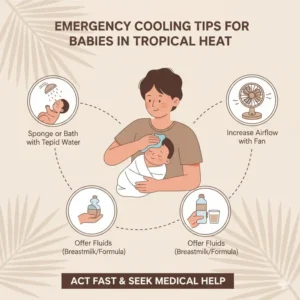
✅ Yes, applying a lukewarm (not ice-cold) damp cloth to the baby's neck, armpits, and groin is an effective way to lower their temperature. Avoid ice-cold water as it can cause shivering, which actually raises core body temperature...
✅ Most plastic 'rain covers' are dangerous in heat because they trap humidity and block airflow. Instead, use a mesh sunshade or a clip-on umbrella that allows air to circulate freely around the baby while providing shade...
✅ Treat heat rash by keeping the area cool and dry. Give the baby a lukewarm bath and avoid using heavy oils or ointments that clog pores. A light layer of a zinc-based cream can help protect the skin...
✅ Yes, air conditioning is one of the best ways to ensure heat safety in tropical climates babies. Just ensure the vent isn't blowing directly on the baby and keep the room at a comfortable 68-72 degrees Fahrenheit... ❓ What are the first signs of overheating in a baby?
❓ Can I put a wet towel on my baby to cool them down?
❓ Is it safe to use a stroller cover in tropical humidity?
❓ How do I treat heat rash on my baby in the tropics?
❓ Is an air-conditioned room safe for a baby after being in the heat?
Recommended for You
- Safe Travel Stroller with Brakes: 7 Best Picks for 2025
- CedarWorks Playset Reviews: 7 Best Models Compared for Ultimate Backyard Fun in 2025
- 7 Best Little Tikes Jungle Gym Options for Epic Backyard Adventures in 2025
Disclaimer: This article contains affiliate links. If you purchase products through these links, we may earn a small commission at no additional cost to you.
✨ Found this helpful? Share it with your friends! 💬🤗
[addtoany]