As an Amazon Associate I earn from qualifying purchases. Links in this article may be affiliate links. How we choose gear
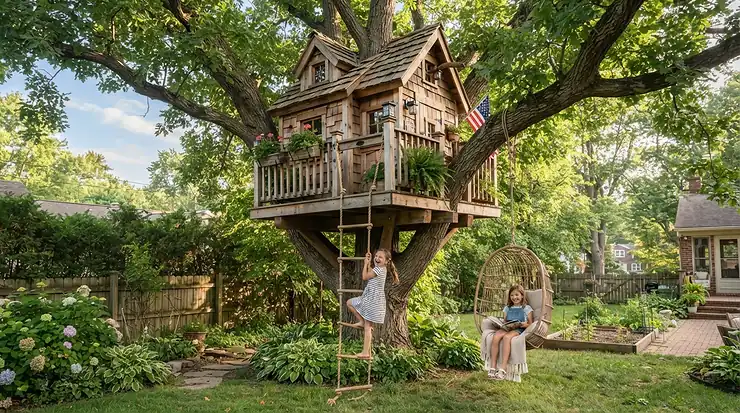
A treehouse mistake can stay invisible for a season or two, and that delay is the expensive part. Tree Top Builders notes that most common building errors will not cause failure right away, so a wrong bolt or an uninspected tree can look fine long after the last board went on. That is why kids treehouses, whether built around a trunk or bought as a freestanding kit, reward slow decisions about the tree, the height and the hardware. The plan for 2027 below favors low platforms, a few large fasteners and surfacing matched to the fall height.
No product was assembled or climbed for this guide, so the safety figures come from CPSC’s home playground handbook, maker spec pages and builders who write about tree health, and any comment on how something holds up is credited to the owner thread or reviewer that reported it. The method comes first, then three products tied to the steps where you would actually need them.
Build it or buy it: the yard test
The decision turns on the tree, the hardware budget and the youngest user. A healthy, mature tree with strong limbs low on the trunk makes a platform build reasonable, though Walter Reeves’ treehouse guide points out that these are structures for children that still need adult construction and supervision. A doubtful tree, a thin budget for specialty bolts or a child under three points toward a freestanding kit, which skips the tree question entirely.
Neither route is homework-free. A kit still needs anchoring and surfacing, and a tree build needs every step below. Where a product fits a step, it shows up there and again in the entries after the method.
How to build a treehouse for kids, from tree check to yearly inspection
Vet the tree before you draw anything
Reeves advises choosing trees with large, strongly connected limbs low on the stem, and staying clear of utility lines, antennas, chimneys and overhanging roofs. This Old House adds that hardwoods such as oak, maple and beech are the usual picks, that a crack can signal a weak trunk, and that a top-heavy tree may need pruning first.
Species can rule a tree out. One family blogger at Frugal Family Times passed on the black walnut in their own yard because walnuts have a reputation for holding bolts poorly. That is a single account, yet it fits the broader advice to bring in an arborist when you are unsure. Tree Top Builders calls skipping an expert’s opinion to save a few hundred dollars a false economy.
Set the height by the youngest climber
Sources disagree here, and the spread is wide. Treehouse Supplies calls 6 to 12 feet reasonable and common, and suggests the low end for more protective parents. Family Handyman says not to build above 8 feet. Reeves goes lower: 3 to 5 feet in trees with reclining branches, with the whole structure kept in the bottom third of the tree.
Lower has a cost. A family blogger at Frugal Family Times notes that tween and teen kids will not want to hang out in a treehouse only 4 feet off the ground. For a first build I’d start near the low-to-middle of the range and add a second, higher platform later, since a smaller fall height also shrinks the surfacing job in step six.
Pick hardware that lets the tree move
Trees sway and trees grow, and a rigid joint fights both. Treehouse Supplies describes a treehouse attachment bolt (TAB) as a thick, unthreaded shank with a wide shoulder that spreads load, while a lag bolt leans on the wood fibers around its threads and suits lighter work. By its own sizing, lag-bolt kits cover treehouses up to 75 square feet and TAB kits go above that, which is vendor guidance rather than an independent test.
Tree Top Builders names two errors that repeat: stacking many small fasteners, which the tree treats as one big wound, and pinning a beam across a trunk, which either restricts growth or gets pushed off its bolts as the trunk thickens. Family Handyman recommends one large bolt over many screws, prefers lag bolts to through-bolts, and says even lighter treehouses spread over three or four attachment points should consider lags 1 to 1¼ inches thick.
Reeves takes the most conservative line: no nails or screws in the tree, and at most one to three eye-bolts set vertically at branch sites if extra stability is needed. The smaller and lower the platform, the closer that approach gets to workable. For the kid-scale tier, the Nelson Treehouse Tree Fort Attachment Bolt (TAB) is covered in the first entry below.
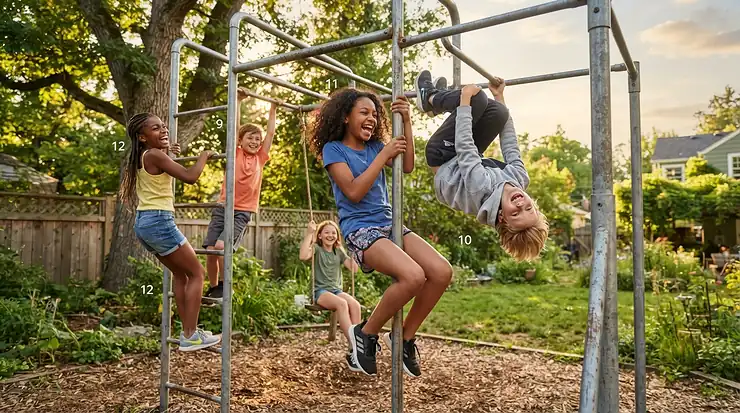
A swing adds a second set of rules. Reeves says rope hardware belongs on the treehouse, never screwed into the tree, and the CPSC handbook asks for surfacing twice the top-bar height in front of and behind a to-fro swing. That is why a kids treehouse with swing is easier to get right as a freestanding set, which the second entry covers.
Frame the platform with room to grow
Hunker advises leaving a 2-inch gap where a deck wraps the trunk, and keeping bolts at least 12 inches apart so the tree does not treat two as one wound. Tree Top Builders lists “no room for growth” as a standalone mistake.
An online build log shows what that looks like. Its author built a treehouse in summer 2009, took it down in fall 2013 because the trees had grown, and rebuilt with 3/4-inch bolts after the original 1/2-inch set had lasted about four years. That is one builder’s report, not a trend. Another route shifts load off the tree: Family Handyman suggests one or two ground supports, and a commenter on an r/Carpentry thread said they would have used 6×6 legs and framed around the trunks instead of fastening framing into the tree.
Add rails, safe openings and a way up
CPSC’s Outdoor Home Playground Safety Handbook asks for guardrails on platforms more than 30 inches above the surfacing: at least 25 inches high from 30 to 48 inches of platform height, a barrier of at least 27 inches from 48 to 72 inches, and at least 33 inches above that. Barrier openings should stay under 3½ inches, and openings between 3½ and 9 inches are the ones that can trap a head. The handbook does not address treehouses specifically, so it is the closest official yardstick rather than a treehouse code.
Treehouse Supplies suggests a 36-inch top rail, 42 inches for very high builds, and no openings of 4 inches or more. The two opening limits differ; the smaller CPSC number satisfies both. For the climb, Reeves and Tree Top Builders both say not to nail rungs into the trunk, and Reeves adds that children should climb down and never jump.
Match the surfacing to the fall height
For equipment up to 8 feet high, the CPSC handbook calls for 9 inches of wood mulch, engineered wood fiber or shredded rubber, and says a 12-inch initial fill settles to about 9. Sand or pea gravel works to 5 feet. Grass, dirt, thin mats and anything laid over concrete are listed as inadequate, and surfacing should extend at least 6 feet in every direction.
One source pulls the other way. Treehouse Supplies warns that more than 4 inches of mulch can overheat tree roots and says to keep it away from the trunk. A certified arborist can help reconcile that with the fall zone near the base of your particular tree.
Inspect on a schedule
Reeves recommends checking the structure monthly and after every storm, looking at knots, bindings and bolts, and replacing rope each year. The CPSC handbook’s schedule for home sets is twice a month for nuts and bolts. Tree Top Builders adds that exterior floors, stairs and railings need resealing every one to three years.
Four mistakes that stay quiet for a season or two
Wrapping a limb comes first. Rope, cable or chain around a branch or trunk can harm or kill it, according to Tree Top Builders, and nailing spacers to soften the wrap breaks the too-many-fasteners rule anyway. The fix is a perched beam on proper bolts, with the wrap removed.
Loose knee braces come next. The same builder says movement stops the tree from sealing its wound, which leads to oozing, decay and eventually a lost fastener. Tightening braces and rechecking after storms is the recovery.
The third is simply outlasting the build. One owner on the TractorByNet forum reports that a similar treehouse built about 20 years earlier survived well past the kids’ interest, and then tree movement tore its attachments apart. It is a single account, and it shows why an annual look at the hardware matters even when nobody climbs there anymore.
The fourth is closing the house in. A commenter on that r/Carpentry thread, who said they had built several, reports that enclosed treehouses get less use because they run hot and limit the view, and prefers an open platform. Netting can replace spindles while keeping the view clear, per Treehouse Supplies.
Best kids treehouses and gear, matched to the step they solve
Three products cover three situations: attaching to a real tree, skipping the tree altogether for school-age kids, and a low climber for toddlers. Check the listing’s age and weight limits against your child’s size before choosing.
Kids treehouses reviews at a glance: three options compared
| Option | Fits | Size or spec | Stated limits | What you still add |
|---|---|---|---|---|
| Nelson Treehouse Tree Fort Attachment Bolt (TAB) | A DIY platform on a healthy tree | 1 in shaft, 2 in boss, 20 in long | About 2,500 to 4,500 lb per bolt by species, per the listing | Install kit, several bolts, a backup cable or strut |
| Little Tikes Tree House Swing Set | Ages 3 to 8, no tree | 139 x 93.44 x 80.9 in | 4 on the climber, 1 per swing, 80 lb per child | Surfacing, a helper, hours of assembly |
| Step2 Naturally Playful Lookout Treehouse | Toddlers to age 5 | 66.5 x 25 x 57.5 in | 50 lb and 2 children per Step2; 66 lb per listing | Adult assembly, level ground |
The table shows the real split: the Nelson Treehouse Tree Fort Attachment Bolt (TAB) is a part, while the other two are finished play sets. Weight limits are per child on the Little Tikes Tree House Swing Set and for the whole unit on the Step2 Naturally Playful Lookout Treehouse, so the numbers do not compare directly. Going by the maker’s and Target’s pages, the Step2 is the lowest-priced of the three.
1. Nelson Treehouse Tree Fort Attachment Bolt (TAB) — kid-scale hardware for a real tree
Hardware is where a tree build holds or fails, and this is the lightest tier Nelson sells for it. Nelson’s hardware page describes its tree fort system as the lightest-duty option, aimed at a child’s treehouse, a sunset deck or a tree fort. The retailer listing gives a 1-inch shaft, a 2-inch boss and a 20-inch overall length in an unfinished steel finish.
Load figures need care, because sources conflict. The listing text puts the working load at roughly 2,500 to 4,500 pounds per bolt depending on species, while Nelson’s own shop page for its larger Standard Limb bolt says its TABs carry no weight ratings. Nelson’s shop also says softer trees such as pines and cedars hold less than oaks and hickories, and that a cable or strut backup adds strength. Treehouse Supplies’ hardware FAQ says it tested its own TABs in oak but declines to publish numbers because the tree tissue would crush before the bolt broke, which is a vendor claim.
The bolt is not the whole bill. The Tree Fort Install Kit, with an auger bit, a 2-inch Forstner bit, a pilot bit and an Allen key, is sold separately, and Nelson’s shop lists the bolt and the kit at around $130 to $145 each, with the bits final sale unless returned unused. Treehouse Supplies also notes that uncoated bolts rust over time and may need replacing. Check the current price on Amazon.com.
2. Little Tikes Tree House Swing Set — freestanding climber with two swings
A kids treehouse with swing that needs no tree is the main reason to look at the Little Tikes Tree House Swing Set (SKU 633843). The maker’s page lists ages 3 to 8, up to four children on the climber, one per swing and up to 80 pounds each. The set weighs about 147 pounds, measures roughly 139 by 93 by 81 inches, and includes two swings and one anchor kit. Features run to a climbing wall, a molded tree trunk with grab handles, a lookout with a steering wheel, a slide and a swing extension.
Anchoring and surfacing are on you. At about 6.7 feet tall (my arithmetic), it falls in the CPSC handbook’s up-to-8-feet band, which means 9 inches of mulch or similar, and swing zones of twice the top-bar height front and back. The maker’s page lists no materials, and it showed the set as sold out with a price above $500, so confirm stock on Amazon.com.
Reviews are mixed. A buyer on a reseller page, quoting Trustpilot, says one person needed several hours alone and found it time-consuming rather than difficult, and calls it sturdy once built. That buyer swapped one swing for a toddler seat. Amazon reviewers reproduced on another reseller page report needing three people and missing parts in 2020, and one in 2023 wished it came with an anchor kit, even though the maker’s page lists one in the box. Those are a handful of reports, not a rate.
3. Step2 Naturally Playful Lookout Treehouse — a low platform for toddlers
Between roughly $150 and $200 depending on the retailer, the Step2 Naturally Playful Lookout Treehouse (model 776900) is the small, plastic option for children aged about 18 months to 5. It measures 66.5 by 25 by 57.5 inches, weighs about 30 pounds, and has a slide, steps and a pivoting periscope. Step2 lists adult assembly, a limit of two children and a 50-pound maximum, while a retailer listing and a manual summary give 66 pounds. When sources differ, follow the lower figure.
Step2’s own site shows an average near 4.5 out of 5 across 105 reviews, a rating hosted by the maker, so treat it as a rough signal. A Foter buying note says it suits younger toddlers best and gets outgrown quickly by older kids. That matches the size: the climber’s interior is listed at 31 inches tall on Target’s page.
For a preschooler, the platform height is the point. A reseller page reproducing the listing gives the platform as 19 inches high, below the 30-inch mark where the CPSC handbook starts asking for guardrails (my comparison, not Step2’s claim), which is a different safety profile from a 6-foot treehouse.
Kids treehouse bed: where the age rule changes the plan
A treehouse bed is furniture, a loft or bunk with a house-shaped frame, so its rules come from bunk bed safety rather than playground handbooks. CPSC’s release on the federal bunk bed standard says upper-bunk openings must be under 3.5 inches, any bed whose foundation sits more than 30 inches above the floor needs guardrails on both sides, and a label must warn against children under 6 on the upper bunk. The release dates the rules to beds made from July 2000, so check the maker’s current label.
Retail pages echo the age. Rooms To Go’s FAQ for its Hidden Hills Twin Low Loft Treehouse line says children should be at least six before using any raised bed, including a low loft. Size is the other limit: the Donco Kids Rustic Sand Twin Tree House Loft Bed listing gives 70 inches high, 39 wide and 87 long, and Rooms To Go suggests taping out the 114.25-inch depth of the steps-and-slide version on the floor first. The Pottery Barn Kids Tree House Twin-Over-Twin Bunk Bed pages show roughly $2,700 to $2,900 across finishes.
CPSC’s warning concerns the upper bunk, which leaves the lower bunk or a floor-level bed for younger children, with a play structure from this guide doing the treehouse job outdoors.
Height, tree damage, beds and permits: short answers
❓ How high should a kids treehouse be?
✅ Sources split. Treehouse Supplies calls 6 to 12 feet typical, Family Handyman says not to exceed 8 feet, and Walter Reeves suggests 3 to 5 feet in the bottom third of the tree. For young children, the low end also reduces fall height.
❓ Do treehouses hurt the tree?
✅ They can. Walter Reeves notes that trees seal wounds rather than heal them, so every cut is permanent, and Family Handyman calls bark damage a possible entry point for disease. Few, large fasteners and a certified arborist's pre-check limit the harm; none of it can be guaranteed.
❓ What age is right for a kids treehouse bed?
✅ Six or older for an upper bunk. CPSC's bunk bed standard requires a label warning against placing children under 6 on the upper bunk, and one retailer applies the same minimum age even to its low loft treehouse line.
❓ Do I need a permit for a kids treehouse?
✅ Rules vary by town and neighborhood. Builder guides advise checking with local building authorities, or your township, and talking to neighbors before starting. A short call to your municipality before buying lumber costs nothing and settles the question.
❓ Does 'treehouse kids underwear' have anything to do with treehouses?
✅ No. That phrase leads to children's clothing, not play structures. A kidswear label called Treehouse launched a 17-piece capsule collection, according to Westchester Family, so shop for clothes there and use this guide for the backyard kind.
Where to start with kids treehouses
The order matters more than the product: check the tree, keep the platform low, use hardware that moves with the trunk, keep rail openings under 3½ inches, put 9 inches of mulch under anything up to 8 feet, and inspect on a calendar. If the first step fails because the tree is doubtful, a freestanding choice such as the Little Tikes Tree House Swing Set for ages 3 to 8, or the Step2 Naturally Playful Lookout Treehouse for toddlers, is the cleaner call. If the tree passes, the Nelson Treehouse Tree Fort Attachment Bolt (TAB) is the part worth pricing first, along with its install kit. Before you order any of them, compare the exact model number on the listing with the one named here.
Recommended for You
- Baby bouncers: Setup Mistakes and the Gear to Buy
- Kids snack containers: Easy Steps and the Right Gear
- Kids reading nooks: Mistakes, Fixes, and What to Buy
Measure the tree, the fall height and your child before you order anything. 🌳