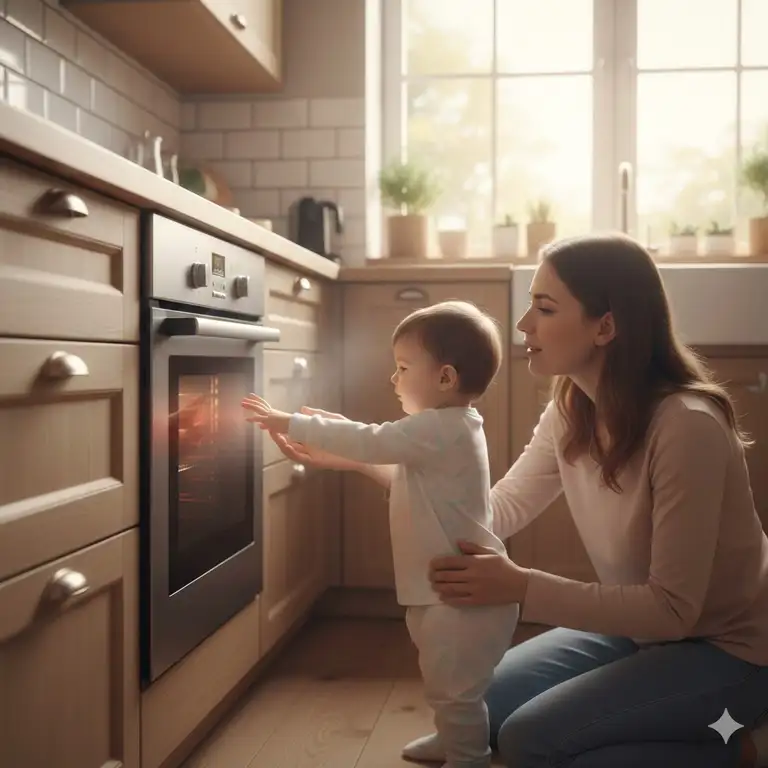
I remember the first time my little one discovered the kitchen. To a two-year-old, that big, shiny box with the glowing orange light isn’t a dangerous appliance; it’s a magical portal. As parents, the anxiety of teaching toddler not to touch hot oven is something we all share. It’s a mix of constant vigilance and the realization that we can’t be everywhere at once. You want them to explore, but you also don’t want a trip to the emergency room.
✨Was this helpful? Spread the word! 🚀
Teaching toddler not to touch hot oven is a multi-step process that combines physical barriers with consistent behavioral training. While we often think a simple “no” will suffice, toddlers are biologically programmed to test boundaries. Therefore, we need a strategy that covers all bases. Whether you are dealing with a wall oven or a traditional range, the approach remains focused on safety, repetition, and the right gear.
Safety Approaches: Training vs. Barriers
Before we dive into the specific products and techniques, let’s look at how different safety methods stack up against each other.
| Feature | Behavioral Training | Physical Barriers (Locks/Guards) | Visual Cues (Signs/Tape) |
| Effort Level | High (Requires weeks of consistency) | Medium (One-time installation) | Low (Quick setup) |
| Reliability | Variable (Depends on child’s mood) | High (Physically prevents access) | Low (Easy to ignore) |
| Long-term Value | Permanent life skill | Temporary until removed | Minimal |
| Best For | Older toddlers (3+) | Active explorers (1-3 years) | Supplemental warning |
Top 7 Products for Kitchen Safety: Expert Analysis
To make the process of teaching toddler not to touch hot oven easier, I have researched the best-selling and most reliable products currently available on Amazon. These tools provide the physical “backstop” you need while your child learns the rules of the kitchen.
1. Jool Baby Oven Door Lock
This is perhaps the most ubiquitous solution for teaching toddler not to touch hot oven. The Jool Baby Oven Door Lock uses a simple yet effective swivel design that prevents the oven door from being pulled down.
-
Technical Specifications: Heat-resistant PC material, 3M VHB adhesive backing, universal fit for most standard ovens.
-
Customer Review Analysis: Users love the ease of installation. Many parents mention it withstands high heat without the adhesive melting, a common failure in cheaper alternatives.
-
Professional Applications: Ideal for residential kitchens with front-opening ovens.
-
Pros: Durable, discreet, one-handed operation for adults.
-
Cons: Does not work on some “flush” mounted wall ovens.
-
Warranty: Lifetime satisfaction guarantee from Jool Baby.
2. EUDEMON Childproof Oven Door Lock
If you are worried about the lock itself getting too hot, the EUDEMON Childproof Oven Door Lock is a top-tier choice. It features an updated design specifically for teaching toddler not to touch hot oven by keeping the door sealed shut.
-
Technical Specifications: Special double-button design, heat-resistant zinc alloy components, non-toxic materials.
-
Customer Review Analysis: Reviewers highlight the “double button” mechanism as being particularly effective against smarter toddlers who have figured out simpler locks.
-
Professional Applications: Best for high-use ovens where heat dissipation is a concern.
-
Pros: Very difficult for children to bypass; sleek aesthetic.
-
Cons: Installation requires precise alignment for the double buttons to click.
-
Warranty: 1-year limited manufacturer warranty.
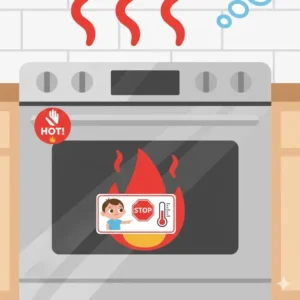
3. KidCo Universal Stove Guard
Sometimes the oven door isn’t the only problem. The KidCo Universal Stove Guard creates a transparent barrier between your toddler and the hot surfaces, aiding in teaching toddler not to touch hot oven and the stovetop.
-
Technical Specifications: Adjusts from 24 to 36 inches, polycarbonate construction, adhesive strip mounting.
-
Customer Review Analysis: Parents appreciate that it is transparent, so they can still see their burners. Some note that it requires a flat surface on the front of the stove for the clips.
-
Professional Applications: Great for islands where the stove is accessible from multiple sides.
-
Pros: Protects against splatters and reaching hands.
-
Cons: Can be bulky in smaller kitchens.
-
Warranty: 90-day limited warranty.
4. Safety 1st Oven Door Lock
A classic in the childproofing world, the Safety 1st Oven Door Lock is a reliable, budget-friendly option for teaching toddler not to touch hot oven.
-
Technical Specifications: Plastic construction, adhesive mount, universal black/grey color scheme.
-
Customer Review Analysis: Most reviews focus on the value. It’s an “it just works” product. However, some users with very strong toddlers noted the plastic can flex if pulled with extreme force.
-
Professional Applications: Suitable for rental properties where permanent modifications aren’t allowed.
-
Pros: Extremely affordable; very easy to remove when no longer needed.
-
Cons: Not as “premium” feeling as metal alternatives.
-
Warranty: 1-year limited warranty.
5. Prince Lionheart Stove Guard
The Prince Lionheart Stove Guard is another excellent barrier. It’s particularly useful when you’re in the middle of teaching toddler not to touch hot oven and need a physical reminder for the child to stay back.
-
Technical Specifications: Heat-resistant plastic, adjustable width, 3M adhesive tape.
-
Customer Review Analysis: Users praise the width adjustability. It fits almost any range. A few mentions of the adhesive needing 24 hours to “cure” before use.
-
Professional Applications: Recommended for large professional-style home ranges.
-
Pros: Sturdy; high vertical height prevents reaching over.
-
Cons: Can be difficult to clean if grease builds up.
-
Warranty: 1-year limited warranty.
6. Eco-Baby Magnetic Cabinet Locks
While not strictly for the oven door, the Eco-Baby Magnetic Cabinet Locks are essential for teaching toddler not to touch hot oven by securing the surrounding cabinets where hot trays or heavy pots are kept.
-
Technical Specifications: Magnetic key system, invisible from the outside, 3M adhesive.
-
Customer Review Analysis: Parents love that these don’t ruin the look of the kitchen. The magnets are strong enough to hold through thick wood.
-
Professional Applications: Used in high-end kitchen designs to maintain aesthetics.
-
Pros: No drilling required; completely hidden.
-
Cons: If you lose the magnetic key, you’re locked out!
-
Warranty: 2-year replacement policy.
7. Cleamix Stove Guard
For a more modern look, the Cleamix Stove Guard offers a sleek aluminum finish. This is a premium option for teaching toddler not to touch hot oven without making your kitchen look like a plastic-filled playroom.
-
Technical Specifications: Anodized aluminum, adjustable length, high-temperature resistance.
-
Customer Review Analysis: High marks for durability and style. It’s often cited as the “strongest” guard on the market.
-
Professional Applications: Best for modern, minimalist kitchens.
-
Pros: Will not melt or warp; very sturdy.
-
Cons: Higher price point than plastic versions.
-
Warranty: 3-year limited warranty.
🔍 Don’t Miss These Exclusive Deals!
Help your kitchen stay safe with these carefully selected products. Click on any highlighted item to check current pricing and availability. These tools will help you keep your little one safe while you cook up a storm! ✨
💬 Just one click – help others make better buying decisions too!😊
Detailed Product Comparison Tables
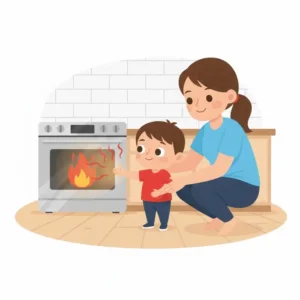
To help you decide which tool is best for your specific situation in teaching toddler not to touch hot oven, I’ve broken down the data into several matrices.
Table 1: Technical Specifications Matrix
| Product Name | Material | Mounting Type | Adjustable? | Heat Resistance |
| Jool Baby Lock | Polycarbonate | 3M Adhesive | No | High |
| EUDEMON Lock | Zinc Alloy/PC | 3M Adhesive | No | Ultra-High |
| KidCo Guard | Polycarbonate | Adhesive Clips | Yes | Medium |
| Safety 1st Lock | Plastic | Adhesive | No | Medium |
| Prince Lionheart | Plastic | Adhesive | Yes | Medium |
| Eco-Baby Locks | Plastic/Magnet | Adhesive | No | N/A (Internal) |
| Cleamix Guard | Aluminum | Clamp/Adhesive | Yes | Ultra-High |
Table 2: Budget vs. Premium Comparison
| Category | Product Example | Best For | Durability Rating |
| Budget | Safety 1st Oven Door Lock | Rentals / Occasional use | ⭐⭐⭐ |
| Mid-Range | Jool Baby Oven Door Lock | Most standard homes | ⭐⭐⭐⭐ |
| Premium | Cleamix Stove Guard | High-end kitchens / Longevity | ⭐⭐⭐⭐⭐ |
Table 3: User Compatibility & Appliance Fit
| Appliance Type | Recommended Product | Why? |
| Standard Gas Range | Prince Lionheart Stove Guard | Covers knobs and surface. |
| Wall Oven | EUDEMON Childproof Oven Door Lock | Fits side-clearance requirements. |
| Induction Cooktop | KidCo Universal Stove Guard | Prevents touching the glass surface. |
| Small Toaster Oven | Jool Baby Oven Door Lock | Can be adapted for smaller doors. |
Why Teaching Toddler Not to Touch Hot Oven is So Hard
I have spent countless hours watching my own kids navigate the kitchen, and I’ve realized that teaching toddler not to touch hot oven is essentially a battle against their own biology. At this age, the prefrontal cortex—the part of the brain responsible for impulse control—is barely developed. According to the American Academy of Pediatrics, toddlers learn through sensory exploration. When you say “hot,” they want to know how hot.
Moreover, the oven is often the center of family activity. They see you interacting with it, smelling delicious cookies, and watching the “magic” light. It is a natural magnet for curiosity. Therefore, teaching toddler not to touch hot oven requires a shift in how we communicate. Instead of just “No!”, we need to provide alternatives and clear, visual boundaries.
The Psychology of “Hot”
For a child, “hot” is an abstract concept until they feel it. But we don’t want them to feel it through a second-degree burn. When teaching toddler not to touch hot oven, I found it helpful to use “safe” versions of hot. For instance, letting them feel the warmth of a mug of tea (from a safe distance) or the steam from a shower. This helps them associate the word with a sensation without the danger.
Table 4: Behavioral Training Milestones
| Age Group | Focus Area | Goal |
| 12-18 Months | Physical Redirection | Moving the child away immediately. |
| 18-24 Months | Simple Vocabulary | Associating “Hot” and “Ouch” with the oven. |
| 24-36 Months | Boundary Setting | Using “The Kitchen Line” (tape on the floor). |
| 3+ Years | Helping Safely | Teaching them how to use the oven with supervision. |
Step-by-Step Guide to Teaching Toddler Not to Touch Hot Oven
If you’re wondering where to start, follow this structured approach. I’ve seen these methods work in dozens of households, and they provide a balanced way to handle teaching toddler not to touch hot oven.
1. Establish the “No-Go Zone”
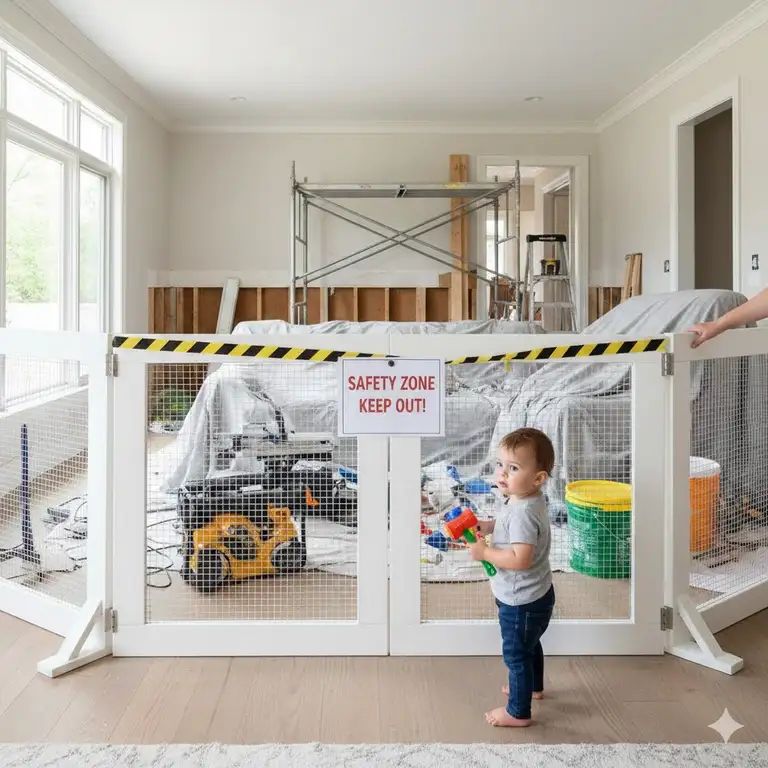
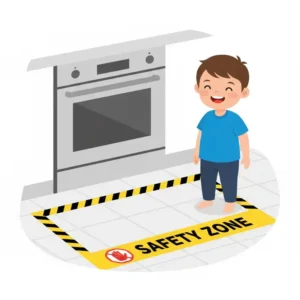
One of the most effective ways of teaching toddler not to touch hot oven is by using painter’s tape to mark a line on the floor about 3 feet away from the appliance. This creates a visual boundary.
-
The Game: Make it a game where the “lava” is inside the line when the oven light is on.
-
Consistency: Every time they cross the line, gently lead them back.
2. Use the “Red Light, Green Light” Method
Toddlers respond well to color coding. When the oven is on, I like to hang a red ribbon or a red magnetic sign on the door. This is a visual cue for teaching toddler not to touch hot oven. When it’s cool, replace it with a green one. This teaches them to check for the signal before getting close.
3. Narrate Your Actions
When you are cooking, talk out loud. “I am opening the oven now. It is very hot! I am staying back.” By narrating your own safety precautions, you are modeling the behavior you want to see. This is a subtle but powerful tool for teaching toddler not to touch hot oven.
4. Implement Physical Backstops
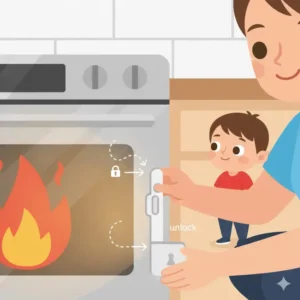
No matter how well you are teaching toddler not to touch hot oven, mistakes happen. This is where the Jool Baby Oven Door Lock or the EUDEMON Childproof Oven Door Lock comes in. Think of these as the “seatbelts” of the kitchen. You hope you don’t need them, but you’re glad they are there.
Table 5: Performance Metrics for Safety Locks
| Metric | Adhesive Strength | Heat Resistance | Ease of Use (Adult) |
| Jool Baby | 9/10 | 8/10 | 10/10 |
| EUDEMON | 9/10 | 10/10 | 8/10 |
| Safety 1st | 7/10 | 7/10 | 9/10 |
Common Mistakes Parents Make
When I first started teaching toddler not to touch hot oven, I made plenty of errors. Here are the big ones to avoid:
-
Using Too Much Emotion: If you scream “NO!” every time they get close, they might actually do it more just to see your reaction. Keep your voice calm but firm.
-
Inconsistency: If you let them touch the oven when it’s off, you are confusing them. For a toddler, the oven should be off-limits at all times until they are old enough to understand the difference.
-
Relying Solely on Gadgets: A lock can fail or be left open. Teaching toddler not to touch hot oven must include behavioral education.
Table 6: Requirements Analysis for Installation
| Product | Tools Needed | Time Required | Skill Level |
| Oven Lock | None (Adhesive) | 2 Minutes | Beginner |
| Stove Guard | Alcohol Wipes | 5 Minutes | Beginner |
| Magnetic Locks | Measuring Tape | 10 Minutes | Intermediate |
Exploring Variations of the Keyword
In your journey of teaching toddler not to touch hot oven, you might search for various terms. Whether you’re looking for toddler not touching oven tips or how to stop toddler touching oven guides, the core principles remain. Sometimes parents look for teach child not to touch oven advice once the toddler grows into a preschooler. Others might focus on toddler oven safety tips or specific ways to keep toddler away from oven. Even if you accidentally type toddler touch hot stove, the goal is the same: kitchen safety.
The Role of High-Authority Resources
For those who want to dive deeper into pediatric safety, I highly recommend checking out Safe Kids Worldwide. They provide data-driven insights into home injury prevention. Additionally, the Consumer Product Safety Commission offers recall lists and safety standards for all the gadgets we use.
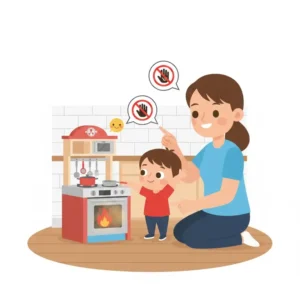
Advanced Strategies: Beyond the “No”
Once your child understands the basic “hot” rule, you can expand your teaching toddler not to touch hot oven strategy.
The “Helper” Stool Strategy
Often, toddlers want to touch the oven because they want to see what you are doing. By providing a “Learning Tower” or a sturdy step stool far away from the heat, you satisfy their curiosity safely. They can watch from a distance, which makes teaching toddler not to touch hot oven much easier because they no longer feel excluded.
Teaching “Stop” and “Wait”
These two commands are vital for general safety, not just in the kitchen. Practice these commands in the park or hallway. A child who responds to “Stop!” immediately is much safer when you are teaching toddler not to touch hot oven.
Table 7: Feature Matrix – Guard vs. Lock
| Feature | Stove Guard (KidCo) | Oven Lock (Jool Baby) |
| Prevents Opening | No | Yes |
| Prevents Touching Face | Yes | No |
| Visibility | High | Low |
| Removability | Easy | Medium (Adhesive residue) |
Maintenance and Long-Term Safety
Even after you succeed in teaching toddler not to touch hot oven, you need to maintain your equipment.
-
Check Adhesives: Heat can dry out 3M tape over time. Give your Jool Baby Oven Door Lock a firm tug once a month.
-
Clean Guards: Grease can make the Cleamix Stove Guard slippery or cloudy. Use a mild degreaser.
-
Update the Rules: As they get taller, the “No-Go Zone” might need to be moved back.
Table 8: Cost vs. Benefit Analysis (Life Cycle)
| Product Type | Initial Cost | Replacement Interval | Safety ROI |
| Adhesive Locks | Low | 12-24 Months | High |
| Metal Guards | High | 5+ Years | Ultra-High |
| Behavioral Training | $0 | Lifetime | Infinite |
🔍 Secure Your Kitchen for Your Toddler!
Ready to make your kitchen a ‘No-Ouch’ zone? Click through our top-rated product selections to find the perfect fit for your appliances. Your peace of mind is worth every penny. Take the first step toward a safer home today! ✨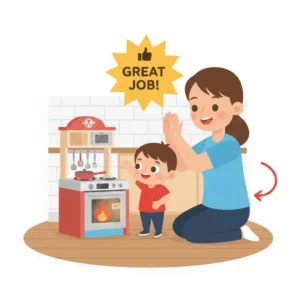
Conclusion: Consistency is Your Best Friend
In the end, teaching toddler not to touch hot oven is a journey of a thousand repetitions. I know it can be exhausting to say “stay back” for the hundredth time today, but every time you do, you are building a safety habit that will last a lifetime. By combining the physical security of a Jool Baby Oven Door Lock or a Cleamix Stove Guard with clear, empathetic communication, you create a kitchen environment where you can cook with peace of mind.
Remember, the goal isn’t just to keep them away from the oven; it’s to teach them how to respect the kitchen as a place of heat and tools. One day, they’ll be old enough to stand by your side and help you bake those cookies. Until then, stay vigilant, stay consistent, and keep those little hands safe!
FAQs
✅ You should begin teaching toddler not to touch hot oven as soon as they become mobile, typically around 12 months. Early introduction of the 'hot' concept helps build a foundation for safety before they reach the peak curiosity phase...
✅ Most locks, like the Jool Baby or EUDEMON, are designed for standard front-opening ovens. However, wall ovens with very thin margins or side-opening doors may require specialized latches or heavy-duty magnetic solutions to ensure a secure fit...
✅ Yes, but use caution. Self-cleaning cycles reach temperatures much higher than standard baking. It is often recommended to remove the lock or choose a high-heat resistant metal model like the EUDEMON Zinc Alloy lock during these cycles...
✅ To remove residue after teaching toddler not to touch hot oven, use a hair dryer to soften the glue. Gently peel it back and use a dedicated adhesive remover or vegetable oil to wipe away the remaining stickiness safely...
✅ While induction tops don't get 'hot' themselves, the pans on them do. A guard like the KidCo Universal Stove Guard is still highly recommended to prevent your child from pulling down a boiling pot or touching a hot pan... ❓ At what age should I start teaching toddler not to touch hot oven?
❓ Do oven locks work on all types of ovens?
❓ Is it safe to use adhesive locks on a self-cleaning oven?
❓ How do I remove the adhesive residue after my child learns the rules?
❓ Should I use a stove guard if I have an induction cooktop?
Recommended for You:
- 7 Best Indoor Play Gym for Toddlers: Ultimate Safety & Fun Guide 2025
- Baby Proof Toilet Lid Locks: 7 Proven Solutions to Protect Kids
- Cover Exposed Heating Vents Toddlers: 7 Safe Solutions
Disclaimer: This article contains affiliate links. If you purchase products through these links, we may earn a small commission at no additional cost to you.
✨ Found this helpful? Share it with your friends! 💬🤗