One of these mini trampolines for kids stops at 55 pounds, allows a single child, and has a handlebar that folds flat against the mat. Another carries 36 coil springs and is rated for 200 pounds. Both turn up when parents search for a kids’ trampoline, and the gap between them decides whether you buy once or twice in 2027.
Below are six models, from a toddler-only folding unit to a fitness rebounder built for adults, with the specs that separate them: age window, weight limit, bounce system, handlebar, and whether a net comes attached. Figures come from maker pages and retailer listings, while durability points come from a Reviewed.com test roundup, a Skywalker manual and owner reviews, each named where it appears; nothing here is a hands-on test.
What pediatricians say before a mini trampoline for kids comes home
The American Academy of Pediatrics is blunt about this. Its home-trampoline guidance, reprinted by a pediatric group, recommends that mini and full-size trampolines never be used at home, and it names children under six as the group at greatest risk. It adds that most injuries happen with more than one person on the mat, and that adult supervision, one jumper at a time, and no somersaults apply to any trampoline in a house.
News coverage of the AAP’s 2012 update quotes a co-author saying current data do not show that netting or padding significantly cuts injury risk. Keep that in mind when a listing leads with its enclosure.
This guide takes a narrower job: for families who have already decided, which models differ, and why. The same AAP page says padding, nets, and other parts should be checked often and replaced when damaged, which matters more on a trampoline that a toddler uses daily.
What the best mini trampolines for kids have in common, and where they split
Every model here is round, and the makers who address it specify one jumper at a time. They split on four points:
Age and weight window. Stated limits run from 55 pounds on the Little Tikes to 225 or 250 on the JumpSport, depending on the source. A low cap means the child can outgrow it sooner; a high cap tends to come with a heavier frame (13 pounds for the Little Tikes, 24.5 for the Upper Bounce).
Bounce system. Coil springs, stretch bands, or elastic cords, and the label does not always match the maker’s page.
Handlebar. Fixed, wrapped all the way around, or adjustable across several heights.
Net and floor space. Only one model ships with an enclosure, and it also needs the most floor.
Model
Frame
Stated max weight
Bounce system
Handlebar
Net
Little Tikes Easy Store 3ft Trampoline
36 in
55 lb
Spring-free (elastic), per a retailer listing and reviewers
Folding, fixed height
No
Skywalker 48-Inch Mini Trampoline with Enclosure Net
48 in
100 lb
Stretch bands or bungees (one spec field says springs)
360-degree, padded
Yes, sewn to the mat
SkyBound 36-Inch Mini Trampoline with Handle
36 in
Not listed on the maker’s page
28 coil springs
Reinforced tubing
No
SereneLife 36-Inch Foldable Toddler Trampoline
36 in
220 lb
Coil springs, per the maker
24 in padded handrail
No
Upper Bounce 40-Inch Mini Trampoline with Adjustable Handrail
40 in
200 lb
36 coil springs
Foam handrail, 5 heights
No
JumpSport Fitness Trampoline Model 250
39 in
225 or 250 lb (sources differ)
30 elastic cords
Sources disagree on whether one ships
No
Read the table by weight limit first. Two models cap at 100 pounds or less and are preschool tools, while the other four will carry a much bigger child but were designed with older kids or adults in mind. The handlebar story changes with that jump: a fixed 26-inch bar suits a three-year-old, and an adjustable one suits a family that wants to keep the trampoline for years.
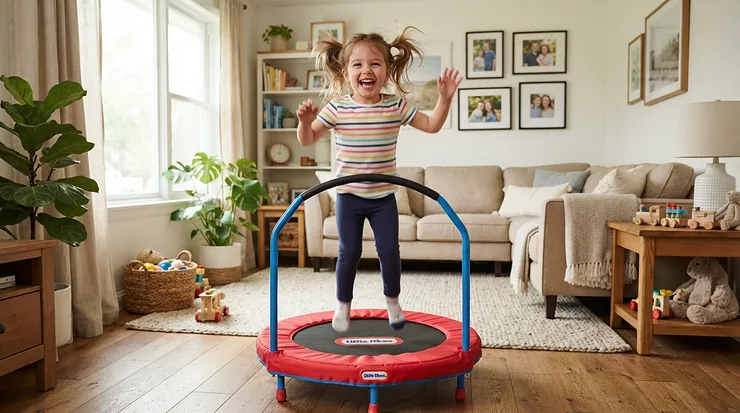
A bedroom corner is the use case this one is built for. The maker’s page lists ages 3 to 6, one child at a time, a 55-pound limit, a 36-by-36-inch footprint, a 13-pound body, and a handlebar that sits 26.25 inches above the jumping surface and folds down for storage. It is designed for home indoor use only, with the SKU 642265 on the maker’s page. A Best Buy listing for the same line calls the construction spring-free, and Target reviewers talk about elastic.
Target’s review summary gives the most owner data of the six: a 4.3 average from 1,753 reviews, with reviewers praising easy assembly and storage under beds and in closets, and one saying a child’s unit still looked good after four years. The complaints cluster around the handlebar. Several owners report wobble while jumping, one reports a handle that broke after three months, and the handlebar does not adjust for height. Another owner found one leg about three inches off the ground at assembly, and one reviewer found it slightly unstable on tile and suggests carpet or a rug.
Replacement elastic is the other sore point. A Target Q&A reply says only metal parts are replaceable, and one owner sewed in elastic bought separately after the original gave out. Expect to pay between about $70 and $95 across the maker’s store and Target.
Pros:
✅ Handlebar folds flat, so it slides under a bed
✅ Small footprint and a 13-pound frame
✅ No metal springs, per reviewers and a Best Buy listing
Cons:
❌ 55-pound cap, so the trampoline outlasts few preschoolers
❌ Elastic is not sold as a replacement part, per the brand’s Target reply
A net is the reason to pay attention to this one, and the maker’s page describes a dual-zipper enclosure with a 360-degree handlebar, a 100-pound maximum, and a 3-year frame warranty (1 year on other materials). The page says the weather-resistant materials suit indoor and outdoor use. Reviewed’s trampoline roundup describes a tightly woven net sewn to the jump mat, a powder-coated steel frame, and bungees on the outside of the net rather than steel springs, and it recommends this model over a full-size trampoline if a young child insists on one. Its testers also flagged a con: the netting will likely wear out before years pass.
Two sources disagree on the bounce parts. A Lowe’s listing counts 30 stretch bands, while spec fields copied onto some retailer mirrors still say 30 springs; the design is the same, but the word on the listing is not. Age guidance disagrees too. A Skywalker manual for the sibling 60-inch model states ages 3 to 7 and, in the same document, says the trampoline is not recommended under 6. The same manual asks for one person inside the enclosure, constant adult supervision, and an inspection of stretch bands, springs and mat before every use.
At 48 inches across, it needs a bigger patch of floor than the 36-inch models. Check the current price on Amazon.com, since prints and sellers vary.
Spotted the net you were after? Take a closer look at the Skywalker listing.
Price tier is the first thing this one shows: the maker’s own store lists it at around $50 to $65 with free U.S. shipping and 30-day returns. SkyBound says it is certified to ASTM F963, F381, F2225 and AS4989, features 28 coil springs, and has handlebar tubing thickened from 1.2 to 2.0 millimeters. The maker’s terms give its spring-based models a 5-year frame warranty, with shorter terms on parts. The maker’s page lists no weight limit, age range or customer rating, so confirm those on the Amazon listing before you decide.
Owner reports come from a different SkyBound model, a unit listed for ages 3 to 6 and 100 pounds that one reviewer puts at 40 inches, with reviews mirrored on a Desertcart listing. Reviewers there call it sturdy, and one prefers spring-based bounce to elastic. A toddler chewed through the rubber handle cover on one unit. One parent says a 5-year-old hit his neck on the handlebar in the first hour, and suggests taking the bar off for kids older than about three. Another found the joints flex enough that the whole unit wobbles. Treat these as single-owner reports on a related model, not a verdict on this one.
Pros:
✅ Maker lists four ASTM certifications
✅ Handlebar tubing thickened to 2.0 millimeters
✅ Coil-spring bounce for families who dislike elastic
Cons:
❌ No weight limit or age range on the maker’s page
❌ Coil springs rely on the frame padding staying in place
Longevity is where this model competes: a 220-pound maximum means a kindergartener does not age out of it. SereneLife‘s own page, for part SLSPT365, lists a 26-inch polypropylene mat, a 24-inch padded handrail, a rust-proof powder-coated steel frame, PVC frame padding, and a fold-flat design with a free kit bag. The 3-year warranty applies only if the unit is registered within 30 days of purchase. The maker’s store shows 4.8 out of 5 from 18 reviews, a small sample on the seller’s own site.
Descriptions of the bounce system collide. The maker’s page says coil springs, one retailer data field for the same part number lists elastic bands, and another mirror describes coil springs. Weight and age claims shift between sellers too: a Target listing for a different SereneLife 36-inch fitness model gives 150 pounds and a suggested age of 13 and up. Confirm the exact model number, SLSPT365, against the listing you are buying, because this brand sells several near-identical 36-inch units.
Around $60 to $70 is where the maker’s own store sits, so check the current price on Amazon.com.
If the weight limit suits your child, take a closer look at the SereneLife listing.
Growth is the angle: a foam-padded handrail that adjusts across five positions, from 31.5 to 47 inches, will suit a three-year-old now and a taller child later. A specialist seller’s page for model UBSF01HR-40 lists a 200-pound capacity, 36 springs of 3.5 inches, a six-leg frame, an 8-inch height, a mat of about 29.7 inches, a 24.5-pound body, and a 1-year manufacturer warranty. The brand markets it for kids and adults, and sellers vary so widely on price that you should check the current price on Amazon.com.
Customer evidence is thin: the single review on the page I read says the kids love it and the buyer uses it for exercise, which is a data point, not a pattern. That leaves the build to be judged on its spec sheet, and the sheet is a fitness trampoline’s. The handrail reaching 47 inches is an adult’s height, and the 36 springs are the bounce system, so the pad and cover on the exact listing deserve a close look.
Pros:
✅ Handrail has five heights from 31.5 to 47 inches
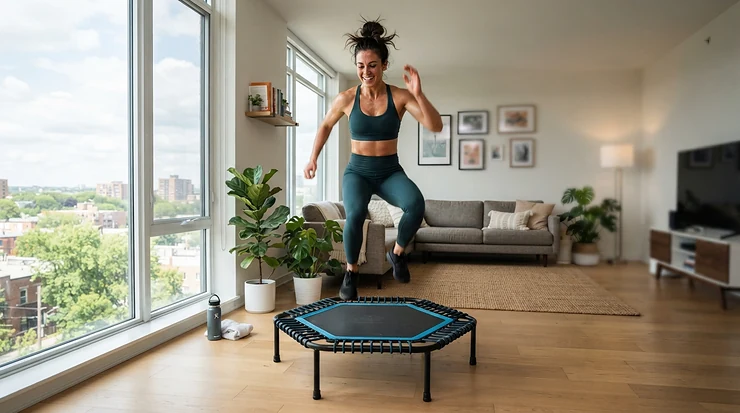
At around $270 to $300, this is the priciest model here, with a cord-based bounce, and it is not a kids’ trampoline. Reviewed calls it a 39-inch fitness rebounder and notes it is not a kids’ model, and its testers’ only con was that it has nothing extra to hold onto. A specialist seller lists 30 EnduroLast elastic cords, a lifetime frame warranty, and 2 years on the mat and cords. The sources disagree on the weight rating: 225 pounds on one seller’s page, 250 on Reviewed and another seller. They also disagree on whether a handlebar ships with it, so check what is in the box.
JumpSport‘s manuals ask for mature, knowledgeable supervision, and the manual for its sibling Model 120, distributed by Stamina, says the trampoline is not recommended for children. The Model 250’s own page never mentions kids at all. If a child bounces on it, that is the household’s decision, made against the AAP guidance above, not the maker’s invitation.
The price, the missing kids’ handle, and those manual warnings make it a poor first trampoline for a three-year-old; it makes more sense as an adult’s cord-based rebounder that a child occasionally shares under supervision.
The best mini trampoline without springs depends on what “springless” means
On the Skywalker, Reviewed describes bungees and no steel springs while a Lowe’s page counts stretch bands. On the Little Tikes, a Best Buy listing says spring-free and Target reviewers talk about elastic. On the JumpSport, cords do the work. On the SereneLife, the maker says coil springs. So a springless shortlist is really Little Tikes, Skywalker and JumpSport, with the others as spring models.
Bands and cords bring their own upkeep. Skywalker‘s manual says to inspect stretch bands, springs and mat before every use and replace anything worn or missing. One Little Tikes owner sewed replacement elastic into a unit because the brand sells only metal parts. A spring-based SkyBound-model buyer, by contrast, said they preferred coils to elastic. That is a single reviewer’s view, but it shows the choice is not one-directional.
The labels deserve a careful read too. A compliance site says it found no trampoline-specific CPSC rules and no ASTM standard that is mandatory for trampolines, though it notes children’s products need third-party testing and a Children’s Product Certificate. The same ComplianceGate overview of US trampoline rules says F381 appears to carry a 20-inch height line and an under-six recommendation, and that F381 and F2225 are voluntary standards. SkyBound lists four ASTM standards on its own page, and Reviewed’s testers credit the Skywalker with meeting or exceeding ASTM standards, so ask the seller which test report or certificate sits behind the claim.
Kids trampoline clothes: what to put on and what to leave off
Skywalker‘s manual is the most specific source on kids trampoline clothes. It says to wear clothing without drawstrings, hooks, loops, or anything that could catch, because entanglement and strangulation are the risks, and to remove jewelry before jumping, since it can snag the net. Pure Fun’s manual, reproduced on manuals.online, says not to wear glasses or helmets on the trampoline.
Footwear is thinner. Skywalker‘s manual does not address shoes or socks, and the only traction warning in the sources is JumpSport‘s: its 120 manual tells adults not to jump in socks alone because good traction matters. For a toddler, grip socks are a reasonable reading of that, but no kids’ manual in the sources states it. Snug clothes without cords, no jewelry, and the floor-level tip from a Target reviewer about carpet or a rug are the sourced basics.
One mini trampoline for kids and adults? Do the weight math first
A 40-pound child on the 55-pound Little Tikes leaves 15 pounds of headroom, so a parent cannot step on to steady them; the 100-pound Skywalker does not allow it either. The Upper Bounce at 200 pounds and the JumpSport at 225 or 250 can carry an adult, but the makers whose pages address it specify one user at a time, and the AAP guidance above adds that most injuries involve more than one person on the mat.
That makes a shared trampoline a scheduling question, not a capacity one. An adult who wants a workout needs a heavier frame; a toddler needs a low handlebar that fits. The Upper Bounce handrail, which moves from 31.5 to 47 inches, is the one sourced design that tries to span both, and Reviewed’s note that the JumpSport has nothing to hold onto is the reason the cord model is for adults.
Mini trampolines for kids reviews: what owners keep reporting
The wear point is the handle and its cover, not the bounce. Two separate sources point at it: Target reviewers of the Little Tikes report handlebar wobble and one handle that broke after three months, and a buyer of a related SkyBound model reports a toddler tearing the rubber handle cover. With samples that small, call it a pattern worth checking in the questions section of any listing, not a proven defect rate.
Assembly is the second theme. Target reviewers mention uneven legs and misaligned screw holes on the Little Tikes, while the SkyBound-model buyers put assembly at roughly 20 to 40 minutes, with one saying two people are needed to tension the springs and mat. Ratings need context as well: Target’s 4.3 comes from 1,753 reviews, but SereneLife‘s 4.8 comes from 18 reviews on its own store.
Choosing among six mini trampolines for kids
Pick by the child, then the room. For one child between 3 and 5 who weighs under 55 pounds and has a carpeted spot indoors, the Little Tikes is the simplest of the six and the one with the most owner feedback behind it. If you want a net and a 100-pound limit, the Skywalker is the sourced choice, with the caveat that netting wears and its own manual contradicts itself on age. For a bigger child who will keep using it, the SereneLife and Upper Bounce carry far more weight but are spring-based and net-free.
Whatever you pick among mini trampolines for kids, keep to one jumper at a time, supervise, and inspect bands, padding and handlebar before each session. Spotted the one that fits your room? Take a closer look at the current listing on Amazon.com.
Age, weight, springs and shared use: the short answers
❓ Are mini trampolines safe for kids?
✅ The American Academy of Pediatrics guidance reprinted by CPCMG advises against mini trampolines at home and names children under six as the group at greatest risk. Families who buy one anyway should allow a single jumper, supervise constantly, and replace worn padding or bands.
❓ What age is a mini trampoline for kids meant for?
✅ Makers print ranges such as 3 to 6 or 3 to 7, and one maker's manual adds that it is not recommended under 6. Treat the printed age as a size and weight guide, not as proof that a toddler is ready.
❓ Is a springless mini trampoline safer than one with springs?
✅ Bands and cords remove exposed coils, which Reviewed's roundup presents as a safety feature. They still wear out, and at least one brand does not sell replacement elastic. Neither design makes jumping injury-proof, so padding checks and supervision still apply.
❓ Can adults and kids share one mini trampoline?
✅ Not at the same time. The makers whose manuals or pages address it specify one user at once, and weight limits range from 55 pounds on the smallest model to 200 or more on the biggest. Match the model to the heaviest person using it.
❓ Can a kids' mini trampoline go outside?
✅ It depends on the model. One kids' model is listed for indoor use only, while another maker's page calls its model suitable for indoors and out. A reviewer also found a light indoor model slightly unstable on tile and suggests carpet or a rug.
Disclaimer: This post contains affiliate links. As an Amazon Associate, I earn from qualifying purchases made through these links, at no additional cost to you.
Comparing bouncers for a small bedroom? Keep this page open while you check each listing’s weight limit. 🙂
At WhizKiddo, our mission is to help parents find the safest and most engaging toys for their little ones. With years of experience researching child-friendly products, we provide honest, in-depth reviews to ensure you make the best choices for your kids