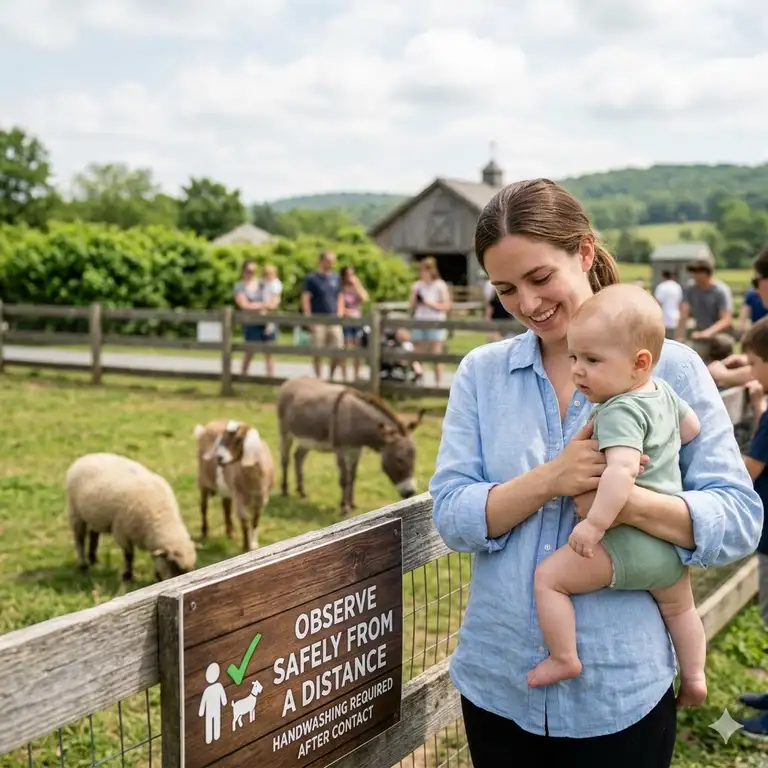
I still remember the first time I took my little one to a local farm. The sun was shining, the goats were bleating, and I had visions of a perfect “Old MacDonald” photo op. But as soon as a curious llama started eyeing my infant’s pacifier, reality hit me like a bale of hay. While these outings are a staple of American childhood, the task of avoiding petting zoo hazards for infants is much more complex than just making sure they don’t get nipped.
✨Was this helpful? Spread the word! 🚀
[addtoany]
Petting zoos are sensory wonderlands, yet they are also hotspots for bacteria that an infant’s developing immune system isn’t quite ready to handle. When we talk about avoiding petting zoo hazards for infants, we are looking at everything from zoonotic diseases—those nasty germs that jump from animals to humans—to physical risks like getting bumped by a clumsy calf.
Before we dive into the deep end of the manure pile (metaphorically speaking!), let’s take a quick look at how a petting zoo experience differs from a standard zoo visit and why the risks for infants are unique.
Comparison: Petting Zoos vs. Traditional Zoos for Infants
| Feature | Petting Zoo / Farm | Traditional Zoo | Risk Level for Infants |
| Contact Level | High (Direct touching/feeding) | Low (Viewing from distance) | Higher at Petting Zoos |
| Germ Exposure | Surface bacteria & manure | Limited to air/surfaces | High at Petting Zoos |
| Supervision | One-on-one required | General observation | Critical at Petting Zoos |
| Physical Safety | Tripping, bumping, nipping | Barrier-protected | Moderate at Petting Zoos |
| Hygiene Stations | Essential but often busy | Available in restrooms | Essential at Petting Zoos |
Quick Comparison: Top Safety Gear for Farm Visits
If you are in a rush to get to the farm, here is a snapshot of the essential gear I recommend for avoiding petting zoo hazards for infants. These items act as your “front-line defense” against germs and physical accidents.
| Product Category | Top Recommendation | Primary Benefit |
| Hand Hygiene | Babyganics Alcohol-Free Sanitizer | Kills 99.9% of germs without drying infant skin |
| Physical Barrier | Jeep Deluxe Stroller Weather Shield | Prevents animals from reaching into the stroller |
| Cleanup | WaterWipes Plastic-Free Wipes | 99.9% water, safe for face and hands |
| Organization | Skip Hop Universal Organizer | Keeps sanitizer and wipes within reach for quick use |
Top 7 Safety Products for Petting Zoos: Expert Analysis
When I go through the process of avoiding petting zoo hazards for infants, I don’t just wing it. I rely on specific tools that make the environment manageable. After scouring the latest options available on Amazon in 2026, here are the seven most effective products for your nursery bag.
1. Babyganics Alcohol-Free Foaming Hand Sanitizer (Mandarin)
This is the “gold standard” for parents on the go. When soap and water aren’t immediately available—which is common at rural farms—this sanitizer is your best friend.
-
Technical Specifications: Active ingredient: Benzalkonium Chloride (0.1%). Alcohol-free, paraben-free, sulfate-free, and fragrance-free options available.
-
Professional Applications: Ideal for sanitizing an infant’s hands after they accidentally touch a fence or a stroller wheel that has rolled through “farm mud.”
-
Customer Review Analysis: Users love that it doesn’t leave a sticky residue. Many parents of infants with eczema report that it doesn’t irritate their baby’s sensitive skin compared to alcohol-based versions.
-
Pros: Non-flammable, foaming action is easy to spread, plant-derived ingredients.
-
Cons: Takes slightly longer to dry than alcohol-based sanitizers.
2. WaterWipes Plastic-Free Original Baby Wipes (720 Count)
Wiping away visible dirt is the first step in avoiding petting zoo hazards for infants before you even apply sanitizer.
-
Technical Specifications: 99.9% purified water and a drop of fruit extract. 100% biodegradable and plastic-free materials.
-
Professional Applications: Used for cleaning milk spills, faces, and hands after animal proximity.
-
Customer Review Analysis: Regarded as the “cleanest” wipe on the market. Parents appreciate the lack of chemical scent which can be overwhelming in the heat of a farm.
-
Pros: Extremely gentle, no harsh chemicals, large pack size.
-
Cons: Wipes can sometimes stick together when pulling them out of the pack.
3. Jeep Deluxe Stroller Weather Shield (Universal Fit)
Think of this as a “bubble” for your baby. One of the best ways of avoiding petting zoo hazards for infants is creating a physical barrier between the baby and the animals.
-
Technical Specifications: Clear, waterproof material with ventilation holes on both sides. Universal fit for most standard strollers.
-
Professional Applications: Protects infants from “animal sneezes,” flying insects, and overly curious goats that might try to nibble on a blanket.
-
Customer Review Analysis: Parents praise the clarity of the plastic, allowing the baby to see the animals without being exposed to them.
-
Pros: Affordable, easy to install, provides UV protection.
-
Cons: Can get warm inside if the farm is in a very hot climate without a breeze.
4. Skip Hop Universal Stroller Organizer (Grab & Go)
In the chaos of a petting zoo, you cannot be digging through a deep diaper bag. Speed is key to avoiding petting zoo hazards for infants.
-
Technical Specifications: Sturdy neoprene material, adjustable Velcro straps, includes a detachable wristlet and a headphone port.
-
Professional Applications: Keeps your Babyganics Alcohol-Free Foaming Hand Sanitizer and phone (for photos) at eye level.
-
Customer Review Analysis: High marks for durability. The “cup holder” sections are perfect for holding a clean bottle away from animal-touched surfaces.
-
Pros: Fits almost any stroller, machine washable, stylish.
-
Cons: If overloaded, it can make lightweight strollers tip backward.
5. Dettol Anti-Bacterial Surface Cleansing Wipes (72 Count)
While WaterWipes are for the baby, Dettol Anti-Bacterial Surface Cleansing Wipes are for the stroller handles and your own hands.
-
Technical Specifications: Kills 99.9% of bacteria, including E. coli and Salmonella. Bleach-free and odorless.
-
Professional Applications: Used to wipe down the stroller tray or handles after you have been touching farm gates.
-
Customer Review Analysis: Trusted for heavy-duty germ-killing. Users note that these are essential for “peace of mind” after leaving the animal contact area.
-
Pros: Trusted brand, no strong chemical smell, kills major zoonotic pathogens.
-
Cons: Not intended for use directly on infant skin.
6. Zoe Stroller Rain Cover (Single Stroller Model)
For those using premium, lightweight strollers like the Zoe, a brand-specific cover is a must for avoiding petting zoo hazards for infants.
-
Technical Specifications: Tailored fit for Zoe XL1/XLC models. Features a front “window” that can be zipped open or shut.
-
Professional Applications: Provides a structured barrier that doesn’t flop around in the wind, keeping dander and dust away from the baby.
-
Customer Review Analysis: Users appreciate the high-quality zippers and the fact that it doesn’t “fog up” as easily as cheaper alternatives.
-
Pros: Very sleek look, custom fit, high durability.
-
Cons: Higher price point than universal shields.
7. Handy Laundry Mesh Diaper Bag (For Soiled Clothes)
When you leave the farm, your clothes are likely covered in invisible hazards. Avoiding petting zoo hazards for infants involves “decontamination” after the visit.
-
Technical Specifications: Large mesh bag with a drawstring closure. Breathable material.
-
Professional Applications: Storing the baby’s outer layers or shoes that have touched the ground before putting them in the car.
-
Customer Review Analysis: Simple but effective. Parents love that they can throw the whole bag into the washing machine when they get home.
-
Pros: Breathable (prevents odors), cheap, reusable.
-
Cons: Not waterproof; if clothes are wet, they might drip.
🚀 Don’t Miss These Exclusive Deals!
🔍 Take your parenting safety game to the next level with these carefully selected products. Click on any highlighted item to check current pricing and availability. These tools will help you create a safe environment your family will love! ✨
💬 Just one click – help others make better buying decisions too!😊
[addtoany]
Detailed Feature Matrix: Choosing Your Defense
| Product | Best For | Material | Primary Protection |
| Babyganics Sanitizer | Sensitive Skin | Plant-based Foam | Microbial (Germs) |
| WaterWipes | Face/Hands | 99.9% Water | Physical Dirt/Debris |
| Jeep Weather Shield | All Strollers | Clear Vinyl | Direct Contact/Animals |
| Dettol Wipes | Surfaces | Anti-Bacterial | Zoonotic Pathogens |
| Skip Hop Organizer | Accessibility | Neoprene | Hygiene Management |
The Hidden Dangers: Why Avoiding Petting Zoo Hazards for Infants is Different
You might think, “I’ve petted a dog before, what’s the big deal?” However, farm animals like sheep, goats, and cows carry specific bacteria in their gut that are shed in their manure. Even if an animal looks clean, its fur or the fence it leans on can be crawling with E. coli, Salmonella, or Cryptosporidium.
For an adult, these might cause a bad weekend in the bathroom. For an infant, they can lead to severe dehydration or even Hemolytic Uremic Syndrome (HUS), a serious kidney condition. Therefore, avoiding petting zoo hazards for infants requires a “look but don’t touch” policy for those under 12 months.
Zoonotic Diseases to Watch Out For
-
Salmonella: Often found on chicks and ducklings. These cute little fluff-balls are major carriers. I always recommend keeping infants away from the poultry section entirely.
-
E. coli O157:H7: Found in cattle, goats, and sheep. This is the big one. It lives in the intestines and is spread through contact with feces—even microscopic amounts on a fence.
-
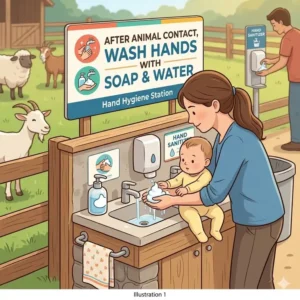
Cryptosporidium: A parasite that causes watery diarrhea. It is very resistant to many disinfectants, making handwashing with soap and water superior to just using gels.
Table: Sanitizer vs. Soap and Water Performance
| Feature | Alcohol-Free Sanitizer | Traditional Soap & Water |
| Ease of Use | 10/10 (Portable) | 4/10 (Need a sink) |
| Effectiveness vs. E. coli | High | High |
| Effectiveness vs. Crypto | Low | High (Physical removal) |
| Skin Irritation | Very Low | Moderate |
| Best Used When… | On the trail/between animals | Before eating/Leaving the farm |
Strategic Steps for Avoiding Petting Zoo Hazards for Infants
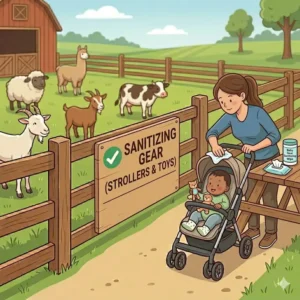
I’ve learned that a successful trip is all about the “zones.” You need to treat the farm like a lab: there’s a Hot Zone (the animal pens), a Transition Zone (the gates/washing stations), and a Cold Zone (your car/picnic area).
1. Maintain the “Stroller Fortress”
The safest place for an infant at a petting zoo is in their stroller. By keeping them strapped in, you prevent them from crawling on the ground or reaching through bars. Using the Jeep Deluxe Stroller Weather Shield acts as a barrier so that even if a goat decides to sneeze, your baby is protected.
Moreover, ensure that the stroller wheels are cleaned before you put the stroller back into your trunk. Those wheels have likely rolled over manure. I use Dettol Anti-Bacterial Surface Cleansing Wipes for this dirty job.
2. The “No-Touch” Mandate
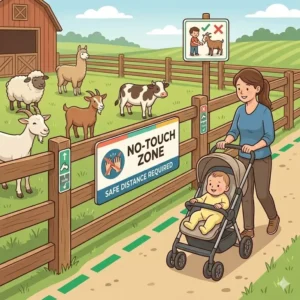
I know it’s tempting to let your 10-month-old feel the wool of a sheep. But babies put their hands in their mouths constantly. Consequently, avoiding petting zoo hazards for infants means you should be the one doing the petting while they watch. If you do let them touch, you must use Babyganics Alcohol-Free Foaming Hand Sanitizer immediately after.
3. Dress for Decontamination
When we go to the farm, I dress my baby in an “outer shell”—usually a light jacket or a pair of overalls that can be easily removed. As soon as we get to the car, that outer layer goes into the Handy Laundry Mesh Diaper Bag. This prevents farm germs from being rubbed onto the car seat.
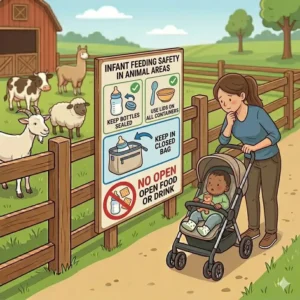
4. Food Safety in the “Cold Zone”
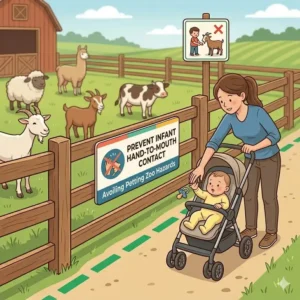
Never, ever feed your infant in the animal contact area. Not even a quick bottle. The risk of hand-to-mouth contamination is just too high. Move to a designated picnic area or back to the car. Use WaterWipes Plastic-Free Original Baby Wipes to clean your own hands before handling their bottle or pacifier.
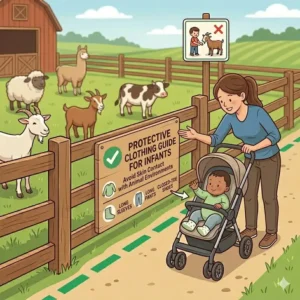
Comparison of Protective Clothing for Farm Visits
| Clothing Type | Pros for Safety | Cons |
| Full-Length Overalls | Protects legs from tall grass/dirt | Can be hot in summer |
| Closed-Toe Shoes | Prevents slips and direct manure contact | Harder to clean than sandals |
| Brimmed Hats | Keeps animals away from baby’s face | Baby might pull it off |
| Long Sleeves | Barrier against dander and flies | Requires breathable fabric |
Expert Tips for Parents: Managing the Environment
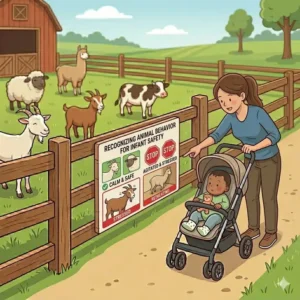
Avoiding petting zoo hazards for infants isn’t just about products; it’s about your own situational awareness. Here are some “pro-tips” from my years of navigating rural Tennessee farms:
-
Avoid the “Big Three”: Chicks, ducklings, and calves are the highest risk for Salmonella and E. coli. Keep the stroller at least three feet back from these specific pens.
-
The “Pacifier Clip” Rule: Use a short pacifier clip. If a pacifier falls on a farm floor, it is gone. Do not try to sanitize it with a wipe; throw it away or put it in a sealed bag to be boiled later.
-
Check the Signage: Reputable farms will have signs from the CDC or local health departments. If a farm doesn’t have handwashing stations, that is a major red flag.
-
Watch the “Kick Zone”: Even small goats can kick. Ensure your stroller is positioned so the baby’s feet aren’t within reach of a playful (or grumpy) hoof.
Table: Age-Based Risk Assessment for Animal Interaction
| Age Group | Primary Hazard | Recommended Safety Level |
| 0-6 Months | Airborne dander/Sneezes | Stroller with cover (High) |
| 6-12 Months | Hand-to-mouth germs | Stroller-bound / Immediate Sanitizing (High) |
| 12-24 Months | Tripping/Animal Nips | Hand-holding / Constant supervision (Moderate) |
| 2-5 Years | Manure on shoes/clothes | Guided touching / Vigorous handwashing (Low-Mid) |
Managing Post-Visit Anxiety
It is natural to feel a bit “germ-phobic” after reading about E. coli. However, the goal of avoiding petting zoo hazards for infants isn’t to live in fear, but to be prepared. If you follow the handwashing and barrier protocols, the risk is significantly minimized.
If your infant does show signs of illness after a visit—such as a fever, stomach cramps, or diarrhea (especially if it’s bloody)—call your pediatrician immediately and mention the petting zoo visit. Early intervention is key for zoonotic diseases.
🌟 Take the Next Step for a Safer Outing!
Don’t wait until you’re standing in a muddy field to realize you forgot the wipes! Click through our top-rated recommendations to stock up on your safety essentials today. Being prepared means you can focus on the fun, not the germs. Happy farming! ✨
Conclusion: Balancing Fun and Safety
Taking your little one to see animals is a beautiful way to introduce them to the world. By focusing on avoiding petting zoo hazards for infants, you aren’t being “over-protective”—you are being a smart, informed parent. Using physical barriers like the Jeep Deluxe Stroller Weather Shield and keeping high-quality hygiene products like Babyganics Alcohol-Free Foaming Hand Sanitizer in your Skip Hop Universal Stroller Organizer makes all the difference.
Remember, the best memories are the ones that don’t end in a doctor’s visit! Stay vigilant, keep those hands clean, and enjoy the sights and sounds of the farm.
Frequently Asked Questions
✅ Yes, it is safe as long as the infant remains in a stroller and does not have direct contact with animals or contaminated surfaces. Avoiding petting zoo hazards for infants at this age focuses on barrier protection and hygiene...
✅ Absolutely. Chicks and ducklings are frequent carriers of Salmonella. Infants should never touch poultry, and strollers should be kept at a distance to prevent any accidental contact with dander or droppings from the birds...
✅ Use anti-bacterial wipes like Dettol for the wheels and frame. For the fabric, a mixture of warm water and mild soap is usually sufficient, but ensure the wheels are thoroughly disinfected before bringing the stroller inside...
✅ While hand sanitizers are great for on-the-go use, they do not kill all parasites like Cryptosporidium. Always follow up with a thorough soap-and-water handwashing session as soon as you reach a proper sink facility...
✅ Yes, changing clothes is a highly recommended practice for avoiding petting zoo hazards for infants. This prevents any animal dander or microscopic fecal matter from transferring to your car seat or home environment... ❓ Is it safe to take a 6-month-old to a petting zoo?
❓ Can infants get Salmonella from baby chicks?
❓ What is the best way to clean a stroller after a farm visit?
❓ Are hand sanitizers enough to kill farm germs?
❓ Should I change my baby's clothes after leaving the petting zoo?
Recommended for You:
- How to Baby Proof Plants Poisonous: 7 Essential Safety Steps for 2026
- First Aid Tips Baby Choking: 7 Life-Saving Tools You Need Now
- What to Do If Baby Swallows Small Object: 7 Smart Safety Tips Every Parent Needs
Disclaimer: This article contains affiliate links. If you purchase products through these links, we may earn a small commission at no additional cost to you.
✨ Found this helpful? Share it with your friends! 💬🤗
[addtoany]