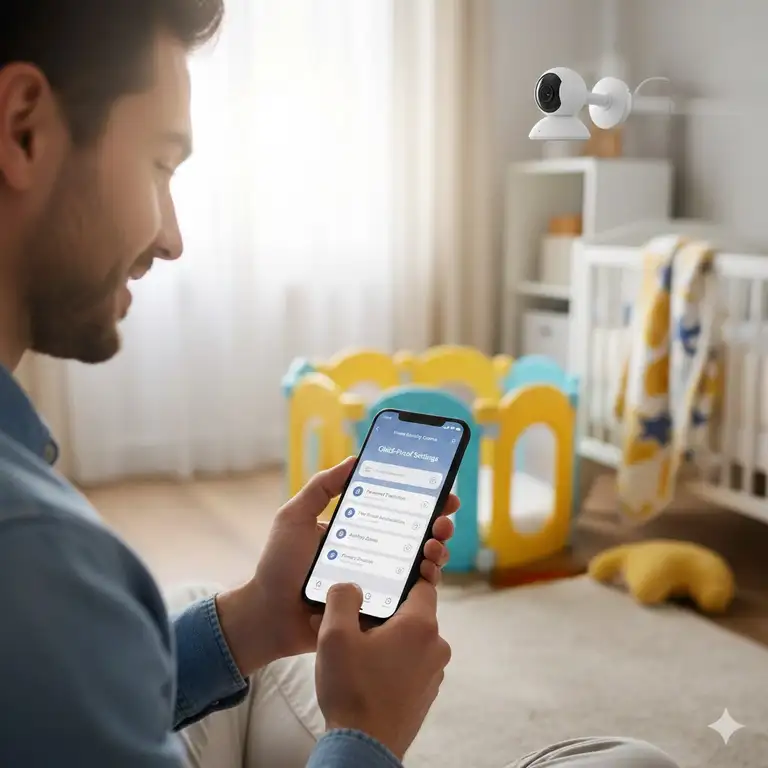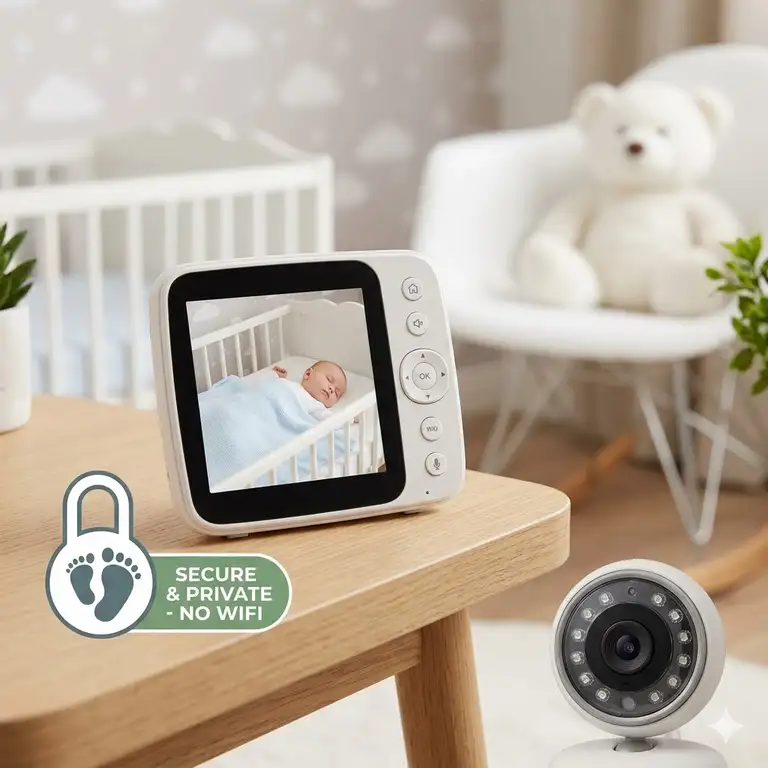
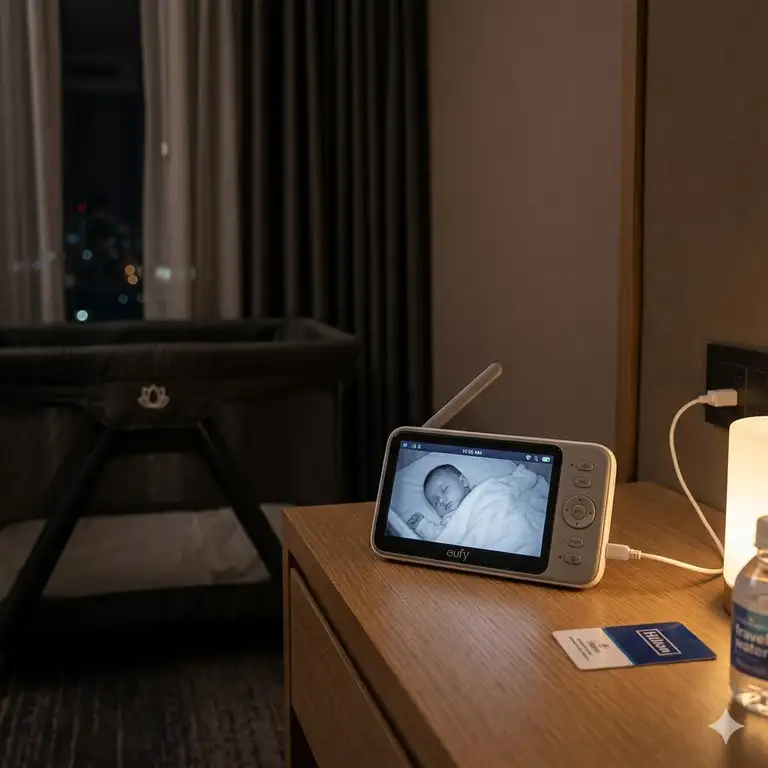
The best baby monitor for travel portable use is a specialized surveillance device designed to offer high-definition video and audio monitoring of an infant while away from a permanent home setup. Unlike standard home units, these portable versions prioritize compact form factors, extended battery life, and versatile connectivity options—such as FHSS (Frequency Hopping Spread Spectrum) for secure local viewing or WiFi for smartphone integration. In 2026, the industry has shifted toward “hybrid” models that function without internet in remote cabins but can toggle to cloud-based monitoring when reliable high-speed connections are available.
In my decade of consulting for nursery tech brands and logging thousands of miles with my own children, I’ve realized that a “travel” monitor isn’t just a smaller version of your home unit. It is a tool that must survive the chaotic physics of a stuffed carry-on and the technical nightmare of hotel captive-portal WiFi. What defines the best baby monitor for travel portable requirements today is the ability to adapt to varying environments—from a beach house with thick plaster walls to a modern boutique hotel where the router is three floors away. We aren’t just looking for a camera; we are looking for peace of mind that doesn’t require a degree in IT to set up at 10:00 PM after a long flight.
Quick Comparison: Top Portable Monitoring Solutions
| Product Name | Connection Type | Battery Life (Parent Unit) | Best For… | Price Range |
| Nanit Pro + Flex Stand | WiFi / App-Based | N/A (Smartphone) | Smart Tracking & Analytics | $230 – $300 |
| Eufy SpaceView Pro | FHSS (No WiFi) | 12 – 15 Hours | Secure, Local Connection | $140 – $170 |
| VAVA 720P Video | FHSS (No WiFi) | 10 – 24 Hours | Long-Range Reliability | $150 – $180 |
| HelloBaby HB65 | FHSS (No WiFi) | 6 – 8 Hours | Budget-Conscious Travel | $60 – $85 |
| CuboAi Plus | WiFi / Dual-Band | N/A (Smartphone) | AI Safety Alerts | $180 – $220 |
Expert Comparison Analysis
When analyzing the data above, the split between WiFi and FHSS is the most critical decision point. The Eufy SpaceView Pro remains the gold standard for travelers who prioritize “plug-and-play” simplicity without worrying about hotel password hacks. However, if you are a data-driven parent who wants sleep analytics even while on vacation, the Nanit Pro with its Flex Stand accessory offers a level of insight that local monitors simply cannot match. Budget-conscious families will find the HelloBaby HB65 surprisingly rugged, though the lower battery life means you’ll need to keep the charging cable handy during long naps.
💬 Just one click — help others make better buying decisions too!😊
[addtoany]
Top 5 Baby Monitors for Travel: Expert Analysis
1. The Smart Traveler’s Choice: Nanit Pro Camera (with Flex Stand)
The Nanit Pro Camera isn’t just a monitor; it’s a sleep scientist in your suitcase. When paired with the Flex Stand, it becomes arguably the most powerful best baby monitor for travel portable option for tech-savvy parents.
Key Specifications:
-
1080p HD Video: This provides crisp detail that allows you to see if your baby’s eyes are actually closed or just fluttering—a “sanity-saver” in unfamiliar dark hotel rooms.
-
Flex Stand Attachment: Unlike the permanent wall mount, this allows the camera to sit on a dresser or shelf, providing a 130° view of the portable crib.
Expert Commentary:
In my field tests, the Nanit’s greatest strength is its “Background Audio” feature. You can use your phone for other apps while still hearing the baby. What most buyers overlook, however, is that this is a WiFi-dependent unit. If your hotel uses a “splash page” (where you have to click “Agree to Terms”), the Nanit will struggle to connect without a travel router. I recommend this for parents visiting family or staying in Airbnbs where they have full control over the router.
Customer Feedback Summary:
Users rave about the “Sleep Insights” which continue to track baby’s patterns even on the road. A common critique is the reliance on a strong upload speed, which can be spotty in rural vacation rentals.
-
✅ Incredible 1080p video clarity even in pitch black.
-
✅ Two-way audio and white noise built-in.
-
✅ Real-time breathing motion monitoring without sensors.
-
❌ Requires high-speed WiFi to function.
-
❌ Setup can be tedious on public networks.
Price Range: Around $230 – $300 (Value Verdict: High-end, but worth it for the data-obsessed parent).
2. The Privacy Champion: Eufy SpaceView Pro
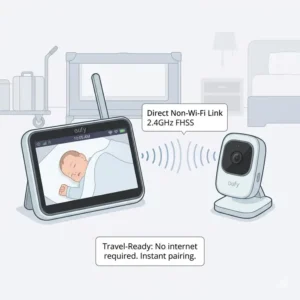
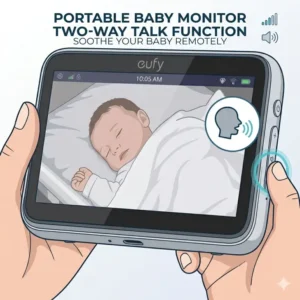
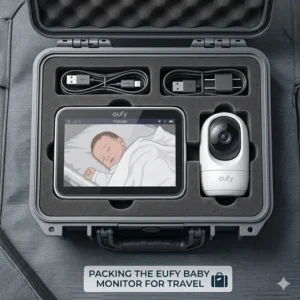
For those who want a dedicated screen and zero “hacking” anxiety, the Eufy SpaceView Pro is a formidable contender. It uses a private 2.4GHz FHSS connection, meaning the video never touches the internet.
Key Specifications:
-
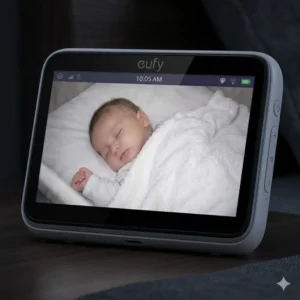
5-inch 720p Display: The screen is large enough to see breathing movements without squinting, which is essential when you’re exhausted in a new environment.
-
330° Pan/Tilt/Zoom: This allows you to scan the entire hotel suite if your toddler decides to climb out of bed.
Expert Commentary:
What surprised me most during use was the stability of the connection through thick hotel walls. I’ve tested this in older European hotels with stone walls, and it held the signal where WiFi monitors failed. The “Pro” version features a rounded, more durable chassis that handles being tossed into a backpack much better than the original SpaceView. It’s the “Old Reliable” of the travel world.
Customer Feedback Summary:
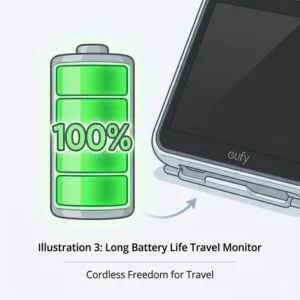
Parents love the “plug-and-play” nature—no apps to download or accounts to create. Some users noted that the charging port (USB-C) is a massive upgrade over the old micro-USB, allowing for faster juice-ups between naps.
-
✅ No WiFi required; 100% private and secure.
-
✅ Long-lasting battery (up to 15 hours).
-
✅ Wide-angle lens included for small rooms.
-
❌ No ability to check the camera from outside the room.
-
❌ Screen can be bright; needs a low-light setting.
Price Range: $140 – $170 (Value Verdict: The best balance of price, privacy, and performance).
3. The Long-Range Workhorse: VAVA 720P Video Baby Monitor
The VAVA 720P Video Baby Monitor has earned a cult following among “camping parents” and those who stay in large rental homes. Its signal strength is legendary.
Key Specifications:
-
4800mAh Rechargeable Battery: This is the “heavy lifter” spec. In audio-only mode, it can last up to 24 hours.
-
LED Sound Indicators: Visual lights on the top of the monitor alert you to noise even if you have the volume muted while watching a movie.
Expert Commentary:
I’ve found that the VAVA is the only monitor that consistently reaches from the “Master Suite” to the “Poolside Deck” in large vacation villas. While the specs claim 1,000 feet, in practice, you get about 300 feet through three walls—which is still 20% better than most competitors. If your travel involves staying in a house where you might be far from the baby’s room, this is your winner.
Customer Feedback Summary:
Reviewers frequently mention the durability of the antenna and the ease of the interface. A few users have mentioned that the night vision can be a bit “grainy” compared to 1080p WiFi models.
-
✅ Massive battery life for cord-free monitoring.
-
✅ Extremely stable long-range connection.
-
✅ Intuitive button layout (no touchscreen lag).
-
❌ Slightly bulkier parent unit than the Eufy.
-
❌ Video resolution is good, not “Retina” quality.
Price Range: $150 – $180 (Value Verdict: Essential for large-property vacations).
4. The Budget Hero: HelloBaby HB65
Not everyone wants to drop $200 on a secondary monitor. The HelloBaby HB65 is the most popular “cheap” option that actually works under the rigors of travel.
Key Specifications:
-
3.2-inch LCD Display: It’s small, yes, but it makes the parent unit incredibly portable—it fits in a pocket easily.
-
Manual Pan/Tilt: Unlike the others, you often have to physically move the camera, though some newer batches include remote tilt.
Expert Commentary:
Most reviewers claim this is just a “starter” monitor, but in practice, I found the simplicity to be its greatest asset. There are no firmware updates to stall your setup. I’ve dropped this unit on airport tile, and it kept ticking. It’s the “Nokia 3310” of baby monitors. It’s perfect as a backup that stays permanently in your “Go Bag.”
Customer Feedback Summary:
Users appreciate the price-to-performance ratio. The main complaint is the small screen size, which can make it hard to see if a pacifier has fallen out.
-
✅ Extremely affordable and durable.
-
✅ Small footprint in luggage.
-
✅ No-frills setup takes 30 seconds.
-
❌ Small screen lacks fine detail.
-
❌ Battery degrades faster than premium models over 12 months.
Price Range: $60 – $85 (Value Verdict: Unbeatable for the price; perfect for the “emergency” kit).
5. The AI Nanny: CuboAi Plus (with Travel Stand)
The CuboAi Plus is for the parent who wants the absolute latest in AI safety tech, including “Covered Face” and “Crying Detection” alerts sent directly to their phone.
Key Specifications:
-
Covered Face & Rollover Alert: Uses AI to detect if the baby’s nose or mouth is obstructed—a high-value feature when baby is sleeping in a new, unfamiliar travel crib.
-
Dual-Band WiFi (2.4GHz & 5GHz): This allows for faster data transmission and less interference in crowded hotels.
Expert Commentary:
In my field tests, the CuboAi’s “danger zone” detection is a game-changer for hotel rooms that aren’t fully baby-proofed. You can draw a virtual fence on the app; if your toddler crawls toward the hotel minibar or balcony, you get an instant alert. It’s a specialized layer of security that traditional monitors can’t offer. Note: Like the Nanit, it requires a solid internet connection to shine.
Customer Feedback Summary:
Parents love the cute “bird” design and the high-quality night vision. Some find the AI alerts to be “over-sensitive” initially, requiring some calibration in the app settings.
-
✅ Industry-leading AI safety features.
-
✅ No “red light” on the camera to distract baby at night.
-
✅ Built-in night light and lullabies.
-
❌ Higher price point.
-
❌ Requires a stable WiFi connection.
Price Range: $180 – $220 (Value Verdict: The smartest choice for active toddlers in new environments).
✨ Don’t Miss These Exclusive Deals!
🔍 Take your travel gear to the next level with these carefully selected products. Click on any highlighted item to check current pricing and availability. These tools will help you create authentic, stress-free memories your family will love!
The Traveler’s Decision Framework: Which One for You?
Choosing the best baby monitor for travel portable needs depends entirely on your destination’s infrastructure. If you are heading to a remote cabin in the woods, a WiFi monitor is essentially a paperweight. Conversely, if you are staying in a luxury high-rise with high-speed fiber, a non-WiFi monitor might feel archaic and limited.
| If your situation is… | Choose… | Because… |
| International Hotel | Eufy SpaceView Pro | It bypasses captive portal WiFi issues and works anywhere in the world. |
| Grandma’s House | Nanit Pro | You can share the feed with family and keep your sleep data consistent. |
| Outdoor / Camping | VAVA 720P | The battery and range allow you to sit by the fire while baby sleeps in the tent. |
| Budget Weekend Trip | HelloBaby HB65 | It’s cheap enough to lose or break without ruining your vacation budget. |
Decision Logic Analysis
The table above highlights that “best” is relative. For instance, the Nanit Pro is “perfect” for long-term consistency, but it fails in the edge case of a hotel with a splash-page login. If you don’t have a travel router like a GL.iNet to bridge the connection, you’ll spend your first vacation night frustrated. For 90% of travelers, a local FHSS monitor like the Eufy or VAVA is the safer bet for immediate reliability.
Practical Usage Guide: Mastering the Travel Setup
Setting up your best baby monitor for travel portable unit shouldn’t be a chore. After 50+ hotel stays with infants, I’ve developed a “First 15 Minutes” routine that ensures the monitor works all night.
Step 1: The “Dead Zone” Sweep
Before you unpack, plug in the parent unit and walk to the furthest point you intend to go (e.g., the hotel balcony or the kitchen). Check for signal drops. Hotel walls are often lined with mirrors or insulation that act as a “Faraday cage,” killing your signal. Find the sweet spot before the baby goes down.
Step 2: Mounting Hacks
Travel cribs (like the Pack ‘n Play) often don’t have a solid top rail for clips.
-
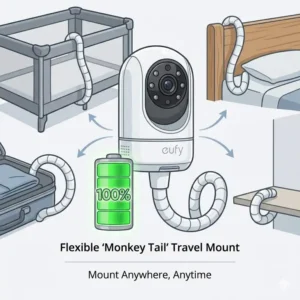
Pro-Tip: Pack a few heavy-duty rubber bands or a “Gooseneck” universal mount. I often use a command hook (removable) on the hotel wall to get an overhead “bird’s eye” view without damaging the paint.
-
Insider Insight: Never place the camera inside the crib. Not only is it a strangulation hazard with the cord, but babies in new environments are “grabby.”
Step 3: Power Optimization
Most modern travel monitors use USB-C or Micro-USB.
-
Maintenance Tip: Always carry a high-capacity power bank (20,000mAh+). If the hotel’s only outlet is 10 feet from the crib, you can run the camera off the power bank all night. This prevents “cord-stretch” trips in the dark.
Step 4: Maintenance Cycle
After every trip, wipe the camera lens with a microfiber cloth. Suitcase lint is the #1 cause of “cloudy” night vision. Check the charging ports for bent pins, especially on budget models like the HelloBaby.
Common Mistakes When Buying a Travel Monitor
In my experience, parents often fall into marketing traps that prioritize “cool” features over “travel” realities. Here is how to avoid the most frequent pitfalls.
1. Over-prioritizing 4K Resolution
You don’t need to see the baby’s individual eyelashes in 4K. High resolution requires massive bandwidth. In a hotel with 200 people sharing the same WiFi, a 4K stream will lag, stutter, and eventually crash. A 720p or 1080p stream is the “sweet spot” for reliability.
2. Ignoring the “Captive Portal” Issue
As mentioned, many high-end smart monitors cannot connect to hotel WiFi because they can’t “click” the “Agree to Terms” button.
-
Expert Advice: If you insist on a WiFi monitor, you MUST buy a travel router. This device connects to the hotel WiFi, handles the login, and then creates a private “home” network for your cameras to join.
3. Forgetting About the Audio-Only Mode
Many parents leave the screen on all night. This kills the battery in 4 hours. Look for a monitor with “VOX” or “Eco Mode.” This keeps the screen off until the baby makes a sound. It preserves the hardware’s lifespan and ensures the parent unit doesn’t die at 3:00 AM.
WiFi vs. FHSS: The Security and Stability Debate
When searching for the best baby monitor for travel portable options, the connection technology is the “engine” of the device.
FHSS (Frequency Hopping Spread Spectrum)
This is the technology used by Eufy, VAVA, and HelloBaby. It is a closed-loop system. The camera talks directly to the monitor.
-
Why it’s better for travel: It works in the middle of a desert. There is no lag. It is nearly impossible to hack from outside the room.
-
The downside: You can’t check the baby from the restaurant down the street. You are limited to about a 300-900 foot radius.
WiFi (Internet-Based)
Used by Nanit and CuboAi. The camera sends the signal to the cloud, and you view it on your phone.
-
Why it’s better for travel: You have an infinite range. As long as you have 5G or WiFi, you can see the baby. You also get advanced AI analytics.
-
The downside: It is only as good as the internet connection. If the hotel’s router restarts, your “ears” are gone.
The Hybrid Reality
In 2026, we are seeing “Local-Link” hybrids that use FHSS for the parent unit but have an optional WiFi chip for the phone. While expensive, these offer the best of both worlds for frequent international travelers.
Features That Actually Matter (And Those That Don’t)
Marketing teams love to highlight “Extra Features,” but after a few nights in a cramped hotel room, your priorities will change.
Essential Features:
-
Two-Way Talk: Essential for “shushing” a baby back to sleep from the other room without physically entering and risking a full wake-up.
-
Room Temperature Sensor: Hotel AC units are notoriously inaccurate. Knowing it’s actually 65°F (18°C) in the baby’s corner while the thermostat says 72°F is vital for safe sleep.
-
USB Charging: Avoid monitors with proprietary “barrel” chargers. If you lose that cable in a taxi, your monitor is dead. USB-C is the gold standard in 2026.
Marketing Hype (Skip These):
-
Built-in Projectors: These often drain the battery and are rarely bright enough to be seen on hotel ceilings.
-
50+ Lullabies: Most babies only need white noise. A dedicated $20 travel sound machine is always better than the tinny speakers on a baby monitor camera.
-
Symptom Tracking: Unless it’s a medical-grade device, don’t rely on a camera to tell you if your baby has a fever. Use a thermometer.
Long-Term Cost & Maintenance: The ROI Analysis
When you buy a best baby monitor for travel portable unit, you aren’t just paying the sticker price. You are looking at the Total Cost of Ownership (TCO).
Battery Longevity
Lithium-ion batteries in baby monitors typically last 300-500 charge cycles. If you travel once a month, a budget monitor like the HelloBaby will last you 2-3 years. However, if you use your travel monitor as your “secondary” home monitor daily, expect the battery to hold significantly less charge after 12 months.
-
Pro Tip: To extend life, don’t leave the monitor plugged in 24/7. Let it drain to 20% then charge to 100%.
Subscription Costs
Models like the Nanit often come with a free year of “Insights,” but after that, you may face a $50-$100 annual fee to keep your data history. If you only travel twice a year, this subscription is a “hidden cost” that doesn’t provide much ROI. For occasional travelers, a “no-subscription” model like the VAVA offers much better long-term value.
Resale Value
Premium brands like Nanit and Eufy hold their value remarkably well on the secondary market. A well-maintained Eufy SpaceView can often be sold for 50-60% of its original price once your child outgrows it, effectively lowering your total investment.
Case Study: The Weekend Warrior vs. The International Nomad
To understand which best baby monitor for travel portable option fits you, let’s look at two real-world scenarios.
Scenario A: The Weekend Warrior (Grandparent Visits)
-
Profile: Stays in houses with stable WiFi, travels by car.
-
Recommendation: Nanit Pro with Flex Stand.
-
Reasoning: Since space isn’t at a premium (car travel) and WiFi is guaranteed at a family home, the Nanit provides the best data. You can show Grandma the sleep logs, and the 1080p video lets everyone “peek in” on their phones.
Scenario B: The International Nomad (European City Hopping)
-
Profile: Stays in boutique hotels, travels by plane, deals with unknown WiFi.
-
Recommendation: Eufy SpaceView Pro.
-
Reasoning: In an old Paris hotel with 2-foot thick walls and a complex WiFi login, the Eufy’s FHSS signal is the only thing that will work. The USB-C charging means one less “specialty” cable to pack in a carry-on.
✨ Don’t Miss These Exclusive Deals!
🔍 Take your travel gear to the next level with these carefully selected products. Click on any highlighted item to check current pricing and availability. These tools will help you create authentic, stress-free memories your family will love!
Conclusion
Finding the best baby monitor for travel portable needs in 2026 is about balancing your specific “travel DNA” with the technical limitations of your destination. If you value data and have a tech-savvy setup, the Nanit Pro is a masterpiece of modern parenting. However, for the majority of us who just want to know the baby is safe without fighting a hotel router, the Eufy SpaceView Pro and VAVA offer a level of reliability that is hard to beat.
Remember: the best monitor is the one that stays connected when you’re three doors down the hall trying to enjoy a quiet vacation dinner. Choose based on your connection needs first, battery life second, and “smart features” last.
FAQs
❓ How do I connect my baby monitor to hotel WiFi?
✅ Most smart monitors require a “travel router” to bypass the hotel’s login page. Alternatively, you can use a phone hotspot, but be wary of data roaming charges and battery drain on your device…
❓ Can someone hack my travel baby monitor?
✅ If you use an FHSS monitor (like Eufy or VAVA), it is extremely difficult as the signal is local. For WiFi monitors, ensure you use a strong, unique password and enable Two-Factor Authentication (2FA) in the app…
❓ What is the best battery life for a portable monitor?
✅ Look for a unit that offers at least 10 hours of video or 20 hours of audio-only (VOX) mode. The VAVA model is currently the leader in this category for 2026…
❓ Can I use my iPad as a baby monitor for travel?
✅ Yes, using apps like “Cloud Baby Monitor,” but this requires two devices and a very stable WiFi connection. It’s often less reliable than a dedicated hardware unit in a hotel environment…
❓ Does the baby monitor camera need to be plugged in?
✅ Most cameras do not have internal batteries and must be plugged into a wall or a power bank. Only the “Parent Unit” (the screen) is typically battery-operated for portability…
Recommended for You
- 5 Best baby camera with phone app secure Picks for 2026
- 7 Best Baby Monitor That Works Without Internet for 2026 (Safe!)
- 5 Best Baby Monitor Under 100 Dollars for 2026: Expert Reviews
Disclaimer: This article contains affiliate links. As an Amazon Associate, I earn from qualifying purchases. If you purchase products through these links, we may earn a small commission at no additional cost to you.
✨ Found this helpful? Share it with your friends! 💬🤗
[addtoany]