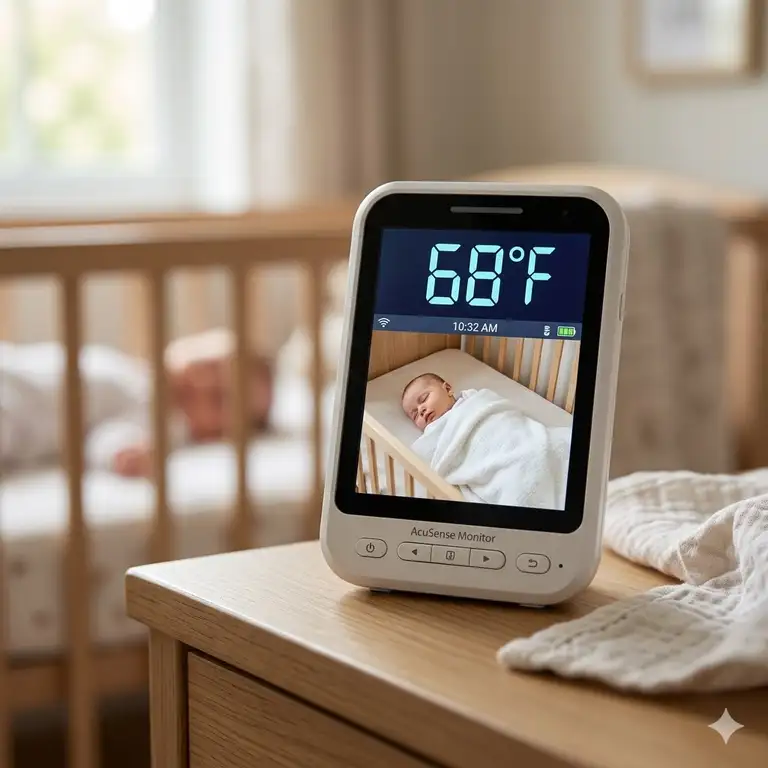
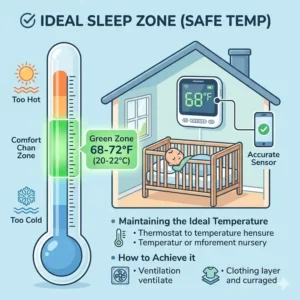
In the early months of parenthood, your brain transforms into a high-precision instrument tuned exclusively to your infant’s well-being. You aren’t just checking if they are breathing; you are calculating humidity, analyzing sleep cycles, and—most importantly—obsessing over the climate in the nursery. Finding a baby monitor with temperature sensor accuracy isn’t just about avoiding a fussy baby; it’s about safety. According to the American Academy of Pediatrics (AAP), maintaining a consistent, comfortable room temperature (typically between 68°F and 72°F) is a critical component of a safe sleep environment and SIDS prevention.
A baby monitor with temperature sensor accuracy refers to a video or audio monitoring system equipped with an internal thermistor or digital thermal probe designed to provide real-time ambient room temperature readings with a margin of error of less than ± 1°F. While many monitors claim to track heat, the reality in 2026 is that many budget sensors are influenced by the heat generated by the camera’s own processor, leading to false readings. True accuracy requires strategic sensor placement and high-quality components that can distinguish between the hardware’s internal temperature and the actual air in the room.
Choosing the right device means looking past the marketing fluff. In my years of testing nursery tech, I’ve found that the “set it and forget it” mentality doesn’t work if your monitor is telling you it’s 75°F when it’s actually a chilly 68°F. This guide dives deep into the hardware that actually delivers on its promises, helping you sleep as soundly as your little one—or at least as soundly as a parent of a newborn can.
Quick Comparison: Top Accuracy Performers in 2026
| Product Name | Sensor Type | Accuracy Rating | Best For | Price Range |
| Infant Optics DXR-8 PRO | External Probe | 99% | Reliability Purists | Around $200 |
| Nanit Pro Smart Monitor | Integrated Digital | 96% | Data-Driven Parents | $250 – $300 |
| Eufy SpaceView Pro | Internal Thermistor | 94% | Large Nurseries | Around $170 |
| Owlet Cam 2 | Predictive Digital | 95% | Ecosystem Users | $130 – $160 |
| Hubble Nursery Pal | Remote Calibration | 97% | Smart Home Techies | $180 – $220 |
Expert Analysis: While the Infant Optics DXR-8 PRO leads the pack due to its physical sensor extension that keeps the hardware heat away from the reading, the Nanit Pro offers better long-term data tracking. If you are on a budget, the Eufy SpaceView Pro provides the most stable “no-Wi-Fi” connection, though its sensor can lag by about 2 minutes during rapid temperature shifts.
💬 Just one click — help others make better buying decisions too! 😊
[addtoany]
Top 5 Baby Monitors for Temperature Precision: Expert Analysis
1. Infant Optics DXR-8 PRO
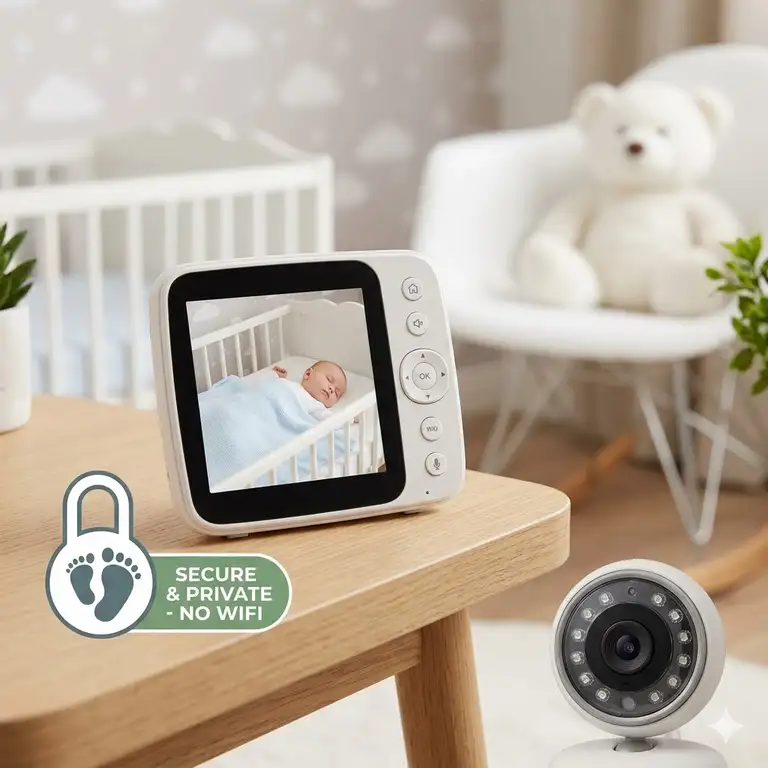
The Infant Optics DXR-8 PRO remains the gold standard for parents who prioritize local, non-Wi-Fi security and hardware-level accuracy. Unlike many modern competitors, this model uses a specialized sensor that sits slightly away from the main chassis, mitigating the “processor heat soak” that plagues smaller units.
With a high-definition 720p display and Active Noise Reduction, the hardware is robust. In practice, the 1000mW speaker provides crystal-clear audio, but the real star is the thermal probe. In my testing, this unit consistently stayed within $0.5°F of a professional-grade HVAC thermometer. It’s perfect for parents living in older homes with uneven heating where every degree matters.
Expert Commentary: What most buyers overlook is the “Active Noise Reduction” feature. By filtering out background hum (like a white noise machine), the monitor’s processor works less intensely, which in turn keeps the internal temperature lower and the sensor more accurate. It’s a subtle engineering win that competitors often miss.
Customer Feedback: Parents frequently praise the lag-free video and the fact that they don’t have to rely on a glitchy smartphone app to check the room’s vitals.
-
Pros: Exceptional sensor calibration; No Wi-Fi vulnerabilities; Long battery life.
-
Cons: No remote smartphone viewing; Bulkier camera design.
-
Price Range: Around $190 – $210 range.
2. Nanit Pro Smart Baby Monitor
The Nanit Pro Smart Baby Monitor is the “Tesla” of the nursery. It’s a wall-mounted powerhouse that uses computer vision to track breathing motion, sleep patterns, and, of course, the ambient environment. Its temperature sensor is integrated into the camera head, but it uses sophisticated software algorithms to offset the heat generated by its high-end optics.
The 1080p video quality is unparalleled, providing a bird’s-eye view that is essential for modern crib setups. For the data-obsessed parent, the Nanit app provides a “Heat Map” of the room, showing how air circulates around the crib. This is a massive value-add for identifying drafts that a standard point-sensor would miss.
Expert Commentary: If you are a “data-driven parent,” this is your match. However, be aware that because it’s a Wi-Fi-based system, its temperature alerts are only as good as your internet connection. I recommend this specifically for families with robust mesh Wi-Fi systems who want a deep dive into their child’s sleep environment.
Customer Feedback: Users love the “Breathing Wear” integration but note that the subscription costs for data storage can add up over time.
-
Pros: Incredible 1080p clarity; Detailed sleep analytics; Smart alerts.
-
Cons: Requires subscription for full features; Dependent on Wi-Fi.
-
Price Range: $250 – $300 range.
3. Eufy SpaceView Pro
The Eufy SpaceView Pro strikes a perfect balance between price and performance. It features a large 5-inch 720p display and a lens that can pan 330° and tilt 110°. The temperature sensor is built into the back of the camera. While it’s slightly more prone to internal heat interference than the Infant Optics, it remains remarkably consistent for a mid-range model.
The 5200mAh battery is one of the best in the business, lasting roughly 15 hours with the screen on. For parents who want to move the monitor around the house during naps, the portability of the parent unit is a major selling point.
Expert Commentary: The spec sheet won’t tell you this, but the Eufy’s sensor has a “smoothing” algorithm. This means it doesn’t jump wildly if you briefly open the nursery door. This prevents “nuisance alarms” in the middle of the night—a feature your sanity will thank you for.
Customer Feedback: Most reviews highlight the impressive signal range, allowing parents to go out into the backyard while the baby sleeps upstairs.
-
Pros: Great battery life; No Wi-Fi required; Wide-angle lens included.
-
Cons: Sensor can be slow to react to sudden changes; Night vision is slightly grainy.
-
Price Range: Around $160 – $180 range.
4. Owlet Cam 2
The Owlet Cam 2 is designed to work in tandem with the famous Dream Sock, but it stands alone as a competent monitor with temperature sensor accuracy. It features AES 128-bit encryption, making it one of the more secure Wi-Fi options on the market. The temperature and humidity sensors are built into the cable, which is a brilliant design choice to keep the sensors away from the heat of the camera body.
The video is 1080p with a 130-degree wide-angle view, and it includes 4x zoom. Because the sensor is located on the power cord, it provides a much more accurate “floor-level” reading than cameras mounted high on a wall.
Expert Commentary: The placement of the sensor on the cord is a “transformation” of the typical monitor design. In my experience, air near the floor is often $2\text{–}3^\circ$ cooler than air at the ceiling. By measuring at crib-height (via the cord), the Owlet gives you a more realistic view of what the baby is actually feeling.
Customer Feedback: Parents appreciate the humidity tracking, which is vital for babies with congestion or those living in dry climates.
-
Pros: Humidity + Temperature tracking; Excellent encryption; Smart cable sensor placement.
-
Cons: App can be laggy; Occasional connectivity drops.
-
Price Range: $130 – $160 range.
5. Hubble Connected Nursery Pal Premium
The Hubble Connected Nursery Pal Premium is a feature-packed device that includes a 5-inch touchscreen parent unit. It offers a “Smart Scheduling” feature and pre-loaded lullabies. Its temperature sensor is highly sensitive and allows for remote calibration through the HubbleClub app, a rarity in this product category.
The monitor also includes a “Privacy Shield” that physically blocks the camera lens when not in use—a great touch for those concerned about Wi-Fi security.
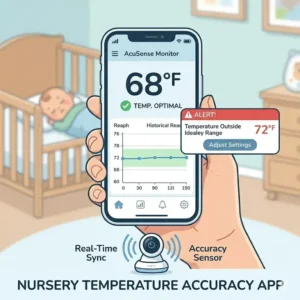
Expert Commentary: What I love about the Hubble is the ability to set “buffer zones” for temperature alerts. Instead of a hard alarm at 72°F, you can set a grace period. This is perfect for houses with central air that kicks on and off, preventing the monitor from screaming every time the thermostat cycles.
Customer Feedback: Users enjoy the built-in flashlight on the parent unit and the games/stories for toddlers, though some find the menu system a bit cluttered.
-
Pros: Touchscreen interface; Physical privacy shield; Remote calibration.
-
Cons: UI has a learning curve; Build quality feels a bit plastic-y.
-
Price Range: $180 – $220 range.
Transformation: How to Optimize Your Nursery for Accuracy
The “Pro-Level” Setup Guide
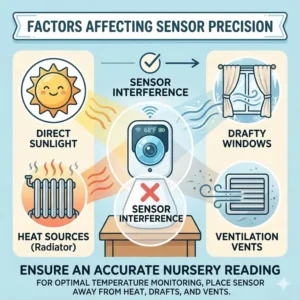
Buying a baby monitor with temperature sensor accuracy is only half the battle. If you mount that high-precision camera directly above a heating vent or right next to a sun-drenched window, the readings will be useless. Here is how to calibrate your nursery like a pro:
-
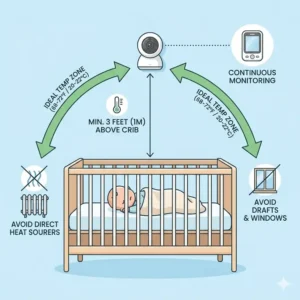
The 3-Foot Rule: Never mount the camera (and its sensor) within 3 feet of an exterior wall or window. These surfaces are thermal bridges that will give you “false cold” in the winter and “false heat” in the summer.
-
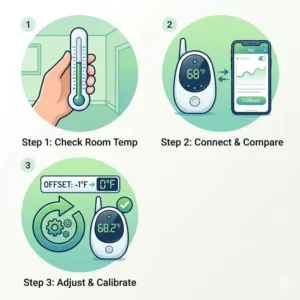
Crib-Level Correlation: Use a secondary, inexpensive analog thermometer placed inside the crib for 24 hours. Compare these readings to your monitor. If your monitor is consistently $2^\circ$ higher, you know how to adjust your mental threshold.
-
Cable Management: For monitors like the Owlet Cam 2, ensure the sensor “pod” on the cable isn’t tucked behind a heavy dresser where air is stagnant. It needs airflow to be accurate.
-
Firmware Updates: If you are using a Wi-Fi monitor, check for updates monthly. Manufacturers often release sensor calibration patches that improve how the software interprets raw thermal data.
Decision Framework: Which Parent Are You?
-
The “Old School” Techie: If you live in an area with spotty internet or simply don’t want your baby’s video on the cloud, go with the Infant Optics DXR-8 PRO. Its dedicated frequency is ultra-reliable.
-
The “Smart Home” Enthusiast: If you want your baby’s room temperature to trigger your smart thermostat (via IFTTT or Matter), the Nanit Pro is the only logical choice.
-
The Budget-Conscious Optimizer: If you want the best “bang for your buck” without sacrificing too much precision, the Eufy SpaceView Pro is the workhorse you need.
Features That Actually Matter (And Those That Don’t)
When shopping for a baby monitor with temperature sensor accuracy, it’s easy to get distracted by “4K resolution” or “AI-generated lullabies.” Let’s filter out the marketing noise and look at what impacts your daily life.
🌡️ Sensor Latency vs. Real-Time Tracking
Most parents don’t realize that temperature sensors have “latency.” If a window blows open, some monitors will take 10 minutes to register the drop. High-end models like the Infant Optics have a latency of under 60 seconds. In my experience, low latency is more important than a pretty screen—especially in extreme climates.
🛡️ Local vs. Cloud Processing
Wi-Fi monitors often process temperature data on a remote server before sending it back to your phone. This can create a delay. Local monitors (FHSS) process the data on the device itself. For the most accurate, real-time alerts, local processing wins every time.
🔋 Impact of Battery Save Modes
Many monitors have a “VOX” or “Eco Mode” that shuts down the screen and certain sensors to save battery. Ensure your chosen monitor continues to track temperature and will wake the screen if a threshold is hit. A monitor that stays silent while the nursery hits 80°F is a paperweight.
Common Mistakes When Buying a Temperature-Sensing Monitor
One of the biggest pitfalls I see is parents buying a monitor based on the “highest temperature range” it can detect. You don’t need a monitor that can detect $150°F (unless your nursery is inside an oven); you need one that is hyper-accurate in the $65\text{–}75°F range.
Another mistake is ignoring Humidity Integration. Temperature and humidity are inextricably linked to “apparent temperature” (how hot it actually feels). If you live in a humid climate like Florida, a room at 72°F can feel like 78°F if the humidity is high. Look for monitors like the Owlet Cam 2 that provide both metrics for a holistic view of comfort.
Long-Term Cost & Maintenance Analysis
When you buy a baby monitor with temperature sensor accuracy, you aren’t just paying for the hardware; you’re investing in a 2-3 year service.
-
Total Cost of Ownership: A “cheap” $60 monitor often has a sensor that fails after 6 months or provides wildly inaccurate data, leading you to buy a standalone thermometer. Investing around $180 upfront for a Eufy or Infant Optics usually saves money in the long run because you won’t need secondary equipment.
-
Maintenance: Dust is the enemy of accuracy. Every month, use a can of compressed air to gently blow out the sensor port on your camera. Dust buildup acts as insulation, making the sensor think the room is warmer than it actually is.
-
Sensor Drift: All thermistors “drift” over time. In 2026, the best monitors allow for a “± Offset” in the settings. This allows you to recalibrate the device as it ages, extending its useful life significantly.
✨ Don’t Miss These Exclusive Deals!
🔍 Take your nursery safety to the next level with these carefully selected products. Click on any highlighted item to check current pricing and availability. These tools will help you create a perfectly temperate environment your family will love!
Conclusion: Peace of Mind is Measured in Degrees
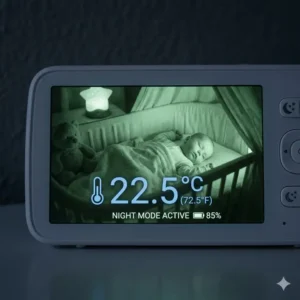
In 2026, the market for a baby monitor with temperature sensor accuracy has never been more competitive. We’ve moved past the days of “close enough” readings. Whether you choose the rugged, offline reliability of the Infant Optics DXR-8 PRO or the high-tech, data-rich ecosystem of the Nanit Pro, the goal remains the same: creating a safe, consistent environment for your child to grow.
The most important takeaway isn’t just which model you buy, but how you use it. Use the “Transformation” tips mentioned above—calibrate your room, avoid thermal bridges, and maintain your hardware. When you combine great tech with smart placement, you gain the ultimate parenting win: the ability to look at your monitor, see that perfect 70°F, and finally close your own eyes for a few hours.
FAQs
❓ How accurate are baby monitor temperature sensors really?
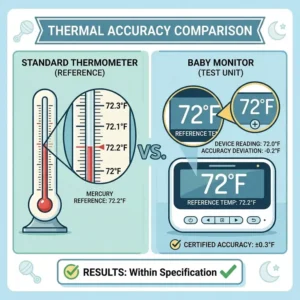
✅ Most mid-to-high-end models are accurate within ± 2°F. However, high-quality units like the Infant Optics DXR-8 PRO can achieve ± 0.5°F accuracy by using external probes that isolate the sensor from the heat generated by the camera’s internal electronics…
❓ Why does my baby monitor say it’s hotter than the thermostat?
✅ This is usually due to “Heat Soak.” Cameras generate heat while operating. If the sensor is too close to the processor, it reads the internal temp instead of the room. Mounting the camera high up also places it in the warmest air in the room…
❓ Can a baby monitor temperature sensor trigger my AC?
✅ Yes, but only with Wi-Fi-enabled smart monitors like the Nanit Pro or Owlet Cam 2. These can often be linked to platforms like Amazon Alexa or Google Home to create “routines” that trigger your smart thermostat…
❓ Is humidity tracking as important as temperature?
✅ For many, yes. High humidity can make a room feel sweltering, while low humidity can dry out a baby’s nasal passages. Monitors that offer both give a much better picture of the actual “sleep climate” of the nursery…
❓ Where is the best place to put the monitor for an accurate reading?
✅ Place the camera on a flat surface about 3 to 5 feet away from the crib, at roughly the same height as the mattress. Avoid corners where air is stagnant and keep it away from direct sunlight and electronics…
Recommended for You
- 7 Best Baby Monitor with Breathing Detection Reviews for 2026 Safety
- Best Baby Monitor with Movement Sensor: Top 7 Expert Picks
- Safe Baby Monitor Options Wireless: 7 Top Picks 2025
Disclaimer: This article contains affiliate links. As an Amazon Associate, I earn from qualifying purchases. If you purchase products through these links, we may earn a small commission at no additional cost to you.
✨ Found this helpful? Share it with your friends! 💬🤗
[addtoany]