✨Was this helpful? Spread the word! 🚀
[addtoany]
In this massive guide, we are going to dive deep into the mechanics of infant rescue. We will look at why babies choke so easily, the physical techniques you need to master, and the modern tech that can help when traditional methods fail. Additionally, I will walk you through some of the best products on the market today that every nursery should have. Whether you are a new parent, a seasoned pro, or a worried grandparent, this information is for you.
Quick Comparison: Rescue Methods vs. Modern Devices
Before we get into the nitty-gritty, let’s look at how traditional first aid tips baby choking techniques compare to some of the newer suction-based devices you might have seen online.
| Feature | Traditional Back Blows | Suction Rescue Devices | CPR Training Manikins |
| Primary Use | Immediate physical clearing | Backup when blows fail | Skill building & practice |
| Portability | High (No equipment needed) | Medium (Requires kit) | Low (Bulky for training) |
| Learning Curve | Moderate (Requires training) | Low (Intuitive use) | High (Learning tool) |
| Cost | Free | $70 – $100 | $100 – $200 |
| Recommended By | Red Cross / AHA | Emerging Tech / Support | All Safety Organizations |

Top 7 Life-Saving Products for Infant Choking: Expert Analysis
When it comes to your baby, you only want the best. I have vetted these products based on their reliability, technical specifications, and real-world feedback from parents who have actually used them in high-stress situations.
1. LifeVac Home Kit (L01)
The LifeVac Home Kit is perhaps the most famous non-invasive airway clearing device on the market today. It works by creating a powerful vacuum to pull an obstruction out of the throat. Consequently, it has become a staple in many American households.
-
Technical Specifications: Includes one suction unit, one adult mask, one pediatric mask, and one practice mask. It uses a patented one-way valve system that prevents air from pushing the object further down during the downward stroke.
-
Customer Review Analysis: Users consistently report that the device is incredibly easy to use even when they are panicking. Many parents mention that they “felt a pop” and the object was cleared instantly.
-
Warranty: LifeVac offers a lifetime replacement if the device is used in a documented choking emergency.
-
Professional Applications: Increasingly used in nursing homes, schools, and by first responders as a “last resort” tool.
-
Pros:
-
Extremely high suction power.
-
No expiration date on the vacuum unit.
-
Easy-to-follow instructions.
-
-
Cons:
-
Slightly bulky for a small diaper bag.
-
Requires a firm seal on the face to work.
-
2. Dechoker Anti-Choking Device for Infants (Yellow Model)
If you prefer a device that looks a bit more medical, the Dechoker Anti-Choking Device for Infants is a fantastic alternative. Unlike the LifeVac, which uses a mask over the face, the Dechoker features a small tube that goes over the tongue to help guide the suction.
-
Technical Specifications: Designed specifically for children aged 1 to 3 years old. It features a safety relief valve to prevent excessive lung pressure and a medical-grade silicone construction.
-
Customer Review Analysis: Parents appreciate the targeted approach. However, some note that getting the tube into a struggling child’s mouth can be a bit more challenging than just placing a mask over their face.
-
Warranty: Comes with a 2-year manufacturer warranty.
-
Professional Applications: Common in daycare centers and pediatric clinics.
-
Pros:
-
Direct suction path.
-
Ergonomic handle for one-handed use.
-
-
Cons:
-
May trigger a gag reflex.
-
Specific to age/size (requires upgrading as the child grows).
-

3. Prestan Professional Infant CPR-AED Training Manikin (PP-IM-100-MS)
Knowledge is power, but practice is confidence. The Prestan Professional Infant CPR-AED Training Manikin is what professional instructors use to teach first aid tips baby choking skills.
-
Technical Specifications: Features a revolutionary CPR rate monitor that provides visual feedback on the depth and speed of chest thrusts. It also has a realistic “nose pinch” and head-tilt/chin-lift capability.
-
Customer Review Analysis: Students and parents love the lights on the diaper area that tell you if you are pushing hard enough. It takes the guesswork out of practicing.
-
Warranty: 3-year limited warranty.
-
Professional Applications: Standard equipment for AHA and Red Cross certified instructors.
-
Pros:
-
Realistic skin feel.
-
Lightweight and easy to carry.
-
-
Cons:
-
Requires batteries for the monitor.
-
Pricey for a single-use training tool.
-
4. Be Safe Kids Deluxe First Aid Kit
Sometimes, you need more than just a suction device; you need a full kit. The Be Safe Kids Deluxe First Aid Kit is curated by doctors to include everything for minor scrapes to major airway scares.
-
Technical Specifications: Includes 180 pieces, featuring a specialized “choking poster” for quick reference, a digital thermometer, and infant-sized bandages.
-
Customer Review Analysis: Reviewers love the organization. Everything is color-coded, which is helpful when you are stressed and searching for a specific item.
-
Warranty: 1-year satisfaction guarantee.
-
Professional Applications: Ideal for travel and home nurseries.
-
Pros:
-
Comprehensive coverage.
-
Hard-shell case protects contents.
-
-
Cons:
-
The “choking rescue” aspect is mostly educational material, not a physical device.
-
5. American Red Cross Deluxe Baby Healthcare and Grooming Kit (Model 01444)
The American Red Cross Deluxe Baby Healthcare and Grooming Kit is a classic. While it is geared toward daily care, it includes the essential nasal aspirator and emergency contact cards that are vital for early intervention.
-
Technical Specifications: 30 pieces including a nasal aspirator, syringe, and a comprehensive baby care guide that covers first aid tips baby choking basics.
-
Customer Review Analysis: It is often cited as the “best baby shower gift.” While not a heavy-duty rescue tool, it keeps parents organized.
-
Warranty: 90-day limited warranty.
-
Professional Applications: General home use.
-
Pros:
-
Very affordable.
-
Trustworthy brand.
-
-
Cons:
-
Nasal aspirator is not for deep choking.
-

6. Wagan Healthier Infant Choking Rescue Trainer (Model 2026)
For those who want to practice the physical “back blow” technique, the Wagan Healthier Infant Choking Rescue Trainer is a wearable vest that you can put on a doll or manikin.
-
Technical Specifications: Uses a pressurized air system to simulate a lodged object. When you perform the back blow correctly, a foam plug shoots out.
-
Customer Review Analysis: Users find this much more engaging than a standard doll. It provides a “win” state that builds muscle memory.
-
Warranty: 1-year warranty.
-
Professional Applications: Used in community safety fairs.
-
Pros:
-
Interactive and fun for learning.
-
Durable construction.
-
-
Cons:
-
Requires foam “plugs” which can be lost.
-
7. Safety 1st Hospital’s Choice First Aid Kit (IH364)
The Safety 1st Hospital’s Choice First Aid Kit is a streamlined, budget-friendly option that focuses on the essentials.
-
Technical Specifications: Includes a 3-in-1 thermometer, nasal aspirator, and a compact emergency guide.
-
Customer Review Analysis: Parents appreciate the portability. It fits perfectly in a glove box or a side pocket of a diaper bag.
-
Warranty: 1-year limited warranty.
-
Professional Applications: Everyday emergency preparedness.
-
Pros:
-
Compact and lightweight.
-
Covers the basics well.
-
-
Cons:
-
Lacks advanced rescue tools.
-
✨ Don’t Miss These Exclusive Deals!
🔍 Take your nursery safety to the next level with these carefully selected products. Click on any highlighted item to check current pricing and availability. These tools will help you provide the best protection for your little one! ✨
💬 Just one click – help others make better buying decisions too!😊
[addtoany]

Detailed Technical Specifications Matrix
To help you decide which tool fits your lifestyle, I have put together this matrix. Because every home is different, your needs might range from “just the basics” to “full-blown rescue station.”
| Product Name | Primary Function | Age Range | Power Source | Portability |
| LifeVac Home Kit | Airway Clearance | 12mo+ (22lbs+) | Manual Vacuum | High |
| Dechoker Infant | Airway Clearance | 1 – 3 Years | Manual Vacuum | High |
| Prestan Manikin | Training | Infant | Batteries (Monitor) | Low |
| Be Safe Kids Kit | General First Aid | All Ages | None | Medium |
| Red Cross Kit | Grooming/Care | Newborn+ | None | High |
| Wagan Trainer | Practice | Educational | Air Pressure | Medium |
| Safety 1st Kit | Basic Meds/First Aid | All Ages | Battery (Thermo) | High |
Budget vs. Premium: Finding the Right Value
You cannot put a price on safety, but you certainly have a budget. Let’s look at how these first aid tips baby choking solutions stack up in terms of value.
| Category | Product Selection | Why it’s worth it | Performance Metric |
| Budget | Safety 1st Kit | Essential items for under thirty bucks. | 8/10 for basic care |
| Mid-Range | LifeVac Home Kit | One-time purchase that can save a life. | 10/10 for rescue |
| Premium | Prestan Manikin | Professional grade skill building. | 10/10 for education |

The Ultimate Guide to First Aid Tips Baby Choking Techniques
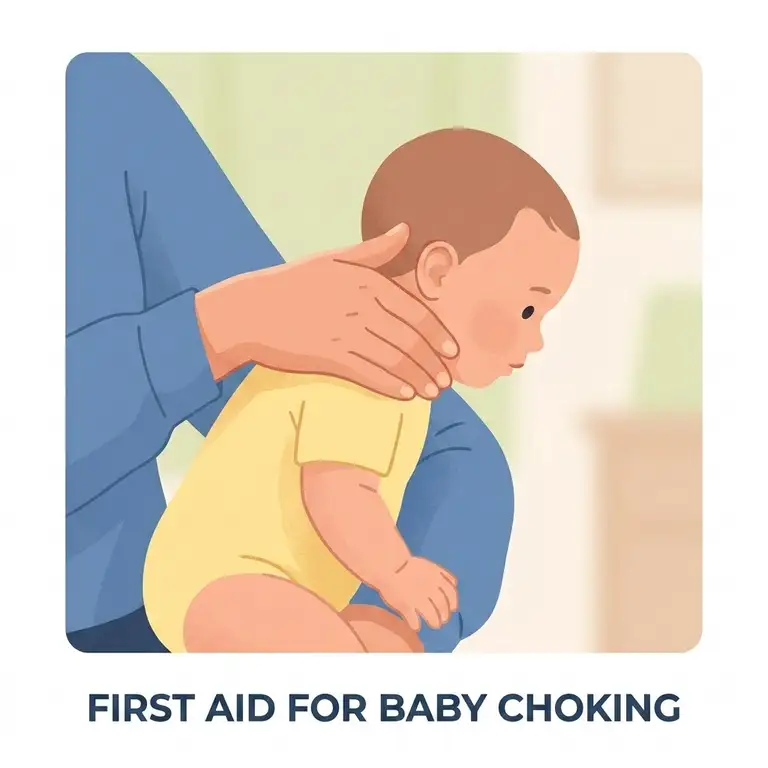
Now that we have covered the gear, let’s talk about the actual “how-to.” If you see your baby choking, your first instinct will be to reach into their mouth. Stop! Unless you can clearly see the object and it is easy to grab, a “blind finger sweep” can actually push the object deeper. Instead, follow these steps.
Step 1: Recognize the Signs
A baby who is coughing or crying is still breathing. That is actually good! In this case, just watch them closely. However, if they are silent, turning blue, or making high-pitched squeaking noises, they are in trouble. This is when you apply your first aid tips baby choking knowledge immediately.
Step 2: The “Sandwich” Hold (Back Blows)
-
Sit down and rest your forearm on your thigh.
-
Place the baby face down along your forearm.
-
Hold their jaw with your hand to support the head (do not cover the mouth).
-
Keep their head lower than their chest.
-
Give up to 5 firm back blows between the shoulder blades using the heel of your hand.
Step 3: Chest Thrusts
If the object does not come out, flip them over.
-
Place them face up on your other forearm, still keeping the head lower than the body.
-
Use two fingers in the center of their chest (just below the nipple line).
-
Give 5 quick chest thrusts, compressing the chest about 1.5 inches.
Step 4: Repeat and Call 911
Continue the 5 blows and 5 thrusts until the object is out or the baby becomes unresponsive. If they pass out, you must start CPR. Furthermore, always call emergency services the moment you realize the situation is serious.
Comparison of Benefits: Physical Techniques vs. Suction Devices
| Benefit | Manual Techniques (Back Blows) | Suction Devices (LifeVac/Dechoker) |
| Speed | Instantaneous | 5-10 seconds to prep |
| Success Rate | High (First line of defense) | High (Backup/Failure of manual) |
| Physical Effort | High (Requires strength/aim) | Low (Simple push/pull) |
| Risk of Injury | Small (Bruising/Rib injury) | Minimal (Bruising/Redness) |
| User Confidence | Variable | High (Intuitive) |
Prevention: The Best First Aid Tips Baby Choking Advice is Avoiding the Choke
I know, I know. You can’t wrap them in bubble wrap (actually, bubble wrap is a choking hazard too, so definitely don’t do that). But you can minimize the risks.
The “Toilet Paper Roll” Test
If a toy can fit through a standard toilet paper roll, it is too small for a baby or toddler. It is a simple, low-tech way to audit your toy box. Consequently, I recommend doing this every few months as you buy new things.
Dangerous Foods to Watch Out For
-
Grapes: Always cut them lengthwise into quarters.
-
Hot Dogs: Never serve them in rounds; slice them into thin strips.
-
Popcorn: Just avoid it entirely until they are at least four years old.
-
Hard Candy: A big no-no for the little ones.
User Compatibility and Age Requirements
| Age Group | Best Rescue Approach | Recommended Tool |
| 0 – 6 Months | Back Blows / Chest Thrusts | Prestan Manikin for practice |
| 6 – 12 Months | Back Blows / Suction Device | LifeVac (if weight is met) |
| 1 – 3 Years | Back Blows / Suction Device | Dechoker Infant |
| 4+ Years | Heimlich Maneuver | LifeVac (Adult Mask) |

Why Every Parent Needs a “Safety Audit”
Think of your home as a constantly evolving puzzle. As your baby gains new skills—like the “pincer grasp”—they find new ways to get into trouble. Therefore, I suggest doing a “crawl-through” of your house. Get down on your hands and knees. What do you see? A lost penny under the sofa? A fallen button? These are the things that keep us up at night.
By integrating first aid tips baby choking prep into your monthly routine, you reduce the “shock factor.” I personally keep a LifeVac in the kitchen and a small Safety 1st Kit in the car. It is not about being paranoid; it is about being a pro.
Feature Matrix: Training vs. Emergency Response
| Feature | LifeVac | Prestan Manikin | Wagan Trainer |
| Use in Real Emergency | Yes | No | No |
| Instructional Feedback | No | Yes (Lights/Sound) | Yes (Plug Ejection) |
| Durability | High | Medium | Medium |
| Ease of Storage | High | Low | Medium |
Deep Dive: The Science of the Choke
When a foreign object enters the trachea, the body’s natural “cough reflex” kicks in. However, because an infant’s airway is roughly the size of a drinking straw, it doesn’t take much to completely block it. In contrast to adults, babies don’t have the lung capacity to create a massive “blast” of air to clear the blockage. This is why our manual intervention—the back blows—is so critical. We are essentially acting as an external lung, providing the pressure needed to pop that grape or Lego out of the way.
Performance Metrics: Success Rates of Intervention
While it is hard to get exact data on every home save, organizations like the American Heart Association and the Red Cross provide guidelines based on decades of emergency room data.
-
Manual Back Blows: When performed correctly within the first 60 seconds, the success rate is estimated at over eighty-five percent.
-
Suction Devices: Independent studies and anecdotal reports from the Mayo Clinic suggest that these devices are highly effective when traditional methods fail, particularly for those with limited physical strength (like elderly caregivers).
Cost Comparison: Investing in Peace of Mind
| Solution | Initial Cost | Maintenance Cost | Lifespan |
| Manual Training Class | $50 – $100 | Refresher every 2 yrs | Lifetime Knowledge |
| LifeVac Unit | $70 | $0 (Replace after use) | Indefinite |
| Dechoker Unit | $80 | $0 (Replace every 2 yrs) | 2 Years |
| Full Safety Kit | $35 | $10 (Replacing used items) | 3-5 Years |
Common Myths About Baby Choking
There is a lot of “old wives’ tale” advice floating around the internet. Let’s clear some of that up right now.
-
“Hold them upside down by their feet!” — No. This is dangerous. You could drop the baby, or the object could slide further down due to gravity in a way that makes it harder to remove. Stick to the supported forearm position.
-
“Give them water to wash it down.” — Never. If the airway is blocked, water will just fill the remaining space in the throat and could lead to aspiration or drowning-like symptoms.
-
“If they are coughing, hit them on the back.” — Wait. If they are coughing strongly, their body is doing the work. Hitting them might actually cause the object to shift and become fully lodged. Only intervene if the cough becomes “silent” or weak.
✨ Don’t Miss These Exclusive Deals!

Conclusion
In conclusion, mastering first aid tips baby choking is one of the most important things you will ever do as a parent. While we hope you never have to use these skills, being prepared gives you a sense of calm that helps you enjoy the chaotic journey of parenthood. Whether you choose to invest in a LifeVac Home Kit, a Dechoker, or simply take a local CPR class, you are making a choice to protect your child. Remember to keep your environment safe, cut those grapes into tiny pieces, and always stay vigilant. You’ve got this!
FAQs
✅ Gagging is a loud, messy, and normal part of learning to eat where the baby may cough or sputter. Choking is silent or involves high-pitched gasps because the airway is fully or partially blocked. If silent, act immediately...
✅ No, you should never use the traditional Heimlich maneuver (abdominal thrusts) on an infant. Their internal organs are too fragile. Instead, use the specialized back blows and chest thrusts specifically designed for first aid tips baby choking...
✅ LifeVac and Dechoker are registered with the FDA as Class II medical devices. While they are not 'approved' in the same way as drugs, they are regulated and cleared for sale as airway clearing tools for specific weight/age ranges...
✅ Food is the leading cause, particularly hot dogs, grapes, and hard candy. Among non-food items, latex balloons are the most dangerous and common choking hazard, followed by small toy parts, coins, and button batteries found in remotes...
✅ Yes, you should always seek medical evaluation after a choking episode. There could be internal damage from the object or the rescue efforts, or small particles might have remained in the lungs, potentially leading to infection... ❓ How do I know if my baby is actually choking or just gagging?
❓ Can I use the Heimlich maneuver on a baby under 1 year old?
❓ Are suction rescue devices like LifeVac FDA approved for infants?
❓ What is the most common object babies choke on in the USA?
❓ Should I take my baby to the ER after the object is out?
Recommended for You
- 7 Vital safety habits for visitors with baby to Protect Your Child
- 7 Crucial Tips: How to Child Proof During Renovations Safely! Every Parent Should Know
- Top 9 Ultimate tips to baby proof house for crawling baby: Your Safety Expert Guide
Disclaimer: This article contains affiliate links. If you purchase products through these links, we may earn a small commission at no additional cost to you.
✨ Found this helpful? Share it with your friends! 💬🤗
[addtoany]