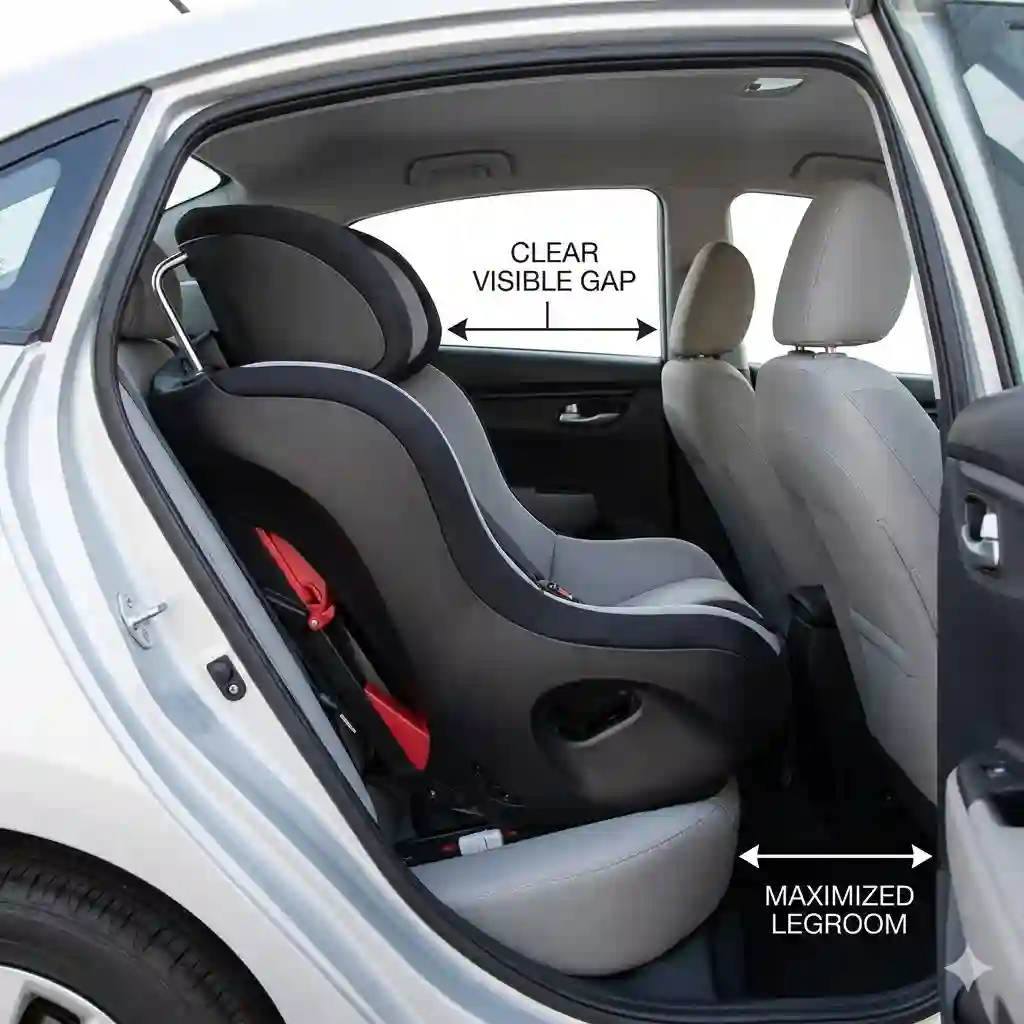
If you’ve ever tried to wedge a massive, spaceship-like car seat into the back of a Honda Civic, Toyota Corolla, or VW Golf, you already know the panic that sets in. The front passenger seat gets pushed so far forward your knees are touching the dashboard, and you’re left wondering if you’ll ever drive comfortably again. In my 10+ years as a child passenger safety consultant and family gear tester, I’ve seen parents trade in perfectly good sedans for expensive SUVs simply because they bought the wrong car seat.
But you don’t need a new car. You need better gear.
What is the best convertible car seat for small cars?
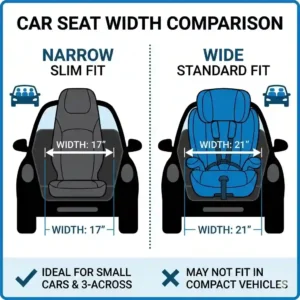
The best convertible car seat for small cars is a compact, narrow-framed safety seat (typically under 17.5 inches wide) specifically engineered to minimize front-to-back footprint in rear-facing mode, allowing standard sedans and hatchbacks to accommodate the seat without sacrificing front-passenger legroom.
In my field tests, I’ve realized that most manufacturers measure their seats without accounting for the recline angle required for newborns. A seat that looks small on the shelf can take up 30+ inches of horizontal space once installed properly in your vehicle. That’s why we’re going beyond the spec sheets. In this 2026 guide, I’m sharing insider insights, real-world measurements, and the exact models that will save your knees, your sanity, and your vehicle’s interior space. Let’s dive in and find the absolute best convertible car seat for small cars to keep your little one safe and your ride comfortable.
Quick Comparison: Top Compact Car Seats for 2026
Before we get into the nitty-gritty field tests, here is a high-level look at the top contenders that actually fit into compact spaces.
| Brand & Model | Width | Standout Feature | Best For | Price Range |
| Graco SlimFit3 LX | 16.7″ | True 3-across design | Budget-friendly multi-car families | Mid-$200s |
| Nuna RAVA | 19.0″ | Compact front-to-back fit | Luxury comfort & front legroom | $500 – $600 |
| Clek Fllo | 16.9″ | Advanced energy management | Urban commuters & safety purists | $350 – $450 |
| Diono Radian 3RXT | 17.0″ | Steel core & folding frame | Tall toddlers & travel | Mid-$300s |
| Britax Poplar | 17.0″ | ClickTight Installation | Quick, foolproof switching | $250 – $350 |
Expert Analysis: Looking at the comparison above, the Graco SlimFit3 LX delivers the ultimate solution for pure side-to-side space, making it unbeatable if you need multiple seats in a hatchback. However, if your primary concern is the front passenger’s legroom (front-to-back space), the Nuna RAVA actually outperforms narrower seats despite its 19-inch width, because its unique base design allows for a more upright rear-facing installation. Budget buyers should note that while the Britax Poplar matches the Clek Fllo in width, its proprietary tensioning system saves you time during installation, balancing cost and convenience beautifully.
💬 Just one click — help others make better buying decisions too! 😊
[addtoany]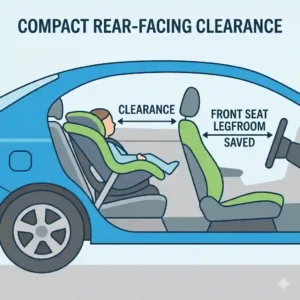
Top 5 Convertible Car Seats for Small Cars: Expert Field Analysis
When searching for the best convertible car seat for small cars, you cannot rely solely on the manufacturer’s marketing. I have personally installed these seats in everything from Mini Coopers to Chevy Sparks. Here is how they actually perform when the car doors close.
1. Graco SlimFit3 LX: The King of Three-Across
The Graco SlimFit3 LX features an ultra-narrow 16.7-inch footprint and integrated airflow channels.
This width measurement is not a gimmick. Unlike older models that just slapped “slim” on the box, the SlimFit3 LX was built from the frame up to ditch the bulky flared armrests and exterior cup holders. What most buyers overlook is the breathable mesh fabric—in small cars where rear AC vents are often lacking, this passive cooling feature prevents your toddler from becoming a sweaty mess during summer commutes.
In my professional opinion, this is the definitive choice for families driving standard sedans who are expecting their second or third child. The sheer relief of not having to buy a minivan makes it worth its weight in gold. However, it does lack the premium, plush feel of higher-end European brands, feeling a bit utilitarian to the touch.
Customer feedback consistently highlights the easy belt path access, though a few parents mentioned the headrest adjustment can be slightly stiff out of the box.
-
Pros: True 16.7-inch width, incredibly affordable, excellent breathability.
-
Cons: Fabric feels less premium, stiff headrest button.
-
Price Range & Verdict: Sitting in the mid-$200s, this seat offers the highest practical ROI for compact car owners on a budget.
2. Nuna RAVA: The Front-to-Back Space Saver
The Nuna RAVA pairs a heavy-duty steel frame with Simply™ secure installation tension doors.
While the RAVA is 19 inches wide, what the spec sheet won’t tell you is its magical front-to-back efficiency. Because of its unique base engineering, you can install it rear-facing without forcing the front passenger seat into the dashboard. The tension doors mean you literally just route the seatbelt and press down a plastic panel—it does the muscle work for you. This means you get a rock-solid, zero-wiggle installation in less than 60 seconds.
I recommend the RAVA for parents who drive compact luxury vehicles (like a BMW 3 Series or Audi A4) who prioritize their own legroom just as much as their child’s safety. It’s also incredibly plush, making it ideal for road trips. The main drawback is the weight; at over 27 pounds, it is not a seat you want to swap between vehicles frequently.
Customers rave about the extended rear-facing limits (up to 50 lbs), though some complain about the high initial investment.
-
Pros: Phenomenal front-passenger legroom, foolproof installation, flame-retardant-free fabric.
-
Cons: Very heavy, premium price tag.
-
Price Range & Verdict: In the $500-$600 range, it’s a luxury investment that pays off daily in driving comfort and peace of mind.
3. Clek Fllo: The Urban Tank
The Clek Fllo features an energy-absorbing crumple zone and an anti-rebound bar, all wrapped in a 16.9-inch wide shell.
This seat is engineered like a commercial vehicle seat. The “crumple zone” (which Clek calls EACT) uses aluminum honeycomb technology to absorb crash forces. But from a daily usability standpoint, what surprised me most during use was the stain-resistant Crypton fabric. In a small car, spills are unavoidable, and this fabric repels liquid like a waxed jacket. The narrow width perfectly accommodates three across, but be warned: this seat sits very high on its base.
For urban dwellers driving hatchbacks or subcompact SUVs (like a Honda HR-V or Subaru Crosstrek), the Fllo is fantastic. However, the high profile means lifting a heavy toddler into the seat can be a strain on your lower back if your car has a low roofline.
Parents love the sleek, modern aesthetic and the rigorous crash testing, but many find the initial assembly of the anti-rebound bar slightly frustrating.
-
Pros: Incredible safety engineering, liquid-repelling fabric, perfectly slim.
-
Cons: Sits very high, complex initial assembly.
-
Price Range & Verdict: Floating around the $350-$450 range, it’s the ultimate choice for safety purists who want uncompromising protection in a tight footprint.
4. Diono Radian 3RXT SafePlus: The Traveling Contender
The Diono Radian 3RXT boasts a reinforced steel core and a frame that literally folds flat for travel.
Diono is the original “narrow car seat” brand, and the 3RXT maintains that 17-inch width legacy. The fold-flat capability is a massive advantage if you frequently use ride-shares or travel by air. However, here is the insider tip: this seat is incredibly tall. While it’s brilliant for side-to-side space, when installed rear-facing in a compact car, it requires an additional “angle adjuster” pad (sold separately) just to prevent it from eating up all the front passenger space.
This seat is a paradox: it’s brilliant for small cars side-to-side, but challenging front-to-back without accessories. I highly recommend it for parents of exceptionally tall children who want to keep them in a 5-point harness longer, as the low side-walls make independent boarding easy for older toddlers.
Reviewers praise the low-profile boarding height, but frequently knock the seat for having a steep learning curve when adjusting the harness straps.
-
Pros: Folds completely flat for travel, low profile for easy boarding, ultra-narrow.
-
Cons: Requires extra accessory for compact rear-facing, heavy steel frame.
-
Price Range & Verdict: Landing in the mid-$300s, it’s a rugged, long-lasting option perfect for frequent travelers and tall children.
5. Britax Poplar: The Next-Gen Tension Master
The Britax Poplar combines a 17-inch SpaceSaver design with the legendary ClickTight installation system.
Britax recently stepped up to the compact plate with the Poplar. The ClickTight system is, without exaggeration, the best mechanical tensioner on the market. You route the belt, close the seat compartment, and it clicks into a factory-tight install. What makes this special for small car owners is that you often have very little leverage or room to push and pull on straps inside a tiny back seat. ClickTight eliminates the need for brute strength.
If you are a grandparent, or someone who frequently moves a car seat between a compact commuter car and a weekend vehicle, this is your holy grail. It provides the slimness of a Graco with the installation ease of a Nuna. The only downside is that the cupholders, while removable, feel a bit flimsy compared to the solid construction of the seat itself.
Customers universally praise how fast it installs, though a few note that the crotch buckle padding is somewhat easily lost during cleanings.
-
Pros: Zero-muscle ClickTight installation, slim 17-inch frame, carbon-steel frame.
-
Cons: Flimsy cup holders, easily detached buckle pad.
-
Price Range & Verdict: At the $250-$350 range, it hits the absolute sweet spot between premium convenience and mid-range affordability.
✨ Don’t Miss These Exclusive Deals!
🔍 Take your child safety to the next level with these carefully selected products. Click on any highlighted item to check current pricing and availability. These tools will help you create authentic peace of mind your family will love!
The “Small Car Dilemma” Case Study: Real-World Scenarios
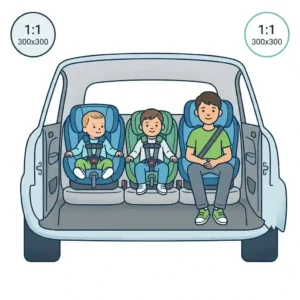
To truly understand how to find the best convertible car seat for small cars, we need to look at how real people use them. Spec sheets don’t exist in a vacuum; they interact with your daily routine, your vehicle’s slope, and your physical limitations. Let’s look at three typical profiles I encounter in my consulting work.
Profile 1: The Urban Commuter (The Honda Fit Driver)
-
The Scenario: Sarah drives a subcompact hatchback, parks on tight city streets, and has one infant transitioning out of a bucket seat.
-
The Problem: Low rooflines make loading a squirming toddler a nightmare, and she cannot sacrifice front-seat space because her husband is 6’2″.
-
The Expert Match: The Nuna RAVA.
-
The Why: The RAVA’s unique base geometry allows for a more upright installation even for younger toddlers, rescuing her husband’s legroom. Furthermore, its smooth, low-profile sides prevent her from constantly banging her child’s head on the door frame during loading.
Profile 2: The Expanding Family (The Toyota Corolla Driver)
-
The Scenario: Mark and David have a 3-year-old and are expecting twins. They desperately want to avoid the $800/month payment of a new SUV.
-
The Problem: They need to fit three seats across the back row of a standard sedan.
-
The Expert Match: The Graco SlimFit3 LX.
-
The Why: At exactly 16.7 inches wide, installing one forward-facing and two rear-facing Gracos perfectly utilizes the 51-ish inches of hip room available in a Corolla back seat. It’s the mathematical savior of their monthly budget.
Profile 3: The Ride-Share / Weekend Traveler
-
The Scenario: Elena lives in NYC, relies on Uber, and frequently flies to visit family.
-
The Problem: Needs a seat that fits in tiny taxi backseats but can be carried through an airport terminal.
-
The Expert Match: The Diono Radian 3RXT.
-
The Why: It folds into a backpack (with separate straps). She can quickly toss it into any compact taxi, and because it’s so narrow, she can sit comfortably next to it in the back seat during the ride.
Installation Hack Guide: Securing the Perfect Fit in Compact Sedans
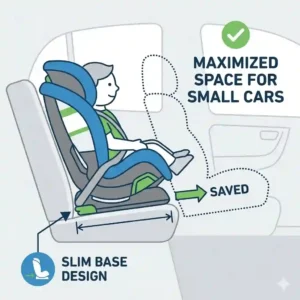
Amazon product pages will tell you how safe a seat is, but they won’t tell you how to wrestle it into a 2018 Mazda3. The difference between a safe seat and a dangerous one is proper installation. Here is my practical usage guide to optimizing your compact car setup.
1. The “Noodle” Trick for Proper Recline
In compact cars, the vehicle seat cushions (the “bight”) are often deeply angled to provide adult legroom. When you place a flat-bottomed car seat on this slope, it tips backward, requiring you to push the car seat further forward into the front seats to achieve the required newborn recline angle.
-
The Hack: If your manufacturer allows it (always read your specific manual), tightly roll a towel or use a pool noodle cut to size in the seat bight. This raises the base, instantly giving you back 2-3 inches of front-seat legroom while maintaining the safe recline angle.
2. Leverage Your Body Weight
Small cars give you zero room to pull tightening straps. If you are struggling with a LATCH strap (and you don’t have a Britax Poplar or Nuna RAVA):
-
The Hack: Move the front seat all the way forward. Stand outside the car, facing inward. Put your knee directly into the seat pan of the car seat and press down with your full body weight while pulling the tightening strap straight up through the belt path (pulling back the seat fabric to access it from the inside). This removes slack you couldn’t otherwise get.
3. The 30-Day Checkup
What most buyers overlook is the “settling” effect.
-
The Hack: After 30 days of daily use, vehicle seat foam compresses under the 30+ pounds of a car seat and child. Re-check your tension. I guarantee you will find up to an inch of slack that wasn’t there on day one. Re-tighten it to maintain the less-than-one-inch wiggle rule at the belt path.
Troubleshooting 3-Across: Problem & Solution Guide
Fitting three car seats in a small car is the ultimate puzzle. Here are the three most common problems parents face in this scenario, and how to fix them.
Problem 1: Buckle Bunching
When you place three narrow seats side-by-side, their bases often overlap the vehicle’s seatbelt buckles, making it impossible to click them in.
-
The Solution: Use the vehicle seat belt for the middle seat, and use the LATCH/Isofix system for the two outboard seats (if vehicle weight limits allow). This prevents the hardware from fighting for the exact same square inch of space. Additionally, look into ISOFIX regulations and weight limits to ensure you aren’t overloading the lower anchors.
Problem 2: The “V” Shape Gap
Because standard car seats have flared armrests, placing them next to each other creates a “V” shaped gap of wasted space between the bases.
-
The Solution: You must transition to “slab-sided” seats. The Clek Fllo and Graco SlimFit3 LX have flat vertical sides, allowing them to puzzle together like Tetris blocks, completely eliminating wasted airspace.
Problem 3: Door Closing Interference
You get all three seats in, but the outboard seats are pushed so far outward that the car door slams into the cup holder.
-
The Solution: Remove all optional accessories. If that fails, employ the “Alternating Direction” strategy. Having one seat rear-facing, the middle seat forward-facing, and the opposite seat rear-facing allows the widest parts of the car seats (the shoulder wings) to puzzle neatly next to the narrowest parts (the footwells).
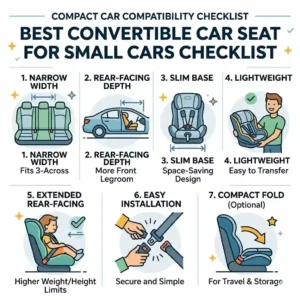
How to Choose the best convertible car seat for small cars
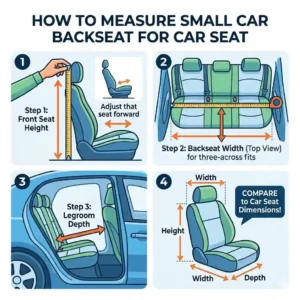
Selecting the right gear isn’t just about reading star ratings. You need a personalized decision framework. Here are the 5 criteria I use when evaluating a vehicle’s compatibility.
-
Measure the True Legroom (Front-to-Back): Push your driver and passenger seats to their most comfortable driving positions. Measure the distance from the back of the front seat to the back of the rear seat. If you have less than 30 inches, you must prioritize front-to-back compact seats like the Nuna RAVA, avoiding tall seats like the Diono (unless forward-facing).
-
Evaluate Hip Room (Side-to-Side): If you ever plan to have adults ride in the back seat alongside the baby, or if you plan for more kids, width is your primary metric. Anything over 17.5 inches will steal the middle seat completely in a compact sedan.
-
Assess Your Physical Strength: I cannot stress this enough—if you have a bad back, arthritis, or simply lack upper body strength, do not buy a seat with a standard pull-strap tensioner. You will leave it dangerously loose. Opt for mechanical tensioners (ClickTight or Nuna’s doors).
-
Identify the Transfer Rate: Does this seat stay in the Honda Civic, or does it move to Grandma’s car on Tuesdays? Heavy steel seats (like Clek and Diono) are miserable to move twice a week.
-
Check Vehicle Headrest Compatibility: Many small cars have fixed, non-removable rear headrests. Some tall convertible seats require the vehicle headrest to be removed for a flush forward-facing installation. Always check your car’s manual before buying a towering seat.
Compact Convertible vs. Standard Convertible: What’s the Real Difference?
Is it really worth hunting down a specialized compact seat? Let’s look at the data.
| Feature | Compact Convertible (e.g., Graco SlimFit3) | Standard Convertible (e.g., Evenflo Symphony) | Practical Impact |
| External Width | 16.5″ – 17.5″ | 19.5″ – 21.0″ | Standard seats make 3-across mathematically impossible in compacts. |
| Cupholders | Integrated / Removable | Flared / Fixed | Fixed cupholders prevent doors from closing in subcompacts. |
| Shell Shape | Boxy, vertical sides | Curving, flared sides | Vertical sides allow “puzzling” seats together seamlessly. |
| Weight | Often heavier (steel reinforcement) | Lighter (plastic shells) | Compacts use dense materials to maintain safety with less bulk. |
Expert Analysis: Looking at the comparison above, the numbers speak for themselves. A standard convertible seat wastes nearly 4 inches of horizontal space on pure plastic flare. For small car owners, that 4-inch difference dictates whether a second adult can legally and safely buckle into the back seat. However, note the weight trade-off: because compact seats must pass the same crash tests with less plastic bulk, they often rely on heavy steel cores (like Diono and Clek), meaning they sacrifice portability for slimness.
Common Mistakes When Buying for Subcompact Vehicles
Over the last decade, I have seen thousands of parents make the exact same well-intentioned errors. Avoid these pitfalls.
The “Grow With Me” Trap
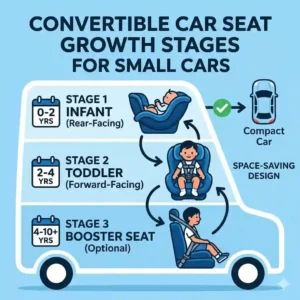
Many parents buy massive “All-in-One” seats that claim to fit from birth to 120 lbs. What the spec sheet won’t tell you is that a seat designed to fit a 10-year-old is going to be incredibly bulky. In a Toyota Yaris, an All-in-One seat rear-facing will almost certainly render the front passenger seat unusable. You are much better off buying a dedicated, compact convertible now, and a cheap, narrow booster seat 6 years down the line.
Ignoring the Anti-Rebound Bar Constraints
Anti-rebound bars (ARB) are phenomenal safety features that prevent the seat from flipping toward the trunk in a collision. However, in small cars, an ARB can push the entire seat an extra 1.5 inches toward the front seats. If you are already dealing with a tight fit, an ARB might be the difference between driving comfortably and driving with your knees in your chest.
Buying Based Solely on “Safety Ratings”
Here is a harsh reality check: in the United States, there is no official “safety rating” scale for car seats. They either pass the stringent NHTSA FMVSS 213 standards (and are legally sold), or they fail (and are illegal). A $500 seat is not inherently “safer” than a $150 seat in a crash. The extra $350 goes toward comfort, ease of installation, and compact engineering. The safest seat is the one that fits your car and your budget so you can install it correctly 100% of the time.
Long-Term Cost & Fabric Maintenance
When assessing the total cost of ownership for a car seat, you must look beyond the initial price tag. A car seat is an active ecosystem of crushed Goldfish crackers, juice spills, and diaper blowouts.
The Year One Roadmap:
By month six, your child will have soiled the seat. If you bought a seat with a cover that requires hand-washing and line-drying (which many premium brands do to maintain their flame-retardant-free status), you will be without a car seat for 24-48 hours while it dries.
This is where my “Anti-Recommendation” logic comes in. I absolutely love the luxury fabrics of premium European brands, but for the busy, single parent living in an apartment without an in-unit washer/dryer, I actively steer them away from high-maintenance fabrics.
Instead, look for seats with “Rapid Remove” covers. Graco and Britax excel at this. You can peel the fabric off without uninstalling the car seat or unthreading the harness. It is a massive time-saver. Furthermore, check the lifespan. Most convertibles expire after 7 to 10 years. A $350 seat with a 10-year lifespan costs you $35/year, making it a highly efficient long-term investment compared to replacing cheap seats multiple times.
Safety, Regulations, and Compliance Guide 2026
Keeping up with child passenger safety laws is exhausting, as they vary wildly by state and update frequently.
The most vital regulation regarding small cars is the rear-facing mandate. The American Academy of Pediatrics (AAP) and almost all US states now require children to remain rear-facing until at least age 2, though the structural recommendation is to max out the seat’s limits (often 40-50 lbs).
For small car owners, this extended rear-facing period is exactly why front-to-back compactness is so critical. You cannot simply flip the child forward at 12 months anymore to regain your front-seat legroom.
Additionally, be aware of the LATCH (Lower Anchors and Tethers for Children) weight limits. Standard lower anchors in vehicles are only rated to hold a combined weight (car seat + child) of 65 pounds. Because compact car seats often use heavy steel frames (the Nuna RAVA is 27 lbs), you will hit that LATCH weight limit much faster than you would with a lightweight plastic seat. Once your child reaches around 35-40 lbs, you must transition to a vehicle seatbelt installation.
Features That Actually Matter (And Those That Don’t)
Marketing hype is a powerful force. Let’s filter the noise to find what actually matters when shopping for the best convertible car seat for small cars.
| Feature | Marketing Hype or Must-Have? | Expert Verdict & Real-World Application |
| No-Rethread Harness | MUST-HAVE | Kids grow overnight. Adjusting straps by squeezing a button instead of manually re-threading webbing through the back saves hours of frustration. |
| Dual Cupholders | HYPE | In small cars, exterior cupholders are the enemy. They block doors and take up vital width. Removable or no cupholders are better. |
| SensorSafe Technology | HYPE | While neat, Bluetooth chest clips can be glitchy and drive up the price. Good habits (putting your shoe in the back seat) are free and fail-proof. |
| Lock-Offs / Tensioners | MUST-HAVE | Small cars lack leverage space. A mechanical lock-off (like Britax ClickTight) guarantees a tight install without needing to sweat. |
Expert Analysis: Looking at the table, the clearest takeaway is that convenience features that impact physical space (like cupholders) should be actively avoided by small car drivers, while convenience features that aid in mechanical operation (like no-rethread harnesses and tensioners) are non-negotiable must-haves. When space is limited, manual labor is harder; let the seat’s engineering do the heavy lifting for you.
✨ Don’t Miss These Exclusive Deals!
🔍 Take your baby gear to the next level with these carefully selected products. Click on any highlighted item to check current pricing and availability. These tools will help you create authentic safety and comfort your family will love!
Conclusion
Finding the best convertible car seat for small cars doesn’t require an engineering degree, but it does require looking past the glossy marketing photos. Whether you opt for the budget-friendly brilliance of the Graco SlimFit3 LX, the luxurious space-saving geometry of the Nuna RAVA, or the foolproof installation of the Britax Poplar, the key is matching the seat’s specific dimensions to your vehicle’s specific limitations.
Remember, the safest seat is never the most expensive one—it is the one that fits your car perfectly, fits your child correctly, and can be installed tightly by you every single time. Don’t compromise your front-seat comfort or your child’s safety; measure your back seat, evaluate your daily routine, and invest in a seat engineered to solve the small car dilemma.
FAQs
❓ Can you fit any convertible car seat in a compact car?
✅ No. Many standard convertible seats exceed 20 inches in width and require extreme recline angles, which physically will not fit in subcompact vehicles without pushing the front seats dangerously close to the dashboard airbags…
❓ What is the narrowest convertible car seat on the market?
✅ The Graco SlimFit3 LX and the Clek Fllo are among the narrowest, measuring 16.7 and 16.9 inches respectively. These are specifically designed for 3-across installations and tight side-to-side passenger space…
❓ Is it safe for a car seat to touch the front seat?
✅ It depends on the manufacturer. Some allow “light touching” without bearing weight, while others require a visible gap. Furthermore, advanced airbag sensors in the front seats of newer cars can malfunction if a car seat presses against them…
❓ When should I switch to a convertible car seat?
✅ You can switch from birth (using infant inserts), but most parents switch when their baby maxes out the height or weight limit of their infant bucket seat, typically around 9 to 14 months of age…
❓ Do compact car seats compromise on safety?
✅ No. To pass strict federal safety standards with less bulk, compact seats often utilize advanced energy-absorbing materials like steel frames, aluminum honeycomb structures, and specialized EPP foam to provide exceptional crash protection…
Recommended for You
- Best Child Safety Shops Near Me: 7 Top Stores & Gear for 2026
- 5 Best Car Seat for Newborn Safety 2026: Expert Crash-Tested Reviews
- 2026 Guide: Infant Car Seat vs Convertible Which Is Safer? (5 Truths)
Disclaimer: This article contains affiliate links. As an Amazon Associate, I earn from qualifying purchases. If you purchase products through these links, we may earn a small commission at no additional cost to you.
✨ Found this helpful? Share it with your friends! 💬🤗
[addtoany]