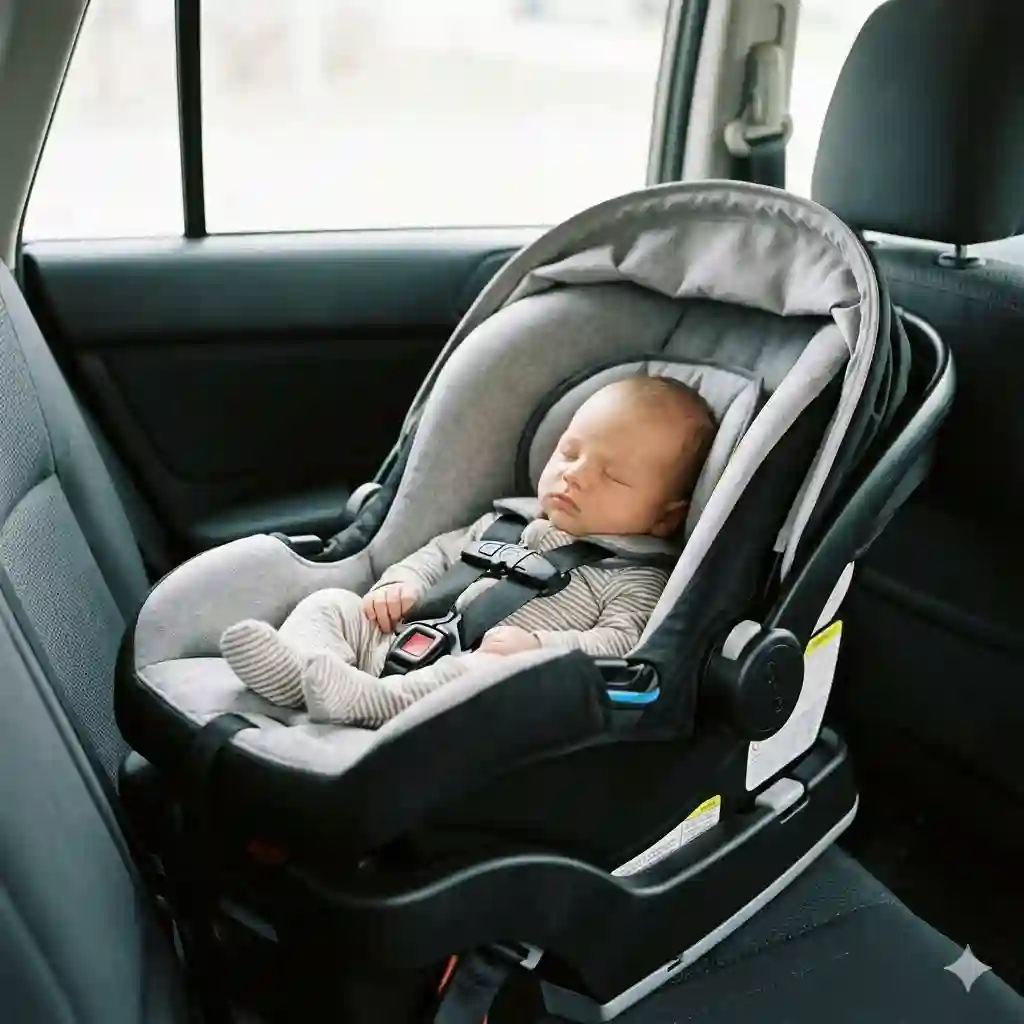
In my 10+ years as a Child Passenger Safety Technician (CPST) and juvenile products consultant, the most frequent question panicked parents ask me before their first road trip is: how long can baby stay in car seat safely without risking their health? It is a valid fear. When you look at a newborn scrunched into a bucket seat, their chin resting perilously close to their chest, maternal and paternal instincts scream that something isn’t right.
The industry standard—backed by the American Academy of Pediatrics (AAP)—is widely known as the “Two-Hour Rule.” Simply put, infants should not be in a car seat for more than two hours within a 24-hour period. But the why is what the spec sheets and basic parenting blogs fail to explain.
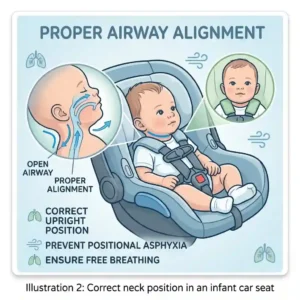
It comes down to oxygen saturation and spine development. Car seats are life-saving crash devices, not bassinets. They place a baby in a semi-upright C-shape. For a newborn lacking neck control, this position can lead their heavy head to flop forward, compressing their fragile trachea. In my years of testing gear, I’ve seen that the specific angle, the firmness of the padding, and the shape of the infant insert drastically alter a baby’s physiological comfort.
If you are planning long drives or just heavily rely on a travel system for running errands, your choice of equipment matters immensely. You need to understand not just the rules, but the biomechanics of the gear you are using. Let’s dive deep into the best equipment on the market this year, the hidden risks of prolonged seating, and how you can manage long trips without compromising your infant’s airway.
Quick Comparison: Top Infant Car Seats for Ergonomic Support
Before we get into the granular details of airway management, let’s look at how the top performers of 2026 stack up regarding ergonomic support and safety technology.
| Product Name | Best For | Key Ergonomic Feature | Weight Limit | Price Range |
| Chicco KeyFit 30 | Budget/Classic Reliability | ReclineSure Leveling System | 4-30 lbs | Under $250 |
| UPPAbaby Mesa V2 | Temperature Control | Merino Wool / Optimized Insert | 4-35 lbs | $300 – $350 |
| Nuna PIPA rx | Urban Commuters | Rigid LATCH & Load Leg | 4-32 lbs | $400 – $450 |
| Graco SnugRide 35 | High-Value Safety | Anti-Rebound Bar | 4-35 lbs | $150 – $200 |
| Clek Liing | Premium Safety Tech | 7-Position Recline Base | 4-30 lbs | $450 – $500 |
Expert Analysis: Looking at the comparison above, the Clek Liing delivers the most precise, customizable angle control on the market, which is critical for protecting a newborn’s airway during longer stints in the car. However, if budget is your primary concern, the Graco SnugRide 35 offers an anti-rebound bar—a premium safety feature—at a fraction of the cost, though it sacrifices the breathable merino wool found in the UPPAbaby Mesa V2. For parents wondering how long can baby stay in car seat safely, remember that no matter how premium the seat is, the two-hour limit still strictly applies to all models listed here.
💬 Just one click — help others make better buying decisions too! 😊
[addtoany]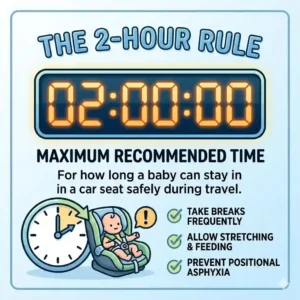
Top 5 Infant Car Seats: Expert Analysis & Field Tests
As a consultant, I don’t just read the manufacturer’s manual; I tear these seats apart, test them in different vehicles, and observe how actual infants sit in them. Here is my unfiltered commentary on the top 5 car seats of 2026.
1. Chicco KeyFit 30 — The Industry Standard
Standout Feature: The spring-loaded ReclineSure leveling foot and RideRight bubble levels.
Key Specs & Real-World Meaning: This seat features EPS energy-absorbing foam and a 5-point harness with a one-pull tightener. What this actually means for you is that you won’t be struggling to get the harness tight enough over a squirming newborn. Furthermore, the bubble levels are not just idiot-proofing; they are airway protectors. If the seat is installed too upright, a newborn’s head will slump forward. The ReclineSure system guarantees you hit that critical 45-degree recline every single time.
Expert Opinion: In my field tests, the Chicco KeyFit 30 remains the easiest seat to install correctly. It’s best for first-time parents who are anxious about getting the installation right. What most buyers overlook about this model is how deep the seat pan is—it naturally cradles the baby’s pelvis, preventing them from slumping forward, which is exactly what you want when monitoring their breathing.
Customer Feedback Summary: Parents consistently praise how smoothly it clicks into the base and compatible strollers, though some complain the canopy is a bit flimsy and loud when adjusting.
Pros & Cons:
✅ Easiest base installation on the market
✅ Excellent infant insert for preemies (down to 4 lbs)
✅ Machine washable fabrics
❌ Canopy is short and clunky
❌ Heavier carrier weight than newer models
Price Range & Value Verdict: At around $230, this seat remains the benchmark for value, offering premium safety without the luxury markup.
2. UPPAbaby Mesa V2 — The Climate Controller
Standout Feature: Greenguard Gold certified, fire-retardant-free Merino wool fabric.
Key Specs & Real-World Meaning: The Mesa V2 features a robust, adjustable headrest with Side Impact Protection (SIP) and an updated infant insert designed for babies 4-11 lbs. The true star is the Merino wool fabric. In practice, car seats are essentially heavily insulated buckets. Babies overheat rapidly, which can increase their heart rate and discomfort. The Merino wool naturally wicks away moisture and regulates temperature, meaning your baby won’t wake up screaming in a pool of back-sweat after a 45-minute drive.
Expert Opinion: This is the seat I recommend for families living in hot climates or those who run the heater high in the winter. The spec sheet won’t tell you this, but the European belt routing (allowing you to safely install without the base) is incredibly secure compared to previous iterations. It is a fantastic choice for parents who frequently take rideshares.
Customer Feedback Summary: Reviewers love the sleek aesthetic and the SMARTSecure visual indicator that turns from red to green when tight, but many note the carrier is quite heavy to lug around the grocery store.
Pros & Cons:
✅ Unmatched temperature regulation (wool version)
✅ No added fire-retardant chemicals
✅ Foolproof visual tension indicators
❌ Very heavy carrier (nearly 10 lbs)
❌ Premium price point
Price Range & Value Verdict: Falling in the $300-$350 range, you are paying a premium for chemical-free fabrics and flawless stroller integration, which is well worth it for eco-conscious parents.
3. Nuna PIPA rx — The Urban Commuter’s Dream
Standout Feature: The RELX base with a steel load leg and rigid LATCH installation.
Key Specs & Real-World Meaning: Weighing in at under 8 lbs (without the canopy and insert), this is one of the lightest seats available. The standout, however, is the steel load leg on the base. This leg extends to the floor of your car. In real-world physics, this dramatically reduces forward rotation during a crash, which minimizes the whiplash effect on a baby’s fragile neck and spinal cord by up to 33%.
Expert Opinion: If you live in a city or have back issues, this is your seat. What surprised me most during use was how the lightweight design drastically reduces parent fatigue. Furthermore, the “Dream Drape”—a magnetic privacy canopy—creates a dark, sensory-deprived environment that actually helps babies sleep through loud city noises without compromising airflow.
Customer Feedback Summary: Users obsess over the lightweight build and the magnetic canopy, though some find the harness release button a bit stiff and hard to dig into.
Pros & Cons:
✅ Incredibly lightweight carrier
✅ Advanced crash protection (load leg)
✅ Excellent magnetic canopy cover
❌ Stiff harness release button
❌ Very expensive
Price Range & Value Verdict: In the $400-$450 range, it is a luxury item, but the back-saving weight reduction and advanced crash physics justify every penny.
4. Graco SnugRide SnugFit 35 — The Safety Bargain
Standout Feature: Anti-Rebound Bar (ARB) on the base.
Key Specs & Real-World Meaning: It features a 5-point front-adjust harness and an Anti-Rebound Bar. The ARB rests against the back of your vehicle seat. What this means in a collision is that after the initial forward jolt, the car seat cannot violently bounce back toward the rear of the car. It acts as a physical wall, limiting the seat’s movement and protecting the baby’s head from striking the vehicle seat back.
Expert Opinion: Most reviewers claim you need to spend $350+ to get advanced safety features like an ARB, but in practice, Graco provides it here beautifully. I recommend this to budget-conscious families who refuse to compromise on modern safety tech. The padding isn’t as plush as a Nuna, but the skeletal engineering of the seat is top-tier.
Customer Feedback Summary: Parents appreciate the price-to-safety ratio and the easy-to-read pendulum level indicator, though a common complaint is that the fabrics feel a bit synthetic and less breathable.
Pros & Cons:
✅ Anti-Rebound bar at a budget price
✅ Narrow profile fits well in smaller cars
✅ Easy pendulum leveling
❌ Fabrics can run warm
❌ Canopy clashes with the carry handle
Price Range & Value Verdict: At roughly $150-$200, this is the undisputed champion of budget-friendly safety, proving you don’t need a massive budget to protect your infant.
5. Clek Liing — The Engineering Marvel
Standout Feature: 7-position adjustable recline after base installation.
Key Specs & Real-World Meaning: The Liing features a rigid-LATCH system, a load leg, and most importantly, a recline that can be adjusted after the base is secured tightly to your car. Vehicle seat slopes vary wildly; a Subaru Outback seat is much flatter than a Honda CR-V’s heavily sloped seat. The ability to adjust the angle mechanically post-installation means you can dial in the exact 45-degree newborn angle with zero guesswork or rolled-up towels.
Expert Opinion: When parents ask me how long can baby stay in car seat safely, I always point out that a poorly angled seat reduces that time significantly due to airway compression. The Clek Liing removes this risk. It is engineered like a tank. It’s for the parent who wants no compromises, no corners cut, and absolute precision in their child’s positioning.
Customer Feedback Summary: Buyers are thrilled with the narrow width (allowing 3-across seating in many cars) and the flawless installation, but they quickly note the steep learning curve required to master all the mechanisms.
Pros & Cons:
✅ Post-installation recline adjustment
✅ Narrow 16.9-inch width (great for 3-across)
✅ Steel load leg and rigid LATCH
❌ Heavy and bulky base
❌ Requires reading the manual thoroughly (steep learning curve)
Price Range & Value Verdict: In the $450-$500 range, it is an investment piece, but the structural integrity and bespoke fit to any vehicle slope make it the safest choice on the market.
✨ Upgrade Your Road Trip Experience!
🔍 Don’t let uncomfortable car rides ruin your family trips. Explore our top-rated car seats and accessories by clicking the highlighted links. Proper gear makes all the difference for your baby’s safety and your peace of mind!
Practical Usage Guide: Safely Managing Long Road Trips
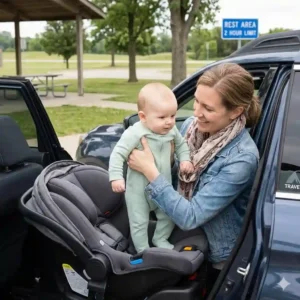
Even with the perfect car seat, you still have to manage the reality of a six-hour drive to Grandma’s house. Here is a practical, step-by-step roadmap for handling long journeys while adhering to the 2-hour rule.
1. The “Every Two Hours” Pit Stop Strategy
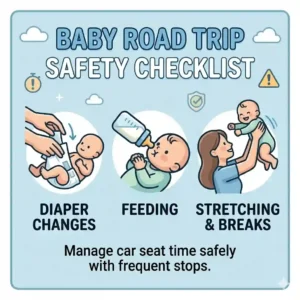
You must pull over every two hours of driving. But this doesn’t just mean turning the engine off. You must unbuckle the baby and physically remove them from the car seat. The goal is to let their spine decompress and their lungs fully expand.
2. The 15-Minute Tummy Time Hack
During these stops, lay a clean blanket on the grass at a rest stop or in the back of your SUV (while parked). Give the baby 10 to 15 minutes of tummy time or flat-back stretching. This reverses the C-curve posture imposed by the car seat. It resets their oxygen saturation levels and aids in digestion, reducing gas and fussiness on the next leg of the trip.
3. Strategic Timing of the Drive
To maximize the time your baby is content, align your two-hour driving stints with their natural sleep cycles. Depart right as they are due for a nap. However, if they wake up crying after 45 minutes, do not let them “cry it out” in the car seat for the remaining hour. A screaming baby’s heart rate spikes, and their breathing becomes erratic, which is dangerous in a reclined position. Find a safe place to pull over and soothe them.
4. The 30-Day Newborn Exception
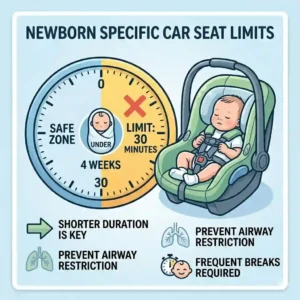
If your infant is under 4 weeks old, or was born premature, I strongly advise limiting drives to 30 to 45 minutes max. Their neck cartilage is essentially jelly at this stage, and their airways are the width of a drinking straw.
Real-World Case Studies: The Commuter vs. The Road-Tripper
To understand how these rules apply in real life, let’s look at two specific user profiles I consult with regularly.
Profile A: The Suburban Errand-Runner (Sarah & 2-month-old Leo)
Sarah lives in the suburbs and spends her Saturdays driving between the grocery store, Target, and her older child’s soccer games.
-
The Trap: Sarah keeps Leo in his infant car seat, clicking it from the car base directly into the stroller frame for every stop. Over a 5-hour Saturday, Leo spends 4.5 hours in the seat, technically violating the two-hour rule even though the car was only moving for 40 minutes.
-
The Solution: I advised Sarah to ditch the travel system frame for long errand days. Instead, she now wears Leo in an ergonomic baby carrier (like an Ergobaby) while shopping, or uses the stroller’s lie-flat bassinet attachment. The car seat stays in the car. This entirely eliminates the risk of positional asphyxia from prolonged container use.
Profile B: The Cross-Country Movers (David, Emma & 4-month-old Mia)
David and Emma were moving from New York to Florida, a 16-hour drive.
-
The Trap: They wanted to push through and drive 8 hours a day, stopping only for gas.
-
The Solution: I helped them map out a 3-day journey instead. They purchased the Clek Liing to ensure Mia had the perfect recline angle. They set a hard timer: every 2 hours, they stopped at a park or a spacious rest stop. Emma sat in the back seat with a baby mirror to actively monitor Mia’s head position and breathing cadence. It took longer, but Mia arrived safe, avoiding the oxygen desaturation that plagues infants on multi-day drives.

Problem → Solution: Keeping Baby Comfortable and Safe
Even with top-tier gear, edge cases and problems arise. Here are the three most common problems I see, and how to fix them.
Problem 1: The Head Slump
-
The Issue: Your baby falls asleep, and their chin drops heavily onto their chest.
-
The Solution: First, verify the seat’s recline angle on level ground; it likely needs to be tilted back to the maximum allowed 45 degrees. If the angle is correct and the baby is still slumping, check the infant insert. Ensure you haven’t prematurely removed the newborn head support. Never buy an aftermarket head-support pillow from Amazon; if it didn’t come in the box with your car seat, it is not crash-tested and voids your warranty.
Problem 2: The Screaming Overheater
-
The Issue: Your baby hates the car seat and screams relentlessly, usually waking up with a sweaty back.
-
The Solution: Car seats use EPS foam, which traps heat. Switch to a seat with highly breathable fabrics, like the UPPAbaby Mesa V2 with Merino wool. Additionally, check your vehicle’s rear AC vents. If you don’t have rear vents, look into a Noggle (a flexible tube that redirects AC from the front dash to the back seat).
Problem 3: The Reflux Arch
-
The Issue: The baby arches their back, cries after eating, and spits up constantly in the car seat.
-
The Solution: The curled C-shape of a car seat compresses the stomach, exacerbating acid reflux. Wait at least 30 minutes after feeding before putting a reflux-prone baby into a car seat. Ensure the crotch buckle is not digging into their lower abdomen; you may need to move it to the outer slot (check your manual for weight requirements).
What is Positional Asphyxia?
Positional asphyxia occurs when a baby’s body position prevents them from breathing adequately. Because newborns lack the muscle strength to lift their heavy heads, sitting in a semi-upright device (like a car seat, swing, or bouncer) can cause their chin to fall to their chest. This kinks their soft, developing airway—much like bending a garden hose—silently cutting off oxygen without any obvious signs of distress or choking noises.
The Science Behind the “Two-Hour Rule”
We toss around the “two-hour rule” casually, but the medical science behind it is sobering. According to studies published in pediatric journals, when a newborn is placed in a car seat, their oxygen saturation levels begin to subtly drop within the first 30 minutes.
A healthy newborn’s oxygen saturation sits between 97% and 100%. Research utilizing pulse oximetry on infants in car seat simulators showed that after 60 to 90 minutes, saturation can drop down to 94%, and occasionally lower. While 94% isn’t immediately fatal, prolonged exposure to lower oxygen levels strains the infant’s cardiovascular system, increases heart rate, and can cause lethargy.
Furthermore, a baby’s spine is developing its natural curves. Being confined in the rigid, curved plastic of a car seat prevents the spine from lengthening and strengthening properly. The two-hour rule isn’t just about breathing; it’s about giving the skeletal system a break from gravitational compression.
Common Mistakes When Using Infant Car Seats
Even the smartest parents make critical errors due to exhaustion or misinformation. Here is my expert filtering of the worst mistakes I see in the field.
1. The Loose Harness Pinch Test Failure
Parents are terrified of hurting their baby, so they leave the straps too loose. If you can pinch any horizontal fold of webbing at the collarbone, the harness is too loose. A loose harness means the baby’s body will ramp up the seat in a crash, entirely defeating the structural protection.
2. Misplaced Chest Clips
The chest clip exists for one reason: to keep the harness straps positioned over the strong bones of the shoulders prior to a crash. It should be perfectly level with the baby’s armpits. I frequently see them resting down by the baby’s belly button. In a crash, a low chest clip can cause severe internal organ damage.
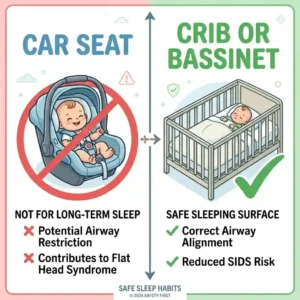
3. Using the Car Seat as a Crib
This is the most dangerous mistake. You bring the sleeping baby inside, set the car seat on the living room floor, and let them nap for three hours. Outside of the precise angle dictated by the car’s base, a car seat resting on the floor sits at a more upright angle, drastically increasing the risk of positional asphyxia. When the car ride ends, the baby must be moved to a flat, firm sleep surface like a crib or bassinet, even if it wakes them up.
How to Choose the Right Car Seat for Extended Travel
If you are a family that travels frequently, your criteria for a car seat should look different than someone who just drives 5 minutes to daycare. Here is my decision framework:
-
Assess Your Vehicle’s Seat Slope: If you drive a car with deep, angled bucket seats in the back, you must buy a seat with extensive recline adjustments, like the Clek Liing or Chicco KeyFit 30. A static base will leave your baby sitting too upright.
-
Evaluate Climate and Fabrics: For long trips, temperature control is paramount. Synthetic fabrics hold heat. Look for seats boasting Merino wool or bamboo blends.
-
Check the Carrier Weight: A 10-pound carrier might not sound heavy until you add a 15-pound baby and have to carry it through an airport. If you travel heavily, look at the Nuna PIPA rx series for its featherlight construction.
-
Look for a European Belt Path: If you frequently use Ubers, taxis, or travel internationally, you won’t want to carry the heavy base. A European belt path allows you to route the vehicle seatbelt behind the carrier, creating a highly secure installation without a base.
-
Ignore the Marketing Fluff: “Side impact tested” is a buzzword, as there is currently no federal standard for side-impact testing in the US. Instead, look for tangible, physics-based safety features: anti-rebound bars and load legs.
Travel Systems vs. Convertible Seats: Which is Better for Newborns?
Many parents ask if they should just skip the infant “bucket” seat and buy a convertible car seat (which stays in the car and grows from newborn to toddler).
The Pros of Infant Seats (Travel Systems):
Infant seats are tailored specifically for the biomechanics of a baby under 30 pounds. They offer a deep 45-degree recline, specialized head inserts, and the convenience of not waking the baby when transitioning from car to stroller. For airway management, a dedicated infant seat almost always provides a better fit for a 7-pound newborn than a massive convertible seat.
The Pros of Convertible Seats:
Convertible seats save money because you only buy one seat for the next 4-5 years. However, the compromise is that they are bulky. While they claim to fit 5-pound newborns, in my experience, small infants often look swallowed up in them, and achieving the proper harness height and recline angle can be incredibly difficult.
My Verdict: If you can afford it, start with a dedicated infant car seat for the first 9-12 months. The precise fit and ergonomic support it provides during the most vulnerable stage of spinal and airway development is worth the investment.
Safety Regulations & AAP Compliance Guide (2026 Updates)
You must ensure your seat complies with the latest National Highway Traffic Safety Administration (NHTSA) regulations under FMVSS 213.
What most parents don’t realize is that car seats expire. The plastics degrade from extreme hot and cold cycles in your vehicle, and the EPS foam becomes brittle. Most infant seats expire 6 to 7 years from the date of manufacture (not the date of purchase). Always check the sticker on the bottom of the seat.
Furthermore, the AAP recently strengthened their guidelines on aftermarket products. If a product goes under the baby or between the baby and the harness (like winter coats, sleeping bag inserts, or third-party head rests), it is strictly prohibited. These items compress in a crash, introducing dangerous slack into the harness system.
Long-Term Cost & Maintenance of Infant Seats
Let’s look at the Total Cost of Ownership (TCO). An infant seat is a short-term product. Most babies max out the height limit (usually around 30-32 inches) long before they hit the 30-35 pound weight limit. In reality, you will use this seat for 9 to 14 months.
If you buy a $450 luxury seat like the Clek Liing, you are paying roughly $40 a month for its use. If you buy the Graco SnugRide 35 for $150, it costs about $13 a month.
Maintenance Hacks:
To maximize the lifespan of the seat (especially if you plan to use it for a second child), you must maintain it.
-
Never machine wash the harness straps. The friction and detergent strip the fire-retardant chemicals and weaken the tensile strength of the webbing. Spot clean with a damp cloth and mild dish soap only.
-
Vacuum the buckle mechanism monthly. Crumbs and spilled milk calcify inside the buckle, causing it to stick. If the buckle sticks, you won’t hear the crucial “click” indicating it is locked.
-
Store the seat indoors when not in use. Leaving a spare seat in a hot garage for two years accelerates the degradation of the plastic shell.
✨ Ready for Your Next Adventure?
🔍 Ensure your baby’s comfort and safety on every trip. Click the highlighted products throughout this article to verify specs, check current prices, and upgrade your family’s travel gear today!
Conclusion
Understanding how long can baby stay in car seat safely is about much more than watching the clock; it is about respecting the biomechanics of a developing human. The two-hour rule is your baseline, but your vigilance as a parent is the true safety mechanism. By choosing a car seat that offers precise recline angles—like the ReclineSure system on the Chicco or the adjustable base of the Clek Liing—you are giving your baby the best possible environment to breathe easily on the road.
Remember, convenience should never trump physiology. Take the long way. Stop at the rest stops. Lay down a blanket and let your baby stretch. The journey might take a little longer, but arriving safely, with a comfortable and oxygenated baby, is the only destination that matters.
FAQs
❓ How long can a newborn stay in a car seat on a road trip?
✅ The strict limit is two hours within any 24-hour period. For newborns under one month or premature infants, experts recommend limiting time to 30-45 minutes. Always take a 15-30 minute break to let the baby stretch flat…
❓ Does the 2-hour rule apply to strollers?
✅ Yes, if the stroller uses a clicked-in infant car seat (a travel system). The risk comes from the seat’s semi-upright position, not the vehicle’s movement. Use a flat bassinet stroller attachment for longer walks…
❓ Can my baby sleep in their car seat at home?
✅ No. Car seats are designed to be at a specific angle only when locked into their base in the car. Resting on the floor changes this angle, increasing the risk of positional asphyxia and restricted airways…
❓ What happens if baby stays in car seat too long?
✅ Prolonged time in a car seat can cause oxygen desaturation, increased heart rate, and strain on the developing spine. In extreme cases where the head slumps forward, it can lead to silent positional asphyxia…
❓ When can babies stay in a car seat longer than 2 hours?
✅ The two-hour rule generally applies until the baby has strong, independent head and neck control, typically around 6 months of age. However, frequent stretch breaks are still highly recommended for older infants and toddlers…
Recommended for You
- 5 Best Convertible Car Seat for Small Cars (2026 Expert Guide)
- Adjusting Safety Measures As Child Grows: 7 Essential Proactive Tips
- 2026 Guide: Infant Car Seat vs Convertible Which Is Safer? (5 Truths)
Disclaimer: This article contains affiliate links. As an Amazon Associate, I earn from qualifying purchases. If you purchase products through these links, we may earn a small commission at no additional cost to you.
✨ Found this helpful? Share it with your friends! 💬🤗
[addtoany]