How long does the net on trampolines with enclosure systems actually last, and what happens to the rest of the trampoline once it wears out? The sources behind this 2027 guide give a spread, not one number: Springfree’s net guidance says two to four years, while a Sportspower manual tells owners to replace the net and pad every 12 months. The CPSC’s trampoline safety sheet adds that enclosures can help prevent injuries from falls, which is one risk among several, so a net is a part to maintain and not a guarantee.
Short version: find out how the net attaches to the mat before you buy, treat the net and spring pad as parts with their own warranty line, and inspect both every month. The findings rest on CPSC and pediatric guidance, maker spec pages, manuals and the review pages that retailers carry, and wherever those disagree on weight limits, warranty terms or net life, both figures appear in the text. Pediatricians go further than any buying guide and strongly discourage home trampolines altogether, a position covered in the safety section so you can weigh it.
What follows is a method first, then four products tied to its steps.
What is a trampoline enclosure net, and how does it attach?
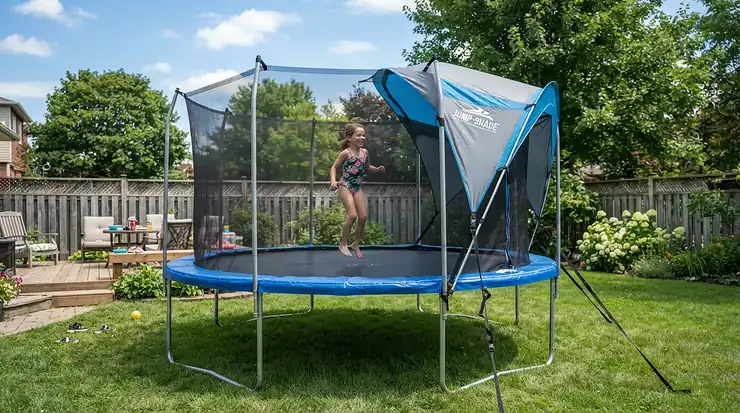
A trampoline enclosure net is a mesh wall held up by poles around the jumping area, with an entry that closes by zipper and buckles. Skywalker’s Walmart listing describes a dual zipper and latch clip; Jumpzylla’s lists a zipper and two buckles. The net’s one job is to stop a jumper leaving the mat sideways.
Attachment is where designs split. A trampoline-parts seller’s help page sorts nets into three types: one fixed to the outer edge of the frame, one fixed to the inner side of the springs, and an inside type fixed to the mat itself. The inside type keeps the springs outside the net, which is why makers sell it as no-gap. With the other two, springs sit between the jumper and the mesh, and the spring pad does the protecting.
Hold on to that distinction. It settles how a mat gets replaced, which replacement net fits, and where gaps can open.
From box to backyard: five checks that keep the net working
Confirm the attachment before paying. Skywalker’s listings describe a patented design in which button-hole openings interlock the net and the mat at each spring, and Walmart’s page places the 72 steel springs outside the net, so the Skywalker 12-Foot Round Trampoline with Enclosure is clear on this point. The Zupapa 14FT Trampoline carries a No-Gap mat claim, yet the maker’s page never says how the net attaches. The Walmart page for the Jumpzylla 14FT Trampoline with Enclosure lists curved poles, a zipper and two buckles, and stays silent on the net-to-mat connection. A listing that says nothing deserves a question to the seller before checkout.
Judge the poles and the closure, not just the mesh. Which?, the UK consumer group, hangs 60 kilograms from the top of every enclosure it tests. The stronger ones don’t budge; weaker ones pop out of their pole connections or end up with a permanently bent top pole. It also checks how easily the net comes down in strong wind. Model-level scores sit behind its paywall and the tests follow UK rules, but the weak points (pole joints, top edge, entry) are the same on any US model. Padded poles are worth looking for: Zupapa wraps its net poles in 10 mm foam, and Skywalker lists arched, foam-padded poles.
Read the net’s own warranty line. Frame terms headline the listing, yet the net wears first. Zupapa gives 10 years on the frame and 2 on the mat, pad, net and springs; Skywalker gives 3 years and 1 year; the Walmart page for Jumpzylla shows 1 year, while another listing shows 2.
Place and assemble with the net in mind. Zupapa’s assembly guide says never to hook springs on one after another around the circle: start at 3, 6, 9 and 12 o’clock, then fill in between each pair. Skywalker’s manual advises leather gloves for the spring step. The CPSC asks for pads that fully cover springs, hooks and frame, a position away from structures, trees and other play areas, and no ladder, and it says children under 6 should not use a full-size trampoline.
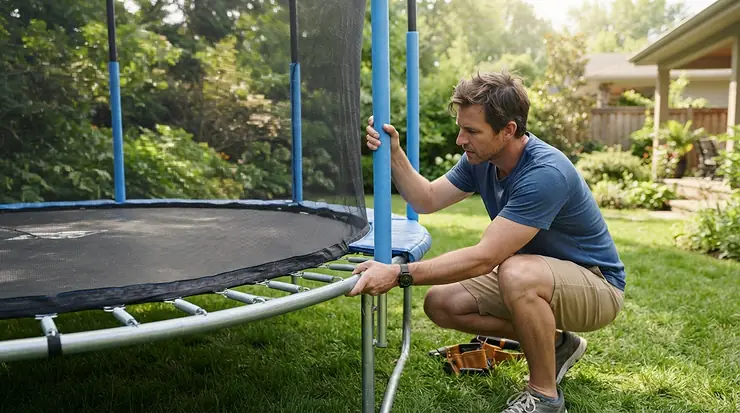
Inspect on a schedule. Springfree recommends a monthly look at the net, poles and attachment points, and Zupapa’s spring checklist covers punctures, tears, sagging, the entrance and its zipper. A manual hosted on Lowe’s asks for inspection before each use. Springfree adds that isolated tears can be patched, while a net that turns brittle, visibly faded or torn in several places should be replaced.
To replace a trampoline mat, do you need to remove the enclosure?
It depends on how the net is attached, and the manuals show both cases.
Where the net rides on the mat, it comes off with it. Skywalker’s manual for a 15-foot model has each V-ring on the mat threaded through a matching buttonhole in the net’s bottom edge, and a Jumptek manual attaches the net’s lower end to the bed with the existing bed springs, lining up eyelets with V-rings. Swapping the mat in those designs means unhooking the net from the old one and re-attaching it to the new one. That is reasoning from the manuals, not one maker’s published procedure.
Where the net hangs separately, it can stay up. Rebound Products’ guide to fitting a new bed on a complete trampoline starts with the enclosure left on and most frame pads removed, then works from inside, taking out the side springs. Springfree’s springless models go the other way: its disassembly guide lowers the net first and needs two people for the mat rods.
Whatever the design, a few steps hold. Lift off the spring pad, release the springs in the reverse of the order they went on (Zupapa’s guide says removal follows the opposite steps of installation), then fit the new mat’s springs in the 3, 6, 9 and 12 o’clock pattern. Order the mat by frame size, because the fabric measures smaller than the frame once the springs fill the gap.
Cost shapes the decision. Springfree puts replacement mats at about $49 to $200 or more depending on size. Holes under half an inch can be taped, holes between half an inch and 3 inches repaired by hand, and anything larger calls for a new mat or a new trampoline. On a low-priced model that is already giving trouble, the same source leans toward buying new. Springfree sells premium models of its own, so read that lean as a view and not a measurement.
Trampoline enclosure safety: what the net covers and what it doesn’t
The CPSC estimated 104,691 emergency-room-treated trampoline injuries in 2014 and recorded 22 deaths between 2000 and 2009. Its sheet says enclosures can help prevent fall injuries, then lists what a net leaves untouched: only one person on the mat at a time, because collisions hurt people; pads over springs, hooks and frame; and no ladder.
Pediatric guidance is blunter. A HealthDay report on the American Academy of Pediatrics statement says the group strongly discourages recreational home trampolines, finds that most injuries involve several simultaneous users, and notes that flips and somersaults can injure the neck. Safety measures, the authors say, “have not significantly reduced injury rates.” The article does not single out nets.
Standards sit behind the marketing, with a limit. ASTM F2225 is the enclosure standard, and its scope note says an enclosure alone will not necessarily prevent every injury; a 2024 revision, F2225-24, is listed as active. ComplianceGate’s overview found no CPSC rule specific to trampolines and no trampoline standard incorporated by reference, which leaves ASTM F381 and F2225 compliance voluntary. An ASTM badge on a listing is therefore a maker’s statement, a floor and not a guarantee.
Straps are a known weak point. According to the CPSC’s recall notice, JumpSport recalled about 2,300 net enclosures in 1999 because the straps on the bottom of the net could break and a child could fall out; two such falls were reported, with no injuries. The notice is old, but pulling on every strap is still a fair habit.
Where the plan goes wrong: four mistakes and how to recover
Trusting the weight number on the listing is the first. Skywalker’s Walmart page gives 200 pounds in the spec table and a feature line that mixes an 800-pound figure with 200 pounds under ASTM. The maker’s page for the Zupapa 14FT Trampoline lists 425 pounds, yet an image caption on the same page says 1,500, which reads like a static load rating. Follow the single-jumper figure in the manual and treat the larger number as frame strength, not a jumping allowance.
Reading maximum occupancy as permission is the second. The Jumpzylla page on Walmart lists up to four people. The CPSC and the pediatricians point the other way, toward one jumper at a time. Keep it to one, whatever the listing says.
Ordering a net by diameter alone is the third. Upper Bounce lists 14-foot nets separately for four curved poles with a top ring, six poles or three arches, eight poles or four arches, and a universal style with adjustable straps. Springfree’s measuring guide makes the same point with a 12-foot example that needs a net with six connection points. Count poles and arches, note whether the net hangs inside or outside the frame, and measure before ordering.
Leaving the net up through every season is the fourth. The manual hosted on Lowe’s says to remove the enclosure in harsh weather or during long periods of non-use, and SkyBound recommends indoor storage in winter to extend a net’s life. Lower or remove the net before storms and snow, brush off snow buildup, and inspect again in spring.
Best price on trampolines with enclosure: what the total bill includes
Listings that were open for this guide put the Skywalker 12-Foot Round Trampoline with Enclosure between roughly $260 and $300 at Walmart, the Jumpzylla 14FT Trampoline with Enclosure at around $390 on its Walmart page (which showed it marked down by roughly $100), and the Zupapa 14FT Trampoline at around $450 to $500 on the maker’s own page. Those are snapshots, and prices move.
The sticker is the smaller part of the bill. Net-only replacements for 14-foot frames run between roughly $50 and $95 on Home Depot, Walmart and Tractor Supply pages, and a net-and-pole enclosure set with foam sleeves and caps lands around $140 to $170. Springfree lists springs at $10 to $20 or more each and mats at $49 to $200 or more, and Walmart’s pages offer a professional assembly service for $156.
A worked example shows why the paperwork matters. A 12-foot Skywalker plus one net-only replacement in the $35 to $95 range seen on retailer listings comes to roughly $295 to $395. If that net fails in year two, the maker’s 1-year term on soft parts has already ended, while Zupapa’s 2-year term would still apply. The extra cover is worth the price gap only if the net fails inside that window, and Springfree’s two-to-four-year estimate suggests it may not. Springfree, which sells premium models, also claims that trampolines in the $200 to $400 range may need a new pad or springs within a year, a vendor’s view that is worth knowing but not taking as settled.
The best price on trampolines with enclosure is therefore the lowest total over three or four seasons, not the lowest at checkout. Check the current price on Amazon.com for any model before deciding.
Best trampolines with enclosure, matched to the steps above
These four are tied to the method rather than ranked: three complete trampolines whose nets are built differently, and one replacement net for the day the original gives out. Net attachment and warranty terms lead the comparison because those are the two things the steps above turn on.
Model
Net attachment, as stated
Net, pad and mat cover
Weight limit as listed
Price snapshot
Zupapa 14FT Trampoline
No-Gap mat; net attachment not stated
2 years (frame 10)
425 lb (an image caption shows 1,500 lb)
Around $450 to $500 on the maker’s page
Skywalker 12-Foot Round Trampoline with Enclosure
Interlocked with the mat at each spring
1 year (frame 3)
200 lb in the spec table
Between roughly $260 and $300 at Walmart
Jumpzylla 14FT Trampoline with Enclosure
Curved poles; mat connection not stated
1 year on Walmart, 2 on another listing
450 lb, up to 4 people listed
Around $390 on Walmart’s page
Warranty length and price rise together, but not evenly. The Zupapa 14FT Trampoline is the only one of the three with a two-year net term, and the Skywalker 12-Foot Round Trampoline with Enclosure is the only one with a documented net-to-mat interlock. The Jumpzylla 14FT Trampoline with Enclosure leaves both questions open on the Walmart page, which is the reason to confirm them first.
Warranty is why this one fits step three. The maker’s page lists 10 years on the frame, 2 years on the mat, frame pad, net and galvanized springs, and a lifetime term on other accessories, plus TÜV and ASTM certification, a 425-pound limit, 96 springs per the page’s meta description, a higher net and net poles that reach the ground in 10 mm foam. The maker also promises support replies within 12 hours.
What the page leaves unsaid matters: how the net attaches (step one), and what the 1,500-pound image caption refers to. A non-slip ladder appears in the product images, so the CPSC’s advice against ladders applies.
Owner evidence comes from a review platform that Zupapa itself uses, which shows 4.9 from 320 reviews for the company. One owner there reports that the net and pad lasted about three years in sun and weather, though the net never closed cleanly at the zipper and clasps and the zipper broke in the final year. The same owner was satisfied with the company’s support when the worn parts had to be replaced. It is a single report, but the zipper complaint matches what other owners describe elsewhere. The maker’s page showed the 14-footer as sold out when opened, at a single price near $480.
Check current availability before you plan around it.
Between roughly $260 and $300 at Walmart, this is the lowest-priced complete trampoline of the three. The net design is the draw: Target’s listing describes a patented system where button-hole openings interlock the net and mat at each spring, and Walmart’s page adds 72 steel springs outside the net, arched foam-padded poles, a polyethylene net listed as blocking 99% of UV rays, and a dual zipper with latch clip.
Walmart shows 4.3 stars from 1,365 ratings, 69% of them five-star and 9% one-star. The most-tagged review topics are ease of assembly (254 mentions), value for money (140), build quality (105) and the safety net (70). The warranty runs 3 years on the frame and 1 year on everything else, so the net sits on the shorter term. The spec table says 200 pounds while the feature text carries an 800-pound line, so the manual decides.
Pros:
✅ Net interlocks with the mat at each spring, per the listings
✅ Lowest entry price of the three, and a spring tool is in the box according to one Walmart reviewer
Review volume is where this model starts: Walmart’s page shows 4.5 stars from 958 ratings (842 written reviews), roughly 70% of them five-star and 4% one-star. It lists a 450-pound limit, curved safety poles, an entry with zipper and two buckles, and a patented reversible spring cover. Reviewers describe assembly as about one to two hours with two people.
The same page carries the complaint that matters here. Walmart’s automated review summary says poles and zipper break or tear within weeks, and one reviewer of the 8-foot size reports springs warping after a few months. A machine-written summary is a signal and not a count, but it points at the net hardware, the area other owners mention too. The warranty is listed as 1 year on Walmart and 2 years on another listing, so compare the exact listing before buying. Occupancy is listed as up to four people, which conflicts with the CPSC’s one-jumper guidance.
Pricing sits around $390 on the Walmart page. The page does not say how the net attaches to the mat.
Fit is the entire decision here. Retailer listings separate 14-foot Upper Bounce nets by pole layout: four curved poles with a top ring (a Lowe’s listing gives a 71-inch net height), six poles or three arches, eight poles or four arches, and a universal style with adjustable straps. Net-only prices run between roughly $50 and $95, and a net-and-pole set with foam sleeves and caps lands around $140 to $170.
Owner reports are thin and mixed. A reviewer on a Target listing says the net that came with the trampoline lasted about two years before sun destroyed it, and is waiting to see how the replacement does. A buyer on a Desertcart-mirrored listing posted a three-year update: the net itself held up well, while the fabric where it attaches to the top ring started drying out after the first year. A Dick’s Sporting Goods page shows two reviews averaging 1.0, one saying the connectors holding the net to the trampoline came apart in about five months on a 15-foot unit. Three buyers, three outcomes, which fits Springfree’s point that UV exposure and usage set net life.
Pros:
✅ A net-only purchase costs a fraction of a new trampoline
✅ Several pole layouts, so many 14-foot frames have a matching version
Cons:
❌ The wrong pole layout means a return, not an adjustment
❌ Top-ring fabric and straps are the reported wear points
Trampolines with enclosure reviews: what owners and testers keep reporting
Assembly dominates the praise and the complaints. Skywalker’s Walmart page tags ease of assembly more than any other topic, Jumpzylla reviewers there give one to two hours for two people, and a trampoline seller’s mat-install sheet warns that the final two springs are the hardest to hook. Plan on two adults and gloves.
The soft edges fail before the steel. Separate owners on separate retail pages describe a Zupapa zipper that never closed cleanly and eventually broke, an Upper Bounce net whose top-ring fabric dried out after a year, and a Wayfair UK reviewer whose pole covers ripped and net tore near the zipper within three months on an Upper Bounce enclosure set. Walmart’s automated summary of Jumpzylla reviews flags the same zones. Each is one report; together they are a consistent pattern across four unrelated pages, and all of them point at attachment points and closures, not the mesh.
Independent enclosure testing is scarce in the sources reached for this guide, and the Which? hanging test, the clearest, follows UK rules. It shows that enclosure strength varies between models without naming US ones.
None of this settles which of the four fits a given yard. It does show what to compare on any model: how the net attaches, how the entry closes, what the net’s own warranty says, and how many poles and arches a replacement will need.
Net life, mat swaps, winter storage: straight answers
❓ How long does a trampoline enclosure net last?
✅ Sources split. Springfree says most nets last two to four years, depending on sun and use, while a Sportspower manual says to replace the net and pad every 12 months. Replace sooner if the mesh turns brittle, fades or tears repeatedly.
❓ Do you have to take the net off to replace a trampoline mat?
✅ It depends on the design. Where the net is hooked to the mat's V-rings, it has to be detached from the old mat first. One parts maker's guide for fitting a new bed leaves the enclosure on and removes the frame pads. Follow your manual before loosening any spring.
❓ Do trampolines with a safety net prevent injuries?
✅ A net helps with falls off the edge, which the CPSC says enclosures can help prevent. It does not stop collisions between jumpers or neck injuries from flips, and the American Academy of Pediatrics still strongly discourages home trampolines. One jumper at a time remains the baseline rule.
❓ Is it cheaper to replace the net or the whole trampoline?
✅ Per Springfree, nets usually cost under $100 and a replacement frame can cost $500 or more, so a net is the cheaper fix on a sound frame. On a $200 to $400 trampoline that keeps needing parts, the same source says replacing the whole thing can make more sense.
❓ Should the net stay up through winter and storms?
✅ Makers lean toward taking it down. One manual hosted on Lowe's says to remove the enclosure in harsh weather or long periods of non-use, and SkyBound advises clearing snow buildup and checking the mat, net and pad for rips before reuse. Storing the net indoors extends its life.
Which setup to buy: a decision rule
Start with the net, not the diameter. A household that wants the longest paperwork on the parts that wear will find it on the Zupapa 14FT Trampoline, with 2 years on net, pad, mat and springs and 10 on the frame. The Skywalker 12-Foot Round Trampoline with Enclosure is the lower-cost route, with a documented net-to-mat interlock and a 1-year term on soft parts. The Jumpzylla 14FT Trampoline with Enclosure brings the larger review pool and a net that owners watch closely. Whichever of these trampolines with enclosure fits the yard, write down the pole and arch count now so a replacement such as the Upper Bounce Trampoline Replacement Net fits later, inspect monthly, and keep to one jumper at a time. Check current availability below.
Disclaimer: This post contains affiliate links. As an Amazon Associate, I earn from qualifying purchases made through these links, at no additional cost to you.
Check current availability on the models above, then set a monthly reminder to walk the net’s perimeter.
At WhizKiddo, our mission is to help parents find the safest and most engaging toys for their little ones. With years of experience researching child-friendly products, we provide honest, in-depth reviews to ensure you make the best choices for your kids