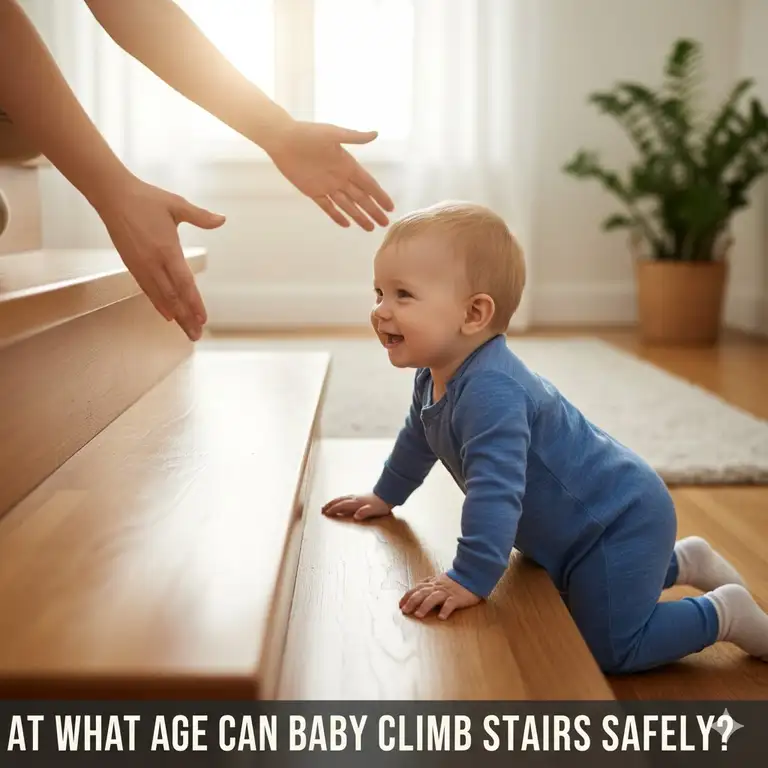
It’s that heart-in-your-throat moment. You turn your back for one second, and your newly mobile baby, who you swore was just playing with blocks, is halfway up the staircase.
If you’re frantically Googling “at what age can baby climb stairs safely,” first, take a breath. Second, go get your baby. Third, welcome to the club. You’ve unlocked a new, terrifying level of parenting. Stairs are a magnet for curious crawlers and wobbly walkers, and managing this new obsession is a full-time job.
✨Was this helpful? Spread the word!
You have the million-dollar question: at what age can baby climb stairs safely?
The short answer is… it’s complicated. The honest answer? It’s much later than you think. While a baby might attempt to climb stairs as early as 8-12 months, “safely” is the operative word. True, safe, independent climbing—including the all-important descent—often doesn’t fully develop until they are 2 or even 3 years old.
This article is your new best friend. We’re going to break down the developmental milestones, the real risks, how to teach stair safety (when the time is right), and most importantly, the gear you need to keep them safe in the meantime.
Before they can master the stairs, your job is to prevent an accident. This means creating a safe environment, which often involves barriers or new strategies.
Table 1: Stair Safety Management Approaches
| Approach | Best For | Key Feature | Downsides |
| ️ Hardware-Mounted Gates | Top of stairs (non-negotiable) | Maximum security; drills into wall/banister | Requires tools and permanent holes |
| Pressure-Mounted Gates | Bottom of stairs, doorways | Portable, no-drill installation | Not safe for the top of stairs; can be pushed over |
| Playpens/Playards | Containing baby away from stairs | Creates a large, stair-free “safe zone” | Limits natural exploration; bulky |
| Constant Supervision | Short, focused teaching periods | Direct involvement, teaches skills | Not feasible 24/7; high human error |
Quick Comparison: Top 7 Safety Gates for Stair-Bound Babies
When it comes to stair safety, a good gate isn’t a suggestion; it’s a requirement. We’ve compared the best of the best to help you secure your “danger zone” before your little explorer gets there.
Table 2: Top-Rated Stair Gates at a Glance
| Product | Type | Best For | Key Feature |
| Munchkin Loft Aluminum | Hardware-Mounted | Top of Stairs (Stylish) | Sleek design, no-trip bar |
| Regalo 1160 Easy Step | Pressure-Mounted | Bottom of Stairs (Budget) | Simple, reliable, 1-touch release |
| Summer Banister to Banister | Hardware-Mounted | Homes with Banisters | No-drill banister kit included |
| Toddleroo by North States 72” | Hardware-Mounted | Extra-Wide Openings | Fits huge spaces (up to 72 inches) |
| Cardinal Gates SS-30 | Hardware-Mounted | Max Security (Auto-Lock) | Heavy-duty, auto-locking, stops-wing |
| DreamBaby Retractable Gate | Retractable (Hardware) | Space-Saving (Indoors/Outdoors) | Disappears when not in use |
| Evenflo Expansion Walk-Thru | Pressure-Mounted | Doorways & Bottom of Stairs | Easy-to-use lever handle |

️ Top 7 Products for Baby Stair Safety: Expert Analysis
I’ve sifted through hundreds of reviews and product specs to find the gates that actually give parents peace of mind. Here’s the detailed breakdown.
1. Munchkin Loft Aluminum Hardware Mount Baby Gate
-
Detailed Specifications:
-
Type: Hardware-Mounted
-
Width: Fits openings 26.5 to 40 inches
-
Height: 30.5 inches tall
-
Material: Anodized Aluminum
-
Features: Indexed Sizing System (ISS) for quick width adjustment, Integrated Tuning System (ITS) for perfect vertical fit, quick-release for removal.
-
-
Customer Review Analysis: Parents consistently rave about its modern, sleek look that doesn’t scream “baby jail.” The biggest pro is the no-trip bar, making it a top-of-stairs champion. However, many reviews, like one from a dad named Tom, mention the installation is “not for the faint of heart” and requires precise measurements.
-
Warranty: Typically comes with a 1-year limited warranty from Munchkin.
-
Pros & Cons:
-
✅ Pros: Extremely stylish, no bottom trip bar (critical for top of stairs), swings open fully, one-handed operation.
-
❌ Cons: Installation can be very tricky, more expensive than other models.
-
2. Regalo 1160 Easy Step 38.5-Inch Extra Wide Walk Thru Baby Gate
-
Detailed Specifications:
-
Type: Pressure-Mounted
-
Width: Fits 29 to 38.5 inches (with included extensions)
-
Height: 30 inches tall
-
Material: Steel
-
Features: One-touch safety lock, includes 4-inch extension, JPMA certified.
-
-
Customer Review Analysis: This is the workhorse of baby gates. It’s affordable and it just works. Thousands of reviews praise its sturdy steel construction and the simple, reliable latch. The main complaint? The 3-inch high trip bar at the bottom. This makes it a strict “no” for the top of stairs, but perfect for doorways or the bottom landing.
-
Warranty: 90-day limited warranty.
-
Pros & Cons:
-
✅ Pros: Great value, very sturdy, easy one-handed operation, simple setup.
-
❌ Cons: Has a trip bar (bottom of stairs ONLY), latch can be loud.
-
3. Summer Banister to Banister Universal Gate
-
Detailed Specifications:
-
Type: Hardware-Mounted (Banister Kit)
-
Width: Fits openings 32 to 48 inches
-
Height: 32 inches tall
-
Material: Wood and Metal
-
Features: Includes a dual-installation kit—can be installed banister-to-banister (no drilling on banister) or banister-to-wall.
-
-
Customer Review Analysis: This gate is a lifesaver for homes with tricky, older staircases. Reviewers with round or square banisters love that they don’t have to drill into their expensive woodwork. The main criticism is that the “no-drill” banister side uses zip-tie-like straps, which some parents feel are less secure than a full hardware mount.
-
Warranty: 1-year manufacturer warranty.
-
Pros & Cons:
-
✅ Pros: Solves the “banister problem” without drilling, good height, attractive wood finish.
-
❌ Cons: Banister-side install can feel less rigid than a wall-to-wall mount, more complex setup.
-

4. Toddleroo by North States 72” Wide Arched Decor Metal Gate
-
Detailed Specifications:
-
Type: Hardware-Mounted
-
Width: Fits 38.3 to 72 inches
-
Height: 30 inches tall
-
Material: Steel
-
Features: Arched walk-thru door, can be used as a gate or play-yard extension, extra-wide.
-
-
Customer Review Analysis: If you have an open-plan living room where the stairs are just there, this is your solution. Parents use it to block off entire sections of a room. It’s praised for its versatility and sturdiness over such a long span. The downside is its sheer size—it’s not subtle, and installation takes time to get all the panels angled correctly.
-
Warranty: 1-year limited warranty.
-
Pros & Cons:
-
✅ Pros: Massive width, very versatile (can be angled), sturdy, stay-open feature.
-
❌ Cons: Takes up a lot of visual space, installation is a multi-step process.
-
5. Cardinal Gates SS-30 Stairway Special Safety Gate
-
Detailed Specifications:
-
Type: Hardware-Mounted
-
Width: Fits 27 to 42.5 inches
-
Height: 29.5 inches tall
-
Material: Aluminum (lighter than steel)
-
Features: Auto-locking mechanism, one-handed operation, optional stop-bracket (prevents swinging over stairs), JPMA certified.
-
-
Customer Review Analysis: This gate is frequently cited as the gold standard for safety. Parents of “little Houdinis” swear by the auto-lock—you just push it closed, and it’s locked. No second-guessing. It’s also one of the few that can be mounted at an angle. The primary complaint is the latch mechanism, which some find “sticky” or “loud” until it’s broken in.
-
Warranty: Lifetime limited warranty (a huge selling point).
-
Pros & Cons:
-
✅ Pros: Unbeatable security, auto-lock, lifetime warranty, can be mounted at angles.
-
❌ Cons: Latch can be stiff at first, utilitarian appearance.
-

6. DreamBaby Retractable Gate
-
Detailed Specifications:
-
Type: Hardware-Mounted (Retractable)
-
Width: Fits up to 55 inches
-
Height: 34 inches (mesh height)
-
Material: UV-treated mesh
-
Features: Retracts fully into the base, one-handed operation, indoor/outdoor use, includes two sets of mounting hardware for multiple locations.
-
-
Customer Review Analysis: This is the minimalist’s dream gate. When you don’t need it, it’s virtually invisible. It’s perfect for high-traffic areas where a swinging gate would be annoying. However, it’s mesh. A determined toddler can push against it or try to slide under it. Most reviews say it’s a great deterrent but might not stop a full-force charge like a steel gate.
-
Warranty: 1-year limited warranty.
-
Pros & Cons:
-
✅ Pros: Disappears when not in use, extra-tall mesh, comes with two mounting kits.
-
❌ Cons: Not as rigid as a metal gate, requires two hands to retract (pull and turn), potential to slide under.
-
7. Evenflo Expansion Walk-Thru Room Divider Gate
-
Detailed Specifications:
-
Type: Pressure-Mounted
-
Width: Fits 38 to 60 inches
-
Height: 32 inches tall
-
Material: Wood and Metal
-
Features: Extra-wide, “easy-up” pressure mount system, one-handed lever handle.
-
-
Customer Review Analysis: Another great option for wider, non-stair openings. The pressure-mount system is noted as being surprisingly strong for its size. The 3-panel design gives it stability. Like all pressure-mounts, it has a trip bar, making it suitable only for the bottom of stairs or hallways. Some users note the wooden slats can feel a bit flimsier than an all-metal gate.
-
Warranty: 90-day limited warranty.
-
Pros & Cons:
-
✅ Pros: Very wide for a pressure-mount gate, easy setup, tall height.
-
❌ Cons: Has a trip bar, wood accents may not hold up to heavy abuse (or biters!).
-
✨ Don’t Miss These Essential Safety Guards!
Secure your home and get peace of mind today. A baby gate is the single most important safety device for a mobile baby. Click on any of the highlighted products to check current pricing, read more reviews, and find the perfect fit for your home!
Just one click – help others make better buying decisions too!
The Developmental Milestones That Signal Stair Time
So, why isn’t there a magic age? Because development is a range, not a race. Answering “what age can a baby climb stairs” depends entirely on their physical and cognitive skills.
-
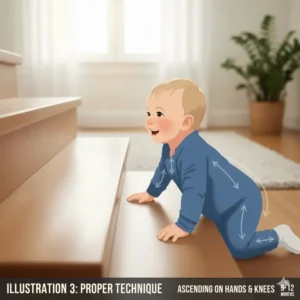
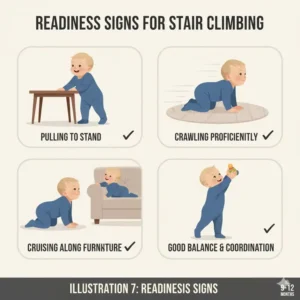
Crawling (8-10 Months): This is “Phase 1: The Discovery.” Your baby realizes stairs are a thing. They will lunge for the bottom step. They have the motor skills to go up (badly), but zero ability to get down. Risk Level: High.
-
Pulling to Stand (9-12 Months): Now they see the stairs as a ladder. They’ll use the steps, the banisters, and the gate itself to pull up. This is when a wobbly baby can easily topple backward. Risk Level: Very High.
-
Walking (12-18 Months): This is, paradoxically, the most dangerous phase. They have a high center of gravity, zero judgment, and a desire to do everything “standing up.” A fall from even a few steps can be serious. This is when the question “when can babies climb stairs” becomes “when can they survive a fall on stairs?”
-
Running (18-24+ Months): A “toddler climbing stairs age” is all about overconfidence. They’ll try to run up and down, often carrying a toy, which is a recipe for a tumble.
Table 3: Milestones vs. Stair Risk
| Milestone | Age (Approx) | Stair-Related Behavior | Risk Level |
| Rolling | 4-6 mos | Accidental fall near stairs | Low |
| Crawling | 8-10 mos | Will go straight for the bottom step | High |
| Pulling Up | 9-12 mos | Uses gate/stairs to pull up | High |
| Walking | 12-18 mos | Unsteady, high center of gravity | Very High |
| Running | 18-24 mos | Confident, but clumsy descent | High |
How to Actually Teach a Baby to Climb Stairs Safely
Okay, so you’ve gated the top and bottom. But your baby is still obsessed. The truth is, you will have to teach them eventually. This is a life skill. But it must be done with 100% focused, hands-on supervision.
-
Start with “Up.” Going up is physically easier. Sometime after they are confidently crawling (around 10-12 months), you can let them practice. Stay one step behind them, hands-on, guiding them to crawl on their hands and knees.
-
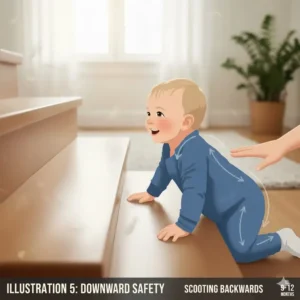
Teach the “Booty Scoot” Down. This is the most important skill. Going down head-first is a no-go. You must physically turn them around at the top step, have them sit on their bottom, and “scoot” down one step at a time. Do this over and over. “Tummy to the stairs to go up, booty to the stairs to go down!”
-
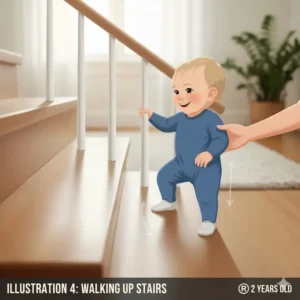
Hold Hands (Much Later). A toddler climbing stairs age (around 2+) is when they might be ready to try walking up, holding your hand. Going down holding a hand will come even later.
-
No Toys, No Rushing. Enforce a “one-thing-at-a-time” rule. We’re climbing, or we’re carrying a toy. Not both.
The American Academy of Pediatrics (AAP) emphasizes that supervision and environmental safety (like gates) are the most critical components of injury prevention for toddlers.
Table 4: Teaching Methods: Pros & Cons
| Method | Description | Pros | Cons |
| Belly Crawl Up | Crawling up on hands and knees | Natural extension of crawling | Slow, baby may get stuck |
| Booty Scoot Down | Sitting and sliding down one step at a time | Safest method for descent | Hard to teach, takes time |
| Walking (Holding Hand) | Toddler holds adult hand | Builds confidence | Teaches reliance on help, risky if they pull away |
| “No Stairs” Policy | Strict gate use, no teaching | 100% prevention (when enforced) | Doesn’t teach a life skill for other environments |
The Dangers You’re Not Thinking About
Why are we so fanatical about this? Because stair-related injuries are one of the leading causes of ER visits for young children. According to the Center for Disease Control and Prevention (CDC), falls are the leading cause of non-fatal injuries for children.
It’s not just the fall down.
-
The “Topple-Back”: A baby climbs up one or two steps, loses their balance, and falls backward, hitting their head.
-
The “Squeeze-Through”: Babies can get their heads or limbs dangerously stuck in banister spindles.
-
The “Gate Failure”: Using a pressure-mounted gate at the top of the stairs. The baby pushes on it, the gate fails, and the baby falls with the gate.
Table 5: Hardware vs. Pressure-Mounted Gates: The Great Debate
This is the most critical decision you’ll make.
| Feature | ️ Hardware-Mounted Gates | Pressure-Mounted Gates |
| Location | Top of stairs, bottom of stairs | NEVER top of stairs, bottom of stairs, doorways |
| Installation | Requires drill, screws, tools | No tools, tension knobs |
| Security | Highest (when installed in studs) | Moderate (can be pushed over by a strong push) |
| Portability | Permanent or semi-permanent | Easily moved |
| Trip Hazard | No trip bar (when properly installed) | Always has a trip bar at the bottom |
| Best For | Ultimate, long-term security | Renters, temporary use, non-stair areas |
Table 6: Essential Stair Safety Accessories
| Product Type | What It Does | Best For |
| Banister Guards | A clear plastic or mesh shield | Stopping kids from squeezing through or climbing banister spindles |
| Non-Slip Stair Treads | Adhesive strips or carpet runners | Adding grip to slick hardwood, tile, or laminate stairs |
| Corner Guards | Soft foam or plastic covers | Softening the sharp, hard edges of steps and landings |
| Gripper Socks | Socks with rubberized bottoms | Giving your baby’s feet traction on all indoor surfaces |
You can find more baby-proofing tips from trusted sources like What to Expect, which provides comprehensive checklists for every room.
Table 7: Budget vs. Premium Safety Setups
| Feature | Budget Setup (Under $100) | Premium Setup ($200+) |
| Top-of-Stairs Gate | Basic, functional hardware-mount (e.g., Regalo) | Premium, auto-lock, no-trip (e.g., Cardinal, Munchkin) |
| Bottom-of-Stairs Gate | Basic pressure-mount (e.g., Regalo) | Retractable or extra-tall pressure-mount |
| Accessories | DIY solutions (e.g., pool noodles on edges) | Custom-fit banister guards, full-length carpet runner |
| Pros | Gets the job done | High convenience, better aesthetics, max security |
| Cons | Less convenient (e.g., manual locks), basic look | High initial cost |
Ready to Secure Your Stairs?
You’ve done the research, now it’s time to take action. Don’t wait for that “heart-in-your-throat” moment. Check out the full specs, customer reviews, and latest prices on our top-rated stair gates. Your peace of mind is just a click away!
Conclusion: It’s a Marathon, Not a Sprint
So, at what age can baby climb stairs safely? As you’ve seen, the answer isn’t a date on a calendar. It’s a slow, gradual process that starts with a 100% “no-go” policy enforced by high-quality gates.
It transitions into a long, supervised “teaching” phase, and finally, much later (around age 3-4), it blossoms into something resembling independence.
Your job right now isn’t to create a stair-climbing prodigy. Your job is to keep your tiny, top-heavy, fearless explorer safe. That means gates, gates, and more gates. Supervise, teach the “booty scoot,” and invest in a hardware-mounted gate for the top of your stairs. It’s the best home improvement you’ll ever make.
❓ Frequently Asked Questions
✅ A 1 year old will want to climb stairs, but it is not safe for them to do so unsupervised. They have the 'up' motor skills but lack the judgment and 'down' skills. All stair access should be blocked by a safety gate or supervised 100% by an adult...
✅ The most effective way is to install hardware-mounted baby gates at the top of the stairs and pressure-mounted or hardware-mounted gates at the bottom. This physical barrier is the only guaranteed method. You can also use large playpens to create a safe zone away from the stairs...
✅ The best and only safe option for the top of stairs is a hardware-mounted gate. These drill into the wall or banister and do not have a trip bar at the bottom. Top-rated models include the Munchkin Loft and the Cardinal Gates SS-30...
✅ If you have a banister-to-banister opening, look for a gate with a special banister installation kit, like the Summer Banister to Banister Gate. These use straps to avoid drilling. For very wide or open-plan areas, an extra-wide gate like the Toddleroo by North States can be used to block off the entire area...
✅ Most toddlers can walk up stairs holding a hand around age 2, but walking down stairs (alternating feet) is a much harder skill that may not develop until age 3 or 4. Before that, they should be taught to 'booty scoot' or crawl down backward... ❓ Is it OK for a 1 year old to climb stairs?
❓ How do I stop my baby from climbing stairs?
❓ What is the best baby gate for top of stairs?
❓ How do I baby proof my stairs without a wall?
❓ When can a toddler walk down stairs?
Recommended for You
- Non Toxic Baby Gates for Wide Openings: 7 Best Picks
- How to baby proof staircase railing: 7 Expert-Approved Safety Solutions
- Securing TV to Wall Baby Proof: 7 Solutions That Save Lives
Disclaimer: This article contains affiliate links. If you purchase products through these links, we may earn a small commission at no additional cost to you.
✨ Found this helpful? Share it with your friends!