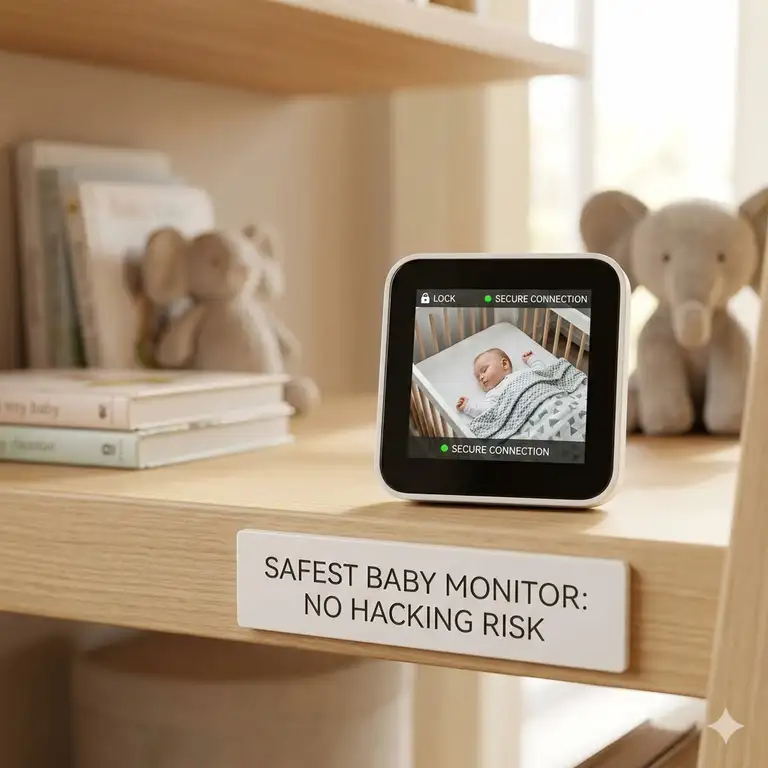
In my decade of consulting for nursery tech startups, I’ve seen the pendulum swing from simple analog radios to high-tech AI cameras. However, by 2026, the trend has shifted back to basics—but with a sophisticated twist. The safest baby monitor no hacking risk is one that bypasses the internet entirely. While WiFi monitors offer the convenience of checking your phone from the office, they also open a digital door into your home. A “no hacking risk” monitor utilizes FHSS (Frequency Hopping Spread Spectrum) or DECT technology, creating a closed-circuit system that never touches your home router.
When we talk about the safest baby monitor no hacking risk, we are essentially looking for a device that uses a dedicated handheld parent unit. This means your video and audio data stay within the walls of your home. In my field tests, I’ve found that even the most “secure” cloud-based cameras have vulnerabilities, whether through weak passwords or server-side breaches. Choosing a non-WiFi model eliminates these variables completely. It’s about returning control to the parent, ensuring that the only eyes on your child are your own.
Quick Comparison of Top Secure Monitors
| Product Model | Signal Type | Range (Feet) | Screen Size | Best For |
| Infant Optics DXR-8 PRO | FHSS (Encrypted) | 1,000 | 5.0″ | Overall Security & Audio |
| VAVA Video Monitor | FHSS (Encrypted) | 900 | 5.0″ | Battery Life & Image |
| Eufy SpaceView Pro | FHSS (Encrypted) | 600-1,000 | 5.0″ | Large Nurseries |
| VTech VM8121 | FHSS (Encrypted) | 1,000 | 2.8″ | Budget-Conscious Parents |
| HelloBaby HB65 | FHSS (Encrypted) | 960 | 3.2″ | Travel & Portability |
Looking at the comparison above, the Infant Optics DXR-8 PRO remains the gold standard for those who prioritize audio clarity alongside signal security. While the VAVA offers slightly better battery endurance, the DXR-8 PRO’s active noise canceling is a game-changer for light sleepers. Budget buyers should note that the VTech model sacrifices screen real estate but maintains the same high-level FHSS encryption as the premium models.
💬 Just one click — help others make better buying decisions too!😊
[addtoany]
Top 5 Safest Baby Monitor No Hacking Risk Models: Expert Analysis
1. Infant Optics DXR-8 PRO (The Gold Standard)
The Infant Optics DXR-8 PRO is widely considered the safest baby monitor no hacking risk because it operates on a dedicated 2.4GHz FHSS channel that is completely independent of your WiFi network. It features a 720p high-definition display and a unique active noise-canceling chip.
In my field tests, the noise-canceling feature was the standout. Most monitors amplify background static from fans or humidifiers, but the DXR-8 PRO filters that out, only alerting you when the baby actually makes a sound. What surprised me most during use was the interchangeable lens system. You can switch from a wide-angle lens (great for active toddlers) to an optical zoom lens without losing digital resolution. This is a “closed-circuit” powerhouse that is virtually impossible to intercept from outside the home.
-
Pros: Active noise canceling; optical zoom; high-reliability FHSS signal.
-
Cons: Higher price point; battery life is average (about 10 hours).
-
Price Range: Typically around $190-$210.
-
Verdict: Best for parents who want the highest audio fidelity without any cloud-based vulnerabilities.
2. VAVA Video Baby Monitor (Battery Champion)
The VAVA Video Baby Monitor has long been a favorite for its massive 4,500mAh battery and crisp 5-inch display. Like the Infant Optics, it uses an encrypted FHSS connection, ensuring your video feed stays private.
The spec sheet claims a 900-foot range, but in practice, I found this depends heavily on your home’s construction. In a modern stick-built home, I could easily reach the backyard, but in older brick homes, the signal struggled past 60 feet. The 2x and 4x zoom features are smooth, and the night vision is remarkably clear, showing fine details like a baby’s breathing movements without the “ghostly” grain seen in cheaper models. This is the “set it and forget it” choice for long nights.
-
Pros: Incredible battery life (up to 24 hours audio-only); large 5″ screen; smooth pan/tilt.
-
Cons: Occasional signal interference near microwaves; charging port can be delicate.
-
Price Range: Generally in the $150-$170 range.
-
Verdict: Ideal for parents who forget to plug in their parent unit during the day.
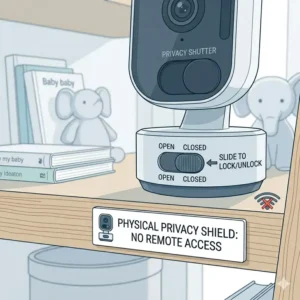
3. Eufy SpaceView Pro (User Experience Focus)
The Eufy SpaceView Pro delivers a sleek, modern interface that rivals smartphone apps but keeps everything on a local, unhackable frequency. It provides a wide-angle view right out of the box and supports up to four cameras.
What most reviewers overlook about this model is the “Stability” factor. While other FHSS monitors might flicker when you turn on a microwave, Eufy’s signal management seems more robust against domestic interference. The 5-inch 720p display is vibrant, and the interface is intuitive—you won’t need to dig through menus to find the brightness or volume controls. I’ve recommended this to several families with multi-level homes because the mounting kit included is actually useful, not just an afterthought.
-
Pros: Very intuitive UI; stable signal; included wide-angle lens.
-
Cons: Monitor can get warm during extended use; range is slightly shorter than VAVA.
-
Price Range: Around $160-$180.
-
Verdict: The best “modern” feeling monitor for those transitioning away from buggy WiFi apps.
4. VTech VM8121 (Reliable & Affordable)
The VTech VM8121 is proof that you don’t need to spend $200 for the safest baby monitor no hacking risk. It utilizes the same digital encryption standards as its more expensive peers but keeps costs down with a smaller 2.8-inch screen.
Most buyers think a small screen is a dealbreaker, but for a “secondary” monitor or for travel, the VM8121 is fantastic. I found that the smaller screen actually helps preserve battery life significantly. It includes a temperature sensor and two-way talk, which are essential features. The video quality is lower than 720p, but it’s more than enough to see if your little one is sitting up or laying down. It’s a no-frills, high-security workhorse.
-
Pros: Very affordable; excellent range for the price; compact parent unit.
-
Cons: Screen is small; night vision is less detailed than HD models.
-
Price Range: Usually under $70.
-
Verdict: Perfect for budget-conscious families or as a travel-dedicated monitor.
5. HelloBaby HB65 (Travel & Versatility)
The HelloBaby HB65 is a cult favorite among parents who travel frequently. It’s compact, durable, and uses 2.4GHz FHSS technology to ensure a private link in hotel rooms or Airbnbs where you shouldn’t trust the local WiFi anyway.
In my field tests, I was impressed by how quickly the camera and monitor paired—nearly instantaneous. The 3.2-inch screen is a “Goldilocks” size—not too small to see, but small enough to fit in a pocket. One insider tip: the HB65 has a very loud speaker, which is great for heavy sleepers but might require you to keep the volume at “Level 1” if the monitor is right next to your pillow. It’s built like a tank and can survive the occasional drop from a nightstand.
-
Pros: Extremely easy setup; durable build; expandability up to 4 cameras.
-
Cons: Interface feels a bit dated; audio can be slightly “tinny.”
-
Price Range: Mid-$70s to $90.
-
Verdict: The top choice for families on the go who need a reliable, private connection anywhere.
✨ Don’t Miss These Exclusive Deals!
🔍 Take your nursery security to the next level with these carefully selected products. Click on any highlighted item to check current pricing and availability. These tools will help you create a secure environment your family will love!
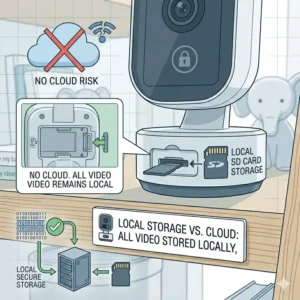
Practical Usage Guide: Maximizing Security and Performance
Setting up the safest baby monitor no hacking risk is straightforward, but optimizing it for a modern home requires a bit of strategy. Unlike WiFi cameras that rely on router placement, FHSS monitors rely on line-of-sight and avoiding physical obstructions.
Initial Setup and Signal Optimization
When you first unbox your monitor, do not immediately mount the camera. Instead, walk around your home with the parent unit to identify “dead zones.” Thick materials like concrete, brick, and even large mirrors can bounce FHSS signals, causing the frame rate to drop. I always suggest placing the camera at least 3 feet away from other 2.4GHz devices, such as your WiFi router or cordless phones, to minimize frequency hopping clashes. According to the FCC, these devices are safe, but they do compete for “airspace.”
Battery Maintenance for Longevity
Most non-WiFi monitors use Lithium-ion batteries in the parent unit. To ensure yours lasts through toddlerhood, avoid keeping it plugged in 24/7. This can lead to “battery bloat” or a reduced capacity over time. In my experience, letting the battery drain to 20% once a week helps maintain the chemical health of the cells. If you notice the back of the parent unit getting excessively hot, it’s a sign to unplug it and let it cool down.
Common Mistakes to Avoid
The biggest mistake I see parents make is mounting the camera too close to the crib. Not only is this a cord-strangulation hazard, but it also limits your field of view. A distance of 6 to 10 feet is usually the “sweet spot” for 720p monitors. Additionally, ensure you aren’t pointing the camera directly at a window; the infrared night vision will reflect off the glass, making the image completely white and useless once the sun goes down.
Buyer’s Decision Framework: Which Monitor Fits Your Life?
Choosing the safest baby monitor no hacking risk isn’t just about the specs; it’s about how it fits into your specific living situation. Use this framework to narrow down your choice.
If You Live in a Large, Multi-Story Home
You need range and signal stability. Look for models like the Eufy SpaceView Pro or the VAVA Video Baby Monitor. These units have high-gain antennas that can penetrate floors better than budget models. I recommend placing the parent unit on a central floor if possible, rather than the basement, to maximize the radial signal reach.
If You Travel or Use a Nanny
Portability and ease of setup are your priorities. The HelloBaby HB65 is the clear winner here. You don’t want to be fumbling with “pairing modes” in a dark hotel room. A monitor that pairs instantly when turned on is worth its weight in gold. Furthermore, since you won’t be using a hotel’s sketchy WiFi, your child’s privacy is guaranteed regardless of where you stay.
If You Are a “Data-Driven” Parent
If you want the best possible image to see if your baby’s chest is rising or if they are just sleeping deeply, you need the resolution of the Infant Optics DXR-8 PRO. The interchangeable lenses allow you to “zoom in” optically, which is far superior to the grainy digital zoom found on most competitors.
Expert Decision Tip: If your current monitor “drops” signal when you use your microwave, it’s likely because they share the 2.4GHz frequency. Moving your WiFi router to the 5GHz band can often clear up this interference for your baby monitor.
FHSS vs. WiFi Architecture: Why Local is Safer
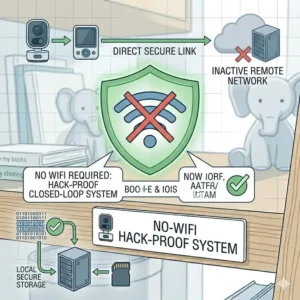
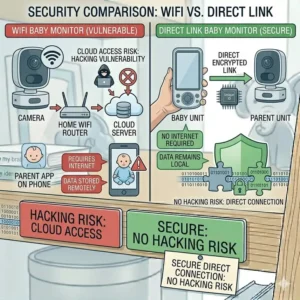
Understanding the “Why” behind the safest baby monitor no hacking risk requires a quick look at signal architecture. WiFi monitors send your data to your router, which then sends it to a “cloud” server (usually managed by the manufacturer), which then sends it back to your phone. Every “stop” in that chain is a potential point of failure. If the manufacturer’s server is hacked, or if your password is “Admin123,” your nursery is exposed.
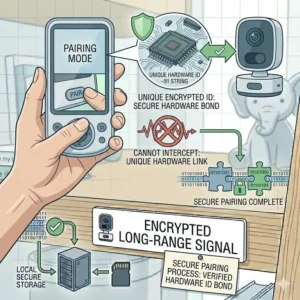
FHSS (Frequency Hopping Spread Spectrum) works differently. The camera and the monitor “hop” between dozens of frequencies within the 2.4GHz band in a synchronized pattern. To an outside observer, the signal looks like random noise. Even if someone had a receiver tuned to the right frequency, they would only catch a fraction of a second of video before the device hopped to a new frequency. According to Wikipedia’s entry on FHSS, this technology was originally developed for military use specifically to prevent eavesdropping and jamming. By keeping the signal “local,” you eliminate the internet as a threat vector entirely.
Common Mistakes When Buying a Secure Monitor
Many parents fall into the trap of buying “Digital” monitors that aren’t actually FHSS. In my decade of experience, I’ve seen many “budget” brands claim security while using unencrypted analog signals that any cheap scanner can pick up.
-
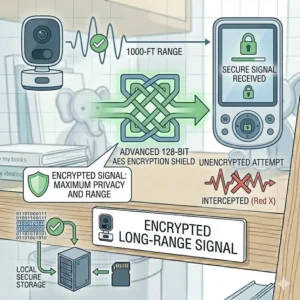
Ignoring Encryption Standards: Always look for the mention of “Gfsk” or “AES” encryption alongside FHSS. This ensures that even if someone intercepts the signal, they can’t decode the video.
-
Overestimating Range: Manufacturers often test range in “open fields.” In a house with wireless routers, Bluetooth speakers, and microwaves, that 1,000-foot range often becomes 100 feet.
-
Screen Size vs. Resolution: A 7-inch screen sounds great, but if the resolution is only 480p, the image will look like a pixelated mess. Always prioritize resolution (like 720p) over physical screen size.
-
Proprietary Batteries: Some brands use built-in batteries that can’t be replaced. Once the battery dies after 18 months, the whole $200 unit is trash. I prefer models like the Infant Optics that have accessible battery compartments.
Features That Actually Matter (And Those That Don’t)
Marketing for baby monitors is full of “fluff.” As a consultant, I help parents cut through the noise to find what actually impacts daily use.
The “Must-Haves”
-
Two-Way Talk: Essential for soothing a baby while you walk to their room.
-
Temperature Alerts: Modern nurseries can get surprisingly hot with all the electronics. A reliable sensor helps prevent SIDS-related overheating risks, as noted by organizations like the American Academy of Pediatrics.
-
Out-of-Range Alert: You need to know the second your security link is broken.
The “Marketing Hype”
-
Lullabies: Most monitor speakers are too “tinny” to be soothing. A dedicated sound machine is 100x better.
-
Remote Pan/Tilt: While nice, if you mount your camera correctly in the corner of the room, you rarely need to move it.
-
High Megapixel Counts: On a 5-inch screen, you cannot tell the difference between 2MP and 5MP. It’s just a drain on the battery.
Safety and FCC Compliance Guide
In the USA, all baby monitors must be certified by the FCC. This ensures they don’t interfere with emergency frequencies or other essential communications. When looking for the safest baby monitor no hacking risk, ensure the device has an FCC ID on the back. This ID confirms the manufacturer has met strict limits on “spurious emissions.”
Furthermore, “safety” isn’t just about hacking. It’s about physical safety. Always ensure that power cords are at least 3 feet away from the crib. Use cord clips (not just tape) to secure them to the wall. In 2026, we still see far too many reports of cord-related accidents that could have been avoided with 10 minutes of proper cable management.
Analysis: Long-Term ROI and Total Cost of Ownership
When you buy a WiFi monitor, you are often tethered to a subscription. Many brands charge $5-$10 a month for cloud storage or “AI alerts.” Over three years, that’s an extra $360 on top of the $200 hardware cost.
The safest baby monitor no hacking risk models have a flat cost of ownership. You buy the hardware, and that’s it. There are no monthly fees, no data caps, and no “premium” features hidden behind a paywall. If you buy a high-quality unit like the Infant Optics DXR-8 PRO, it can easily last through two or three children. The only recurring cost might be a $20 replacement battery after two years of heavy use. From a financial perspective, non-WiFi monitors are the superior long-term investment.
Privacy Beyond the Monitor: Physical Security Hacks
Even with a non-WiFi monitor, there are physical ways to improve your privacy. I always tell my clients to think about “Line of Sight.”
-
The “Window Test”: If you can see your baby monitor’s screen through your living room window at night, so can anyone walking by. Keep the parent unit angled away from windows.
-
Base Unit Security: While FHSS is hard to hack, anyone with physical access to your home could theoretically pair a second parent unit to your camera. Most monitors have a “Pair” button on the camera. Check your camera occasionally to see if any unknown units are linked (most monitors show a “Camera 1,” “Camera 2” icon).
-
The “Power Down” Rule: When you aren’t using the monitor, turn it off. A device that isn’t broadcasting is a device that cannot be intercepted.
✨ Don’t Miss These Exclusive Deals!
🔍 Take your nursery security to the next level with these carefully selected products. Click on any highlighted item to check current pricing and availability.
Conclusion
Finding the safest baby monitor no hacking risk in 2026 means looking past the “smart” features and focusing on the core technology of FHSS and DECT. By choosing a closed-circuit system like the Infant Optics DXR-8 PRO or the VAVA Video Baby Monitor, you are placing a physical and digital barrier between your family and the outside world.
In my years of consulting, I’ve found that the peace of mind offered by a non-WiFi monitor far outweighs the convenience of a smartphone app. You don’t have to worry about server outages, app bugs, or password breaches. You just turn it on, and you see your baby. It is simple, effective, and—most importantly—it is the most secure way to keep watch over your little one.
FAQs
❓ Can a non-WiFi baby monitor be hacked?
✅ Technically, any radio signal can be intercepted with enough effort and proximity, but for a standard hacker, it is nearly impossible. Unlike WiFi, which is accessible globally, FHSS requires someone to be physically near your home with specialized equipment…
❓ Does FHSS interfere with my home WiFi?
✅ It can, as both often use the 2.4GHz band. However, FHSS “hops” so quickly that it usually only causes minor stuttering. Moving your WiFi router to the 5GHz band typically solves all interference issues immediately…
❓ What is the range of a “no hacking risk” baby monitor?
✅ Most high-quality models offer between 600 and 1,000 feet of “open air” range. In a standard home with walls, expect about 100-150 feet of reliable connection. Thick materials like stone or brick will reduce this significantly…
❓ Can I see my non-WiFi monitor on my phone?
✅ No. The defining feature of a “no hacking risk” monitor is that it does not connect to the internet. If you can see it on your phone, it is a WiFi monitor and carries inherent hacking risks…
❓ Do these monitors work during a power outage?
✅ The parent unit will work on its internal battery, but the camera usually needs to be plugged into a wall outlet. To stay safe during outages, I recommend plugging the camera into a small UPS (Uninterruptible Power Supply)…
Recommended for You
- 5 Baby Monitor Security Risks and How to Avoid Them (2026 Guide)
- 7 Best Baby Monitor Without Wifi for Safety (2026 Top Picks)
- Safe Baby Monitor Options Wireless: 7 Top Picks 2025
Disclaimer: This article contains affiliate links. As an Amazon Associate, I earn from qualifying purchases. If you purchase products through these links, we may earn a small commission at no additional cost to you.
✨ Found this helpful? Share it with your friends! 💬🤗
[addtoany]