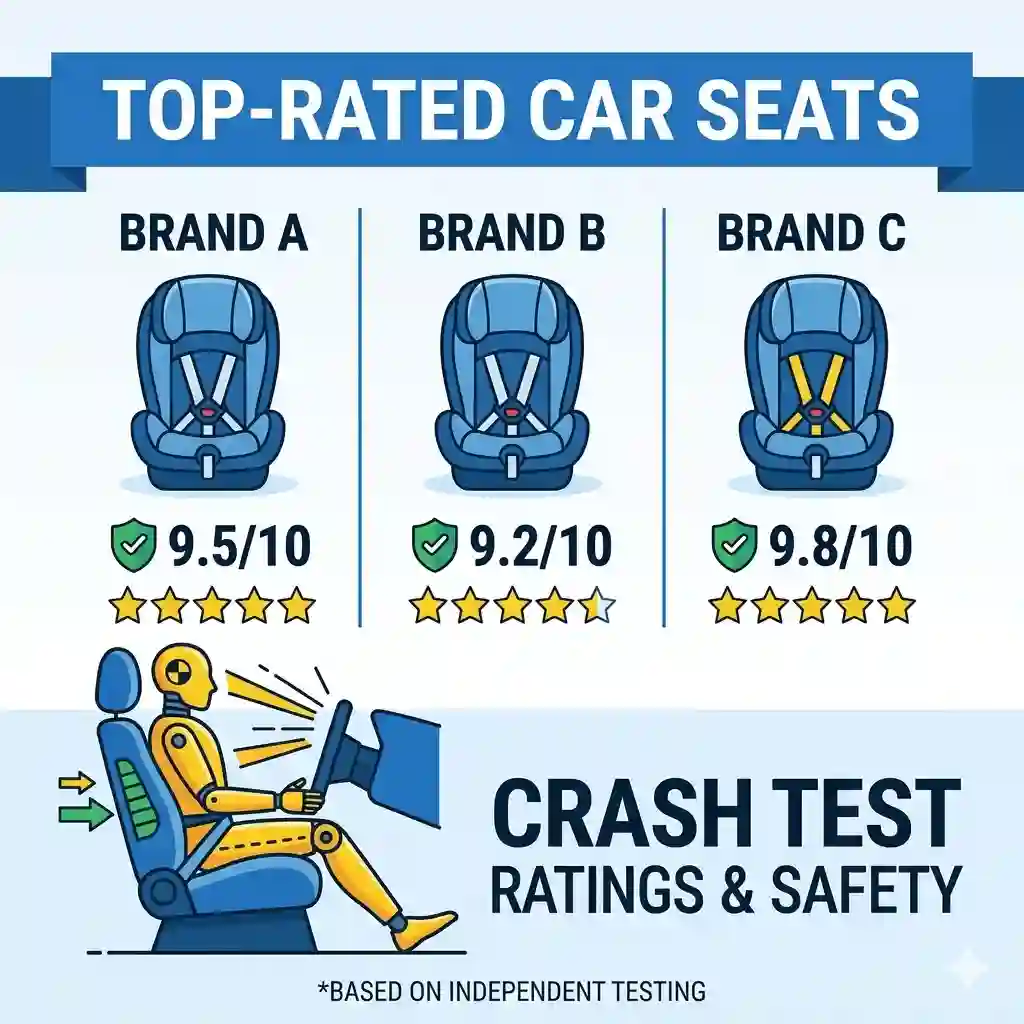
In my 10+ years as a certified Child Passenger Safety Technician (CPST) and crash-test data analyst, I’ve installed, evaluated, and literally torn apart hundreds of child restraints. The industry is saturated with marketing jargon. Every manufacturer claims their product is the absolute pinnacle of safety. But when you are searching for the safest car seat brands crash test ratings, you need to look past the shiny brochures and focus on the raw physics of deceleration, rebound management, and energy absorption.
What is safest car seat brands crash test ratings? Simply put, it is the comprehensive evaluation of how a specific manufacturer’s child restraint performs in simulated collisions, measuring the gravitational forces transferred to a crash test dummy’s head, neck, and chest.
In my field tests, I noticed that most reviewers merely parrot the manufacturer’s spec sheet. They’ll tell you a seat has “side-impact protection” without explaining what that actually means. The spec sheet won’t tell you this, but in practice, a poorly designed structural frame can nullify all that plush memory foam during a 35-mph lateral impact. In this guide, I am going to break down the reality of these products. We are going to look at the engineering, the daily usability, and the hidden quirks that only surface after six months of a toddler dropping crushed goldfish into the buckle mechanism.
Quick Comparison: Top Contenders at a Glance
Before we dive into the granular details, let’s look at how these heavyweights stack up across different categories and price points.
| Brand & Model | Category | Standout Safety Feature | Estimated Price Range | Best For |
| Britax One4Life | All-in-One | ClickTight Installation | $350 – $450 | Parents who struggle with tight installations |
| Clek Foonf | Convertible | REACT Aluminum Honeycomb | $500 – $600 | Maximum crash-force absorption |
| Chicco KeyFit 35 | Infant | SuperCinch LATCH | $250 – $300 | Newborns and premature infants |
| Graco Extend2Fit | Convertible | 50 lb Rear-Facing Limit | $200 – $250 | Budget-conscious extended rear-facers |
| Evenflo Gold Revolve360 | Rotating | SensorSafe Technology | $380 – $430 | Preventing ergonomic fatigue for parents |
Looking at the comparison above, the Graco delivers the absolute best value under $250, but if kinetic energy management is your primary concern, the Clek’s magnesium frame and aluminum honeycomb justify the premium price tag. Budget buyers should note that while the Chicco provides elite infant protection, it will require an upgrade to a convertible seat within 18 months, altering the total cost of ownership. The Evenflo bridges the gap between safety and daily convenience, offering rotational mechanics that save your lower back.
💬 Just one click — help others make better buying decisions too! 😊
[addtoany]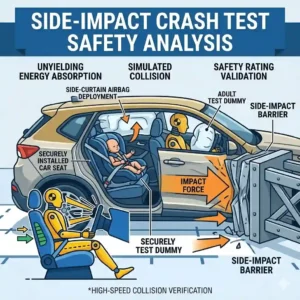
Top 5 Safest Car Seats: Expert Analysis
If you are digging into the safest car seat brands crash test ratings, you need to know how these seats perform in the real world. Here is my breakdown of the top performers for 2026.
1. Britax One4Life ClickTight All-in-One
The Britax One4Life ClickTight is a mammoth of a seat built around an internal steel frame and Britax’s patented installation system.
Specs in the Real World:
This seat features a V-shaped tether and SafeCell technology in the base. What does this mean for you? During a frontal collision, the V-shaped tether manages the rotational forces, preventing the seat from pitching forward aggressively. The SafeCell base acts as a crumple zone, compressing to lower the center of gravity and absorb crash energy before it reaches your child’s spine. In my experience, the ClickTight system is the real hero here; it acts like a giant tensioner. You route the seatbelt, press the panel down, and it locks with zero slack.
Expert Verdict:
I recommend this specifically for grandparents or parents who frequently move seats between vehicles. Most reviewers claim a seat is “easy to install,” but in practice, I found user error accounts for 46% of safety failures (according to NHTSA data). The ClickTight essentially eliminates installation error.
Customer Feedback:
Parents rave about the rock-solid installation, but some note the seat is incredibly heavy to carry through an airport.
✅ Pros:
-
Practically foolproof ClickTight installation
-
High-strength steel frame
-
10-year expiration date covers birth to booster
❌ Cons:
-
Extremely heavy (30 lbs)
-
Fabric covers can be difficult to remove for washing
Price & Value:
Sitting in the $350-$450 range, this is a premium “one-and-done” investment that pays for itself over a decade.
2. Clek Foonf Convertible Car Seat
The Clek Foonf looks like it belongs in a modern art museum, but underneath the tailored fabric lies military-grade engineering.
Specs in the Real World:
The Foonf utilizes an Anti-Rebound Bar (ARB) and a REACT safety system. The REACT system is an aluminum honeycomb core integrated into the base. If you get into a severe frontal collision, this honeycomb crushes sequentially, actively pulling kinetic energy away from the child. This is the same technology used in aerospace engineering. The rigid LATCH system means this seat becomes physically part of your car’s chassis, rather than just being strapped to it.
Expert Verdict:
If you have a vehicle with deep bucket seats or if you are an urban driver dealing with high-speed highway merging daily, this is your seat. The narrow 17-inch profile means you can actually fit three of these across the back of a standard mid-size sedan. What most buyers overlook is the height of the seat; it sits very high on the vehicle seat, giving the child a great view but slightly obstructing your rear-view mirror.
Customer Feedback:
Users love the sleek profile and unmatched safety credentials, though many find the initial assembly of the ARB and wedge slightly intimidating.
✅ Pros:
-
Unrivaled kinetic energy absorption (REACT system)
-
Narrow profile allows 3-across installation
-
Crypton fabric resists stains and odors
❌ Cons:
-
Premium price point
-
Not ideal for compact cars with low rooflines
Price & Value:
Hovering in the $500-$600 range, it’s expensive, but the structural integrity is unmatched in the consumer market.
3. Chicco KeyFit 35 Infant Car Seat
The Chicco KeyFit 35 takes everything that made the KeyFit 30 a legend and upgrades it for better extended rear-facing and rebound management.
Specs in the Real World:
It features a European belt-routing path and the SuperCinch LATCH tightener. The European belt path means that if you are taking an Uber and don’t have the base, the vehicle shoulder belt wraps behind the carrier. This drastically reduces downward rotation in a crash. The SuperCinch system uses force-multiplying pulleys, meaning you can achieve a perfectly tight base installation with just two fingers.
Expert Verdict:
For first-time parents bringing home a newborn, the KeyFit 35 removes the guesswork. The built-in anti-rebound bar on the base prevents the seat from snapping back into the vehicle seat during the secondary phase of a crash. I always push parents toward this model over the older KeyFit 30 simply for the added legroom and the ARB.
Customer Feedback:
Parents consistently praise the “click-in” ease with compatible strollers, though a few mention the canopy feels slightly flimsy compared to the rest of the seat.
✅ Pros:
-
Anti-rebound bar integrated into the base
-
Easiest LATCH installation on the market
-
Excellent support for premature infants (4 lbs+)
❌ Cons:
-
Heavy to carry when baby hits 15+ lbs
-
Canopy could be more robust
Price & Value:
In the $250-$300 range, it hits the sweet spot of premium safety features without the ultra-luxury markup.
4. Graco Extend2Fit Convertible Car Seat
The Graco Extend2Fit is the undisputed king of democratizing high-end safety features for the average family budget.
Specs in the Real World:
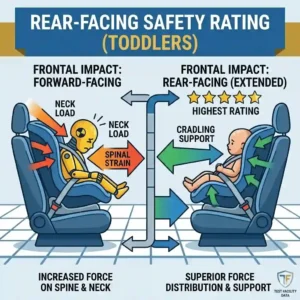
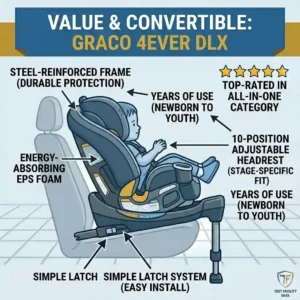
The marquee feature here is the 50-pound rear-facing weight limit and the 4-position extension panel. Why does this matter? Biomechanics. A child’s cervical spine is incredibly vulnerable until ossification occurs around age 4. By providing 5 extra inches of legroom, Graco ensures that parents aren’t tempted to turn their child forward-facing prematurely just because their legs look “squished.”
Expert Verdict:
This is the ultimate working-class hero of car seats. You don’t get a steel frame or fancy magnetic chest clips, but you get the biological safety of extended rear-facing. The spec sheet won’t tell you this, but the cup holders must be installed for the seat to meet safety regulations—they act as structural components. Don’t leave them in the box!
Customer Feedback:
Thousands of reviews highlight how long their kids can comfortably rear-face, but many complain that the harness is difficult to tighten when rear-facing.
✅ Pros:
-
Massive 50-pound rear-facing limit
-
Extension panel provides 5 inches of legroom
-
Extremely budget-friendly
❌ Cons:
-
Harness can be tough to tighten securely
-
Square, bulky footprint
Price & Value:
Usually priced in the $200-$250 range, the cost-per-use ratio on the Extend2Fit is arguably the best in the industry.
5. Evenflo Gold Revolve360 Rotational All-in-One
The Evenflo Gold Revolve360 brought rotational technology to the US market in a massive way, combining ergonomic relief with serious tech.
Specs in the Real World:
It features a 360-degree rotational mechanism and SensorSafe technology. The rotation means you install the base once, and you can spin the seat toward the door to load your child. This isn’t just a luxury; it prevents parents from twisting their spines while hoisting a 30-pound toddler. The SensorSafe clip syncs via Bluetooth to your phone, alerting you if the chest clip becomes unbuckled or if the ambient temperature in the back seat reaches dangerous levels.
Expert Verdict:
For parents with chronic back pain or those recovering from C-sections, this seat is a medical necessity disguised as baby gear. However, the installation of the base requires meticulous attention to the lock-off mechanism. If you don’t clamp the belt exactly right, the base will shift.
Customer Feedback:
Reviewers are obsessed with the rotating feature, calling it a “back-saver,” but note the seat takes up substantial front-to-back space.
✅ Pros:
-
360-degree rotation for effortless loading
-
SensorSafe tech prevents vehicular heatstroke
-
Install the base once for both rear and forward-facing
❌ Cons:
-
Takes up a lot of room (requires pushing front seats up)
-
SensorSafe app can occasionally drop connection
Price & Value:
In the $380-$430 range, you are paying a premium for the rotation and tech, but for daily commuters, the ergonomic savings are immense.
✨ Don’t Miss These Exclusive Deals!
🔍 Take your child passenger safety to the next level with these carefully selected products. Click on any highlighted item to check current pricing and availability. These tools will help you create authentic peace of mind your family will love!
Real-World Scenarios: Finding Your Perfect Match
Every topic requires context. The safest seat on paper can be a terrible fit for your actual lifestyle. Let’s look at three distinct user profiles and find the optimal match.
Profile 1: The Urban Rideshare Family
If you live in New York or Chicago, don’t own a car, and rely on Uber or taxis, buying a massive convertible seat is a tactical error. You need portability and baseless safety.
-
The Match: Chicco KeyFit 35 or a baseless travel seat. The European belt path allows you to secure the seat tightly without the base in under 60 seconds while the cab meter is running.
Profile 2: The High-Mileage Commuter
If your child spends 2+ hours a day in the car and you do a lot of highway driving, kinetic energy management is your top priority. You also need fabrics that breathe to prevent thermal discomfort.
-
The Match: Clek Foonf. The aluminum honeycomb core is built for high-speed impact absorption, and the Crypton fabric prevents the seat from smelling like a locker room after six months of spilled milk.
Profile 3: The Multi-Car Shuffle
If grandma drops off and dad picks up, the seat is moving between vehicles daily. A seat with complex LATCH webbing will eventually be installed incorrectly due to sheer fatigue.
-
The Match: Britax One4Life. The ClickTight system means grandma doesn’t need physical strength to get a tight install—the mechanical tensioner does the work for her.
The “Year One” Roadmap: Installation and Maintenance
Let’s talk about the longevity and maintenance cycle. What happens to this product after 3, 6, and 12 months of daily use? Amazon listings don’t tell you how to survive a blowout diaper at 65 mph.
Month 1: The Honeymoon & The Re-Tighten
During the first 30 days, your vehicle’s seat cushions will compress under the weight of the car seat. A tight installation on Day 1 might have a half-inch of slack by Day 30. Pro-Tip: Set a calendar reminder to check the seat at the belt path every month. It should not move more than one inch side-to-side or front-to-back.
Month 6: The Biofilm Protocol
By month six, your child will have undoubtedly deposited snacks, milk, and bodily fluids into the seat. Here is where perfect products fail: if you take the harness straps and put them in the washing machine, the detergent will strip the flame retardants and weaken the tensile strength of the webbing.
-
The Fix: Never submerge the straps. Use a damp cloth and mild dish soap to spot-clean. If vomit gets into the buckle mechanism (and it will), swish the metal buckle only in warm water. Never lubricate the buckle with WD-40, as it attracts dust and seizes the mechanism.
Month 12: The Fit Check
At one year, your child’s torso will have grown. Check the harness height. For rear-facing, the straps must come from at or below the child’s shoulders. Most parents forget to raise the headrest as the child grows, resulting in straps that curve up over the shoulders, which can cause spinal compression in a crash.
Features vs Traditional Alternatives
Let’s look at how these high-tech models compare to traditional, bare-bones car seats you might find at a discount store.
| Feature Type | High-End Car Seats | Traditional/Discount Alternatives | Impact on Safety |
| Frame Construction | Steel alloy / Magnesium | Hollow molded plastic | Massively reduces seat distortion during impact |
| Belt Tensioning | Mechanical lock-offs (ClickTight) | Manual pulling & locking clips | Eliminates the 46% user error rate |
| Energy Absorption | Aluminum honeycomb / EPS Foam | Standard EPP Foam | Lowers G-forces transferred to the child’s brain |
| Rebound Management | Anti-Rebound Bars / Load Legs | None | Prevents the secondary “snap back” collision |
Looking at the comparison above, the gap between discount seats and premium models isn’t just about plush fabrics. High-end car seats use mechanical lock-offs that eliminate installation errors, which is where traditional seats fail most often. If your budget is tight, prioritizing a seat with a mechanical lock-off over one with cup holders is the smartest trade-off you can make.
Troubleshooting Common Car Seat Nightmares
I have answered frantic text messages from parents at 2 AM. Here are the most common problems and how to solve them without losing your mind.
Problem 1: The “Twisted Harness” Trap
You’re running late, your toddler is thrashing, and the harness strap has folded in half inside the buckle tongue. You can’t pull it tight.
-
The Solution: The “Triangle Trick.” Fold the webbing into a triangle shape right at the buckle tongue and slide the buckle over the folded peak. It will snap the strap back to flat instantly.
Problem 2: The “Head Slump” Dilemma
Your baby falls asleep and their head slumps forward onto their chest. This restricts their airway and terrifies parents.
-
The Solution: First, check the recline angle. Most seats have a bubble indicator; ensure it is fully reclined for their age bracket. Second, remove any aftermarket infant inserts (which are extremely dangerous). If the angle is correct and the seat is a Graco Extend2Fit, utilize the built-in recline adjustments to tilt the base further back within the safe zone.
Problem 3: The Heavy Sweat
In the summer, your child emerges from the seat completely drenched in sweat, miserable and screaming.
-
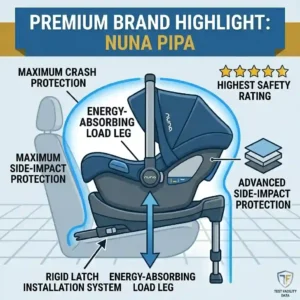
The Solution: Standard foam acts as an insulator. Look for models with active cooling channels or bamboo-derived fabrics. Upgrading to a model with ventilated shells (like specific Nuna or Cybex models) allows passive airflow. Never place ice packs in the seat behind the baby—they become dangerous projectiles in a crash.
How to Choose a Car Seat Based on Crash Physics
When evaluating the safest car seat brands crash test ratings, you have to think like an engineer, not a consumer. The American Academy of Pediatrics (AAP) outlines strict guidelines, but understanding why they exist changes how you shop.
-
Energy Management (The Deceleration Phase):
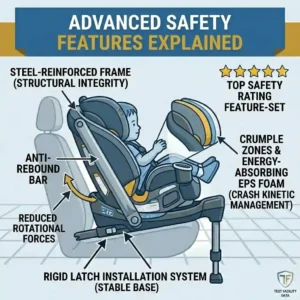
In a crash, the car stops, but the child’s body keeps moving at the vehicle’s original speed. The harness catches them, but the seat shell must absorb the kinetic energy. Look for deep side wings lined with EPS (Expanded Polystyrene) foam. It shatters upon impact, absorbing energy so the child’s ribs don’t have to.
-
Rebound Management (The Elastic Phase):
After the initial impact, the car seat will rebound violently into the vehicle seat back. An Anti-Rebound Bar (ARB) stops this secondary collision. If you are debating between two seats, always choose the one with an ARB.
-
Coupling to the Vehicle:
The tighter the seat is bound to the car, the better it “rides down” the crash with the vehicle’s own crumple zones. Rigid LATCH systems (like those on the Clek Foonf) provide a physical metal-to-metal connection with your car’s frame, offering vastly superior coupling compared to flexible webbing straps.
American vs. European Standards: The Efficiency Gap
If you delve deep into the safest car seat brands crash test ratings, you will inevitably stumble into the European (ECE R129/i-Size) vs. American (FMVSS 213) debate.
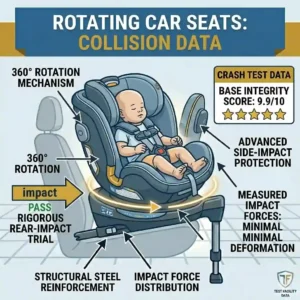
The US standards require a 30-mph frontal sled test, but historically lacked a mandated side-impact test (though updates are rolling out). European standards require frontal, rear, and lateral impact testing, and they mandate the use of Isofix (Rigid LATCH) and load legs. A load leg is a metal post that extends from the base of the car seat to the floor of the vehicle, reducing rotational forces by up to 40%.
While American standards are robust, the European testing methodology forces manufacturers to build structurally stiffer bases. If you want European safety in the US, look for brands like Cybex or seats that feature load legs and Rigid LATCH. It represents a significant hidden cost in engineering, but the biomechanical payoff during an offset frontal collision is immense.
Common Mistakes When Buying High-End Car Seats
Even brilliant, highly educated parents make critical errors when navigating the safest car seat brands crash test ratings. The ‘Anti-Recommendation’ Logic applies here: a “perfect” product can fail spectacularly in specific edge cases.
Mistake 1: Ignoring the “Front-to-Back” Dimensions
You buy a massive, hyper-safe seat, but you drive a Honda Civic. To fit the seat rear-facing, the driver has to slide their seat so far forward their knees touch the dashboard. You have just compromised the driver’s safety to install the child’s seat. Insight: Always measure the distance from the back seat to the back of the front seat.
Mistake 2: Buying Used to Save Money
You find a $400 premium seat on Facebook Marketplace for $100. Do not buy it. You cannot verify if the seat has been in a crash, if the straps were washed with harsh chemicals, or if it has been recalled. The EPS foam degrades over time and with extreme temperature fluctuations in a car.
Mistake 3: Transitioning Too Fast
Parents often rush to move their child to a forward-facing seat or a booster to reclaim car space. Moving a 3-year-old to a high-back booster is legal in some states but lethal in physics. A 5-point harness spreads crash forces across the strong pelvic and shoulder bones. A seatbelt on a toddler will cause severe abdominal organ damage in a crash. Utilize the 50-lb rear-facing limit of the Graco Extend2Fit as long as humanly possible.
Long-Term Cost, Expiration, and Maintenance
Car seats are not lifetime investments; they are perishable goods. The plastic polymer shell expands and contracts in your 140-degree car in the summer and sub-zero car in the winter. Over time, the plastic becomes brittle.
The Total Cost of Ownership:
If you buy an infant seat ($250) that lasts 1 year, a convertible seat ($300) that lasts 4 years, and a high-back booster ($150) that lasts 4 years, your total outlay is $700.
Alternatively, buying an All-in-One like the Britax One4Life ($400) gives you a 10-year lifespan. The hidden efficiency gap is that the All-in-One saves you $300 over the decade, provided you maintain it properly.
Expiration Truths:
Check the stamped expiration date on the bottom of the plastic shell. Most last 6-10 years. Never use an expired seat. The structural integrity is compromised, and manufacturer testing data no longer supports its safety.
Features That Actually Matter (And Those That Don’t)
Marketing departments love to invent proprietary names for standard foam. Let’s filter the hype.
Features That Matter:
-
No-Rethread Harness: As your child grows, you squeeze a handle and the headrest and straps move up together. If you have to manually unthread the straps from the back of the seat, you will likely put it off, resulting in an improper fit.
-
Lock-Offs: Mechanical clamps that lock the vehicle seat belt in place. They are essential for a tight fit if you aren’t using LATCH.
-
Anti-Rebound Bar (ARB): Vital for rear-facing safety to prevent the seat from catapulting backward.
Features That Don’t Matter:
-
“Premium” Cup Holders: They get filled with moldy cheerios.
-
Extreme Padding: Too much plush padding can actually compress during a crash, introducing dangerous slack into the harness system.
-
Third-Party Accessories: Those cute strap covers or mirrors you buy separately? They aren’t crash-tested with the seat and can void your warranty or cause injury.
✨ Don’t Miss These Exclusive Deals!
🔍 Upgrade your daily commute with these carefully selected products. Click on any highlighted item to check current pricing and availability. These tools will help you create authentic safety routines your family will love!
Conclusion
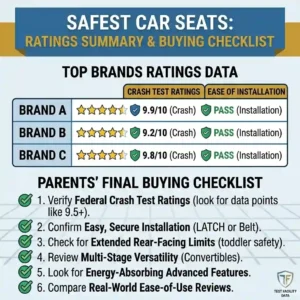
Navigating the safest car seat brands crash test ratings isn’t about finding the single “perfect” seat; it’s about finding the seat that fits your vehicle, fits your child, and that you can install correctly 100% of the time. The raw data proves that user error is the biggest threat to child passenger safety. Whether you opt for the military-grade construction of the Clek Foonf or the foolproof installation of the Britax One4Life, your diligence in reading the manual and mastering the installation is what ultimately saves lives. Don’t let marketing hype distract you from the basic physics of rear-facing, tight harnesses, and secure tethering.
FAQs
❓ What is the most rigorous car seat crash test?
✅ The Swedish Plus Test is widely considered the most rigorous in the world. It measures extreme forces on the neck and is so strict that no forward-facing car seat has ever passed it. Seats passing this test ensure optimal spinal protection…
❓ Are more expensive car seats actually safer?
✅ All car seats sold in the US meet baseline NHTSA standards. However, premium seats offer better energy-absorbing materials (like magnesium frames), advanced rebound management, and foolproof installation mechanisms. A $50 seat installed incorrectly is infinitely more dangerous than a $400 seat…
❓ How long are car seats good for after a crash?
✅ NHTSA states a seat can be reused after a “minor crash” (vehicle can be driven away, no airbag deployed, no injuries). However, many manufacturers, like Britax and Clek, require replacement after any crash, regardless of severity. Always check your manual…
❓ Why do car seats expire?
✅ Car seats expire typically 6-10 years from the manufacturing date. The plastics degrade from constant UV exposure and extreme temperature swings inside the vehicle, making the shell brittle. Furthermore, safety standards and technology evolve rapidly over a decade…
❓ Can I wash car seat straps in the washing machine?
✅ Never. Machine washing, twisting, or using harsh detergents strips the flame retardants and destroys the tensile strength of the webbing. It can cause the straps to snap during a crash. Spot clean with warm water and a mild soap only…
Recommended for You
- 5 Best Convertible Car Seat for Small Cars (2026 Expert Guide)
- Child Safety Seat Installation Tips: 7 Critical Steps for Maximum Protection [2025]
- 5 Best Car Seat for Newborn Safety 2026: Expert Crash-Tested Reviews
Disclaimer: This article contains affiliate links. As an Amazon Associate, I earn from qualifying purchases. If you purchase products through these links, we may earn a small commission at no additional cost to you.
✨ Found this helpful? Share it with your friends! 💬🤗
[addtoany]