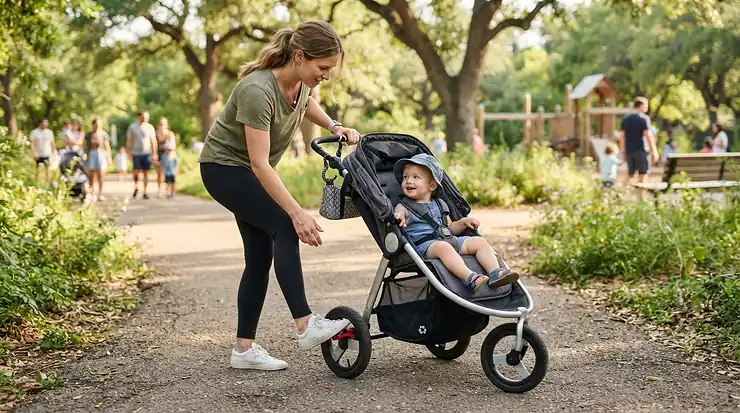
For most families shopping for baby strollers in 2027, the UPPAbaby Cruz V3 is the safest all-round buy, and each of the other five picks beats it in exactly one job: a lower price, a second child on the way, a trunk-sized fold, rough ground or a lie-flat first month. The Bump, BabyGearLab and Reviewed each name the Cruz V3 their top full-size stroller.
This shortlist leans on those three independent test write-ups, maker spec sheets and retailer listings, and where baby strollers reviews disagree about weight or fold type, the text gives both versions. The Bump’s full-size stroller tests, updated in July 2026, are the backbone for most of the real-use notes below.
How the shortlist was sorted: weight, fold, newborn mode and brakes
Four details decide whether a stroller gets used every day or ends up in the garage. Weight matters at the trunk and on stairs, and these picks run from 16.7 pounds for the UPPAbaby Minu V3 to about 28 pounds for the Mockingbird Single-to-Double Stroller 3.0. Fold type matters because testers keep contradicting the marketing: two picks advertise a one-handed fold that took two hands in a reviewer’s test.
Among strollers for baby’s first months, newborn mode splits the field three ways: seats that lie flat, strollers that take an infant car seat, and seats that wait until a baby can sit up. Brakes get their own section further down because a federal rule covers them. Price ranges come from review and retailer pages and move often, so treat them as tiers rather than quotes.
Weights, folds and newborn modes in one table
| Stroller | Weight | Fold | Newborn use | Price range |
|---|---|---|---|---|
| UPPAbaby Cruz V3 | 25.5 to 26.5 lb | Two hands, self-standing | From birth with insert; bassinet sold separately | Around $900 |
| Mockingbird Single-to-Double Stroller 3.0 | 28 lb (36 lb with two seats) | Advertised one-handed; testers differ | Bassinet, insert or adapter, sold separately | Around $550 |
| Joie Ginger DLX | 24.9 to 26.67 lb | Two hands, self-standing | Built-in lie-flat pramette | Around $400 |
| Mompush Meteor 2 | 23.2 lb | Two hands in testing, self-standing | Reversible lie-flat bassinet seat | Around $190 to $200 |
| UPPAbaby Minu V3 | 16.7 lb | One hand, but a button plus a slider | Birth to 50 lb; a car seat is easier | Between $500 and $550 |
| Thule Urban Glide 3 | 26.2 lb | One hand, automatic lock | Needs a separate bassinet | Between $800 and $900 |
The weight gap is the first thing to notice: the UPPAbaby Minu V3 is about 10 pounds lighter than every full-size pick here, and it is the only one a parent can realistically carry up a flight of stairs with a bag on the other arm. Price follows size and brand more than features, since the Mompush Meteor 2 and Joie Ginger DLX both include newborn modes for a fraction of what the UPPAbaby Cruz V3 costs. That spread is why the best baby strollers here can’t be ranked on a single scale.
Check current availability on Amazon.com for the color and configuration you want, because several of these ship in multiple bundles.
1. UPPAbaby Cruz V3 — smooth ride, built for years
Three independent testers reached the same verdict on the UPPAbaby Cruz V3. BabyGearLab ranked it first of 20 full-size strollers with an Editors’ Choice award and called it a stroller for one child who will use it for years; The Bump and Reviewed both gave it their overall-best slot. The reasons overlap: it pushes smoothly, handles curbs well and carries a 30-pound basket, the largest in this group, for a child up to 50 pounds.
Newborns are handled by a seat that reclines almost flat with an infant insert. It accepts all UPPAbaby infant seats, with adapters for Chicco, Clek, Cybex, Maxi-Cosi and Nuna, according to BabyGearLab. The Bump notes the bassinet is sold separately, so decide early whether the insert is enough.
Weight is listed at 25.5 pounds by Reviewed and 26.5 pounds by The Bump and by BabyGearLab’s scale. Folding takes two hands and a few steps, and the frame then locks and stands on its own at roughly 22.5 by 17.5 by 33 inches. BabyGearLab files that under cons as a larger fold, and one Bump tester found the flat fold stretched across her RAV4’s trunk floor and scuffed the sides.
The softer spots are specific. BabyGearLab says the stiffer suspension struggled more with cracks and bumps than rivals did, the stroller isn’t designed for off-road use or jogging, and the setup instructions are pictures only. Foam-filled rubber wheels mean no flats, and the same testers mention good resale value. Reviewed’s write-up was first done on the V2 and carried over, a detail worth knowing before leaning on its notes.
Retailers list it around $900, the highest tier in this guide.
2. Mockingbird Single-to-Double Stroller 3.0 — grows with a second child
Families planning another baby are the audience this one is built for. The stroller starts as a single and expands to a double with a second seat kit sold separately, and The Bump counts 44 possible configurations. In single mode it weighs 28 pounds, rising to 36 with two seats, per the maker’s page, though Reviewed lists 26.5 pounds.
The seat takes children up to 50 pounds and 42 inches, or 45 pounds per seat in double mode. The maker lists a three-month minimum for the seat itself; from birth, the stroller needs the bassinet, the infant insert or a car seat adapter, all sold separately. The bassinet weighs 11.9 pounds and is meant for use until a baby pushes up on hands and knees or reaches 20 pounds. The stroller alone runs around $550, and The Bump’s figures put the stroller plus bassinet near $700.
Real-use notes cut both ways. Reviewed’s tester said the marketed one-handed fold needed two hands and that this was the widest stroller in the test, with a high seat that made it hard for a 5-foot-tall adult to see ahead. The Bump’s tester reported that her 3-year-old once released a connector mid-outing, so check the white buttons before every walk, and that curbs took more effort than expected. Babylist’s own listing averages about 4.7 across more than 6,000 reviews, which is retailer sentiment rather than an independent test.
Pros:
- ✅ Switches between single, double and bassinet setups without tools
- ✅ A 25-pound basket plus storage pockets
- ✅ Smooth push on mixed terrain, per The Bump
Cons:
- ❌ Newborn gear and the second seat cost extra
- ❌ Heavy in both modes, with a bulky two-handed fold as a double
- ❌ Reviewed found the front wheels catch on uneven sidewalks
For a deeper look at how it fared against the other models in that group, see Reviewed’s 2026 roundup, which tested it alongside the Cruz V3 and Vista V3.
3. Joie Ginger DLX — lie-flat newborn mode built in
Around $400 buys a stroller whose seat converts to a lie-flat pramette with one hand, so there is no separate bassinet to purchase. Joie’s page lists use from birth up to 50 pounds, an approximate weight of 26.67 pounds and a folded size of 21.5 by 24.5 by 31.7 inches. BabyGearLab’s scale read 24.9 pounds, a gap worth noting if the trunk is tight.
The tires are foam-filled all-terrain rubber with all-wheel suspension, and the box includes a cup holder and car seat adapters that fit all Joie infant seats. BabyGearLab named it the best value among full-size strollers on a tight budget and found it handles uneven ground better than many similar models. The basket is small, at 10 pounds, according to Babylist and The Bump.
Folding takes two hands, and the frame stands by itself once folded. The Bump’s testers found the fold buttons sit close to the handlebar adjusters, which caused confusion until they learned the layout. BabyGearLab lists a wobbly footrest and a larger fold as cons, while The Bump adds a frame that scuffs easily and a low-quality cup holder.
One practical detail from Babylist’s Q&A: in pramette mode the integrated harness straps are not designed to be removed. Babylist’s listing averages 4.6 across only 17 ratings, too few to say much about long-term wear.
4. Mompush Meteor 2 — bassinet seat at the lowest price
The bassinet and the toddler seat are the same piece of fabric here: the seat reverses and lies flat for a newborn, then turns forward or parent-facing as the child grows. Retailers list the stroller between about $190 and $200, which is about half the price of the Joie Ginger DLX. The box includes a rain cover, foot cover, cup holder and car seat adapter, per Babylist’s detailed listing.
Specs from that listing: 23.2 pounds, a 50-pound child limit, 9.4-inch rear and 6.5-inch front wheels, a handlebar that adjusts from 31.9 to 45.28 inches, and a folded size of 33.9 by 25.2 by 16.7 inches. The underseat basket holds only 10 pounds.
The Bump named it the best budget-friendly full-size pick, and its tester Krysten called it “an absolute steal” while finding it easy to steer on flat ground. The same test turned up a fold that took two hands despite the one-handed marketing, EVA tires without the grip or shock absorption of foam-filled or rubber ones, and a flimsy cup holder. The Bump’s hands-on test is the main independent write-up in the sources for this model, so long-term durability evidence is thin.
EVA tires and a 10-pound basket point it toward smooth sidewalks rather than gravel.
5. UPPAbaby Minu V3 — compact fold for trunks and planes
Weight is the whole argument. BabyGearLab measured 16.7 pounds and ranked the UPPAbaby Minu V3 first of 12 travel strollers with an Editors’ Choice award, noting it is heavier than the roughly 14-pound average for the category. It folds to 21.6 by 17.6 by 9.2 inches and stands up on its own, and it holds a 20-pound basket, large for a travel model.
It works from birth to 50 pounds. The manual describes a bassinet-style setup for infants up to 4 months, but BabyGearLab’s reviewer recommends an infant car seat with an adapter instead. Retailers list the stroller between $500 and $550.
The fold is where sources disagree. Babylist’s listing promises a one-second, one-handed fold, while BabyGearLab says it needs a button pressed and a slider pushed out of the center position at the same time, takes practice and hand strength, and is tricky with a baby in one arm. Airline fit is murky too: the folded size meets IATA carry-on guidelines per BabyGearLab, yet its own spec table marks carry-on compatibility “No,” so check the airline’s rules before flying.
Pros:
- ✅ Well-built, smooth ride, UPF 50+ sunshade
- ✅ Peek-a-boo window and use from birth
- ✅ A large basket for a travel stroller
Cons:
- ❌ No seat ventilation and an unpadded crotch strap
- ❌ Struggles in thick grass, per BabyGearLab
- ❌ Babylist’s listing averages 4.4 over 128 reviews, a step below the Mockingbird’s score
6. Thule Urban Glide 3 — gravel, grass and downhill control
Gravel paths, grass and long hills are where this one earns its price. The Bump’s testers pushed it over gravel, ruts and grass with ease, and BabyGearLab gave it the Best All-Terrain Multi-purpose title, calling its handling fluid regardless of terrain. It weighs 26.2 pounds, takes children up to 49 pounds and folds to about 34.6 by 22.8 by 12.2 inches, according to a running-retailer spec sheet.
Newborns are not covered out of the box. The Bump says it isn’t newborn-ready without the bassinet, which costs around $300 on top of a stroller that retails between $800 and $900. Air-filled tires need an occasional top-up, there is no cup holder, and the folded height eats trunk space, though the wheels come off to help.
Folding takes one hand and locks automatically. BabyGearLab describes lowering the handlebar to its lowest position, lifting the leg rest and using the twist-and-slide handle. A Bump tester found the self-standing feature took trial and error and isn’t covered in the manual, and one Backcountry reviewer complained that the handle doesn’t stay in place when folded, which can release the brake and let the stroller touch the ground. Backcountry’s listing averages 4.5 across 47 ratings.
Pros:
- ✅ Twist hand brake for downhill speed control plus a single-action parking brake
- ✅ One-handed push and fold with automatic lock
- ✅ Air-filled tires that absorb rough ground
Cons:
- ❌ Not newborn-ready without a separate bassinet
- ❌ Heavy and cumbersome to transport, though lighter than most full-size strollers per BabyGearLab
- ❌ Folded height takes up trunk space
Folded dimensions vary more than the weight numbers suggest, so check current availability and configurations on Amazon.com only after matching a model to your trunk and stairs.
Baby stroller with safety brakes: what the federal rule covers and what to check
Strollers sold in the US fall under the CPSC’s mandatory rule, 16 CFR part 1227, which adopts ASTM F833 with modifications. The agency’s business guidance for carriages and strollers lists parking brake and restraining-system requirements among the performance tests and says makers certify compliance with a Children’s Product Certificate. Units manufactured after February 15, 2022 follow ASTM F833-21. The page doesn’t give the technical criteria, so a certificate tells you the stroller was tested, not how its brake feels in your hand.
Brand advice fills the gap. Britax’s safety page calls a five-point harness non-negotiable and says to engage the parking brake any time you stop. Consumer Reports’ stroller checklist adds that a parking brake should be easy to operate and lock both rear wheels, and that on models with two pedals you should use both.
For a baby stroller with safety brakes beyond the basics, the Thule Urban Glide 3 is the only one among these six with a speed-control hand brake in addition to its parking brake, according to BabyGearLab. The sources reviewed don’t describe the parking-brake design of every other pick, so read each manual’s brake section before the first outing.
Recalls are worth a two-minute check. CPSC warned consumers on June 11, 2026 to stop using B. Childhood High Landscape stroller travel systems because of an entrapment hazard and violation of the mandatory standard. A June 18, 2026 CPSC recall covered Joolz Aer2 car seat adapters that can fail to attach, though the stroller itself wasn’t involved. Search cpsc.gov before buying used or from an unfamiliar marketplace seller; federal law prohibits selling recalled products.
Baby stroller how to fold: the order that avoids jams
Every brand folds differently, so the manual wins, but the preparation is shared. Searches for baby stroller how to fold mostly return brand-specific videos; guides from Macrobaby, The Tool’s Trunk and a UPPAbaby Vista folding walkthrough, taken together, point to this order:
- Engage the parking brake so the frame doesn’t roll while your hands are busy.
- Take the child out, then remove any car seat, bassinet or seat attachment, since folding with one connected isn’t the intended motion.
- Empty the basket and clear the fold path; items in the basket are a common reason the frame won’t close.
- Lower the handlebar if the model needs it, as BabyGearLab says the Thule Urban Glide 3 does.
- Use the release and listen for the lock. If it jams, reopen it and check the seat position and wheel angle rather than forcing it, because forcing bends frames and breaks latches.
Testers describe the latch on each model differently. The UPPAbaby Cruz V3 needs two hands and several steps but unfolds in one. The UPPAbaby Minu V3 takes a button and a slider together and rewards practice. The Mockingbird Single-to-Double Stroller 3.0 is marketed as one-handed; The Bump found that true in single mode only, while Reviewed’s tester needed two hands. Practice at home with the seat off before the first outing with a baby, not in a parking lot.
Baby stroller vs carrier: what each one does better
The baby stroller vs carrier debate is a routing question rather than a contest. Ergobaby, a carrier maker with an obvious stake, says a fully reclining stroller can be used from birth while upright seats suit babies who can sit unassisted, usually around six months. The parenting blog Pregnant Chicken says a carrier may be the better bet if you rely on public transit, climb many stairs and have a baby under 35 pounds.
Forum parents lean the other way for some days. One Mumsnet parent says a pram is better for longer pavement walks and for restaurant meals, while another reports using a sling for about three-quarters of outings once their older child was on and off buses a lot. A baby-photography blog sums up the usual result: in almost all cases, parents end up with both.
For positioning or sleep questions, ask your pediatrician; this guide sticks to gear specs. If you pick one, choose by route: stairs and buses favor the carrier, while long walks and a full basket favor strollers for baby’s daily outings.
Baby strollers reviews: what testers and parents keep reporting
Three patterns recur across the independent write-ups, and each should change what you buy.
One-handed folds are often a two-handed fold. Reviewed reported it for the Mockingbird Single-to-Double Stroller 3.0, The Bump for the Mompush Meteor 2, and BabyGearLab described a practice-heavy two-control fold on the UPPAbaby Minu V3. Three independent testers, three models: a consensus worth believing over product pages.
Newborn mode often costs extra. The Bump lists a bassinet around $300 for the Thule Urban Glide 3 and says newborn add-ons for the Mockingbird Single-to-Double Stroller 3.0 and the UPPAbaby Cruz V3 are sold separately. Only the Joie Ginger DLX and Mompush Meteor 2 build a lie-flat mode into the seat.
Basket size splits the field. Reviewed lists a 30-pound basket for the UPPAbaby Cruz V3 and 25 pounds for the Mockingbird Single-to-Double Stroller 3.0, while Babylist and The Bump put the Joie Ginger DLX and Mompush Meteor 2 at 10 pounds. If you shop big, that gap decides daily usability.
Expect scuffs on any of them: The Bump’s tester saw them on the Cruz’s sides, BabyGearLab on the Minu, and The Bump on the Joie’s frame. For the full rankings behind these notes, see BabyGearLab’s stroller review.
Brakes, folds, carriers and the first months: quick answers
❓ What are the best baby strollers for a newborn?
✅ Look for a seat that lies nearly flat, a bassinet attachment or an infant car seat adapter, and confirm the maker's minimum age and weight. Five of the six picks here work from birth in some form; the all-terrain one needs a separately sold bassinet.
❓ Is there a federal safety standard for strollers?
✅ Yes. In the US, strollers fall under the CPSC's 16 CFR part 1227, which incorporates ASTM F833 and covers items such as the parking brake and restraint system. Manufacturers must certify compliance with a Children's Product Certificate, so ask the seller for it if a listing is vague.
❓ How do I fold a stroller that keeps jamming?
✅ Lock the brake, remove the seat attachments and anything in the basket, lower the handlebar if the model needs it, then use the release the manual shows. If the frame resists, reopen it and check the seat position and wheel angle instead of forcing it.
❓ Is a stroller or a baby carrier better for the first few months?
✅ Neither wins outright. Carrier brands and parenting blogs point to stairs and public transit for carriers, while a Mumsnet parent prefers a pram for long pavement walks and restaurants. Many families use both, so let your daily route decide.
❓ When can a baby use the regular upright seat?
✅ Makers set their own minimums, so follow the manual. One maker lists three months for its plain seat unless a bassinet or insert is added, and a carrier brand says upright seating usually suits babies who can sit unassisted, around six months. Ask your pediatrician if unsure.
One decision rule for choosing among these baby strollers
Among the best baby strollers here, choose the UPPAbaby Cruz V3 if one stroller has to last through toddlerhood and the budget allows. Choose the Mockingbird Single-to-Double Stroller 3.0 if a second child is likely within a couple of years, the Joie Ginger DLX or Mompush Meteor 2 if a newborn mode matters more than polish, the UPPAbaby Minu V3 if stairs and airports shape your days, and the Thule Urban Glide 3 if your routes are gravel and hills. Check the exact folded dimensions against your trunk, read the brake section of the manual before the first walk, and check current availability on Amazon.com for the bundle you want.
Recommended for You
- Safe Travel Stroller with Brakes: 7 Best Picks for 2025
- 7 Expert-Reviewed CedarWorks Playset Prices That Deliver Big Value in 2025
- 5 Safest Baby Monitor No Hacking Risk Models of 2026 (Expert Tested)
Disclaimer: This post contains affiliate links. As an Amazon Associate, I earn from qualifying purchases made through these links, at no additional cost to you.
Know a parent comparing strollers this month? Share this shortlist with them. 🍼