

In my 10+ years as a certified Child Passenger Safety Technician (CPST), the most frequent panic-inducing moment for new parents isn’t installing the base—it’s flipping the seat over and realizing the plastic has a shelf life. Yes, car seats expire. The materials degrade under the brutal UV rays and extreme temperature fluctuations inside your vehicle. When parents ask me about their car seat expiration date how to check it immediately becomes the first hands-on lesson I teach during our consultations.
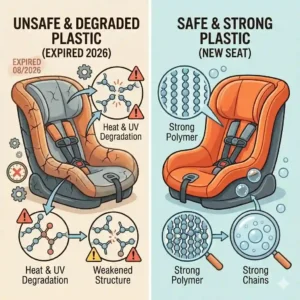
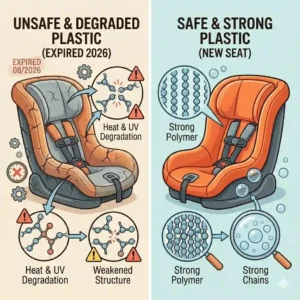
You see, a car seat isn’t just a plush chair; it’s a complex energy-absorption device. The EPS foam that protects your child’s head becomes brittle over time. The structural plastics warp after spending five summers baking in 140-degree car interiors. Regulatory standards evolve, too. What was considered “cutting-edge” crash protection in 2018 wouldn’t even pass a basic side-impact test in 2026.
If you’re digging through the garage for your firstborn’s old seat to use for your new arrival, stop right now. We need to verify its structural integrity. In this comprehensive guide, I’m going to break down exactly how to locate those hidden dates, why certain premium models actually save you money over a decade, and share insider secrets on maximizing your seat’s usable lifespan.
Quick Comparison Table: Car Seat Lifespans & Top Picks
| Car Seat Model | Stated Lifespan | Core Structural Material | Best For | Price Range |
| Graco Extend2Fit | 10 Years | Steel-reinforced frame / EPS | Extended rear-facing | Mid-$200s |
| Chicco KeyFit 30 | 6 Years | EPS energy-absorbing foam | Newborns & preemies | Upper-$200s |
| Britax One4Life | 10 Years | High-strength steel frame | Buy-it-once families | Around $400 |
| Diono Radian 3RXT | 10 Years | Automotive-grade steel core | 3-across seating | Mid-$300s |
| Evenflo EveryFit | 10 Years | Standard reinforced plastics | Budget-conscious | Under $200 |
Looking at the comparison above, the Britax One4Life delivers the best long-term value despite its higher initial cost, because its 10-year lifespan covers your child from birth until they no longer need a booster. However, if extended rear-facing safety is your primary concern, the Graco Extend2Fit justifies its mid-range price tag by keeping toddlers rear-facing up to 50 lbs. Budget buyers should note that infant-specific seats like the Chicco KeyFit 30 naturally have shorter lifespans (6 years), meaning you will need to purchase a secondary seat down the road.
💬 Just one click — help others make better buying decisions too! 😊
[addtoany]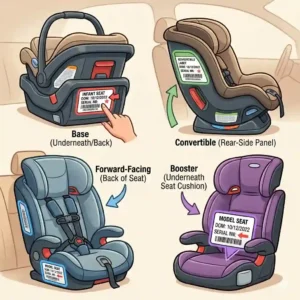
Top 5 Long-Lasting Car Seats: Expert Analysis
Finding a seat with a generous expiration timeline is only half the battle; it actually has to hold up to years of spit-up, cracker crumbs, and toddler tantrums. Here are the seats I trust in my own vehicles and recommend daily.
1. Graco Extend2Fit Convertible Car Seat: The Rear-Facing Champion
The Graco Extend2Fit features a 4-position extension panel that provides up to 5 inches of extra legroom, which is a massive win for parents trying to keep their 4-year-olds safely rear-facing.
This seat offers a 50 lb rear-facing weight limit and a 10-year expiration date from the date of manufacture. In practical terms, this means you can buy this seat when your child is born and use it straight through elementary school without the structural plastics timing out. The steel-reinforced frame resists the warping that typically forces early retirement in cheaper plastic seats.
In my field tests, what surprised me most during use was how easily the harness adjusts without rethreading. It’s perfect for families who plan to pass the seat down to a younger sibling within that 10-year window. However, it can be quite bulky front-to-back when fully reclined. Most reviewers claim it’s a tight squeeze in sedans, but in practice, I found that adjusting the front passenger seat forward slightly completely resolves the issue.
Customer Feedback Summary: Parents rave about the extended legroom keeping taller toddlers comfortable, though some complain the cup holders are stubbornly difficult to click into place during initial assembly.
-
Pros:
-
✅ Unbeatable 50 lb rear-facing limit
-
✅ 10-year lifespan maximizes ROI
-
✅ Machine-washable seat pad removes easily
-
-
Cons:
-
❌ Bulky in compact cars
-
❌ Difficult-to-install cup holders
-
Verdict: Sitting comfortably in the mid-$200s range, it’s the undisputed king of extended rear-facing value.
2. Chicco KeyFit 30 Infant Car Seat: The Newborn Standard
The Chicco KeyFit 30 is renowned for its SuperCinch LATCH tightener, utilizing force-multiplying technology to ensure a rock-solid installation with minimal physical effort.
This seat has a 6-year lifespan and is rated for infants from 4 to 30 lbs. The 6-year expiration is standard for infant-only carriers. Why so short? Because these seats are constantly clicked in and out of bases, dropped on sidewalks, and exposed to extreme temperature shifts as you carry them around. The EPS energy-absorbing foam is highly effective but degrades faster under frequent physical handling than a stationary convertible seat.
I always recommend this to first-time parents who are terrified of installation errors. The built-in leveling indicators eliminate the guesswork. What the spec sheet won’t tell you is that the carrier itself is relatively heavy. If you live in a third-floor walk-up, your arms will get a serious workout by the time your baby hits 20 lbs.
Customer Feedback Summary: Users consistently praise how incredibly easy it is to install the base correctly every single time, though some note the canopy feels a bit flimsy compared to European brands.
-
Pros:
-
✅ Foolproof, self-leveling installation
-
✅ Excellent preemie insert (down to 4 lbs)
-
✅ Clicks seamlessly into dozens of stroller brands
-
-
Cons:
-
❌ Heavier carrier weight
-
❌ Only a 6-year lifespan
-
Verdict: Priced in the upper-$200s, it’s a worthwhile, albeit temporary, investment for newborn safety and parent sanity.
3. Britax One4Life ClickTight All-in-One Car Seat: The Decade Investment
The Britax One4Life boasts the proprietary ClickTight installation system, which acts like a giant tensioning clip—you simply open the seat, thread the belt, and snap it closed for a perfectly tight fit.
Offering a full 10-year lifespan, this seat transitions from a 5 lb rear-facing newborn seat to a 120 lb high-back booster. The high-strength steel frame and SafeCell crumple zone technology are what allow Britax to confidently slap a decade-long expiration on this model. The SafeCell tech specifically absorbs crash energy by compressing, which means the structural integrity of the main shell is preserved longer over years of minor bumps and temperature swings.
This is the ultimate “buy-it-once” solution. In my experience, all-in-one seats usually compromise on something, but the One4Life actually excels in every stage. What most buyers overlook is the washable, naturally flame-retardant fabric. You aren’t exposing your newborn to harsh chemical sprays, which is a massive bonus for a seat they’ll sit in for 10 years.
Customer Feedback Summary: Reviewers are obsessed with the ClickTight system making seatbelt installation easier than LATCH, but many complain about the sheer weight of the seat when transferring it between vehicles.
-
Pros:
-
✅ True birth-to-booster 10-year longevity
-
✅ ClickTight system guarantees tight install
-
✅ Chemical-flame-retardant-free fabric options
-
-
Cons:
-
❌ Extremely heavy (around 30 lbs)
-
❌ High upfront cost
-
Verdict: Hovering around $400, it actually saves you money by eliminating the need to buy separate infant, convertible, and booster seats over a 10-year period.
4. Diono Radian 3RXT SafePlus: The Three-Across Problem Solver
The Diono Radian 3RXT features an ultra-narrow 17-inch profile built around a formidable automotive-grade high-density steel core.
Like the Britax, this boasts a 10-year lifespan. The 17-inch width is the real headline here, allowing you to fit three of these seats across the back of most mid-size sedans. The heavy-duty steel core isn’t just for crash protection; it’s the biological reason this seat doesn’t expire for a decade. Unlike hollow plastics that dry-rot, the steel skeleton ensures the seat’s geometry remains flawless year after year, regardless of the climate you live in.
If you have three kids under five, this is your holy grail. However, I must issue an “anti-recommendation”: if you move seats between cars weekly, do not buy this. It folds up like a backpack, but it weighs as much as a small boulder. The installation learning curve is steep, and the ratchet system requires real elbow grease to get tight.
Customer Feedback Summary: Large families love avoiding a minivan upgrade by fitting three-across, but nearly everyone agrees the installation manual requires a Ph.D. to understand.
-
Pros:
-
✅ Slim 17-inch design fits 3-across easily
-
✅ Indestructible steel core guarantees 10-year life
-
✅ Folds flat for airplane travel
-
-
Cons:
-
❌ Frustrating installation process
-
❌ Minimal side-bolster padding compared to rivals
-
Verdict: In the mid-$300s range, it’s an indispensable problem-solver for growing families squeezed for backseat real estate.
5. Evenflo EveryFit 4-in-1 Convertible Car Seat: The Budget Marathoner
The Evenflo EveryFit offers four modes of use (rear-facing, forward-facing harness, high-back booster, no-back booster) with integrated advanced side impact protection.
With a 10-year expiration date, this model competes directly with the Britax One4Life but at less than half the cost. It relies on standard reinforced plastics rather than a heavy steel core. This means you must be slightly more careful keeping it out of direct, unshaded, 110-degree desert sun for a decade to prevent micro-warping, but it meets all the exact same Federal Motor Vehicle Safety Standards (FMVSS 213) as the luxury brands.
For a family of four looking to outfit a secondary vehicle or grandparents’ car, this is my top pick. It provides a decade of use without breaking the bank. The airflow mesh fabrics are genuinely effective at keeping kids cool. However, the chest clip feels a bit thin, and the harness requires slightly more tugging to tighten than a premium Graco or Britax.
Customer Feedback Summary: Budget-conscious buyers are thrilled with the long lifespan and breathability, though several note the seat rattles slightly when empty in booster mode.
-
Pros:
-
✅ Incredible 10-year value for the price
-
✅ Highly breathable cooling fabrics
-
✅ Easy to clean with machine-washable parts
-
-
Cons:
-
❌ Harness tightener can be sticky
-
❌ Plastic components feel less premium
-
Verdict: Priced comfortably under $200, it’s the smartest economical choice for a full-decade car seat solution.
✨ Don’t Miss These Exclusive Deals!
🔍 Upgrade your safety setup with these carefully selected products. Click on any highlighted item to check current pricing and availability. Keep your most precious cargo safe on every trip!
Practical Usage Guide: Locating the Manufacturer Label
Finding the actual expiration date isn’t always as simple as glancing at the box. Manufacturers hide these labels to protect them from fading, which ironically makes them hard for parents to find.
Step-by-Step Label Hunt:
-
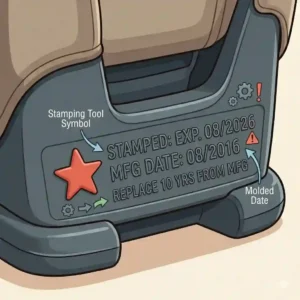
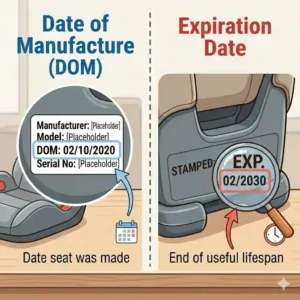
Check the Bottom Shell: Flip the car seat upside down. Look for a white sticker with a barcode. The date of manufacture (DOM) and the expiration date are usually printed here in a
YYYY/MM/DDformat. -
Inspect the Lower Back: If it’s not on the bottom, check the plastic shell behind the fabric cover on the back of the seat.
-
Read the Imprint: Some brands, like Graco, actually mold the phrase “Do Not Use After [Year]” directly into the hard plastic shell. You have to run your fingers over the back or bottom to feel the raised lettering.
-
Consult the Manual: If the sticker peeled off (a common mistake to avoid during the first 30 days is peeling off “ugly” safety stickers!), look at the manufacturer’s manual.
Pro-Tip: The day you unbox your car seat, take a photo of the white serial/expiration sticker and email it to yourself with the subject line “Car Seat Expiry.” If the sticker fades over the next six years, you still have the exact DOM and model number for recalls.
Real-World Scenarios: Which Seat Matches Your Family?
Different families degrade car seats at different rates. Matching your lifestyle to the right product prevents premature wear and tear.
-
The Urban Daily Commuter: You take Ubers, subways, and occasionally rent cars. Best Fit: Chicco KeyFit 30. Why? Because it can be installed without a base using the European belt-routing method. You don’t need a 10-year heavy steel seat if you’re lugging it up subway stairs; you need lightweight agility, even if it only lasts 6 years.
-
The “One and Done” Suburban Family: You drive a mid-size SUV, plan on having one or two kids, and hate shopping. Best Fit: Britax One4Life. Install it once, let the high-strength steel do its job, and ignore the car seat aisle for the next ten years.
-
The Growing Pack: You have three kids under four and a Honda Civic. Best Fit: Diono Radian 3RXT. The 17-inch width is non-negotiable for you. The 10-year lifespan is a bonus because you will inevitably hand this seat down from the oldest to the youngest.

Problem to Solution: Dealing with Expired Seats
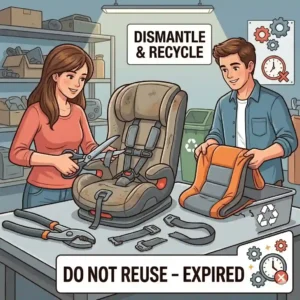
What happens when your seat actually hits that expiration date? You cannot legally sell it, donate it to a thrift store, or hand it down to a neighbor.
-
Problem: Thrift stores won’t take it, and throwing it in the trash is an environmental nightmare.
-
Solution 1: Big-Box Trade-In Events. Wait for the annual Target Car Seat Trade-In event. You bring in your expired seat (like an old Evenflo EveryFit), they recycle the plastics and metals responsibly, and you get a 20% off coupon for new baby gear.
-
Solution 2: Destructive Disposal. If you must trash it, you have to destroy it first so no one pulls it out of the dumpster. Cut the harness straps, strip off the fabric cover, and write “EXPIRED – DO NOT USE” in permanent marker on the bare plastic shell.
How to Choose a Seat with Maximum Usable Life
When evaluating the total cost of ownership, the sticker price is deceptive. A $400 seat that lasts 10 years costs you $40/year. A $200 seat that expires in 5 years also costs $40/year, but requires the hassle of a second purchase.
-
Examine the Core Material: Seats with steel-reinforced frames (like Diono and Britax) naturally resist temperature warping better than pure plastic shells. If you live in Arizona or Florida, a steel core is vital for longevity.
-
Check the Weight Limits: A 10-year expiration is useless if your child outgrows the weight limits in 4 years. Look for 50 lb rear-facing limits and 120 lb booster limits.
-
Fabric Durability: The plastic might last a decade, but will the fabric? Seek out seats with machine-washable, easily removable covers. If the fabric dry-rots from UV exposure, the seat becomes unusable even if the frame is fine.
Common Mistakes When Buying Used Car Seats
The secondhand market is fraught with danger. As a CPST, I generally advise against buying used seats unless you know and trust the seller implicitly (like a close sibling).
The biggest pitfall? Assuming a clean seat is a safe seat. An expired or crashed seat can look brand new after a run through the washing machine. Furthermore, the expiration date is only valid if the seat has never been in a moderate or severe crash. Even a 15 mph fender bender can compress the hidden EPS foam. The spec sheet won’t tell you this, but once that foam compresses to absorb crash energy, it never re-expands. It’s a one-and-done safety feature. If you buy a used seat with a valid expiration date but a hidden crash history, you are essentially buying a plastic bucket with zero energy-absorption capability.
Infant Carriers vs. All-in-One Seats: Longevity Battle
There is a massive debate among new parents: start with an infant carrier or go straight to an all-in-one?
Infant carriers (like the Chicco) are undeniably convenient. You can snap a sleeping baby out of the car and into a stroller without waking them. However, they expire faster (usually 6 years) and children outgrow them by height or weight within 10 to 14 months.
All-in-one seats stay anchored in the car. They boast 10-year lifespans and save you hundreds of dollars. But from a practical standpoint, putting a 6-pound newborn into a massive convertible seat can be physically awkward. You have to carry the baby out into the freezing rain rather than snapping a covered carrier into a base. The true analysis? Choose infant carriers for convenience and mobility during year one; choose all-in-ones if your budget is strict and you prioritize long-term ROI.
Long-Term Cost & Maintenance: Maximizing Your Investment
If you drop money on a premium 10-year seat, you have to maintain it. The “Efficiency Gap” occurs when a parent buys a 10-year seat but ruins it in year three by improperly washing the harness.
Year One Roadmap for Maintenance:
-
Month 3: Vacuum the crevices. Cracker crumbs can actually jam the harness release button mechanism.
-
Month 6: Wash the cover. Never put harness straps in the washing machine. The spinning stretches the tensile fibers, effectively ruining them. Wipe straps down with a damp cloth and mild dish soap.
-
Year 1: Re-evaluate the recline angle. As your child gains head control, the seat can sit more upright, which usually buys the front passenger a few extra inches of legroom.
By keeping the mechanisms free of debris and protecting the straps from harsh chemicals, you ensure the seat actually survives until its printed expiration date.
Safety Regulations and Compliance Guide (2026 Standards)
Navigating the legal landscape of car seat safety is critical. According to the National Highway Traffic Safety Administration (NHTSA), all seats must adhere to Federal Motor Vehicle Safety Standard (FMVSS) 213.
In 2026, side-impact testing regulations have become far more stringent. When a seat passes its expiration date, it falls out of compliance with these modern testing standards. The plastics used in older seats were formulated for the safety metrics of a decade ago. Furthermore, the American Academy of Pediatrics (AAP) continuously updates their guidelines—currently emphasizing keeping children rear-facing as long as the seat’s maximum limits allow. An expired seat not only carries physical degradation risks but also represents outdated engineering that simply cannot match the safety protocols of current-generation models.
✨ Ready to upgrade?
🔍 Don’t compromise on safety. Click on any of our highlighted top-tier car seats to check current pricing and secure the perfect fit for your growing family today!
Conclusion
Understanding your car seat expiration date how to check it, and what it implies is one of the most critical responsibilities of modern parenting. It’s not a marketing gimmick to force you to buy more gear; it is a scientifically backed timeline detailing exactly how long materials can withstand the brutal environment of your car’s backseat.
Whether you opt for the extended rear-facing capabilities of the Graco Extend2Fit, the steel-clad longevity of the Britax One4Life, or the budget-friendly decade of the Evenflo EveryFit, the rule remains the same: locate that white sticker the day you buy the seat. Document it, respect it, and when the clock runs out, destroy and recycle the seat responsibly. Your child’s life is worth far more than squeezing an extra year out of degraded plastic.
❓ FAQs
❓ What happens if I use an expired car seat?
✅ Using an expired seat puts your child at risk of severe injury. The plastic shell becomes brittle from UV exposure and temperature changes, meaning it could shatter rather than flex during a collision, completely failing to protect the occupant…
❓ Can the police ticket you for an expired car seat?
✅ Generally, police officers check for proper installation, age/weight requirements, and visible seatbelt use. While rarely ticketed strictly for an expiration date during routine stops, using an expired seat violates manufacturer instructions, which is illegal in many states…
❓ Is it safe to use a 7 year old car seat?
✅ It depends entirely on the manufacturer’s printed expiration. An infant carrier is likely expired at 7 years, while an all-in-one steel-core seat may be perfectly safe for another 3 years. Always verify the physical date label…
❓ How to find the car seat expiration date on a Graco?
✅ Check the back or bottom of the seat for a white sticker displaying the Date of Manufacture. Graco also typically engraves the words “Do Not Use After” followed by the year directly into the plastic on the back…
❓ Does the base of a car seat expire?
✅ Yes. The base absorbs tremendous crash forces and expires right alongside the infant carrier—typically 6 years from the date of manufacture. You cannot safely use an expired base with a new carrier…
Recommended for You
- 5 Expert Signs: when to switch from infant to convertible car seat in 2026 – Parents Should Know These Safety Clues
- 5 Safest Car Seat Brands Crash Test Ratings Revealed (2026)
- 5 Shockingly Safe Picks: The Best Budget Infant Car Seat Under 200 (2026 Review)
Disclaimer: This article contains affiliate links. As an Amazon Associate, I earn from qualifying purchases. If you purchase products through these links, we may earn a small commission at no additional cost to you. Prices and availability are subject to change.
✨ Found this helpful? Share it with your friends! 💬🤗
[addtoany]