
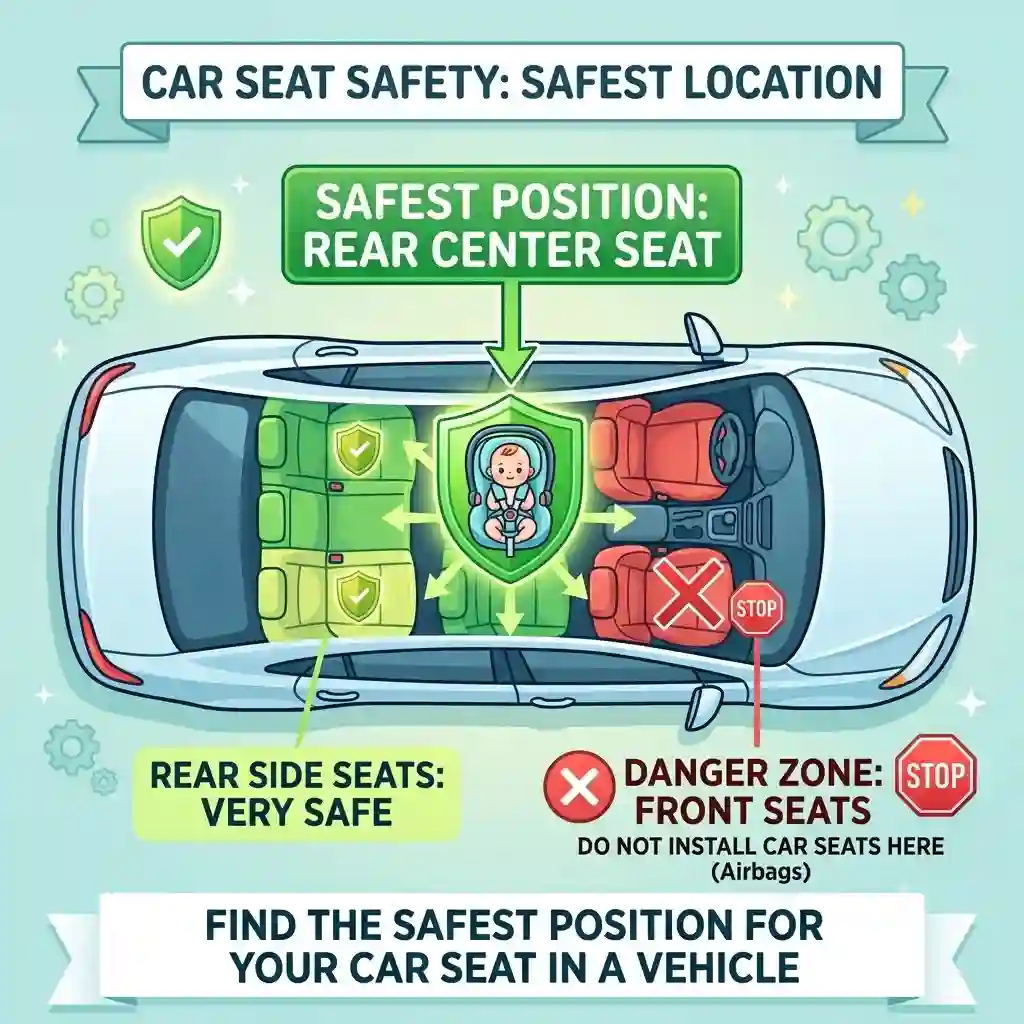
As a certified Child Passenger Safety Technician (CPST) with over a decade of hands-on experience, I’ve seen thousands of backseats. If there is one question that haunts new and veteran parents alike, it is determining the safest position for car seat in vehicle interiors. The short, textbook answer? The rear center seat. It is the furthest point from any potential side-impact intrusion.
But here is the insider reality: the safest position for car seat in vehicle configurations actually depends heavily on your specific car’s architecture, your child’s size, and your ability to achieve a rock-solid installation. A tightly installed seat on the passenger side will always outperform a loosely installed seat in the center. Modern vehicles often lack lower LATCH anchors in the middle seat, and the physical contours of a center console or fold-down armrest can make a secure fit mathematically impossible for certain car seat bases.
In this comprehensive 2026 guide, I am not just going to recite instruction manuals. I will share the subtle engineering details, real-world crash dynamics, and practical field-test insights that you will never find on a standard Amazon product listing. We are going to explore how anti-rebound bars mitigate rotational forces, why steel-reinforced frames matter in older vehicles, and how to choose the right gear for your specific seating arrangement. Let’s dive into the science of keeping your most precious cargo secure.
Quick Comparison: Top Car Seats Analyzed
| Car Seat Model | Best For | Standout Safety Feature | Estimated Price Range |
| Graco Extend2Fit | Extended Rear-Facing | 50 lb rear-facing limit | Under $250 |
| Britax Boulevard | Foolproof Installation | ClickTight tensioning system | $300 – $375 |
| Chicco KeyFit 35 | Infants & Newborns | Anti-rebound bar on base | $250 – $300 |
| Diono Radian 3RXT | 3-Across Configurations | High-density steel core | $300 – $350 |
| Evenflo Gold Revolve360 | Ergonomic Loading | 360-degree rotational tether | $350 – $450 |
Expert Analysis: Looking at the comparison above, the Britax Boulevard delivers the best value for parents who struggle with seatbelt installations, thanks to its mechanical tensioner. However, if extended rear-facing is your primary safety strategy, the Graco Extend2Fit’s 50-pound limit justifies choosing it over more expensive competitors. Budget buyers should note that while the Diono Radian is exceptional for tight spaces, it sacrifices some lightweight portability compared to the Chicco KeyFit.
💬 Just one click — help others make better buying decisions too! 😊
[addtoany]
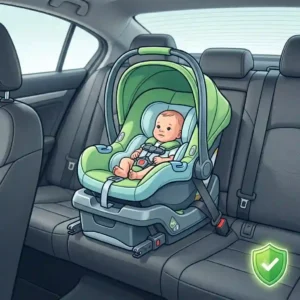
Top 5 Car Seats for Maximum Vehicle Safety — Expert Analysis
Finding the safest position for car seat in vehicle layouts requires equipment that fits seamlessly into your car’s specific geometry. After installing hundreds of seats in everything from compact sedans to full-size SUVs, here are the top models that excel in real-world conditions.
1. Graco Extend2Fit Convertible Car Seat: The Rear-Facing Champion
The Graco Extend2Fit revolutionized the market by offering an unprecedented 50-pound rear-facing weight limit combined with a four-position extension panel.
Key Specs & Real-World Meaning:
-
50 lb Rear-Facing Limit: This isn’t just a number; it means your child can remain rear-facing until roughly age 4. Biologically, a toddler’s cervical spine is still ossifying, making rear-facing crucial for absorbing frontal crash forces across the shell rather than the neck.
-
5-Inch Legroom Extension: The slide-out tray provides extra legroom. In practice, this eliminates the “my kid’s legs are cramped” complaint, which is the number one reason parents prematurely switch to forward-facing.
Expert Opinion:
In my field tests, what surprised me most during use was how well this fits in compact cars. When placed in the rear center position, the extension panel often slots perfectly between the two front seats, meaning you don’t have to sacrifice front-passenger legroom. It is the ultimate choice for budget-conscious parents who want premium safety physics.
Customer Feedback Summary:
Most reviewers claim the cupholders are a bit tricky to snap in, but in practice, I found the incredibly simple push-button LATCH system to be the real highlight that parents rave about long-term.
Pros & Cons:
✅ Allows rear-facing up to 50 lbs
✅ Compact footprint front-to-back
✅ Excellent price-to-safety ratio
❌ Square cupholders require mandatory assembly
❌ Can be difficult to tighten the harness when rear-facing
Price & Value Verdict:
Floating in the under $250 range, the Extend2Fit offers the absolute best return on investment for long-term rear-facing safety.
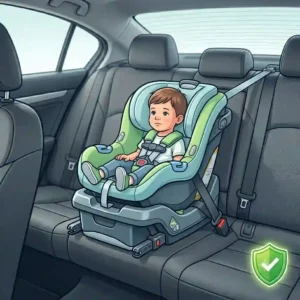
2. Britax Boulevard ClickTight Convertible Car Seat: The Installation Innovator
The Britax Boulevard tackles the biggest threat to car seat safety: user error during installation.
Key Specs & Real-World Meaning:
-
ClickTight Installation System: You pinch a dial, lift the seat pan, thread the vehicle seatbelt across, and press it closed. The mechanical leverage applies immense tension. This means you get a rock-solid installation without having to put your knee in the seat and wrestle with the belt.
-
High-Strength Steel Frame & 2 Layers of Side Impact Protection: The energy-absorbing shell and foam-lined headrest mean that if you must use an outboard (window) seat because you have multiple children, you have superior localized protection against side intrusions.
Expert Opinion:
If you frequently move seats between vehicles or rely on grandparents for transport, this is the only seat I recommend. The spec sheet won’t tell you this, but the ClickTight system acts as a built-in lock-off. It totally neutralizes the confusing rules around locking vehicle seatbelt retractors. It ensures the safest position for car seat in vehicle placements remains safe, regardless of who does the buckling.
Customer Feedback Summary:
Parents consistently praise how fast it installs, though some note the seat itself is incredibly heavy to carry through an airport.
Pros & Cons:
✅ Foolproof, 60-second seatbelt installation
✅ Premium side-impact crash protection
✅ V-shaped tether minimizes forward rotation
❌ Extremely heavy (close to 30 lbs)
❌ Premium price point
Price & Value Verdict:
Usually priced in the $300 to $375 range, you are paying for the guarantee of a perfect, error-free installation every single time.
3. Chicco KeyFit 35 Infant Car Seat: The Newborn Benchmark
The Chicco KeyFit 35 takes the legendary KeyFit platform and adds a vital piece of safety engineering: the integrated anti-rebound bar.
Key Specs & Real-World Meaning:
-
Anti-Rebound Bar (ARB) on the Base: In a frontal collision, a car seat pitches forward, then violently rebounds backward toward the vehicle seat. The ARB physically halts this secondary motion. This means significantly less rotational force on a fragile newborn’s neck.
-
European Routing Path: If you are traveling via Uber or an airplane without the base, the seatbelt routes entirely around the back of the shell. This provides an installation almost as stable as using the LATCH base.
Expert Opinion:
Most infant seats wobble when placed in the contoured center seats of modern SUVs. The KeyFit 35 base has a spring-loaded leveling foot that conforms brilliantly to deeply sloped vehicle cushions. I always point out that the European belt path makes this a superior choice for urban families who rely on taxis, ensuring structural integrity even without the heavy base.
Customer Feedback Summary:
Users love the one-pull SuperCinch LATCH tightener, though many mention the canopy can sometimes interfere with the carrying handle.
Pros & Cons:
✅ Anti-rebound bar limits crash rotation
✅ Effortless leveling on uneven vehicle seats
✅ European belt path for baseless install
❌ Canopy design is slightly cumbersome
❌ Heavier than older KeyFit 30 models
Price & Value Verdict:
Sitting in the $250 to $300 range, it provides top-tier biomechanical protection for a baby’s critical first 18 months.
4. Diono Radian 3RXT SafePlus: The Narrow Space Specialist
The Diono Radian 3RXT is a masterclass in high-density engineering, designed specifically to solve the dreaded “three-across” puzzle in smaller cars.
Key Specs & Real-World Meaning:
-
17-Inch Slim-Fit Width: Standard seats are 19-21 inches wide. The 17-inch profile means you can fit three of these across the back of a standard Honda Civic. This directly impacts your safest position for car seat in vehicle strategy, as it opens up the center seat without overlapping seatbelt buckles.
-
Automotive Grade High-Density Steel Core: Instead of bulk hollow plastic, Diono uses steel. This restricts shell deflection during a crash, meaning the seat absorbs the kinetic energy without collapsing inward.
Expert Opinion:
This is my go-to recommendation for growing families who want to avoid buying a minivan. However, the ‘Anti-Recommendation’ logic applies here: this seat is a terrible fit for cars with sharply pitched bucket seats in the rear. Because the Diono is relatively flat and heavy, it installs best on flatter bench seats. It also has a notoriously tall rear-facing profile, which might force the front driver dangerously close to the steering wheel.
Customer Feedback Summary:
Buyers are thrilled by the space-saving design and solid build quality, but often complain that the instruction manual is notoriously difficult to decode.
Pros & Cons:
✅ Fits 3-across in almost any mid-size vehicle
✅ Unmatched structural steel integrity
✅ Folds flat for travel/storage
❌ Very tall rear-facing footprint requires space
❌ Complex installation curve for beginners
Price & Value Verdict:
At roughly the $300 to $350 range, its 10-year lifespan and slim footprint make it a long-term problem solver for multi-kid households.
5. Evenflo Gold Revolve360 Rotational All-in-One: The Ergonomic Lifesaver
The Evenflo Gold Revolve360 introduced European rotational technology to the US market, completely changing how parents interact with their vehicle’s backseat.
Key Specs & Real-World Meaning:
-
360-Degree Rotation: You install the base once, and the seat spins toward the car door for loading, then locks into rear or forward-facing mode. This means you aren’t contorting your spine or banging your child’s head on the door frame of low-profile sedans.
-
Sure360 Safety Installation System: It utilizes a lock-off system combined with a top tether that remains attached even in rear-facing mode (a rarity). This anchors the top of the seat against the vehicle, reducing forward pitch by up to 45% in crash tests.
Expert Opinion:
I cannot overstate the ergonomic benefits for parents with mobility issues, C-section recoveries, or tall SUVs. However, a crucial installation insight: because the base is quite bulky, installing this in the center seat often blocks the driver’s rear-view mirror. For the Revolve360, the safest position for car seat in vehicle setups is usually the passenger-side outboard seat, where the rotation feature can be fully utilized without obstructing driver visibility.
Customer Feedback Summary:
Parents call the rotation feature “life-changing” for their daily routines, but some have noted the crotch buckle padding is a bit thin for older toddlers.
Pros & Cons:
✅ Eliminates back strain when loading children
✅ Rock-solid base installation that stays put
✅ Extended use from newborn to booster
❌ Wide base may block adjacent seating
❌ Higher initial price point
Price & Value Verdict:
Generally falling in the $350 to $450 range, the daily ergonomic relief and 10-year usage span justify the premium price tag.
✨ Don’t Miss These Exclusive Deals!
🔍 Take your child passenger safety to the next level with these carefully selected products. Click on any highlighted item to check current pricing and availability. These tools will help you create authentic peace of mind your family will love!
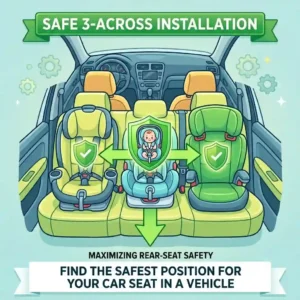
Practical Usage Guide: Installing in the Center vs. Outboard Seats
When determining the safest position for car seat in vehicle layouts, understanding the nuances between the center and outboard (window) seats is vital.
Step-by-Step Optimization
-
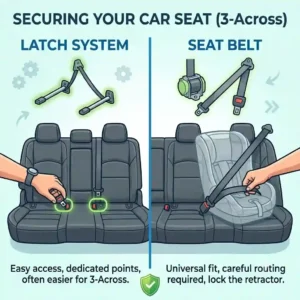
Assess the LATCH Situation: Check your vehicle owner’s manual. Most cars do not have dedicated lower anchors for the center seat. “Borrowing” the inner anchors from the two outboard seats is only permitted if both the vehicle manufacturer and the car seat manufacturer explicitly allow it. If they don’t, you must use the seatbelt for a center installation.
-
Evaluate Seat Contours: The center seat often features a “hump” or a fold-down armrest. If your car seat base overhangs this hump by more than 20%, or if the base wobbles side-to-side more than 1 inch at the belt path, the center is not the safest position.
-
The Outboard Compromise: If a solid center install is impossible, move to the passenger-side outboard seat. Why the passenger side? It allows you to safely load and unload your child from the sidewalk rather than standing in traffic.
Expert Maintenance Trick: During the first 30 days of use, check the tightness of the installation weekly. Vehicle seat cushions compress over time under the weight of the heavy base, which can introduce dangerous slack into the seatbelt or LATCH strap.
Real-World Scenarios: Multi-Car Seat Configurations
Arranging the safest position for car seat in vehicle interiors becomes a game of geometric chess once you have more than one child.
Profile 1: The Newborn and the Toddler
If you have an infant and a forward-facing three-year-old, the safest configuration is generally putting the newborn in the center (rear-facing) and the toddler behind the passenger. Why? The forward-facing toddler is statistically at higher risk in a side-impact crash than the rear-facing infant, whose shell protects them. However, if the infant seat blocks the toddler from buckling themselves, place the newborn behind the passenger and the toddler behind the driver. I recommend the Chicco KeyFit 35 for the newborn and the Britax Boulevard for the toddler in this setup.
Profile 2: The Three-Across Challenge (The Commuting Family)
For families avoiding minivans, fitting three seats in a sedan is brutal. You must utilize independent seatbelt installations, not LATCH, as LATCH pulls seats toward the center, creating overlap. The Diono Radian 3RXT is mandatory here. Place the most vulnerable child (usually the rear-facing infant) in the center, flanked by the older children.
Profile 3: Grandparents’ Weekly Chauffeur
For occasional use, complex installations are dangerous. Grandparents need intuitive gear. The Evenflo Gold Revolve360 behind the passenger seat is ideal here. It saves their backs during loading and prevents the need to ever uninstall and reinstall the seat, eliminating a massive vector for human error.
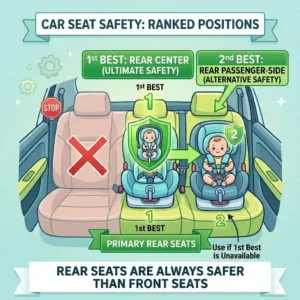
Detailed Comparison: Center vs. Outboard Installation Physics
| Seating Position | Side Impact Protection | Rollover Stability | Setup Difficulty | Best For |
| Rear Center | Maximum (Furthest from doors) | Excellent | High (Contours/No LATCH) | Single child / Narrow bases |
| Rear Passenger Side | Moderate (Relies on seat shell) | Good | Low (Easy LATCH access) | Sidewalk loading / 2+ Kids |
| Rear Driver Side | Moderate (Relies on seat shell) | Good | Low (Easy LATCH access) | Tall drivers needing space |
Expert Analysis: Looking at the comparison above, the Rear Center delivers the best theoretical protection from side-impact intrusions. However, the Setup Difficulty column is where theory meets reality. If the lack of dedicated LATCH anchors in the center leads to a loose seatbelt installation, the moderate side-impact risk of the Rear Passenger Side becomes statistically much safer because a tight outboard install always beats a loose center install.
How to Choose a Car Seat Based on Vehicle Architecture
You cannot force a square peg into a round hole, and you cannot force a massive car seat into a subcompact backseat.
-
Check the Headrest Interference: Modern vehicles have forward-leaning headrests to prevent whiplash for adults. However, these can push a forward-facing car seat off the seatback, creating a dangerous gap. Look for seats like the Britax Boulevard that have a relatively flat back, or ensure your vehicle’s headrests are fully removable.
-
Measure the Front-to-Back Depth: According to NHTSA guidelines, a car seat must never touch the front driver or passenger seat. Doing so transfers crash energy from the front seat directly into the child’s shell, bypassing the vehicle’s crumple zones. Measure the distance from your rear seatback to the back of the front seat. If it is under 30 inches, prioritize compact models like the Graco Extend2Fit.
-
Evaluate Belt Stalk Length: The “belt stalk” is the female end of the seatbelt. In some vehicles (like older Jeeps or Subarus), these stalks are exceptionally long and rigid. When you thread the seatbelt through the car seat, a long stalk might interfere with the lock-off or sit right on the belt path edge, preventing a tight fit. You need a seat with an open belt path to counteract this.
Common Mistakes When Buying and Installing Car Seats
The gap between purchasing top-tier equipment and actually achieving safety is user error.
The “Using Both LATCH and Seatbelt” Myth
The most dangerous thing I see parents do is route both the LATCH strap and the vehicle seatbelt through the car seat, thinking “two is better than one.” This is deadly. These plastics are engineered to flex and stretch with one system. Using both makes the system too rigid, concentrating all the crash force onto a single point of the plastic shell, which can shatter it.
Ignoring the LATCH Weight Limit
LATCH anchors in your car are legally only required to hold a combined weight (child + car seat) of 65 pounds. Because heavy seats like the Britax Boulevard weigh nearly 30 pounds, you must switch from LATCH to a seatbelt installation once your child reaches 35 pounds.
The Harness Pinch Test Failure
Parents are terrified of pinching their babies, so they leave the harnesses loose. The spec sheet won’t tell you this, but in a 30 mph crash, a loose harness allows the child to ramp up the back of the seat, risking severe spinal trauma. You must do the “Pinch Test” at the collarbone: if you can pinch any vertical fold of the webbing between your thumb and forefinger, it is too loose.
Safety / Regulations / Compliance Guide for 2026
The landscape of child passenger safety regulations has evolved rapidly. Ensuring you have the safest position for car seat in vehicle compliance requires understanding the latest standards.
-
FMVSS 213 Updates: The Federal Motor Vehicle Safety Standard 213 now includes side-impact testing requirements for all seats manufactured after 2025. This means older hand-me-down seats might not meet the current lateral force mitigation standards.
-
The Expiration Rule: Never use a car seat older than 6 to 10 years (check the stamp on the plastic shell). The dramatic temperature swings in your car—baking in 180°F summer heat and freezing in winter—degrade the structural integrity of the plastic. It will become brittle and snap during a high-G impact.
-
Aftermarket Accessories are Banned: If an accessory (like a padded head positioner, a winter coat, or a seat protector) did not come in the box with the car seat, it is strictly prohibited. The American Academy of Pediatrics (AAP) routinely emphasizes that thick winter coats compress during a crash, leaving the harness dangerously slack.
Long-Term Cost & Maintenance of Premium Car Seats
The “Total Cost of Ownership” Analysis
It is easy to suffer sticker shock when looking at a premium rotating seat, but let’s break down the efficiency gap.
An infant ‘bucket’ seat (like the Chicco KeyFit 35) lasts roughly 12 to 18 months. Afterward, you must buy a convertible seat. If you instead purchase a high-quality All-in-One convertible from day one, you save the $250+ initial purchase.
However, there is a hidden cost: cleaning. A car seat is essentially a dining room chair, a toilet, and a bed for a toddler. What happens to this product after 12 months of daily use? The harness buckles get jammed with cracker crumbs and sticky juice.
-
Maintenance Hack: Never use harsh chemicals or submerge the harness straps in water. The fibers in the webbing are coated with a fire-retardant and tensile strengthener. Soaking them strips this off, reducing their crash-strength. Use a damp cloth and mild dish soap only. If the crotch buckle is sticking, you can dip only the metal buckle mechanism in warm water to clear the debris.
✨ Don’t Miss These Exclusive Deals!
🔍 Ready to invest in top-tier safety? Equip your vehicle with the industry’s most reliable car seats. Click on any of the products mentioned above to check out current availability and ensure your family travels with total confidence!
Conclusion
Determining the safest position for car seat in vehicle layouts is less about adhering to a rigid “center-is-always-best” rule, and more about achieving harmony between your specific car, your chosen equipment, and your child’s developmental stage.
Through my years of field testing, the data remains uncompromising: an outboard seat with a rock-solid, zero-wobble installation will forever protect your child better than a center seat with a sloppy, loose belt fit. Prioritize seats with robust engineering like steel frames, anti-rebound bars, and foolproof tensioning systems over aesthetic colors or cup holder counts. Take the time to read your vehicle’s manual, understand your LATCH limits, and never hesitate to consult a local CPST to verify your work. Safety isn’t an accident—it is a meticulous choice you make every time you buckle them in.
FAQs
❓ What is the safest position for car seat in vehicle if I have two kids?
✅ Place the youngest, most vulnerable child (usually rear-facing) behind the passenger seat, and the older child behind the driver. The middle is technically safest, but side-by-side installations are often impossible without seats overlapping and compromising the installation tightness…
❓ Can I put a car seat in the front passenger seat?
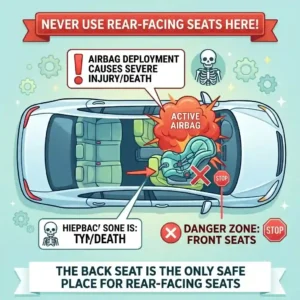
✅ Never place a rear-facing car seat in the front seat with an active airbag. The force of a deploying airbag will cause fatal crush injuries. Front seat placement is only legal for forward-facing seats if rear seats are unavailable, with the vehicle seat pushed back fully…
❓ Is LATCH safer than a seatbelt installation?
✅ No. Both are equally safe when used correctly. LATCH was simply invented to be easier for parents to use. However, seatbelts have no weight limits, whereas lower LATCH anchors must be abandoned once the child and seat exceed a combined weight of 65 pounds…
❓ Why does my car seat base wobble side to side?
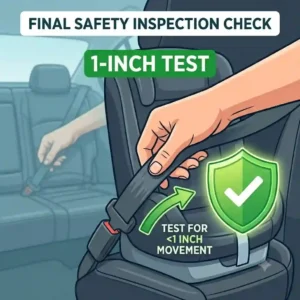
✅ Up to 1 inch of movement at the belt path (where the seatbelt routes through) is acceptable. If it moves more, you may be using the wrong belt path, the vehicle retractor isn’t locked, or the vehicle seat contours are incompatible with your car seat base…
❓ Should the carrying handle of an infant seat be up or down while driving?
✅ It depends entirely on the manufacturer’s manual. Some models require the handle to be pushed forward as an anti-rebound bar, while others demand it be locked in the upright carrying position to act as a roll-cage. Always read your specific manual…
Recommended for You
- 5 Expert Picks: Best Car Seat for Airplane Travel Infant (2026)
- 5 Top Picks: best car seat for tall babies comfort and safety in 2026
- Is The best all in one car seat worth it In 2026? 5 Expert Picks
Disclaimer: This article contains affiliate links. As an Amazon Associate, I earn from qualifying purchases. If you purchase products through these links, we may earn a small commission at no additional cost to you.
✨ Found this helpful? Share it with your friends! 💬🤗
[addtoany]