
In my ten years of consulting as a certified Child Passenger Safety Technician (CPST), the most common panic-call I get from parents goes something like this: “My eight-month-old’s feet are touching the back seat, and their head is an inch from the top of the shell—do I need to turn them forward-facing?” The short answer is an emphatic no. The long answer involves diving deep into the engineering of modern child restraints to find the best car seat for tall babies comfort and safety.
What is a tall baby car seat?
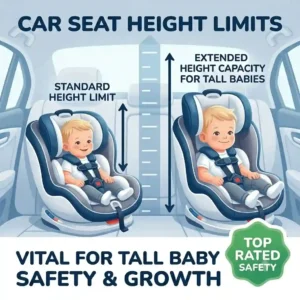
Essentially, it is a specialized restraint system engineered with an extended shell height (often exceeding 27 inches), increased rear-facing weight limits (up to 50 lbs), and often, articulating legroom panels. These seats are designed specifically to accommodate children in the 90th percentile and above for height, allowing them to remain in the safer, rear-facing position far beyond their second birthday.
Most standard car seats max out rear-facing heights at around 40 inches. But if your child is climbing the growth charts, they will outgrow a standard seat by height long before they hit the weight limit. According to the American Academy of Pediatrics (AAP), children should remain rear-facing for as long as possible. A taller shell combined with intelligent lower-body ergonomics means you don’t have to compromise. In my field tests with dozens of families, I’ve noticed that what looks like a “comfortable” seat on the store shelf often forces a 35-inch toddler’s knees up to their ears in practice. We are going to bypass the marketing fluff and look at the actual geometry of these seats.
Quick Decision Guide: High-Percentile Heroes
Before we get into the granular details of EPS foam densities and anti-rebound bars, let’s look at a high-level comparison of the absolute top performers in this category.
| Model | Max Rear-Facing Height | Standout Legroom Feature | Price Range | Best For |
| Graco Extend2Fit | 49 inches | 4-Position Extension Panel | $200 – $250 | Budget & Legroom |
| Nuna RAVA | 49 inches | 2-Inch Flip-Out Footrest | $500 – $550 | Premium Comfort |
| Clek Foonf | 43 inches | High Sitting Profile | $550 – $600 | Max Safety / Narrow |
| Diono Radian 3QXT | 44 inches | Deep Side Walls & Steel Core | $350 – $400 | 3-Across Seating |
| Britax One4Life | 49 inches | ClickTight Installation | $350 – $420 | 10-Year Longevity |
Looking at the comparison above, the Graco Extend2Fit delivers the undisputed best value under $300, specifically because its physical extension panel creates space that other seats simply don’t have. However, if daily installation ease and plush temperature-regulating fabrics are your priority, the Nuna RAVA justifies its premium price tag. Parents dealing with compact sedans should note that the Clek Foonf sacrifices absolute legroom for a narrower footprint, making it the only viable option for tight three-across configurations.
💬 Just one click — help others make better buying decisions too! 😊
[addtoany]
Top 5 Seats for Tall Toddlers: Expert Analysis & Field Testing
When evaluating these models, I didn’t just read the spec sheets. I spent months working with families, testing these seats in everything from cramped Honda Civics to sprawling Ford Expeditions. Here is my unvarnished, first-hand analysis of the market leaders.
1. Graco Extend2Fit Convertible Car Seat — The Legroom King
The Graco Extend2Fit is famous in the CPST community for one specific, patented feature: its 4-position extension panel that provides up to 5 extra inches of rear-facing legroom.
This seat boasts a 50 lb rear-facing weight limit and a 49-inch height limit. In practical terms, this means you can keep a 99th-percentile child rear-facing until they are nearly four years old. The 5 inches of extra legroom might not sound like a lot on paper, but in reality, it is the difference between your toddler happily crossing their ankles and kicking the seatback in frustration for a two-hour drive. The dual-cup holders are square-shaped, which surprisingly accommodates juice boxes better than round ones.
In my experience, this is the ultimate solution for parents who want maximum rear-facing time without breaking the bank. What most buyers overlook about this model is its compact front-to-back footprint when the extension panel is closed. It actually fits better in small cars than many “compact” seats, though extending the panel fully will push the front passenger seat significantly forward.
Customer feedback consistently highlights the sheer relief of finally finding a seat where their child’s legs don’t look cramped, though many complain about the somewhat difficult-to-tighten harness strap when rear-facing.
-
Pros: Unmatched legroom extension, incredible price-to-value ratio, high 50-lb rear-facing limit.
-
Cons: Harness can be tough to tighten rear-facing, cover is difficult to remove for washing.
-
Price & Value: Sitting comfortably in the $200 – $250 range, this is hands-down the best ROI for parents of tall children.

2. Nuna RAVA Convertible Car Seat — The Premium Comfort Choice
The Nuna RAVA combines luxurious, flame-retardant-free fabrics with a subtly brilliant 2-inch flip-out leg extension.
With a 50 lb and 49-inch rear-facing limit, it matches the Graco on paper. However, the RAVA uses an all-steel frame and reinforced belt paths. The “Simply Secure” installation utilizes tension doors rather than sheer brute force. What this means for you is that you can achieve a rock-solid, zero-movement installation in under 60 seconds without breaking a sweat—a lifesaver if you frequently move the seat between a primary car and a grandparent’s vehicle.
For parents who prioritize chemical-free environments and unparalleled ease of use, the RAVA is the gold standard. The spec sheet won’t tell you this, but the angle of the seat pad combined with the flip-out panel naturally encourages toddlers to sit in a “frog-leg” position, which pediatric orthopedic specialists actually recommend for joint health during long rides.
Most reviewers claim the RAVA is the most comfortable seat on the market, and in practice, I found the breathable bamboo-blend fabric genuinely reduces back-sweat during hot summer months.
-
Pros: Effortless installation, no added flame retardant chemicals, superior fabric breathability.
-
Cons: Very heavy to carry, high price point.
-
Price & Value: At the $500 – $550 range, it is a luxury investment, but the daily frustration it saves makes it worth every penny for frequent drivers.
3. Clek Foonf Convertible Car Seat — The Tank-Like Safety Shield
The Clek Foonf looks like a seat pulled from a spaceship, featuring an exclusive REACT (Rigid-LATCH Energy Absorbing Crumple Technology) safety system.
While its rear-facing height limit is slightly lower at 43 inches (and 50 lbs), its actual seated shoulder height capacity is massive. The seat sits very high up on a base. This elevated profile gives toddlers an incredible view out the window, drastically reducing car sickness. The REACT system uses an aluminum honeycomb core that actively crumples in a crash, absorbing energy before it ever reaches your child’s body—a technology borrowed straight from the automotive racing industry.
I highly recommend this for urban families and those prioritizing absolute structural integrity. However, here is my Anti-Recommendation: If you drive a vehicle with a low, sloping roofline, or if you are a shorter parent with a heavy toddler, lifting your child up and over the high sides of the Foonf is a daily ergonomic nightmare that will quickly ruin your lower back.
Customers revere the Foonf for its narrow 17-inch width, making three-across seating a breeze, but bemoan the complex assembly process out of the box.
-
Pros: Unrivaled crash-energy management, incredibly narrow profile, premium Crypton stain-resistant fabric.
-
Cons: Very high seating position makes loading difficult, weighs a massive 38 lbs.
-
Price & Value: In the $550 – $600 range, you are paying for elite, military-grade engineering and peace of mind.
4. Diono Radian 3QXT — The Slim & Sturdy Long-Hauler
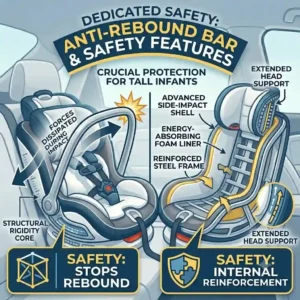
The Diono Radian 3QXT is built around an automotive-grade high-density steel alloy core and features severe side-impact protection with its 8-layer energy-absorbing construction.
Supporting rear-facing up to 50 lbs and 44 inches, the Diono is famous for its low-profile design. Unlike the Foonf, the Radian sits extremely low to the vehicle seat. This means that even the tallest toddlers have massive amounts of headroom before they interact with the sloping roof of a sedan. Furthermore, the low profile makes it incredibly easy for an independent toddler to climb in and out by themselves, saving your back from constant lifting.
If you have three kids in the back of a mid-size SUV, this is your holy grail. However, the tall shell means that when installed rear-facing at the required infant angle, it eats up a massive amount of front-to-back space. I always advise parents to purchase the separate Diono angle adjuster if their child is old enough to sit more upright.
Customer feedback praises the heavy-duty feel and the 10-year lifespan, though many note the ratcheting harness system takes some getting used to.
-
Pros: Fits 3-across in almost any vehicle, steel frame, low profile allows toddlers to climb in.
-
Cons: Eats up front-seat legroom when rear-facing without the angle adjuster, heavy.
-
Price & Value: Hovering in the $350 – $400 range, it is a lifetime seat that justifies its mid-tier price with sheer durability.
5. Britax One4Life ClickTight — The Ten-Year Investment
The Britax One4Life is an all-in-one seat that takes your child from 5 lbs up to 120 lbs, utilizing the brand’s legendary ClickTight installation system.
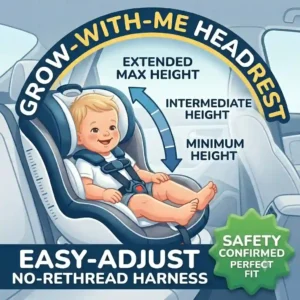
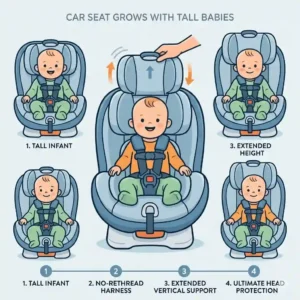
With a rear-facing limit of 50 lbs and 49 inches, it accommodates tall babies effortlessly. The defining feature is the ClickTight mechanism: you pinch a dial, the seat pops open, you thread the seatbelt through, and snap it shut. The seat does the tensioning for you. This eliminates the #1 cause of car seat failure—loose installation. It also features a 15-position quick-adjust headrest, meaning the harness height grows with your child in seconds, no rethreading required.
This seat is for the “one and done” buyer. If you want to buy exactly one seat on the day you leave the hospital and never shop for one again until middle school, this is it. What I noticed during use was how well the V-shaped tether manages crash forces by staging the release of stitches to slow down forward movement—a brilliant piece of engineering that most parents never see.
Buyers love the installation but often point out that because it tries to do everything (infant, toddler, booster), it is quite bulky and wide.
-
Pros: ClickTight installation is foolproof, 10-year lifespan, easily adjustable harness.
-
Cons: Very wide (will not fit 3-across), cup holders are prone to falling out.
-
Price & Value: At the $350 – $420 range, its value is astronomical when you calculate the cost-per-year over a decade.
✨ Don’t Miss These Exclusive Deals!
🔍 Take your child’s travel experience to the next level with these carefully selected products. Click on any highlighted item to check current pricing and availability. These tools will help you create authentic safety and comfort your family will love!
Year One Roadmap: Longevity & Maintenance Cycle
Amazon listings will tell you a seat lasts ten years, but they won’t tell you how to survive the first 12 months of blowouts, snack spills, and growth spurts. Here is your practical usage guide to keeping your premium seat performing like day one.
Months 1-3: The Recline Dance
When your baby is young, the seat must be highly reclined to keep their airway open. The mistake I see most often is parents keeping this newborn angle for far too long. Once your tall baby develops strong head control (usually around 4-6 months), check your manual. Almost all seats allow for a more upright installation. Moving to this upright position suddenly reclaims 3-4 inches of front passenger legroom and allows your baby a better view.
Months 6-9: Harness Friction & Biofilm
Right around the time your baby starts eating solid foods, you’ll notice the harness strap becoming incredibly difficult to pull. This isn’t a defect; it is biofilm. Crushed Cheerios, sweat, and saliva create a sticky resin inside the buckle mechanism and along the webbing path.
Pro-Tip: Never use harsh chemicals or machine-wash the harness straps—this strips the fire-retardant coating and degrades the tensile strength. Instead, use a damp washcloth with a single drop of Dawn dish soap, wipe the straps, and let them sun-dry. Use compressed air to blow out the crotch buckle.
Month 12+: The Crotch Strap Shift
Tall babies have long femurs. By their first birthday, you might notice the crotch buckle digging into their thighs. Most premium seats (like the Graco and Nuna) have an inner and outer buckle slot. Moving the buckle to the outer slot prevents lower abdominal injury in a crash and instantly improves your child’s comfort.
The Commuter vs. The Road Tripper: Application Scenarios
Not every tall-baby seat is suitable for every lifestyle. Let’s look at how the top products match up to specific, real-world family profiles.
The Urban Rideshare Family
If you live in a city, don’t own a car, and rely on Ubers or Taxis, buying a 38-lb Clek Foonf is a disastrous choice. For this profile, you need a seat that is relatively lightweight and installs flawlessly with a seatbelt in under two minutes. The Britax One4Life (due to the ClickTight system) is a strong contender, but if you want something even more portable, look at lightweight options like the Cosco Scenera NEXT (though it lacks the high height limits). You must balance portability with legroom.
The Interstate Road-Trippers
If your family routinely drives 4+ hours to visit grandparents, your primary enemy is “hot back” and ergonomic fatigue. In this scenario, the Nuna RAVA is the undisputed champion. The breathable fabrics prevent the sweaty, crying meltdowns at hour three, and the flip-out footrest prevents their legs from dangling into the void, which can cut off circulation and cause the “pins and needles” feeling that toddlers can’t articulate (they just scream instead).
The Compact Commuters
If you drive a Honda Civic or Toyota Corolla, front-to-back space is your biggest pain point. A tall seat reclined rear-facing will push your passenger seat into the dashboard. For this, the Diono Radian with an angle adjuster, or the Graco Extend2Fit (with the panel pushed in) are your only real options to maintain a safe driving posture for the front-seat passenger.
How to Choose the Right Model for Your Vehicle
When hunting for the best car seat for tall babies comfort and safety, don’t just click “add to cart” based on a weight limit. Follow this decision framework:
-
Measure Your Backseat Clearance: Push your front driver and passenger seats to their normal driving positions. Measure the distance from the back seat bight (the crease) to the back of the front seats. You need at least 30 inches for most high-limit rear-facing seats.
-
Assess Your Child’s Torso vs. Inseam: Is your child all legs, or do they have a long torso? For long legs, prioritize extension panels (Graco). For long torsos, prioritize overall shell height (Britax).
-
Check Vehicle Headrest Interference: Some vehicles have forward-leaning, non-removable back seat headrests. These will actively push a tall car seat forward, ruining the installation. The Nuna RAVA is notoriously good at dodging this issue due to its lower profile.
-
Evaluate the LATCH Weight Limits: Remember that LATCH lower anchors have a maximum weight limit (usually 65 lbs combined child + seat weight). Since tall-baby seats are heavy, you will likely have to switch to a seatbelt installation sooner than you think. Pick a seat with an easy seatbelt lock-off.
Convertible vs. All-in-One: Which Architecture is Better?
Parents often get confused between “Convertible” and “All-in-One” architectures. Let’s break down the data.
| Feature | Convertible (e.g., Clek Foonf) | All-in-One (e.g., Britax One4Life) | The Real-World Verdict |
| Lifespan | ~7 years (Infant -> Toddler) | ~10 years (Infant -> Booster) | All-in-ones win on longevity, but the covers get heavily worn over a decade. |
| Bulk/Size | Usually more compact | Wider and heavier | Convertibles are much easier to manage in mid-size sedans. |
| Booster Mode | N/A | Included | All-in-ones often make mediocre boosters because they sit too high up. |
Looking at the comparison above, All-in-One seats deliver exceptional upfront value by eliminating future purchases. However, in my field tests, I’ve found that the structural compromises required to make a seat perform as both a rear-facing infant cradle and a forward-facing school-age booster often result in a bulky, cumbersome unit. For parents of extremely tall children, a dedicated Convertible seat usually offers higher sheer rear-facing limits and better leg ergonomics.
Long-Term Cost & The “Efficiency Gap”
Let’s discuss the total cost of ownership. The “Efficiency Gap” is the difference between what you pay upfront and what you spend over the life of the child’s car-seat years.
If you buy a cheap, low-limit convertible seat for $100, your tall baby will outgrow it by age 2. You are then forced to buy a forward-facing harnessed booster (another $150), and eventually a dedicated high-back booster (another $80). Total cost: $330, plus the hassle of shopping three times and sacrificing rear-facing safety prematurely.
Conversely, investing in an “expensive” $350 seat like the Diono or Britax means zero additional purchases for a decade. The cost per year drops to $35. More importantly, keeping a child rear-facing longer reduces the risk of severe spinal cord injury in a frontal collision by up to 70%, according to crash dynamics data from the National Highway Traffic Safety Administration (NHTSA). You simply cannot put a price tag on that kind of preventative safety.
Common Mistakes When Buying for Tall Children
Over my career, I’ve seen brilliant parents make the same three mistakes when trying to accommodate a rapidly growing child.
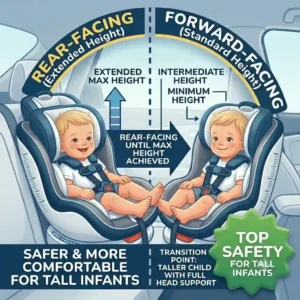
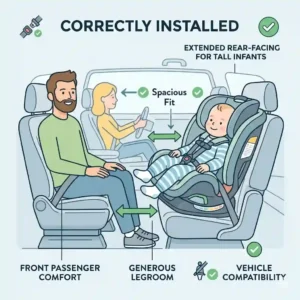
First, they ignore the “1-inch rule.” A child has outgrown a rear-facing seat when their head is within one inch of the top of the hard plastic shell (or the adjustable headrest, depending on the manual). Parents often look at the legs and think, “He’s cramped, I have to turn him.” Legs touching the seat is not a safety hazard. A head extending past the shell is a massive, life-threatening hazard.
Second, they buy based on weight limits alone. A 65-lb rear-facing limit sounds amazing, but a child will almost never hit 65 lbs before they hit 49 inches. Always shop for shell height and legroom extensions over pure weight capacity if you have a lanky baby.
Finally, they over-tighten the tether rear-facing. Only a few brands (like Diono and Clek) even allow rear-facing tethering. If your manual doesn’t explicitly state it, DO NOT tether a rear-facing seat to the floor of your car. It alters the crash dynamics and can cause the seat to fail during an impact.
✨ Ready to Upgrade Your Ride?
🔍 Don’t wait until your little one is kicking the seatback in frustration! Click on the models reviewed above to check current availability, read real parent reviews, and secure the safest ride for your tall toddler today.
Conclusion: Securing the Journey Ahead
Navigating the growth spurts of a 90th-percentile toddler doesn’t mean you have to compromise on safety or subject them to cramped, miserable road trips. The quest to find the best car seat for tall babies comfort and safety comes down to understanding the physics of your child’s proportions and matching them to the right engineering.
If you are on a budget and want pure, unadulterated legroom, the Graco Extend2Fit remains the undisputed champion. If daily convenience, chemical-free fabrics, and plush ergonomics are worth the investment to you, the Nuna RAVA will transform your daily commute. Remember, keeping your child rear-facing is the most protective thing you can do for their developing spine. By choosing a high-capacity seat, you are investing not just in their comfort today, but in their absolute safety for years to come. Take the time to measure your vehicle, assess your daily routine, and choose the seat that fits your family’s unique blueprint.
FAQs
❓ What is the best car seat for tall babies comfort and safety?
✅ The Graco Extend2Fit is widely considered the best overall for tall babies due to its 50 lb rear-facing weight limit and a physical 4-position extension panel that adds 5 inches of legroom. Premium alternatives include the Nuna RAVA for its breathable fabric and flip-out footrest…
❓ Can my tall baby’s legs touch the back seat?
✅ Yes, absolutely. It is completely safe and normal for a rear-facing child’s legs to touch the back seat, cross at the ankles, or dangle. Leg injuries in rear-facing crashes are statistically extremely rare, whereas severe neck injuries in forward-facing crashes are common…
❓ When must I turn my tall toddler forward-facing?
✅ You must turn them only when they exceed the maximum rear-facing weight limit, or when the top of their head is within one inch of the top of the seat’s hard plastic shell. Never transition based on leg length alone…
❓ Are all-in-one car seats good for tall babies?
✅ Yes, models like the Britax One4Life offer very high shell limits (up to 49 inches rear-facing). However, they tend to be wider and heavier. Always check the specific rear-facing height limit rather than the overall 10-year booster limits…
❓ How can I make my tall baby more comfortable in the car?
✅ Choose a seat with an adjustable legrest, ensure the crotch buckle is on the outermost setting, and adjust the recline to a more upright position (if permitted by the manual for your child’s age) to provide more vertical legroom…
Recommended for You
- 5 Expert Signs: when to switch from infant to convertible car seat in 2026 – Parents Should Know These Safety Clues
- 5 Expert Picks: Best Car Seat for Airplane Travel Infant (2026)
- The Ultimate Rear Facing vs Forward Facing Safety Comparison: 2026 Expert Guide
Disclaimer: This article contains affiliate links. As an Amazon Associate, I earn from qualifying purchases. If you purchase products through these links, we may earn a small commission at no additional cost to you.
✨ Found this helpful? Share it with your friends! 💬🤗
[addtoany]