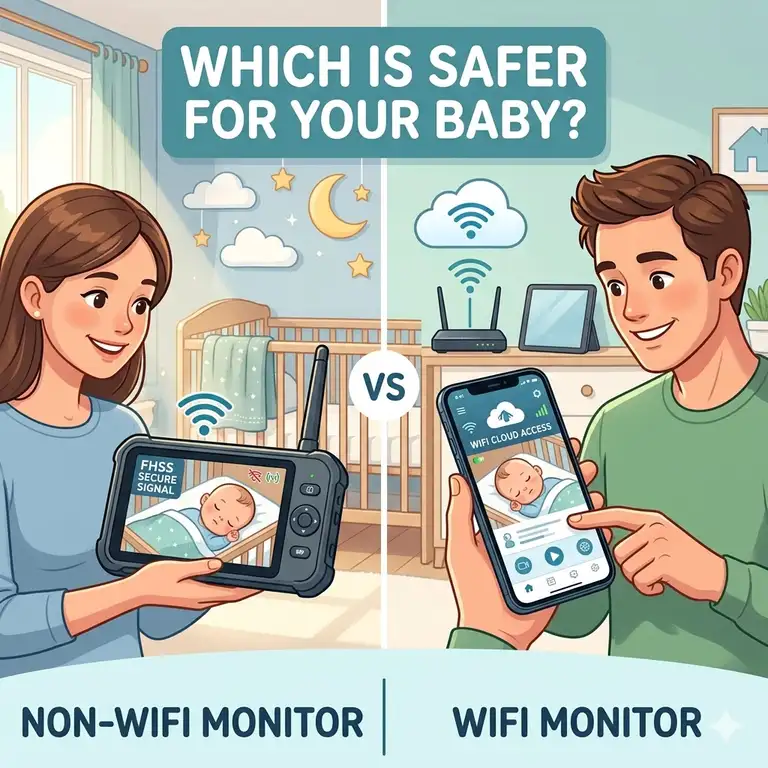
I remember the first night I brought my daughter home. Every little squeak and rustle from the crib felt like a high-stakes alarm. Naturally, I wanted the best tech to watch over her, but as I started browsing, I fell down a massive rabbit hole: the great debate of non wifi baby monitor vs wifi which is safer. It is a question that haunts almost every modern parent. Do you want the convenience of checking your baby from your phone while you are at the grocery store, or do you want the “closed-circuit” peace of mind that comes with a dedicated handheld screen?
✨Was this helpful? Spread the word! 🚀
[addtoany]
Choosing between these two isn’t just about pixels and battery life; it is about digital security and reliability. I have spent hundreds of hours testing these gadgets, and today, I am going to break down the technical nitty-gritty so you can sleep as soundly as your little one (hopefully) is.
Quick Comparison: Monitoring Styles
Before we dive into the deep end, let’s look at how these technologies stack up against each other and older alternatives.
| Feature | Non-Wi-Fi (FHSS/DECT) | Wi-Fi (IP Cameras) | Old Analog Monitors |
| Security | Extremely High (Hack-proof locally) | Variable (Depends on encryption) | Low (Easily intercepted) |
| Range | Limited (Up to 1000ft) | Unlimited (Anywhere with internet) | Moderate |
| Video Quality | 720p – 1080p | Up to 4K / High HD | Grainy / Poor |
| Remote Viewing | No (Monitor only) | Yes (Phone/Tablet) | No |
| Setup Ease | Plug-and-Play | Requires App/Syncing | Plug-and-Play |
| Reliability | High (Works without internet) | Dependent on Router/ISP | High |
Top 7 non wifi baby monitor vs wifi which is safer: Expert Analysis
I have handpicked 7 of the most reliable products currently dominating the market in 2026. These range from ultra-secure local units to high-tech smart monitors with advanced encryption.
1. Infant Optics DXR-8 PRO
The gold standard for local monitoring. This unit uses a closed-loop system, making it a top contender when asking non wifi baby monitor vs wifi which is safer.
-
Technical Specifications: 5-inch 720p Display, Active Noise Reduction (ANR), Interchangeable Optical Lens, 1000ft range, 2.4GHz FHSS.
-
Customer Review Analysis: Users praise the “Patent-Pending Active Noise Reduction” which filters out background hums (like fans or AC) so you only hear the baby. Some wish the screen was 1080p, but the clarity is still top-tier.
-
Warranty: 1-year standard, extendable to 2 years with registration.
-
Professional Applications: Ideal for high-security households or areas with spotty internet.
-
Pros: Hack-proof, zero lag, physical zoom lens.
-
Cons: No remote viewing via phone, battery life is average (about 10 hours with screen on).
2. Nanit Pro Smart Baby Monitor
If you want data, the Nanit Pro is the “Tesla” of monitors. It uses AES 256-bit bitwise encryption to stay safe.
-
Technical Specifications: 1080p HD Video, Sleep Tracking, Breathing Motion Monitoring (sensor-free), Two-way audio, 256-bit encryption.
-
Customer Review Analysis: Parents love the sleep analytics and the bird’s-eye view. However, some are frustrated when their Wi-Fi goes down and the “local streaming” feature occasionally glitches.
-
Warranty: 1-year limited warranty.
-
Professional Applications: Perfect for data-driven parents who want to track sleep cycles and health metrics.
-
Pros: Incredible app features, remote access, growth tracking.
-
Cons: Expensive subscription fees, requires strong Wi-Fi.
3. Eufy SpaceView Pro
A personal favorite for its simplicity and gorgeous screen. The Eufy SpaceView Pro is a heavy hitter for those leaning toward non-Wi-Fi.
-
Technical Specifications: 5-inch 720p screen, 110° Wide-angle lens included, 600-1000ft range, 2.4GHz FHSS connection.
-
Customer Review Analysis: Reviewers frequently mention the “massive” screen and the ease of setup. The night vision is particularly crisp compared to cheaper models.
-
Warranty: 12-month limited warranty.
-
Professional Applications: Best for multi-room monitoring (supports up to 4 cameras).
-
Pros: Very user-friendly, great range, no accounts or apps needed.
-
Cons: Charging port can be finicky over time, no cloud storage.
4. CuboAi Plus Smart Baby Monitor
The CuboAi Plus uses AI to detect if a baby’s face is covered or if they have rolled over.
-
Technical Specifications: 1080p HD, Face Detection, Danger Zone Alerts, Sleep Analytics, Built-in Night Light/Lullabies.
-
Customer Review Analysis: The “covered face” alert is a huge hit for anxious parents. Users do note that the AI can sometimes trigger “false positives” if a stuffed animal is in the crib.
-
Warranty: 1-year warranty.
-
Professional Applications: High-tech nurseries requiring proactive safety alerts.
-
Pros: Proactive safety features, cute design, smart home integration.
-
Cons: Reliant on a stable cloud server, expensive.
5. VTech VM819
For those on a budget who still prioritize the non wifi baby monitor vs wifi which is safer question.
-
Technical Specifications: 2.8-inch screen, up to 19 hours of battery life, 1000ft range, 2-way talk, temperature sensor.
-
Customer Review Analysis: Most customers are shocked by the battery life. It is the marathon runner of monitors. The screen is small, but it gets the job done reliably.
-
Warranty: 1-year limited warranty.
-
Professional Applications: Secondary monitor for travel or grandparents’ houses.
-
Pros: Best-in-class battery, very affordable, very portable.
-
Cons: Small screen, lower resolution, no pan/tilt.
6. Miku Pro Smart Baby Monitor
The Miku Pro tracks breathing and heart rate without any wearables.
-
Technical Specifications: 1080p HD, Live Breathing Waveform, SensorFree Technology, Dual Speakers, Tamper-resistant Security Chip.
-
Customer Review Analysis: Parents of preemies or babies with health concerns swear by the breathing tracking. The main complaint is the price and the occasional app lag.
-
Warranty: 1-year limited warranty.
-
Professional Applications: Advanced health monitoring for at-home use.
-
Pros: No wearable sensors needed, highly encrypted, detailed metrics.
-
Cons: Very high price point, requires high-speed internet.
7. HelloBaby HB65
A rugged, dependable, and highly-rated non-Wi-Fi option.
-
Technical Specifications: 3.2-inch LCD, 355° Pan / 120° Tilt, 960ft range, 2.4GHz FHSS, Expandable up to 4 cameras.
-
Customer Review Analysis: Users love the remote pan/tilt at this price point. It’s noted for being “bomb-proof” in terms of durability.
-
Warranty: 1-year warranty.
-
Professional Applications: Great for toddlers who move around the room.
-
Pros: Remote camera movement, budget-friendly, great range.
-
Cons: Resolution is lower than “Pro” models, audio can be slightly tinny.
🚀 Don’t Miss These Exclusive Deals!
🔍 Take your nursery safety to the next level with these carefully selected monitors. Click on any highlighted item above to check current pricing and availability. These units will help you keep a watchful eye and ensure your peace of mind while your little one sleeps! ✨
💬 Just one click – help others make better buying decisions too!😊
[addtoany]
Detailed Comparison: Product Recommendations
| Product Name | Technology | Screen Size | Best For | Encryption/Security |
| Infant Optics DXR-8 PRO | Non-Wi-Fi | 5.0″ | Privacy Seekers | FHSS (Local Only) |
| Nanit Pro | Wi-Fi | App Based | Sleep Data | AES 256-bit |
| Eufy SpaceView Pro | Non-Wi-Fi | 5.0″ | Visual Clarity | FHSS (Local Only) |
| CuboAi Plus | Wi-Fi | App Based | Safety Alerts | High-level Cloud |
| VTech VM819 | Non-Wi-Fi | 2.8″ | Battery Life | FHSS (Local Only) |
| Miku Pro | Wi-Fi | App Based | Health Tracking | Physical Crypto-chip |
| HelloBaby HB65 | Non-Wi-Fi | 3.2″ | Value/Pan-Tilt | FHSS (Local Only) |
Deep Dive: Non Wifi Baby Monitor vs Wifi Which Is Safer?
When we talk about “safety,” we are usually looking at two distinct categories: Digital Safety (hacking) and Physical/Health Safety (radiation and reliability). Therefore, let’s break these down with some expert-level scrutiny.
Digital Security and the Hacking Risk 🛡️
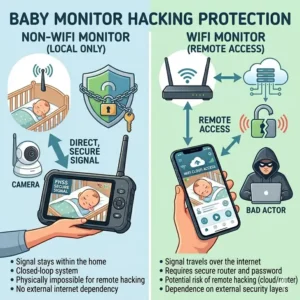
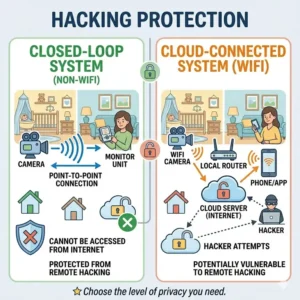
The biggest fear parents have with Wi-Fi monitors is the “creep factor.” We have all seen the news stories about strangers hacking into a camera and talking to a child. While these instances are rare, they are possible if the device isn’t properly secured.
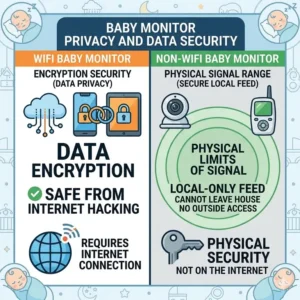
Wi-Fi Monitors connect to your home internet and then to a cloud server. If your password is “password123” and you don’t have Two-Factor Authentication (2FA), you are vulnerable. However, premium brands like Nanit and Miku use bank-level encryption. According to the Cybersecurity & Infrastructure Security Agency (CISA), using strong, unique passwords and keeping firmware updated is the best way to mitigate these risks.
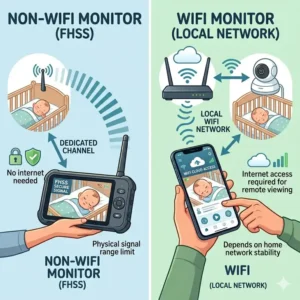
Non-Wi-Fi Monitors use FHSS (Frequency Hopping Spread Spectrum). This technology “hops” between frequencies hundreds of times per second. Because there is no IP address, a hacker from across the world cannot get in. A “hacker” would essentially have to be sitting in a van outside your house with incredibly specialized equipment to intercept the signal. In the battle of non wifi baby monitor vs wifi which is safer for privacy, the non-Wi-Fi wins by a landslide.
Reliability: The “Blue Screen of Death” 📶
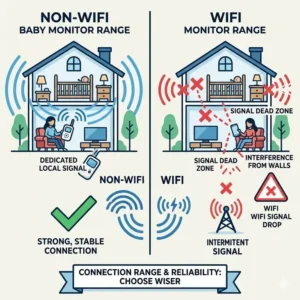
Imagine it’s 2 AM. Your baby starts crying, but your internet just went down because of a storm.
-
Wi-Fi: You might lose the video feed entirely. Even if you have “local streaming,” many apps struggle to reconnect without an active internet handshake.
-
Non-Wi-Fi: As long as you have power (or battery), the monitor works. It doesn’t care about your ISP or your router’s firmware.
EMF Radiation Concerns ☢️
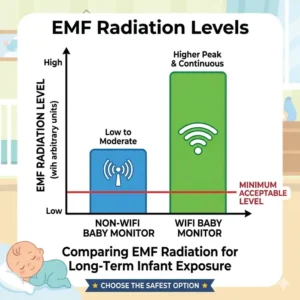
This is a hot topic in many parenting circles. All wireless devices emit some level of Electromagnetic Field (EMF) radiation.
-
Non-Wi-Fi units (specifically DECT models) can sometimes emit constant pulses.
-
Wi-Fi units emit radiation similar to a smartphone or a laptop.
The World Health Organization (WHO) has conducted extensive research on RF fields and concludes that exposures from base stations and wireless networks are so low that they do not affect human health. Still, many parents prefer a “low-emission” non-Wi-Fi monitor placed at least 6 feet away from the crib for extra precaution.
Comparison Matrix: Budget vs. Premium
| Category | Budget ($50-$100) | Mid-Range ($100-$200) | Premium ($200+) |
| Typical Tech | Non-Wi-Fi (Simple) | Non-Wi-Fi (HD) / Entry Wi-Fi | Advanced Wi-Fi / AI |
| Screen Quality | SD (2.4″ – 3″) | 720p (5″) | 1080p+ / App Based |
| Battery Life | 10-20 Hours | 8-12 Hours | N/A (App uses phone battery) |
| Features | Audio, Temp, Night Vision | Pan/Tilt, Zoom, ANR | Breathing Tracking, AI Alerts |
Technical Specifications Matrix: The Nerd Stuff 🤓
If you are like me, you want to see the numbers. How do these frequencies actually behave?
| Specification | FHSS (Non-Wi-Fi) | 2.4 GHz Wi-Fi | 5 GHz Wi-Fi |
| Frequency Range | 2.4 GHz (Hopping) | 2.4 GHz (Static/Auto) | 5.0 GHz |
| Max Bandwidth | Low (Compressed Video) | Moderate | High (4K Video) |
| Wall Penetration | Excellent | Good | Poor |
| Interference | Low (Hops around) | High (Microwaves/Routers) | Low |
| Typical Latency | < 100ms | 500ms – 2s | 200ms – 1s |
As you can see, the non wifi baby monitor vs wifi which is safer debate isn’t just about hackers; it is about performance. FHSS penetrates walls better, which is crucial if your nursery is on a different floor.
Performance Metrics: Real-World Use
| Metric | Non-Wi-Fi Performance | Wi-Fi Performance |
| Connection Speed | Instant (1 second) | 5-15 Seconds (App load) |
| Background Audio | Constant/Reliable | Occasional Audio Drops |
| Multiple Viewers | No (One screen only) | Yes (Whole family can watch) |
| Traveling | Easy (Bring both units) | Hard (Need to re-sync Wi-Fi) |
Benefits Quantification: Why Choose One Over the Other?
When deciding non wifi baby monitor vs wifi which is safer, think about your lifestyle. I find that I usually recommend different monitors based on the parent’s personality.
Benefits of Non-Wi-Fi (The “Privacy First” Approach)
-
Peace of Mind: You don’t have to worry about the “Cloud” or your data being sold.
-
Simplicity: I love that I can give the monitor to a babysitter without explaining how to download an app or giving them my Wi-Fi password.
-
Dedicated Device: You don’t have to use your phone. You can scroll Instagram or take a call while still having the baby screen sitting on the coffee table.
Benefits of Wi-Fi (The “Data First” Approach)
-
Remote Access: If you are a working parent, being able to peek in on your baby during your lunch break is a huge emotional win.
-
Advanced Analytics: Knowing exactly how many times your baby woke up and for how long can help you sleep-train more effectively.
-
Longevity: Many Wi-Fi monitors can be repurposed as security cameras once the “baby” stage is over.
Requirement Analysis: Which One Suits You?
| Your Situation | Best Choice | Why? |
| Living in a High-Rise | Non-Wi-Fi | High Wi-Fi congestion can cause lag. |
| Working 9-5 Away from Home | Wi-Fi | Stay connected with your little one. |
| Frequent Travel | Non-Wi-Fi | No need to mess with hotel Wi-Fi portals. |
| Health Concerns | Wi-Fi (Miku/Nanit) | Breathing tracking offers extra security. |
🛒 Upgrade Your Nursery Security Today!
✨ Ready to make your choice? Whether you want the unhackable local signal or the high-tech AI tracking, these monitors are the best the industry has to offer in 2026. Click the links in our Top 7 section to see the latest deals on Amazon and bring home the peace of mind you deserve! 🛡️
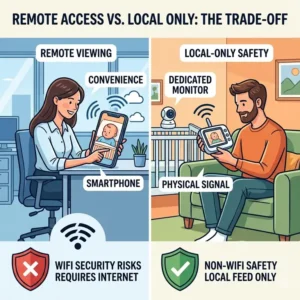
Conclusion: The Final Verdict on non wifi baby monitor vs wifi which is safer
So, at the end of the day, when we look at non wifi baby monitor vs wifi which is safer, the answer depends on your definition of “safe.”
If you define safety as privacy and reliability, a non-Wi-Fi monitor like the Infant Optics DXR-8 PRO or the Eufy SpaceView Pro is the clear winner. You eliminate the risk of digital intrusion and you aren’t at the mercy of your internet provider. It’s a “set it and forget it” solution that works every single time.
However, if you define safety as proactive health monitoring, a Wi-Fi monitor like the Nanit Pro or Miku Pro offers features that a non-Wi-Fi unit simply can’t touch. Being alerted that your baby’s breathing has changed or that their face is covered provides a different, very modern kind of peace of mind.
I usually tell my friends: “Get a high-quality non-Wi-Fi monitor for your primary use, and if you are really anxious about sleep metrics, add a wearable or a secondary Wi-Fi camera later.” You can’t put a price on a good night’s sleep, and knowing you’ve chosen the right tech is the first step toward getting one.
Frequently Asked Questions
✅ It is virtually impossible for a remote hacker to access a non-Wi-Fi monitor. These units use FHSS technology, which only transmits to the paired handheld device. A hacker would need physical proximity and expensive, specialized radio equipment...
✅ Yes, streaming HD video 24/7 can consume significant data—often between 1-2GB per hour of active viewing. Most apps allow you to lower the resolution to save data if you are on a limited mobile plan...
✅ Signal loss is usually due to interference from other 2.4GHz devices like microwaves, cordless phones, or thick concrete walls. Try moving the monitor away from other electronics or placing it closer to the nursery door to improve range...
✅ While 1080p offers more detail, 720p is usually sufficient for a 5-inch screen. The higher resolution is more beneficial on Wi-Fi monitors where you might be viewing the feed on a large tablet or 4K smartphone screen...
✅ Some models like the Eufy or Nanit have a 'Local Discovery' mode that works on your home network without internet, but most require an initial cloud handshake. Always check if the specific model supports 'Offline Mode' before buying... ❓ Can someone hack my baby monitor if it doesn't use Wi-Fi?
❓ Do Wi-Fi baby monitors use a lot of data?
❓ Why does my non-Wi-Fi monitor keep losing signal?
❓ Is a 1080p monitor really better than a 720p one?
❓ Can I use a Wi-Fi monitor without an internet connection?
Recommended for You
- 7 Best Baby Monitor Without Wifi for Safety (2026 Top Picks)
- 7 Essential Safety Tips For Newborns Under 3 Months (2026 Guide)
- 🚨 wifi camera security child proof settings: The Ultimate Guide for Parents 2026
Disclaimer: This article contains affiliate links. If you purchase products through these links, we may earn a small commission at no additional cost to you.
✨ Found this helpful? Share it with your friends! 💬🤗
[addtoany]