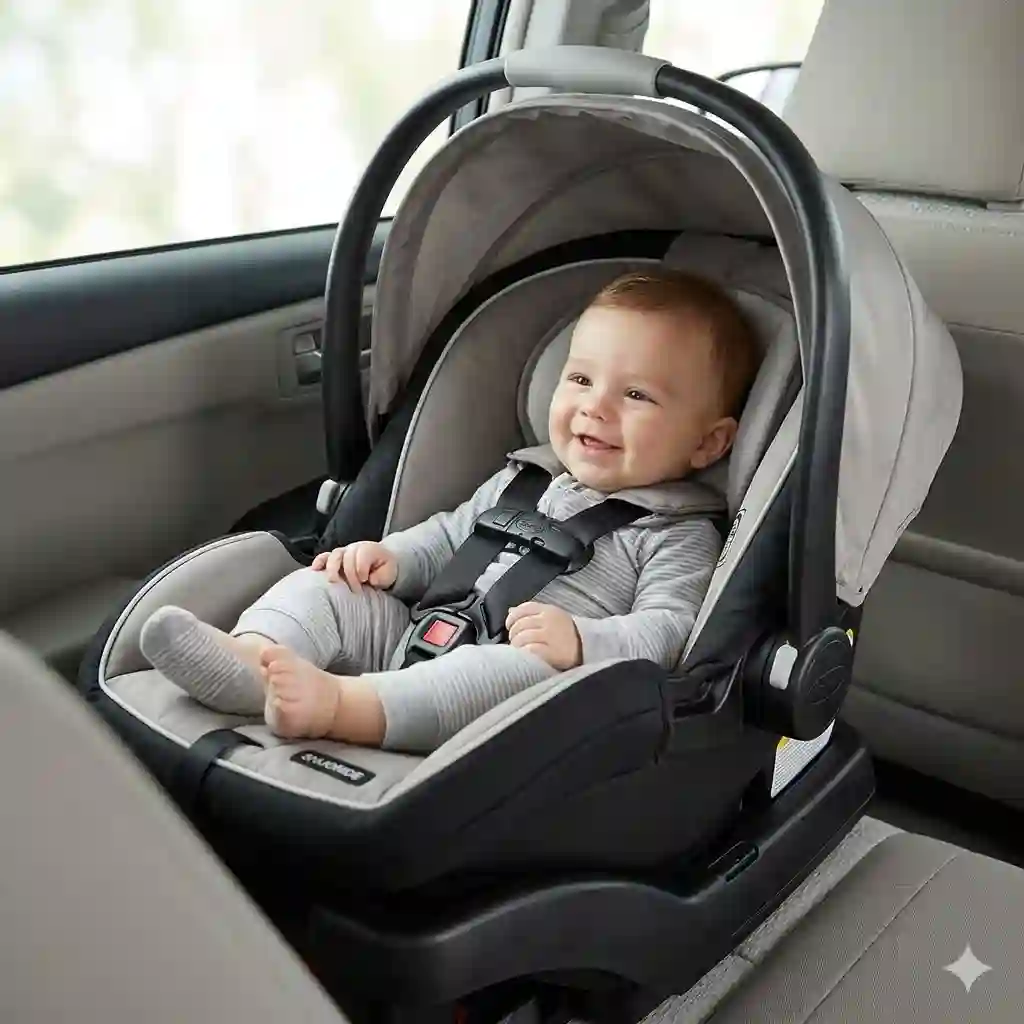
In my 10+ years as a certified Child Passenger Safety Technician (CPST) and baby gear consultant, I’ve seen countless new parents paralyzed by anxiety in the baby aisle. There is a pervasive, terrifying myth in the parenting world: if you don’t spend $400 on a car seat, you are somehow compromising your newborn’s safety. Let me burst that bubble right now. Every single car seat legally sold in the United States must pass the exact same stringent crash tests mandated by the federal government. Period.
When you spend more, you are paying for convenience features—like no-rethread harnesses, premium merino wool fabrics, or magnetic buckle holders—not necessarily a higher safety threshold. If you are navigating the heavy expenses of your first year with a new baby, finding the best budget infant car seat under 200 is not just possible; it’s a smart financial decision.
What the spec sheet won’t tell you, but my years of hands-on field testing will, is that a $150 seat that you can install correctly 100% of the time is infinitely safer than a $500 luxury seat with a complex routing system that you install improperly. In this comprehensive 2026 guide, we are stripping away the marketing fluff. We will dive deep into EPS energy-absorbing foam, LATCH mechanics, and ergonomic carry weights to find the safest, most reliable, and genuinely best budget infant car seat under 200 for your family’s specific lifestyle.
Quick Comparison Table: Top Affordable Infant Carriers
Before we dive into the granular details of thread paths and canopy extensions, let’s look at how the top contenders stack up in the sub-$200 category.
| Car Seat Model | Carrier Weight | Key Engineering Feature | Price Range | Best For |
| Graco SnugRide 35 Lite LX | 7.2 lbs | ProtectPlus Engineered™ Testing | $110 – $130 | Everyday portability |
| Evenflo LiteMax 35 | 8.5 lbs | Integrated belt lock-off system | $110 – $140 | Urban commuters / Rideshares |
| Safety 1st onBoard 35 LT | 7.1 lbs | Side Impact Protection (SIP) | $90 – $110 | Ultra-tight budgets |
| Century Carry On 35 LX | 7.9 lbs | Recycled Metro™ fabrics | $130 – $160 | Eco-conscious parents |
| Baby Trend EZ Flex-Loc | 9.0 lbs | Delta multi-grip carry handle | $100 – $125 | Ergonomic carrying |
Expert Analysis:
Looking at the comparison above, the Graco SnugRide 35 Lite LX delivers the best overall value for the average suburban family, primarily because that 7.2 lb carrier weight is a massive relief for postpartum recovery. However, if you rely heavily on rideshares or taxis, the Evenflo LiteMax 35 justifies its slightly higher weight because its belt routing system ensures a much tighter baseless installation. Budget buyers should note that while the Safety 1st onBoard 35 LT is incredibly affordable, it sacrifices some canopy coverage and fabric breathability to hit that price point.
💬 Just one click — help others make better buying decisions too! 😊
[addtoany]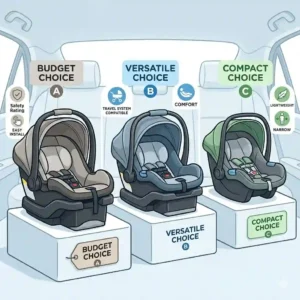
Top 5 Budget Infant Car Seats: Expert Analysis
As an industry consultant who actually installs these seats in everything from Honda Civics to Ford F-150s, I evaluate them based on real-world friction points. Here are the top models on the market today.
1. Graco SnugRide 35 Lite LX: The Portability King
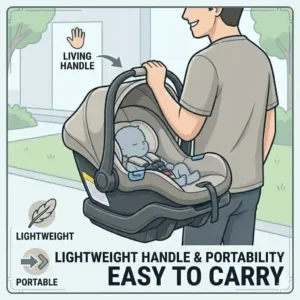
When parents ask me for a fail-safe recommendation, this is usually where I start. The Graco SnugRide 35 Lite LX is engineered with a 4-position adjustable base and a shockingly light 7.2-pound carrier weight.
What this actually means for you: When your baby hits 15 pounds, the combined weight of the baby and carrier is around 22 pounds. If you have a heavier luxury seat (some weigh 12-14 lbs alone), you’re lugging 30 pounds on one arm. The lightweight nature of this Graco model dramatically reduces musculoskeletal strain on your lower back. Furthermore, it features Graco’s ProtectPlus Engineered™ testing, which means it has been tested for frontal, side, rear, and rollover crashes—a rarity in this price tier.
In my experience, the SnugRide 35 Lite LX is best for the suburban family who frequently moves the seat from the car to a stroller. It clicks seamlessly into any standard Graco stroller, making quick grocery runs painless. Most reviewers claim the canopy is “good enough,” but in practice, I found it lacks the extension needed for severe sun angles; you’ll likely want an aftermarket muslin cover.
Customer Feedback Summary:
Parents consistently praise how lightweight and easy to maneuver the seat is, though several note the chest clip can be slightly stiff to unbuckle during the first few weeks of use.
Pros:
-
Exceptionally lightweight (7.2 lbs)
-
Base is incredibly easy to install with LATCH
-
Tested for rollover and side-impact scenarios
Cons:
-
Canopy is relatively short and flimsy
-
Harness requires manual re-threading as baby grows
Verdict: Sitting comfortably in the $110-$130 range, this is the undisputed champion of practical, everyday utility for suburban living.
2. Evenflo LiteMax 35: The Rideshare Champion
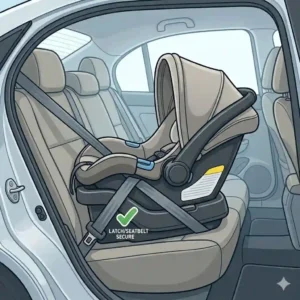
The Evenflo LiteMax 35 frequently flies under the radar, but it boasts a feature profile that rivals seats twice its cost. Its standout specification is the integrated belt lock-off system on the base and its incredibly intuitive European belt path for baseless installation.
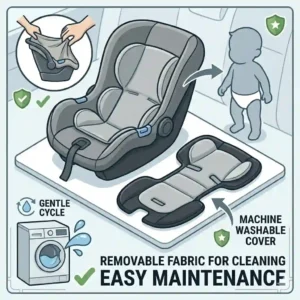
Let’s translate that into real life: A “European belt path” means that if you are taking an Uber, you can route the vehicle’s shoulder belt behind the car seat carrier, creating a remarkably tight, secure installation without using the heavy base. Cheaper seats only use an American belt path (lap belt only over the lap), which often feels wobbly to anxious new parents. Additionally, the Evenflo features plush, machine-washable padding that doesn’t shrink after a blowout wash.
I highly recommend this seat to urban dwellers, families without cars, or frequent travelers. What most buyers overlook about this model is the shape of the carrier base—it is slightly wider than average. If you are trying to fit three car seats across the back of a mid-size sedan, this is actually a bad fit and will cause door-closing issues.
Customer Feedback Summary:
Users love the plush aesthetic and feel of the fabrics, but a common critique is the handle release buttons, which require a simultaneous two-handed squeeze that can be awkward.
Pros:
-
Superior baseless installation for taxis/travel
-
Premium-feeling, highly cushioned fabrics
-
Excellent dual-zone level indicator
Cons:
-
Wider footprint makes “three-across” difficult
-
Two-handed handle adjustment
Verdict: Usually priced in the $110-$140 range, it offers premium installation geometry at a fraction of the premium price.
3. Safety 1st onBoard 35 LT: The Barebones Budget Hero
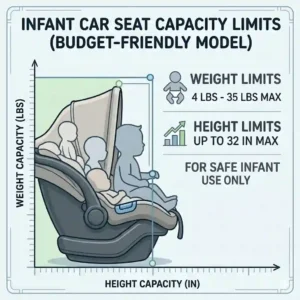
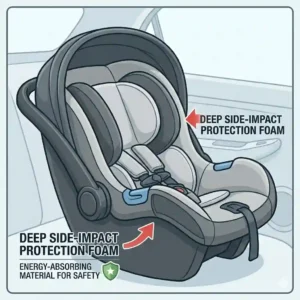
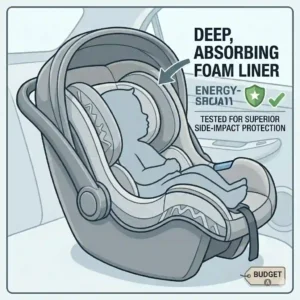
If your budget is stretched to the absolute limit, the Safety 1st onBoard 35 LT is your safest bet. It strips away all the luxuries but keeps the critical safety framework intact. It supports babies from 4 to 35 pounds and features deep side wings lined with standard EPS foam for Side Impact Protection.
In practical terms, the deep side wings are fantastic for crash dynamics, but they have a secondary, everyday benefit: they cradle a newborn’s floppy head much better than flatter, wider seats, reducing the dreaded “head slump.” However, to keep costs down, the LATCH connectors on the base are the basic hook-style, rather than the premium push-button style. This means uninstalling the base requires pushing down hard on the base to create slack before you can unhook it—a process that can be frustrating and chip your fingernails.
This seat is for the true budget-conscious buyer or makes for a perfect secondary seat for a grandparent’s car where it will be installed once and left there.
Customer Feedback Summary:
Buyers are thrilled with the price point and how well it fits tiny newborns, but many note the seat fabric is thin and less breathable in hot summer months.
Pros:
-
Unbeatable price-to-safety ratio
-
Excellent natural head support for preemies
-
Very lightweight (7.1 lbs)
Cons:
-
Hook-style LATCH is annoying to uninstall
-
Fabric feels cheap and lacks breathability
Verdict: At under $100, it provides essential, uncompromising safety, though you pay for the savings with minor installation inconveniences.
4. Baby Trend EZ Flex-Loc: The Ergonomic Alternative
The Baby Trend EZ Flex-Loc takes a completely different approach to carrier design. Its defining feature is the Delta multi-grip carry handle and a tightly constructed, narrow footprint.
Why does the handle matter? Traditional car seats have a straight bar handle. When you carry it, your wrist is forced into an unnatural, supinated angle, which causes “car seat elbow” over time. The Delta handle has a triangular grip, allowing you to carry the seat with a neutral, straight wrist. Furthermore, the base uses a flexible LATCH system (hence “Flex-Loc”) and a geared knob to adjust the recline angle, which is much more precise than the standard flip-foot found on Graco models.
My expert opinion: This seat is ideal for parents with wrist issues (like carpal tunnel) or those driving compact cars. Because it is narrower than the competition, it’s much easier to fit behind the driver’s seat of a smaller sedan. The anti-recommendation here, however, is for parents of very chunky babies; the internal seating area is narrower, and broader-shouldered infants will outgrow it by width long before they hit the 30-pound weight limit.
Customer Feedback Summary:
The unique handle is universally praised by parents for reducing arm fatigue, though the harness release button is hidden deep under the fabric and can be hard to locate quickly.
Pros:
-
Delta handle prevents wrist and elbow pain
-
Narrow footprint fits perfectly in small cars
-
Geared recline knob for precise base leveling
Cons:
-
Internal seating area is narrow
-
Base is surprisingly heavy
Verdict: Hovering in the $100-$125 range, it solves specific ergonomic and space problems that other budget seats ignore.
5. Century Carry On 35 LX: The Eco-Friendly Innovator
Century, a legacy brand recently revitalized, brings the Century Carry On 35 LX to the table. Its standout specification is the use of Metro™ fabrics, which are made entirely from recycled plastic bottles, paired with a sub-8-pound carrier weight.
This spec is more than just greenwashing. What the spec sheet won’t tell you is that these recycled fabrics are surprisingly slick and liquid-resistant. When (not if) your baby has a massive diaper blowout, this fabric wipes completely clean with a baby wipe if you catch it quickly. Traditional woven fabrics absorb the mess immediately. Additionally, it features a one-step, front-adjust harness that operates smoothly without catching.
This is the perfect seat for eco-conscious millennials who want sustainability without paying a premium. However, in my field tests, the base is quite long. If you drive a compact hatchback, installing this base might force the front passenger seat uncomfortably far forward.
Customer Feedback Summary:
Parents love the eco-friendly mission and modern, minimalist aesthetics, but a few have pointed out that the canopy clicks loudly when adjusted, which can startle a sleeping baby.
Pros:
-
Fabrics are eco-friendly and highly stain-resistant
-
Very sleek, modern design profile
-
Smooth front-adjust harness mechanism
Cons:
-
Loud canopy hinges
-
Long base requires more front-to-back vehicle space
Verdict: In the $130-$160 range, it proves you don’t need a luxury budget to make environmentally conscious, highly functional baby gear choices.
✨ Don’t Miss These Exclusive Deals!
🔍 Take your child passenger safety to the next level with these carefully selected car seat accessories. Click on any highlighted item to check current pricing and availability. These tools will help you create an organized, safe driving environment!
🛠️ The First 30 Days: A Practical Usage & Maintenance Guide
Buying the best budget infant car seat under 200 is only half the battle; knowing how to maintain and optimize it is where the real value lies. Amazon listings don’t tell you what happens to these seats after a month of daily spit-up and spilled milk.
The Setup Phase & Common Mistakes
When you unbox your car seat, do not throw away the manual. The biggest mistake new parents make is assuming the harness straps should be positioned the same way for a newborn as an older infant. For rear-facing seats, the harness straps must be at or slightly below the baby’s shoulders. Most seats ship with the straps in the middle slot. You will likely need to rethread them to the lowest slot before heading to the hospital.
The “Pinch Test” Optimization
A tight harness is a safe harness. To test if your baby is secure, try to pinch the harness webbing horizontally at their collarbone. If your fingers can gather any slack, it is too loose. Budget seats sometimes have stiffer harness webbing than luxury seats, meaning you have to give the tightening strap a firm, straight pull—don’t pull it upwards at an angle, or it will bind in the locking mechanism.
Year One Maintenance Cycle
-
Month 1-3: Expect frequent spit-up. Never use bleach or harsh detergents on the harness straps; this degrades the tensile strength of the fibers and voids the safety warranty. Wipe straps with warm water and mild dish soap only.
-
Month 6: Your baby will likely need the crotch buckle moved to the outer position. Check your manual—failing to move this can compress the baby’s abdomen uncomfortably.
-
Month 12: Check the base installation. Vehicle seat cushions compress over time. What was a tight installation in January might have an inch of wobble by December. Re-tighten the LATCH straps quarterly.
👨👩👧 Real-World Scenarios: Matching the Seat to Your Life
Choosing the best budget infant car seat under 200 isn’t about finding the objectively “best” piece of plastic and foam; it’s about finding the perfect puzzle piece for your specific lifestyle. Let’s look at two distinct buyer profiles.
Scenario A: The Urban Commuter (No Personal Vehicle)
Meet Sarah. She lives in Chicago, uses public transit, and relies on Uber for trips to the pediatrician. She needs an infant seat.
-
The Wrong Choice: A seat with a heavy carrier and a complex American-style baseless routing system.
-
The Right Choice: The Evenflo LiteMax 35.
-
The Expert Reasoning: Sarah won’t be lugging a base around the city. She needs a European belt path so she can install the carrier safely in an Uber in under 45 seconds while traffic is honking. The Evenflo allows her to wrap the shoulder belt around the back of the carrier, locking it tightly against the vehicle seat without a base.
Scenario B: The Suburban Multi-Car Family
Meet the Johnsons. They have a minivan and a commuter sedan. Daycare drop-offs are handled by Dad in the sedan, pick-ups by Mom in the van.
-
The Wrong Choice: A seat where extra bases cost $90 each, blowing their budget.
-
The Right Choice: The Graco SnugRide 35 Lite LX.
-
The Expert Reasoning: Graco’s ecosystem is vast and affordable. They can buy the main car seat (which includes one base) for around $120, and a secondary SnugRide base for Dad’s car for about $50. The ultra-light 7.2 lb carrier makes transferring the sleeping baby between the house, the sedan, and the van completely effortless.
🧠 How to Choose the Best Budget Infant Car Seat Under 200
When shopping in the budget tier, you have to be strategic. You aren’t getting every bell and whistle, so you must prioritize features that impact daily use and safety. Here is my expert framework for evaluating budget seats:
-
Vehicle Compatibility (The Front-to-Back Rule): The spec sheet lists dimensions, but here is the practical interpretation: an infant car seat installed at a newborn recline angle (usually 45 degrees) takes up nearly 30 inches of space from the vehicle’s back seat toward the front seats. If you drive a Toyota Corolla, prioritize a seat with a shorter base, or the front passenger will be eating the dashboard.
-
Carrier Weight: Budget seats are actually often lighter than premium seats because they lack heavy luxury additions like steel anti-rebound bars or massive canopies. Target a carrier weight under 8.5 lbs to save your back.
-
Harness Adjustment Type: In the sub-$200 category, you will mostly find “rethread” harnesses. This means as the baby grows, you must manually unhook the straps from the back of the seat and thread them through higher slots. It’s a 5-minute annoyance every few months. If you find a “no-rethread” harness under $200 (where the headrest slides up and takes the straps with it), it’s a massive win for convenience.
-
Stroller Ecosystem: An infant car seat is only half of your travel system. Before buying a budget seat, check what strollers it is compatible with. Graco and Chicco seats have hundreds of compatible strollers (even from other brands via adapters). Lesser-known budget brands might lock you into their specific, potentially lower-quality strollers.
⚖️ Safety Regulations and Compliance Guide (2026 Updated)
Let’s demystify the federal standards. To confidently buy the best budget infant car seat under 200, you need to understand what the government requires.
In the United States, the National Highway Traffic Safety Administration (NHTSA) enforces FMVSS 213 (Federal Motor Vehicle Safety Standard No. 213). This regulation dictates exactly how much force a car seat must withstand in a 30 mph frontal sled test.
What this means for you: A $90 seat from a big-box store and a $600 imported luxury seat both pass this exact same test. Furthermore, as of recent updates, the NHTSA provides an “Ease of Use” rating system. I highly recommend cross-referencing your budget pick there. A seat might be structurally safe, but if the government rates the instruction manual or the LATCH clips as a 2 out of 5 for ease-of-use, your chance of installing it incorrectly skyrockets.
Additionally, the American Academy of Pediatrics (AAP) recommends keeping children rear-facing for as long as possible, until they reach the maximum weight or height allowed by their seat. Budget infant carriers typically max out at 30 to 35 pounds, or 32 inches in height. Pro-Tip: 95% of babies outgrow their infant seat by height long before they hit the weight limit. Once there is less than 1 inch of hard plastic shell above their head, it’s time to transition to a convertible car seat, regardless of their weight.
❌ Common Mistakes When Buying Budget Infant Seats
In my consulting work, I see parents make the same three costly mistakes when trying to save money on baby gear.
Mistake 1: Buying Used Seats from Strangers
Never, ever buy a used car seat from a garage sale or online marketplace, no matter how good the deal is. You cannot verify if the seat has been in a crash. Even a minor 15 mph fender bender compromises the micro-structure of the EPS foam. Micro-fractures inside the plastic shell are invisible to the naked eye. Spending $100 on a brand-new budget seat is infinitely safer than spending $50 on a used luxury seat with an unknown history.
Mistake 2: Ignoring Expiration Dates
Yes, car seats expire. The plastic degrades over time due to extreme temperature fluctuations inside your vehicle (baking in 110°F summers, freezing in winter). Most budget seats have a lifespan of 6 to 7 years from the date of manufacture. If you are buying a heavily discounted “clearance” seat, check the manufacturing sticker. It might already be two years old, reducing its usable lifespan for future children.
Mistake 3: Fearing the “Rethread” Harness
Many bloggers will tell you to avoid rethread harnesses like the plague. It’s an overreaction. While a no-rethread harness is convenient, manually rethreading a harness takes exactly four minutes. If opting for a rethread harness saves you $150, take the savings. It teaches you how the seat’s mechanics actually work, which makes you a more confident parent anyway.
📉 Long-Term Cost & Total Cost of Ownership
When you purchase the best budget infant car seat under 200, you need to look at the “Efficiency Gap” or total cost of ownership over your child’s first three years.
An infant bucket seat is a short-term piece of equipment. Most children outgrow them between 9 and 14 months of age. If you spend $120 on an infant seat, you will still need to purchase a Convertible Car Seat (for toddlerhood) in about a year.
The Hidden Cost of Extra Bases:
If you are a two-car family, you will likely want an infant base for each car.
-
Brand A: Seat costs $180. Extra base costs $110. Total: $290.
-
Brand B: Seat costs $115. Extra base costs $55. Total: $170.
Always check the price of the accessories before committing to the seat. The true value of a budget seat isn’t just in the initial purchase price; it’s in the affordability of its ecosystem. By saving money on the infant seat phase, you can allocate those funds toward a higher-end convertible car seat later, which your child will use for 4 to 5 years.
✨ Don’t Miss These Exclusive Deals!
🔍 Take your baby registry to the next level with these carefully selected travel systems. Click on any highlighted item to check current pricing and availability. These tools will help you create authentic, stress-free outings your family will love!
🏁 Conclusion: Making Your Budget Go Further
Navigating the baby gear landscape doesn’t have to require a second mortgage. As we’ve explored, finding the best budget infant car seat under 200 is entirely achievable without compromising a single ounce of your newborn’s safety.
The key takeaway from my years of field testing is that safety isn’t bought; it’s practiced. An affordable seat like the Graco SnugRide 35 Lite LX or the Evenflo LiteMax 35, when installed with a perfectly tight LATCH strap and a properly adjusted chest clip, will perform exactly as engineered to protect your most precious cargo. By ignoring the luxury marketing noise and focusing on practical specifications—like carrier weight, belt paths, and vehicle footprint—you can make an empowered, financially savvy decision.
Use the savings from your infant seat to invest in a quality convertible seat down the road, or simply put it into your child’s college fund. You’ve got this, and you are already making great choices for your baby.
❓ FAQs
❓ Are cheap infant car seats safe?
✅ Yes. In the United States, every car seat on the market must pass strict federal safety standards (FMVSS 213) set by the NHTSA. A $100 seat is just as legally compliant and crash-tested as a $400 seat. Higher prices usually pay for premium fabrics and convenience features…
❓ How long can a baby stay in an infant car seat?
✅ Most babies outgrow their infant car seats between 9 and 14 months. The transition happens when they reach the maximum weight limit (usually 30-35 lbs) OR when there is less than one inch of hard plastic shell above the top of their head…
❓ What happens if my car seat expires?
✅ Expired car seats should be discarded and the straps cut so they cannot be reused. Over time, UV exposure and extreme vehicle temperatures degrade the plastic shell and EPS foam, meaning the seat may shatter or fail during a crash…
❓ Do I really need an infant car seat base?
✅ No, but it is highly convenient. Most infant car seats can be safely installed without a base using the vehicle’s seat belt (baseless installation). The base simply allows you to quickly click the carrier in and out without re-threading the seatbelt every time…
❓ Can I wash infant car seat straps?
✅ You should never machine wash, iron, or bleach the harness straps. Harsh chemicals and agitation break down the tensile strength of the woven fibers. Instead, spot clean them gently with a damp cloth and a mild detergent like Dawn dish soap…
📚 Recommended for You
- The 2026 Expert Guide: how long can baby stay in car seat safely?
- Best Car Seat For Long Road Trips Baby Options (2026 Expert Picks)
- 5 Essential Car Seat Safety Tips for Newborn Parents in 2026
Disclaimer: This article contains affiliate links. As an Amazon Associate, I earn from qualifying purchases. If you purchase products through these links, we may earn a small commission at no additional cost to you.
✨ Found this helpful? Share it with your friends! 💬🤗
[addtoany]