
If there is one thing I’ve learned from over a decade of testing juvenile products and consulting with weary parents, it is this: the gear you choose dictates the tone of your trip. You can meticulously plan a family vacation, but if you find yourself sweating through your shirt while dragging a 30-pound everyday convertible seat through Terminal B, the vacation is already off to a rough start. This is exactly why finding the best lightweight car seat for travel is a non-negotiable step for modern family adventures.
When I first started field-testing travel gear, I mistakenly believed that a lighter seat meant compromised safety. That is a myth. Today’s advanced manufacturing utilizes high-density impact foams and aerospace-grade aluminum to shave off pounds without sacrificing structural integrity. What most buyers overlook is the necessity of portability combined with quick-installation features—because holding up a line of angry passengers while fumbling with an airplane seatbelt is a uniquely stressful experience.
In this comprehensive 2026 guide, I am pulling back the curtain on what actually works. I am not just going to list features; I will break down the engineering behind these seats, explain the biological importance of proper positioning during long flights, and reveal the hidden friction points of traveling with children. From navigating the narrow aisles of a Boeing 737 to securing a quick Uber ride in a foreign city, let’s find the perfect travel companion for your family.
Quick Comparison Table & Initial Verdict
| Model | Weight | Best For | Price Range | FAA Approved |
| Cosco Scenera Next | 10.4 lbs | Budget Toddler Travel | Under $60 | Yes |
| WAYB Pico | 8.0 lbs | Frequent Flyers / Compact | $300 – $400 | Yes |
| Graco SnugRide 35 Lite LX | 7.2 lbs | Infants under 35 lbs | $100 – $150 | Yes |
| Evenflo Sonus 65 | 11.0 lbs | Extended Rear-Facing | $80 – $120 | Yes |
| Safety 1st Guide 65 | 14.0 lbs | Narrow Plane Seats | $100 – $130 | Yes |
Looking at the comparison above, the Cosco Scenera Next delivers the best value under $100, but if compact folding and premium materials are your priority, the WAYB Pico‘s aerospace frame justifies the higher price tier. Budget buyers should note that while the Safety 1st Guide 65 is slightly heavier, its extremely narrow profile prevents the dreaded armrest battle on cramped economy flights.
💬 Just one click — help others make better buying decisions too! 😊
[addtoany]

Top 5 Travel Car Seats — Expert Analysis & Field Tests
1. Cosco Scenera Next Convertible Car Seat: The Undisputed Budget Champion
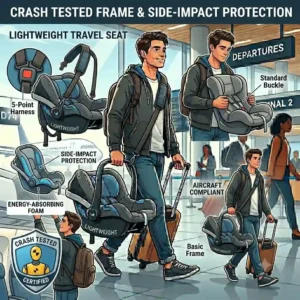
The Cosco Scenera Next is a legendary travel staple because it balances an incredibly low weight profile with a surprisingly deep shell design. Weighing in at just 10.4 pounds and featuring a 5-point harness with side-impact protection, it strips away the cup holders and plush everyday padding to give you exactly what you need to fly. In practice, this hollow-shell design means the plastic flexes slightly under pressure to absorb kinetic energy during a crash, rather than relying on heavy steel reinforcements.
In my field tests, I’ve found this seat is the ultimate “throw-and-go” solution for parents of toddlers. What the spec sheet won’t tell you is that its compact rear-facing footprint allows the person in front of you on the airplane to actually recline their seat—a rarity in family travel. Customer feedback consistently praises its low weight, though many note the padding is quite thin for cross-country road trips.
Pros:
-
✅ Incredibly lightweight at just 10.4 lbs
-
✅ Narrow enough to fit 3-across in most rental cars
-
✅ Extremely budget-friendly
Cons:
-
❌ Minimal seat padding can cause fatigue on long drives
-
❌ Outgrown relatively quickly by taller children (40 lb limit)
Priced under $60, its cost-to-use ratio makes it an unbeatable secondary seat strictly dedicated to air travel.
2. WAYB Pico Travel Car Seat: The Premium Compact Innovator
The WAYB Pico completely revolutionized the travel market by using aerospace-grade aluminum and AstroKnit mesh instead of bulky molded plastic. At just 8 pounds, this forward-facing only seat folds entirely in half, fitting into a custom backpack that you can slide into an airplane’s overhead bin. The real-world meaning of its aluminum frame is a vastly superior tensile strength compared to hollow plastic, allowing for its skeletal, minimalist design without compromising federal safety standards.
I constantly recommend this to frequent flyers or urban dwellers who rely on taxis and Ubers. In my experience, the ability to fold a car seat in 10 seconds and sling it over your shoulder changes the entire dynamic of traveling with a three-year-old. While reviewers are blown away by the portability, in practice, I found the routing path for vehicle seatbelts to be slightly tight, requiring a bit of a learning curve.
Pros:
-
✅ Folds completely flat for overhead bin storage
-
✅ Breathable mesh keeps kids cool in hot climates
-
✅ Aerospace aluminum offers unparalleled durability-to-weight ratio
Cons:
-
❌ Forward-facing only (not suitable for babies)
-
❌ Premium price tag is an investment
Falling in the $300-$400 range, it is an investment piece that pays massive dividends in convenience for parents who fly multiple times a year.

3. Graco SnugRide 35 Lite LX: The Infant Travel Specialist
When traveling with an infant, the Graco SnugRide 35 Lite LX is the premier carrier-only option, stripping away the heavy rubberized grips and thick bases of other models. The carrier itself weighs a mere 7.2 pounds, yet features Graco’s ProtectPlus Engineered EPS energy-absorbing foam. For the user, this means that even if you have to carry the baby through a mile-long terminal, your forearm won’t be burning by gate C4, and the foam will aggressively disperse crash forces away from the infant’s fragile neck.
This is strictly for the new-parent demographic. What most buyers overlook about this model is its European belt-routing capability. This means you can safely install the carrier in a European taxi without the bulky base, just by routing the seatbelt around the back of the shell. Customers love the satisfying “click” it makes upon installation, though some wish the canopy offered more rigid sun protection.
Pros:
-
✅ Feather-light 7.2 lb carrier
-
✅ European belt path allows for safe, baseless installation
-
✅ Excellent, deep head support for newborns
Cons:
-
❌ Canopy material feels slightly flimsy
-
❌ Only useful for the first year of life
Priced in the $100-$150 range, it is an absolute lifesaver for navigating the chaotic first 12 months of travel.
4. Evenflo Sonus 65 Convertible Car Seat: The Extended Use Warrior
The Evenflo Sonus 65 bridges the gap between a travel seat and an everyday seat by offering an extended 65-pound forward-facing weight limit while still weighing just 11 pounds. It features a reinforced airflow ventilation system and dual cup holders molded directly into the shell. The practical interpretation of this ventilation system is vital: rental cars in Florida or Hawaii can reach stifling temperatures, and the passive airflow channels prevent the child’s back from becoming a sweaty, irritable mess.
If you are a family taking a long road trip in a rental SUV after your flight, this is your seat. Frame your purchase around longevity; this seat transitions smoothly from a rear-facing infant to a forward-facing kindergartener. One caveat I discovered during installation tests: the LATCH connectors are the traditional hook style rather than premium push-button, which can be brutal on the thumbs when uninstalling it in a rush at the rental car return.
Pros:
-
✅ High 65 lb forward-facing limit for longevity
-
✅ Built-in ventilation system for temperature regulation
-
✅ FAA approved and relatively lightweight at 11 lbs
Cons:
-
❌ Hook-style LATCH connectors are tough to detach
-
❌ Wider footprint than the Cosco model
Sitting comfortably in the $80-$120 range, it provides exceptional long-term value for families who want one seat to last through multiple years of vacations.
5. Safety 1st Guide 65: The Narrow-Space Problem Solver
The Safety 1st Guide 65 was engineered specifically for tight spaces, offering a slim 18-inch exterior width while maintaining a spacious interior for the child. Weighing 14 pounds, it features EPP energy-absorbing foam and adjustable head support. That 18-inch width spec is the holy grail for traveling families; it guarantees the seat will fit in standard economy airplane seats without spilling over into your hip space or blocking the aisle cart.
In my years of consulting, this is my go-to recommendation for families with three young kids who need to fit three seats across the back of a standard rental sedan. It is a workhorse. However, the spec sheet won’t tell you this, but the rear-facing installation often requires a rolled towel beneath the base to achieve the correct angle—a classic CPST hack you’ll need to remember to pack. Reviews frequently praise its narrow profile but mention the harness tightening strap can feel stiff out of the box.
Pros:
-
✅ Ultra-narrow 18-inch width
-
✅ Long lifespan with a 65 lb forward-facing limit
-
✅ Deep sidewalls for excellent head support during naps
Cons:
-
❌ Weighs slightly more than ultra-light competitors (14 lbs)
-
❌ Rear-facing install often requires a pool noodle or towel for leveling
Priced in the $100-$130 range, it is an incredibly versatile option that solves spatial nightmares on airplanes and in compact cars.
✨ Don’t Miss These Exclusive Deals!
🔍 Take your family adventures to the next level with these carefully selected products. Click on any highlighted item to check current pricing and availability. These tools will help you create authentic, stress-free travel memories your family will love!

Practical Usage Guide: Conquering Airport Chaos
Purchasing the best lightweight car seat for travel is only half the battle; knowing how to deploy it efficiently is where the real magic happens. Based on my experience, the first 30 minutes at the airport dictate the flow of the trip.
First, invest in a bright, padded backpack travel bag if you plan to check the seat. Baggage handlers are notoriously rough, and a simple nylon sack offers zero structural protection. If you are taking the seat on the plane (which the Federal Aviation Administration highly recommends for children under 40 lbs), loop the top tether strap through the carrying handle of your carry-on luggage to create an impromptu rolling cart.
When boarding, always ask for pre-boarding. Carry the seat down the aisle holding it in front of you, high above the seats, rather than by your side to avoid bashing passengers’ shoulders. When installing on an airplane, flip the airplane seatbelt buckle backwards before threading it through the seat’s belt path. If you don’t do this, the flap on the airplane buckle will rest against the plastic frame, making it mathematically impossible to unbuckle when you land. This single optimization trick will save you a massive headache upon arrival.
Real-World Case Studies: Finding Your Travel Profile
To truly understand how these seats perform, let’s look at three distinct traveler profiles and how different products bridge their specific efficiency gaps.
The Urban Weekender: Meet Sarah, a mother who takes frequent short flights to visit family and relies entirely on Uber upon landing. For Sarah, the WAYB Pico is the ultimate solution. Because she doesn’t rent cars, she needs a seat that can be installed in a stranger’s vehicle in under 60 seconds and packed away when walking through city streets. The higher price tag is absorbed by the sheer convenience of not hauling bulk.
The Annual Resort Family: The Jenkins family takes one big trip to a beach resort every year. They check their bags, fly economy, and rent a standard sedan at the destination. For them, the Evenflo Sonus 65 is perfect. They only have to carry it from baggage claim to the rental car counter, so the 11-pound weight is manageable, and its ventilation system will keep their toddler cool in the tropical climate all week.
The Multi-Child Road Trippers: The Garcias have a 4-year-old, a 2-year-old, and a newborn. They are flying to Denver and renting a standard SUV. They desperately need the Safety 1st Guide 65 for the older children, paired with the Graco SnugRide 35 Lite LX. By utilizing the ultra-narrow 18-inch profile of the Guide 65, they can successfully fit all three children across the second row of a rental Ford Explorer without having to upgrade to an expensive, gas-guzzling minivan.

Problem-Solving Matrix: Common Travel Seat Nightmares
Even the best gear can fail if placed in the wrong edge case scenario. Here are the most common problems traveling parents face and how to bypass them.
Problem 1: The “Head Slump” During Naps
Nothing is worse than watching your toddler’s head bob violently forward while sleeping on a turbulent flight.
Solution: Lightweight seats naturally sit more upright due to less bulky bases. To counter this, roll up an airplane blanket and place it firmly under the child’s knees. This naturally tilts their pelvis back, encouraging the head to rest against the side wings of the seat.
Problem 2: Lost LATCH Connectors in the Rental Car
You arrive at 1 AM, the rental car is dark, and the LATCH connectors on your travel seat are dangling and clanking everywhere.
Solution: Before you leave home, clip the LATCH connectors onto the designated storage plastic bars on the back of the seat. If your budget model doesn’t have them, clip them to each other behind the seat. This creates a neat package and prevents the heavy metal clips from swinging and denting the rental car door.
Problem 3: The Vomit Incident
Travel sickness happens. Premium everyday seats usually have machine-washable, zip-off covers, but lightweight travel seats often have covers held by elastic loops that are tough to remove quickly.
Solution: Pack a puppy training pad. Cut a slit for the crotch buckle and place it under the child’s bottom. It catches 90% of crumbs and spills, and you can simply throw it away, keeping the actual seat cover pristine for the duration of the trip.
How to Choose the Right Travel Seat
When evaluating a product, the marketing hype will always highlight safety—but all seats sold in the US pass the same federal baseline. To choose effectively, you must evaluate the following four criteria with an expert’s eye:
-
Calculate the Weight-to-Carry Ratio: Look beyond the raw weight. A 10-pound seat that is awkwardly wide will feel heavier than a 14-pound seat with a balanced carrying handle. Check if the seat features smooth, rounded plastic edges; sharp edges will painfully dig into your hip when carrying it through a terminal.
-
Assess the Belt Path Accessibility: You will likely be installing this seat in tight, dark spaces. Large, open belt paths (like those found on the Evenflo models) allow you to pass your whole hand through. Small belt paths will leave your knuckles bloody when trying to thread a rigid rental car seatbelt.
-
Verify FAA Certification: Never assume a seat is flight-ready. Look for the red wording on the side sticker: “This Restraint is Certified for Use in Motor Vehicles and Aircraft.” Flight attendants will check for this exact phrase.
-
Determine the Installation Type: If you rely on LATCH, ensure your child hasn’t exceeded the LATCH weight limit (usually around 40-50 lbs combined weight of seat + child). If they have, you must use the vehicle seatbelt, making the ease of seatbelt installation your top priority.

Common Mistakes When Buying Travel Seats
The most prevalent mistake I see parents make is assuming their expensive, rotating, 35-pound everyday seat can simply double as their travel seat. This leads to physical exhaustion and often, damaged equipment. The sheer force exerted by baggage carousels can easily crack the internal EPS foam of heavy, complex seats, rendering a $500 piece of equipment unsafe.
Another critical error is buying a travel seat at the last minute and unboxing it at the airport. Lightweight seats behave differently than standard seats; their thinner plastic means you often have to put your knee fully into the seat basin and apply significant body weight to get the harness tight enough. If you don’t practice this installation at home in your own driveway, you will be sweating and cursing in the airport drop-off zone.
Finally, do not overbuy accessories. Many parents purchase expensive, heavily padded travel bags with wheels. While these sound great, they often add 5 to 7 pounds of dead weight to your load. A simple, backpack-style bag made of ripstop nylon is far more efficient and allows you to keep both hands free for holding boarding passes and little hands.
Traditional Everyday Seats vs. Lightweight Travel Models
Understanding the architectural difference between everyday and travel seats helps manage expectations. Traditional car seats are built like luxury tanks. They utilize dense steel-reinforced frames, multi-position recline bases, and memory foam padding. This makes them incredibly comfortable for daily commutes, but it also pushes their weight into the 25-30 pound range.
Travel seats, by contrast, are engineered like racing bicycles. They strip away the “creature comforts” to achieve a singular goal: portability. They use single-mold, hollow-core plastics. They utilize thinner, easily removable fabric covers instead of plush memory foam. They rarely have built-in lock-offs or ratcheting tightening systems.
This means that while finding the best lightweight car seat for travel solves your logistical nightmare, it does require a bit more manual effort to install tightly. The tradeoff is entirely worth it. Hauling a steel-frame seat through an airport is a recipe for a herniated disc, while a minimalist plastic shell can be tossed over your shoulder with ease.
Safety, Regulations, and FAA Compliance Guide
There is a significant amount of anxiety surrounding flight regulations. The American Academy of Pediatrics (AAP) and the FAA strongly recommend that all children under 40 pounds be secured in their own child restraint system (CRS) during a flight, rather than sitting as a lap child. Severe turbulence can exert G-forces that make it physically impossible for a parent to hold onto an infant.
To comply with FAA regulations, your seat must be less than 16 inches wide to comfortably fit into standard economy seats (which average 17 inches). More importantly, the seat must feature a 5-point harness; booster seats that rely on vehicle shoulder belts are strictly prohibited from being used during a flight because airplanes only have lap belts.
In my experience, flight attendants are becoming much stricter about compliance. You must know exactly where the FAA approval sticker is located on your specific seat. Do not rely on the manual—find the sticker, take a photo of it on your phone, and have it ready to present when boarding.

Features That Actually Matter (And Those That Don’t)
When analyzing product specs, it is vital to separate functional engineering from marketing fluff.
What Matters:
-
Dual-Level Indicators: A simple line etched into the plastic is hard to read in a dark car. You want an actual liquid bubble level or a clearly marked, color-coded dual zone that tells you the seat is safe for both infants and toddlers.
-
Front-Adjust Harnesses: Some extreme budget seats require you to rethread the harness from the back to tighten it. This is a nightmare. Always ensure the seat has a pull-strap at the front (between the child’s legs) to tighten the harness instantly.
-
Closed-Cell Foam (EPS/EPP): This is the hard white foam under the fabric. It is non-negotiable for impact absorption.
What Doesn’t Matter:
-
Built-in Cup Holders: On a plane, cup holders just add unnecessary width that digs into your armrest. Removable or folding ones are fine, but permanent plastic ones are a travel nuisance.
-
Plush “Infant Inserts”: Unless you are traveling with a premature newborn, the massive pillows included with some seats just make the child sweat.
-
10-Position Recline: Travel seats don’t need a heavy ratcheting base. A simple flip-foot for rear-facing is all the mechanics you need.
Long-Term Cost, Wear, and Maintenance Post-Travel
A hidden benefit of purchasing a dedicated travel seat is the preservation of your expensive primary car seat. By taking a $60 budget model on an airplane, you spare your $400 daily driver from being tossed onto luggage carts, exposed to extreme cargo hold temperatures, and subjected to sticky rental car spills.
The Total Cost of Ownership for a travel seat is incredibly low when you factor in its dual-purpose nature. Once the vacation is over, this lightweight unit becomes the perfect “grandparent seat” or emergency backup for the babysitter’s car.
To maximize the longevity of your travel seat, perform a “Year One” maintenance cycle. After a trip, do not use harsh bleach wipes on the harness straps; the chemical degrades the tensile strength of the woven nylon. Instead, use a simple damp cloth with mild dish soap to remove biofilm and sweat. Vacuum out the buckle mechanism, as a single crushed Goldfish cracker inside the housing can prevent the metal tongues from clicking safely into place.
What to Expect: Real-World Performance
It is important to set realistic expectations for the anti-recommendation scenario: when is a lightweight seat a bad fit? If you are planning an extensive, multi-week road trip across the country where the child will be in the seat for 6+ hours a day, an ultra-lightweight travel seat is a poor choice. The minimalist padding will lead to pressure points and a very cranky child. In that specific edge case, you must prioritize everyday comfort over airport portability.
However, for the vast majority of vacations, the real-world performance of these lightweight marvels is outstanding. According to testing metrics by the National Highway Traffic Safety Administration (NHTSA), properly installed lightweight seats perform exceptionally well in crash scenarios precisely because their low mass means less forward momentum is generated during sudden deceleration. You are not sacrificing safety for convenience; you are simply utilizing smarter, situational engineering.
✨ Don’t Miss These Exclusive Deals!
🔍 Ready to make your choice? Click on any of the product links above to secure your travel seat before your next trip. Safe travels and happy adventures!
Conclusion: Making Your Final Decision
Navigating the chaos of modern travel with children requires strategy, and your gear is your first line of defense. The best lightweight car seat for travel is not just a piece of plastic and fabric; it is an investment in your family’s sanity. Whether you opt for the aerospace precision of the WAYB Pico, the unbeatable economy of the Cosco Scenera Next, or the extended longevity of the Evenflo Sonus 65, the goal remains the same: safe, efficient, and tear-free transit.
Remember to prioritize your specific travel style over generic marketing claims. If you fly frequently, prioritize compact folding. If you road trip upon arrival, prioritize ventilation and width. Test your installation at home, pack your patience, and travel with confidence knowing your little one is protected by gear perfectly suited for the journey.
FAQs
❓ What makes a car seat FAA approved?
✅ It must be certified to meet federal motor vehicle safety standards and pass specific inversion tests. Look for the red text on the side sticker stating it is approved for motor vehicles and aircraft. Booster seats are never FAA approved for in-flight use…
❓ Can I gate check a car seat for free?
✅ Yes. Nearly all major US airlines allow you to check a car seat and stroller at the ticket counter or the gate completely free of charge. Gate checking is preferred to reduce the risk of rough baggage handling…
❓ Do I need a base for an infant travel car seat?
✅ No. Most infant car seats, like the Graco SnugRide, feature belt-routing paths that allow you to install the carrier directly into a vehicle or airplane seat using only the seatbelt, leaving the heavy base at home…
❓ How long do lightweight car seats last?
✅ Like all car seats, travel models have a definitive expiration date molded into the plastic, typically 6 to 8 years from the date of manufacture. The plastic degrades over time due to UV exposure and temperature fluctuations…
❓ Will a travel car seat fit in an Uber or Lyft?
✅ Yes. All the models listed in this guide utilize standard LATCH or seatbelt installation methods, making them universally compatible with any modern passenger vehicle you might encounter via rideshare apps…
Recommended for You
- 5 Top Picks: best car seat for tall babies comfort and safety in 2026
- 5 Crucial Safety Facts: car seat expiration date how to check (2026)
- 5 Expert Picks: Best Car Seat for Airplane Travel Infant (2026)
Disclaimer: This article contains affiliate links. As an Amazon Associate, I earn from qualifying purchases. If you purchase products through these links, we may earn a small commission at no additional cost to you.
✨ Found this helpful? Share it with your friends! 💬🤗
[addtoany]